Copyright 0 1986 by the Genetics Society of America
C.
ELEGANS
UNC-105MUTATIONS AFFECT MUSCLE AND
ARE SUPPRESSED
BY OTHER MUTATIONS T H A T AFFECT
MUSCLE
EUN-CHUNG PARK' AND H. ROBERT HORVITZ
Department of Biology, Massachusetts Institute of Technology, Cambridge, Massachusetts 0 2 1 3 9 Manuscript received January 14, 1986
Accepted May 2, 1986
ABSTRACT
Certain mutations in the unc-105 II gene of the nematode Caenorhabditis elegans have dominant effects on morphology and behavior: animals become small, severely hypercontracted and paralyzed. These unc-105 mutants revert both spontaneously and with mutagens at high frequencies to a wild-type phe- notype. Most of the reversion events are intragenic, apparently because the null (loss-of-function) phenotype of unc-105 is wild type. One revertant defined an extragenic suppressor locus, sup-20 X . Such suppressor alleles of sup-20 are rare, and the apparent null phenotype of sup-20 is embryonic lethality. By construct- ing animals genetically mosaic for sup-20, we have shown that the primary effect of sup-20 is in muscle cells. In addition to mutations in sup-20, other mutations causing muscle defects, such as unc-54 and unc-22 mutations, suppress the hy- percontracted phenotype of unc-105. T h e ease of identifying nonhypercon- tracted revertants of unc-105 mutants greatly facilitates the isolation of new mutants defective in muscle structure and function.
H E free-living nematode Caenorhabditis elegans is a favorable organism for
T
a genetic analysis of behavior. C. elegans is anatomically simple (SULSTON and HORVITZ 1977) and well characterized genetically (BRENNER 1974; HER- MAN and HORVITZ 1980). Its cell lineage from the single-celled zygote to the adult is invariant and completely known (SULSTON and HORVITZ 1977; KIMBLE and HIRSH 1979; SULSTON et al. 1983). Its nervous system (WARD 1973; WARDet al. 19'75; WARE et al. 1975; WHITE et al. 1976, 1983) and musculature (e.g., see WATERSTON, FISHPOOL and BRENNER 1977; WATERSTON, THOMSON and BRENNER 1980; ZENGEL and EPSTEIN 1980) have been studied extensively, and many mutants defective in simple behaviors, such as locomotion (BRENNER
1974), mechanosensitivity (CHALFIE and SULSTON 198 1) and egg-laying (TRENT, TSUNG and HORVITZ 1983), have been isolated and characterized.
We have recently studied a set of mutations with dominant effects on the behavior of C. elegans (PARK and HORVITZ 1986). Of the ten genes we studied in detail, four appeared to have wild-type null phenotypes, i . e . , the apparent loss of gene function did not result in any obvious phenotypic abnormality.
'
Present address: Department of Molecular Biology, Massachusetts General Hospital, Boston, Massachusetts 02114.unc-105 is o n e of these f o u r genes with a n apparently wild-type null phenotype. I n this paper, we present f u r t h e r phenotypic a n d genetic characterizations of
unc-105 mutants.
MATERIALS AND METHODS
Strains and genetic nomenclature: Standard conditions for the culture, maintenance
and ethyl methanesulfonate (EMS) mutagenesis of C. elegans have been described by BRENNER (1974). C. elegans strain N 2 (BRENNER 1974) was the parent wild-type strain from which all mutants used in this study were derived. Most of the mutations have been described by BRENNER (1974) and SWANSON, EDGLEY and RIDDLE (1984): unc- 54(e190) I, rol-6(e187) II, unc-22(e66) IV, him-5(e1490) V , dpy-1 l(e224) V , dpy-21(e428) V , lon-Z(e678) X , unc-84(e1410) X , unc-jr(e15l) X chromosomal aberrations, mnDpl, mnDp2, mnDp8, mnDp9, mnDp26, mnDp27, C l dpy-lO(e128) unc-52(e444) II. Other mu- tations we have used include: unc-l05(n490, n506) (PARK and HORVITZ 1986), unc- 105(n480 r58) (P. ANDERSON, personal communication); sup-20(n821, n l l 6 8 , n l l 6 9 , n1279) (this study).
This paper conforms to the standardized nomenclature for C. elegans genetics (HOR-
VITZ et al. 1979).
Reversion studies: T h e isolation of phenotypic revertants of unc-105 mutants was described in the accompanying paper (PARK and HORVITZ 1986). Briefly, unc-105 mu- tants with dominant phenotypic defects were reverted as homozygotes or as balanced heterozygotes (in trans to the chromosomal balancer C l dpy-10 unc-52) and phenotypic revertant hermaphrodites were picked in the FZ or F1 generations, respectively. To determine whether a reversion event was extragenic or intragenic to unc-105, her- maphrodite progeny of each revertant were crossed with lon-2 X hemizygous males. Cross-progeny, as well as their progeny (identified on the basis of their segregating Lon animals), were scored for the Unc-105 phenotype.
Construction of double mutants: The double mutants unc-54(e190); unc-l05(n490),
unc-54(e190); unc-l05(n506), unc-l05(n490); unc-22(e66) and unc-l05(n506); unc-22(e66)
were constructed by crossing heterozygous males (genotype either unc-22/+ or unc-54/
+) to hermaphrodites homozygous for unc-l05(n490) or unc-l05(n506). Individual cross- progeny were placed onto separate Petri plates, one per plate. From among the progeny of those animals that segregated Unc-54 or Unc-22 progeny, hermaphrodites homozy- gous for unc-105 were picked and placed onto new Petri plates, one per plate. unc-54
or unc-22 segregants from these plates were picked and their genotypes were verified by the Unc-105 cross-progeny (identified on the basis of their non-Unc-54 or non-Unc- 22 phenotype) in the F1 generation when the putative double mutant hermaphrodites were crossed with wild-type males.
Animals of genotype unc-l05(n506); sup-20(n821) were constructed by crossing sup- 20(n821)/0 males to unc-l05(n506) hermaphrodites. (The sup-20(n821) mutation was isolated from among self-progeny of unc-l05(n490)/+; sup-20(n821)/+ heterozygous hermaphrodites that were generated by crossing unc-I05(n490); sup-20(n821) hermaph- rodites with N 2 males.) Cross-progeny (unc-I05(n506)/+; sup-20(n821)/+) were picked and placed onto Petri plates, one per plate. Hermaphrodites homozygous for unc- I05(n506) were picked from the progeny of these animals and were placed onto Petri plates, one per plate. Wild-type segregants were picked, and the genotypes of the putative double mutants were verified by the presence of Unc hermaphrodite cross- progeny when the putative double mutants were crossed with N2 males.
RESULTS
unc-105 M U T A T I O N S AFFECT MUSCLE 855
FIGURE 1 .-Bright-field photomicrographs of N2 (fop) and unc-IOS(n490) ( b o f f m ) adult her- maphrodites, lateral view. Bar = 0.1 mm.
though animals carrying the alleles n490 or n1274 are more severely defective
than are animals carrying the allele
n506.
All three of these mutations havesemidominant effects: heterozygotes (e.g., n490/+) are less severely affected
than homozygotes (e.g., n490/n490). All three unc-105 mutations cause dra-
matic phenotypic abnormalities. Homozygotes are extremely small (Figure 1) and severely impaired in movement; morphologically and behaviorally, homo- zygotes resemble wild-type animals grown in the presence of levamisole, a drug that induces the hypercontraction of C. elegans muscle cells (LEWIS et al. 1980).
When the b o d y wall musculature of unc-105 mutants is examined using polar-
ized optics (EPSTEIN, WATERSTON and BRENNER 1974). the muscle cells can be
seen to be irregular, disorganized and reduced in birefringency. However, the
vulval and uterine muscles that are required for
egg
laying (TRENT, TSUNGand HORVITZ 1983) do not appear to be impaired in unc-105 mutants, because
these animals lay eggs and the birefringency of the sex muscles as observed
with polarized optics appears normal (data not shown).
Isolation of extragenic suppressors of
una205
mutations: unc-105 mutanthomozygotes were mutagenized with
EMS,
and phenotypic revertant animalswere isolated from among the F2 progeny. We found 27 phenotypically wild-
type
revertants and 23 Unc revertants (21 Unc animals that twitched and twothat were paralyzed; all were phenotypically distinct from Unc-105 animals)
among approximately 40,000 F, progeny from mutagenized parents. These
Unc revertants are much longer and/or move better than unc-105 mutants
and, thus, were easily detected among the many small and paralyzed unc-105
animals. Progeny of each revertant were crossed with lon-2/0 males to deter-
mine whether the reversion event was intragenic (see MATERIALS AND METHODS
revertants appeared to be intragenic (PARK and HORVITZ 1986). All male progeny from the cross with the remaining one phenotypically wild-type re- vertant were non-Unc-105 in phenotype, whereas most hermaphrodites (pre- sumably cross-progeny) were Unc- 105, showing that the suppressor mutation is recessive, extragenic and sex-linked. This suppressor mutation, named
“n821,” was genetically mapped (see below) and assigned to a new gene sup-
20
x.
All cross-progeny from crosses between the Unc revertants (both twitchers and paralyzed) and wild-type males were Unc-105, showing that the suppressor mutations were all recessive and likely to be extragenic. T h e twitcher Unc mutations were assigned to unc-22 ZV and the paralyzed Unc mutations to unc- 54
I by complementation tests: the twitcher Unc revertants were crossed with
unc-22/+ males and the paralyzed Unc revertants with unc-54/+ males, gen-
erating twitcher male and paralyzed male progeny, respectively. Spontaneous revertants of unc-105 were also found; they included four phenotypically wild- type, one unc-54 and five unc-22 revertants. We tested 35 other phenotypically wild-type unc-l05(n490) revertants isolated by P. ANDERSON (personal com- munication) and found that all 35 were intragenic, as indicated by their tight linkage to n490 (for example, no Unc-105 progeny were found among 6000 progeny of n490 r58/+; Zon-2/+).
T o test the allele specificity of the suppression of unc-105 by unc-22 and
unc-54 mutations, we constructed a set of double mutant animals: unc-54(e190);
unc-105(n490), unc-54(e190); unc-105(n506), unc-105(n490); unc-22(e66), and
unc-1 05(n506); unc-22(e66). These double mutants were phenotypically indis-
tinguishable from the unc-54; unc-Z05(n490) o r unc-Z05(n490); unc-22 rever- tants, showing that both alleles of unc-105 tested are suppressed by different
unc-54 or unc-22 alleles. These results suggest that the interactions between
these genes are gene-specific rather than allele-specific.
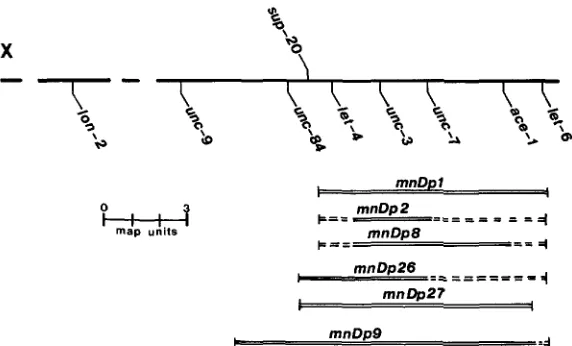
sup-20 mapping: As described above, we observed that sup-20(n821) was recessive and sex-linked. sup-20 was further mapped using duplications of link- age group X (mnDp1 and mnDp9) that carried unc-3(+) X and differing extents of the X chromosome (see Figure
2)
(HERMAN, ALBERTSON and BRENNER 1976; H E R M A N , MADL and KARI 1979). Phenotypically wild-type males of genotypeunc-3/0; Dp were crossed to unc-105; sup-20 hermaphrodites, and male prog-
eny were scored for the Unc-105 phenotype. Unc-105 male cross-progeny were found when males carrying mnDp9 were crossed to unc-105(n490); sup-
20(n821) hermaphrodites, but no Unc-105 males were found when a similar
cross was done using mnDp1, indicating that mnDp9 carried the sup-20 locus
but mnDp1 did not. sup-20 was then mapped to the right of unc-84 by a three-
factor cross. Specifically, unc-l05(n490); Zon-2 su~-20(n821)/0 males were crossed to unc-I05(n490)/+; unc-84 hermaphrodites at 20 O
.
unc-105 homozy-unc-105 MUTATIONS AFFECT MUSCLE 857
X
FIGURE 2.-Partial map of LG X . All duplications shown have been characterized previously (HERMAN, ALBERTSON and BRENNER 1976; HERMAN, MADL and KARI 1979). The localization of
sup-20 with respect to these duplications is described in the text. Bars indicate extent of duplica-
tions, with dotted lines indicating that the corresponding markers have not been tested with respect to that duplication. l e t 4 has not been tested for complementation by mnDp26 or mnDp27. 8 4 and let-4. Specifically, Unc- I05 male cross-progeny were found when males carrying mnDp26 or mnDp27 (unc-3/0; mnDp) were crossed to unc-105; sup-20
hermaphrodites, but no Unc- 105 male cross-progeny were found when similar crosses were done using males carrying mnDp2 or mnDp8. The map position
of sup-20 is shown in Figure
2.
The null phenotype of sup-20 appears to be embryonic lethality: We at- tempted to determine the null phenotype of sup20 by isolating mutations that fail to complement sup-20(n821). Hermaphrodites of genotype rol-6
ZI;
unc-3X (rol-6 and unc-3 are closely linked to unc-105 and sup-20, respectively) were mutagenized with EMS and were crossed with males of genotype unc-105; lon-
2 sup-20/0. Rare phenotypically wild-type hermaphrodite progeny were iso-
lated. [We did not seek to identify rare non-Unc-105 male cross-progeny, because the Unc-3 phenotype of these animals would prevent their mating (HODGKIN 1983)l. We isolated 36 phenotypically wild-type hermaphrodites from among approximately 1 16,000 non-Rol non-Unc-3 hermaphrodite cross- progeny. None of the phenotypically wild-type revertants segregated Unc-105 progeny, suggesting that none carried a dominant suppressor mutation un- linked to sup-20(n821). Two revertants (n1168 and n l l 6 9 ) segregated Unc-3 progeny, whereas the other 34 segregated approximately one-quarter inviable eggs but neither Unc-3 nor Rol-6 Unc-3 progeny, suggesting that in each case
unc-3 had become linked to a recessive lethal mutation. We interpret these
suppressor mutations (n821, n1168 and n1169) of sup-20 do not have obvious phenotypic defects either in the presence or absence of unc-105 mutations, as determined using a dissecting microscope.
The suppression of unc-105 by sup-20 appears to be gene-specific: T h e specificity of the suppression of two unc-105 mutations (n490, n506) by the three independently isolated suppressor mutations sup-20(n821, nl168, n l l 6 9 ) was tested by constructing appropriate double mutants. These three suppressor alleles of sup-20 were obtained on the basis of their abilities to suppress the phenotype of unc-I 05(n490). As mentioned above, unc-I05(n506) animals are much less severely affected than unc-l05(n490) animals. These phenotypic dif- ferences are apparently not a result of other mutations unrelated to unc-105, because apparent intragenic revertants of each are indistinguishable both from each other and from the wild type (PARK and HORVITZ 1986). A strain of genotype unc-1 05(n506); sup-20(n821) was constructed (see MATERIALS AND
METHODS) and found to be phenotypically wild type, showing that the sup- 20(n821) mutation also suppresses the defects caused by the unc-I05(n506) mutation. unc-I05(n506) is also suppressed by the two other sup-20 alleles tested: hermaphrodites of genotype unc-I05(n506); sup-20(n821) were crossed with rol-G/CI dpy-I 0 unc-52 males. T h e phenotypically wild-type male cross- progeny of genotypes unc-105(n506)/rol-6; sup-20(n821)/0 and unc-I05(n506)/ C l dpy-IO unc-52; sup-20(n821)/0 were crossed to unc-I05(n490); sup-20(nl168 or n I 169) unc-3 hermaphrodites. All non-Unc-3 hermaphrodites were pheno- typically wild type. These wild-type cross-progeny were picked onto Petri plates, one per plate. Those animals that did not segregate either Rol or Dpy Unc-52 progeny (i.e., of genotype unc-105(n49O)/unc-I05(n506); sup-20(n821)/ suf1-20(n1168 or n1169) unc-3) were scored for Unc-105 segregants. None segregated Unc-105 progeny, and all segregated Unc-3 and wild-type progeny at a ratio of 1:3. Since one-quarter of the Unc-3 animals should have been homozygous for unc-105(n506), the unc-l05(n506) mutation must have been suppressed by the other two sup-20 alleles tested.
T h e suppression of two dominant alleles of unc-105, which are phenotypi- cally distinct from each other, by three suppressor alleles of sup-20 suggests that the interactions between unc-105 and sup-20 mutations are gene-specific and allele-nonspecific.
The suppression of the Unc-105 phenotype by sup20 alleles is completely recessive: To determine whether the interactions between sup-20 and unc-I 05 mutant alleles depend on gene dosage, we constructed strains carrying differ- ent numbers of copies of unc-105 and sup-20 mutant alleles. We constructed animals of genotype unc-I05(n490)/+; sup-20(n821)/+ by crossing wild-type males to unc-I05(n490); sup-20(n821) hermaphrodites. Animals of genotype
unc-105 MUTATIONS AFFECT MUSCLE 859
105(n490)/CI dpy-10 unc-52. These results suggest that the absence of the wild-
type sup-20 allele is necessary for suppression; in the presence of sup-20(+),
t w o copies of su@-20(n821) do not have any detectable effect on the phenotype
of unc-105/+ animals.
We constructed strains carrying three copies (or what we believe to be the equivalent of three copies) of sup-20(n821) X and two copies of unc-105(n506).
Both a triplo-X strain and a strain carrying the dpy21(e428) mutation were constructed. [dpy-21(e428) diplo-X animals phenotypically resemble triplo-X an- imals, presumably as a result of a defect in dosage compensation (HODGKIN 1983; MENEELY and WOOD 1984; B. MEYER, personal communication)]. Trip- lo-X hermaphrodites were obtained from among the progeny of him-5; lon-2
hermaphrodites; animals of genotype lon-2/lon-2/lon-2 are non-Lon. [him-
5(e1490) results in a high incidence of meiotic nondisjunction of the X chro-
mosome, generating a high frequency of both XO male and triplo-X Dpy her- maphrodite progeny in an otherwise wild-type genetic background (HODGKIN, HORVITZ and BRENNER 1979)]. Animals of genotype dpy-21; lon-2 are similarly non-Lon. Triplo-X animals of genotype unc-105(n506); him-5; lon-2 sup-
20(n821) were constructed by crossing males of genotype unc-I05(n506)/+;
him-5 to unc-105(n506); lon-2 sup-20(n821) hermaphrodites. Hermaphrodites
homozygous for unc-105(n506) from the cross (unc-105(n506); him-5/+; Eon-2
sup-20(n821)/++)were allowed to self and their Lon non-Unc- 105 segregants were isolated. From those that segregated males (unc-105; him-5; lon-2 sup-20),
non-Lon (XXX) hermaphrodite progeny were scored for the Unc-105 pheno- type. Animals of genotype unc-Z05(n506); dpy-21(e428); lon-2(e678) sup-
20(n821) were constructed using a similar protocol. In both cases, non-Lon
animals were non-Unc-105. These results show that the increase of sup-
20(n821) to three copies does not counteract the suppression of unc-105.
We tested the apparent null alleles (lethal alleles) of sup-20 for possible dominant effects on the suppression of unc-105. We constructed a strain of genotype unc-105(n490)/+; suf-20(n1279) unc-3/+
+
by crossing unc-3/0;mnDp26 males to unc-105(n490); sup-20(n 1279) unc-3/sup-20(n821) hemaphro-
dites. All Unc-3 cross-progeny were Unc-105, showing that the sup-20(n1279)
mutation does not have a dominant effect on the suppression of unc-105. This result is consistent with the hypothesis that the suppression of the Unc-105 mutant phenotype by sup-20 nonlethal suppressor mutations is not caused by a reduced level of sup-20 activity. However, it remains possible that sup-
20(n821) homozygotes have a level of sup-20 activity that is reduced beyond
that of sup-20(n1279)/+ heterozygotes.
Mosaic analyses: To determine whether the primary effect of sup-20 mu-
tations is in muscle cells (as suggested by the anatomical abnormalities in body wall musculature of unc-105 mutants), we constructed strains carrying unc-
105(n490), sup-20(n821 o r n1279) and the mitotically unstable free duplication
mnDp26, which carries wild-type alleles of genes on LG X including sup-20
and unc-3. We identified and analyzed animals that had lost this duplication in
composed of some cells with the sup-20(+) allele and some cells lacking the sup-20(+) allele as a consequence of the somatic loss of a free duplication carrying the sup-20(+) allele) were isolated. Appropriate markers were used to define the genotypes of certain cells, which when examined in conjunction with the known cell lineage of C . elegans allowed the point in the lineage of the duplication loss to be inferred. By determining what cells had to be gen- otypically sup-20(n821) for Unc-105 suppression to occur, the site of action of sup-20 was revealed.
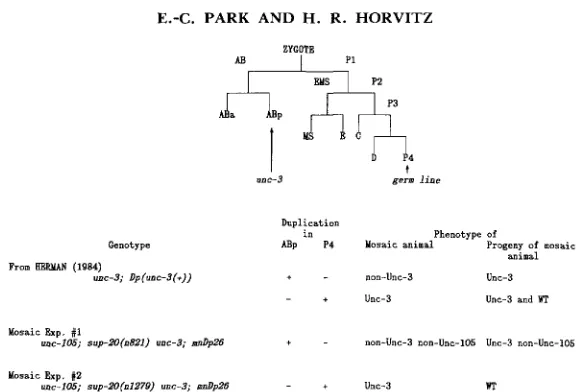
For the first mosaic analysis, a strain of genotype unc-I05(n490)/CI dpy-IO unc-52; lon-2 sup-20(n821) unc-3; mnDp26 was constructed as shown in Figure 3. T h e relevant genetic markers for the mosaic experiment are unc-105, sup- 20, unc-3 and mnDp26, and the remaining markers (C1 dpy-10 unc-52 and lon- 2 ) were used to facilitate the experiment: unc-? is recessive to the unc-3(+)allele and results in an Unc phenotype easily distinguished from the Unc-105 mutant phenotype. HERMAN (1984) has mapped the site of unc-3(+) action to the embryonic ABp lineage by mosaic analysis (Figure 4): animals in which the descendants of AB or ABp are unc-3 in genotype are Unc-3 in phenotype, regardless of the genotype of the cells in the rest of the animal; animals composed of cells carrying an unc-?(+) allele in the descendants of AB or ABp are non-Unc-3. Thus, the Unc-3 phenotype can be used as a marker for the genotype of the ABp descendants (HERMAN 1984). mnDp26, which carries wild- type alleles of both unc-? and sup-20, is a free duplication that is lost mitotically and is carried in only one copy per cell (HERMAN, MADL and KARI 1979; HERMAN 1984). Lon-2, which is linked to sup-20 but is not suppressed by mnDp26, was used to facilitate the identification of mosaic candidates since Lon animals are more easily distinguished from unc-105/+; lon-2 animals than
FIGURE 3.-Schemes used to construct strains for mosaic analysis. A, unc-105(n490)/CI dpy-10
unc-52; Eon-2 sup-20(n821) unc-3; mnDp26 strain construction. In this construction, the alleles unc-
105(n490) and sup-ZO(n821) were used. sup-ZO(n821) is a nonlethal suppressor allele of sup-20. C I
indicates C I dpy-10 unc-52. Both rol-6 and CI dpy-10 unc-52 balance unc-105. mnDp26 carried wild-type alleles of sup-20 and unc-3, but not of Eon-2. The genotypes of strains are shown in italics, and the phenotypes are indicated in parentheses below genotypes. WT indicates wild type in phenotype; Unc-105/+ indicates the phenotype of animals heterozygous for unc-105 (i.e., n490/ +). Unc-105/+ non-Unc-3 hermaphrodites picked from the last cross could be one of the three genotypes indicated, and the strain desired is shown enclosed in a box. B, sup-20(n1279) unc-3;
mnDp26 strain construction. In this construction, the alleles unc-I05(n490) and sup-ZO(n1279) were
used except for the first cross, which also used sup-20(n821). n1279 is a lethal allele of sup-20,
and n821 is a nonlethal suppressor allele. mnTI1, which is a translocation between LG I1 and LG
X and has a dominant Him phenotype (i.e., generation of a high frequency of males), was used for balancing sup-20. mnTZl behaves like a deficiency of some markers on LG I1 and LG X; those markers deficient in mnTl1 are present on the free duplication mnDpl I [for a detailed description of the reciprocal translocation chromosomes mnTll and mnDpI1, see HERMAN, KARI and HART-
MAN (1982)l. Designation of phenotypes is as described in part A. Phenotypically wild-type her-
unc-105 MUTATIONS AFFECT MUSCLE
x / o n - 2 r u p - 2 0 u n c - 3 f
1
pick Lon non-Unc-3 dA
u n c - 3 (VT)'
mnDp26 (Lon Unc-3)I o n - 2 r u p - 2 0 u n c - 3 / 0 : m n D p 2 6 d X l o n - 2 ,up-20 u n c - 3 $
(Lon non-Unc-3) (Loo Unc-3)
1
pick Lon non-Unc-30'
r o l - 6 K I l i d X l o n - 2 s u p - 2 0 u n c - 3 : mnDp26f(W) (Lon non-Unc-3)
1
pick Lon non-Unc-3 dr o l - 6 / + : l o n - 2 r u p - 2 0 u n c - 3 : m a p 2 6
and
)./
x u n c - 1 0 S ; l o n - 2 r u p - 2 0 u n c - 3 q-. C l / + : Ion-2 s u p - 2 0 u n c - 3 : m a p 2 6 (Lon Unc-3 non-Unc-105)(Lon non-Unc-3)
1
pick Unc-105/+ non-Unc-3c
self
I J u n c - I O S / r o l - 6 : l o n - 2 ,up-20 u n c - 3 : mnDp26 -+ segregate Rol progeny (Unc-105/+ non-Unc-3)
self
2J u n c - I O S / + : I o n - 2 s u p - 2 0 u n c - 3 : mnDp26
-
no Rol or C1 progeny (Unc-105/+ non-Unc-3)self
o r 3 J u n c - I O S I C I : l o n - 2 r u p - 2 0 unc-3:mnDp26
-
segregate C1 (Unc-105/+ non-Unc)B
u n c - 3 / 0 : N p 2 6 d X u n c - 1 0 5 / r o l - 6 : s u p - 2 0 u n c - 3 / s u p - 2 0 f n 8 2 1 1 +(W (Unc-105/+)
1
pick Unc-105/+ Unc-3 fm n T / / / o : m p / / .,--x u n c - 1 0 5 / + : s u p - 2 0 u n c - 3 / + u n c - 3 f
(m) (Unc-105/+ Unc-3)
1
pick VT(W
)
-
segregate unc-3 I ) u n c - 3 / m n T l l : m n D p l l2 ) " n c - 3 / m n T l I
3) s o p - 2 0 u n c - 3 / m n T l l ; m n D p l l ( W
-
segregate U T males and hermaphrodites(W
o r 4 ) s u p - 2 0 u n c - 3 / m n T 1 1
-
segregate only VT hermaphrodites(W
self
I ) s u p - 2 0 u n c - 3 / m n r / /
-
segreagate only I l l21 u n c - 3 / m T l l (W
(a) self
3 ) u n c - 3 / m T I I : wvDp26
-
segregate males(W self
o r 4 ) s u p - 2 0 u n c - 3 / + u n c - 3 : d p 2 6
-
segregate Unc-3, no males(W
1
pick WTc
selfI ) s u p - 2 0 u n c - 3 / + u n c - 3 ; mnDp26
-
segregate Unc-3 (VT)1
segregate only VT progenyI
I t
uoc-3 germ l i n e
Duplication
in Phenotype of
Genotype ABp P4 Mosaic animal Progeny of mosaic animal From K&F.MAN (1984)
unc-3; Dp(uoc-3(+)) + - non-Unc-3 Unc-3
- + Unc-3 Unc-3 and WT
Mosaic Exp. #I
mc-IO5; s~p.ZO(nS21) uoc-3; d p Z 6 + - non-unc-3 non-Unc-105 Unc-3 non-Unc-lO5
Mosaic Exp. #Z
unc-lO5; svp-.?O(n1279) unc-3; d p 2 6 - + Unc-3 WT
FIGURE 4.-Schematic representation showing the generation of the founder cells of C. elegans. The six cells AB, MS, E, C and D predominantly give rise to primary ectoderm, primary meso- derm, endoderm, secondary ectoderm and mesoderm and tertiary mesoderm, respectively. The site of action of unc-3 has been mapped to the descendants of the ABp cell (HERMAN 1984), and the P 4 cell gives rise to germ cells (SULSTON et al. 1983).
+
indicates the presence and-
indicates the absence of the duplication in the cell ABp or P4 as determined by the phenotypes of mosaic animals and their progeny.are wild-type animals from unc-105/+ animals. We used a balanced heterozy- gote of unc-105 because unc-105 homozygotes have a smaller brood size, and
mnDp26 mosaics are rare, requiring many individuals to be examined. C l dpy-
10 unc-52 is an appropriate balancer for this purpose because it results in a
distinct, easily scored phenotype and is also sterile (HERMAN 1978).
T h e self-progeny from this strain of genotype unc-l05/Cl dpy-10 unc-52;
lon-2 sup-20(n821) unc-3; mnDp26 are primarily of three distinct phenotypes,
Lon Unc-105 (of both unc-105 homozygous and unc-I05/+ heterozygous phe- notypes), Lon Unc-3 or Dpy Unc-52. Specifically, animals carrying the dupli- cation are Lon Unc-105 non-Unc-3 or Dpy Unc-52 (since the duplication sup- presses both the Unc-3 and the Sup phenotypes), and animals not carrying the duplication are Lon Unc-3 non-Unc-105 or Dpy Unc-52. We found six rare Lon non-Unc-3 non-Unc-105 animals from among approximately 50,000 non- (Dpy Unc-52) non-Unc-3 progeny of this strain. All six of these Lon animals segregated Lon Unc-3 and Dpy Unc-52 progeny (and no non-Unc-3 non-Unc- 105), showing that these animals did not carry the duplication in the germ- line precursor cell and that these animals were mosaic animals rather than recombinants between sup-20(n821) on the X chromosome and unc-3(+) on the duplication. That these animals were phenotypically non-Unc-3 indicated that they carried the duplication in the descendants of ABp. Since the duplication is absent in the germ-line precursor P4 but present in ABp, the duplication loss presumably occurred at the division that generated the cells P1, P2, P3 or P4 (see Figure 4).
unc-105 MUTATIONS AFFECT MUSCLE 863
muscle cells. P2 generates P3 and C, which is the progenitor of 13 hypodermal, two neuronal and 32 body muscle cells. P1 generates P2 and MSE, which divides to produce the MS and E cells. T h e E cell generates the intestine. MS generates mainly 42 body muscle cells, 18 pharyngeal muscle cells, six pharyn- geal neurons and six specialized cells named “coelomocytes.” T h e first division of the zygote generates P1 and AB. AB generates 282 neurons, 200 hypo- dermal nuclei and one body muscle cell. For details of the C. eleguns cell lineage, see SULSTON et al. (1983).
In our mosaic animals, duplication loss probably did not occur in the division that generated P4, since it seems reasonable to assume that mutant germ cells would not affect movement. T h e loss could have occurred in the division that generated P3 or P2; if so, a mutant genotype in only a fraction of the total muscle or hypodermal cells would have to be responsible for the generally hypercontracted-like phenotype of unc-105 animals. It seems more likely that the duplication was lost in the division that generates the P1 cell (Figure 4). Since body muscle cells are the only cell type generated almost entirely from the PI cell (94 of 95), this mosaic experiment suggests that the loss of sup-
20(+) from muscle cells is responsible for the non-Unc-105 phenotype of the
mosaic animals. Thus, the unmasking of su$-20(n821) function in the body muscle cells is sufficient to generate a non-Unc-105 phenotype. T h e results of this mosaic experiment suggest that the primary effect of sup-Z0(n821) is in muscle cells.
This mosaic experiment suggests that sup-20(+) activity in the descendants of P1 masks the sup-20(n821) suppressor activity. In a second mosaic experi- ment, we tested whether sup-20(+) activity in the descendants of the P1 cell is sufficient for the survival of animals homozygous for a recessive lethal allele
of sup-20, n1279. We constructed a strain of genotype sup-ZO(n1279) unc-
3(e151); mnDp26, which is wild type in phenotype and segregates almost en-
tirely progeny that are wild type in phenotype (Figure 3B). We found five Unc-3 progeny among approximately 250,000 phenotypically wild-type prog- eny. All five Unc-3 animals segregated only wild-type progeny, indicating that the duplication must have been present in P4 (which generates the germ line) and establishing that these Unc-3 animals were mosaics rather than recombi- nants between the sup-20(+) allele carried on the duplication and the unc-3
allele carried on the X chromosome. T h e Unc-3 phenotype of these mosaic animals indicates that the duplication must be absent in the descendants of ABp. For the duplication to be present in P4 but absent in ABp, the loss of the duplication must have occurred in the division that generated either AB or ABp. Thus, sup-20(+) must be present in all descendants of P1 in these mosaic animals. This result is consistent with the hypothesis that the expression
of sup-20(+) in the descendants of P I in an embryo otherwise homozygous for
sup-20(n1279) allows the survival of these embryos. However, we cannot rule
DISCUSSION
Certain mutations in the unc-105 11 gene result in a dominant hypercon- tracted phenotype. We have isolated both intragenic and extragenic suppres- sors of these mutations. T h e extragenic suppressors have defined three genes: unc-54 I, unc-22 I V and sup-20 X. unc-54 and unc-22 mutations are epistatic to unc-I05 mutations: animals carrying an unc-105 mutation and either an unc- 54 o r an unc-22 mutation are phenotypically like unc-54 or unc-22 single mu- tants, respectively. T h e suppressor alleles of sup-20 suppress all known phe- notypic abnormalities of unc-105 mutants; these sup-20 alleles result in a wild- type phenotype either in the presence or in the absence of unc-105 mutations. We have also identified 34 recessive lethal alleles of sup-20. These lethal alleles seem likely to be null (loss-of-function) alleles, since they fail to complement nonlethal suppressor alleles of sup-20 and were obtained at a frequency (3 X
per haploid genome per generation) comparable to that typical of EMS- induced gene disruption frequencies in C. elegans (BRENNER 1974; GREENWALD
and HORVITZ 1980), and 15-fold higher than that of obtaining sup-20 sup- pressor alleles
(2
xw5).
T h e suppression of unc-105 by sup-20 suppressor mutations appears to re- quire the absence of the sup-20(+) allele. Thus, sup-20(n821) is completely recessive to sup-20(+). All three suppressor mutations of sup-20 suppress both mutant alleles of unc-105 tested, suggesting that interactions between unc-105 and sup-20 may be gene-specific rather than allele-specific. There are at least two models that can explain the suppression of unc-105 by sup20 suppressor alleles, the wild-type null phenotype of unc-105 and the observation that the sup-20(n821) allele is recessive to the sup-20(+) allele. (1) T h e sup-20 wild-type gene product is required for unc-105 activity. In this model, wild-type sup-20 would have additional functions, such as the activation of other genes in ad- dition to unc-105 (since the null phenotype of sup-20 appears to be lethal), and sup-20 suppressor mutations would specifically impair the ability of sup-20 to allow unc-105 activity.
(2)
T h e mutant gene products of unc-105 and sup-20 interact, although the wild-type gene products need not do so. T h e sup-20 suppressor mutations generate new sites that allow interaction with unc-1 05 mutant products, and this physical interaction blocks the function of the unc- 105 mutant product.unc-105 mutants show a variety of abnormalities, including shortened body length, small brood size and defective muscle structure. Hypercontraction could well be a consequence of a primary defect in muscle; alternatively, the muscle defect could result from a hypercontraction induced as a result of a neuronal or hypodermal abnormality. We examined these alternatives by mos- aic analysis using sup-20. Our studies of animals carrying unc-105 and mosaic for sup-20(n821) have shown that sup-20 suppresses unc-105(n490) by acting in descendants of the cell P1, most likely in muscle cells. This experiment indicates that muscle cells are the sites of sup-20 function, but does not estab- lish that muscle cells are also the sites of unc-105 function. For example, sup-
unc- 105 MUTATIONS AFFECT MUSCLE 865
dependent defects in muscle cells are required to express all known phenotypes of unc-105, including shortened body length and reduced brood size.
T h e interactions of unc-105 mutations with mutations that lead to defects in muscIe contraction suggest a genetic selection scheme for the isolation of new mutants defective in muscle functioning. Specifically, we have shown that mu- tations in the unc-22 and unc-54 genes suppress the apparent hypercontracted phenotype of unc-105 mutants. Mutations in other genes necessary for muscle contraction, such as unc-15, have also been found to be epistatic to unc-105
mutations (P. ANDERSON, personal communication). Since unc-22 and unc-54
mutants move better than and are much longer than unc-105 mutants, it is
easy to select mutants defective in these genes as partial phenotypic suppressors
of unc-105 mutations.
Using our genetic selection scheme, EIDE and ANDERSON (1985a,b) have isolated numerous spontaneous unc-54 mutations. T h e
C.
elegans Bergerac strain contains many copies of the repeated element T c l , which has motecular features characteristic of transposable elements (EMMONS et al. 1983; LIAO,ROSENZWEIG and HIRSH 1983). By crossing unc-Z05(n490) into a Bergerac genetic background and isolating spontaneous unc-54 mutations as unc-105
revertants, EIDE and ANDERSON (1985b) have directly demonstrated the trans- position of T c l .
We thank D. BOTSTEIN, G. FINK, W. FIXSEN, S. KIM, B. MEYER, D. S m c m " , J. THOMAS
and especially D. FINLEY for comments concerning the manuscript. This work was ~ ~ p p o r t e d by United States Public Health Service research gmnts GM24663 and GM24943 and Research Career Development Award HD00369 to H.R.H. E.-C.P. was supported in p a n by a Biogen Fellowship granted to the Department of Biology, Massachusetts Institute of Technology.
LITERATURE CITED
BRENNER, S., 1974 The genetics of Caenorhabditis ekgans. Genetics 77: 71-94.
CHALFIE, M. and J. SULSTON. 1981 Developmental genetics of the mechanosensory neurons of
Caenorhbditis elegam. Dev. Biol. 82: 358-370.
EIDE, D. and P. ANDERSON, 1985a T h e genetic structures of spontaneous mutations affecting a
Caenorhbditk elegans myosin heavy chain gene. Genetics 109: 67-79.
EIDE, D. and P. ANDERSON, 1985b Transposition of T c l in Coenorhabitis eleguns. hoc. Nad. Acad. Sci. USA 8f: 1756-1760.
EMMONS, S., L. YESNER, K. RUAN and D. KATZENBERG, 1983 Evidence for a vansposon in
EPSTEIN, H., R. WATERSTON and S. BRENNER, I974 A mutant affecting the heavy chain of myosin
GREENWALD, 1. and R. HORWTZ, 1980 unc-93(e1500) III: a behavioral mutant of Camorhabdiris
HERMAN, R., 1978 Crossover suppressors and balanced recessive lethals in Camurhabditk ekgans. HERMAN, R., 1984 Analysis of genetic mosaics of the nematode Caenorhobditis ekgans. Genetics
HERMAN, R. K., D. G. ALBERTSON and S. BRENNER, 1976 Chromosome rearrangements in C. Caenorhabditis elegans. Cell 34: 55-65.
in Caenorhabditis elegans. J. Mol. Biol. 90. 291-300.
elegam that defines a gene with a wild-type null phenotype. Genetics 96: 147-164. Genetics 88: 49-65.
108 165-180.
HERMAN, R. K. and R. HORVITZ, 1980 Genetic analysis of Caenorhabditis elegans. pp. 227-261.
Dominant X-chromosome nondisjunction
HERMAN, R. K., J. E. MADL and C. K. KARI, 1979 Duplications in Caenorhabditis elegans. Genetics
HODGKIN, J., 1982 Male phenotypes and mating efficiency in Caenorhabditis elegans. Genetics
HODGKIN, J., 1983 X chromosome dosage and gene expression in C . elegans; two unusual dumpy genes. Mol. Gen. Genet. 192: 452-458.
HODGKIN, J., R. HORVITZ and S. BRENNER, 1979 Nondisjunction mutants of the nematode Cae- norhabiditis elegans. Genetics 91: 67-94.
HORVITZ, H . R., S. BRENNER, J. HODGKIN and R. HERMAN, 1979 A uniform genetic nomencla-
KIMBLE, J. and D. HIRSH, 1979 T h e postembryonic cell lineages of the hermaphrodite and male gonads in Caenorhabditis elegans. Dev. Biol. 7 0 396-417.
LEWIS, J., C.-H. Wu, H. BERG and J. LEVINE, 1980 Genetics of levamisole resistance in the nematode Caenorhabditis elegans. Genetics 9 5 905-928.
LIAO, L. W., B. ROSENZWEIG and D. HIRSH, 1983
Proc. Natl. Acad. Sci. USA 80: 3585-3589.
In: Nematodes as Biological Models, Edited by B. ZUCKERMAN. Academic Press, New York.
mutants of Caenorhabditis elegans. Genetics 102: 379-400.
HERMAN, R. K., C. K. KARI and P. S. HARTMAN, 1982
83: 91-105.
103: 43-64.
ture for the nematode C. elegans. Mol. Gen. Genet. 175: 129-133.
Analysis of a transposable element in C. elegans.
An autosomal gene that affects both X-chromosome expression
Mutations with dominant effects on the behavior and MENEELY, P. and W. WOOD, 1984
and sex determination in C . elegans. Genetics 106: 29-44.
PARK, E.-C. and H. R. HORVITZ, 1986
SULSTON, J. and R. HORVITZ, 1977 Post-embryonic cell lineages of the nematode, Caenorhabditis
SULSTON, j., E. SCHIERENBERG, J. G. WHITE and J. N. THOMSON, 1983 T h e embryonic cell lineage of the nematode C . elegans. Dev. Biol. 100 64-1 19.
SWANSON, M. M., M. L. EDGLEY and D. L. RIDDLE, 1984 Caenorhabditis elegans. pp. 244-258.
In: Genetic Maps, Edited by S. J. O’BRIEN. Cold Spring Harbor Laboratory, Cold Spring Harbor, New York.
Egg-laying defective mutants of the nematode
Caenorhabditis elegans. Genetics 104: 61 9-647.
Chemotaxis by the nematode Caenorhabditis elegans: identification of attractants and analysis of response by use of mutants. Proc. Natl. Acad. Sci. USA 7 0 817-821.
Electron microscopical reconstruction of the anterior sensory anatomy of the nematode Caenorhabditis elegans. J. Comp. Neurol.
160 313-338.
T h e nerve ring of the nematode
Mutants affecting paramyosin in Camor-
Mutants with altered muscle structure in morphology of the nematode Caenorhabditis elegans. Genetics 113: 82 1-852.
elegans. Dev. Biol. 5 6 110-156.
TRENT, C., N. TSUNG and R. HORVITZ, 1983
WARD, S., 1973
WARD, S., N. THOMSON, J. WHITE and S. BRENNER, 1975
WARE, R., D. CLARK, K. CROSSLAND and R. RUSSELL, 1975
Caenorhabditis elegans: sensory input and motor output. J. Comp. Neurol. 162 71-110.
WATERSTON, R., R. FISHPOOL and S. BRENNER, 1977 habditis elegans. J. Mol. Biol. 117: 679-697.
WATERSTON, R., N. THOMSON and S. BRENNER, 1980 Caenorhabditis elegans. Dev. Biol. 77: 27 1-302.
WHITE, j., E. SOUTHGATE, J. N. THOMSON and S. BRENNER, 1976
nerve cord of Caenorhabditis elegans. Philos. Trans. R. Soc. Lond. (Biol.) 275: 327-348.
unc-io5 MUTATIONS AFFECT MUSCLE 867
Factors which determine connectivity in the nervous system of Caenorhabditis elegans. Cold Spring Harbor Symp. Quant. Biol. 4 8 633-640.
Identification of genetic elements associated with muscle struc- WHITE, J., E. SOUTHGATE, J. N . THOMSON and S. BRENNER, 1983
ZENGEL, J. and H. EPSTEIN, 1980
ture in the nematode Caenorhabditis elegans. Cell Motil. 1: 73-97.