The Nuclear Energy Plant Optimization Program-Reactor Component Aging Studies
The Nuclear Energy Plant Optimization Program-Reactor Component Aging Studies
T. R. Allen, Argonne National Laboratory-West B.P. Singh, Jupiter Corporation
K. T. Gillen, D. J. Harris and R. A. Assink, Sandia National Laboratories D. S. Kupperman, S. Bakhtiari, and T. Wei Argonne National Laboratory
ABSTRACT
The Nuclear Energy Plant Optimization (NEPO) Program is a U.S. Department of Energy (DOE) research and development (R&D) program focused on performance of curremly operating U.S. nuclear power plants. The primary areas of focus for the R&D program are plant aging and optimization of electrical production. The NEPO Program is also a public-private R&D partnership with equal or greater matching funds coming from industry through Electric Power Research Institute (EPRI). The goal of the program related to plant aging is to ensure that current U.S. nuclear plants can continue to deliver adequate and affordable energy supplies up to and beyond their initial 40-year license term by providing a strong technical basis for long-term operation, by resolving open issues related to aging mechanisms, and by applying new technologies to improve the cost effectiveness and predictability of the life-cycle management process. Results from two NEPO program aging studies are highlighted in this work. Results from small sample electrical cable aging testing programs indicate that several techniques may provide methods to correlate small sample properties with cable bulk mechanical properties. Advanced steam generator non-destructive testing techniques provide improvements in the capability to detect and characterize cracks, including cracks in difficult to characterize areas of the steam generator tubing.
INTRODUCTION
As the current operating nuclear plants continue to operate, components and structures age or become obsolete, introducing inefficiencies or added costs. Component and structural material degradation occurs in nuclear plants as a result of long-term operation and exposure of materials to harsh environmental conditions including radiation and elevated temperature and pressure environments. Components such as the reactor pressure vessel, reactor internals, steam generator tubes, system piping, structures, and electrical cables incur degradation over time in the form of corrosion, heat and stress related fatigue and cracking, and reductions in fracture toughness due to neutron irradiation and thermal embrittlement.
Even though none of these aging phenomena is an obstacle to a plant-specific application for license renewal by the Nuclear Regulatory Commission, collectively they can greatly affect the economics of existing plants. Research and development can provide a better understanding of significant degradation mechanisms and how they occur, enabling the development of generic, cost effective aging management strategies which will provide capabilities to more effectively manage the degradation through either prevention, detection or repair.
The NEPO program funds research and development to address both plant aging effects and optimization of plant power generation. The NEPO program covers a wide range of research on plant aging, in areas including steam generator performance, electrical cable aging, and mechanical properties of plant components. In this paper, two examples of NEPO research are highlighted: understanding the aging of electrical cables and improving the ability to monitor steam generator tube performance.
CABLE AGING
Control and protection of nuclear reactors depend on the transmission of electrical signals. Cables provide the electrical path for both power transmission to motors for pumps, fans and valve operators and for control and instrumentation signals. Understanding and monitoring the degradation of cables is important to optimizing plant performance. Two aspects of cable-aging are currently being studied in the NEPO program: developing better predictions of cable material lifetimes as well as methods for estimating residual cable lifetimes and developing small sample, essentially non-destructive examination methods for evaluating cable aging. The goal of these studies is to preclude the need for premature replacement of cable systems and to assure that cable is replaced before it becomes a problem. In this section, details on the small sample aging research are presented.
The small sample testing tasks include a careful and systematic investigation of the correlation of elongation results with data taken from several promising and innovative condition monitoring (CM) techniques including modulus profiling, density and nuclear magnetic resonance (NMR). Each of these CM approaches offers the potential for making measurements on very small samples (< 1 mg), much smaller than the size required for other candidate CM techniques. The initial
SMiRT 16, Washington DC, August 2001 Paper # 2008
measurements for each of the techniques are being done on nuclear power plant cable jacket and insulation materials that have already undergone aging and mechanical property measurements in previous cable aging programs at Sandia National Laboratory (-3000 different combinations of materials and aging conditions are available). For materials and environments where a particular CM approach appears to be promising, further studies are being conducted to optimize the CM approach, understand its connection to mechanical properties and determine how any observed correlation depends on environmental stress level (e.g., on the temperature or radiation dose rate). These latter studies are critically important since the accelerated stress levels where the correlation is derived will be much higher than the stress levels appropriate under the ambient aging conditions of interest to the eventual application of CM techniques.
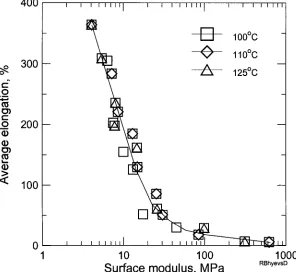
One promising CM technique under investigation is modulus profiling, which involves the use of an apparatus capable of quantitatively mapping modulus (related to hardness) values with 50-micrometer (2-mil) resolution [ 1 ]. Some typical results for a Rockbestos hypalon cable jacketing material are shown in Fig. 1 as a plot relating the elongation of oven- aged samples with modulus values at the sample surfaces. There is a remarkable predictive correlation between surface modulus and elongation which is independent of aging temperature, strongly suggesting that a similar correlation will hold under ambient nuclear power plant aging conditions.
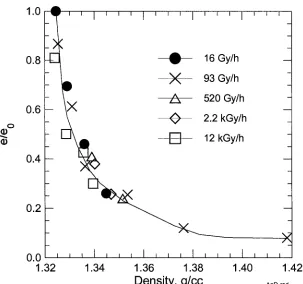
A second approach involves accurate density measurements, which can be carried out by several methods, including density gradient columns [2] and the Archimedes approach (weighing in air and weighing in a liquid). Based on earlier screening studies [3], density may offer the most generally applicable CM method. Figure 2 shows some density results (Archimedes approach) for an Anaconda Durasheeth EPR cable insulation material after radiation aging at several radiation dose rates ranging from 12 kGy/h (1.2 Mrad/h) to 16 Gy/h (1.6 krad/h). Even though the elongation for this material has important dose-rate effects, the correlation of the density measurements with elongation is excellent and independent of dose rate. Since the correlation appears to be dose-rate independent over three orders of magnitude, the results suggest that a similar correlation may extrapolate two more orders of magnitude to conditions representative of ambient aging conditions (typically less than 0.1 Gy/h).
Another exciting new CM technique involves nuclear magnetic resonance (NMR) relaxation time (T2)
measurements taken on samples swollen in a suitable solvent at elevated temperature [4]. Measurements are easily done on many commercial NMR machines, are reproducible, quick (~10 min) and require very small samples (<1 mg). Early results indicate that this method may be particularly useful for CLPO/CLPE materials, important nuclear power plant cable insulation types that have proven difficult for other CM techniques. Figure 3 shows, for example, some results for a Brandrex CLPO cable insulation, where the NMR T2 relaxation times are plotted versus elongation results. The NMR T2 is sensitive to elongation changes and the results are independent of aging temperature.
o OR
t- O . . m . .
400
300
200
100
i i , lllll I i i i Illll I I I I IJlll
[ [
100°C
110°C
/~
125°C
I I I I I IIII
m
I I
10
100
1000
Surface modulus, MPa
RBhyevsDFigure 1. Surface modulus versus elongation for Rockbestos hypalon jacket at the three indicated temperatures.
c~
(t)
1.0
0.8
0.6
0.4
0.2
0.0
i1.32
X
I ' I I I I I I I I I I
- - ~ - - - 1 6
Gy/h
X
93 Gy/h
,/~
520 Gy/h
2.2 kGy/h
r-]
12 kGy/h
N2
i i I i i i I i i i I i i ! I I ~
1.34
1.36
1.38
1.40
1.42
Density, g/cc
AnD-radFigure 2. Density versus elongation for Anaconda Durasheeth EPR cable insulation at the indicated dose rates.
=-
O
om
t~ c- O iii
400
300
200
100
I I i I i I i I I I ~ I J I I I i
["7
L_I 100°C
A
110°C
0 i I i I i I i I J I i I i I I I I
0 2 4 6 8 10 12 14 16 18
NMR T 2, msec
BReveT2
Figure 3. NMR T2 v e r s u s elongation for Brandrex CLPO cable insulation at the indicated temperatures.
STEAM GENERATOR NON-DESTRUCTIVE EXAMINATION
has lead to increased inspection time, particularly when the slow rotating eddy currrent (EC) probe technology is the primary means to inspect specific regions on the tubing (e.g., expansion transitions) or flaw orientations (e.g., circumferential cracks). Additionally, examination of pulled tubes taken from operating reactors has shown that in many cases the cracking often does not compromise the structural integrity of the tube or permit significant leakage under normal operating or accident
conditions. However, because the capability of non-destructive examination (NDE) to detect defects has progressed much more rapidly than the capability to characterize defects, utilities have been forced to adopt a "plug on detection" policy. To meet these limitations, improvements in NDE techniques are still required. In this section, examples of non-destructive examination techniques being developed in the NEPO program are described.
A review of ultrasonic techniques applied to steam generator tubing suggests that an electromagnetic acoustic transducer (EMAT) that launches surface waves on the tube ID or Lamb waves in the tube wall could improve the detection of inner diameter (ID) cracking in or near the roll transition of the tube-sheet region of the steam generator [5]. With an EMAT, no coupling is required and no axial motion of the probe would be needed. The probe would be positioned at the bottom of the tube-sheet. Location of a flaw would be determined from the echo time-of-flight. Minimum interference from tube wall roughness or the roll transition is expected and thus high signal-to-noise ratios would be expected for
circumferential cracks.
Test have been performed using Lamb waves to examine a circumferential OD crack in a roll transition in 22.2-mm (7/8-in.) diameter Inconel 600 tubing. The Lamb wave probe was a 6-mm piezoelectric crystal on a wedge, operated in a pulse echo mode. The inspections were carried out from the inside of the tube with the tube filled with water and the contoured plastic wedge of the probe in contact with the tube ID surface. The nominally 2.25-MHz angle beam probe generated 1.1 MHz guided Lamb waves. The Lamb wave parameter "f*d" (frequency x wall thickness) was 1.4 MHz-mm for these tests. The probe-to-crack echo transit time was varied by moving the probe along the tube axis. The transit times were plotted against the probe position and the Lamb wave velocity was determined from the slope of a linear fit to the data (see figure 4). The data for the rolled tube was collected by launching the wave in the unrolled portion of the tube. This arrangement produced, as expected, a better signal-to-noise ratio than launching the Lamb wave in the expanded part of the tube. The very small echo from the roll did not compromise the quality of the echo from the SCC in the roll. The results suggest that Lamb waves could be effective for detection of circumferential outer diameter stress corrosion crack (ODSCC) in the tube sheet region of steam generator tubes.
Development of EC array probe designs offers the potential to quickly detect steam generator tube degradation in all regions of the tubing with only one probe. The challenges in EC array probe design include: the development of a means to quickly and consistently analyze the large amounts of data acquired and the ability to characterize the degradation as precisely as possible to minimize the need to retest with other probe designs. There are three major technical tasks involved with array probe development: (1) numerical assessment of probe characteristic response; (2) development of signal domain algorithms; and (3) testing of the accuracy of the automated data analysis algorithms.
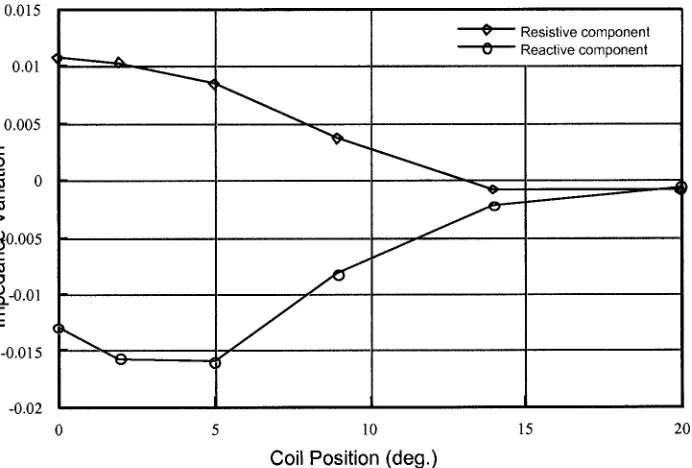
Probe designs are being evaluated by using three-dimensional (3-D) finite element analysis to simulate the response of conventional probes. Initial studies involve the response of a 2.92-mm (0.115-in.) diameter pancake coil to an outer diameter (OD) axial notch as the position of the coil relative to the slot is varied. These can be used to determine the degree of coil separation (thus defining the number of required coils) needed to obtain a given spatial resolution with an array probe. The variation of the coil impedance as a function of probe position with respect to the OD notch is shown in Fig. 5. As expected, the detection sensitivity varies significantly as a function of coil position with respect to flaw. Beyond 15 degrees the response of the eddy current signal to the presence of a 100% throughwall notch was negligible.
CONCLUSIONS
The DOE NEPO program is performing research aimed at better understanding nuclear plant component aging and optimizing plant electricity output. Results from two NEPO program aging studies have been highlighted in this work. Results from small sample cable aging testing programs indicate that several techniques may provide methods to correlate small sample properties with cable mechanical properties. Advanced steam generator non-destructive testing techniques are being developed that will provide the capability to detect and characterize cracks, including cracks in difficult to characterize areas of the steam generator tubing.
ACKNOWLEDGMENTS
Work supported by the U.S. Department of Energy. Sandia is a multiprogram laboratory operated by Sandia Corporation, a Lockheed Martin Company, for the United States Department of Energy under Contract DE-AC04-94AL85000. The steam generator mock-up was developed under a program sponsored by the Office of Nuclear Regulatory Research, U. S. Nuclear Regulatory Commission.
REFERENCES
[1] K. T. Gillen, R. L. Clough and C. A. Quintana, "Modulus Profiling of Polymers", Polym. Degrad. & Stabil., 1_.7.,7 31 (1987).
[2] K. T. Gillen, R. L. Clough and N. J. Dhooge, "Density Profiling of Polymers", Polymer, 27, 225 (1986).
[3] K. T. Gillen, M. Celina and R. L. Clough, "Density Measurements as a Condition Monitoring Approach for Following the Aging of Nuclear Power Plant Cable Materials, Radiat. Phys. Chem., ~ 429 (1999).
140
120
A
E loo
E
-~ 80
~ 60
e,, 0 ~ 4 0
L.
~ 20
Y = 3 0 0 - 4 . 6 X R = . 9 9 9
Tube J10
1.1 MHz Lamb Wave f*d = 1.4 MHz-mm V(Lamb) = 4594 m/s
35 40 45 50 55 60 65 70
Time of Flight (psec)
Figure 4. Plot of ultrasonic path vs. time-of-flight for echo off circumferential ODSCC in roll transition of 22.2 mm
diameter Inconel 600 tube using Lamb waves launched using a piezoelectric transducer with wedge contoured to the tube ID. The velocity (4594 m/s) of the 1.1 MHz wave is determined from the slope of the line.
0 . 0 1 5 0.01 0 . 0 0 5 ¢.. O
,m
t~ 0 -
.n
¢0
>
~ 0 . 0 0 5 - l--- t~ ~Q.-0.01 -
E
- 0 . 0 1 5 - 0 . 0 2
f
~- Resistive component
O Reactive component
,
0 5 10
Coil Position (deg.)
15 2 0
~ ... . . ++.:i ++::+::::::::. :+:.: : : ~ - : - . . . . I ] P C : : S G 0 1 : I H C ~ 0 Q 0 2 9 M 0 n 0 9 : 3 1 8 i 5 8 : : 8 , p , + 1 8 ~ 0 1 ~ ( ~ : 0 0 !I :0C:::::0++~!0+I0 [.:MS]_. +!+_ .,:+!i :+:: i ! + : i ! :+:i+ ,i Fllt~'~l]:T Pts/Scm--t04 Xlrem--O YTram=O )~ot--50 ZRot:317
I<~-81~ 2nd SrJ~ ,,.l~r. Pl.-:~. " . . . . . . +mmmme
• Ii+.. + , ~ .1: . . . + . . . ,+. . . : +1+ , . . . , , , + .. . . : . . . + + , , + , + + . . .
< I::I~ > 6 : 3 0 0 G1 C3 121,Pf
1 ~ ~ i ~ ... i ... :i <~+,.~_Ii
t < ... ~ ...
t++++
i + ... ~ : ... +i~
+ ~m ... +IL
+
'+
+
~
<
i + : ~ ... it ...:
i i++iil ... II ... :;
. L-mm--.-JL-
+
+
<
-
i
~ ~ i : i . : : ..:..:::.:::~:: :+ .... : .+:::.+ P I P C . ; S G 0 0 H C ~ 0 0 0 2 4 F r 1 : 1 4 : 5 4 : 4 4 N o v ~ I . 0 + ' 0 0 S G . 0 0 8 0 C i : O : : i ! 0 0 , 4 . : : : + ... [ M S ] . . . : : ! . !: +:+~++:+++. -++.:..+.+ iS::...+++++::i ... i+.:.:+:.~.y:.:..+2:,+._<+
FllteP:OFF P t s ~ 1 0 3 XTrarm-'¢ YTr~=O )<i+ot~9 .~ot:31~1 ~ - 8 8 1 AFTER .9_l_mo£(_--i~ +PT~ . . .
l ~ ( : , : ... + .. . . +.=, . . .
( I],IAH > 6 : 3 0 0 (;9. C3 l)tfP
/
0 . <
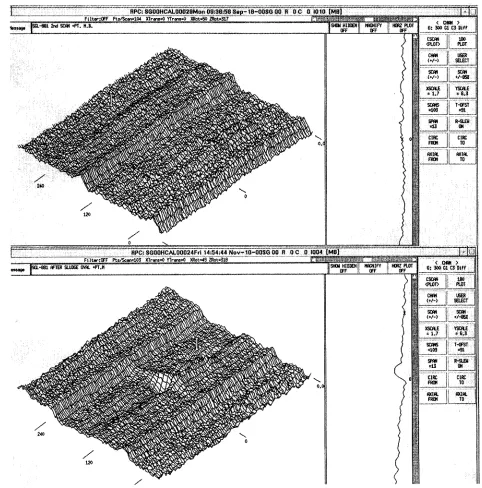
Figure 6. Isometric plots o f test section with oval crossection, simulating U - b e n d geometry, before (top) and after