ABSTRACT
PROBLEM BEING ADDRESSED
Adherence to diabetes treatment guidelines is often poor in primary care.OBJECTIVE OF PROGRAM
To introduce simple accessible interventions in our clinic to improve both physicians’ adherence to diabetes treatment guidelines and patient outcomes.PROGRAM DESCRIPTION
A physician and a nurse practitioner used 3 interventions for diabetes care: 30-minute appointments, reminder telephone calls to patients, and standardized flow sheets. Evaluation of this structured program found that, after 3 years, these interventions had improved primary caregivers’ adherence to diabetes care guidelines and several physiologic parameters in patients with diabetes (compared with outcomes of patients managed with the usual less structured approach).CONCLUSION
This program improved delivery of diabetes care in our clinic. We believe a similar approach could help other physicians and nurse practitioners in primary care practices increase their adherence to guidelines and improve the clinical outcomes of their patients.RÉSUMÉ
PROBLÈME À L’ÉTUDE
Les directives sur le traitement du diabète ne sont pas bien suivies au niveau des soins primaires.OBJECTIF DU PROGRAMME
Introduire dans notre clinique des interventions simples et accessibles, pour améliorer l’adhésion des médecins aux directives sur le traitement du diabète et ainsi améliorer les issues des patients.DESCRIPTION DU PROGRAMME
Un médecin et une infirmière praticienne ont ajouté 3 interventions au suivi des diabétiques: une rencontre de 30 minutes, des rappels téléphoniques aux patients et des notes évolutives standardisées. Après 3 ans de ce programme structuré, ces interventions avaient augmenté l’adhésion du personnel soignant aux directives sur le traitement du diabète et amélioré plusieurs paramètres physiologiques des diabétiques (par rapport aux patients traités par l’approche habituelle moins bien structurée).CONCLUSION
Ce programme a amélioré la prestation des soins aux diabétiques dans notre clinique. Nous croyons qu’une approche semblable pourrait aider d’autres médecins et infirmières praticiennes de soins primaires à mieux suivre les directives, améliorant ainsi les issues de leurs patients.This article has been peer reviewed.
Cet article a fait l’objet d’une révision par des pairs.
Can Fam Physician 2007;53:73-77
Improving diabetes management
Structured clinic program for Canadian primary care
Daren Lin Shirley Hale,
rn(ec)erle Kirby,
mD, mSc, fcfpMr Lin is a medical student in the Schulich School of Medicine and Dentistry at the University of Western Ontario in London. Ms Hale is a nurse practitioner at the Wawa Medical Centre in Wawa, Ont. Dr Kirby is a general prac-titioner at the Wawa Medical Centre and an Associate Professor at McMaster University in Hamilton, Ont.
D
iabetes mellitus, a chronic disease that affects up to 1.4 million Canadians, causes substantial morbidity and mortality.1 Effective managementof patients with diabetes can reduce the complications associated with the disease.2,3 Current guidelines for
optimal management of these patients require a multi-disciplinary approach in which family physicians are the main team members responsible for coordinating proper, timely care.2,3 In busy primary care practices, it is often
difficult to adhere to these guidelines, but this might be because there is no organized approach to care.4-6
In Canada, primary care practitioners are the sole care providers for most patients with diabetes (77%), and these physicians have a low rate of adherence to clinical guidelines for treating diabetes.7
Many interventions have been used in efforts to enhance physicians’ adherence to recommendations for diabetes care and, therefore, to improve patient out- comes. These interventions have included steering com-mittees; dedicated diabetic clinics; education for care providers; patient education and self-management tac- tics; nutrition counseling; use of nurses following proto-cols; computerized monitoring and planning; redesigned office systems; cluster visits involving case managers, psychologists, nutritionists, pharmacists, and physician specialists; physician audits; performance incentives; and use of flow sheets.8-23 Such interventions have
sometimes improved the process of care, patient out-comes, or both.24,25
A systematic review of 41 papers on quality of dia-betic outpatient care found that multifaceted inter-ventions targeted at physicians and organizational changes improved diabetic management, while patient-oriented interventions led to better patient outcomes.24 Unfortunately, many of the interventions
studied are not readily accessible to typical Canadian primary caregivers who manage patients with diabetes. For instance, several studies were conducted in health maintenance organizations that had access to indepen-dent performance incentives, case managers, steering committees, and on-site specialists.19,20,23
The purpose of our program was to introduce simple, accessible interventions to improve adherence to clini-cal guidelines in a Canadian primary care setting with the ultimate goal of improving patient outcomes. Our clinic, a primary care centre staffed by 5 general practi-tioners and a nurse practitioner, services Wawa, Ont, a town of 3700 in northwestern Ontario with a catchment population of 6500. Wawa is 230 km away from the
nearest referral centre. Before we initiated this program, diabetic patients in our clinic were seen about every 3 months for 15-minute appointments and treated accord-ing to current diabetes guidelines.2 There was no
sys-tem in place to remind patients of their appointments. Blood tests were usually scheduled at 3-month intervals, but the results of tests were sometimes not available at the time of patients’ next visits. Patients often attended their appointments without bringing their medications or their diabetic logbooks.
program description
The program was implemented by a doctor and a nurse practitioner for their existing patients. The appointment load was divided evenly between these 2 primary care-givers. The program used 3 interventions previously described in the literature for improving quality of care. First, every 3 months, patients were given 30-minute appointments rather than the default 15-minute appoint-ments normally given. Second, before each diabetes clinic day, a secretary telephoned each of the sched-uled patients to remind them of their appointments, to remind them to bring all their medications and logbooks to the appointment, and to arrange for their routine blood work about 1 week before the appointment so that results would be available at the time of the visit. Third, a standardized diabetic flow sheet that followed the Canadian Diabetes Association’s guidelines for care was used to record information on each patient.26
A research associate used a historical cohort design to compare management of diabetic patients in the more structured program (intervention group) with patients treated in the usual fashion (reference group). Power analysis showed that a sample size of 27 patients per group was needed to detect a difference of 0.5% between the 2 groups in HbAIc levels with 95%
We had sufficient data for analysis for 33 of the 37 patients in the intervention group and 35 of the 45 patients in the reference group. There was no significant difference between groups in demographic character-istics, follow-up time, baseline laboratory results, and medication use (Table 1).
Improvements seen after
implementation of the program
In the intervention group, HbAIc and low-density
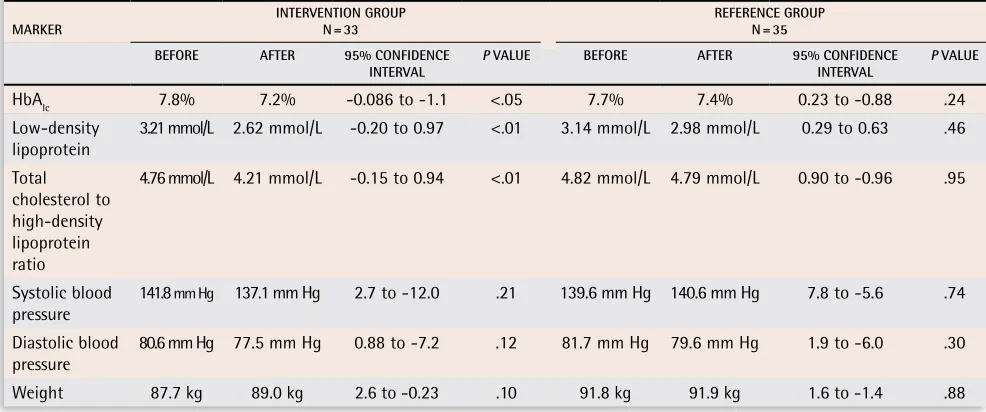
lipo-protein levels and the ratio of total cholesterol to high-density lipoprotein decreased significantly, but did not do so in the reference group (Table 2). Weights and blood pressures did not change significantly in either group. None of the values shown in Table 2 differed significantly between groups at the start of the study or after the follow-up period.
Consistent with diabetes care guidelines, ace-tylsalicylic acid use increased significantly (P <.01) in patients older than 40 in the intervention group (Table 3). Referrals to ophthalmologists were signifi-cantly (P <.01) more frequent in the intervention group
(Table 4). The number of pneumonia and influenza
vaccinations was not significantly different between groups (Table 4). Use of angiotensin-converting enzyme inhibitors and angiotensin receptor blockers by patients with microalbuminuria was not significantly more frequent in the intervention group.
Discussion
The purpose of our program was to improve caregivers’ adherence to guidelines and diabetic patients’ outcomes
Table 1. Baseline characteristics of intervention and
reference groups: Characteristics were not significantly
different between groups.
cHArAcTerISTIc
InTerVenTIOn GrOUp
n = 33
reference GrOUp
n = 35 p VALUe
Mean age 62.7 y ± 15.1 SD 61.6 y ± 10.3 SD .72 Proportion
of women
61% 52% .48
Mean
follow-up time 19.7 mo ± 7.4 SD 19.1 mo ± 6.2 SD .70 SD—standard deviation.
Table 2. Laboratory markers of diabetic outcome: Markers improved significantly only in patients in the intervention
group.
mArKer InTerVenTIOn GrOUp n = 33 reference GrOUp n = 35
BefOre AfTer 95% cOnfIDence
InTerVAL p VALUe BefOre AfTer 95% cOnfIDence InTerVAL p VALUe
HbAIc 7.8% 7.2% -0.086 to -1.1 <.05 7.7% 7.4% 0.23 to -0.88 .24
Low-density
lipoprotein 3.21 mmol/L 2.62 mmol/L -0.20 to 0.97 <.01 3.14 mmol/L 2.98 mmol/L 0.29 to 0.63 .46 Total
cholesterol to high-density lipoprotein ratio
4.76 mmol/L 4.21 mmol/L -0.15 to 0.94 <.01 4.82 mmol/L 4.79 mmol/L 0.90 to -0.96 .95
Systolic blood
pressure 141.8 mm Hg 137.1 mm Hg 2.7 to -12.0 .21 139.6 mm Hg 140.6 mm Hg 7.8 to -5.6 .74 Diastolic blood
pressure 80.6 mm Hg 77.5 mm Hg 0.88 to -7.2 .12 81.7 mm Hg 79.6 mm Hg 1.9 to -6.0 .30
Weight 87.7 kg 89.0 kg 2.6 to -0.23 .10 91.8 kg 91.9 kg 1.6 to -1.4 .88
Table 3. Acetylsalicylic acid use among patients in
intervention and reference groups: Use increased
significantly among those older than 40 only in the
intervention group.
USe Of AceTyLSALIcyLIc AcID BefOre AfTer p VALUe
Intervention group
N = 30 30% 70% <.001
Reference group
N = 33 24% 45% .10
Table 4. Vaccinations and ophthalmology referrals in
intervention and reference groups: Vaccinations were
not significantly more up-to-date among those in the
intervention group, although a trend was seen with
pneumonia vaccinations. Ophthalmology referrals were
significantly more up-to-date only among patients in
the intervention group.
VAccInATIOnS AnD referrALS
InTerVenTIOn GrOUp (%) n = 33
reference GrOUp
(%) n = 35 p VALUe
Pneumonia
vaccination 42 23 .08
Influenza
vaccination 42 37 .66
through 3 simple interventions: 30-minute appoint-ments, reminder telephone calls, and use of flow sheets. We think our program improved on previous programs by using interventions that were simple to implement in our primary care setting and by avoiding interven-tions that required many resources or substantial orga-nizational changes. Evaluation of our program using a historical cohort design found that the interventions resulted in improvement in caregivers’ adherence to certain guidelines and in some physiologic parameters of diabetic patients. Patients treated according to the same guidelines without these simple interventions did not improve significantly during the study period.
A systematic review found that organizational and physician interventions could improve physicians’ adher-ence to guidelines, while patient-oriented interventions could improve patient outcomes.24 Our 3 interventions
seem to have improved physicians’ adherence and patients’ outcomes. Longer counseling sessions might have provided enough time for physicians to encour-age lifestyle changes effectively and to manencour-age these complex chronic cases adequately. Telephone remind-ers might have improved the regularity of follow-up and laboratory tests. Flow sheets might have served as reminders and records specific to the complexities of diabetic treatment. Also, reserving an entire day for dia-betes care might have increased caregiver efficiency and patient motivation by focusing attention on a particular area of patient health.
Despite statistically significant improvements, even in this small cohort, by the end of the follow-up period, the intervention group had not quite reached guideline target levels of ≤7% for HbAIc
, ≤2.5 mmol/L for low-den-sity lipoprotein, and ≤4.0 mmol/L for the ratio of total cholesterol to high-density lipoprotein or 100% physi-cian adherence. Reasons for this could be insufficient length of follow-up time or a need for additional inter-ventions in the program. Results of this study, however, were still encouraging. For instance, the 0.61% ± 0.15% decrease in HbAIc levels in the intervention group is
similar to the decrease expected when one of several antihyperglycemic agents, such as acarbose, nateglinide, or orlistat, is added to patients’ medication regimens.2
Results of our program evaluation were comparable to those of similar studies, although many of these stud-ies were larger and more complex. An outpatient study of 144 patients by Benjamin et al,27
using physician edu-cation combined with audit and feedback, showed that HbAIc levels improved by 0.62% ± 0.3% over 15 months
to 8.68%, a significant difference, but also above target. These authors found that annual dilated retinal examina-tions increased from 32% to 63% of patients and annual influenza vaccinations increased from 30% to 73% of patients. Peters and Davidson23
presented a health main- tenance organization model, including educational mate-rials, audit and feedback, organizational changes, and
follow-up arrangements. Their results showed a decrease in HbAIc levels from 11.9% to 8.6%, a larger absolute
improvement than in our program, but also above the guideline target. Overall cholesterol levels did not change between groups in that study. We are aware of only 2 programs beside ours that resulted in decreases in total cholesterol through improvement in quality of care.28,29
Neither of these programs led to improvement in total cholesterol to high-density lipoprotein ratios as ours did. Many studies found no improvement in weight or blood pressure,30,31 although some did.32
Two primary caregivers participated in the diabetes clinic days, a physician and a nurse practitioner. Although most similar programs used nurses or nurse practitioners as assistants, the nurse practitioner at our clinic indepen-dently managed an equal share of the diabetes patients in our program and had the same role as the physician. We think the outcomes indicate that these results could be achieved equally well by either physicians or nurse prac-titioners working alone and do not suggest that both are needed to achieve the desired outcomes.
Limitations
Since the physician and nurse practitioner involved in the program enrolled only their existing patients at the time of program implementation, prospective random-ization between intervention and reference groups did not occur. This created a selection bias, although the known characteristics of both groups were similar at baseline. Performance bias might have had a role, as the study was not blinded. A research associate, who was not involved in implementation of the program, con-ducted the evaluation independently to avoid detection bias during data collection.
Improvements to the program
To further improve our program, we plan to involve a diabetes educator during our structured diabetes clinic days. Patients will meet for group sessions with the edu- cator either before or after their appointments. The ses-sion will allow patients to discuss common issues, such as diet and exercise, that might still need to be more completely addressed after clinic appointments. Holding these sessions on the same day as the diabetes clinic would improve access for our patients who will then not have to make a separate trip to attend the sessions.
conclusion
Most diabetes care in Canada occurs at the primary care level where physicians’ adherence to guide-lines is often poor.7 Much evidence supports
quality-improvement interventions for diabetes management to increase physicians’ adherence to guidelines and to improve patient outcomes.24
reminder telephone calls, and flow sheets. During a 3-year period, these interventions appeared to improve some of patients’ physiologic parameters and primary caregivers’ adherence to guidelines. A similar approach, using our interventions or other interventions cited in the literature, can be used by interested physicians or nurse practitioners to enhance the quality of their care of patients with diabetes.
acknowledgment
At the time of the study, Mr Lin was on a clinical elec-tive supported by the Northwestern Ontario Medical Programme.
Correspondence to:Dr Erle Kirby, Wawa Medical Centre,
17 Government Rd, Wawa, ON P0S 1K0; telephone 705 856-1313; fax 705 856-1330; e-mail [email protected]
references
1. Health Canada. Diabetes in Canada: national statistics and opportunities for improved surveillance, prevention, and control. Ottawa, Ont: Health Canada; 1999. Catalogue no. H49-121/1999.
2. Canadian Diabetes Association Clinical Practice Guidelines Expert Committee. Canadian Diabetes Association 2003 Clinical Practice Guidelines for the Prevention and Management of Diabetes in Canada. Can J Diabetes 2003;27(Suppl 2):S1-151. 3. Mensing C, Boucher J, Cypress M, Weinger K, Mulcahey K, Barta P, et al. National
standards for diabetes self-management education. American Diabetes Association: clinical practice recommendations 2001. Diabetes Care 2001;24(Suppl 1):S1-133. 4. Ho M, Marger M, Beart J, Yip I, Shekelle P. Is the quality of diabetes care better in a
diabetes clinic or in a general medicine clinic? Diabetes Care 1997;20(4):472-5.
5. Leinung MC, Gianoukakis AG, Lee DW, Jeronis SL, Desemone J. Comparison of dia-betes care provided by an endocrinology clinic and a primary-care clinic. Endocrinol Pract 2000;6(5):361-6.
6. Kirkman MS, Williams SR, Caffrey HH, Marrero DG. Impact of a program to improve adherence to diabetes guidelines by primary care physicians. Diabetes Care 2002;25(11):1946-51.
7. Harris SB, Stewart M, Brown JB, Wetmore S, Faulds C, Webster-Bogaert S, et al. Type 2 diabetes in family practice. Room for improvement. Can Fam Physician 2003;49:778-85.
8. Fernando DJ, Perera SD. The work of a diabetes clinic: an audit. Ceylon Med J 1994;39(3):138-9.
9. Wagner EH, Grothaus LC, Sandhu N, Galvin MS, McGregor M, Artz K, et al. Chronic care clinics for diabetes in primary care: a system-wide randomized trial. Diabetes Care 2001;24(4):695-700.
10. Reed RL, Revel AO, Carter A, Saadi HF, Dunn EV. A clinical trial of chronic care dia-betic clinics in general practice in the United Arab Emirates: a preliminary analysis.
Arch Physiol Biochem 2001;109(3):272-80.
11. Grey N, Maljanian R, Staff I, Cruzmarino de Aponte M. Improving care of diabetic patients through a collaborative care model. Conn Med 2002;66(1):7-11. 12. Montori VM, Dinneen SF, Gorman CA, Zimmerman BR, Rizza RA, Bjornsen SS,
et al. The impact of planned care and a diabetes electronic management system on community-based diabetes care: the Mayo Health System Diabetes Translation Project. Diabetes Care 2002;25(11):1952-7.
13. De Grauw WJ, van Gerwen WH, van de Lisdonk EH, van den Hoogen HJ, van den Bosch WJ, van Weel C. Outcomes of audit-enhanced monitoring of patients with type 2 diabetes. J Fam Pract 2002;51(5):459-64.
14. Schwab J. Diabetes management in a rural clinic setting. Nurs Case Manag 1998;3(5):192-5.
15. Sperl-Hillen J, O’Connor PJ, Carlson RR, Lawson TB, Halstenson C, Crowson T, et al. Improving diabetes care in a large health care system: an enhanced primary care approach. Jt Comm J Qual Improv 2000;26(11):615-22.
16. Stoner KL, Lasar NJ, Butcher MK, Fawcett LM, Danelson ME, Harwell TS, et al. Improving glycemic control: can techniques used in a managed care setting be suc-cessfully adapted to a rural fee-for-service practice? Am J Med Qual 2001;16(3):93-8. 17. Sadur CN, Moline N, Costa M, Michalik D, Mendlowitz D, Roller S, et al. Diabetes
management in a health maintenance organization. Efficacy of care management using cluster visits. Diabetes Care 1999;22(12):2011-7.
18. Kirkman MS, Williams SR, Caffrey HH, Marrero DG. Impact of a program to improve adherence to diabetes guidelines by primary care physicians. Diabetes Care
2002;25(11):1946-51.
19. Sidorov J, Gabbay R, Harris R, Shull RD, Girolami S, Tomcavage J, et al. Disease management for diabetes mellitus: impact on hemoglobin A1c. Am J Manag Care 2000;6(11):1217-26.
20. Renders CM, Valk GD, Franse LV, Schellevis FG, van Eijk JT, van der Wal G. Long- term effectiveness of a quality improvement program for patients with type 2 diabe-tes in general practice. Diabetes Care 2001;24(8):1365-70.
21. Hirsch IB, Goldberg HI, Ellsworth A, Evans TC, Herter CD, Ramsey SD, et al. A multifaceted intervention in support of diabetes treatment guidelines: a cont trial.
Diabetes Res Clin Pract 2002;58(1):27-36.
22. Larsen DL, Cannon W, Towner S. Longitudinal assessment of a diabetes care man-agement system in an integrated health network. J Manag Care Pharm 2003;9(6):552-8. 23. Peters AL, Davidson MB. Application of a diabetes managed care program. The
feasibility of using nurses and a computer system to provide effective care. Diabetes Care 1998;21(7):1037-43.
24. Renders CM, Valk GD, Griffin S, Wagner EH, Eijk JT, Assendelft WJ. Interventions to improve the management of diabetes mellitus in primary care, outpatient and com-munity settings. Cochrane Database Syst Rev 2001;1:CD001481.
25. Bodenheimer T, Wagner EH, Grumbach K. Improving primary care for patients with chronic illness. The chronic care model, part 2. JAMA 2002;288(15):1909-14. 26. Chinook Health Region and Alberta Clinical Guideline Program. Diabetes care
flow sheet for patients with diabetes. Chinook, Alta: Chinook Health Region; 2004. Available from: http://www.chr.ab.ca/about_chr/graphics/diabetes.pdf. Accessed 2006 September 18.
27. Benjamin EM, Schneider MS, Hinchey KT. Implementing practice guidelines for dia-betes care using problem-based learning. A prospective controlled trial using firm systems. Diabetes Care 1999;22(10):1672-8.
28. Pieber TR, Holler A, Siebenhofer A, Brunner GA, Semlitsch B, Schattenberg S, et al. Evaluation of a structured teaching and treatment programme for type 2 diabetes in general practice in a rural area of Austria. Diabet Med 1995;12(4):349-54. 29. De Sonnaville JJ, Bouma M, Colly LP, Deville W, Wijkel D, Heine RJ. Sustained good
glycaemic control in NIDDM patients by implementation of structured care in gen-eral practice: 2-year follow-up study. Diabetologia 1997;40(11):1334-40.
30. Aubert RE, Herman HW, Waters J, Moore W, Sutton D, Peterson BL. Nurse case man-agement to improve glycemic control in diabetic patients in a health maintenance organization. A randomized, controlled trial. Ann Intern Med 1998;129(8):605-12. 31. Hartmann P, Grusser M, Kronsbein P, Jorgens V. Effects of peer review groups on
physicians’ practice. Eur J Gen Pract 1995;1:107-2.
32. Branger PJ, van’t Hooft A, van der Wouden JC, Moorman PW, van Bemmel JH. Shared care for diabetes: supporting communication between primary and second-ary care. Int J Med Inform 1999;53(2-3):133-42.
EDITOR’S KEY POINTS
•
Many interventions have been used in efforts to
enhance physicians’ adherence to recommendations
for care of diabetic patients and to improve patient
outcomes. Unfortunately, many of these
interven-tions are not readily accessible to typical Canadian
primary caregivers.
•
This program introduced 3 simple, accessible
inter-ventions to improve adherence to clinical guidelines
with the ultimate goal of improving patient
out-comes. The interventions were 30-minute
appoint-ments, reminder telephone calls, and use of flow
sheets.
•
During a 3-year period, these interventions improved
several physiologic parameters in patients as well as
primary caregivers’ adherence to guidelines. These
improvements were in comparison with the
out-comes of patients treated using the usual less
struc-tured approach.
POINTS DE REPÈRE DU RÉDACTEUR
•
On a tenté plusieurs interventions pour inciter les
médecins à suivre les directives sur le traitement des
diabétiques et ainsi améliorer les issues des patients.
Malheureusement, plusieurs de ces interventions ne
sont pas facilement accessibles au intervenants de
première ligne au Canada.
•
Ce programme présente 3 interventions simples et
accessibles susceptibles d’améliorer le suivi des
direc-tives cliniques, avec comme but ultime de meilleures
issues pour les patients. Ces interventions consistent
en rencontres de 30 minutes, rappels téléphoniques
et utilisation de notes évolutives.
•