Zero-Knowledge Blind Identification For Smart Cards Using
Bilinear Pairings
Amitabh Saxena and Ben Soh
Computer Science and Computer Engineering
La Trobe University
Bundoora, VIC, Australia 3086
Serguey Priymak
Applied Science Department
RMIT University
Melbourne, VIC, Australia 3000
December 22, 2005
Abstract
In identification protocols with public verifier coins (like Fiat-Shamir), a passive adversary watch-ing the communication gains information intended only for the verifier. On the other hand, private coin protocols with fewer than three rounds cannot be zero-knowledge. In this paper, we introduce the notion ofbounded-prover zero-knowledge proofs which require only two rounds and can be con-sidered perfectly zero-knowledge under certain intractibility assumptions. Specifically, we exploit the gap between two computational problems to achieve zero-knowledge in a dishonest verifier scenario. Our example is based on the apparant intractibility of the Linear Diffie-Hellman Problem in bilinear maps. As a natural extension of the single user identification, we present the concept of ‘all or none’ group identification protocol that can be used to authenticate together an arbitrary number of users in a batch. We also present some extensions of our scheme.
1
Introduction
Zero-knowledge proofs [1, 2, 3] have both theoretical and practical implications. For instance, in a cryptographic protocol, zero-knowledge provides us some assurance of the robustness of the protocol. We observe, however, that either the existing notions of zero-knowledge proofs do not sufficiently capture the security requirements of many protocols or that most protocols do not sufficiently adhere to the theoretical definition of zero-knowledge proofs. We see this as a limitation of our definitions of zero-knowledge. We elaborate this below.
Typically, zero-knowledge proofs assume that the prover is computationally unbounded and the ver-ifier is only allowed to toss public coins. However, in many practical scenarios, it is necessary for the verifier to toss secret coins. To prove security (or essentially, zero-knowledge) of cryptographic protocols in this scenario, new intractability assumptions need to be used; for instance the existence of a “secure” encryption function or the use of random oracles. Likewise, using ‘compilers’ [4] by increasing the num-ber of rounds to convert an honest verifier zero-knowledge protocol to dishonest-verifier zero-knowledge protocol is inefficient in practice.
Our Contribution
In this paper, we study zero-knowledge proofs with bounded provers and secret (verifier) coin-tosses and propose an identification protocol using bilinear pairings based on this study. Our proposed protocol has several advantages:
2. It is a two-round identification protocol (the verifier issues a challenge and the prover replies). To date, all perfect zero-knowledge identification protocols (including Fiat-Shamir [6]) are three-round (prover sends initial message, verifier issues challenge, prover replies). Contrary to popular belief that two-round perfect zero-knowledge protocols are not possible for non-trivial languages, we show that two-round protocols can be classified perfectly zero-knowledge under some reasonable assumptions.
3. The protocol is “blind” to a passive adversary; no passive adversary watching the communication gains any “useful” information on the outcome of the identification. That is, it is impossible for the adversary to tell if the verifier is honest or not. Similarly it is also impossible to tell if the prover is honest or not.1 We note that neither the Fiat-Shamir protocol nor any of the other (perfect
zero-knowledge) identification protocols provide this blindness property.
4. Our protocol is based on exactly the same infrastructure as the BLS scheme [7]. Thus, the two schemes can be used in conjunction.
The rest of the paper is organized as follows. In section 2 we give some notations and concepts neces-sary to describe our protocol. In section 4 we present the cryptographic primitives used in our protocol along with the necessary hardness assumptions. We describe the underlying Public Key Infrastructure required for our protocol in section 4.1. Finally, we present our scheme in section 4.2 and provide several extensions in sections 6 and 7.
2
Background
In this section, we present a simple two-round identification scheme using a public key cryptosystem. Assume that Alice and Bob are two users and Alice wishes to identify herself to Bob. We only consider one-way identification and ignore the case of Bob identifying himself to Alice.
First we give some notation. IfAis a non-empty set, thenx←Adenotes thatxhas been uniformly
chosen inA. Around of a protocol involves the exchange of one message. A sequence of two synchronous
(ordered) message transmissions constitutes two separate rounds while any number of asynchronous messages (i.e. messages that can be unordered) are part of the same round. A single message passing is a one-round protocol.
2.1
Two-Round Identification With Secret Coins
Alice has public encryption function Ea and a secret decryption functionDa. Let H:{0,1}∗ 7→ {0,1}∗
be a cryptographic hash function.
1. Alice begins by claiming to knowDa.
2. Bob tosses secret coins to generate a random challenge messagemand encrypts it usingEa to get
ciphertextc=Ea(m). Bob sendsc to Alice over an insecure channel.
3. Alice generates a random r ← {0,1}∗ and computess = H(D
a(c)kr). She sends back the tuple
hr, sito Bob over the same insecure channel. 4. Bob accepts ifs=H(mkr).
Observe that Alice must toss coins to insert randomness rinto her reply to avoid the known ciphertext attack. The identification protocol presented in this paper is based on a similar idea. However, instead of the difficulty of inverting the public encryption function, we rely on the difficulty of computing discrete logarithms in certain groups. Like the above protocol, our scheme is two-round and begins by the verifier tossing secret coins while the prover then tosses public coins.
1
3
Bounded Prover Zero-Knowledge
In this section, we will formalize the notion of Bounded Prover Zero-Knowledge (BP-ZK). Although, the name is misleading, since by “bounded-prover” we implicitly imply “bounded-prover, secret (verifier) coin toss”, we drop the latter for notational convenience.
Notation
1. We say a real valued function f : Z 7→ [0,1) is negligible if there is no polynomial p such that
∀x∈Z, f(x)≥ |1/p(x)|.
2. If A is a non-empty set, then x ←R A denotes that x has been uniformly chosen in A. Fix the
alphabet Σ ={0,1}. The set of strings over Σ is denoted by Σ∗
. For any strings∈Σ∗
, the symbol |s|denotes the bit-length ofs.
3. LetL∈N P be some language. For anyx∈L, we denote byW(L, x), the witness thatx∈L. We denote bySample, a randomized PPT algorithm that outputs a pair (w, x) such thatw=W(L, x). Note that there may be more than one witness tox.
LetP andV be two PPT machines (intuitively, the ‘prover’ and ‘verifier’). Define the following game betweenP andV. Assume that the setup phase is performed by a trusted third party.
1. Setup phase: Generate (w, x)←R Sample. The proverP is given (w, x) andxis made public. 2. Proof phase: The following 2-round protocol is sequentially repeated arbitrary number of times
between the prover and random verifiers. Each runiof the protocol between prover P and some verifierV∗
is elaborated below:
(a) Challenge: V∗ tosses secret coins s
i to compute challenge ci using a deterministic challenge
generator Challenge. Formally,si R
←Σ∗
;ci←Challenge(x, si).
(b) Response: On receivingci, the proverPuses a PPT algorithmVerifyP : Σ
∗×Σ∗×Σ∗7→ {0
,1} to “verify” the challenge and responds as follows.
i. IfVerifyP(w, x, ci) = 1, it computes a proof πi using the triplet (w, x, ci) and a
random-izedproof generator Proof. Formally,πi R
←Proof(w, x, ci)
ii. IfVerifyP(w, x, ci) = 0, it generatesπi R
←Σ∗. P responds withπi as its proof.
(c) Result: On receivingπi, the verifierV∗ uses a PPT algorithmVerifyV : Σ
∗×Σ∗×Σ∗7→ {0,1} to “check” the proof. It accepts ifVerifyV(x, si, πi) = 1 and rejects otherwise.
Definition 1. The above protocol is a Bounded-Prover Interactive-Proof (BP-IP) between bounded PPT Turing machines P andV∗
if the following two conditions hold:
1. Completeness: For allx∈Landw=W(L, x),
P rhsi R
←Σ∗
;ci←Challenge(x, si);πi R
←Proof(w, x, ci) :VerifyV(x, si, πi) = 1 i
= 1 (1)
2. Soundness: For all x, the following probability is negligible in |x|.
P rhsi, x R
←Σ∗
;ci ←Challenge(x, si);πi← P(x, ci) :VerifyV(x, si, πi) = 1∧x /∈L i
In other words, the probability of V∗ accepting proof π
i as valid is negligible unless P “knows”w. We
will now attempt to define zero-knowledge in this model. First we define the probabilities:
ǫv =P r h
x←R L;ci← V∗(x) :VerifyP(W(L, x), x, ci) = 1 i
ǫp=P r h
si, x R
←Σ∗
;ci←Challenge(x, si);πi← P(x, ci) :VerifyV(x, si, πi) = 1∧x /∈L i
Clearly, ǫv is the probability that a dishonest verifier can convince an honest prover to accept the
challenge as valid whileǫp is the probability that a dishonest prover can convince anhonest verifier that
x∈L(without itself knowing whetherx∈Lor not). Soundness requires thatǫp be negligible.
Definition 2. The above protocol is Bounded-Prover Perfect Zero-Knowledge (BP-pZK) if and only if (a) it is a BP-IP and (b) the following two conditions are satisfied:
1. Honest Verifier Zero-Knowledge: There exists a PPT simulatorSimsuch that for allx∈L, (a) P rhsi
R
←Σ∗;c
i ←Challenge(x, si);πi′ R
←Sim(x, si, ci) :VerifyV(x, si, π′i) = 1 i
= 1, and;
(b) The distributionsSim(x, si, ci) andProof(W(L, x), x, ci) areidentical.
2. Dishonest Verifier Zero-Knowledge: For all x, the ratioδ=ǫv/ǫp is negligible in|x|.
For completeness, we also define Bounded-Prover Computational Zero-Knowledge (BP-cZK) to imply proofs where an honest verifier simulator exists and the ratioǫv/ǫp (<1) is non-negligible. On the other
hand, the protocol is ‘knowledge-revealing’ if this ratio is≥1. We will prove that our protocol is perfect zero-knowledge in this notation. We emphasize that the trivial looking statement of condition 2 in the definition of BP-pZK, could in fact, be considered one of the main results of this paper. This definition essentially provides us with a method to prove (or disprove) that any two-round protocol is perfectly zero-knowledge irrespective of whether a dishonest verifier simulator exists or not.
4
Bilinear Pairings
Pairing based cryptography is based on the existence of efficiently computable non-degenerate bilinear maps (or ‘pairings’) which can be abstractly described as follows: Let G1 be a cyclic additive group of
prime order q andG2 be a cyclic multiplicative group of the same order. Assume that computing the
discrete logarithm in bothG1andG2is hard. A bilinear pairing is a mape:G1×G17→G2that satisfies
the following properties [7, 8]:
1. Bilinearity: e(aP, bQ) =e(P, Q)ab∀P, Q∈G
1 anda, b∈Zq
2. Non-degeneracy: P 6= 0⇒e(P, P)6= 1 3. Computability: eis efficiently computable
The above properties also imply:
e(P+Q, R) =e(P, R)·e(Q, R)∀P, Q, R∈G1 e(P, Q+R) =e(P, Q)·e(P, R)∀P, Q, R∈G1
Additionally, we assume that it is easy tosample elements fromG1. Typically, the mapewill be derived
from either the modified Weil pairing or the Tate pairing on an elliptic curve over a finite field [7, 8, 9]. Without going into the details of generating suitable curves (since the same parameters of [7] will suffice2),
we assume thatq≈2171so that the fastest algorithms for computing discrete logarithms inG
1take≈285
iterations. For the rest of this discussion, we fixP 6= 0 as any uniformly chosen generator ofG1. Define
the following problems in G1.
2
Boneh et al.’s short signature scheme of [7] uses a bilinear mapG0×G1 7→G2 such that an efficiently computable
1. Diffie-Hellman Problem (DHP): Given P, xP, rxP ∈ G1 for unknowns x, r ∈ Z∗q, compute rP ∈G1.3
2. Decisional Diffie-Hellman Problem (DDHP): GivenP, xP, rxP, V ∈G1for unknownsx, r∈
Z∗
q, decide ifV =rP.
3. Extended Diffie-Hellman Problem (EDHP): GivenP, xP, rxP ∈G1 for unknownsx, r∈Z∗q,
computer2
P ∈G1.
4. Extended Decisional Diffie-Hellman Problem (EDDHP): Given P, xP, rxP, U ∈ G1 for
unknownsx, r∈Z∗
q, decide ifU =r
2
P with probability> 1 2.
5. Linear Diffie-Hellman Problem (LDHP): Given P, xP, rxP ∈ G1 for unknowns x, r ∈ Z∗
q,
compute any pairhyP,(r+xy)Pifor some y∈Zq.
6. Linear Decisional Diffie-Hellman Problem (LDDHP): Given P, xP, yP, rxP, Z ∈ G1 for
unknownsx, y, r∈Z∗
q, decide ifZ= (r+xy)P with probability >
1 2.
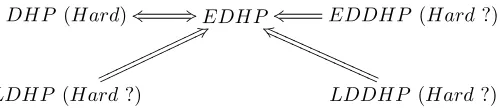
Figure 1 shows the observed relationship between the different problems. We justify the relationships using theorems 1-3 below. First we note an important observation.
Observation. The DDHP in easy.
Proof: It is a well known fact that the DDHP is easy in bilinear maps. GivenP, xP, rxP, V, deciding ifV =rP is equivalent to deciding ife(P, rxP) =e(xP, V) which can be done in polynomial time.
Theorem 1. DHP⇐⇒ EDHP. In other words, the EDHP is hard if and only if the DHP is hard.
Proof: First we prove that EDHP⇒DHP. let DHPP(xP, rxP) be the output of an oracle that solves
the DHP for some fixed P and arbitrary xP, rxP. We can construct an oracle EDHPP(xP, rxP) that
solves the EDHP for any tuplehP, xP, rxPias follows:
EDHPP(xP, rxP) = DHPP(DHPP(DHPP(xP, rxP), xP), rxP).
For the converse, let EDHPP(xP, rxP) be the output of an oracle that solves the EDHP for some
fixedP and arbitraryxP, rxP. We construct a DHPP(xP, rxP) oracle that solves the DHP for the tuple
hP, xP, rxPias follows:
DHPP(xP, rxP) =
1
2(EDHPP(xP, xP+rxP)−EDHPP(xP, rxP)−P) .
Theorem 2. LDHP⇒ DHP. In other words, the LDHP cannot be hard if the DHP is easy.
Proof: It is trivial to prove that LDHP⇒ DHP by constructing an LDHPP(xP, rxP) oracle using
a DHPP(xP, rxP) oracle as follows: Generatey←Zq. Then,
LDHPP(xP, rxP) =hyP,DHPP(xP, rxP) +y(xP)i
.
Theorem 3. LDDHP ⇒DHP and EDDHP⇒DHP.
3
The reader may notice that our statement of the DHP is different from the usually accepted one, which asks finding rxP given (P, xP, rP). It is easy to see that the two definitions are equivalent if the the order ofG1 is prime; denote the
Proof: First we prove the latter; simply use the DHP oracle to solve the EDHP and decide the EDDHP instance (since there is a unique solution). To prove the former; givenP, xP, rxP, yP, Z, use the DHP oracle to output rP from (P, xP, rxP) and decide ife(Z, P) =e(rP, P)·e(xP, yP).
The security of our protocol relies on an unproven hypothesis which we now describe. Define the following statements. The ‘R’ indicates a positive reduction, while the ‘L’ denotes a non-reduction.
R1: DHP⇒LDHP
R2: LDDHP⇒LDHP
L1: DHP6⇒LDHP
L2: LDDHP6⇒LDHP
Clearly from theorem 3, R1 ⇒ R2 (and so L2 ⇒ L1). Here the arrow denotes an ‘implies’ rela-tionship. An open question at this stage is if the converse is true; that is, does R2 ⇒ R1? (i.e. does
L1⇒L2?) Next, we give our hypothesis in the form of the following conjuncture.
Conjuncure 4. (LDHP Hypothesis) LDDHP⇒ LDHP if and only if the LDHP is easy.
If this conjuncture turns out to be true, this would clearly imply that DHP⇒ LDHP if and only if the DHP is easy (since, by theorem 3, we have LDDHP⇒DHP and if DHP ⇒LDHP, this would also
imply LDDHP⇒LDHP).
To disprove this conjuncture, it would seem natural to try and construct a DHP oracle using an LDHP oracle and show that DHP ⇒LDHP even if the DHP is hard. It appears, however, that constructing a DHP oracle using just an LDHP oracle is infeasible if we are unable to verify the LDHP oracle’s outputs (assuming that the oracle outputs different values each time when given the same inputs). Another ap-proach would be to try and exhibit an example where the LDHP is easy but the LDDHP is hard or an example where the LDHP is hard but LDDHP ⇒LDHP. Unfortunately, we have been unable to prove this conjuncture at this stage.
Corollary 4. Assuming conjuncture 4, EDHP6⇒LDHP unless both the problems are easy.
DHP (Hard)ks +3EDHP
3
;
nnnn nnnn
nnnn
nnnn nnnn
nnnn
k
s EDDHP (Hard?)
LDHP (Hard ?) LDDHP (Hard?)
d
lQQ QQQQ
QQ QQQQ
Q QQ
QQ QQQQ
QQ QQQ
Figure 1: Problem Hierarchy
We exploit this apparent “gap” in the two problems (LDHP, EDHP) to construct perfect two-round interactive zero-knowledge proofs as shown in the next section. Before describing our protocol, we make the following three assumptions:
1. LDHP Assumption: The LDHP is intractable inG1
2. LDDHP Assumption: The LDDHP is intractable inG1
4.1
Setup PKI
1. The TA selects a security parameterland uses the BDH parameter generator of [7], which we will call Params, to set the system parameters as follows. It generates{e, q,G1,G2} ←Params(1l)
whereG1,G2are group descriptions for two groups each of prime orderq >2lande:G
1×G17→G2
is a bilinear mapping as defined in section 4. The TA then generatesP ←G1. If P 6= 0 thenP is
a generator ofG1. The system parameters arehe, q, l,G1,G2, Pi.
2. Each participant IDi generates xi ← Zq as the private key. The corresponding public key is
Yi =xiP ∈G1. Each user also obtains a certificate from the CA linking the identityIDi and the
public keyYi, for example, using the identification protocol given below.
4.2
Two-Round (Blind) Identification
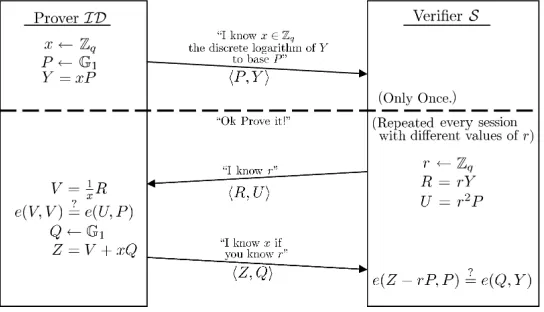
We are now in a position to describe our identification protocol. Assume that user ID having secret key x∈Zq and public keyY =xP ∈G1 wants to prove to serverS, the knowledge of x. Additionally,
ID wants to ensure that no one except the verifier S gets convinced of this fact from watching the communication. Here (ID,S) can be considered as a pair of (prover, verifier). The protocol is graphically described in figure 2.
Figure 2: Two-round Identification
1. IDstarts by claiming to knowx∈Zq, the discrete logarithm ofY ∈G1to baseP.
2. The verifier S generates r ← Zq and computes R = rY and U = r2
P. It sends hR, Ui as its challenge toID.
3. IDcomputes V = 1
xR and verifiese(V, V) = e(U, P). If this test passes, IDis convinced that R
was indeed randomly generated. IDgeneratesQ←G1and computesZ =V+xQ. It sendshZ, Qi
as its proof toS.
4. S accepts ife(Z−rP, P) =e(Q, Y).
Correctness: The correctness of the protocol is easily checked. In the verification process;
LHS =e(Z−rP, P) =e(1
5
Security of the Proposed Protocol
In this section, we prove that the above protocol is perfect zero-knowledge using a restricted definition of Bounded-Prover perfect Zero-Knowledge (BP-pZK) [5], which essentially requires that the probability of a dishonest verifier succeeding is negligibly less then that of a dishonest prover succeeding. The completeness is guaranteed by the correctness of the verification process.
5.1
Soundness
Assuming an honest verifier, we must show that a dishonest prover cannot succeed except with a negligible probability. Given xP, rxP, r2P, the task of a dishonest prover is to compute a pair hZ′, Q′i such that
Z′ =rP+xQ′. It is easy to see that this is an instance of the LDHP (section 4). We also claim that knowledge ofU does not give a dishonest prover any additional advantage in solving this LDHP instance because deciding if U = r2
P is an instance of the EDDHP. An algorithm that has a non-negligible probability in solving the LDHP given a true EDDHP instance is essentially a distinguisher for the EDDHP instance. Thus, the proof is sound from a verifier’s view as long as both the LDHP and the EDDHP are intractable.
5.2
Honest Verifier Zero-Knowledge
We construct a simulator that can generate an accepting transcript {P, xP, rxP, r2P, Z′, Q′} without interaction with a prover as follows. Given (P, xP), generate r, α ← Zq, compute rxP, r2P, Q′ = αP and Z′ =rP+αxP. It is easy to see that the simulated and real distributions are identical. Thus, our protocol isHonest Verifier Zero-Knowledge.
5.3
Dishonest Verifier Zero-Knowledge
A dishonest verifier will generateR non-uniformly. In other words, a dishonest verifier will not knowr
corresponding toR. To prove zero-knowledge in this case, it is enough to prove that the probability of a dishonest verifier succeeding isnegligibly less than the probability of a dishonest prover succeeding.
First, note that it is infeasible for a dishonest verifier to succeed except with a negligible property because computing r2P from P, xP, rxP (without knowledge of r or x) is exactly an instance of the
EDHP.4
Let ǫv be the probability that a dishonest verifierS∗ succeeds in making an honest prover ID
ac-cept a challenge as valid. Also let ǫp be the probability that a dishonest prover ID∗ can convince an
honest verifierS. LetP r[EDHP] andP r[LDHP] be the probabilities that any computationally bounded adversary can solve the EDHP and the LDHP respectively. From the above discussion, we know that
ǫv =P r[EDHP] and ǫp=P r[LDHP|(EDDHP instance = TRUE)]≥P r[LDHP]
We can straightaway conclude that P r(EDHP) < P r(LDHP) under the LDHP hypothesis using corollary 4 and so the above protocol is computationally zero-knowledge in the BP-cZK model. Now let δ=ǫv/ǫp. Clearly, if δ is non-negligible, it would imply that EDHP ⇒LDHP, again contradicting
corollary 4. Hence we conclude that the above protocol is, in fact, perfectly zero-knowledge in the BP-pZK model from a prover’s viewpoint.
4
We observe that the alternate cheating verifier problem; givenP, xP, r2
P, computingrxP is at least as hard as the DHP due to the following reduction. Denote this problem by ACVP (for Alternate Cheating Verifier Problem). For simplicity, we will only show how to reduce the Original Diffie-Hellman Problem (ODHP) (see footnote in section 4) to the ACVP.
Using anACVP(P, xP, r2
P) oracle that always outputsrxP for any given inputsP, xP, r2
5.4
Passive Adversary Blindness
An inherent property of the above protocol ispassive adversary blindnesswhich informally implies that no polynomially bounded adversary has a non-negligible advantage in deciding the honesty of the participants in the protocol. Assuming that the EDDHP is intractable, it is impossible for a passive adversary to decide the honesty of the verifier; given P, xP, rxP, U, deciding if U = r2
P is an instance of the EDDHP. Similarly, it is not possible for a passive adversary to decide the honesty of the prover; given
P, xP, rxP, Q, Z, deciding ifZ=rP+xQ is an instance of the LDDHP.
5.5
Knowledge Extractor
It is trivial to prove that the above interactive protocol is a “proof of knowledge” by constructing an extractor. On a closer look at the protocol, we see that ID essentially proves knowledge of the witness hrP, xQisuch thathQ, Zi ∈L1 using the shared stringhP, xP, rxPiwhereL1is the language:
L1={hQ, Zi |Z =rP+xQ}. ClearlyL1∈N P. Assume that a dishonest prover (ID∗
) is able to make any honest verifier accept. That is, given (P, xP, rxP),ID∗
can always output a pairhZ′
, Q′i
such thate(Z′−
rP, P) =e(Q′
, xP). By simulating the honest verifier itself,ID∗
can obtainhrP, xQ′i, the witness thath
Q′
, Z′i ∈
L1.
6
Two-Round Group Identification
This scheme enables a group of users to identify themselves to a server such that: (a) The identification test passes if none of the users cheat, (b) if any of the users cheat, the test will fail with a high probability, (c) it is not possible for the server or the users to know who cheated.
Assume that{ID1,ID2, . . .IDn} are the set of users who want to jointly identify themselves. It is
necessary that each user IDi must have a certified public key Yi as described earlier. The goal of the
protocol is that all users will simultaneously identify themselves to a serverS. That is, the proof is valid only on all the statements together: “IDi knows xi” ∀i : 1 ≤i ≤ n but not on any of the individual
statements like “ID1 knows x1” or “ID2 knows x2” independently of the others. We will assume the
infrastructure of section 4.1. The identification is done as follows:
1. The n provers ID1,ID2. . .IDn start by claiming to S that they know the discrete logarithms
x1, x2, . . . xn∈Zq ofY1, Y2, . . . Yn∈G1(to base P) respectively.
2. The verifier S generatesr1, r2, . . . rn ← Zq and computes Ri =riYi andUi =r2iP. It makes the
list of challengeshIDi, Ri, Uiipublic.
3. EachIDicomputes Vi =x1iRiand checks thate(Vi, Vi) =e(Ui, P). If this test passes, it generates
Qi ←G1 and computesZi=Vi+xiQi
4. All users then collaborate to jointly compute the valueZ=Pjj==1nZj. This computation is hidden
from S so that individual values Zj are effectively hidden the it’s view. The combined proof
{Z, Q1, Q2. . . Qn} is sent toS.
5. S accepts ife(Z−Pjj==1nrjP, P) = Qj=n
j=1e(Qj, Yj).
6.1
Security Proof (Sketch)
We claim that this test will pass if and only if eachIDiknowsxi. To summarize the goals of the protocol,
the individual users can jointly authenticate themselves to the server such that:
(a) If all users are honest, the server always accepts.
(c) The protocol is zero knowledge. It is not possible for anyone (including the server) to know which user cheated.
(d) Collusions are possible between users but not with the server (the server is trusted).
The protocol is secure based on the following observations:
1. Soundness: Computing individual proofs hZi, Qii without xi or ri is infeasible using similar
rea-soning for the single user scenario (section 4.2). Using the idea of aggregate signatures of [10], the same applies to the multiuser case. Consequently the verifier will reject.
2. Honest Verifier Zero Knowledge:S can generate a valid accepting transcript on its own correspond-ing to {ri, Ri, Ui} ∀i : 1 ≤i ≤ n as follows: S generates αi ← Zq ∀i and computes Qi = αiP,
Ri=riYi. ThenZ = Pj=n
j=1riP+αiYi.
3. Dishonest Verifier-Zero-knowledge: A dishonest verifier will generate R non-uniformly and will therefore not knowri corresponding toRi. Due to this it will be hard for this verifier to generate
Ui such thate(x1iRi,
1
xiRi) =e(Ui, P) due to the hardness of the EDHP. Thus a dishonest verifier will not be able to make anyone accept his/her challenge as valid. The above reasoning for single user identification can be extended here.
4. Honest Verifier Secrecy: We require that it is impossible for a passive adversary to decide the honesty of the verifier. The reasoning for the single user case can be extended here. That is, given
P, xiP, Ri, Ui, deciding ife(x1iRi,x1iRi) =e(Ui, P) is infeasible without knowledge ofri or xi due
to the hardness of the EDDHP.
5. Honest Prover Secrecy: Assume that all the provers are honest and thus,S will eventually accept. We require that it is impossible for a passive adversary (including the provers) to decide the honesty some prover. We note that givenP, xiP, rixiP, ri2P, Qi, Zi, deciding ifZi=riP+xiQi is infeasible
without knowledge ofror xdue to the hardness of the LDDHP. Thus a passive adversary cannot decide the outcome of the identification.
6. Dishonest Prover Secrecy: Assume that some of the provers are dishonest. In this case, given
P, xiP, rixiP, yiP, Zi∈G1, deciding ifZi= (ri+xiyi)Pis infeasible under the LDDHP assumption.
Therefore ifS rejects, none of the provers know which pairs hZi, Qiicorrespond to invalid proofs
(if the individual coin tossesriofS are kept secret andSis honest, no information is leaked to the
provers). Similarly if the individual valuesZiare kept secret (fromS), the identity of the dishonest
provers is still concealed since computing individual proofs Zi just from Z, y1P, y2P . . . ynP such
thatZi= (ri+xiyi)P ∀iis infeasible assuming the hardness of the 2-Element Aggregate Extraction
Problem (2-EAEP) (which is equivalent to the DHP as shown in theorem 1 of of [11]). Consequently, even the verifierS does not have the ability to decide which of the provers are dishonest.
Finally, if the joint computation ofZ is carried out in a way that any one individual prover or a small coalition of provers can knowZi’s for only a small fraction of users, the identities of dishonest
provers can still be effectively hidden, even ifS can be coerced to reveal all the coin tosses ri.
7
Other Extensions
In this section we will provide several extensions of our scheme. We refer to the definitions of sections 4.1 and 4.2. The private keysxi can either be generated by the users or by a trusted authority. The public
keyYiare assumed to be certified in the former case. Note that the identification is a two-round protocol,
7.1
Hidden Signatures
In the protocol of section 4.2, where userIDidentifies to the serverS,IDcan also send plaintext messages along with hidden signatures such that onlyS can extract the signature. Of course, once extracted, the signatures provide the same non-repudiation as the BLS signatures [7].
1. Initialization: The process begins when at some point,S asks ID to identify itself by sending the challengeR=rxP and U =r2
P in the first step of the protocol of section 4.2.
2. Signing: Like the previous scheme, the message to be signed isM ∈G1andQ=H(M). However,
in this case, the verifier’s challenge isnot ignored. As always, the signerIDfirst computesV = 1
xR
and checks thate(V, V) =e(U, P). The hidden signature ofID onM is thenZ =V +xQ. The tuplehM, Ziis sent toS.
3. Verification: On receivinghM, Zi,Sextracts the signatureS=Z−rP. The verification condition ise(S, P) =e(H(M), Y) like before.
7.2
Plaintext-Aware Encryption And Signcryption
The above idea of hidden signatures suggests that we can also easily convert the interactive identification protocol to a non-interactive public key encryption scheme. We present (without a security proof) such a scheme here based on El Gamal encryption. Our variant of El Gamal provides semantic security and additionally achieves plaintext awareness (which informally requires that an adversary cannot generate ciphertexts without “knowing” the actual plaintext [12, 13]). The idea is to simulate the identification protocol for an arbitrary user and give the message as input to the simulator. Then construct the challenge for a specific userIDusing thesamecoin tosses of the verifier from the simulation. As usual, we assume userID has a private keyx∈Zq and the corresponding certified public key Y =xP ∈G1for a known
generatorP ofG1. Let the plaintext be M ∈G1. We also require a hash function H: G1 7→G1. The
use of the hash function is necessary only to achieve semantic security.
1. Encryption: Generater, x′←Z
q,P′←G1. ComputeQ=x1′(H(rP)+M),Z=rP+H(rP)+M,
Y′ = x′
P′
, R = rY and U = r2
P. The ciphertext is the tuple hP′
, Y′
, R, U, Z, Qi. The values {P′
, Y′}
can be re-used in multiple encryptions to save bandwidth (without any compromise in security). It is also possible to haveP =P′
which saves further bandwidth. We allow the case of
P6=P′
to enable signcryption (described later).
2. Decryption: Compute V = 1
xR. Check that e(V, V) = e(U, P) ande(Z−V, P
′) =e(Q, Y′). If both checks pass, accept the ciphertext as valid and computeM =Z−V − H(V).5
Plaintext Awareness: An adversary cannot make ID accept the ciphertext hP′, Y′, R, U, Z, Qi without knowing the corresponding messageM =x′Q− H(rP) such that Y′ =x′P′. This follows from the various Diffie-Hellman assumptions given earlier.
Semantic Security: Given plaintexts{M0, M1}and one of the ciphertextshP′, Y′, R
b, Ub, Zb, Qbi, b∈
{0,1}, computingbis equivalent to one of the following:
1. Decide ifM0=? Zb−1xRb− H(1xRb) with probability greater than 1/2
2. Decide if
Qb, P′, M0+H(1xRb), Y′ forms a valid DDH tuple with probability greater than 1/2.
We say thathA, B, C, Diforms a valid DDH tuple ife(A, B) =e(C, D).
Signcryption: In the above protocol hP′, Y′i acts as the public key of the user in the simulated identification. If it is a real certified public key then this scheme also serves as a signcryption scheme. The tuplehV, Q, Miprovides non-repudiation; a verifier can check thate(M+H(V), P′
) =e(Q, Y′ ).
5
In this casehP′, Y′iacts as the public key of the simulated user. Observe that we have “mixed” the public keys of different users in the identification. This mixing is justified assuming that the order ofG1is prime. Due to this, all elements
ofG1 except 0 will have orderq. Alternatively, ifP′, Y′6= 0 then it is ensured that the hardness assumptions onhP, Yi
7.3
Deniable Signcryption
It is possible for some user IDa to send an authenticated and encrypted message to IDb (withIDb’s
co-operation) such that it can be later denied byIDa. As before we assume that the private key ofIDa
isxa corresponding to the public key xaPa. Also, letxb be the private key ofIDb corresponding to the
public keyxbPb (possibly with Pa =Pb).
1. Initialization: At some point IDb asks IDa to identify itself. To do this it generates rb ←Zq,
computesRb=rbYa,Ub =rb2Pa and sendshRb, UbitoIDa.
2. Signcryption: IDacomputesVa =
1
xaRband accepts the challenge ife(Va, Va) =e(Ub, Pa). Using IDb’s challengeRb, IDa can then encrypt a messageMa ∈G1 forIDb as follows: IDa generates
ra ← Zq, sets Qa = M + 2raPb and computes Za = Va+xaQa as always. It then computes
Ta =Qa−raPb andRa=raYb and sendshZa, Ta, Raias its signcrypted message toIDb
3. Verification/Decryption: On receiving hZa, Ta, Rai, IDb first computes Qa =Ta+x1bRa and
verifies that (Za, Qa) is a valid accepting transcript forIDa. That is,e(Za−rbPa, Pa) =e(Qa, Ya).
If this check passesIDb computes Ma =Ta−
1
xbRa. The zero knowledge identification property ensures thatIDb will only accept messages that were actually sent by IDa. Thus, an adversary
cannot make it accept any random message as valid, thereby ensuring plaintext-awareness.
4. Repudiation (Deniablity): We will show that the above scheme allowsIDato later deny sending
the message Ma. Firstly note that Ma =Qa− x2bRa and Ta =Qa− x1bRa. For any given pair
(Ma, Qa), it is easy to see that IDb has the ability to generate hRa, Tai. Due to this, there is no
evidence left forIDb to prove that these values were actually computed byIDa.
Also note thatZa−rbPa=xaMa+2xaraPb. ExtractingxaMa(which would serve asIDa’s signature
onMa) using this relation is equivalent to computingxaraPbfromraPbandxaPa without knowing
ra orxa. This is a hard problem of the order of the DHP (see [10], section 4.2 and [11]).
7.4
Two-Round Authenticated Key Agreement
UserIDa having public key xaPa and private key xa can establish a shared key with user IDb having
public keyxbPb and private key xb as follows. LetH:G17→G1 be a cryptographic hash function.
1. IDageneratesra←Zq and computesRa =raYb,Ua=r2aPb andZa=raPb+xaH(Ra). It initiates
the protocol by sendinghRa, Ua, ZaitoIDb. Essentially,IDa simulates the identification protocol
with itself and sends part of the transcript toIDb.
2. On receivinghRa, Ua, Zaifrom IDa, IDb computes Vb = x1bRa and Qa =H(Ra). It then verifies
thathRa, Ua, Za, Vb, Qaiis indeed an accepting transcript ofIDa’s identification. That is, it checks
that e(Za−Vb, Pa) = e(Qa, Ya) and e(Vb, Vb) = e(Ua, Pb). If both tests pass IDb accepts IDa’s
authentication. IfIDb decides to continue with the process it generatesQb←G1 andrb←Zq. It
then computesRb=rbYa,Ub =rb2Pa andZb=Vb+rbPa+xbH(Rb). It sendshRb, Ub, ZbitoIDa
as its response. It also keepsKab=rbPa+Vb=rbPa+raPb as the shared key.
3. On receivinghRb, Ub, Zbi,IDa computes Va =
1
xaRb and Qb =H(Rb) and performs the following two checks: e(Va, Va) = e(Ub, Pa) and e(Zb−raPb−Va, Pb) = e(Qb, Yb). If both checks pass, it
acceptsIDb’s authentication and keepsKab=raPb+Va=rbPa+raPb as the shared key.
We claim that in the second step,IDb will accept if and only if IDa knows ra and xa. To see this,
first note thathZa, Qaiis a zero knowledge identification proof ofIDa. Due to this, there is no guarantee
that the proof was generated by IDa (since it could also have been efficiently simulated according to
section 4.2). However, observe that if this protocol is simulated, the resulting Qa will almost certainly
be random. A simulator cannot choose a predetermined value ofQa since there is no way to output an
of the hash function additionally ensures that the simulator did not have control even over the random coin tossesra. Hence, for this particular instance, the simulation must have been carried out by IDa.
The second and third steps of the protocol involve the identification ofIDb to IDa keeping ra as
the random coin tosses of verifier. The need to include Rb becomes evident when we observe that the
first message fromIDa does not include any session specific information. Thus, authenticating the first
message alone cannot guarantee key freshness. We use the technique mentioned in [14], section 3.1 and provide freshness via the computation of the session (or ephemeral) key which includes the ‘fresh’ value
rbPaalong with the possibly ‘stale’ valueraPb. Due to this, a replay attack is detectable when no message
or a garbled message is received by either parties.
7.5
Anonymous Seller Credit Card Payments
In this section, we will present a simple on line payment system with some interesting security features. The protocol requires only one certified key. The seller of a product need not provide a certified key to the buyer, effectively remaining anonymous. The seller must produce some identification to the credit card processor or the bank to ensure that the payment is successful. If the buyer notices a disputed transaction on his credit cart statement, he can ask the bank to reveal the identity of the party who received the money. If the transaction is not disputed, the seller can remain completely anonymous. Moreover, we provide the additional advantage of ‘single-use’ transactions, that is after having successfully processed a payment, the seller cannot later reuse the same information to process another identical payment. We will assume the identification scheme of section 4.2 where the buyer is IDand the seller isS. The protocol also involves a third partyB which could be a bank or a credit card processor. The certified public key of ID is Y =xP. This key could itself serve as a credit card number. We also use two cryptographic hash functions H:G17→G1 andH1:{0,1}∗7→G
1.
1. The buyerIDbegins by visiting the website ofSand initiating a purchase transaction. The details of the transaction are encapsulated in a requestREQ. The tuplehID,REQ, P, Yiis sent toS 2. S generates randomr←Zq and computesR=rY =rxP andU =r2P. It also creates a contract
CON containing the payment amount, transaction date, time and other details (though it will possibly not mention the identity of the seller or the commodity for sale to protect privacy). It sends hCON, R, Ui to ID. It is understood that transactions are accepted as valid by the bank only for a short specified deadline (say five minutes) from the time mentioned in the contract.
3. On receivinghCON, R, Ui, IDchecks that the contract is correct. It then computesV = 1
xU and
checks thate(V, V) =e(U, P). It this check passes, it computesQ=H1(CON),Z1=V +xQ and Z2=xH(Z1). It sendshZ1, Z2iback toS and saveshCON, Riin its database until it receives its next credit card statement from the bank. It also keeps a record ofS’s reply to the transaction in case a dispute arises.
4. S computesQ=H1(CON) and verifies thate(Z1−rP, P) =e(Q, Y) ande(Z2, P) =e(H(Z1), Y).
If both checks pass, S forwards the tuple hZ1, Z2, r, Y,ID,S,CON i as a payment request to the bankB.
5. On receiving a payment request, B does the same verification as S; that is, it computes Q = H1(CON) and verifiese(Z1−rP, P) =e(Q, Y) ande(Z2, P) =e(H(Z1), Y). It also ensures that the
hr,IDipair has not been previously used by checking its database. Finally, the bank checks the date and time specified inCON and ensures that it is within the specified expiry period (five minutes) of the current time. If all checks pass, B accepts this transaction, deducts the amount specified fromID’s account, credits that amounts toS’s account, saves the tuplehZ1, Z2,ID,S,CON, riin its database and returnssuccessto S.
7. If the bank receives another transaction with the samehr,IDipair in the future, it outputsfailure. For security reasons, it also saves the corresponding hS,S′, r,IDi in a blacklist where S′ is the identity of the other seller corresponding to the same pair. This blacklist can be used for further investigation if necessary.
8. Sometime in the future, the bank sendsCON in a credit card statement toID. If some transaction is disputed, IDreports the corresponding hCON, Ri back to the bank, along with some evidence (eg. a transaction receipt with afailureresponse). The bank can easily trace the disputed seller S using its database after validating thatR=rY.
7.6
Identity Based Cryptography (IBC)
Using the primitives for identification of section 4.2, any smart card user can dynamically setup a complete Identity Based Cryptosystem (IBC) [15] incorporating both Identity Based Encryption (IBE) and Identity Based Signatures (IBS). The IBE scheme described here is directly taken from [8]. However, to the best of our knowledge, the IBS scheme presented below has not been proposed earlier (we note that the IBS scheme of [16] can also be directly used here).
This smart card user acts as the Key Generating Center (KGC). The interesting feature of our scheme is that the private keys can be distributed over an insecure channel as long as the key-request can be authenticated. The infrastructure is roughly as follows: messages for a userID can be encrypted using the public keyID. The private key for decryption is given out by the KGC over an insecure public channel but masked using the hidden-signature scheme of section 7.1. User ID, however, must produce some authenticating information to request a private key. We assume that a signature is used to authenticate user’s requests for private keys.
7.6.1 Private Key Distribution
The private key of the user who acts as the KGC for this setup isx∈Zq and the corresponding public
key isY =xP ∈G1. LetH1:{0,1}∗7→G1 be a cryptographic hash function. The public key ofIDi is
implicitly understood to beQi=H1(IDi)
1. All users must have a prior certified public key to authenticate its requests to the KGC. Each user IDi generatesri←Zq and computesRi=riY =rixP andUi=ri2P. IDi then signsRi using its
certified private key and sendshRi, Uiito the KGC over an insecure channel.
2. The KGC verifies the signatures and thus authenticates the request of users. For each valid request
Ri ofIDi, the KGC computesVi=
1
xRiand verifies thate(Vi, Vi) =e(Ui, P). If this check passes,
it computesQi=H1(IDi) andZi=Vi+xQiand makes eachhZi,IDiituple public via an insecure
channel.
3. IfIDi knows corresponding ri, he/she can compute the private keyxQi =Zi−riP after
authen-ticating it by checking thate(xQi, P) =e(Qi, Y). The encryption/decryption can be done exactly
as described in [8] after this step (described next). The zero-knowledge property ensures that only the right user can compute the private key fromZi.
7.6.2 Identity Based Encryption (IBE)
We briefly describe the identity based encryption scheme here (further details can be obtained from [8]). LetH2:G27→ {0,1}kbe a cryptographic hash function. A randomkbit messageM forIDiis encrypted
as follows:
1. Encryption: Generateα←Zq, computeQi=H1(IDi),C1=M⊕ H2(e(αQi, Y)) andC2=αP.
The ciphertext (C1, C2) is sent toIDi.
7.6.3 Identity Based Signatures (IBS)
In this section, we propose a novel IBS scheme using bilinear pairings. The setup of the scheme is exactly as the one for the above IBE scheme. We will use the same hash function H1 : {0,1}∗ 7→ G1 in this
scheme. As before the public key ofIDi ishQi, Y, Piand the private key isxQi whereQi=H1(IDi).
1. Signing: To sign a messageM ∈ {0,1}∗
, userIDigeneratesα←Zq, computesS=xQi+αH1(M)
andT =αP. The tuplehM,(S, T)iis a valid message-signature pair.
2. Verification: To verify a signature, we check thate(S, P) =e(Qi, Y)·e(H1(M), T). To the best
of our knowledge, this IBS variant has not been proposed before.6
The scheme is secure in the random oracle model under the Diffie-Hellman assumption in G1. The
security of this scheme will be further detailed in the full version of this paper.
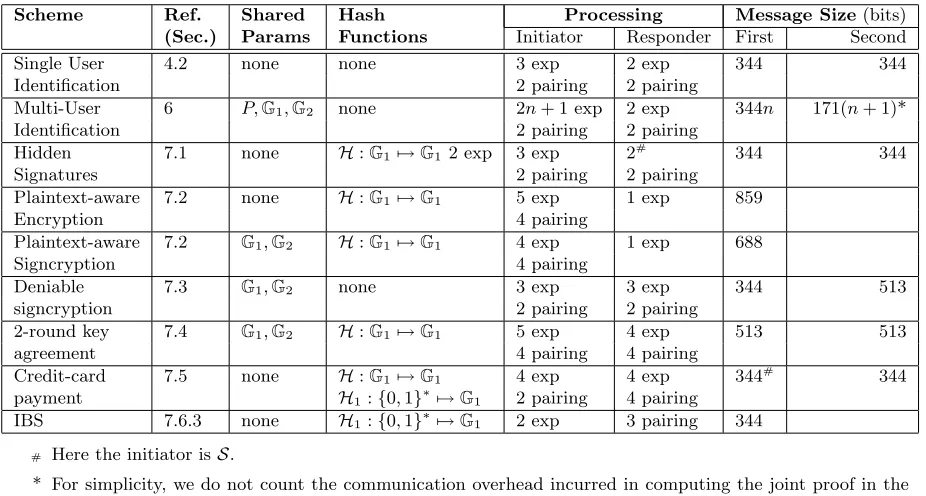
8
Summary
Scheme Ref. Shared Hash Processing Message Size(bits)
(Sec.) Params Functions Initiator Responder First Second
Single User 4.2 none none 3 exp 2 exp 344 344
Identification 2 pairing 2 pairing
Multi-User 6 P,G1,G2 none 2n+ 1 exp 2 exp 344n 171(n+ 1)*
Identification 2 pairing 2 pairing
Hidden 7.1 none H:G17→G12 exp 3 exp 2# 344 344
Signatures 2 pairing 2 pairing
Plaintext-aware 7.2 none H:G17→G1 5 exp 1 exp 859
Encryption 4 pairing
Plaintext-aware 7.2 G1,G2 H:G17→G1 4 exp 1 exp 688
Signcryption 4 pairing
Deniable 7.3 G1,G2 none 3 exp 3 exp 344 513
signcryption 2 pairing 2 pairing
2-round key 7.4 G1,G2 H:G17→G1 5 exp 4 exp 513 513
agreement 4 pairing 4 pairing
Credit-card 7.5 none H:G17→G1 4 exp 4 exp 344# 344
payment H1:{0,1}∗7→G1 2 pairing 4 pairing
IBS 7.6.3 none H1:{0,1}∗7→G1 2 exp 3 pairing 344
# Here the initiator isS.
* For simplicity, we do not count the communication overhead incurred in computing the joint proof in the multi-user identification. Herenis the number of users.
Assumingq≈2171
, each pairing computation takes≈8.5 ms and each exponentiation takes≈1.5 ms on the hardware mentioned.
Table 1: Summary
In this paper, we proposed the notion of zero knowledge blind identification. Informally, in such a protocol, an honest prover reveals only one (intended) bit of information to an honest verifier and reveals less than that information to a dishonest verifier. In effect, using our scheme, any user can correctly identify to a random server and a passive adversary cannot learn anything about the outcome of the
6
A previously proposed IBS scheme [16] uses a hash functionH3:{0,1}∗7→Zqand works as follows: To sign a message
M ∈ {0,1}∗,ID
i generatesα←Zq and computesS= (H3(M) +α)xQiand T =αP. The signature ishS, Tiwhich is
verified by checking thate(S, P) =e(H3(M)Qi+T, Y). Our scheme has the advantage of requiring only one hash function
identification. Hence we coin the term blind identification. To the best of our knowledge, this blinding property is unique to our scheme.
Referring to the definitions of sections 4 and 4.2, essentially, the security of our protocol relies on the hardness of the LDDHP (i.e. deciding if Z = (r+xy)P for givenP, xP, rxP, yP, Z). Although, this is not a well studied hard problem like the DHP, we feel reasonably confident that it is computationally intractable.
In section 7, we show how these simple identification primitives can be used for constructing complex mechanisms like key agreement, digital signatures, encryption and signcryption. As a simple application of our smart card scheme, we propose a model for on line credit card and cheque transactions. The protocol can be used in conjunction with the Secure Electronic Transaction (SET) specification or in a completely different infrastructure. As some other applications, we mention subliminal identification, designated verifier proofs and multiuser authentication. For optimal security, the primitives for signing are best implemented in a tamper proof chip supporting elliptic curve point addition and doubling operations. As observed, all the verification primitives require one or two pairing computations and deal with public keys only. Consequently, they are not restricted to a secure tamper proof device. We refer the reader to [7] for details on constructing the hash functions used here.
Finally, we summarize the efficiency and viability of our scheme. For this discussion, we will assume that q≈2171 so that the best known algorithms for computing discrete logarithms inG
1 require ≈285
operations and are therefore impractical. The benchmarks of [17] indicate that each pairing operation using these parameters takes≈8.6 ms and each elliptic curve point exponentiation takes≈1.5 ms. These results were obtained on a desktop PC with an AMD Athlon 2100+ 1.8 GHz, 1 GB RAM and an IBM 7200 RPM, 40 GB, Ultra ATA/100 hard drive [17]. Using these values we obtain the following results. Table 1 summarizes our results.
References
[1] Oded Goldreich and Yair Oren. Definitions and properties of zero-knowledge proof systems.Journal of Cryptology, 7(1):1–32, 1994.
[2] Oded Goldreich, Silvio Micali, and Avi Wigderson. Proofs that yield nothing but their validity or all languages in np have zero-knowledge proof systems. J. ACM, 38(3):690–728, 1991.
[3] Mihir Bellare and Oded Goldreich. On defining proofs of knowledge. Lecture Notes in Computer Science, 740:390–420, 1993.
[4] M. Bellare, S. Micali, and R. Ostrovsky. The (true) complexity of statistical zero knowledge. In STOC ’90: Proceedings of the twenty-second annual ACM symposium on Theory of computing, pages 494–502, New York, NY, USA, 1990. ACM Press.
[5] Amitabh Saxena and Ben Soh. Bounded prover zero-knowledge in two-rounds, 2005. Unpublished Manuscript. url: http://homepage.cs.latrobe.edu.au/asaxena/saxena05bounded.pdf.
[6] Amos Fiat and Adi Shamir. How to prove yourself: practical solutions to identification and signature problems. InProceedings on Advances in cryptology—CRYPTO ’86, pages 186–194, London, UK, 1987. Springer-Verlag.
[7] Dan Boneh, Ben Lynn, and Hovav Shacham. Short signatures from the weil pairing. InASIACRYPT ’01: Proceedings of the 7th International Conference on the Theory and Application of Cryptology and Information Security, pages 514–532, London, UK, 2001. Springer-Verlag.
[9] Paulo S. L. M. Barreto, Hae Yong Kim, Ben Lynn, and Michael Scott. Efficient algorithms for pairing-based cryptosystems. In CRYPTO ’02: Proceedings of the 22nd Annual International Cryptology Conference on Advances in Cryptology, pages 354–368, London, UK, 2002. Springer-Verlag.
[10] Dan Boneh, Craig Gentry, Ben Lynn, and Hovav Shacham. Aggregate and verifiably encrypted signatures from bilinear maps. In Eli Biham, editor, EUROCRYPT, volume 2656 ofLecture Notes in Computer Science, pages 416–432. Springer, 2003.
[11] Jean-S´ebastien Coron and David Naccache. Boneh et al.’s k-element aggregate extraction assumption is equivalent to the diffie-hellman assumption. In Chi-Sung Laih, editor,ASIACRYPT, volume 2894 ofLecture Notes in Computer Science, pages 392–397. Springer, 2003.
[12] Moses Liskov, Anna Lysyanskaya, Silvio Micali, Leonid Reyzin, and Adam Smith. Mutually inde-pendent commitments. Lecture Notes in Computer Science, 2248:385+, 2001.
[13] Jonathan Herzog, Moses Liskov, and Silvio Micali. Plaintext awareness via key registration. Technical report, MIT Laboratory for Computer Science, February 2003.
[14] Hugo Krawczyk. Hmqv: A high-performance secure diffie-hellman protocol. Cryptology ePrint Archive, Report 2005/176, 2005.
[15] Adi Shamir. Identity-based cryptosystems and signature schemes. In Proceedings of CRYPTO 84 on Advances in cryptology, pages 47–53, New York, NY, USA, 1985. Springer-Verlag New York, Inc.
[16] Jae Choon Cha and Jung Hee Cheon. An identity-based signature from gap diffie-hellman groups. In Yvo Desmedt, editor,Public Key Cryptography, volume 2567 ofLecture Notes in Computer Science, pages 18–30. Springer, 2003.