R E S E A R C H
Open Access
Successive interference cancellation
aided sphere decoder for multi-input
multi-output systems
LI Alex LI
1*, Rodrigo C. de Lamare
2,3and Alister G. Burr
2Abstract
In this paper, sphere decoding algorithms are proposed for both hard detection and soft processing in multi-input multi-output (MIMO) systems. Both algorithms are based on the complex tree structure to reduce the complexity of searching the unique minimum Euclidean distance and multiple Euclidean distances, and obtain the corresponding transmit symbol vectors. The novel complex hard sphere decoder for MIMO detection is presented first, and then the soft processing of a novel sphere decoding algorithm for list generation is discussed. The performance and
complexity of the proposed techniques are demonstrated via simulations in terms of bit error rate (BER), the number of nodes accessed and floating-point operations (FLOPS).
Keywords: Complex sphere decoder (CSD), Detection algorithms, Multi-input multi-output (MIMO), QR decomposition
1 Introduction
To achieve a high spectral efficiency, maximum likeli-hood (ML) detection should be employed with high-order constellations. However, “brute-force” ML detection is impractical even for a system with a small num-ber of antennas. An alternative method is called the sphere decoder (SD), and this has attracted signifi-cant attention in the last decade, due to the con-siderable complexity reduction it achieves [1, 2]. The key idea behind the SD is to find the lattice point closest to the received signals within a sphere radius. Although the computational complexity has been greatly reduced, it is still very high for systems with a large number of antennas and high-order modulation. For the complexity reduction, the authors in [3–8] have studied different search strategies and enumeration schemes. Additionally, some suboptimal methods with linear and decision feedback equalization (DFE) [9, 10] have been proposed to approach the ML performance.
*Correspondence: [email protected]
1School of Communication Engineering, Chengdu University of Information Technology, No. 24, 1st Section Xuefu Road, 610025 Chengdu, China Full list of author information is available at the end of the article
In most applications, the complex-valued system is decoupled and reformulated as an equivalent real-valued system. Real-valued SDs can only process lattice-based modulation schemes such as quadrature amplitude mod-ulation (QAM) and pulse amplitude modmod-ulation (PAM), while other modulations such as phase shift keying (PSK) cannot be processed as efficiently, because some invalid lattice points are included in the search. Additionally, the depth of the expanded tree for real-valued SDs is twice of that for complex counterparts. Hence, the complex-valued SE-SD and a modified version of SE-SD were proposed in [11, 12]. The complex-valued SDs avoid the decoupling of the complex system and can be widely applied to different modulations without reaching invalid lattice points. Especially, the latter one can achieve a very low complexity compared to other real-valued and complex-valued SDs [13]. However, the intricacy of com-plex SE enumeration is still a weak point that makes the real-valued SDs preferred for hardware implementa-tion. Some novel low-complexity complex enumerators have been studied in [14–16], and these enumerators are interchangeable in most complex-valued SDs. Neverthe-less, the enumeration still must be employed in each
detection layer and performed for several times once new branches are accessed. Furthermore, the authors in [17] investigate the practical performance of a novel sphere decoder (Geosphere) for multiuser detection. A novel two-dimensional zig-zag ordering strategy has been studied in the sense that the number of path metric cal-culations is reduced. Additionally, the lower bound of the path metric is employed to eliminate the branches if the path metric is smaller than the lower bound. Another efficient ordering and pruning scheme is stud-ied in [18], which performs the horizontal pruning and vertical pruning with a novel tight lower limit for the path metric. These two schemes discussed above could also be used in the complex-valued SDs with simple modifications.
Motivated by the description above and probabilistic tree pruning SD (PTP-SD) [7], we devise a novel complex-valued SD (CSD) with statistical pruning strategy (SPS), successive interference cancellation (SIC) aided modified probabilistic tree pruning (MPTP).
In addition to hard decision type detection, soft pro-cessing for multi-input multi-output (MIMO) systems has been recently studied in several works [11, 14, 19–21]. In [11], the authors report a near-capacity MIMO detec-tion using list-SD (LSD) with a relatively large candidate list. With a large list, the performance of the LSD will be very close to the maximum a posteriori probability (MAP) detector. The results in [14] illustrate the hard-ware implementation of LSD with four candidates, which may not be considered as an implementation of approx-imate MAP detector [19]. This is because the list size is too small to achieve near-capacity performance. Hence, it is not an optimum detection technique. Additionally, the log-likelihood ratio (LLR) clipping is also required for the LSD with a small list, because the +1 or −1 is missing in a particular bit LLR calculation based on the max-log MAP criterion. It can be fixed by setting a given magnitude of LLR as in [11], but the performance loss is unavoidable. Although the authors in [20, 21] have fixed this problem for non-iterative detection decoding scheme and non-coherent detection, these LLR clipping tech-niques are still relatively complicated in most cases and may not be suitable for every iterative detection decoding structure. However, a large list will result in irreducible complexity which limits the applications of LSD, because the candidate updates in the list is difficult in hardware implementation [22]. This is not a desirable feature. If the list generation for LSD is simple, the multiple search will not be required in the iterative processing compared to single tree search (STS) sphere decoder. In the following, we will discuss a simple list generation for the LSD given the proposed CSD.
The main contribution of this paper is summarized as follows:
1. An efficient CSD has been proposed that approaches the linear complexity for practical large-scale MIMO systems. This is because the proposed CSD
significantly reduces the required number of times for performing enumeration and the span of the detection tree.
2. Due to the additional conditions (ACs), the performance loss of the conventional CSD is compensated.
3. The search strategy of the proposed CSD can be easily extended to the LSD with lower complexity. 4. The scatter list generation and the ML ordering
accelerate the construction of the list and make the LSD more suitable for the parallel hardware implementation.
Due to the requirement of enumerators, the SDs we dis-cuss in this work are all based on complex-valued SE enu-meration in [11, 12] for simplicity, namely computation of coordinate bound (CCB) enumeration.
The rest of the paper is organized as follows. Section 2 presents the system model and problem formulation. Section 3 describes the proposed complex sphere decoder and the algorithm table. The soft processing with LSD is also discussed in Section 4. In Section 5, the simulation results demonstrate the complexity and BER performance of CSD and LSD, respectively. A conclusion is drawn in Section 7.
2 System model
The channels between transmit and receive antennas are assumed to be independent frequency flat fading. Here, we denote the dimension symbolCNt×Nr as the complex
number with the vertical dimension Nt and the hori-zontal dimension Nr. The channel can be represented by H ∈ CNt×Nr. Defining the transmit symbol vector s =[s1. . .si. . .sNt]T∈ CNt×1, the received signal y =
[y1. . .yj. . .yNr]T∈ CNr×1, and the AWGN noise vector v =[v1. . .vj. . .vNr]T∈ CNr×1, the MIMO system model
can be written as
y=Hs+v, (1)
whereE{ssH} =σs2INt×Nt. Note that each element in the
noise vector is assumed to be a zero-mean circular sym-metric complex Gaussian variable, which implies that the phase rotation of v will not affect its statistical proper-ties, andE{vvH} = σv2INr×Nr. After QR decomposition,
the reformulated mathematical expression of (1) can be presented as follows:
where vectors v˜ and v have the same statistical properties. In the remaining part of the paper, we use the same notation v for both cases. Note that we assume Nt ≤ Nr throughout this paper. However, for the rank deficit MIMO systems, the authors in [23] and [24] proposed new forms of the Cholesky and QR decomposition to exploit the performance advantage of the SDs for over-loaded MIMO systems (Nt > Nr). The algorithms dis-cussed in the paper could be also naturally extended to the rank deficit MIMO systems with modifications of such preprocessing techniques. To clarify the summation of the Euclidean distance for multiple single layers, the full path metric (FPM) and the partial path metric (PPM) are defined as
where the branch metric
Bi=
For theith detection layer, the only firsti elements in theith row of the matrixRare used for the branch metric calculation in Eq. (5). In other words, the FPMpNt
cor-responds to the Euclidean distance of all detection layers, and the PPMpmmeans the Euclidean distance of partial detection layers. Note that the quantity pNt denotes the
FPM whenm=Nt, and the quantitypmdenotes the PPM whenm<Nt.
3 Complex sphere decoder with successive
interference cancellation-based tree pruning The proposed CSD is based on the CCB enumeration scheme discussed as follows. Hence, the system model becomes (2). Furthermore, the minimum mean square error-sorted QR-decomposition (MMSE-SQRD) is used as the processing technique [2], which provides several efficient QR decomposition methods. For fair comparison between different CSDs, the one with the most promis-ing decomposition methods (SQRD) with the optimum signal to interference plus noise ratio (SINR) ordering is used for pre-processing to obtain the upper-triangular
matrix R. Thus, the CSDs with MMSE-SQRD can achieve the ML performance at the expense of very low complexity.
3.1 The review of CCB
This subsection briefly demonstrates a complex-valued enumeration namely CCB or complex SE enumeration. This bound was first proposed in [11], and an improved version was presented in [12], which separates the con-stellation points into groups located on one or multiple concentric rings and computes the phase bound based on the current sphere radius and previously detected sym-bolsˆskandri,k. In this case, these constellation points can be tested according to the bound to determine whether they are in the circle of nulling-cancelling points, which are the symbol estimates of the SIC. The constellation points smi = γeθm can be represented in polar
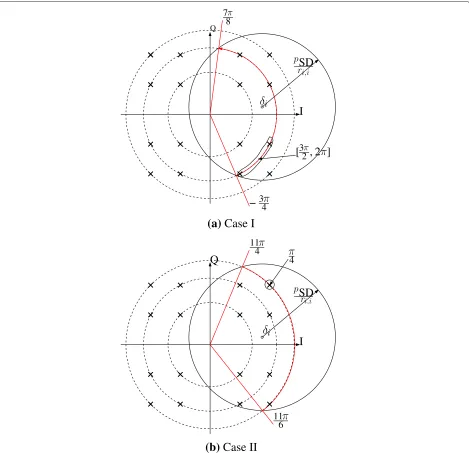
coordi-nates, where the quantitysmi denotes themth candidate constellation point at layer i, and 0 ≤ θm < 2π. Note that the quantityγ will be different in different concentric rings as shown in [11]. Figure 1 illustrates that the phase bound of the constellation points for one particular con-centric ring can be determined by the sphere radius. The red curves correspond to the phase bounds of concen-tric rings. Accordingly, the null-cancelling point for theith layer can be defined as
δi=
where the quantityˆsk is defined as the accessed symbol at thekth detection layer in the surviving branch. With the aid of trigonometric functions, we calculate the phase bound ofθmas
where the quantityθδi denotes the phase of the
Q
I
78
−
34SD
[
32, 2 ]
(a)
Case I
Q
I
SD
11 6 11
4
4
(b)
Case II
Fig. 1Two specific examples to exclude the constellation points erroneously:ain case I, the phases are bounded by78π −34π, which is supposed to cover the constellation points between32π2π. But these constellation points are excluded by the CCB, because they are not inside the bound.
bCase II has the similar problem: the constellation pointπ4 is not in the bound114π 116π
where 0 ≤ arccos(ψ) ≤ π. From (8), no constellation points in one concentric ring will be included for the can-didates ifψ > 1, which implies that the phase bound is too small to cover any constellation points exceptδi. For
ψ <−1, the corresponding phase bound [θδi−π,θδi+π]
to include all constellation. For −1 ≤ ψ ≤ 1, only the constellation points inside the bound can be used for the search. However, the phase bound described above may eliminate some candidates, which should be included in the search. This is because the phases of the constellation
points are between 0 and 2π, and the corresponding phase bound may not be located within [ 0, 2π]. Thus the mis-match between the phases of constellation points and the phase bound must be fixed to avoid missing candidates.
3.2 Novel search strategy and successive interference cancellation tree pruning
3.2.1 Search strategy
Compared to conventional SE-CSD, the novel search strategy first performs SIC to obtain the nulling-cancelling points and the FPM without calculating the PPM of other constellation points and sorting for each layer, and the radius pSD may be updated by FPM, i.e., pNt, once the
search reaches the bottom layer. The rest of the search can be performed upwards starting from the nulling-cancelling point of the bottom layer rather than top layer as in conventional SE-CSD. Additionally, the span of the tree can be further shrunk by the MPTP. In (7), the can-didates chosen by CCB can be determined by the new updated radius obtained by the MPTP. Hence, the num-ber of possible candidates for each layer can be signifi-cantly reduced. The details of the proposed algorithm are described in Algorithm 1.
Algorithm 1 Proposed complex sphere decoder with modified tree pruning and SIC
Require: pSD= ∞,R,v,ρiin (14),i=1, 2,. . .,Nt. Ensure:sML
1: Compute the NC points and obtain the FPM and PPM p11,...,Nt, saves1,...,Nt,sML=s.
6: Elseobtain the sorted candidates ski
i ∈ scandi ,ki = [ 1, 2,. . .,Ni
c] in (8) by the CCB with ρi, where Nci denotes the number of available branches at theith layer.
12: Calculate the PPM for the kth candidate at the ith layer,pki
3.2.2 Statistical pruning strategy
As discussed in [25], the complexity of the SD is sig-nificantly affected by the initial radius. However, the new search strategy does not require the search start-ing with an appropriate initial radius to control the tree span. This is because the bottom layer will be arrived by the SIC process. For some extreme channel condi-tions, the radius derived by the SIC may still have a very small chance to be very large. In other words, the result obtained by the proposed search strategy may reach the local optima rather than the global one. Hence, the initial radius for CSDs must be considered. First, we assume the ML solution is obtained. Thus, the opti-mum radius would be the summation of squared noise termsNt
i=1|v|2i
of the detection layers, which follows χ2distribution with N
t degree of freedom and upper bounded by the initial radiuspSD. The normalized radius
can be written asβ = pSD
σ2
v , and the normalized
summa-tion of squared noise terms can be written asu=
Nt
i=1|v|2i σ2
v .
The quantityσv2 is the noise variance. In the following, an appropriate value of β is required. The cumulative density function (CDF) of the random variableucan be represented as
where the quantity is the pre-defined threshold probability according to the empirical results with the dif-ferent number of antennas of the MIMO systems, and the quantityβcan be easily calculated by the inverse calcula-tion of (9), i.e., the inverse incomplete Gamma funccalcula-tion. OncepSD>pSD, the quantitypSDwill be updated bypSD at the bottom layer without performing multiple search compared to that in [25].
3.2.3 Modified probabilistic tree pruning
We assume that the remainingNt−mlayers’ symbols are perfectly detected in (5). Then, the PPM is only affected by the noise. Hence, the current PPMpmplus the norm of the remaining layers’ noiseNt
i=m+1|vi|2must be smaller than the radius in most cases. Hence, the possible FPM can be represented as
Nt
i=m+1
|vi|2/σv2≤(pSD−pm) /σv2 (11)
Accordingly, the value of PrNt
i=m+1|vi|2/σv2≤
(pSD−pm)/σv2
is reasonably large. Because the sphere radius pSD is sufficiently large to avoid missing the ML solution. As discussed above, the summation
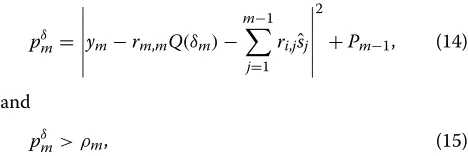
Nt titypis the pre-defined probability. Hence, the left hand side (LHS) of the Eq. (13) can be considered as the upper bound of the PPM at the mth detection layer. In other words, any PPMpmlarger than the LHS of (13) is unlikely to be the correct path for the ML solution, so these nodes at themdetection layer with their child nodes are elimi-nated in the search tree. To avoid the CCB, we introduce the quantized nulling-cancelling point Q(δm) obtained by SIC to calculate the minimum PPM for the mth layer as quantized symbol for the givenmth layer. If the inequality in (15) is satisfied, the NC point and the remaining nodes with their child nodes are all pruned, and the CCB is not carried out. Otherwise, the quantitypδm is used in (7) to replacepSDto further reduce the number of candidates. Note that the parameter ρm is pre-computed before the start of the transmission.
3.3 Additional conditions for CCB
There are two ACs we should consider to avoid the can-didates missing, if we introduceρias the intra radius for CCB in each detection layer.
1. Ifθδi−arccos(ψ) <0andθδi+arccos(ψ) >0, set
will not be included.
In Fig. 1, we present two examples that can be fixed by the conditions described above. The phase range between −3π
4 and 78π does not match to the above definition 0 ≤ θk < 2π, so the two points between 32π and 2π will be pruned erroneously in Fig. 1a within the red circle. For Fig. 1b, the phase of the constellation point is π4, which should be considered as a candidate based on the phase range. But the upper bound of phase obtained by CCB is greater than 2π, which will eliminate the candidate at π4. Note that these ACs are not specified in previous works such as [11, 12], which employ extremely large ini-tial radius instead. For PSK modulation and QAM, all constellation points are located on one ring, and the can-didates can be obtained in one shot. For high-order QAM, the CCB must be performed multiple times for different concentric rings.
4 List soft processing-based complex sphere
decoder
As we discussed above, the conventional LSD has a vari-able complexity. In our case, we extend our proposed CSD to the LSD with a simpler list generation. From the orig-inal idea of the LSD, a list of symbol candidates with the smallest FPMs are required in the LLR calculation as (17). Furthermore, it would be possible to construct a list with the MAP solution inside. However, the com-plexity of list generation will be variable and significant [11]. For the simple implementation of LSD with a large number of candidates, the scatter list generation (SLG) is proposed.
4.1 Extrinsic LLR calculation of LSD
where the vectorbk¯denotes the bit vector omitting thekth bit, the a priori LLR Le2(bk¯) denotes the LLR from the channel decoder corresponding to the bits in bk¯, and the quantityBk± denotes the list of bit vectors obtained by the LSD having ±1 at the kth bit. The symbol vec-tor sk± denotes the possible symbol combinations cor-responding to the set Bk±, and the corresponding kth bit of sk± equals ±1. Following the max-log approxi-mation and the list obtained by the LSD [11], Eq. (16) becomes
The LLR Le1 for the kth bit in the transmit symbol vector is obtained for the channel decoder. The extrin-sic informationLe1from the LSD will be fed forward to the channel decoder as the input, and the extrinsic infor-mationLe2from the channel decoder will be fed back to the LSD. Thus, the information between two decoding components exchanges iteratively.
4.2 Scatter list generation
To build a large list with simple implementation, a few modifications will be made to the proposed CSD:
(1) Perform the search by the proposed CSD to obtain the branches accessed in the search, and rearrange these branches in an ascending order according to the PPMs. Start several searches with the ML ordering by traversing the spans of the sub-trees of the branches until the list is filled. Note that the sub-tree search will be terminated once it reaches the starting point of the neighbouring sub-tree search.
(2) Replace the radiuspSDby the largest FPM of the
symbol vector in the list.
(3) MPTP will be carried out given the new radiuspSD.
(4) The sphere radiuspSDmay be updated in (9) with the
new largest FPM in the list once a candidate with a smaller FPM is found.
The search strategy described above splits the entire tree into different sub-trees and searches them indepen-dently. The algorithm table is shown in Algorithm 2. Although the proposed CSD is needed to perform sev-eral times for the scatter list generation, its complexity has been significantly reduced, which is measured via the number of updates in the list generation.
Algorithm 2Proposed list sphere decoder with scatter list generation
Require: pSD= ∞,R,v,ρi,i=1, 2,. . .,Nt. Ensure:sMAP1,...,|B|
1: Perform the proposed CSD and output the branches L1,...,|ζ|∈ζaccessed in the search.
2: Rearrange the branchesLl,...,|ζ| ∈ ζ in an ascending order with (18).
3: forl=1, 2,. . .,|ζ|
4: Perform the search as the same strategy as the pro-posed CSD starting fromLland output the branches with the FPMpN
The ML solution can be exploited to re-order the remain-ing branches for the list generation of the LSD. When the list is full, the search will go back to the upper layers and proceed down the tree. However, the unvisited nodes at the lower layers are unknown to this search, and these partial branches would be ordered according to the SE enumeration. The basic idea of ML-based ordering is to sort the remaining partial branches with the ML solution in the low detection layers rather than only computing their real PPM for a given layer. Additionally, a large pro-portion of the remaining branches may be discarded if the distance (pSD) is much smaller than the Euclidean distance ofsr. In our case, the following equation can be used for ordering at theith layer:
κ =arg min implies that the unknowni−1 transmit symbols at low detection layers are replaced by the symbols in the ML solution, which can be used for ordering. The quantityR denotes the set of available branches for theith layers, and the quantityκdenotes the smallest Euclidean distance in the sorting process. The calculation of ML-based order-ing has a modest cost in (18), which only needs|R|(i+1) multiplications for each layer. The notation|·|denotes the size of the set.
5 Simulation results
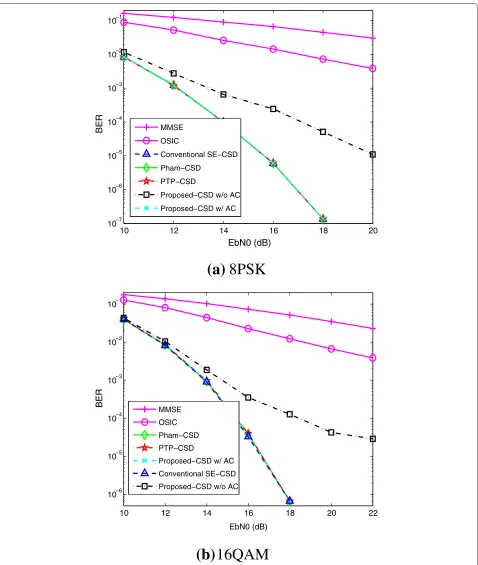
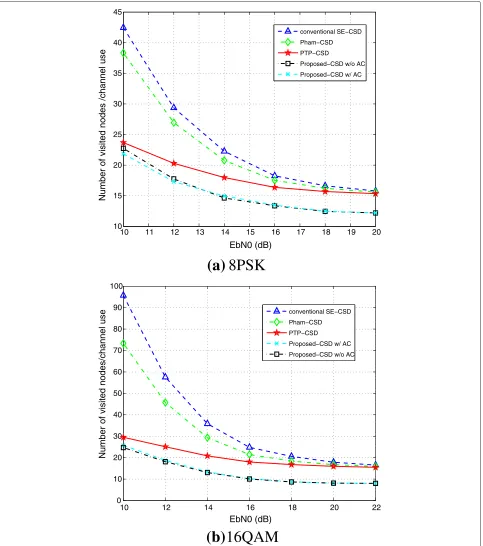
performance and complexity of several CSDs are com-pared via BER and the number of visited nodes in a 8×8-MIMO system with 16QAM and 8PSK. An MPSK
modulation in our simulation is defined asγe(2n+1)π/M : n=0, 1,. . .,M−1. The quantityγ is defined as the mag-nitude of the modulation scheme, and the quantityMis
10 12 14 16 18 20
10−7 10−6 10−5 10−4 10−3 10−2 10−1
EbN0 (dB)
BER MMSE
OSIC
Conventional SE−CSD
Pham−CSD
PTP−CSD
Proposed−CSD w/o AC
Proposed−CSD w/ AC
(a)
8PSK
10 12 14 16 18 20 22
10−6 10−5 10−4 10−3 10−2 10−1
EbN0 (dB)
BER MMSE
OSIC
Pham−CSD
PTP−CSD
Proposed−CSD w/ AC
Conventional SE−CSD
Proposed−CSD w/o AC
(b)
16QAM
the size of the modulation. We consider the conventional SE-CSD, Pham-CSD [12], PTP-CSD [7], and the proposed CSD with and without AC for CCB, all of which are com-plex SE enumeration-based CSD withpSD = ∞at the beginning of the search. The PTP can be simply extended
to Pham-CSD. The energy per bit to noise (EbN0) is used. The MIMO channel coefficients (Nt = Nr) are gener-ated according to Jakes model, and the channel noise is additive white Gaussian noise, which is identically inde-pendently distributed for each receive antenna as stated
10 11 12 13 14 15 16 17 18 19 20 10
15 20 25 30 35 40 45
EbN0 (dB)
Number of visited nodes /channel use
(a)
8PSK
10 12 14 16 18 20 22
0 10 20 30 40 50 60 70 80 90 100
EbN0 (dB)
Number of visited nodes/channel use
conventional SE−CSD
Pham−CSD
PTP−CSD
Proposed−CSD w/ AC
Proposed−CSD w/o AC
(b)
16QAM
in the previous section. The probabilistic noise constraint is set to p = 0.2. The threshold for SPS must be appropriately adjusted according to the dimensions and the modulation as stated earlier, and we set=0.001. The ISRC scheme [8] is not employed because of the difficulty of choosing parameters for intra radius.
As shown in Figs. 2 and 3, the complexity of the pro-posed CSD improves upon the others in terms of visited nodes per channel use by 25 % for 16QAM and more than 25 % for 8PSK at highEbN0values without any BER per-formance loss, even compared to conventional SE-CSD between the mid and highEbN0regime. The performance loss of the proposed algorithm without ACs is significant at high SNRs. In other words, it is more sensitive to the missing candidates in low noise scenarios. However, the complexity reduction is not obvious at lowEbN0scenarios due to the CCB including more unreliable constellation points. It can be observed that the curves of the number of visited nodes for different SDs converge at very highEbN0, so the improvement of the proposed SD is reduced at high EbN0, but is still very promising.
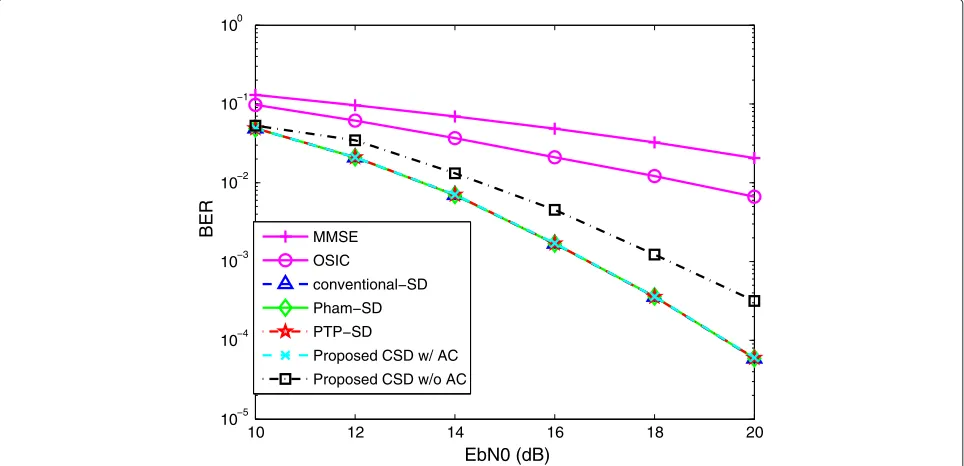
To show the robustness to the channel estimation errors, the BER performance of CSDs for 8× 8 MIMO system with 8PSK and least square (LS) channel estima-tion [26] is plotted in Fig. 4. We can observe that the BER performance of the proposed CSD with imperfect channel estimates can still achieve the same performance as other existing CSDs. The BER performance of 16QAM is not shown here, because it has similar curves as in Fig. 4.
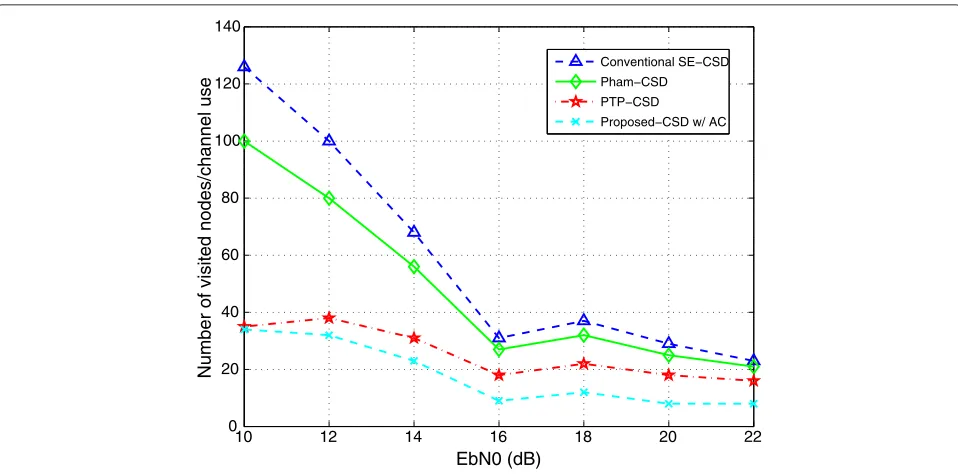
The worst-case complexity is measured by the 99 % quantile of the total number of visited nodes per channel
use (Pr(Cw > Cany) = 0.99) [27], where the quantity Cwdenotes the number of visited nodes accessed by the SDs in one particular channel use, and the quantityCany denotes the number of visited nodes accessed by the SDs in any channel use. The corresponding worst-case com-plexityCwof CSDs are also plotted in Fig. 5, which implies that the number of visited nodes of the proposed CSD is tightly lower bounded by the complexity of SIC at high SNRs.
Additionally, the complexity of SDs increases exponen-tially with increasing dimension. We therefore plot the number of visited nodes against the dimensions (Nt=Nr) at a highEbN0(20 dB) to show that the complexity is still reduced by our proposed algorithm in Fig. 6.
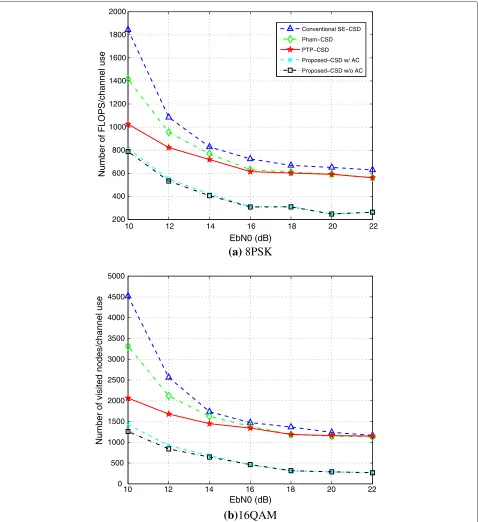
The complexity discussed so far is only based on the number of visited nodes. In order to show the advan-tages of complexity reduction of complex SE enumeration (CCB) and eliminating unnecessary candidates, the curves with the number of FLOPS are presented in Fig. 7. For a fair comparison, we assume that a complex addition requires 2 FLOPS, and a complex multiplication requires 16 FLOPS. The proposed algorithm still outperforms the other CSDs, because of fewer implementations of complex SE enumeration and the reduced number of candidates. The number of FLOPS of the detection ordering are not considered, because the CSDs are performed with the same preprocessing technique. Furthermore, the parame-ters for MPTP can be pre-computed before the start of the transmission.
For soft output CSD (LSD), we consider 8×8-16 QAM and a NSC half rate convolutional code with constraint
10 12 14 16 18 20
10−5 10−4 10−3 10−2 10−1 100
EbN0 (dB)
BER MMSE
OSIC
conventional−SD
Pham−SD
PTP−SD
Proposed CSD w/ AC
Proposed CSD w/o AC
10 12 14 16 18 20 22 0
20 40 60 80 100 120 140
EbN0 (dB)
Number of visited nodes/channel use
Conventional SE−CSD Pham−CSD PTP−CSD
Proposed−CSD w/ AC
Fig. 5Worst case. The number of visited nodes of CSDs against SNR,Nt=Nr=8 with 16QAM
length 3 for simplicity. In a coded system, the energy per bit to noise has been re-defined: Eb
N0dB = EsN0dB+ 10 log10 Nt
RNrM, where R denotes the rate of the channel
code. The performance and complexity of the proposed LSD have been evaluated by BER and the number of updates in the list, respectively. The EXIT chart has also been introduced to illustrate how the mutual information changes. Note that a fixed value clipping has been adopted
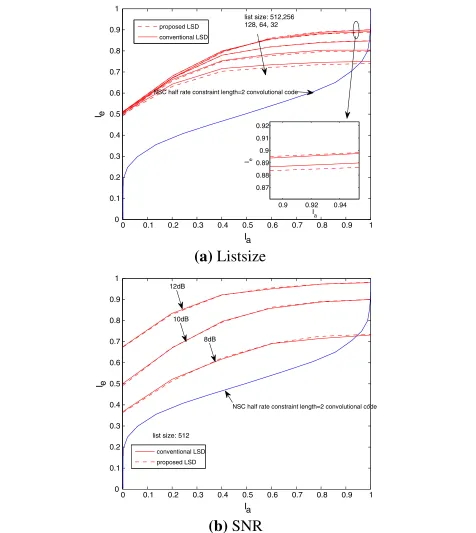
in our simulation and the appropriate clipping values can be simply obtained by evaluating the mutual information Ieas [20]. In our case, the clipping value is set to±12. In Fig. 8a, the EXIT chart of conventional LSD [11] and the proposed LSD is illustrated with different sizes of list. We can observe that both of them perform almost identically with different sizes of list, and the list size has a signifi-cant influence on the LSD performance. Additionally, the
2 3 4 5 6 7 8 9 10 11 12
0 10 20 30 40 50 60
The number of Tx antennas
Number of visited nodes/channel use
EXIT chart of LSD with the same list size in different SNR has also been plotted in Fig. 8b. The SNR only moves the curves up and down without changing the shapes. Similarly, the BER performance of two LSD with L = 512 agrees with the results in the EXIT chart, which has been presented in Fig. 9, and the performance improves
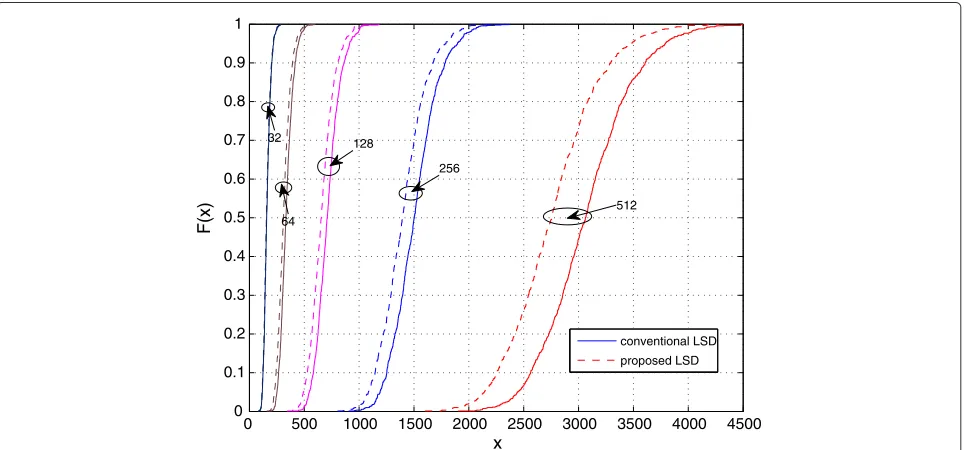
with the increasing number of iterations. The complex-ity comparison made by CDF has been shown in Fig. 10, which indicates that the number of updates in the list has been significantly reduced by the proposed LSD with a large list size. Furthermore, the search can be terminated early to suit the hardware implementation.
10 12 14 16 18 20 22
200 400 600 800 1000 1200 1400 1600 1800 2000
EbN0 (dB)
Number of FLOPS/channel use
Conventional SE−CSD
Pham−CSD
PTP−CSD Proposed−CSD w/ AC
Proposed−CSD w/o AC
(a)
8PSK
10 12 14 16 18 20 22
0 500 1000 1500 2000 2500 3000 3500 4000 4500 5000
EbN0 (dB)
Number of visited nodes/channel use
(b)
16QAM
6 Related work discussion
For a very large-scale integration (VLSI) implementa-tion, the enumeration scheme becomes the bottleneck of sphere decoding algorithm as discussed in [14, 15, 17]. The enumeration must be efficiently implemented, so “one-node-per-cycle architecture” is one of the promising
structures for the hardware implementation. Our pro-posed sphere decoder basically is a variant of the method proposed in [14]. The authors proposed a new architec-ture which consists of two entities: (1) metric computation unit (MCU) and (2) metric enumeration unit (MEU). These two components perform in a parallel manner to
0 0.1 0.2 0.3 0.4 0.5 0.6 0.7 0.8 0.9 1 0
0.1 0.2 0.3 0.4 0.5 0.6 0.7 0.8 0.9 1
Ia I e
proposed LSD
0.9 0.92 0.94
0.87 0.88 0.89 0.9 0.91 0.92
Ia Ie
proposed LSD
conventional LSD
NSC half rate constraint length=2 convolutional code
list size: 512,256 128, 64, 32
(a)
Listsize
0 0.1 0.2 0.3 0.4 0.5 0.6 0.7 0.8 0.9 1 0
0.1 0.2 0.3 0.4 0.5 0.6 0.7 0.8 0.9 1
Ia I e
conventional LSD
proposed LSD
NSC half rate constraint length=2 convolutional code
12dB
10dB
8dB
list size: 512
(b)
SNR
4 5 6 7 8 9 10 11 12 10−5
10−4 10−3 10−2 10−1 100
E bN0(dB)
BER
proposed LSD
conventional LSD
iter. 1
iter. 2
iter. 3
iter. 4
Fig. 9BER performance. Conventional LSD and proposed LSD with different iterations,Nt=Nr=8 with 16QAM
handle the forward search and the backward search sepa-rately. In our proposed method, the enumeration scheme, i.e., MEU and the MCU can work in the same way. The search will always perform the successive interference cancellation to obtain the nulling-cancelling points, once the unvisited node is accessed. In the meanwhile, the MEU can be used to find the remaining surviving nodes after the above process. Furthermore, the latency require-ment of “one-node-per-cycle” architecture will not be a
problem in our case. This is because the second term in the modified probabilistic tree pruning is not real-time calculation as described in Eq. (14). Only one additional cycle is needed to obtain the tight radius in each detection layer. The reduction of the number of the visited nodes is more significant than the few additional cycles. Addi-tionally, the statistical pruning we used in the paper is also pre-computed to avoid that the radius obtained by the successive interference cancellation is too large in some
0 500 1000 1500 2000 2500 3000 3500 4000 4500 0
0.1 0.2 0.3 0.4 0.5 0.6 0.7 0.8 0.9 1
x
F(x)
extreme cases. In [14], the authors modified the SE enu-meration scheme to achieve the critical path reduction. However, the modified one is not strictly compatible with the “one-node-per-cycle” architecture. Due to the com-plexity reduction and a few additional cycles required, the modified scheme is still working under the architecture. This situation is quite similar to the one we discussed above.
Furthermore, the complexity of the enumeration scheme can be further reduced by the method introduced in [15, 17]. The authors proposed the two-dimensional zigzag enumeration schemes to avoid the sorting process and unnecessary partial path metric calculation, which are very computational intensive for the practical hardware implementation. In other words, the partial path metrics of the unvisited nodes are only calculated once the expan-sion of the tree is demanded. Hence, there is no need to visit all children of a parent node with the real Euclidean distance sorting. To the authors’ best knowledge, the two-dimensional zigzag enumeration scheme is the most efficient method for the complex sphere decoder.
7 Conclusion
In this paper, novel sphere decoding algorithms for MIMO detection and iterative detection and decoding have been presented. The proposed CSD, incorporating the statistical tree pruning technique and SIC, first reaches the bottom layer and eliminates the candidates for the lower layers before the search reaches them rather than eliminating these candidates at the lower layers. From the simulation results, it is seen that the proposed CSD can significantly save computational efforts compared to the conventional CSD. Furthermore, the proposed CSD has been naturally extended to the list SD (LSD) based on the scatter list generation. The proposed LSD makes better use of the ML solution to re-order the remain-ing branches. Hence, the list generation becomes sim-pler than that of the conventional LSD. The complexity of the proposed sphere decoding algorithms for MIMO detection is significantly reduced, and the algorithm provides an attractive tradeoff between complexity and performance.
Competing interests
The authors declare that they have no competing interests.
Authors’ contributions
The main contribution of this paper is summarized as follows: (1) An efficient CSD has been proposed that approaches the linear complexity for practical large-scale MIMO systems. This is because the proposed CSD significantly reduces the required number of times for performing enumeration and the span of the detection tree. (2) Due to the ACs, the performance loss of the conventional CSD is compensated. (3) The search strategy of the proposed CSD can be easily extended to the LSD with lower complexity. (4) The scatter list generation and the ML ordering accelerate the construction of the list and make the LSD more suitable for the parallel hardware implementation. All authors read and approved the final manuscript.
Acknowledgements
This work is supported by the Scientific Research Foundation of CUIT (NO. KYTZ201415), the Scientific Research Foundation for the Returned Overseas Chinese Scholars, State Education Ministry and the Sichuan Provincial Department of Science and Technology Innovation and R&D projects in Science and Technology Support Program (NO. 2015RZ0060).
Author details
1School of Communication Engineering, Chengdu University of Information Technology, No. 24, 1st Section Xuefu Road, 610025 Chengdu, China. 2Department of Electronics, University of York, YO10 5DD York, UK.3CETUC, Pontifical Catholic University of Rio de Janeiro (PUC-Rio), Gávea, Rio de Janeiro, Brazil.
Received: 15 June 2015 Accepted: 5 February 2016
References
1. E Viterbo, J Boutros, A universal lattice code decoder for fading channels. IEEE Trans. Inf. Theory.45(5), 1639–1642 (1999)
2. Y Li, N Seshadri, S Ariyavisitakul, On maximum-likelihood detection and the search for the closest lattice point. IEEE Trans. Inf. Theory.49(10), 2389–2402 (2003)
3. CP Schnorr, M Euchner, Lattice basis reduction: improved practical algorithms and solving subset sum problems. Math. Program.66(2), 181–191 (1994)
4. E Agrell, T Eriksson, A Vardy, K Zegar, Closet point search in lattices. IEEE Trans. Inf. Theory.48(8), 2201–2214 (2002)
5. AD Murugan, HE Gamal, et al., A unified framework for tree search decoding: rediscovering the sequential decoder. IEEE Trans. Inf. Theory. 52(3), 933–953 (2006)
6. R Gowaikar, B Hassibi, Statistical pruning for near-maximum likelihood decoding. IEEE Trans. Signal Process.55(6), 2661–2675 (2007) 7. B Shim, I Kang, Sphere decoding with a probabilistic tree pruning. IEEE
Trans. Signal Process.56(10), 4867–4878 (2008)
8. MX Chang, On further reduction of complexity in tree pruning based sphere search. IEEE Trans. Commun.58(2), 471–422 (2010)
9. GJ Foschini, Layered space-time architecture for wireless communication in a fading environment when using multiple antennas. Bell Lab Technical J.1(2), 41–59 (1996)
10. RC de Lamare, R Sampaio-Neto, Minimum mean square error iterative successive parallel arbitrated decision feedback detectors for DS-CDMA systems. IEEE Trans. Commun.56(5), 778–789 (2008)
11. B Hochwald, S Ten Brink, Achieving near-capacity on a multiple-antenna channel. IEEE Trans. Commun.51(3), 389–399 (2003)
12. D Pham, KR Pattipati, et al., An improved complex sphere decoder for V-BLAST systems. IEEE Signal Process. Lett.11(9), 748–751 (2004) 13. K-C Lai, L-W Lin, Low-complexity adaptive tree search algorithm for MIMO
detection. IEEE Trans. Wireless. Commun.8(7), 3716–3726 (2009) 14. A Burg, M Borgmann, et al., VLSI implementation of MIMO detection
using the sphere decoding algorithm. IEEE J. Solid-State Circuits.40(7), 1566–1577 (2005)
15. M Shabany, K Su, P Gulak, inProc. IEEE Int. Conf. Acoust., Speech, Signal Process. (ICASSP). A pipelined scalable high throughput implementation of a near-ML K-Best complex lattice decoder, (2008), pp. 3173–3176. doi:10.1109/ICASSP.2008.4518324
16. M Barrenechea, M Mendicute, et al., inProc.19th European Signal Process. Conf. (EUSIPCO). Implementation of complex enumeration for multiuser MIMO vector precoding, (2011), pp. 739–743
17. K Nikitopoulos, J Zhou, B Congdon, et al., inProc. 2014 ACM Conf. on SIGCOMM. Geosphere: Consistently turning MIMO capacity into throughput, pp. 631–642. doi:10.1145/2619239.2626301
18. K Nikitopoulos, A Karachalios, D Reisis, Exact Max-Log MAP Soft-Output Sphere Decoding via Approximate Schnorr-Euchner Enumeration. IEEE Trans. Veh. Technol.64(6), 2749–2753 (2015)
19. SA Laraway, B Farhang-Boroujeny, Implementation of a Markov Chain Monte Carlo based multiuser/MIMO detection. IEEE Trans. Circuits Syst. I. 56(1), 246–255 (2009)
21. RH Gohary, TJ Willink, On LLR clipping in BICM-ID non-coherent MIMO communications. IEEE Commun. Lett.15(6), 650–652 (2011) 22. C Studer,Iterative MIMO decoding: algorithms and VLSI implementation
aspects. (Ph.D. dissertation, Hartung-Gorre Verlag Konstanz, 2009) 23. T Cui, C Tellambura, An efficient generalized sphere decoder for
rank-deficient MIMO systems. IEEE Commun. Lett.9(5), 423–425 (2015) 24. P Wang, T Le-Ngoc, A low-complexity generalized sphere decoding
approach for underdetermined linear communication systems: performance and complexity evaluation. IEEE Trans. Commun.57(11), 3376–3388 (2009)
25. B Hassibi, H Vikalo, On the sphere-decoding algorithm I.Expected complexity. IEEE Trans. Signal Process.53(8), 2806–2818 (2005) 26. S Kay,Fundamentals of Statistical Signal Processing: Estimation Theory. (A
Simon & Schuster Company, Upper Saddle River, New Jersey, 1993) 27. DW Waters, JR Barry, The chase family of detection algorithms for
multiple-input multiple-output channels. IEEE Trans. Signal Process.56(2), 739–747 (2008)
Submit your manuscript to a
journal and benefi t from:
7Convenient online submission
7Rigorous peer review
7Immediate publication on acceptance
7Open access: articles freely available online
7High visibility within the fi eld
7Retaining the copyright to your article