
R E S E A R C H
Open Access
Performance of a cooperative multiplexing
scheme with opportunistic user and relay
selection over Rayleigh fading channels
Dileep Kumar Verma and Shankar Prakriya
*Abstract
In this article, we analyze the performance of a cooperative spatial multiplexing scheme using amplify and forward relays over Rayleigh fading channels. We propose a simple user and relay selection scheme, and demonstrate that gains in spectral efficiencies are possible by such opportunistic selection. Using a bound on the outage performance, we develop a power control mechanism. We develop a bound on the ergodic rate of the proposed scheme.
Computer simulation results are presented to demonstrate the performance of the scheme, and to validate the analytical expressions.
Introduction
Several new standards for cellular communication are now incorporating amplify and forward (AF) or decode and forward (DF) relays [1]. Cooperative communication protocols have the ability to exploit these relays to har-ness the spatial features of the network for reliable data transmissions [1-3]. A variety of protocols has been pro-posed to obtain higher spectral efficiencies, better outage performance, or to save transmitter power. Typically, the relays are half-duplex due to practical constraints, and this leads to loss of spectral efficiency. Various protocols have been proposed to overcome this limitation, and their performance has been analyzed [4].
It is well known that enormous gains in spectral efficien-cies are possible through frequency reuse by exploiting the spatial features of the network [5-8]. Yomo and Carvalho [5] discuss the spectral efficiency improvement of the cel-lular system where two mobile subscribers uplink their respective data to base station (BS) while an AF relay facilitates communication to a shadowed subscriber. For downlink transmission, a similar type of spectrally effi-cient scheme to obtain gain in spectral efficiency for two users is proposed in [6]. Thai and Popovski [7] proposed an alternative to two-way relaying, and use a half-duplex
*Correspondence: [email protected]
Department of Electrical Engineering, Indian Institute of Technology, Delhi, India
relay to obtain significant improvement in spectral effi-ciency. Cooperative multiplexing protocols [9-11] pro-posed in recent years help realize these promised gains through frequency reuse. In addition, they also help to overcome the loss in spectral efficiency due to half-duplex nature of practical relays. In [10], a two-user coopera-tive multiplexing and scheduling (CMS) protocol using AF relays has been proposed, where a BS multiplexes the data of two selected users. In the first phase, the BS transmits the signal intended for the second user to the relay. In the second phase, the BS transmits the signal intended for the first user, while the relay retransmits the signal intended for the second user. In [11], interference cancellation and precoding techniques are proposed (assuming DF relays) to deal with the interference due to simultaneous trans-missions in the second phase. This interference (in the second phase) makes the study of power distribution between the BS and the RS important. While Shi et al. [10] do not address this issue, an optimum power distribution is derived in [11] for the case when DF relays are utilized. In both [10,11], the focus is on the achievable sum data rates, though some simplified outage analysis is also pre-sented assuming Rayleigh fading channels. Performance with these protocols is limited by the link between the BS and the relay. Although CMS protocols employing relay selection are consequently of interest, they have not been considered so far. To the best of the authors’ knowledge, outage and ergodic rate performance of CMS protocols
with AF relays have not been analyzed for Rayleigh fading channels.
In this article, we consider an opportunistic user and relay selection-based CMS system that enables the BS to multiplex data to a (selected) user, and another (selected) user in the shadowed region. AF relays are utilized for transmission to the user in the shadowed region. A sub-optimal distributed users’ selection scheme is pro-posed. For relay selection the sub-optimal scheme [12] is employed to facilitate distributed implementation. How-ever, we propose a sub-optimal selection strategy based on [12] for the CMS network, in which the node is selected that maximizes the gain of the corresponding channel for desired signal, unlike the optimal node selection scheme in which interference channel should also be considered. Assuming Rayleigh fading channels, an analysis of the out-age probability and ergodic performance of the user(s) and relay selection scheme-based CMS system is presented. Since the exact analysis is mathematically intractable, we present bounds of outage and ergodic performances. Moreover, we develop a power control strategy for the sec-ond phase of the multiplexing scheme. In summary, the contributions of the article are as follows:
1. We demonstrate that a simple user and relay
selection scheme can be implemented in a distributed manner and yield good performance.
2. Unlike other work on cooperative multiplexing [9-11], we consider both user and relay selection. Also, we consider AF relays, analysis for which is complicated by the noise amplification in cooperative multiplexing scenarios.
3. We evolve a simple power control scheme for the second phase of the multiplexing scheme.
The rest of the article is organized as follows. The sys-tem model is described in “Syssys-tem model description” section. In “Outage performance & power control” section, a power control scheme is discussed based on a bound on the outage probability. A bound for the ergodic sum-rate is presented in “Ergodic sum-rate” section. Performance of the proposed protocol is ana-lyzed through computer simulations in “Numerical and simulation results” section, where the derived analyti-cal expressions are validated. Conclusions are drawn in “Conclusion” section.
Notations: The probability density function of gain
(|h|2) of Rayleigh fading channel coefficient (h) is given
byf|h|2(x) = exp(−x/ )/ and cumulative distribution
function Pr(|h|2 ≤ x) = 1− exp(−x/ ) where =
E[|h|2], and E[·] denotes expectation of random vari-ables. (m) = 0∞tm−1e−t dt is the Gamma function, and En(x)(=
∞
1
exp(−xt)
tn dt)represents the exponential
integral of ordern.
System model description
We consider a cellular cooperative communication system as depicted in Figure 1. It consists of a BS withQusers, and Ldedicated distributed relays (RS) of the channel-assisted AF type. Each node is equipped with single antenna, and operates in a half-duplex mode. TheQusers are grouped into two clusters (AandB) ofMandNso thatQ=M+N. The M users (in cluster A) andL relays (in cluster L) have strong average channel link with the BS, while the N users in cluster B are assumed to be in a shadowed region with a comparatively weak channel link to the BS. Relays are utilized to enable the BS to ensure data reliabil-ity for users in setB. Using a sub-optimal scheme, one user m ∈ Aand another usern ∈ Bare selected along with one relayl∈L. The selection scheme is discussed later in this section. In the considered CMS system, only two time slots are required for the BS to transmit data to two dif-ferent users despite the use of relays. In the first time-slot, the BS transmits data of usern∈Bto the relay. In the sec-ond time-slot, the BS and one opportunistically selected relayl ∈ Lspatial multiplex the data of usern ∈ Band one selected userm∈A.
We assume that the fading channels (from any node) to nodes in each cluster are statistically independent and identically distributed (i.i.d.). The Rayleigh fading chan-nel coefficients are denoted by hj,k where source j ∈ {BS,l}, destinationk ∈ {l,m,n}, l ∈ {1, 2,. . .,L}, m ∈ {1, 2,. . .,M}, and n ∈ {1, 2,. . .N}. The inter node dis-tance (nodes in separate cluster) is approximated to inter cluster distance, as nodes in cluster are close to each other as compared to distance between clusters. There-fore, the average channel gains of various links are denoted by j,k = E[|hj,k|2]= d1α
j,k, where dj,k is the distance
between nodes/clustersjandk, andαis the pathloss expo-nent. Note, we use subscriptsBS,A,R, andBfor alternatively
representing the BS, selected user fromA, selected relay from RS, and selected user fromB, respectively.
In the first phase (time slot), the BS broadcasts unit energy symbols (sB) with power P meant for user n ∈
where superscript “I” represents the phase number (first, in this case), andwlandwImare zero mean additive white
Gaussian noises with varianceσw2at thelth relay andmth user, respectively. User n ∈ B in the shadowed region ignores the weak signal from the BS in this phase. Themth user of clusterAdetects the symbolssB, and utilizes it in the subsequent phase to mitigate interference caused by simultaneous transmission from BS and RS.
In second time slot, to exploit spatial multiplexing, the BS transmits symbols sA of mth user with transmitting powerPBS, while thelth relay simultaneously forwards the
amplified version of the signal meant for usern∈Bwith power PRS. The manner in which PBS andPRS are deter-mined to minimize the outage probability is discussed in “Outage performance & power control” section. Usern∈ Breceives symbolsyn=√PRShl,nβyl+
√
PBShBS,nsA+wn usinglth relay, whereβ = 1/(P|hBS,l|2+σw2)andwnis zero mean additive white Gaussian noise with varianceσw2. The signal-to-interference-plus noise ratio (SINR) at user n∈Bvia thelth relay is given by
w. The last expression is obtained by neglecting
the 1 in the denominator. This sort of approximation has widely been used in literature, and the approximateγn,lso obtained has been shown to be indistinguishable from the true value at all SNRsγ. Using the well-known bounds on the harmonic mean [13], we can then see that the SINR is bounded by:
Accordingly, we note that the upper boundγUB
n,l on the
SNR is given by
γUB
n,l =min(γ|hBS,l|2,γRS|hl,n|2/In). (3)
It is clear from (1) and (2) that relay selection (choicel) plays an important role in determining performance. It is noted that the influence of interference due to the term Incan readily be minimized independently by minimizing
In. For this reason, it is proposed to choosento minimize In. This is discussed in detail in “Outage performance &
power control” Section. Estimation of the channel gains, and selection of usersm, n, and relayl is facilitated
by a training phase that precedes the actual data trans-mission. Ideally, the best users and best relay should be selected jointly so as to minimize the outage probabil-ity. However, such joint selection, though ideal, is difficult to implement. Note that this users and relay selection scheme are important in a distributed manner. We there-fore propose to use the sub-optimal scheme such that a distributed timer-based scheme for cooperative commu-nication network is used to opportunistically select the best relay node as given in [12,14]. Making use of the fact that the termInis common to allγn,l(for different relays
tonth node), we directly use [12] for the selection of the best relay (l = arg max
l∈L γn,l) as explicit mechanism of
selection is already discussed in [12]. For ease of presen-tation, we first consider the single user setB, i.e.,N = 1, and later in “Outage performance & power control” and “Ergodic sum-rate” sections show how the case of general Ncan be accommodated.
Therefore, SINR of user inBusing the opportunistically selected relay (l) is given by
γn,l=max
l∈L γn,l. (4)
With the chosen relay, the mth user receives yII
m =
√
PBShBS,mxsA+ √
PRShl,mβyl+wIImin the second phase, wherewIImis additive noise of varianceσw2. The interfering symbolssBat users in clusterAcan be cancelled using the symbols decoded in the first phase [11].
After cancellation, the resultant signal of themth user is yIIm = √PBShBS,msA +
√
ratiotends to unity as number of relay increases because BS tolchannel gain maximizes. Selection of the best user from clusterAshould therefore be made to maximize this quantity. Clearly, the SNR in (5) is bounded as
γm≤γBS|hBS,m|2γmUB. (6)
The SNR of opportunistically selected node (m) is given as
γm = max
m∈{1,2,...,M}γm. (7)
It is noted that the selection of userm∈ Ahas to take into consideration the degradation in SNR due to noise amplification at the relay. This degradation performance is a consequence of the use of AF relays. However, AF relays possess several advantages in implementations, and introduce less delay as compared to DF relays.
Relay selection in (4) ensures thathBS,lis large. Further, user selection using (7) ensures that in (5) is close to unity. For this reason, whenL > 1 and M > 1,γUB
m is almost always close toγm.
Using the relay selection as per (4), and user selection as per (7), we analyze the performance of the cooperative multiplexing scheme in the following sections.
Outage performance & power control
In this section, we investigate the outage performance of the considered system, and demonstrate how powersPBS and PRS can be selected to minimize the outage perfor-mance (which is a relevant QoS parameter in the cellular scenario).
Assuming a target rate ofRfor the users, the system can be said to be in outage if either of the users fails to attain the target SNRγth = 22R−1. Hence, the overall outage probabilitypoof the system is given by
po=Pr{min(γm,γn,l) < γth}.
Since, the signaling mechanism signals to two users together, such an overall outage probability is more mean-ingful than a single-user outage, and has been used by other authors in the context of cooperative multiplexing [10,11]. From (1) and (5), it can be seen that the SNRs at the two terminalsγm andγn,l are statistically depen-dent, making analysis of the exact outage performance intractable. In what follows, we derive a lower bound pLB
o(=Pr{min(γmUB,γnUB,l)≤γth})on the outage probability. To this end, we use the fact that
Pr{min(γm,γn,l)≤γth}≥Pr{min(γmUB,γnUB,l)≤γth}=pLBo, (8)
whereγUB
m andγnUB,l are given by (6) and (2), respectively. Making use of the statistical independence of γUB
m and
Since |hBS,m|2 is exponentially distributed, it is readily seen that
Pr(γBS|hBS,m|2≤γth)=1−exp(−γth/(γBSBS,A)), (10)
where BS,A is an average channel gain between BS and clusterA.
thatIntakes values between 1 and∞). Using the fact that
channel gains|hBS,l|2,|hl,n|2 and|hBS,n|2 are independent
and exponentially distributed, it can readily be shown that
PrγUB
From (12), it is notable that Pr
as average interference
chan-nel gain BS,B → 0. This situation occurs as distance between BS and usern ∈ Bincreases. After substituting (10) and (12) in (9), we can obtainpLB
In the second phase, both the BS and the relay transmit simultaneously resulting in interference at both usersm∈ Aandn∈ B(due to the use of AF). In such interference channels, power control is of great significance. Though no outage expression is possible due to intractability, the bound in (13) can be used to perform power allocation. To this end, we assume thatPBS = ζBSPandPRS =(1−ζBS)P so thatPBS+PRS=P, whereζBSlies between 0 and 1. The power allocation factorζ
BScan then be obtained from ζBS =min
ζBS pLB
o (14)
through numerical techniques. Note that this requires knowledge of the channel variances only.
Special case
We now discuss the case whenN > 1 so that user selec-tion is applied for users in setB. It is clear from (1) that the SNR of usern∈ Bcan be maximized by limiting the interference termIn. This implies that user in setBcan
be selected simply by
In=min n∈B|hBS,n|
2.
Interference to usern ∈ Bbecause of the signal trans-mission by the BS in the second phase can similarly be dealt with by user selection in setB. Statistically, the prob-ability density function of the interference powerIn =
γBS|hBS,n|2+1 with the help of order statistics [15] is given
N andBS,Bis average channel gain from BS to user in setB. From (15), it is interesting to note that such type of selection directly reduces the channel gain variance by the degree of freedom in selection of user inB. Consequently, the overall outage probability of the system is given by
It can be seen that as N becomes large, the outage performance improves and outage probability does not saturate asN→ ∞.
Ergodic sum-rate
In this section, we develop a bound on the ergodic rate, and show that significant improvement in data rates is possible with the increase inL,M, andN. As in “Outage performance & power control” section, we first discuss the case whenN=1, and discuss the case of user selection in user setBas a special case. With the user and relay selec-tion discussed, the sum rate of the two usersRsumis given by
where subscripts A and B represent user m ∈ A and n ∈ B, respectively. We use the bounds for γn,l in (2) to obtain the lower bound of the ergodic sum-rate. Using the fact that 12min(γ|hBS,l|2,γRS|hl,n|2/In)≤γn,l <
min(γ|hBS,l|2,γRS|hl,n|2/In), we can bound the rate of user n ∈ B. For user m ∈ A, we need a lower bound on the SNR. To this end, we proceed as follows. We first use a very tight approximation in (5) by assuming that γ|hBS,l|21 to getγm:
Such assumptions are commonly made in anal-ysis of cooperative systems, it can be verified that the CDF of the RHS is indistinguishable from that of γA,m. Since, the channel gain γ|hBS,l|2 ≥
where C = γRSR,A
With this, the sum-rate can be bounded byRLB sum using
We use the Taylor series method used in literature [16] to bound the ergodic rate. To this end, we first evaluate the moments of the SNRs γ˜m and X =
using ([17], Eq. (5.53)),[18] as
E[Xt]=t X)] about the mean, the approximate expression for
E[RLB
To determine a bound on the ergodic rate of selected user in clusterA, we again useE[γ˜mt]= t
∞
0 xt−1(1− Fγ˜m(x))dxto find the first and second moments ofγ˜mby
using its CDF in (20). The exponential integral appearing in (20) can be rewritten as incomplete Gamma function ([19], Eq. (5.1.45)), after some algebraic manipulation and using ([20], Eq. (6.455)), the closed form expression for the first moment can be shown as
E[γ˜m]≈ is regularized Hypergeometric function. Computational software MATHEMATICA can also be used to directly obtainE[γ˜m] in (25). Similarly, the second moment for SNR of best user in clusterAis obtained as
E[γ˜m2]≈2 rate obtained by user inAcan be written as:
E[RLB
Using (24) and (27), in (21) a lower bound on the ergodic rate can be written as
E[RLB
Table 1 Outage sub-optimal power allocation factor (ζBS)
5 10 15 20 25 10−5
10−4 10−3 10−2 10−1 100
SNR (γ) in dB
Outage Probability (p
o
)
L=3, M=3, Analysis (Lower Bound) eq.(13) L=3, M=3, Simulation
L=1, M=3, Analysis (Lower Bound) eq.(13) L=1, M=3, Simulation
Figure 2Outage probability (po) versus SNR (γ) for various number of relays and users combinations.
Special case
In what follows we discuss the ergodic performance when user selection is applied for users in setB. Exploiting the user scheduling and obtaining the usern, the ergodic rate
for this user is given by
E[RLB
n]≈ 1
2log2(1+E[X])− 1 2
E[X 2]−(E[X])2 loge(4) (1+E[X])2,
(29)
where
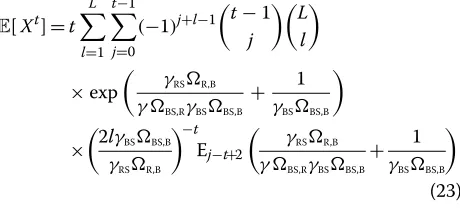
E[X t]= =t L
l=1
t−1
j=0
(−1)j+l−1
t−1 j
L l
×exp
γRSR,B γ BS,RγBSBS,B
+ 1
γBSBS,B
× 2lγBS
BS,B γRSR,B
−t Ej−t+2
γRSR,B γ BS,RγBSBS,B
+ 1
γBSBS,B
,
where BS,B = BS,B
N , N is the number of users in
clus-terB. As only the statistics of interference channel gain
5 10 15 20 25
10−5 10−4 10−3 10−2 10−1 100
SNR (γ) in dB
Outage Probability (p
o
)
Analysis (Lower Bound) Simulation
L=3, M=3
d
BS,B=1, dBS,R=dR,B=dR,A=dBS,A=0.5
d
BS,B=2, dBS,R=dR,B=dR,A=1, dBS,A=0.5
N=1, eq.(13)
N=3, eq.(16)
5 10 15 20 25 1
2 3 4 5 6 7 8 9
SNR (γ) in dB
Ergodic Sum−rate (E[R
sum
])
Analysis (Lower Bound) Simulation
L=3, M=3
dBS,B=1, dBS,A=dBS,R=dR,A=dR,B=0.5
dBS,B=2, dBS,A=0.5, dBS,R=dR,A=dR,B=1 N=3, eq.(30)
N=1, eq.(28)
Figure 4Ergodic sum-rate (E[Rsum]) versus SNR (γ) for two different network configurations.
is changed as given in (15), we can use analysis similar to that used earlier for obtaining the ergodic rate E[RLB
n]. Resultantly, the ergodic sum-rate is given by
E[RLB
sum]=E[R
LB
A]+E[R
LB
B ] . (30)
As we demonstrate in the next section, the ergodic rate (due to interference cancellation) continuously improves with SNR. Also, the ergodic rate can be improved by
increasingL,M, andN. This makes the use of cooperative multiplexing with user/relay selection advantageous.
Numerical and simulation results
In this section, we present numerical results based on the derived analytical expressions along with computer simu-lations, to demonstrate the performance of the considered system. We assume that the normalized distances between nodes dBS,A = dBS,R = dR,A = dR,B = 0.5 with pathloss
1 2 3 4 5 6 7 8 9 10
3 4 5 6 7 8 9 10
Number of nodes (L=M)
Ergodic Sum−rate (E[R
sum
])
Analysis (lower bound) eq.(28) Simulation
γ=15 dB
γ=20 dB
5 10 15 20 25 1
2 3 4 5 6 7 8
SNR (γ) in dB
Ergodic Sum−rate (E[R
sum
])
Analysis (lower bound), eq.(28) Simulation
dR,A=0.5 d
BS,B=2, dBS,R=dR,B=1, dBS,A=0.5
L=3, M=3 dR,A=2
Figure 6Ergodic sum-rate (E[Rsum]) versus SNR (γ) for two network configurations with different distances between the clusters.
exponentα=4, except for the direct channel link from BS to user setB, which is assumed to be unity (dBS,B=1). We obtain the threshold SNR by considering the target data-rateR = 1 bps/Hz requirement for both the users. We use (14) to allocate power in the second phase. The opti-mal power allocation factorsζBSfor various parameters are listed in Table 1. From this, it is observed that when the number of users and relays are equal, the power allocation factor is approximately equal, that is quite intuitive for the considered scenario. It is also notable that BS is allocated
lesser power than the relay in second phase because of interference from BS to user B.
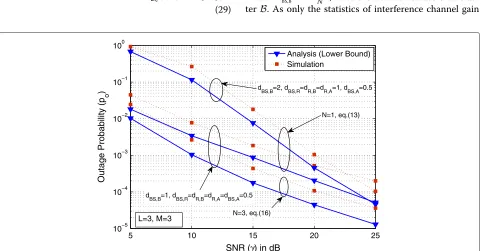
Figure 2 depicts the outage performance (13) of the sys-tem over a range of SNRs γ in dB, and shows that the performance of the considered system can be improved by increasing the number of relays and users (which is quite intuitive). In Figure 3, it can be seen that while per-formance is degraded by increasing the distances between nodes, the crossover at high SNR indicates that perfor-mance is improved due to decreased interference at both
1 2 3 4 5 6 7
4 4.5 5 5.5 6 6.5 7 7.5 8 8.5 9
Number of Relays (L)
Ergodic Sum−rate (E[R
sum
])
Analysis (Lower Bound), eq.(28) Simulation
γ = 20 dB γ = 15 dB
L+M = 8
m ∈ A and n ∈ B. This makes the multiplexing protocol advantageous in large cells. Moreover, we also demonstrate using (16) that scheduling one userBamong large number of users is advantageous over arbitrarily consideration of single user.
We now present the ergodic sum-rate of the system in Figures 4 and 5. Using (30), it is demonstrated that the ergodic sum-rate is improved by using scheduling for user in cluster B. It can be seen that the ergodic sum-rate increases with SNR and increase inLandM, and this gain diminishes with increasingLandMwhen these quantities are large. Figure 6 shows the effect of separation of clus-ters (AandL). Note that a tighter bound is obtained as the distance between these clusters increases. Figure 7 depicts highest ergodic sum-rate for the equal number relay (L) and user in cluster (M) for fixed number of overall nodes.
Conclusion
We analyzed the performance of a cooperative spatial multiplexing scheme with opportunistic user and relay selection over Rayleigh fading channels. Bounds were derived for the outage probability and ergodic sum-rate with the proposed scheme. A simple power control scheme was suggested to improve outage performance. Performance of the protocol was validated by computer simulations and numerical analysis, and the suggested protocol was shown to be advantageous.
Appendix
In this section, we derive the CDF expression ofγ˜m. The SNR of best selected user fromAis given by
˜
γm = max
m∈{1,2,...,M}γ˜m, (31)
whereγ˜m = γBS|hBS,m|2Z+ZV whereV =γRS|hl,m|2. Using the theory of order statistics, the PDF ofZcan be obtained asfZ(z)=Ll=1(−1)l−1
We first note thatZis common to all the nodes in cluster A. Therefore, we first average overVby using itsfV(v)= using ([19], Eq. (5.1.4)), the CDF of (31) can be obtained as
Fγ˜m(y)=1−
This completes the proof.
Competing interests
The authors declare that they have no competing interests.
Acknowledgment
This study was funded by the Department of Science and Technology, Govt. of India (Project no. SR/S3/EECE/031/2008).
Received: 16 February 2012 Accepted: 27 August 2012 Published: 21 November 2012
References
1. J Laneman, D Tse, G Wornell, Cooperative diversity in wireless networks: efficient protocols and outage behavior. IEEE Trans. Inf. Theory.
50(12), 3062–3080 (2004)
2. A Sendonaris, E Erkip, B Aazhang, User cooperation diversity. Part I. System description. IEEE Trans. Commun.51(11), 1927–1938 (2003) 3. A Sendonaris, E Erkip, B Aazhang, User cooperation diversity. Part II.
Implementation aspects and performance analysis. IEEE Trans. Commun.
51(11), 1939–1948 (2003)
4. K Azarian, H El Gamal, P Schniter, On the achievable diversity-multiplexing tradeoff in half-duplex cooperative channels. IEEE Trans. Inf. Theory.
51(12), 4152–4172 (2005)
5. H Yomo, E Carvalho, inIEEE 19th International Symposium on Personal, Indoor and Mobile Radio Communications, 2008. PIMRC 2008. Spectral efficiency enhancement with interference cancellation for wireless relay network, (Cannes, 15-18 September 2008), pp. 1–5
6. B Bandemer, Q Li, X Lin, A Paulraj, in2009 IEEE 70th Vehicular Technology Conference Fall (VTC 2009-Fall). Overhearing-based interference cancellation for relay networks, (Anchorage, AK, 20-23 September 2009), pp. 1–5
7. CDT Thai, P Popovski, Coordinated direct relay transmission with interference cancelation in wireless systems. IEEE Commun. Lett.
15(4), 416–418 (2011)
8. C Zhong, T Ratnarajah, KK Wong, Outage analysis of decode-and-forward cognitive dual-hop systems with the interference constraint in Nakagami-m fading channels. IEEE Trans. Veh. Technol.
60(6), 2875–2879 (2011)
9. O Oyman, inIEEE International Symposium on Information Theory, 2007. ISIT 2007. Opportunism in multiuser relay channels: scheduling, routing and spectrum reuse, (Nice, 24-29 June 2007), pp. 286–290
10. Y Shi, W Zhang, K Ben Letaief, inIEEE International Conference on Communications, 2008. ICC ’08. Cooperative multiplexing and scheduling in wireless relay networks, (Beijing, China, 19-23 May 2008), pp. 3034–3038 11. CK Sung, I Collings, Multiuser cooperative multiplexing with interference
suppression in wireless relay networks. IEEE Trans. Wirel. Commun.
9(8), 2528–2538 (2010)
12. A Bletsas, A Khisti, D Reed, A Lippman, A simple Cooperative diversity method based on network path selection. IEEE J. Sel. Areas Commun.
24(3), 659–672 (2006)
13. P Anghel, M Kaveh, Exact symbol error probability of a Cooperative network in a Rayleigh-fading environment. IEEE Trans. Wirel. Commun.
3(5), 1416–1421 (2004)
14. M Chen, T Liu, X Dong, Opportunistic multiple relay selection with outdated channel state information. IEEE Trans. Veh. Technol.
61(3), 1333–1345 (2012)
16. D da Costa, S Aissa, Capacity analysis of cooperative systems with relay selection in Nakagami-m fading. IEEE Commun. Lett.
13(9), 637–639 (2009)
17. A Papoulis, S Pillai,Probability, Random Variables and Stochastic Processes, 4th edn. (Tata McGraw-Hill Publishing Company, India, 2002) 18. PL Yeoh, M Elkashlan, I Collings, Selection relaying with transmit
beamforming: a comparison of fixed and variable gain relaying. IEEE Trans. Commun.59(6), 1720–1730 (2011)
19. M Abramowitz, IA Stegun,Handbook of Mathematical Functions with Formulas, Graphs, and Mathematical Tables. (Dover, New York, 1964) 20. IS Gradshteyn, IM Ryzhik,Table of Integrals, Series, and Products, 7th edn.
(Academic Press, New York, 2007)
doi:10.1186/1687-1499-2012-345
Cite this article as:Verma and Prakriya:Performance of a cooperative
multiplexing scheme with opportunistic user and relay selection over Rayleigh fading channels.EURASIP Journal on Wireless Communications and Networking20122012:345.
Submit your manuscript to a
journal and benefi t from:
7 Convenient online submission 7 Rigorous peer review
7 Immediate publication on acceptance 7 Open access: articles freely available online 7 High visibility within the fi eld
7 Retaining the copyright to your article

![Figure 4 Ergodic sum-rate (E[ Rsum]) versus SNR (γ ) for two different network configurations.](https://thumb-us.123doks.com/thumbv2/123dok_us/967860.1118799/8.595.57.541.492.713/figure-ergodic-rate-rsum-versus-dierent-network-congurations.webp)
![Figure 6 Ergodic sum-rate (E[ Rsum]) versus SNR (γ ) for two network configurations with different distances between the clusters.](https://thumb-us.123doks.com/thumbv2/123dok_us/967860.1118799/9.595.59.541.491.713/figure-ergodic-versus-network-congurations-dierent-distances-clusters.webp)