R E S E A R C H
Open Access
Adaptive limited feedback for interference
alignment in MIMO interference channels
Yang Zhang
1*, Chenglin Zhao
1,2, Juan Meng
3, Shibao Li
2and Li Li
2Abstract
It is very important that the radar sensor network has autonomous capabilities such as self-managing, etc. Quite often, MIMO interference channels are applied to radar sensor networks, and for self-managing purpose, interference management in MIMO interference channels is critical. Interference alignment (IA) has the potential to dramatically improve system throughput by effectively mitigating interference in multi-user networks at high signal-to-noise (SNR). However, the implementation of IA predominantly relays on perfect and global channel state information (CSI) at all transceivers. A large amount of CSI has to be fed back to all transmitters, resulting in a proliferation of feedback bits. Thus, IA with limited feedback has been introduced to reduce the sum feedback overhead. In this paper, by exploiting the advantage of heterogeneous path loss, we first investigate the throughput of IA with limited feedback in
interference channels while each user transmits multi-streams simultaneously, then we get the upper bound of sum rate in terms of the transmit power and feedback bits. Moreover, we propose a dynamic feedback scheme via bit allocation to reduce the throughput loss due to limited feedback. Simulation results demonstrate that the dynamic feedback scheme achieves better performance in terms of sum rate.
Keywords: MIMO, Interference alignment, Limited feedback, Waterfilling
1 Introduction
The network of radar sensors should operate with mul-tiple goals managed by an intelligent platform network that can manage the dynamics of each radar to meet the common goals of the platform [1, 2], rather than each radar to operate as an independent system. Therefore, it is significant to perform signal design and process-ing, and networking cooperatively within and between platforms of radar sensors and their communication mod-ules [3]. In addition, radar sensor network’s performance can be greatly enhanced by changing the radar’s algo-rithms as the mission changes (mission aware), and it is also very important that the radar sensor network has autonomous capabilities [4, 5]: organizing, self-healing, self-reconfiguring, and self-managing [6], etc. Quite often, MIMO interference channels are applied to radar sensor networks [7], and for self-managing purpose, interference management in MIMO interference channels is critical, especially when the channel conditions are not
*Correspondence: [email protected]
1School of Information and Communication Engineering, BeiJing University of Posts and Telecommunications, Xitucheng Road, 100876 Beijing, China Full list of author information is available at the end of the article
friendly such as foliage environment [8]. In this paper, we study interference alignment in MIMO interference channels.
Interference is one of the key roadblocks to improv-ing the throughput of multi-user wireless networks. By aligning the interference from other users to a lower-dimensional subspace, interference alignment (IA) allo-cates higher dimensional subspace for desired receivers, and achieves the optimal degrees of freedom (DoF). In K-user interference channels, IA is shown to achieve fullK/2 multiplexing gain per time, frequency and antenna dimen-sion [9] . Encouraged by this surprising result, extensive works have proposed various schemes to align interfer-ence at each receiver by novel designed signal structures [10, 11].
For most of IA approaches, perfect CSI is assumed to be available at all transceivers. As is well known, CSI can be obtained at transmitters through the reciprocity between forward and reverse channels in time division duplex (TDD) systems. However, in frequency division duplex (FDD) systems, CSI is sent from receivers to trans-mitters via feedback links, whose data rate is often severely limited. This issue of IA with limited feedback in MIMO
networks is widely researched in the work [12] and its references.
The throughput loss of IA technology due to limited feedback of MISO frequency selected channel is first investigated in [13], and this work is extended to MIMO frequency selected channel in [14]. For an interference channel withNantennas per user and the transmit power P, the works in [13] and [14] show that each user achieves the optimal DoF while the channel coherence time is large and the feedback rate at least(N2−1)log2P. The effective DoF achieved by IA is studied in [15] when both chan-nel estimation and CSI limited feedback are taken into consideration. Based on the closed-form solution of trans-mit precoders for a special interference channel, a novel feedback topology for IA has been designed in [16], and it reduces feedback overhead significantly compared with conventional feedback frameworks.
Grassmannian codebooks are widely used to quan-tize the CSI [13–15]. It has been well-known that the Grassmannian codebooks are optimal for independent identically distributed channels, but it is challenging to design the optimal codebooks except for some special cases. Therefore, it is impractical to use Grassmannian codebooks for limited feedback [17, 18]. Random vector quantization (RVQ) codebooks, which consist of inde-pendent isotopically distributed unit norm vectors, are proposed to reduce the design complexity in [19] and [20]. For moderate size codebooks, RVQ codebooks per-form close to the Grassmannian codebooks for wire-less channels with independent identically distributed gain. An IA scheme with RVQ-based quantized trans-mit precoders for MIMO interference channel is proposed in [21].
It is noteworthy that, in previous works, the CSI from different interfering transmitters is quantized with sym-metric codebooks. Intuitively, if the interfering links have different path loss, they should not be quantized with the same amount of bits. To exploit the potential advantage of heterogeneous path loss, the works [16] and [22] propose dynamic quantization schemes via bit allocations. They adaptively allocate the number of feedback bits under the constraints of total feedback bits for whole systems. However, these works only investigate systems while each user transmits only single stream simultaneously, and the assumption of all receivers’ cooperation is impractical in downlink networks. In this paper, we extend these investi-gations from single stream to multi streams for each user without cooperation between receivers. We first evaluate the throughput loss of IA due to limited feedback. On this basis, we optimize the receivers bit allocation scheme to decrease the throughput loss by exploiting the advantage of heterogeneous path loss.
The rest of this paper is organized as follows. In Section 2, the system model is introduced. In Section 3,
the throughput loss is analyzed and an optimal bit allocation scheme is addressed. Simulation results are pro-vided in Section 4, and the conclusions are given in the last section.
Notations:The superscriptsT,H and∗denote transpo-sition, Hermitian transpose and element-wise conjugate, respectively. E[•] stands for the expectation operator. Lower-case and upper-case bold-face letters are used to vectors and matrices, respectively.tr(A)is the trace of the matrixA.|x|is the absolute value of the complex scalarx andAFis the Frobenius norm of the matrixA.
2 System model
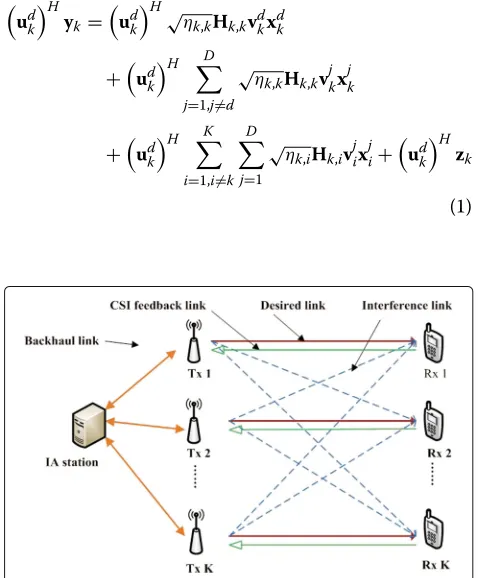
As shown in Fig. 1, we consider a K-user MIMO inter-ference channel. For simplicity, we investigate the case of the homogeneous network where each transmitter and receiver is equipped withNantennas, respectively. Thus, each transmitter delivers D(D ≤ N) independent data streams to its corresponding receiver and provided that IA remains feasible.
Considering a block fading channel model, in which channels are drawn independently across all users and antennas, and remain fixed for a constant interval. Under the assumption of perfect CSI at the transmitters, the sam-pled baseband signal at receiverkfor thed-th data stream can be written as
udk
H
yk =
udk
H√
ηk,kHk,kvdkxdk
+udk
H D j=1,j=d
√η
k,kHk,kvjkx j k
+udkH
K
i=1,i=k D
j=1
√η
k,iHk,ivjix j i+
udkHzk
(1)
Wherexk =
x1k,· · ·xDkTdenotes data symbols, and the symbols inxkare assumed to be independently generated
with unit variance.zk ∈CD×1is the additive white
Gaus-sian noise vector observed at receiverk.Vi =
the channel from transmitterito receiverk, whileHk,iis
the small scale fading of channel. Each entity ofHk,i are
assumed to be independently and identically distributed complex Gaussian random variables with zero mean and unit variance. And, we only pay attention to the feed-back of small scale fadingHk,i. For path loss, we choose
a model for outdoor to indoor and pedestrian test envi-ronment recommended by Radiocommunication Sector of the International Telecommunication Union (ITU-R). The path loss is given by:
ηk,i=40 log10rk,i+30 log10f +49[ dB] (2)
whererk,iis the distance from transmitterito receiverk.
With perfect CSI, the precoding vectors should satisfy [2]
Therefore, the throughput of system with perfect CSI is
R=
From above equations, CSI must be acquired and exchanged through channel estimation, quantization and feedback. The details are shown in [10] and [17]; we will not repeat it.
It is noteworthy that, in downlink networks, there is no coordinate node connected with receivers via high capac-ity backhaul links. At each receiver k, the CSI{Hk,i}from
transmitterito receiverkare quantized to be{ ¯Hk,i}using
a local codebook. The quantized codeword indexes are then fed back to the transmitterjvia fixed rate feedback channels. The feedback bit rate derived in this paper tar-gets a periodic feedback protocol, which is more suitable
for existing communication standards such as 3GPP-LTE, where a fixed number of bits in each data block of reverse links are allocated for CSI feedback. For simplify, we assume Bf feedback bits per data block to be delivered
from each receiver. As illustrated in Fig. 1, we assume that there is an IA station with backhaul connections to all the transmitters. The IA station performs IA schemes based on global CSI collected from transmitters, and then dis-tributes precoding matrices and receiving filter matrices to all transmitters. With the quantized CSI{ ¯Hk,i}, the IA
station calculates the precoding vectors{¯vi}, yielding
⎧ vectors which designed for quantized channels. Thus, we have
The throughput of system employ IA technology with limited feedback is:
where ¯Ikd,1 is the intra-user interference from the trans-mitter k, and is the inter-user interference from other transmitters, as shown as the follows
¯
3 Dynamic feedback bit allocation
To minimize the throughput loss due to limited feedback, dynamic feedback-bit allocation strategies that adaptively distribute the number of feedback bits to each pair of links are introduced in [11] and [17]. However, a cen-tralized bit controller is assumed to gather channel gains from all receivers and computes the number of feedback-bits for each link. It is impractical for downlink networks. In this section, we allocate the feedback-bits among the interfering links of each receiver but not all receivers with-out receiver cooperation. We first introduce the principle of CSI quantization. Then, we investigate the throughput loss in the feedback topology proposed in the previous section. Finally, we introduce the dynamic feedback bit allocation strategy.
3.1 CSI Quantization
Take the example of receiverk, we describe the process of CSI quantization briefly. We denoteBas the number of feedback bits forHk,i. The receiverkfirst expands the CSI
Hk,iinto a vectorhk,i, which is quantized based on a local
where ωm is of unit-norm, the size of codebook is
2B, dist(hk,i,ωm) =
1− |hHk,iωm|2 denotes the chordal
distance between vectors hk,i and ωm. the quantizing
result is the codeword indexe which has the minimize distance between vector hk,i in codebook C. It is found
and fed back to the transmitterk. As a result, the quan-tized CSIH¯k,iis obtained by reshape the codeword which
obtained from codebook with the received index.
To characterize the performance loss of the IA with limited feedback, we introduce an upper bound of the throughput loss as a function of the number of feedback bits. Using the quantized CSIH¯k,i , the CSIHk,i can be
decomposed as [23]
Hk,i=cosθk,iH¯k,i+sinθk,iHk,i (11)
where the principal angles are defined as θi =
arccosHHk,iH¯k,i, andHk,iis the error vector due to the
quantization withHk,iF= ¯Hk,iF=1.
3.2 Throughput loss analysis
For the limited feedback systems, both intra-user inter-ference and inter-user interinter-ference cannot be eliminated perfectly so that the residual interference degrades the throughput of systems. We denote the rate loss for thedth stream of thekth receiver asRdk = E[Rdk − ¯Rdk] . Then, the throughput loss is upper-bounded as below:
Rdk =E ing the quantized CSI by the same IA scheme, (b) follows from the fact thatI¯kd,1 >0,¯Ikd,2 >0 and log2(·)is a mono-tonically increasing function, (c) follows the fact thatHk,k
andH¯k,k are independently distributed, (d) uses Jensen’s
inequality.
For inter-user interference of thedth stream of thekth receiver, we can rewrite (9) as
¯
Where (e) comes from the fact of (11), (f ) follows the fact that (u¯dk,v¯ji) is designed based on quantized
Thus, we can rewrite (14) as
¯ isotropic unit vector on the(N2−1)dimensional hyper-plane orthogonal to vecH¯k,i
H
. Moreover, vecHk,i
H
is the quantization distortion distributed in the same (N2 − 1)-dimensional null space of vecH¯k,i
the expected inter-user interference of thedth stream of thekth receiver can be obtained as
E
feedback bits for link from transmitter i to receiver j,(¯ N2) =(1/(N2−1))/(N2−1), and(x)represents the gamma function ofx. Substituting above results into (16), we have
Therefore, the expectation of sum interference to noise ratio for thedth stream ofkth receiver is given by
E
From (12), we have
Rdk ≤log2 1+
Thus, the rate loss of thekth receiver can be written as
3.3 Feedback-bits allocation
As shown in (22), given transmit power, antenna num-bers and feedback bits, we can obtain the upper bound of throughput loss. Hence, the result is useful for the design, analysis, and optimizations of the MIMO interference channels. It is obvious that allocating the same amount feedback bits for all links may degrade the rate of users. Motivated by the above observations, we consider that the different links might have different fading gain with heterogeneous path loss in this subsection to minimize the upper-bound of sum leakage interference and improve the throughput for each receiver. Based on the through-put loss analysis in the previous subsection, we perform dynamic feedback-bits allocation at each receiver in order to minimize the rate loss of each user by exploiting the heterogeneity of path loss. Moreover, the feedback-bits that minimize the sum residual interference also minimize the rate loss ofkth user since the log2(·)is monotonically increasing. Specifically, we need to determine the optimal feedback-bits to minimize the sum residual interference of each receiver using the following optimization.
Problem 1Dynamic feedback-bits allocation for the kth receiver
min k
K
i=1
ak,i2−
Bk,i N2−1
(23)
s.t.
K
i=1
Bk,i≤Bf (24)
Where k = {Bk,1,· · ·,Bk,K}, and Bk,1,· · ·,Bk,K are
non-negative integers.
In order to solve the problem 1, we formulate the lagrangian with multiplier γ, and take derivative with respect to Bk,iandγ. Then, we get
L=
K
i=1
ak,i2−Bk, i N2−1
+γ
K
i=1
Bk,i−Bf
!
(25)
and
∂L ∂Bk,i = −
ak,iln 2
N2−12 − Bk,i
N2−1 +γ =0 (26)
∂L ∂γ =
K
i=1
Bk,i−Bf =0 (27)
From (26), we can get
Bk,i=(N2−1)
log2
ak,i
N2−1
+b
(28)
Whereb = log2(ln 2/γ ). Combine (28) and (24) with Bk,i ≥ 0. The number of optimal feedback-bits as the
optimal solution to problem 1 is obtained as
Bk,i=(N2−1)
log2
ak,i
N2−1
+ ˆb
(29)
Where bˆ satisfies %Kk=1Bk,i = Bk, and [x]+ implies
that [x]+=max(x, 0). the solution of (29) could be found through the famous waterfilling algorithm, to avoid repe-tition, it is not described in this paper. For more details, one may refer to [17]. It is noteworthy that the num-ber of feedback-bits should be integer, then the optimal feedback-bits are determined as the nearest integer to them.
4 Simulation results
In this section, we evaluate the performance of the pro-posed scheme in term of the throughput by simulation. We focus on a three-hexagonal, multi-cell layout while each hexagonal containing a transmitter near its center, and a receiver locate the edge of cell. The distance between transmitter and its desired receiver distribute randomly between 0.8 ∗r and r, where r is the radius of inscribed circle of hexagon and is assumed to be 400 m. We evaluate the sum rate by mean of a Monte-Carlo simulation (averaging over 1000 realiza-tions) with random generated small-scale fadingHk,iand
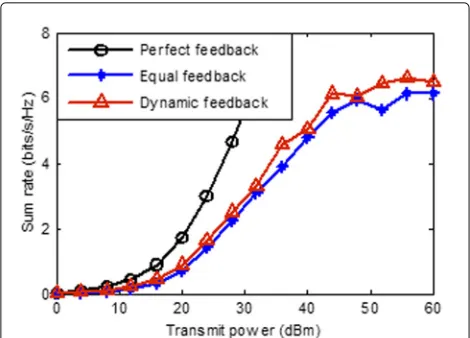
the location of receivers. The path loss is determined by the model shown in (2) and the noise power is given by -113 dBm. We compare the mean sum rates obtained using three different CSI feedback schemes, perfect feedback, equal feedback and proposed dynamic feed-back, as a function of the transmit power for the cases K = 3,N = 2,d = 1;K = 3,N = 4,d = 2 and K = 3,N = 4,d = 2, respectively. The total number of feedback-bits for each receiver is set to 20.
First, we compare the sum of average rate of three CSI feedback schemes withK = 3,N = 2,d = 1. As seen in Fig. 2, the sum rate loss is small when the transmit power is lower than 40 dBm, this is because that the sum residual interference is too small to degrade the rate of receivers. However, when the transmit power is larger than 40 dBm, the throughput loss due to the limited feedback is signifi-cant. It is shown that our proposed dynamic feedback-bits allocation scheme have decided advantage over the equal feedback-bits allocation. This is because of that the sum residual interference is reduced by our proposed dynamic feedback-bits allocation scheme, and that increase with transmit power.
Fig. 2Average sum rate vs transmit power withN=2,d=1,K=3
perfect feedback scheme. The difference is that the inter-ference is more complex than last simulation, the benefit of the proposed dynamic feedback scheme is larger than last simulation. it is obviously that the average sum rate is also limited by the strong interference when the transmit power is larger than 40 dBm.
Finally, we investigate the performance of three CSI feedback schemes. It is obvious that the performance in Fig. 4 is much less than in Figs. 2 and 3, this is because the intra-user residual interference is much more than inter-user residual interference when dof is more than 1, and that reduces the system performance seriously. Hence, it is important for each user to select the optimal number of degree of freedom from the perspective of performance. This problem will be investigated in my future works.
5 Conclusions
In this paper, we consider MIMO interference channel with heterogeneous path loss and derive the performance
Fig. 3Average sum rate vs transmit power withN=4,d=1,K=3
Fig. 4Average sum rate vs transmit power withN=4,d=2,K=3
of IA under limited feedback. Using the derived upper bound, we proposed a dynamic feedback bit allocation scheme to adapt to the path loss. We analyze the per-formance bounds under the proposed dynamic feedback scheme, in terms of the transmit power. Simulation results show that the proposed scheme enhance feedback effi-ciency.
Acknowledgements
This work was supported by NSFC(No.61471056), the Shandong Provincial Natural Science Foundation, China (No.ZR2015FL002, No.2014BSE28044), the Fundamental Research Funds for the Central Universities, China
(No.15CX02048A, No.15CX05025A).
Competing interests
The authors declare that they have no competing interests.
Author details
1School of Information and Communication Engineering, BeiJing University of
Posts and Telecommunications, Xitucheng Road, 100876 Beijing, China. 2College of Computer and Communication Engineering, China University of
Petroleum, Changjiang West Road, 266580 Qingdao, China.3Department of Disaster Prevention Instrument, Institute of Disaster Prevention, Xueyuan Road, 065201 Sanhe, China.
Received: 8 June 2016 Accepted: 8 September 2016
References
1. Q Liang, Automatic target recognition using waveform diversity in radar sensor networks. Pattern Recogn. Lett.29(3), 377–381 (2008)
2. Q Liang, Situation understanding based on heterogeneous sensor networks and human-inspired favor weak fuzzy logic system. IEEE Syst. J.
5(2), 156–163 (2011)
3. Q Liang, X Cheng, S Huang, D Chen, Opportunistic sensing in wireless sensor networks: theory and application. IEEE Trans. Comput.63(8), 2002–2010 (2014)
4. Q Liang, X Cheng, SW Samn, New: network-enabled electronic warfare for target recognition. IEEE Trans. Aerosp. Electron. Syst.46(2), 558–568 (2010) 5. Q Liang, X Cheng, Kups: knowledge-based ubiquitous and persistent
sensor networks for threat assessment. IEEE Trans. Aerosp. Electron. Syst.
44(3), 1060–1069 (2008)
7. L Xu, Q Liang, Zero correlation zone sequence pair sets for mimo radar. IEEE Trans. Aerosp. Electron. Syst.48(3), 2100–2113 (2012)
8. Q Liang, Radar sensor wireless channel modeling in foliage environment: Uwb versus narrowband. IEEE Sensors J.11(6), 1448–1457 (2011) 9. VR Cadambe, SA Jafar, Interference alignment and degrees of freedom of
the K-user interference channel. IEEE Trans. Inf. Theory.54(8), 3425–3441 (2008). doi:10.1109/TIT.2008.926344. 0707.0323.
10. K Gomadam, VR Cadambe, SA Jafar, A distributed numerical approach to interference alignment and applications to wireless interference networks. IEEE Trans. Inf. Theory.57(6), 3309–3322 (2011). doi:10.1109/TIT.2011.2142270
11. SW Peters, RW Heath, Cooperative algorithms for MIMO interference channels. IEEE Trans. Veh. Technol.60(1), 206–218 (2011). doi:10.1109/TVT.2010.2085459
12. DJ Love, RWH Jr, S Member, VKN Lau, D Gesbert, S Member, BD Rao, M Andrews, An overview of limited feedback in wireless communication systems. IEEE J. Sel. Areas Commun.26(8), 1341–1365 (2008)
13. J Thukral, B Helmut, inIEEE International Symposium on Information Theory (ISIT). Interference Alignment with Limited Feedback (IEEE, Seoul, 2009), pp. 1759–1763
14. RTT Krishnamachari, MKK Varanasi, Interference alignment under limited feedback for MIMO interference channels. Inf. Theory Proc. (ISIT), 2010 IEEE Int. Symp.61(15), 619–623 (2010). doi:10.1109/ISIT.2010.5513544 15. B Xie, S Member, Y Li, S Member, inIEEE Global Communications
Conference (GLOBECOM). Interference Alignment under Training and Feedback Constraints (IEEE, Houston, 2011), pp. 1–6
16. S Cho, K Huang, DK Kim, VKN Lau, H Chae, H Seo, B-h Kim, Feedback-topology designs for interference alignment in MIMO interference channels. IEEE Trans. Sig. Process.60(12), 6561–6575 (2012) 17. P Xia, S Zhou, GB Giannakis, Achieving the Welch bound with difference
sets. IEEE Trans. Inf. Theory.51(5), 1900–1907 (2005). doi:10.1109/TIT.2005.846411
18. JH Conway, RH Hardin, NJA Sloane, Packing lines, planes, etc.: Packings in Grassmannian Spaces. Exp. Math.5(2), 139–159 (1996).
doi:10.1080/10586458.1996.10504585
19. JC Roh, BD Rao, Transmit beamforming in multiple-antenna systems with finite rate feedback: a VQ-based approach. IEEE Trans. Inf. Theory.52(3), 1101–1112 (2006)
20. W Santipach, ML Honig, A Given, capacity of a multiple-antenna fading channel with a quantized precoding matrix. IEEE Trans. Inf. Theory.55(3), 1218–1234 (2009)
21. H-H Lee, Y-C Ko,Interference Alignment with Random Vector Quantization for MIMO Interference Channels. 2012 IEEE Vehicular Technology Conference (VTC Fall). (IEEE, Québec, 2012), pp. 1–5. doi:10.1109/VTCFall.2012.6399166 22. X Rao, L Ruan, VKN Lau, Limited feedback design for interference
alignment on MIMO interference networks with heterogeneous path loss and spatial correlations. IEEE Trans. Signal Process.61(10), 2598–2607 (2013). doi:10.1109/TSP.2013.2252168
23. W Dai, YE Liu, B Rider, HE Grassmann, Quantization bounds on Grassmann manifolds and applications to MIMO communications. IEEE Trans. Inf. Theory.54(3), 1108–1123 (2008)
Submit your manuscript to a
journal and benefi t from:
7Convenient online submission 7Rigorous peer review
7Immediate publication on acceptance 7Open access: articles freely available online 7High visibility within the fi eld
7Retaining the copyright to your article