Cite as: Can Urol Assoc J 2018;12(2):38-43. http://dx.doi.org/10.5489/cuaj.4528
Published online December 1, 2017
See related commentary on page 44
Abstract
Introduction: There is concern that surgical quality initially declines
during the learning phase of robotic surgery. At our institution, we used a multi-surgeon programmatic approach to the introduction of robotic surgery. The purpose of this study was to evaluate outcomes of patients treated during the first year of our program.
Methods: This is a historical cohort of all radical prostatectomy
patients during a one-year period. Baseline, perioperative, and long-term followup data were prospectively and retrospectively collected. Treatment failure was a composite of any postopera-tive radiation, androgen-deprivation, or prostate-specific antigen (PSA) ≥0.2.
Results: During the study period, 225 radical prostatectomy
pro-cedures were performed (104 robotic and 121 open). Baseline characteristics were similar between groups (p>0.05). All patients were continent and 74% were potent prior to surgery. Mean esti-mated blood loss (280 cc vs. 760 cc; p<0.001) and blood trans-fusion (0% vs. 8.3%; p=0.002) was lower in the robotic cohort. Non-transfusion complications were similar between groups (13% vs. 12%; p=0.7). Mean hospital stay was shorter in the robotic cohort (1.4 vs. 2.5 days). There was no difference in overall positive margin rate (38% vs. 43%; p=0.4) or treatment failure at a median followup of 3.5 years (p=0.4). Robotically treated patients were more often continent (89% vs. 77%; p=0.02) and potent (48% vs. 32%; p=0.02).
Conclusions: Using an inclusive multi-surgeon approach, robotic
pros-tatectomy was introduced safely at a Canadian academic institution.
Introduction
Robotic assisted laparoscopic radical prostatectomy (RALRP) has gained popularity for the surgical treatment of prostate
cancer. Advantages of the robotic approach include bet-ter surgeon ergonomics, improved visualization, and easier instrumentation compared to pure laparoscopy. RALRP may result in less blood loss, fewer blood transfusions, less time in hospital, and quicker recovery with equivalent cancer outcomes and long-term quality of life compared to an open
surgical approach.1-6 Disadvantages of robotic prostatectomy
is the higher cost per case, and potentially the learning curve associated with adoption of a new surgical procedure.
Hospitals may offer only open or robotic surgery while others offer both based on surgeon preference and resource availability. Over the last decade, the use of RALRP has increased in many jurisdictions. In the U.S., a robotic approach increased from approximately 1% of patients in
2001 to 70% by 2012.7,8 In contrast to the rapid uptake of
robotic surgery in the U.S., uptake in Canada has been much slower. The proportion of cases being performed robotically
in Canada was 19% in 2012‒2013.9 Presumably, the cost
of robotic surgery will decrease over time and more centres in Canada will develop a robotic surgery program and offer this surgical option to prostate cancer patients.
There is no standard method to optimally implement a robotic surgery program. Some centres may limit the num-ber of surgeons who perform robotic surgery, while others may adopt a more inclusive, multi-surgeon approach. At our institution, the robotic surgery program was introduced using a multi-surgeon approach. We believed that inclusion of multiple surgeons would allow for a more rapid program expansion and we hoped there would not be a negative impact on patient outcomes. In this study, we report the outcomes of patients receiving robotic surgery during the first year of implementation of our multi-surgeon robotic surgery program compared to patients over the same time period treated with open prostatectomy.
Joshua Montroy, MSc
1; Ehab Elzayat, MD
2; Chris Morash, MD
2;
Brian Blew, MD
2; Luke T. Lavallée, MD
1,2;
Ilias Cagiannos, MD
2; James Watterson, MD
2; Jeffrey S. Oake, MD
2; Michael FungKeeFung, MD
3;
Calvin Thompson, MD
4; Robert Weber
5; Rodney H. Breau, MD
1,21The Ottawa Hospital Research Institute; 2Division of Urology, Department of Surgery, The Ottawa Hospital, University of Ottawa; 3Department of Gynecology, The Ottawa Hospital, University of Ottawa; 4Department of Anesthesiology and Pain Medicine, The Ottawa Hospital, University of Ottawa; 5Department of Nursing, The Ottawa Hospital; Ottawa, ON, Canada
Methods
Clinical setting
Institutional ethics review board approval was obtained. This was a historical cohort of prospectively collected data for all patients who underwent radical prostatectomy (open or robotic) from October 31, 2011 to October 31, 2012 at our institution. The surgeons performing RALRP included one with robotic surgery fellowship training (RB), two expe-rienced in laparoscopic prostatectomy (BB, JW), and one experienced in open prostatectomy but with no laparoscopic experience (CM). All surgeons performing open prostatec-tomy had oncology fellowship training (RB, IC, CM) or were highly experienced with this procedure (FD, RG, JM, JO, and JW). No criteria were used to select patients for RALRP or open prostatectomy. The choice of which procedure was performed was based on who operated on the patient and resource availability. Since the wait times were generally longer for RALRP, higher-risk patients may have more fre-quently received open prostatectomy to reduce their wait time to surgery.
All surgeons performing RALRP attended a training ses-sion at an Intuitive Surgical training facility prior to the first case. The robotic-trained urologist mentored the other sur-geons until both the mentor and the mentee were confident that routine mentoring was no longer required. A common anesthesia pathway was used, but no specific anesthesiol-ogy training or anesthesiologist was required. The nursing team leader (RW) received training at an Intuitive Surgical training facility and he subsequently trained the remain-der of the nursing team. All patients followed a common perioperative care pathway. All surgeons followed similar surgical steps using standardized instruments and sutures. All RALRPs were performed using the da Vinci surgical robot system (Intuitive Surgical, Sunnyvale, CA, U.S.) and a trans-peritoneal approach.
Baseline characteristics
Preoperative characteristics, including patient age, body mass index (BMI), preoperative prostate-specific anti-gen (PSA), prostate volume, patient American Society of Anesthesiologists (ASA) class, PSA density, prostate volume, preoperative erectile function, digital rectal exam (DRE) result, biopsy Gleason score, number of positive cores, and tumour grade, were abstracted from the medical record.
Surgery characteristics
Intraoperative parameters, such as the estimated blood loss (EBL), number of nodes removed, nerve-sparing technique,
operative time, intraoperative complications, and positive margin status, were prospectively recorded in a database.
Postoperative outcomes
Postoperative complications until discharge were collected from the medical record. Postoperative complications were
classified by their severity based on the Clavien-Dindo scale.10
The Clavien-Dindo classification system is used to grade the severity of adverse events that occur as a result of surgical procedures. More details on this classification system can be found online (http://www.surgicalcomplication.info/index-2. html). As part of the clinical pathway, all robotic patients had pelvic drain fluid analyzed for creatinine irrespective of symptoms and output volumes. Open prostatectomy patients did not have routine drain creatinine analyzed unless the drain output was high. Patients were typically seen at least three, six, nine, 12, 18, 24, and 36 months postoperatively and oncological and functional outcomes were recorded at
each visit. Biochemical failure was defined as PSA ≥0.2. If
postoperative radiation or androgen deprivation was initi-ated, the date of therapy commencement was recorded. A composite outcome of primary treatment failure was defined
as one or more of: a postoperative PSA ≥0.2, postoperative
radiation, or postoperative androgen deprivation.
Data analysis
Baseline characteristics and outcomes of patients receiving open and robotic surgery were summarized and compared using descriptive statistics. Treatment failure-free survival was calculated from surgery to any of the composite endpoint events. Patients were censored at last followup or death. The Kaplan-Meier method was used to estimate survival, and a log-rank test was used to test for differences in the treatment failure-free survival between groups. Univariable and mul-tivariable cox proportional hazard regression was used to estimate hazard ratios of cancer recurrence associated with the surgical approach, preoperative PSA levels, pathologi-cal Gleason score, and pathologipathologi-cal tumour stage. A p value <0.05 was considered significant. No adjustment was made for multiple testing and all analyses were performed using SAS (SAS Institute Inc., Cary, NC, U.S.). To encourage participation
of all surgeons, it was decided a priori that no analysis would
be performed comparing results between individual surgeons.
Results
Patient characteristics
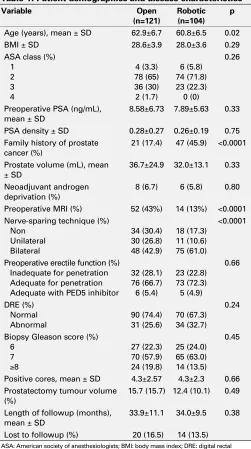
121 were performed using an open approach. The number of cases for each surgeon in the robotic groups was 36, 34, 30, and 4. The number of cases for each surgeon in the open group was 30, 29, 28, 12, 10, 8, 3, and 1. The patients in the robotic cohort were slightly younger and more frequently had a family history of prostate cancer (Table 1). Fewer robotically treated patients received a preoperative magnetic resonance imaging (MRI) and more received a nerve-sparing procedure (p<0.001). The mean preoperative PSA in the entire cohort was 8.3±6.2 ng/ml and mean prostate volume was 34.5±20.3 cc. The biopsy Gleason score was 6 in 52
(22.3%), 7 in 135 (57.9%), and ≥8 in 38 (19.8%) patients.
Incomplete followup was similar between groups, with 20 (16.5%) patients lost to followup in the open group and 14 (13.5%) in the robotic group.
Surgical parameters
Surgical outcomes are presented in Table 2. The operating room time was similar between groups (p=0.10). The blood loss was 278.7 ±220.1 ml in the robotic group compared to 756.8 ±451.8 ml in the open group (p<0.0001). No patients in the robotic group required a blood transfusion compared to 10 (8.3%) patients in the open group (p=0.002). Among the 10 patients receiving a transfusion in the open cohort, an average of 2.1±1.0 units of blood was transfused (median 2,
range 1‒3). The number of lymph nodes dissected was
simi-lar between groups (p=0.19). Other than blood transfusion, there were no intraoperative complications in either cohort and no patients were converted from a robotic approach to open. The risk of a non-transfusion-related postoperative complication was 12.4% overall, 11.6% in the open group Table 1. Patient demographics and disease characteristics
Variable Open
(n=121)
Robotic (n=104)
p
Age (years), mean ± SD 62.9±6.7 60.8±6.5 0.02
BMI ± SD 28.6±3.9 28.0±3.6 0.29
ASA class (%)
Preoperative PSA (ng/mL), mean ± SD
8.58±6.73 7.89±5.63 0.33
PSA density ± SD 0.28±0.27 0.26±0.19 0.75
Family history of prostate cancer (%)
21 (17.4) 47 (45.9) <0.0001
Prostate volume (mL), mean ± SD
36.7±24.9 32.0±13.1 0.33
Neoadjuvant androgen deprivation (%)
8 (6.7) 6 (5.8) 0.80
Preoperative MRI (%) 52 (43%) 14 (13%) <0.0001 Nerve-sparing technique (%)
Preoperative erectile function (%) Inadequate for penetration Adequate for penetration Adequate with PED5 inhibitor
32 (28.1)
Biopsy Gleason score (%) 6
Positive cores, mean ± SD 4.3±2.57 4.3±2.3 0.66 Prostatectomy tumour volume
(%)
15.7 (15.7) 12.4 (10.1) 0.49
Length of followup (months), mean ± SD
33.9±11.1 34.0±9.5 0.38
Lost to followup (%) 20 (16.5) 14 (13.5)
ASA: American society of anesthesiologists; BMI: body mass index; DRE: digital rectal exam; MRI: magnetic resonance imaging; PED5: phosphodiesterase type-5; PSA: prostate-specific antigen; SD: standard deviation.
Table 2. Operative characteristics and adverse events Open
(n=121)
Robotic (n=104)
p
OR time, minutes ± SD 270.82±65.9 282.7±63.2 0.10
Transfusion (%) 10 (8.3) 0 (0) 0.002
Estimated blood loss, mL ± SD
756.8±451.8 278.7± 220.1
<0.0001
Length of stay, mean days ± SD
2.5±0.9 1.4±0.7 <0.0001
Lymph nodes dissected ± SD 7.4±6.2 6.04±4.5 0.19 Total postoperative
and 13.5% in the robotic group. No patients had a Grade 4 or 5 complication. Five (5%) robotic patients had a Grade 3 complication compared to nine (7%) open patients. Eight patients had anastomotic leak, six (6%) in the robotic group compared to two (2%). Six were treated conservatively with no intervention, and two were treated with prophylactic antibiotics, both of whom were in the robotic group. Two patients in the open group and two patients in the robotic group were diagnosed with a postoperative urinary tract infection. No patient in the robotic group experienced a bladder neck contracture compared to six patients (5%) in the open group. Other documented complications included hiatal hernia exacerbation, incision seromas, lymphoceles, meatal stenosis, and wound infections. The mean hospital stay was 1.4±0.7 days in the robotic group compared to 2.5±0.9 days in the open group (p<0.0001).
Oncological outcomes
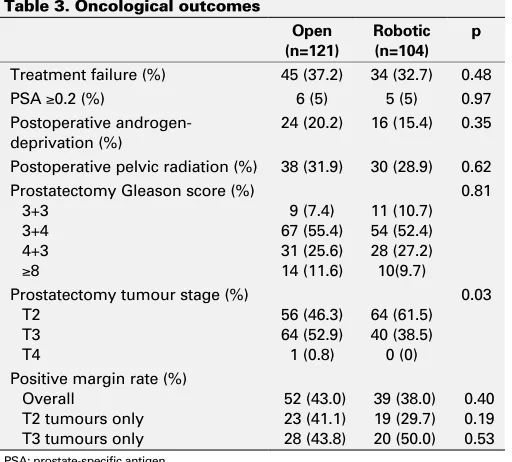
Oncological outcomes are presented in Table 3. The pros-tatectomy pathology specimen showed Gleason score 3+3,
3+4, 4+3 and ≥8 to be comparable between groups (p=0.81).
The risk of a positive surgical margin was similar between groups (p=0.4). No significant difference was observed when patients were stratified by pT2 or pT3 tumours. The risk of cancer recurrence (p=0.48), the number of patients
having a 36-month PSA ≥0.2 (p=0.97), and the number of
patients requiring postoperative hormonal (p=0.35) or radia-tion (p=0.62) therapy was comparable between groups. The overall three-year treatment failure-free survival using the composite endpoint was 62.0%, with no statistical difference between the two cohorts (p=0.53) (Fig. 1). Preoperative PSA,
prostatectomy tumour stage, and prostatectomy Gleason score were significantly associated with an increased risk of cancer recurrence (Table 4). The surgical approach was not predictive of cancer recurrence.
Functional outcomes
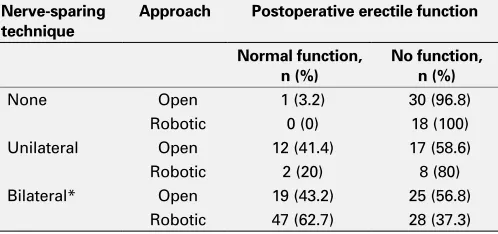
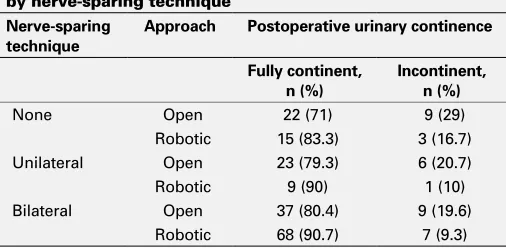
Preoperative erectile function was slightly higher in the robotic cohort (77% vs. 72% able to achieve penetration). At last followup, more patients had erectile function adequate for penetration in the robotic group (48% vs. 32%; p=0.02) (Table 5). When stratified by nerve-sparing technique, of the patients who underwent a bilateral nerve-sparing pro-cedure, a higher proportion of patients in the robotic group had adequate postoperative erectile function (p=0.04) (Table 6). At last followup, almost 90% of patients in the robotic group were fully continent compared to 77.4% of patients in
the open group (p=0.02). When stratified by nerve-sparing
technique, similar associations were observed (Table 7).
Discussion
At our institution, we adopted a programmatic approach and assembled a core team of surgeons, nurses, administrators, and anesthetists who were dedicated to the initiation of the program and who consistently attended planning meetings, training sessions, and actual walk-through surgical rehears-als prior to the first case being done. All surgeons completed a standardized set of robotic surgical simulation programs on the da Vinci simulator and we included multiple surgeons with a consistent surgical team with the aim of mitigating some of the potential concerns with the learning phase of
new technology.11
The present study reports three-year followup data on 225 patients who had prostatectomy performed during the Table 3. Oncological outcomes
Open (n=121)
Robotic (n=104)
p
Treatment failure (%) 45 (37.2) 34 (32.7) 0.48
PSA ≥0.2 (%) 6 (5) 5 (5) 0.97
Postoperative androgen-deprivation (%)
24 (20.2) 16 (15.4) 0.35
Postoperative pelvic radiation (%) 38 (31.9) 30 (28.9) 0.62 Prostatectomy Gleason score (%)
3+3 3+4 4+3
≥8
9 (7.4) 67 (55.4) 31 (25.6) 14 (11.6)
11 (10.7) 54 (52.4) 28 (27.2) 10(9.7)
0.81
Prostatectomy tumour stage (%) T2
T3 T4
56 (46.3) 64 (52.9) 1 (0.8)
64 (61.5) 40 (38.5) 0 (0)
0.03
Positive margin rate (%) Overall
T2 tumours only T3 tumours only
52 (43.0) 23 (41.1) 28 (43.8)
39 (38.0) 19 (29.7) 20 (50.0)
0.40 0.19 0.53
PSA: prostate-specific antigen.
Survival
Open Robotic
Log-rank test p=0.53
Open 121 (0) 78 (36) 66 (40) 43 (43) 0 (48)
Robotic 104 (0) 75 (25) 64 (27) 34 (31) 0 (34)
Time (years) 1.0
0.8
0.6
0.4
0.2
0.0
0 1 2 3 4
first year of our robotic surgery program, 104 of which were performed robotically. We had permissive inclusion crite-ria, as is reflected in the similar baseline characteristics. Reassuringly, we did not observe worse cancer outcomes in RALRP patients compared to those treated by experienced surgeons using an open approach. Furthermore, the benefits of the laparoscopic approach were consistent with other
series. RALRP patients had lower blood loss,3,4,6 fewer
trans-fusions,6,12,13 and shorter length of hospital stay.11,12 In the
current study, there were no intraoperative complications or conversions to an open approach. The overall postop-erative complication rate in our study was 12.4%, and the rate was comparable between the two groups. Some studies have shown a decrease in complications associated with
RALRP,14,15 others have simply shown equivalence to open
cases;16,17 however, some evidence suggests the
complica-tions experienced with RALRP are less severe,12 consistent
with our findings. Five percent of patients in the open group experienced a bladder neck contracture, while none of the patients in the robotic group experienced such a compli-cation. The higher risk of anastomotic leak in the robotic cohort is of questionable clinical significance, and may be a reflection of detection bias since all RALRP patients had drain fluid creatinine analyzed.
While we believe our inclusive-surgeon approach facili-tated good patient outcomes, we do not know if outcomes would have been better using a more restrictive-surgeon approach. To our knowledge, and not surprisingly, there are no randomized trials or observational studies comparing robotic
implementation strategies. At least one published study using a single-surgeon approach has shown a potential decrease in patient outcomes during the learning phase, but it is unclear if this would have been improved or worsened using a
multi-surgeon approach.18 Similarly, while there are small series of
multi-surgeon approaches with favourable safety outcomes, it is unclear if this would have been altered with a
single-surgeon series.19 Certainly, having a dedicated anesthesia and
nursing team are important to facilitate the safe and efficient
implementation of a robotic surgery program,20 and the team
benefits by the larger number of cases that are possible by including multiple surgeons. Lastly, a surgeon mentor trained
in robotic surgery is critical to program success.21,22
This is an observational study and associations we observed may be due to confounding or bias. The selection between treatments was based primarily on the preference of the surgeon evaluating the patient or the resources avail-able. Another limitation was the inconsistent use of validated patient function instruments. It is also worth noting that this is a single-centre study and generalizability of our findings has not yet been established.
Conclusion
Using an inclusive multi-surgeon approach with a roboti-cally trained mentor, RALRP was introduced safely at a Canadian academic institution. Short-term and long-term Table 4. Univariable and multivariable analysis of disease characteristics with cancer recurrence following radical
prostatectomy
Univariable Multivariable
Variable Comparison Hazard ratio p Hazard ratio p
Surgical approach Open vs. robotic 1.2 (0.74–1.8) 0.53 0.8 (0.5–1.3) 0.44
Preoperative PSA (per ng/ml) N/A 1.1 (1.0–1.1) <0.0001 1.1 (1.0–1.1) <0.0001
Gleason score 3+3 vs. 3+4 Not estimable Not estimable
4+3 vs. 3+4 3.6 (2.1–5.9) <0.0001 2.7 (1.6–4.6) 0.0004
≥8 vs. 3+4 7.8 (4.3–14.2) <0.0001 5.5 (2.9–10.4) <0.0001
Pathological stage T3 vs. T2 5.6 (3.3–9.6) <0.0001 3.0 (1.7–5.3) 0.0002
PSA: prostate-specific antigen.
Table 5. Long-term functional outcomes Open (n=121)
Robotic (n=104)
p
Postoperative erectile function, n (%)
Adequate for penetration with or without PDE5 inhibitors Not adequate for penetration
36 (31.9)
77 (68.1)
49 (47.6)
54 (52.4) 0.02
Postoperative continence, n (%) Continent (no pads)
Incontinent (1 or more pads)
89 (77.4) 26 (22.6)
92 (89.3) 11 (10.7)
0.02
PED5: phosphodiesterase type-5.
Table 6. Patient postoperative erectile function with or without PDE5 inhibitors stratified by nerve-sparing technique
Nerve-sparing technique
Approach Postoperative erectile function
Normal function, n (%)
No function, n (%)
None Open 1 (3.2) 30 (96.8)
Robotic 0 (0) 18 (100)
Unilateral Open 12 (41.4) 17 (58.6)
Robotic 2 (20) 8 (80)
Bilateral* Open 19 (43.2) 25 (56.8)
Robotic 47 (62.7) 28 (37.3)
patient outcomes during the first year of our robotic surgery program were equivalent or better than patients treated with open surgery during the same time period. By including multiple surgeons, a high procedure volume was achieved and this allowed for a rapid attainment of experience for the anesthesia and dedicated nursing teams. We believe our approach should be considered by other institutions initiating a robotic surgery program.
Competing interests: Dr. Morash has been an advisor for Abbvie, Astellas, Ferring, Janssen, and Sanofi; and has participated in clinical trials supported by Abbvie. Dr. Lavallée has been an advisor for Ferring and Sanofi; and has received a grant from Sanofi. Dr. Cagiannos has been an advisor for Abbvie and Ferring; and has received speaker honoraria from Abbvie, Acerus, and Ferring. The remaining authors report no competing personal or financial interests related to this work.
This paper has been peer-reviewed.
References
1. Yaxley JW, Coughlin GD, Chambers SK, et al. Robot-assisted laparoscopic prostatectomy vs. open radical retropubic prostatectomy: Early outcomes from a randomized controlled phase 3 study. Lancet 2016;388:1057-66. https://doi.org/10.1016/S0140-6736(16)30592-X
2. Canadian Agency for Drugs and Technologies in Health. Robot-assisted Surgery versus Open Surgery and Laparoscopic Surgery: Clinical Effectiveness and Economic Analyses. (2011). Available at https://www.cadth.ca/robot-assisted-surgery-versus-open-surgery-and-laparoscopic-surgery-clinical-effectiveness-and. Accessed Jan. 18, 2018.
3. Ahlering TE, Woo D, Eichel L, et al. Robot-assisted vs. open radical prostatectomy: A comparison of one surgeon’s outcomes. Urology 2004;63:819-22. https://doi.org/10.1016/j.urology.2004.01.038 4. Farnham SB, Webster TM, Herrell SD, et al. Intraoperative blood loss and transfusion requirements for
robotic-assisted radical prostatectomy vs. radical retropubic prostatectomy. Urology 2006;67: 360-3. https://doi.org/10.1016/j.urology.2005.08.029
5. Patel VR, Sivaraman A. Current status of robot-assisted radical prostatectomy: Progress is inevitable. Oncology 2012;26:616-9.
6. Tewari A, Srivasatava A, Menon M, et al. A prospective comparison of radical retropubic and robot-assisted prostatectomy: Experience in one institution. BJU Int 2003; 92:205-10. https://doi.org/10.1046/ j.1464-410X.2003.04311.x
7. Hu JC, Gu X, Lipsitz SR et al. Comparative effectiveness of minimally invasive vs. open radical prostatec-tomy. JAMA 2009;302:1557-64. https://doi.org/10.1001/jama.2009.1451
8. Lowrance WT, Eastham JA, Savage C, et al. Contemporary open and robotic radical prostatectomy practice patterns among urologists in the United States. J Urol 2012;187:2087-92. https://doi.org/10.1016/j. juro.2012.01.061
9. Canadian Institute for Health Information (CIHI). Analysis in Brief The Delivery of Radical Prostatectomy to Treat Men With Prostate Cancer. (2014). Available at https://secure.cihi.ca/free_products/ ProstateSurgeryinCanada_EN_web.pdf. Accessed Jan. 18, 2018.
10. Dindo D, Demartines N, Clavien P-A Classification of surgical complications: A new proposal with evaluation in a cohort of 6336 patients and results of a survey. Ann. Surg 2004;240:205-13. https://doi.org/10.1097/01.sla.0000133083.54934.ae
11. Steers WD, LeBeau S, Cardella J, et al. Establishing a robotics program. Urol Clin North Am 2004;31:773-80. https://doi.org/10.1016/j.ucl.2004.06.004
12. Carlsson S, Nilsson AE, Schumacher MC, et al. Surgery-related complications in 1253 robot-assisted and 485 open retropubic radical prostatectomies at the Karolinska University Hospital, Sweden. Urology 2010;75:1092-7. https://doi.org/10.1016/j.urology.2009.09.075
13. Punnen S, Meng MV, Cooperberg MR, et al. How does robot-assisted radical prostatectomy (RARP) compare with open surgery in men with high-risk prostate cancer? BJU Int 2013;112:E314-20. https://doi.org/10.1111/j.1464-410X.2012.11493.x
14. Trinh QD, Sammon J, Sun M, et al. Perioperative outcomes of robot-assisted radical prostatectomy compared with open radical prostatectomy: Results from the nationwide inpatient sample. Eur Urol 2012;61:679-85. https://doi.org/10.1016/j.eururo.2011.12.027
15. Tewari A, Sooriakumaran P, Bloch DA, et al. Positive surgical margin and perioperative complication rates of primary surgical treatments for prostate cancer: a systematic review and meta-analysis comparing retropubic, laparoscopic, and robotic prostatectomy. Eur Urol 2012;62:1-15. https://doi.org/10.1016/j. eururo.2012.02.029
16. Ficarra V, Novara G, Fracalanza S, et al. A prospective, non-randomized trial comparing robot-assisted laparoscopic and retropubic radical prostatectomy in one European institution. BJU Int 2009;104:534-9. https://doi.org/10.1111/j.1464-410X.2009.08419.x
17. Barton MK. No cost or safety advantage to robot-assisted radical prostatectomy compared with open-procedure surgery for patients with prostate cancer. CA Cancer J Clin 2014;64:293-4. https://doi.org/10.3322/caac.21241
18. Povolotskaya N, Woolas R, Brinkmann D. Implementation of a robotic surgical program in gyneco-logical oncology and comparison with prior laparoscopic series.Int J Surg Oncol 2015;2015:814315. https://doi.org/10.1155/2015/814315
19. Kwon EO, Bautista TC, Blumberg JM, et al. Rapid implementation of a robot-assisted prostatec-tomy program in a large health maintenance organization setting. J Endourol 2010;24:461-5. https://doi.org/10.1089/end.2009.0212
20. Carter-Brooks CM, Du AL, Bonidie MJ, et al. The impact of a dedicated robotic team on robotic-assisted sacrocolpopexy outcomes. Female Pelvic Med. Reconstr Surg 2017. [Epub ahead of print]. https://doi.org/10.1097/SPV.0000000000000413
21. Luthringer T, Aleksic I, Caire A, et al. Developing a successful robotics program. Curr Opin Urol 2012;22:40-6. https://doi.org/10.1097/MOU.0b013e32834d5455
22. Zorn KC, et al. Training, credentialing, proctoring, and medicolegal risks of robotic urological sur-gery: Recommendations of the society of urologic robotic surgeons. J Urol 2009;182:1126-32. https://doi.org/10.1016/j.juro.2009.05.042
Correspondence: Dr. Rodney H. Breau, The Ottawa Hospital Research Institute and Division of Urology, Department of Surgery, The Ottawa Hospital, University of Ottawa, Ottawa, ON, Canada; [email protected]
Table 7. Patient postoperative urinary continence stratified by nerve-sparing technique
Nerve-sparing technique
Approach Postoperative urinary continence
Fully continent, n (%)
Incontinent, n (%)
None Open 22 (71) 9 (29)
Robotic 15 (83.3) 3 (16.7)
Unilateral Open 23 (79.3) 6 (20.7)
Robotic 9 (90) 1 (10)
Bilateral Open 37 (80.4) 9 (19.6)