R E S E A R C H
Open Access
Feedback-based adaptive network coded
cooperation for wireless networks
Kaibin Zhang
1*, Liuguo Yin
2and Jianhua Lu
1Abstract
A novel feedback-based adaptive network coded cooperation (FANCC) scheme is proposed for wireless networks that comprise a number of terminals transmitting data to a common destination. The proposed FANCC exploits network coding and matches code-on-graph with network-on-graph, which is a substantial extension of adaptive network coded cooperation (ANCC). In the relay phase of FANCC, the terminal will be active when its channel fading coefficient magnitude |h| is larger than the thresholdTthand the broadcast-packet of one terminal will be possibly selected for check-sum when |h| is less than the thresholdRth. In the indication phase, the destination broadcasts above message at cost of 2 bits per terminal. Therefore, distributed fountain codes are generated at the destination. Both achievable rates and outage probabilities are evaluated for FANCC and closed-form expressions are derived when the network size approaches infinity. Moreover, compared with ANCC, analysis results
demonstrate that FANCC achieves 1-2 dB performance improvement at the outage probability of 10-6and 1-2 dB gain at the same achievable rate and the simulation results shows that FANCC has better Frame error ratio (FER) performance.
Index Terms–cooperative wireless network, network coding, fountain codes, distributed coding
I. Introduction
The random fading in wireless networks has posed a fundamental challenge to maintain excellent perfor-mance under lossy conditions. User cooperation, first discussed by vander Merlrn in 1971 [1], involves the deliberate permission of one or more cooperating nodes, known as the relays, into the conventional point-to-point communication link. Hence, a number of single-antenna users share their single-antennas and transmit infor-mation jointly as a virtual MIMO system, which enables them to obtain higher data rates and extra diversity than when they operate individually.
Exploiting wireless network coding [2,3] in user
cooperation, adaptive network coded cooperation
(ANCC) [4,5] fully exploits the spatial diversity in dis-tributed terminals and redundancy residing in channel codes, which is composed of two phases: broadcast phase and relay phase. In the broadcast phase, each terminal broadcasts its own data (broadcast-packet) and the others which keep silent decode the received
packets. In the relay phase, each terminal randomly selects several correctly-decoding packets to form the check-sum (relay-packet), then relays it to the destina-tion. Hence, matching the instantaneous network topologies, ANCC adaptively generates an ensemble of low-density parity-check (LDPC) codes [6,7] in a dis-tributed manner at the destination. Using the message-passing decoding algorithm at the destination, ANCC shows much more excellent performance than the repetition-based cooperation frameworks [8] and Space-Time Coded Cooperation (STCC) schemes [9]. Despite source-destination channel quality, ANCC pro-tocol allows all the broadcast-packets to be selected for relay-packets and all the terminals to attend relaying, which provides equal error protection to all the term-inals. However, terminals with poor source-destination channel, intuitively need more error protection pro-vided by coded cooperation. Thereby, ANCC which
doesn’t exploit the source-destination channel state
information, is a subop-timal solution to the end-to-end performance because it only considers the
term-inal-terminal cooperation other than overall
cooperation.
* Correspondence: [email protected] 1
Department of Electronic Engineering, Tsinghua University, Beijing, 100084 P. R. China
Full list of author information is available at the end of the article
Inherent to network communication is the coopera-tion among different users which pulls together all dimensions of resources [3,10]. Recently a number of papers have been published, proposing information exchange protocols between destination and terminals [11-13]. References [11,12] analyze the performance of opportunistic relaying protocols which employ simple feedback from the receivers, but network coding is not adopted. Another study proposes an opportunistic net-work coded cooperation scheme for small netnet-works [13]. To achieve a potential larger diversity gain of large
wireless networks, in this paper, we propose
Feedback-based network coded cooperation (FANCC). Compared with ANCC, between broadcast phase and relay phase, FANCC adds indication phase. In the indication phase, the destination broadcasts the following knowledge, which costs 2 bits per terminal: the broadcast-packets
transmitted in the channel whose |h| is less than
Rth =
could be selected for check-sums
and the terminal whose |h| is larger than
Tth =
is permitted to relay the relay-packets,
wherem is the network size, 0≤s ≤m and 0≤l ≤m.
Thus, distributed fountain codes with unequal error protection matching channel quality are generated in an efficient and practical manner.
Obviously, FANCC subsumes ANCC as its
degener-ated case when bothl and s are equal to the network
size m. Intuitively, the feedback from the destination
helps FANCC make efficient use of the degree of free-dom of the channel. Furthermore, we analyze the infor-mation-theoretic results of each source-destination channel: achievable rate and outage probability. In the
limiting case when m approaches infinity, closed-form
expressions for achievable rate and outage probability are derived for FANCC. For any finite network where the expression of outage probability is hard to simplify, we perform the numerical evaluation. From the analysis results, the achievable rate of FANCC has no relation to land increases with the decrease ofs. The outage
prob-ability improves with the decrease ofl for fixed s and
decreases with the increase ofs for fixedl. Despite the network size, our analysis demonstrates that FANCC has superior performance over ANCC. Finally, simula-tion results also verify that FANCC is more effective than ANCC.
The rest of the paper is organized as follows: Section II briefs the system model of interest and ANCC. Sec-tion III provides FANCC protocol, and SecSec-tion IV ana-lyzes the achievable rate and outage probability for
FANCC, then gives numerical and simulation results. Finally, Section V draws the conclusion.
II. System model and ANCC
A. System model
The system model discussed in this paper comprisesm
terminals wirelessly transmitting data to a common des-tination. We assume that all the communication chan-nels here are orthogonal in frequency, time or spread code and are subject to frequency nonselective fading.
The fading coefficient h is modeled as a zero-mean,
independent, circularly complex Gaussian random vari-able with unit variance. The magnitude |h| is Rayleigh distributed and the probability density function (pdf) of the channel powerμ= |h|2 ispu(x) = e-x. The channel
noise Z accounts for the addictive channel noise and
inference, which is modeled as a complex Gaussian ran-dom variable with varianceN0.
For each transmission, terminalisends binary
phase-shift keying (BPSK) modulated datab(n) with the trans-mitted energy per bitEiat timen. Thereby the
discrete-time signal transmitted by terminal i is modeled as
√
andj. We assume that the mean of the signal-to-noise
ratio (SNR) between terminals and the destination is the
same and the mean of SNR between terminal iand the
destination is
We also consider that the receivers can maintain channel state information (CSI) but the transmitters not. Furthermore, we assume that the fading coefficient
hkeeps constant in one round of data transmission, but
changes independently from one to another.
B. Adaptive Network Code Cooperation
From recent literatures, network coding is applied to a cooperative wireless network where a relay node plays the role of the network coding node which mixes the information received from other nodes and airs the coded ones, which can improve the overall system performance.
repetition-based cooperation schemes and space-time coded cooperation frameworks.
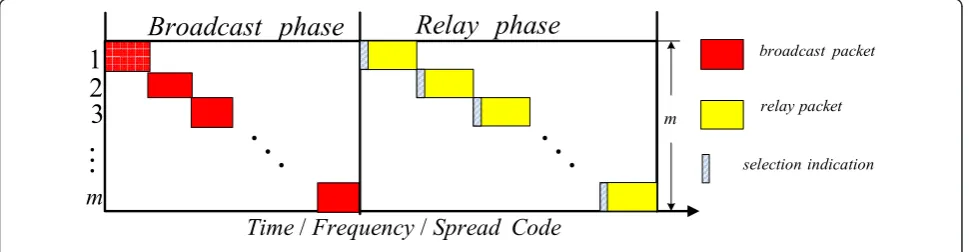
The strategy proceeds as follows. In the broadcast phase, each terminal transmits its broadcast-packet in the orthogonal channel and all the others listen and decode what it hears. Due to the channel random fad-ing, a terminal may not decode all the broadcast-packets successfully. Here,retrieval-set (i) denotes the assem-ble of broadcast-packets which are correct-decoding for terminal i, where (i)⊂ {1, 2,· · ·,m}. In the relay phase, each terminal randomly selects a small, fixed
number d of broadcast-packets from its retrieval-set,
and calculates its relay-packet by XORing those packets symbol by symbol in the binary domain, then airs the results to the destination.
Thereby, through each round of broadcast and relay
phase, a (2m, m) distributed network code in the form
of a random, systematic, degree-dlow-density
generate-matrix (LDGM) acode, is generated at the destination.
The systematic bits of the distributed LDGM code com-prises the broadcast-packets transmitted in the broad-cast phase, the parity bits are formed of the relay-packets sent in the relay phase.
Due to the random construction of the distributed code, the knowledge that how the relay-packets are formed (selection indication) is included in the head of each relay-packet. Matching the instantaneous code graph, the destination will generate an adaptive decoder to perform message-passing decoding algorithm, which can be implemented by software radio [14]. To sum up, the ANCC protocol is shown in Figure 1.
It is clear that different selections of the subset of (i) result in different distributed LDGM codes.
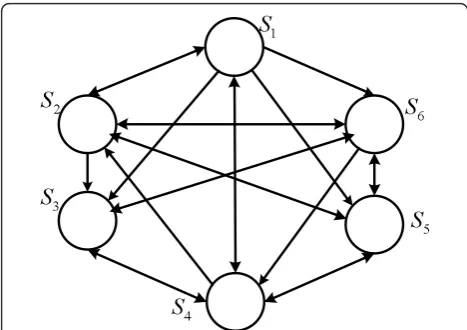
Take a cooperative wireless network for an example, where 6 terminals,S1 toS6. If terminaljdecodes suc-cessfully the packet from sourcei, a directed edge,i toj, is generated. In one communication round, the instanta-neous network topology is illustrated in Figure 2 (desti-nation is not shown in Figure 2). The retrieval-set (i) of each terminal is, respectively,
(1) ={1,2,4},
Every bold font numeral represents the terminal whose broadcast-packet is selected to form the check-sum in the relay phase. Hence, the corresponding parity check matrix of the distributed LDGM code is obtained:
H=
III. Feedback-based adaptive network coded cooperation(FANCC)
A. The traditional fountain codes
In this section, before proposing FANCC, we first intro-duce the traditional LT codes invented by Luby [15].
Suppose that a message containsninput symbols should
be sent. Hence, the encoding process works as follows:
1) randomly select a degree d from the distributed
function.
2) Uniformly choose randomdsymbols
3) Xoring the dsymbols into a check symbol,
trans-mitting it forward to the destination.
4) repeat above three process until the destination receives enough check symbol to recover all input symbols.
Clearly, the traditional rateless codes select the input symbols at the same probability and have equal error protection for all information.
1
2
3
Broadcast phase
Relay phase
/
/
Time Frequency Spread Code
m
From the encoding process, we may treat the input and check symbols as vertices of a bipartite graph which is similar to an LDPC code. Therefore, the input sym-bols are information bits and the check symsym-bols are the check bits. The decoding process of LT codes repeatedly uses the following simple recovery rule: Find any equa-tion with exactly one variable, recover the value of the variable by setting it equal to the value of the equation, and then remove the newly recovered variable from any other equations that it appears in by exclusive-oring its value into each of these equations. For example, con-sider the fountain code with equationsy1 =x3,y2 =x2
⊕ x3, y3 = x3 ⊕ x1 and y4 = x4 ⊕ x2 ⊕ x1. And the decoding process is shown as follows:
1) we obtain the value ofx3from the equationy1 =x3. Then, we XOR the equationy2andy3withx3and yield new equation y˜2=x2 and ˜y3=x1.
2) Thus, we recover the value ofx2from ˜y2=x2. The new value of x2is substituted intoy4to achieve the new simplified equation y˜4=x4⊕x1.
3) Then, we get the value ofx1 from y˜3=x1 and XOR it into y˜4 yielding the new simplified equation y4=x4.
4) At last, we recover the value ofx4from y4=x4.
B. The Basic Idea of FANCC
The greatest cooperation among different users can pull together all dimensions of communication resources efficiently (i.e. time, frequency, spread code or terminal etc.). The more understanding users play with, the greater diversity the system gets. The ANCC protocol takes advantage of the cooperation between terminals but not between terminals and the destination. Utilizing each source-destination channel state information obtained at the destination for resource management, it is evident to produce additional cooperative benefits. Furthermore, terminals never stop relaying unless the destination successfully decodes all the broadcast-pack-ets if the system complexity is not considered, that is to say, a rateless code is generated from the view of the destination [16]. However, two advanced protocols men-tioned above are too complex to be practical. Based on above discussion, our idea finds its intuitive motivation that more data can be transmitted in good channels and the broadcast-packets in bad channels should require greater protection of relay-packets in the distributed codes, which is in line with the classic information
the-ory. In this paper, we propose Feedback-based adaptive
network coded cooperation (FANCC), which makes use of the indexed feedback from the destination to indicate
which terminals’broadcast-packets to form the
check-sum and which terminals to transmit the relay-packets in the relay phase.
Figure 3 demonstrates the FANCC strategy in detail. The specific process works as described below:
In the broadcast phase, each terminal broadcasts its
broadcast-packet in its orthogonal channel while the others keep silent and decode what it hears, which is the same as that in ANCC.
2
S
4
S
5
S
6
S
1
S
3
S
Figure 2an instantaneous network topology of 6 terminals
communicating to a common destination (not shown).
In the indication phase, the destination uses trans-mission indication,Tandrelay indication,R, whereTis a length-mvector and every element is‘0’or‘1’, as well
and terminal i
will transmits the check-sum in the relay phase. Like-wise,R(i) = 1(1 ≤i ≤m) means that terminaliwhose |
and its
broadcast-packet is allowed to be selected to form the check-sum,
wheremis the number of terminals. In this phase, the
destination broadcasts R, T to each terminal. l is
selected to guarantee the broadcast packets error free in
the channels where |h|>
and s satisfies
the conditionm -l ≤ s ≤ m. Here we assume that the
feedback process is free of error, which is similar to relay selection indication transmission in ANCC.
In the relay phase, for terminal i, if T(i) = 1, it ran-domly selects d broadcast-packets of terminals {j1, j2, ..., jd}, where jk⊂ (i) and R (jk) = 1(1 ≤ k ≤ d),
XORs them from symbol by symbol and conveys the result to the destination in the orthogonal channel. For example, in Figure 3, the broadcast-packet of terminal 3 can not be selected for check-sums and terminals except terminal 2 transmit the relay-packet in the relay phase.
For one communication round, we assume that there are k1 1s in Tand k2 1s in R. Thus a distributed (k1,
2m) fountain code is produced, whose parity check
matrix has m- k2 zero columns, that is to say,m- k2 broadcast-packets get no error protection. FANCC
needsk 1 time slots in the relay phase rather than m
time slots in ANCC. Clearly, ANCC is a special case of FANCC withk1 =m, k2=m.
Compared with ANCC, FANCC requires the destina-tion to broadcast 2mbits for the relay and transmission indication information, but the additional cost in the indication phase could be ignored if the length of broad-cast-packet is large, which can be implemented easily and has great practical value.
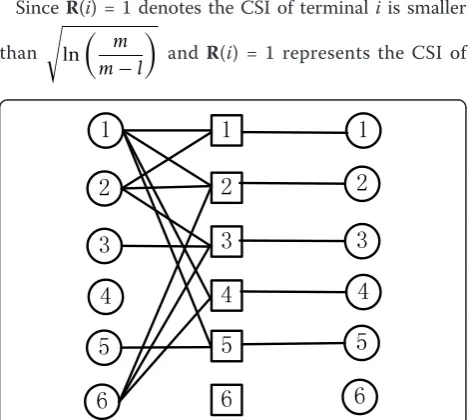
Without loss of generality, we take an cooperative wireless network for an example, which is shown in Fig-ure 2. After broadcast phase, we assume the the destina-tion has known the CSI of terminalS4 is larger than Rth
and that of terminal S6 is smaller than Tth. Then, the
destination broadcastsT=‘111110’andR=‘111011’to all terminals. According to this knowledge, all terminals finish the corresponding relay phase. Following the con-vention of code graph, let us use boxes to represent check-nodes and circles to represent bit-nodes.
Therefore, the bipartite code graph is illustrated in Figure 4 and the corresponding check matrix is shown in equation (4). From the code graph, the data received at the destination could construct a digital fountain code with unequal error protection.
HFANCC=
IV. Performance Analysis
In this section, we will study the information-theoretic results of each source-destination channel (i.e. achiev-able rate and outage probability). Following the refer-ence [5], we first formulate the mutual information of each terminal, then provide the corresponding outage probability and the achievable rate as functions of the
network size m, l ands. Assuming l and s are linear
functions ofm, at last we provide their numerical analy-sis whenm<∞as well as their limit evaluation whenm
® ∞. We also assume that perfect channel coding has been performed in each packet, thereby Shannon limita-tion can be used to denote the informalimita-tion that each terminal can convey per second. For simplicity, we focus on continuous-input, continuous-output channels with Gaussian sources.
A. Preparations
We begin with introducing some signs for convenient description. We use subscript (i, d) to mark“from term-inalito the destination”.
SinceR(i) = 1 denotes the CSI of terminaliis smaller
terminaliis larger than
we can compute
P(R(i) = 1) =P(|hi,d|2≤ln(
We usek1to denote the number of nonzero elements
in T and k2 to mark the number of element 1 in R.
Since all the channels from terminals to the destination are independent and identically distributed, k1 and k2 satisfy Bernoulli distribution and their probability den-sity functions are
P(k1=p) = Their expectations are
E(k1) =m× s
m =s (10)
and
E(k2) =m× l
m =l (11)
B. Information-theoretic analysis of FANCC
After making above preparations, we successively ana-lyze mutual information, achievable information rate and outage probability of FANCC.
1) Mutual Information: For terminali which gets no error protection in the relay phase, that is, R(i) = 0. Using the Shannon formula with the instantaneous
SNR, the mutual information between terminali and
the destination can be directly written asb
IR(i)=0 =
k1 m+k1
log(1 +γ|hi,d|2) (12)
where the factor k1
m+k1
accounts for: m + k1 time
slots are used in FANCC constitutes of m slots in the
broadcast phase andk1slots in the relay phase. Thereby the contribution in broadcast phase is normalized by
k1 m+k1
and that in relay phase is m
m+k1.
In the relay phase of FANCC, the broadcast-packets from the terminals (R(i) = 1) are encoded further into relay-packets of the distributed LDGM code and the term-inals (T(i) = 1) convey the different check-sum to the des-tination. Since the distributed codeword is transmitted by the terminalsi(T(i) = 1) through independent channels, the total system mutual information can be written as the sum of the Shannon formula with all the instantaneous SNRs. For fairness, the energy saved in the relay phase of FANCC is added uniformly to the terminalsi(T(i) = 1), which renders the total energy consumption the same as that in ANCC. We derive the following expression for the mutual information for terminali(R(i) = 1):
like this: thek1parity check packets of the network code protect k2 broadcast packets of terminals i(R(i) = 1)
equally, and the mutual information transmitted byk1
terminals (T(i) = 1) provides uniform contribution tok2 broadcast packets.
From (12) and (13), we observe that the mutual
infor-mation in FANCC is not a function of retrieval-set ,
which is similar to ANCC. For reasonableRthandTth, it
is always true that the number of broadcast packets which can be allowed to be selected is larger than the
fixed number D, which guarantees that the resulting
LDGM codes are excellent.
From equation (8) and (9), we can know that k1 and
k2 approach their expectationsandlwhen the network
size m approaches infinity. Therefore, for large
2) Achievable Information Rate: When m is large enough, according to its definition, the achievable infor-mation rate can be derived as the expectation of the mutual information in (14).
CFANCC =Eh[IFANCC] bps/Hz (15)
(14) can be simplified as
CFANCC≈Ehi,d
whereEi(.) is exponential-integral function defined as:
Ei(x) =
The true amazing result comes that the achievable rate of FANCC is not a function of the parameterl.
3) Outage probability: From equation (14) we can directly derive the outage probability from its definition, as can be seen in(19).
From equation (19), we directly simplifyΓ1as
(R) =
, respectively. Using the
Jacobi law, we can get the pdf off1andf2:
We then obtain
2=
where ⊗ denotes the convolution operation. From
equation (20) and (25), the outage probability of each terminal in FANCC can be written as:
FANCC(R) =
l m1+
m−l
m 2 (26)
(25) is hard to simplify. Hence we will numerically analyze it for different parameters, which is presented in Section IV-C.
Next, we analyze its outage probability when the size
of network mapproaches infinity. From the law of large
numbers, we get
From (26), we can derive
lim
m→∞2= Pr
s
s+mlog(1 +γ|hs,d|
2) + <R
= 1−exp
1
γ(1−2ϑ)
,
(28)
where
ϑ= s+m
s R− m
l log
1 +γm s ln
m
s
− m2
lsln(2)exp
s
γm
Ei
s
γm+ ln
m s
(29)
Therefore, we can get
lim
m→∞FANCC(R) = l m1+
m−l
m mlim→∞2 (30)
C. Numerical results
To demonstrate the superiority of FANCC, in this sub-section we numerically evaluate the information-theore-tic results of the two protocols.
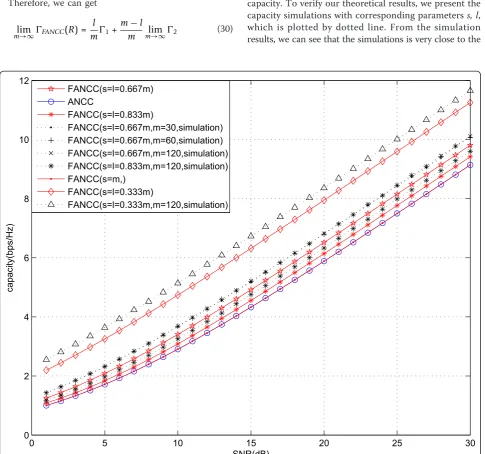
The achievable rates of FANCC (red,solid) and ANCC (black,solid) are demonstrated in Figure 5. SinceCFANCCis
irrelevant tol, we provide the achievable rates of FANCC
with different s. From the figure, FANCC outperforms
ANCC andCFANCCdecreases with the increase of
para-meters. Whens approachesm, CFANCCgradually gets
close toCANCC. This is in accord with our prediction: the
terminals which have better terminal-destination channel can transmit more information to improve total system capacity. To verify our theoretical results, we present the capacity simulations with corresponding parameterss, l, which is plotted by dotted line. From the simulation results, we can see that the simulations is very close to the
0 5 10 15 20 25 30
0 2 4 6 8 10 12
SNR(dB)
capacity(bps/Hz)
FANCC(s=l=0.667m) ANCC
FANCC(s=l=0.833m)
FANCC(s=l=0.667m,m=30,simulation) FANCC(s=l=0.667m,m=60,simulation) FANCC(s=l=0.667m,m=120,simulation) FANCC(s=l=0.833m,m=120,simulation) FANCC(s=m,)
FANCC(s=l=0.333m)
FANCC(s=l=0.333m,m=120,simulation)
theoretical results. Furthermore, we also give the
simula-tions with differentm (m = 30,60,120) to analyze the
impact of network size on capacity. Even the network size mis equal to 30, the simulated capacity is close to the the-oretical capacity. Therefore, our thethe-oretical derivation is inconsistent with the actual networks.
Since the outage of FANCC is a function of m, land
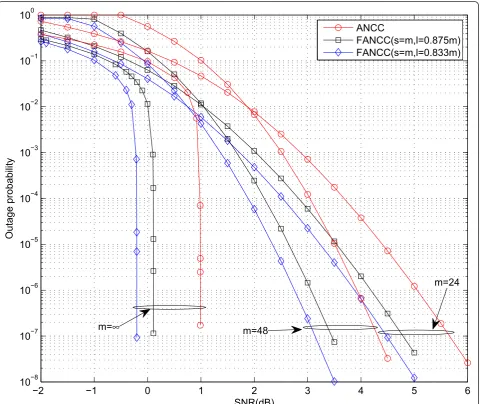
s, we analyze the their contributions to its outage prob-ability in Figure 6 and Figure 7. Figure 6 shows the
out-age probabilities with different l and s = m (l= 7 8m:
black square; l= 5
6m: blue diamonds). The curve of
ANCC is plotted by red round line. As expected, the
outage improves asl decreases, which is attributed to
the fact that the broadcast-packets in the worse
channels receive more error protection asl decreases.
We takem= 48 as an example, at the outage probability
of 10-7, FANCC with l=7
8m outperforms ANCC about
2dB and FANCC with l=5
6m gets 2.5dB improvement.
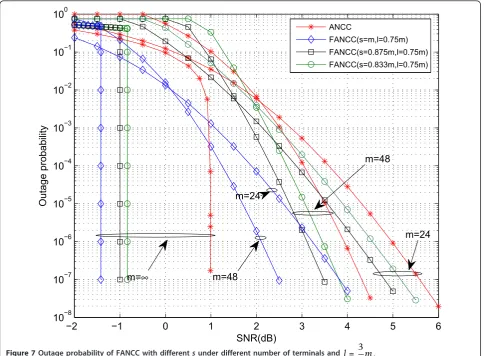
Figure 7 demonstrates that the outage probabilities
with different s and l= 3
4m (s =m: blue diamonds;
s= 7
8m: black square; s= 5
6m: cyan round). The corre-sponding curve of ANCC is plotted by red star line. From the numerical results, we also discover the similar phenomenon that, whether the network size is finite or not, the outage probability of FANCC improves with the
increase of s. It can be explained that the impact of
−2 −1 0 1 2 3 4 5 6
10−8 10−7 10−6 10−5 10−4 10−3 10−2 10−1 100
SNR(dB)
Outage probability
ANCC
FANCC(s=m,l=0.875m) FANCC(s=m,l=0.833m)
m=∞ m=48
m=24
multiplexing gain takes dominant place for l= 3 4m.
When m = 24, we can see that FANCC with s= 5
6m outperforms ANCC about 0.3dB at the outage probabil-ity of 10-7. The advantage is expanded to about 1dB for
s= 7
8m and about 1.7dB fors=m.
From Figure 5 and Figure 6, the outage probability improves with the increase of network sizem, which is accordance with the fundamental principle that user colla-boration can improve the system performance. Moreover, numerical results show that FANCC noticeably
outper-forms ANCC whethermis finite or not. For FANCC with
s=m, l= 5
6m in Figure 6,m= 24 needs about 4.5dB,m=
48 requires about 3dB andm=∞only demand about
-0.2dB, to reach the outage probability of 10-7.
D. simulation results
After we discuss the effectiveness of FANCC through theoretical analysis such as the capacity and outage
probability, the simulation results are analyzed as follows.
Since each packet can use any practical channel code, different channel codes result in different bit error rate (BER) of the whole system. In order to evaluate the impact of user cooperation, we only focus on the perfor-mance after network coding and ignore the channel coding used in each packet. Thereby we assume each terminal transmits one bit for itself and relays one bit for others. For comparison purpose, we consider differ-ent terminals communicating with a common destina-tion, that is to say, the network sizes, such asm= 100, 200, 300. We also assume that every channel, either between terminals or from terminal to destination, has the same SNR. Belief Propagation (BP) algorithm with iteration time 31 is adopted at the destination. For each
network size, we choose three fixed numberd = 5,6,7
and two assembles of the parameterssandlare selected
for every d. Therefore, totally we have performed 18
scenario simulations and the results of ANCC is plotted in red while those of FANCC is drawn in black. In this
subsection, circle represents d = 5, star means d = 6
−2 −1 0 1 2 3 4 5 6
10−8 10−7 10−6 10−5 10−4 10−3 10−2 10−1 100
SNR(dB)
Outage probability
ANCC
FANCC(s=m,l=0.75m) FANCC(s=0.875m,l=0.75m) FANCC(s=0.833m,l=0.75m)
m=48 m=24
m=48
m=24
m=∞
Figure 7Outage probability of FANCC with differentsunder different number of terminals andl= 3
and diamond indicates d = 7; The average Eb/N0 of channels from terminals to destination is plotted in the
X axis. For fairness, the total energy consumption of
FANCC and ANCC for cooperation round are all the half of that in the no-cooperation scheme. The trans-mission energy is normalized for each terminal for
power reduction in FANCC. The Y axis denotes the
FER averaged over different packets from different terminals.
In Figure 8, the average FER of FANCC withm= 100,
l = 80,s = 100 and ANCC is demonstrated. From the
figure, we observe that, FANCC has a little worse
per-formance than ANCC at low Eb/N0 while it has better
performance at a little high Eb/N0. The larger the fixed
numberd, The greater the superiority of FANCC is. We
can see that,FANCC achieves about 1dB improvement
over ANCC for d = 5 while it gets about 2dB coding
gain ford= 7.
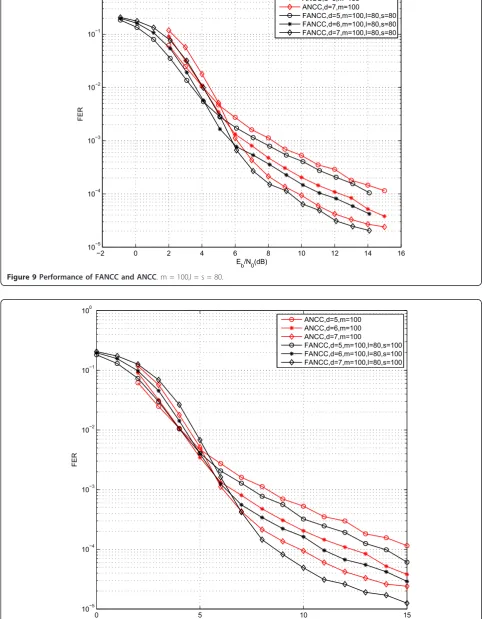
In Figure 9, we select an assemble of parameters,s=l
= 80 for d = 5, 6, 7 to evaluate the effectiveness of
FANCC in 100-terminal network. The excitement comes from that FANCC not only has better
0 5 10 15
10−5 10−4 10−3 10−2 10−1 100
Eb/N0(dB)
FER
ANCC,d=5,m=300 ANCC,d=6,m=300 ANCC,d=7,m=300
FANCC,d=5,m=300,l=250,s=300 FANCC,d=6,m=300,l=250,s=300 FANCC,d=7,m=300,l=250,s=300
−2 0 2 4 6 8 10 12 14 16 10−5
10−4 10−3 10−2 10−1 100
Eb/N0(dB)
FER
ANCC,d=5,m=100 ANCC,d=6,m=100 ANCC,d=7,m=100
FANCC,d=5,m=100,l=80,s=80 FANCC,d=6,m=100,l=80,s=80 FANCC,d=7,m=100,l=80,s=80
Figure 9Performance of FANCC and ANCC. m = 100,l = s = 80.
0 5 10 15
10−5 10−4 10−3 10−2 10−1 100
Eb/N0(dB)
FER
ANCC,d=5,m=100 ANCC,d=6,m=100 ANCC,d=7,m=100
FANCC,d=5,m=100,l=80,s=100 FANCC,d=6,m=100,l=80,s=100 FANCC,d=7,m=100,l=80,s=100
performance whether Eb/N0 is low or high but also it saves 10 percent of communication round time than ANCC. The advantage of FANCC is less than 1dB.
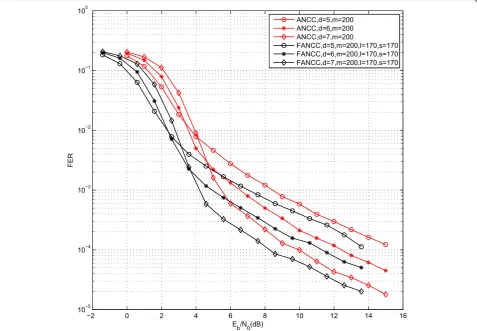
Figure 10 and Figure 11 show a comparison of the simulated FER of FANCC and ANCC when the network size is 200.s= 200,l= 170 ands =l= 170 are used for FANCC in Figure 10 and Figure 11, respectively. From Figure 10, it can observed that FANCC outperforms ANCC at high Eb/N0. However, the opposite is true at lowEb/N0 but the gap is small. Asdincreases, the inter-section of two FER curves moves to the lower right side and the performance gain increases whenEb/N0 crosses the intersection. Ford= 5, the intersection coordinates is (3dB, 4 × 10⁻²) and ford= 7, the coordinates is (6dB, 7 × 10⁻⁴). The coding gain is about 1dB.
From Figure 11, FANCC withs=l= 170 has achieved
much better performance over ANCC for m = 200.
Compared with ANCC, the coding gain of FANCC is
becoming smaller and smaller as FER decreases. Ford=
7, FANCC achieves about 1.5dB coding gain than
ANCC at the FER of 10-3 while less than 1dB at the
FER of 2 × 10⁻⁵.
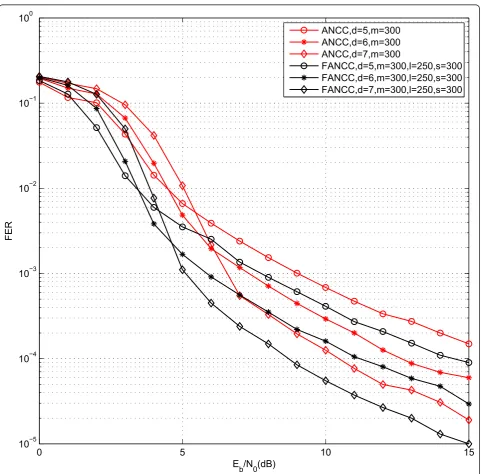
The average FER of FANCC and ANCC form= 300
is further compared in Figure 12 and Figure 13. In
Fig-ure 12, we choose l= 300, s = 250 for FANCC, where
the destination only feedbacks 1bit per terminal, that is to say, 300-bit indication message, in the indication phase. Seen from that, FANCC significantly outperforms
ANCC at the same FER, which is different from m=
100 andm= 200. Furthermore, FANCC gets about 2dB
coding gain over ANCC at everyd.
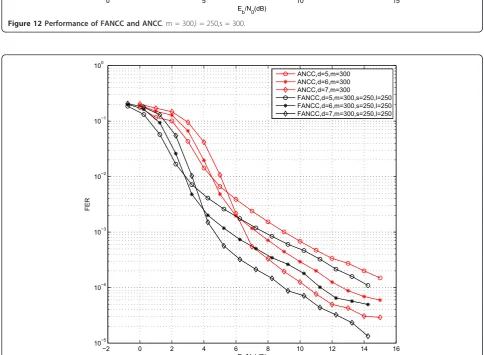
At last, the parameters l = s = 250 is selected in
FANCC form = 300, which reduces 50 time slots than
ANCC in one communication round. Figure 13 com-pares the proposed FANCC with ANCC. In this simula-tion, the destination broadcasts 600-bit message in the indication phase. From the simulation results, our pro-posed FANCC achieves about 2dB coding gain com-pared with ANCC.
From above results, compared with ANCC, FANCC can improve the system performance. However, the
parameters l ands used in the simulation are selected
approximately and there may be better parameters. It is also meaningful and interesting to establish a simple
−2 0 2 4 6 8 10 12 14 16
10−5 10−4 10−3 10−2 10−1 100
Eb/N0(dB)
FER
ANCC,d=5,m=200 ANCC,d=6,m=200 ANCC,d=7,m=200
FANCC,d=5,m=200,l=170,s=170 FANCC,d=6,m=200,l=170,s=170 FANCC,d=7,m=200,l=170,s=170
0 5 10 15 10−6
10−5 10−4 10−3 10−2 10−1 100
Eb/N0(dB)
FER
ANCC,d=5,m=200 ANCC,d=6,m=200 ANCC,d=7,m=200
FANCC,d=5,m=200,l=170,s=200 FANCC,d=6,m=200,l=170,s=200 FANCC,d=7,m=200,l=170,s=200
Figure 12Performance of FANCC and ANCC. m = 300,l = 250,s = 300.
−2 0 2 4 6 8 10 12 14 16
10−5 10−4 10−3 10−2 10−1 100
Eb/N0(dB)
FER
ANCC,d=5,m=300 ANCC,d=6,m=300 ANCC,d=7,m=300
FANCC,d=5,m=300,s=250,l=250 FANCC,d=6,m=300,s=250,l=250 FANCC,d=7,m=300,s=250,l=250
model of searching the best sandlfor FANCC, and we will continue this work in the future research.
V. Conclusion
In this paper, a new cooperative scheme, termed
Feed-back-based adaptive network coded cooperation (FANCC), is proposed for large wireless networks. Matching the quality of channels, the destination in FANCC feedbacks which broadcast-packets to be selected for relay-packets and which terminals to relay, which costs 2 bits per terminal. Therefore, distributed fountain codes with unequal error protection are gener-ated at the destination. To evaluate the performance of FANCC, the closed-form expressions of achievable rate and outage probability are derived when the network size approaches infinity and they are numerically ana-lyzed for finite networks. Furthermore, our analysis and simulation results demonstrate that FANCC significantly outperforms ANCC and achieves 1-2dB improvement.
VI. Competing interests
The authors declare that they have no competing interests.
Endnotes a
a terminal which is yet to relay may continue to decode relay-packets in the relay phase and the correctly decoding relay-packets will be collected into the retrieve-set. Then, low-triangular ldpc codes are gener-ated at the destination. But it only can occur when the system operates in a tdma manner. For simplicity, we only consider ldgm codes in this paper, which is suitable for any systems.
b
all the log(.) functions in this paper have base 2
Acknowledgements
This research work was supported by National Basic Research Program of China {No. 2007cb310601}, nsfc {No. 61021001 and No. 60972021}, National Science and Technology Major Project under contract 2010zx03006-003-01 and Program for New Century Excellent Talents in University (ncet). Part of this paper has appeared in Chinacom 2010.
Author details
1Department of Electronic Engineering, Tsinghua University, Beijing, 100084 P. R. China2School of Aerospace, Tsinghua University, Beijing, 100084 P. R. China
Received: 16 February 2011 Accepted: 10 November 2011 Published: 10 November 2011
References
1. EC vander Meulen, Three-terminal communication channels. Adv Appl Prob. 3, 120–154 (1971). doi:10.2307/1426331
2. R Ahlswede, N Cai, S-YR Li, RW Yeung, Network information flow. IEEE Trans Inf Theory.46, 1204–1216 (2000). doi:10.1109/18.850663
3. R Koetter, M M’edard, An algebraic approach to network coding. IEEE/ACM Trans Networking.11(5), 782–795 (2003). doi:10.1109/TNET.2003.818197
4. X Bao, J Li, Matching code-on-graph with networks-on-graph: adaptive network coding for wireless relay networks, inProc Allerton Conf on Commun, Control and Computing, Urbana Champaign, IL (Sept. 2005) 5. X Bao, J Li, Adaptive network coded cooperation(ANCC) for wireless relay
network: matching code-on-graph with network-on-graph. IEEE Trans wireless commun.7(2), 573–583 (2008)
6. Andrea Montanari, Tight bounds for LDPC and LDGM codes under MAP decoding. IEEE Trans Inf Theory.51(9), 3221–3246 (2005). doi:10.1109/ TIT.2005.853320
7. J Laneman, Cooperative Diversity in Wireless Network: Algorithm and Architecture, Ph.D. dissertation, Massachusetts Institute of Technology, Cambridge, MA (Aug. 2002)
8. J Laneman, G Wornell, Distributed space-time-coded protocols for exploiting cooperative diversity in wireless networks. IEEE Trans Inf Theory. 49(10), 2415–2425 (2003). doi:10.1109/TIT.2003.817829
9. Y Chen, S Kishore, J Li, Wireless diversity through network coding. inProc IEEE Wireless Commun Networking Conf1681–1686 (March 2006) 10. G Kramer, M Gastpar, P Gupta, Cooperative strategies and capacity
theorems for relay networks. IEEE Trans Inform Theory.51(9), 3037–3063 (Sep. 2006)
11. S Cui, A Haimovich, O Somekh, H Vincent Poor, Opportunistic relaying in wirelss networks. IEEE Trans Inf Theory.55(11), 5121–5137 (Nov. 2009) 12. A Bletsas, A Khisti, M Win, Opportunistic cooperative diversity with feedback
and cheap radios. IEEE Trans Wireless Commun.7(5), 1823–1827 (May 2008) 13. C Peng, Q Zhang, M Zhao, Y Yao, Opportunistic network-coded
cooperation in wireless networks. inProc IEEE Wireless Communications and Networking Conference (WCNC’07)3358–3363 (Mar. 2007)
14. Joseph Mitola, Software radio architecture: A mathematical perspective. IEEE J Sel Areas Commun.17(4), 514–538 (1999). doi:10.1109/49.761033 15. M Luby, LT codes.43th Annual IEEE Symposium on Foundations of Computer
Science(April 2002)
16. JW Byers, M Lubu, M Mitzenmacher, A digital fountain approach to asynchronous reliable multicast. IEEE J Sel Areas Commun.20(8), 1528–1540 (Oct. 2002). doi:10.1109/JSAC.2002.803996
doi:10.1186/1687-1499-2011-164
Cite this article as:Zhanget al.:Feedback-based adaptive network coded cooperation for wireless networks.EURASIP Journal on Wireless Communications and Networking20112011:164.
Submit your manuscript to a
journal and benefi t from:
7Convenient online submission
7Rigorous peer review
7Immediate publication on acceptance
7Open access: articles freely available online
7High visibility within the fi eld
7Retaining the copyright to your article