R E S E A R C H
Open Access
Adaptive tracking control for a class of
uncertain nonlinear systems with infinite
number of actuator failures using neural
networks
Wenshun Lv and Fang Wang
**Correspondence: [email protected] College of Mathematics and Systems Science, Shandong University of Science and Technology, Qingdao, Shandong 266510, P.R. China
Abstract
We consider adaptive compensation for infinite number of actuator failures in the tracking control of uncertain nonlinear systems. We construct an adaptive controller by combining the common Lyapunov function approach and the structural
characteristic of neural networks. The proposed control strategy is feasible under the presupposition that the systems have a nonstrict-feedback structure. We prove that the states of the closed-loop system are bounded and the tracking error converges to a small neighborhood of the origin under the designed controllers, even though there are an infinite number of actuator failures. At last, the validity of the proposed control scheme is demonstrated by two examples.
Keywords: nonlinear systems; actuator failures; adaptive control; backstepping; neural networks; nonstrict feedback
1 Introduction
In recent years, many approximation-based adaptive fuzzy or neural backstepping con-trollers have been developed for uncertain nonlinear systems; see [–]. Among them, to eliminate the problem of ‘explosion of complexity’ inherent in the existing method, in [] a control design strategy was developed for a class of nonlinear systems in strict-feedback form with arbitrary uncertainty. To deal with the state unmeasured problem, a novel con-trol scheme was introduced in []. To address the concon-trol problem of nonsmooth hystere-sis nonlinearity in the actuator, adaptive neural controllers were constructed for nonlinear strict-feedback systems with unknown hysteresis in []. It should be noted that the con-trol schemes mentioned are under the presupposition that the systems have a nonstrict-feedback structure.
In the nonlinear systems without strict-feedback structure, the unknown nonlinear functions involve all the state variables, so they cannot be approximated with current states. To deal with such a structural restriction, in [] a variable separation method was proposed. The control scheme in [] assured that the tracking performance is achieved as time variable goes to infinity. Besides the proposed control scheme, many efforts have been made in relaxing such a restriction of system structure; see [–]. In practical
plication, the actuator component is usually employed to execute control actions on the plant. However, the actuation mechanism may suffer from failures, which results in the actuator losses of partial or total effectiveness. To prevent the emergence of performance deterioration and instability of the closed-loop system caused by actuator faults, accom-modating actuator failures should be taken into account in the control design.
In recent years, many control schemes have been proposed to accommodate actuator failures; see, for example, [–]. By applying backstepping technique for the linear sys-tems, a systematic actuator failure compensation control was presented in []. Then, in [] the proposed control method was extended to nonlinear systems with actuator fail-ures; in [] the problem of accommodating actuator failures was investigated for a lass of uncertain nonlinear systems with hysteresis input as a follow-up extension. In practice, the failure pattern in an actuator may change repeatedly, which makes failure parameters suffer from an infinite number of jumps. Consequently, the considered Lyapunov function would experience infinite number of jumps. In [], this problem was addressed by apply-ing a new tunapply-ing function under the frame of adaptive control. However, the proposed control strategy can only apply to the strict-feedback systems.
Motivated by the aforementioned researches, in this paper, we focus on the problem of adaptive compensation for an infinite number of actuator failures in neural tracking control for a class of nonstrict-feedback systems. The main contributions in this paper can be summarized as follows.
() The control scheme in this paper relaxes the restriction of system structure so that a better approach is proposed to deal with the problem of compensation for an infinite number of actuator failures, which is more meaningful in practical application in comparison with [].
() In this paper, combining neural networks and a new piecewise Lyapunov function analysis, we establish an adaptive control scheme for a class of uncertain nonlinear systems with a nonstrict-feedback structure.
The remainder of the paper is organized as follows. In the next section, the problem de-scription and preliminaries are presented. Section shows the major result. In Section , the simulation result expounds the validity of the proposed control scheme. Finally, we give a simple summary.
2 Preliminaries and problem description
2.1 A. System description
We consider the following nonstrict-feedback system form:
˙
xi=xi++fi(x), ≤i≤n– ,
˙
xn= m
j=
bjσj(x)uj+fn(x),
y=x,
For simplicity, the internal dynamics in actuators can be negligible. Letujˇ (j= , . . . ,m) bejth actuator input, and then the normal actuator is described asuj=uj. However, inˇ practical applications, the actuation components may suffer from failures or faults. The actuator failure model in this paper is given as follows:
uj=κj,k(t)ujˇ +ufj,k(t), ()
κj,k(t)ufj,k(t) = , j= , . . . ,m, ()
wheret∈[tk,tk+) fork= , , . . . , andtkdenotes the unknown failure time instant at which the failure parameter jumps occur. In ()-(), ≤κj,k(t)≤ is called the efficiency factor, andufj,k(t) is the stuck value. Note that the proposed model covers two classes of typical actuator failures, that is, partial loss of effectiveness (PLOE) faults ( <κj,k< ) and total loss of effectiveness (TLOE) faults (κj,k= ), as detailed in [].
Remark The unknown time-varying value ufj,k(t) can be linearly parameterized as
ufj,k(t) =uj,k+i=qj ζji,kφji(t) with known functionsφji(t) and unknown constantsuj,kand
ζji,k.
Control objective: design the control inputuˇj to compensate for the actuator failures modeled as ()-() such that all the closed-loop signals are bounded and the system out-putytracks the given reference signalydwith a tracking error converging to a residual around zero. The following assumptions are general in the literature on the adaptive ac-tuator failure compensation control.
Assumption The number of failed actuators undergoing TLOE faults simultaneously is
allowed to be at mostm– , and achieving control objective with the remaining actuators is still possible.
Assumption The reference signalyd(t) and its firstnth-order time derivativesyd(t) (i= , . . . ,n) are known, smooth, and bounded.
Assumption sign(bj) are known forj= , , . . . ,m.
Assumption The conditionsσj(·)= , <b≤ |bj| ≤bM, and|ufj,k(t)| ≤ufM are satis-fied. In addition, for the PLOE faults, <κ≤κj,k(t) < . Note thatb,bM,ufM, andκare known constants.
Assumption The failure parametersκj,k(t) andufj,k(t) are smooth and continuous over [tk,tk+). Moreover, their change rates are bounded, that is, supt∈[tk,tk+)|˙κj,k(t)| ≤d and
supt∈[t
k,tk+)|˙ufj,k(t)| ≤d, wheredandddenote two unknown positive constants.
2.2 B. RBF neural networks
In the following design, the radial basis function (RBF) neural networks will be utilized to approximate an unknown functionf(ζ) defined on some compact set. For sufficiently large nodes numberκ, the RBF neural networksξ∗T (ζ) can approximate any continuous functionf(ζ) over a compact set⊂Rqto arbitrary accuracyε> as follows:
where the approximation error(ζ) satisfies|(ζ)| ≤ε,ϕ(ζ) = [ϕ(ζ),ϕ(ζ), . . . ,ϕκ(ζ)]Tis the basis function vector, andξ∗= [ξ,ξ, . . . ,ξκ]T∈Rκis defined as
ξ∗:=arg min
ξ∈Rκ
sup
ζ∈
f(ζ) –ξTϕ(ζ),
where ξ ∈Rκ denotes the weight vector. In this research, the following Gaussian basis
functionsφi(ζ) will be used:
ϕi(ζ) =exp
–(ζ–ιi) T(ζ–ι
i)
ωi
, i= , , . . . ,κ, ()
whereιi= [ιi,ιi, . . . ,ιiq]T denotes the center of the receptive field, andωirepresents the width of the Gaussian function.
Lemma ([]) Let f(χ)be a continuous function defined on a compact set.Then,for everyε> ,there exists a neural networkθT(χ)such that
sup
χ∈
f(χ) –θT(χ)≤ε. ()
Lemma ([]) For anyω∈R andε> ,the following holds:
≤ |ω|–ωtanh
ω
ε ≤δε ()
withδ= ..
3 Adaptive tracking control design and stability analysis
In this section, based on a backstepping technique and neural networks, we design an adaptive actuator failure compensation control scheme. The control goal of this manuscript is to establish an adaptive controller such that the system outputyfollows a desired reference signalyd.
3.1 A. Adaptive tracking control design
Before implementing the design, a set of uncertain constants is defined as
Wi=Mi θi =MiθiTθi, i= , . . . ,n, ()
whereθi= [θi,, . . . ,θi,Ni] andNiare the weight vector and the number of neurons inith
hidden layer, respectively. The operator · represents the Euclidean norm of a column vector. From the definition we know thatWiis an unknown constant. The adaptive pa-rameterWiˆ is utilized to estimateWi, and the estimated error isWi˜ =Wi–Wi. The com-ˆ putation in adaptation mechanism utilized in the literature can be reduced fromi=n Mi ton.
The coordinate transformations are defined as follows:
z=x–yd,
zi=xi–αi––y(i–)d , i= , . . . ,n,
()
Denote
To ensure the boundedness of the jumping size of the Lyapunov function at failure in-stants, we design the adaptation laws for updating parameter estimators with projection operation.
The adaptive laws are selected as
˙ˆ with positive constantsri),Proj(·) denotes the projection operator, andτ is a known convex compact set given by
τ=
αi–is the virtual controller designed as
αi= –λizi–
With the developed projection-based tuning function approach, we further propose new piecewise Lyapunov function analysis to establish the closed-loop system stability.
3.2 B. Stability analysis
Theorem Consider the closed-loop adaptive system consisting of nonlinear plant()with actuator failures()-()and the proposed control scheme()-().Moreover,the nonstrict-feedback nonlinear system()satisfies Assumptions-.Then:
() All the signals of the closed-loop system are bounded; () The tracking error converges to a small neighborhood of zero.
Proof Consider the following Lyapunov function candidate:
whereε˜iis used to estimateεi,ε˜i=εi–εˆirefers to the estimated error, andτ˜i=τi–τˆiis
From the related properties of a projection operator in [] we can derive thatτˆ(t)∈τ. We get
τ˜(t)=τ(t) –τˆ(t)≤. ()
The time derivative ofV¯ is
˙¯
Define unknown functions as
f(x) =ϕ(x), ()
Moreover, according to () and (), we have
m
Sincefi(x) contain the unknown functionsϕi, they cannot be implemented in practice. According to Lemma , for any given constantεi> , there exists a neural networkθiTi such that
Substituting () and () into (), we have
By Assumption and by () and () we get
Then, it follows that
˙¯
To establish the closed-loop system stability for all the time under the case of actuator failures or faults, we need to consider the overall Lyapunov function defined as
V(t) =V(t)k,¯ t∈[tk,tk+),k= , , . . . , () wheret= is the initial time instant. Note thatV(t) is not a continuous function, and it experiences a sudden jump at each failure instanttk+(k= , , . . .). The jumping size at instanttkis computed as
–
Integrating both sides of () over [tk,tk+), we have
Ht–k+≤Ht+k++
We denote byℵ(t,T) the number of jumps of the overall LyapunovV(t) during (t,T) for t≥. LetT=min{tk+–tk},k= , , . . . . Then it follows that Then all closed-loop signals are bounded. Note thatn
i=≤V(t), and letT→ ∞. The bound of the tracking error can be derived as
Remark Inequality () makes a vital contribution to the backstepping design because it builds the relation betweenxiandzi, which makes a backstepping-based design procedure viable.
Remark The adaptive parametersWi,ˆ εˆ,τˆare utilized to estimateWi,ε,τ, respectively.
˜
Wi=Wi–Wi,ˆ ε˜=–εˆ, andτ˜=τ–τˆdenote the estimated errors. Note that the failure parameter κj,k is allowed to be time varying during each time interval [tk,tk+) fork= , , . . . and bj (j= , . . . ,m) are unknown control coefficients. The instability cannot be ensured when [tk,tk+) andbjare not contained in the Lyapunov function.
Remark The failure-related parametersτcontained in the Lyapunov function () will
undergo a sudden jump at unknown time instanttk, and it follows that decreasing of the Lyapunov function, shown as in (), is only valid at the time interval [tk,tk+) during which the Lyapunov functionVk(t) is differentiable. To establish the closed-loop system stability¯ under the case of actuator failures or faults, we consider the overall Lyapunov function defined in ().
4 Simulation example
In this section, we use two examples to expound our design scheme and testify the results obtained.
4.1 A. Example 1
The nonlinear system is given as
˙
x=x+ x,
˙
x=xx+ –e–x
+e–x +bu+bu,
y=x,
˙
ξ=Z(ξ,x,x),
Z(ξ,x,x) = –ξ+x+tan–x
+ +x +x
xx+ – e –x
+e–x
,
()
whereyis the system output, anduj(j= , ) are control inputs to the plant. The param-eters b= and b= . are unknown for controller design. The last subsystem system
˙
ξ =Z(ξ,x,x) represents the zero dynamics for the system. From [, ] we have that
ξ=Z(ξ,x,x) is input-to-state stable with respect to [x,x], which implies that the state variableξis bounded ifx(t),x(t)∈∞. The system is initialized asx() = .,x() = ,
ξ() = , andu() =u() = . In the simulation, the failure case studied is given by
u=cos
.t–hTu
c ()
u=uc,t∈hT, (h+ )T, h= , , , . . . , ()
u= sin(.t), ()
whereujˇ is thejth actuator input forj= , , andT= s denotes the minimum length of
time intervals between two successive jumps of failure parameters. It is seen that during the time interval [hT, (h+ )T),h= , , , . . . , the first actuator suffers from PLOE faults
with a time-varying efficiency indicatorκ,h(t) =cos(.(t–hT)), whereas the second
actuator works normally, and during [hT, (h+)T),h= , , , . . . , the first actuator output
is stuck at an unknown time-varying value, that is,u= sin(.t), whereas the second actuator loses %of the effectiveness of its input. The boundary informationb= ., bM= ,κ= ., andufM= is employed to construct the projection adaptation law (), and then the compact setτ in () is computed as
τ = [τ,τ,,τ,]T|.≤τ≤., –.≤τ,≤.,j= , ]. ()
To make all the signals bounded andyfollow a given signalyd= .sin(.t), we select the scheme
z=y–yd,
z=x–α–yd,˙
α= –z– .W zˆ –εˆ(.z),
α= –.z– .W zˆ –εˆ(.z),
˙ˆ
W= .z+ .ztanh(.z) – .εˆ,
˙˙
τ=Proj(–τvzn), ˆ∈τ,
ˇ
uj=τˆ(α+yd) +¨ τˆ,+τˆ,, j= , ,
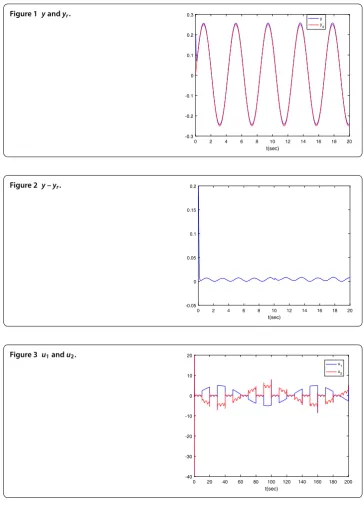
withτ = I, whereIdenotes the × identity matrix. The initial parameter estimates are set asWˆ() = ,εˆ() = ., andτˆ() = [., ., .]T. Figures - demonstrate the cor-responding simulation results.
4.2 B. Example 2
We consider the subsystem of the cascade chemical reactor system as in [, ]:
˙
x=x+φ+x,
˙
x=φ+bu+bu,
y=x.
()
In the system,
φ=
(q+qR)Td
V –
x+Td
V (q+qR) – CdAαλ
ρcρ
e–
Ea
R(x+Td ) – UA ρcρV
x+Td–Tjd, ()
and
φ= UA
ρcρV
qj
Vj
Tjd –ρcρVx UA –T
d j +
UA
ρjcjVj
x+Td–ρcρVx UA –T
Figure 1 yandyr.
Figure 2 y–yr.
Figure 3 u1andu2.
where q andq=q+qR are the flows of reactants,b =ρUAqcρVVj
j andb=
UAqj
ρcρVVj denote
the control coefficients,V represents the volume of the reactor. The system parameters are given in Table . The system is initialized asx() = ., x() = ,x() = , and u() =u() = . In the simulation, the failure case studied is given by
u=uc,
u=uc, t∈
hT, (h+ )T,h= , , , . . . ,
u= .uc, ()
Table 1 Parameters of the cascade chemical reactor system
q= 2.8317 m3/h q
R= 1.4158m3/h V= 1.3592 m3
Td
1= 750◦C T2d= 737.5◦C CdA2= 10.4178 mol/m3
α= 7.08×10¹⁰h–1
λ= –3.1644×10⁷h–1
ρ= 800.9189 kg/m3 cρ= 1395.3 J/kg◦C Ea= 3.1644×10⁷J/mol R= 1679.2 J/mol◦C
U= 1.3625×10⁷J/hm2◦C A= 23.2 m2 Td
j2= 727.6◦C
qj2= 1.4130 m3/h Tjd20= 608.2◦C ρj= 997.9450 kg/m3
cj= 1860.3 J/kg◦C V= 0.1090 m3
whereuˇjis thejth actuator input forj= , , andT= s denotes the minimum length of time intervals between two successive jumps of failure parameters;b= .,bM= ,
κ= ., andufM= are employed to construct the projection adaptation law (), and then the compact setτ in () is computed as
τ = [τ,τ,,τ,]T|.≤τ≤., –.≤τ,≤.,j= , ]. () To make all the signals bounded andyfollow a given signalyd= , we select the scheme
z=y–yd,
z=x–α–yd,˙
α= –z– .W zˆ –εˆ(.z),
α= –.z– .W zˆ –εˆ(.z),
˙ˆ
W= .z+ .ztanh(.z) – .εˆ,
˙˙
τ=Proj(–τvzn), ˆ∈τ,
ˇ
uj=τˆ(α+¨yd) +τˆ,+τˆ,, j= , ,
withτ = I, whereIdenotes the × identity matrix. The initial parameter estimates are set asW() = ,ˆ εˆ() = ., andτˆ() = [., ., .]T. Figures - demonstrate the cor-responding simulation results.
4.3 C. Conclusions
In this papedr, we investigate the issue of adaptive finite-time tracking for a class of non-linearity systems with hysteresis. On the basis of the approximation capability of fuzzy logic systems, we give an adaptive law and an intermediate control function. Moreover, we proved that the aforementioned approach can make the system SGPFS.
Figure 4 yandyr.
Figure 5 y–yr.
Figure 6 u1andu2.
Acknowledgements
The authors greatly appreciate the reviewers suggestions, the editors’ encouragement, and Yan Li’s contribution to this paper. Yan Li is currently professor at Shandong University of Science and Technology. She made a significant contribution to this paper, including control scheme design, paper writing, and revision. This work is supported partially by the National Natural Science Foundation of China (Grant No. 61503223), in part by the Project of Shandong Province Higher Educational Science and Technology Program (J15LI09), in part by China Postdoctoral Science Foundation-funded project 2016M592140, in part by Shandong innovation postdoctoral program 201603066, and in part by the SDUST Research Fund (2014TDJH102).
Competing interests
The authors declare that they have no competing interests.
Authors’ contributions
Publisher’s Note
Springer Nature remains neutral with regard to jurisdictional claims in published maps and institutional affiliations.
Received: 30 July 2017 Accepted: 13 November 2017
References
1. Wang, F, Chen, B, Lin, C, Li, XH: Distributed adaptive neural control for stochastic nonlinear multiagent systems. IEEE Trans. Cybern.47(7), 1795-1803 (2017)
2. Wang, F, Liu, Z, Zhang, Y, Philip Chen, CL: Adaptive fuzzy control for a class of stochastic pure-feedback nonlinear systems with unknown hysteresis. IEEE Trans. Fuzzy Syst.24(1), 140-152 (2016)
3. Tang, L, Zhao, J: Neural network based adaptive prescribed performance control for a class of switched nonlinear systems. Neurocomputing230, 316-321 (2017)
4. Shi, XC, Lu, JW, Li, Z, Xu, SY: Robust adaptive distributed dynamic surface consensus tracking control for nonlinear multi-agent systems with dynamic uncertainties. J. Franklin Inst.353, 4785-4802 (2016)
5. Wang, HQ, Chen, B, Liu, XP, Lin, C: Robust adaptive fuzzy tracking control for pure-feedback stochastic nonlinear systems with input constraints. IEEE Trans. Cybern.43(6), 2093-2104 (2013)
6. Kayacan, E, Ramonf, H, Saeys, W: Adaptive neuro-fuzzy control of a spherical rolling robot using sliding-mode-control-theory-based online learning algorithm. IEEE Trans. Cybern.43(1), 170-179 (2013) 7. Yu, JP, Ma, YM, Yu, HS, Lin, C: Reduced-order observer-based adaptive fuzzy tracking control for chaotic permanent
magnet synchronous motors. Neurocomputing214, 201-209 (2016)
8. Hamayun, MT, Edwards, C, Alwi, H: Design and analysis of an integral sliding mode fault-tolerant control scheme. IEEE Trans. Autom. Control57(7), 1783-1789 (2012)
9. Tong, SC, Li, YM, Shi, P: Observer-based adaptive fuzzy backstepping output feedback control of uncertain MIMO pure-feedback nonlinear systems. IEEE Trans. Fuzzy Syst.20(4), 771-785 (2012)
10. Li, H, Chen, Z, Wu, L, Lam, HK, Du, H: Event-triggered fault detection of nonlinear networked systems. IEEE Trans. Cybern.47(4), 1041-1052 (2017)
11. Zhou, Q, Shi, P, Tian, Y, Wang, M: Approximation-based adaptive tracking control for MIMO nonlinear systems with input saturation. IEEE Trans. Cybern.45(10), 2119-2128 (2015)
12. Chen, B, Liu, XP, Liu, KF, Lin, C: Direct adaptive fuzzy control of nonlinear strict-feedback systems. Automatica45(6), 1530-1535 (2009)
13. Wang, D, Huang, J: Neural network-based adaptive dynamic surface control for a class of uncertain nonlinear systems in strict-feedback form. IEEE Trans. Neural Netw.16(1), 195-202 (2005)
14. Swaroop, D, Hedrick, J, Yip, P, Gerdes, J: Dynamic surface control for a class of nonlinear systems. IEEE Trans. Autom. Control45(10), 1893-1899 (2000)
15. Ge, SS, Wang, C: Adaptive neural control of uncertain MIMO nonlinear systems. IEEE Trans. Neural Netw.15(3), 674-692 (2004)
16. Chen, B, Liu, XP, Liu, K, Lin, C: Fuzzy-approximation-based adaptive control of strict-feedback nonlinear systems with time delays. Automatica18(5), 883-892 (2010)
17. Daniel, W, Li, JM, Niu, YG: Adaptive neural control for a class of nonlinearly parametric time-delay systems. IEEE Trans. Neural Netw.16(3), 625-635 (2005)
18. Zhang, TP, Ge, SS: Adaptive neural control of MIMO nonlinear state time-varying delay systems with unknown dead-zones and gain signs. Automatica43(6), 1021-1033 (2007)
19. Wang, F, Liu, Z, Yu, GY, Zhang, Y, Chen, X, Chen, CL: Adaptive neural control for a class of nonlinear time-varying delay systems with unknown hysteresis. IEEE Trans. Neural Netw. Learn. Syst.25(12), 2129-2140 (2014)
20. Chen, B, Liu, XP, Ge, SS, Lin, C: Adaptive fuzzy control of a class of nonlinear systems by fuzzy approximation approach. IEEE Trans. Fuzzy Syst.20(6), 1012-1021 (2012)
21. Liu, XP, Gu, GX, Zhou, KM: Robust stabilization of MIMO nonlinear systems by backstepping. Automatica35(2), 987-992 (1999)
22. Liu, XP, Jutan, A, Rohani, S: Almost disturbance decoupling of MIMO nonlinear systems and application to chemical processes. Automatica40(3), 465-471 (2004)
23. Ploycarpou, MM, Ioannou, PA: A robust adaptive nonlinear control design. Automatica32(3), 423-427 (1996) 24. Yao, B, Tomizuka, M: Adaptive robust control of SISO nonlinear systems in a semi-strict feedback form. Automatica
33(5), 893-900 (1997)
25. Yao, B, Tomizuka, M: Adaptive robust control of MIMO nonlinear systems in semi-strict feedback forms. Automatica
37(9), 1305-1321 (2001)
26. Tao, G, Joshi, SM, Ma, XL: Adaptive state feedback control and tracking control of systems with actuator failures. IEEE Trans. Autom. Control46(1), 78-95 (2001)
27. Tang, XD, Tao, G, Joshi, SM: Adaptive actuator failure compensation for parametric strict feedback systems and an aircraft application. Automatica39(11), 1975-1982 (2003)
28. Cai, JP, Wen, C, Su, HY, Li, XD: Robust adaptive failure compensation of hysteretic actuators for a class of uncertain nonlinear systems. IEEE Trans. Autom. Control58(9), 2388-2394 (2013)
29. Lai, GY, Liu, Z, Philip Chen, CL, Zhang, Y, Chen, X: Adaptive compensation for infinite number of time-varying actuator failures in fuzzy tracking control of uncertain nonlinear systems. IEEE Trans. Fuzzy Syst. (2017).
doi:10.1109/TFUZZ.2017.2686338
30. Jajarmi, A, Hajipour, M, Baleanu, D: A new approach for the optimal control of time-varying delay systems with external persistent matched disturbances. J. Vib. Control. doi:10.1177/1077546317727821
31. Mobayen, S, Baleanu, D: Linear matrix inequalities design approach for robust stabilization of uncertain nonlinear systems with perturbation based on optimally-tuned global sliding mode control. J. Vib. Control23(8), 1285-1295 (2017)
32. Jajarmi, A, Hajipour, M, Baleanu, D: New aspects of the adaptive synchronization and hyperchaos suppression of a financial model. Chaos Solitons Fractals99, 285-296 (2017)
34. Park, J, Sandberg, IW: Universal approximation using radial-basis-function network. Neural Comput.3(2), 246-257 (1991)
35. Ploycarpou, MM, Ioannou, PA: A robust adaptive nonlinear control design. Automatica32(3), 423-427 (1996) 36. Li, XJ, Yang, GH: Robust adaptive fault-tolerant control for uncertain linear systems with actuator failures. IET Control
Theory Appl.6(10), 1544-1551 (2012)
37. Liu, X, Jutan, A, Rohani, S: Almost disturbance decoupling of MIMO nonlinear systems and application to chemical processes. Automatica40(3), 465-471 (2004)
38. Li, D: Neural network control for a class of continuous stirred tank reactor process with dead-zone input. Neurocomputing131, 453-459 (2014)
39. Tang, XD, Tao, G, Joshi, SM: Adaptive actuator failure compensation for parametric strict feedback systems and an aircraft application. Automatica39(11), 1975-1982 (2003)
40. Tang, XD, Tao, G, Joshi, SM: Adaptive actuator failure compensation for nonlinear MIMO systems with an aircraft control application. Automatica43(11), 1869-1883 (2007)
41. Cai, JP, Wen, C, Su, HY, Li, XD: Robust adaptive failure compensation of hysteretic actuators for a class of uncertain nonlinear systems. IEEE Trans. Autom. Control58(9), 2388-2394 (2013)
42. Wang, W, Wen, C: Adaptive actuator failure compensation control of uncertain nonlinear systems with guaranteed transient performance. Automatica46(12), 2082-2091 (2010)
43. Wang, CL, Wen, C, Lin, Y: Adaptive actuator failure compensation for a class of nonlinear systems with unknown control direction. IEEE Trans. Autom. Control62(1), 385-392 (2016)
44. Wang, CL, Wen, C, Lin, Y: Decentralized adaptive backstepping control for a class of interconnected nonlinear systems with unknown actuator failures. J. Franklin Inst.352(3), 835-850 (2015)
45. Tong, SC, Sui, S, Li, YM: Adaptive fuzzy decentralized tracking fault-tolerant control for stochastic nonlinear large-scale systems with unmodeled dynamics. Inf. Sci.289, 225-240 (2014)
46. Tong, SC, Wang, T, Li, YM: Fuzzy adaptive actuator failure compensation control of uncertain stochastic nonlinear systems with unmodeled dynamics. IEEE Trans. Fuzzy Syst.22(3), 563-574 (2014)