Volume 2009, Article ID 528161,9pages doi:10.1155/2009/528161
Research Article
Analysis of Distributed Consensus Time Synchronization with
Gaussian Delay over Wireless Sensor Networks
Gang Xiong and Shalinee Kishore
Department of Electrical and Computer Engineering, Lehigh University, Bethlehem, PA 18015, USA
Correspondence should be addressed to Shalinee Kishore,[email protected]
Received 28 June 2008; Accepted 6 May 2009
Recommended by Visa Koivunen
This paper presents theoretical results on the convergence of the distributed consensus timing synchronization (DCTS) algorithm for wireless sensor networks assuming general Gaussian delay between nodes. The asymptotic expectation and mean square of the global synchronization error are computed. The results lead to the definition of atime delay balanced networkin which average timing consensus between nodes can be achieved despite random delays. Several structured network architectures are studied as examples, and their associated simulation results are used to validate analytical findings.
Copyright © 2009 G. Xiong and S. Kishore. This is an open access article distributed under the Creative Commons Attribution License, which permits unrestricted use, distribution, and reproduction in any medium, provided the original work is properly cited.
1. Introduction
Wireless sensor networks are typically comprised of inex-pensive, small-sized, power-limited terminals. In a variety of applications, sensor nodes are required to maintain accurate time synchronization, for example, moving object tracking, reconnaissance and surveillance, environmental monitoring, and so forth [1]. This necessitates algorithms that achieve and maintain global time synchronization at all network nodes, that is, algorithms that align all nodes to a common notion of time.
Due to imperfections in low-cost hardware nodes and the decentralized nature of wireless sensor networks, global time synchronization has been recognized as a particularly challenging task. Recently, several distributed time synchro-nization algorithms have been proposed; one such class is distributed consensus time synchronization (DCTS) [2]. In the DCTS approach, a global time consensus can be sufficiently reached within a connected network by averaging pairwise local time information. In [3], Olfati-Saber et al. established a theoretical framework for the analysis of con-sensus synchronization algorithms. Later, a fully distributed, asynchronous DCTS algorithm was proposed in [4]; this scheme was designed to reach agreement on time offset and skew offset between network nodes using media access control (MAC) layer time-stamped packet exchanges. As
an alternative, a physical layer-based DCTS algorithm was introduced in [5] by modeling sensor nodes as coupled discrete time oscillators. Based on our knowledge, the existing body of literature on the DCTS approach does not examine the effects of time delay uncertainty between network nodes. In this paper, we study the convergence of the DCTS algorithm when uncertain delays impact local pairwise time information exchange.
In [6], Xiao et al. considered distributed average con-sensus with additive noise and investigated the design of network link weights to minimize the mean-square deviation in steady state. In this paper, we analyze the convergence characteristics of the DCTS algorithm under Gaussian delay uncertainties. First, we determine the asymptotic expectation of the global synchronization error. Our results lead to the definition of atime delay balanced network, and we claim that under such network topologies average timing consensus between nodes can be achieved despite the presence of random delays. Additionally, we show that the asymptotic mean square synchronization error is lower and upper bounded by several values related to network parameters. As examples, we analyze the global synchronization error of the DCTS algorithm for several structured networks.
Transmission
Reception
Estimated time of arrival Sender
nodei
Receiver nodej
Tp+η
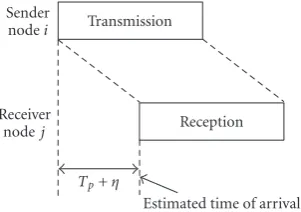
Figure1: Physical layer-based time delay model.
the synchronization error of the DCTS algorithm due to Gaussian random delays between nodes.Section 4discusses the convergence characteristics of the global synchronization error for several structured networks. Simulation results are presented in Section 5, and we conclude our discussion in
Section 6.
2. Background and System Model
2.1. Time Delay for Local Time Information Exchange. The DCTS algorithm requires local time information exchange between two or more nodes in a wireless sensor network. This exchange can occur using either MAC layer time-stamped packets or via physical layer pulse signals. In either case, the delay between two network nodes is defined as the interval between when the time information is generated by the sender node and when this information is determined by the receiver node. Furthermore, in either case, this delay can be comprised of a deterministic and a random portion. In the following, we discuss the delay sources at the two layers and argue that, in both cases, a common underlying model of Gaussian delay uncertainty can be adopted. (We have separately examined the performance of the DCTS algorithm considering alternate delay distributions, e.g., exponential delay distribution [7]. Results show similar performance bounds as those presented in this paper for the Gaussian assumption. For this reason, we constrain our discussion here to the more common Gaussian delay model.)
2.1.1. Physical Layer-Based Time Delay. Sender nodes using physical layer synchronization algorithms convey local time information to receiver nodes by transmitting pulse signals according to their local clocks. The receiver node, however, estimates the arrival time of the pulse signal as the clock of the sender node. As shown inFigure 1, there is an offset between the transmit time of the pulse at the sender and the arrival time estimate at the receiver.
One source of this lag is Tp, the propagation delay between the sender and receiver nodes. The propagation delay is related to the distance between the two nodes such thatTp=i j/c, wherei jis the distance between nodesiand
jandcis the speed of light. Once the pulse signal propagates to the receiver, the receiver node takes some time to reliably detect the pulse signal and to make an arrival time estimate.
Tx process Access Transmission
Reception Rx process Sender
nodei
Receiver nodej
Tt p Ta Tp Tr Tr p
Tt
Figure2: MAC layer-based time delay model.
We assume the arrival time estimation procedure at the receiver will automatically compensate for this detection and estimation delay. However, since the pulse signal is received in noise (and may additionally experience fading over the wireless link), the actual arrival time estimate produced at the receiver will have an associated error. It is known from parameter estimation theory that any maximum likelihood (ML) estimator is asymptotically unbiased, and an ML estimate is asymptotically Gaussian distributed [8]. Thus, if an ML arrival time estimator is employed at the receiver, the arrival time estimation error can be modeled as a Gaussian random variable, νPHY, with zero mean and varianceσPHY2 (the variance of arrival time estimator). In the physical layer delay model used here, we assume such an estimation error and write the total delay between the transmit time and estimated arrival time of a pulse signal as
TPHY-delay=Tp+νPHY. (1)
2.1.2. MAC Layer-Based Time Delay. At the MAC layer, local time information at a sender node is clocked and incorporated into a packet during packet formation. The overall delay between two nodes exchanging such time-stamped packets is, therefore, the time interval between when the sender time is clocked and when the receiver node decodes this time information from its received packet [9]. The sources of delay during this interval are shown in
Figure 2.
The major sources of random delay at the MAC layer are Tt p, the transmission processing time; Ta, the channel access time; and Tr p, the receiver processing time. The delay in processing a packet (at either the transmitter or receiver) depends on several factors such as the protocol processing time, the CPU load, and delays in the operating system.Ta, on the other hand, is the time the sender node that must wait to access the transmit channel, which is determined by the MAC protocol in use as well as the current network traffic. Here, we assume the overall delay,
a Gaussian random variable with meanμMAC = E(Tt p) +
E(Ta) +E(Tr p) and varianceσMAC2 = Var(Tt p) + Var(Ta) + Var(Tr p). Additionally, the packet experiences a propagation delay ofTp; the overall MAC layer delay is therefore given as
TMAC-delay=Tp+νMAC. (2)
In the following, we use a general delay model that incorporates the two delay calculations for the physical and MAC layers, that is, we assume
Tdelay=Tc+Tp+ν, (3)
whereTcis a constant equal to zero for physical layer-based schemes andμMACfor MAC layer-based schemes; andνis a zero mean Gaussian random variable. The variance ofν,σ2, is equal toσPHY2 for physical layer schemes and toσMAC2 for MAC layer-based schemes.
2.2. DCTS Algorithm With Gaussian Delay. In each iteration of the DCTS algorithm, each node processes and decodes the time-stamped message from its neighbors in the MAC layer-based approach or estimates the arrival time of its neighbors’ pulse signals in the physical layer scheme. Each node then updates its local clock time using the weighted average of the time differences with its neighbor nodes. It is well known that in a connected network with nonrandom delay between nodes, this DCTS algorithm can reachaverage consensus[10]; that is, all nodes converge to the average of the initial timing differences between the nodes.
Our study focuses on the operation of the DCTS algorithm when there are both deterministic and random (Gaussian) delays during local time information exchange, as described above. In this case, the timing update rule of the DCTS algorithm at each nodeiis given as
ti(k+ 1)=ti(k) +ε
j∈Ni
tj(k)−ti(k), (4)
whereti(k) is the local time at nodeiduring iterationk;Niis the set of neighboring nodes that can communicate reliably with nodei;tj(k)=tj(k)+Tdelay=tj(k)+Tc+i j/c+vj(k);Tc is the constant delay defined above;εis the constant step size for each iteration;vj(k) are i.i.d Gaussian random variables, with zero mean and variance σ2. Local time information exchange between nodesiand j under this delay model is shown inFigure 3.
The DCTS algorithm in (4) can be rearranged as
ti(k+ 1)=ti(k) +ε
j∈Ni
tj(k)−ti(k)+ni(k), (5)
whereni(k)=εj∈Ni[Tc+i j/c+vj(k)]. It should be noted that ni(k) and nj(k) might not be independent between nodesiandjsince the two nodes might have identical noise coming from some potentially overlapping neighbors.
2.3. Network Model and Some Preliminaries. In the following, we model a wireless sensor network as an undirected graph
tj(k)
tj(k)
ti(k+ 1)
ti(k+ 1)
Tc+Tp+vi(k) Tc+Tp+vi(k+ 1)
Nodei
Nodej
Figure3: DCTS algorithm with Gaussian delay during local time information exchange.
G=(V,E), consisting of a set ofnnodesV = {1, 2,. . .,n} and a set of edgesE. (The convergence properties presented here can be easily extended for a directed graph. We omit this extension here.) Each edge is denoted ase =(i,j)∈E wherei∈Vandj∈Vare two nodes connected by edgee. We assume that the presence of an edge (i,j) indicates that nodesiandjcan communicate with each other reliably. We assume here a connected graph; that is, there exists a path connecting any pair of distinct nodes in the network.
Given this network model, we denoteAas the adjacency matrix ofGsuch that
Ai,j=
⎧ ⎨ ⎩
1, i,j∈E,
0, otherwise. (6)
Next, we letLbe the graph Laplacian matrix ofGwhich is defined as
L=D−A, (7)
where D = diag(d1,d2,. . .,dn) is the degree matrix of G. Specifically,diis equal to the number of neighbors of node
iwith which it can communicate reliably, that is,di= |Ni|. Given this matrixL, we can show thatL1=0and1TL=0T, where1=[1, 1,. . ., 1]T and0 =[0, 0,. . ., 0]T. Additionally,
Lis a symmetric positive semidefinite matrix (implying its eigenvalues are all nonnegative), and for a connected graph, the rank ofLisn−1 and its eigenvalues can be arranged in increasing order as 0=λ1(L)< λ2(L)≤ · · · ≤λn(L) [11]. We now define vectorst(k) = [t1(k),t2(k),. . .,tn(k)]T and
n(k)=[n1(k),n2(k),. . .,nn(k)]T. Based on these definitions, the evolution of DCTS algorithm in (5) can be written as
t(k+ 1)=Ht(k) +n(k), (8) where H = In−εL is called a Perron matrix of a graph with parameter ε [3]. Here,In denotes the n×n identity matrix. The eigenvalues of H are λi(H) = 1 − ελi(L) and can be ordered in decreasing order: 1 = λ1(H) >
eigenvalues of the Laplacian matrixL. However, in practical applications, a numerical solution can be obtained offline based on node deployment within a given wireless sensor network, and this εopt can then be flooded to all nodes before they run the DCTS algorithm.) Let us definev(k)= [v1(k),v2(k),. . .,vn(k)]T and u = [u1,u2,. . .,un]T, where
ui=
j∈Ni(Tc+i j/c). Then the noise vector in (8) is given asn(k)=ε[u+Av(k)].
When there is no Gaussian delay between nodes, it can be shown that [10,12], for a time-invariant, connected, undi-rected network, whenε∈(0, 2/λn(L)),average consensuscan be asymptotically achieved by the DCTS algorithm, that is, limk→ ∞Hk = (1/n)11T.In our discussion, we also assume an undirected, connected network with a constant step size 0< ε <2/λn(L) unless otherwise stated.
In the following analysis, we use the following matrices:
K =(1/n)11T,P =H−K andQ=I
n−K. For matricesP andQ, it is straightforward to show that (1) the eigenvalues ofPagree with those ofHexcept thatλ1(H)=1 is replaced byλ1(P)=0; (2)Pk=Hk−Ksuch that limk→ ∞Pk=0n; and (3)QPkQ=PkandQk=Q.
3. Convergence Analysis of DCTS Algorithm
with Gaussian Delay
Let us define the average value in each iteration asm(k) = (1/n)1Tt(k). Then, mean of the average valuem(k) in each iteration of the DCTS algorithm ism(0) +kε/nni=1ui, and the variance of the average value iskε2σ2/n2n
i=1d2i.It can be seen that as iteration time increases, both mean and variance increase linearly with the time index k. Furthermore, the variance ofm(k) increases linearly with the variance of the random Gaussian delay,σ2.
3.1. Expectation and Second Central Moment of Disagreement Vector. We now define the disagreement vector as δ(k) =
t(k)− Kt(k); that is, δ(k) is the difference between the updated times and the actual average times of the network nodes. Then, the disagreement vector evolves as δ(k) =
Pδ(k−1) +Qn(k−1).
Lemma 1. For the DCTS algorithm in(8), the expectation of disagreement vector is
E[δ(k)]=Pkδ(0) +ε
k−1
l=0
PlQu. (9)
The proof of this lemma is straightforward and thus omitted from the paper. Let us define the second central moment of disagreement vector as κδ(k) = E{(δ(k) −
E[δ(k)])T(δ(k)−E[δ(k)])}. We next note the following.
Lemma 2. For the DCTS algorithm in(8), the second central moment of disagreement vector is given as
κδ(k)=δ(0)TP2kδ(0) +ε2σ2tr
⎛ ⎝Qk−1
l=0
P2lQA2
⎞
⎠, (10)
wheretr(·)denotes the trace of a matrix.
Proof. Please see Appendix.
3.2. Asymptotic Expectation of Global Synchronization Error. UsingLemma 1, we see that the steady state of expectation of disagreement vector is
μ(∞)=. lim
k→ ∞E[δ(k)]=ε(In−P)
−1Qu. (11)
Let us defineW1 = (In−P)−1; then the eigenvalues ofW1 areλ1(W1)= 1 andλi(W1)= 1/[ελi(L)], i = 2,. . .,n. For thisμ(∞), we can show that.
Theorem 1. In a network with fixed, connected topology,μ(∞) in(11)is a constant vector independent of the constant value ofε.
Proof. Let us denote the eigenvectors ofW1asωi. It is easy to check that the eigenvector corresponding toλ1(W1)=1 is ω1=1.μ(∞) in (11) can thus be written as
μ(∞)=ε11TQu+
⎡
⎣n
i=2 1
ελi(L)ωiω T i
⎤
⎦Qεu
=(L+K)−1Qu.
(12)
Thus,μ(∞) does not depend onε.
Thus, for a constant step size ε, the steady state of expectation of disagreement vector is a constant vector regardless of ε. In other words, in a network with fixed topology, the expectation of global synchronization error is the same regardless of the speed of synchronization.
In general, we see that the DCTS algorithm with Gaussian delay cannot achieve average consensus sinceμ(∞) is a linear function ofu(is not equal to0). This global synchronization error can be viewed as the accuracy of time synchronization algorithm. If this synchronization error is tolerable or small compared to time resolution of the system, we say that this DCTS algorithm still achieves the average consensus but with “tolerable synchronization error”. Let us now define the asymptotic expectation of pairwise synchronization error as
Δti,j= lim
k→ ∞E
ti(k)−tj(k)=μi(∞)−μj(∞), i,j∈V.
(13)
Hence, the maximum asymptotic expectation of global synchronization error between any two nodes is Δtmax = max{|Δti,j|}. It is worth mentioning that, under certain net-work topologies (e.g., the ring netnet-work studied inSection 4), average consensus can still be asymptotically achieved when using the DCTS approach under Gaussian delays.
Recall thatμ(∞)=(L+K)−1Qu. In this equation,Qu=
u−Kuis the disagreement vector ofu. Whenu = Ku, we see thatj∈Ni(Tc+i j/c)=
m∈Nk(Tc+km/c), for (i,j)∈ E and (k,m) ∈ E. More specifically, when di = dj and
nodes can be canceled if each node receives the same amount of time delay from all neighbors; networks that meet this condition are defined as follows.
Definition 1. A network is called “time delay balanced network” if j∈Ni(Tc + i j/c) =
m∈Nk(Tc + km/c), for (i,j)∈Eand (k,m)∈E, or equivalently,Δtmax=0.
Otherwise we refer to the network as “time delay unbal-anced”. It is worth mentioning that a similar definition of “equal delay networks” was discussed in [13] for continuous time network synchronization. Based on the definition above, we see that time delay balance may be readily (but not exclusively) achieved in well-structured networks.
3.3. Asymptotic Mean Square Synchronization Error. Using
Lemma 2, the steady state of second central moment of disagreement vector is square time synchronization error as
σΔ2t= lim
which indicates the amount of error by which the updated time at each node differs from the average value over alln
nodes. We see that
σΔ2t=uTQ(L+K)−2Qu+ε2σ2tr
W2A2
. (16)
Theorem 2. For a connected, time delay unbalanced network,
σ2
Proof. Please see the Appendix.
Based on this result, it can be seen that the lower and upper bounds ofσ2
Δtare determined by several values related to network parameters: eigenvalues ofLandA2, total degree of network, step size, and delay time vector.
4. DCTS Algorithm with Gaussian Delay in
Structured Networks
In this section, we apply the DCTS algorithm under Gaussian delay for several structured networks. In particular, we study
the structured networks as they are analytically tractable, provide some valuable insights, and can be used to validate our analytical findings. (Typical sensor network deployments may in fact have a random topology. We study how our results extend to such random network scenarios using simulation in Section 5.) Specifically, we analyze at the impact of Gaussian delay when using DCTS in the following networks.
Definition 2(A Ring Network with Equal Distance (Rn)). A ring network is a network that consists of a single cycle. The ring network with equal distance is a ring network that hasn
nodes,nedges, andc =i j =kmfor (i,j)∈E and (k,m) ∈E.
Definition 3(A Star Network with Equal Distance (Sn)). A star network is a network that consists of edge set{(i,n), 1≤
i < n}. The star network with equal distance is a star network that hasnnodes,n−1 edges, andc=i j=kmfor (i,j)∈E and (k,m)∈E.
Definition 4 (A Hypercube Network with Equal Distance Degree (Hn)). A hypercube network with equal distance degree is a hypercube network that hasnnodes,nlog2nedges andj∈Nii j=
i∈Njji.
Figure 4illustrates several examples of such networks. In the following, we simply present convergence results for these structured networks without proof.
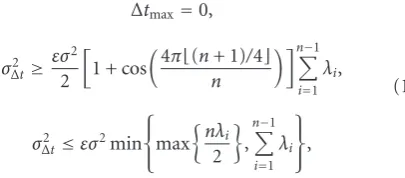
4.1. Convergence Properties for Ring Networks. For a ring networkRn, the DCTS algorithm in (8) produces a global synchronization error with the following properties:
Δtmax=0,
Rnis a time delay balanced network.
4.2. Convergence Properties for Star Networks. For a star networkSn, the DCTS algorithm in (8) produces a global synchronization error with the following properties:
(a) (b) (c)
Figure4: Structured networks: (a)R8, (b)S8, and (c)H8.
The star networkSnis time delay unbalanced. Further-more, it should be noted that when operating the DCTS algorithm withεopt, we get thatκδ(∞)=(n−1)σ2/n. This is becauseW2can be simplified in this case to ((n+ 1)2/4n)Q. As a result, we see that asnbecomes large,κδ(∞)≈σ2.
4.3. Convergence Properties for Hypercube Networks. For a hypercube networkHn, the DCTS algorithm in (8) produces a global synchronization error with the following properties:
Δtmax=0,
σΔ2t≥
⎧ ⎪ ⎪ ⎪ ⎨ ⎪ ⎪ ⎪ ⎩
0, whenϑnis even,
εσ2 ϑn
i=1
ϑn
i !
λi, whenϑnis odd,
σ2
Δt≤εσ2ϑnmin
⎧ ⎨
⎩max{nλi},ϑn ϑn
i=1
ϑn
i !
λi
⎫ ⎬ ⎭,
(20)
where ϑn = log2n andλi = 1/(4i−4εi2),i = 1,. . .,ϑn. Since Δtmax = 0, the hypercube network is also time delay balanced.
5. Simulation Results
The simulation parameters are described as follows: initial time phase of node i is (i−1/2)T/n, i = 1,. . .,n, where
T = 1000μs, and the standard deviation of delay variance isσ = 1μs. The simulation results are based on 5000 runs. (Trends similar to the ones noted below were observed when initial time offsets between nodes were arbitrary (e.g., when they were uniformly distributed over [0,T]). We use this fixed offset assumption here for comparison purposes.)
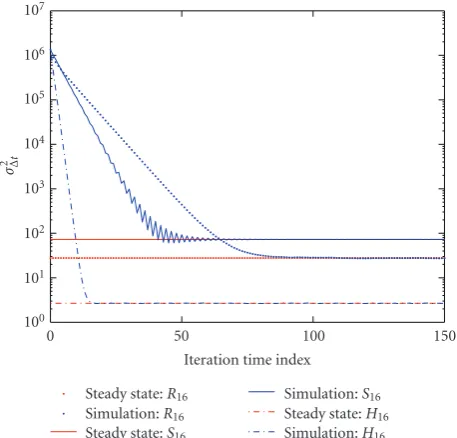
5.1. Structured Networks. In our simulations of structured networks, we assume ucp = Tc + c/c = 10μs and the optimal constant step size is εopt. The simulation results and asymptotic mean square time synchronization errors for structured networks with 16 nodes are shown in
Figure 5. The asymptotic mean square (steady-state) time synchronization errors σΔ2t are calculated from (16). It can be seen that as the time index increases, the mean square time synchronization errors approach their respective steady state values when using DCTS with Gaussian delay. As expected, DCTS algorithm in a hypercube network achieves
100 101 102 103 104 105 106 107
σ
2 Δt
0 50 100 150
Iteration time index Steady state:R16
Simulation:R16 Steady state:S16
Simulation:S16 Steady state:H16 Simulation:H16
Figure5:σ2
Δtas a function of the iteration time index for the DCTS
algorithm in structured networks with Gaussian delay between network nodes.
0 0.1 0.2 0.3 0.4 0.5 0.6 0.7 0.8 0.9 1
0 0.1 0.2 0.3 0.4 0.5 0.6 0.7 0.8 0.9 1
Figure6: Random network with 16 nodes.
the smallest variance of synchronization error and the fastest convergence among those structured networks. This is primarily due to the high degree of connectivity in the hypercube network, which also results in the smallest value ofεopt.
−500
−400
−300
−200
−100
0 100 200 300 400 500
E
[δi
(
k
)]
Δtmax
0 5 10 15 20 25 30 35 40 45 50
Iteration time index
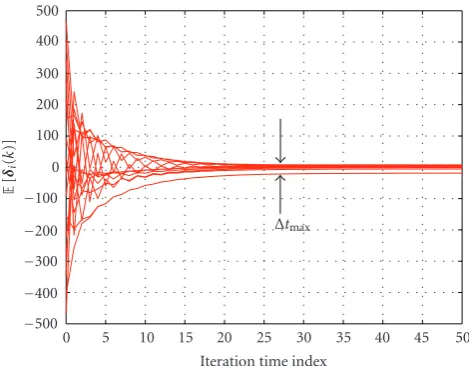
Figure 7: Disagreement evolution of the DCTS algorithm in a random network with Gaussian delay.
Figure 7 shows the simulation results of E[δi(k)] in a particular realization of the random network. We chooseεopt for this simulation. It can be seen that, asymptotically, there exists global synchronization error between some pairs of nodes, and Δtmax = 26.4130μs for this random network. If we specify a threshold ΔtTh to be greater than or equal to this Δtmax, we call this network as “average consensus achievable with tolerable synchronization error” as described inSection 3.2.
As mentioned above, the generation of random networks depends on two parameters: the number of users n and the predefined threshold η. In order to better understand the performance of DCTS algorithm with Gaussian delay in such networks, we show the asymptotic values of σΔ2t andΔtmax in random networks as functions of nandηin Figures8and9. For a given value ofnandη, the presented asymptotic values were averaged over 1000 realizations of the random network, where we excluded disconnected network realizations. From the plots, we see that with the same thresholdη, the asymptotic values ofσ2
ΔtandΔtmaxdecrease as the number of nodes increases. Similarly, with the same number of nodes in the networks, σ2
Δt and Δtmax decrease as threshold η increases. This is primarily due to the fact that when the number of nodes or threshold increases, the random network behaves more like a “time delay balanced network”.
6. Conclusions
In this paper, we present theoretical results on the conver-gence of the DCTS algorithm for wireless sensor networks with general Gaussian delay between nodes. Specifically, we compute the asymptotic expectation and mean square of the global synchronization error of the DCTS algorithm. The results lead to the definition of a time delay balanced networkin which average timing consensus between nodes can be achieved despite random delays. Furthermore, several structured network architectures are studied as examples,
0 0.5 1 1.5 2 2.5 3 3.5
×104
σ
2 Δt
100 80
60 40
20 Nu
mber of
nodes 0.4 0.5 0.6
0.7 0.8
Threshold
η
Figure8:σ2
Δtas a function of the number of nodes and thresholdη
for the DCTS algorithm in random networks with Gaussian delay.
0 20 40 60 80 100
Δ
tmax
100 80
60 40
20 Nu
mber of
nodes 0.4 0.5
0.6 0.7 0.8
Threshold
η
Figure9:Δtmaxas a function of the number of nodes and threshold ηfor the DCTS algorithm in random networks with Gaussian delay.
and their associated simulation results are used to validate analytical findings. In the future, we intend to investigate the effects of skew, link failure, and other practical conditions when utilizing the DCTS algorithm in wireless sensor networks.
Appendices
A. Proof of
Lemma 2
Proof. Define"δ(k)=δ(k)−E[δ(k)]. Then, the dynamics of this vector is given as follows:
"
δ(k)=Pδ"(k−1) +εQAv(k−1). (A.1)
To prove this lemma, we can consider the evolution of covariance matrix of disagreement vectorΣδ(k) instead since
Then, the proof of the lemma is equivalent to proving the The statement is obviously true fork = 1. Now let us assume that the statement is true whenk=m, (m >1), that
B. Proof of
Theorem 2
Before proving the theorem, first we present some known results.
Theorem 3. For any matrixA1and any symmetric matrixA2, letA1=(A1+AT1)/2, then one has [14] whereλi(·)denotes theith smallest eigenvalue of a matrix. In particular, ifA2is a positive semidefinite matrix, one has
λ1 IfA1is a positive semidefinite matrix, replacingA1with
A2in (B.2), we have [15] Combining (B.2) with (B.3), we have the following theorem.
Theorem 4. If A1 and A2 are two positive semidefinite matrices, one has
max{λ1(A1)tr(A2),λ1(A2)tr(A1)} ≤tr(A1A2)
≤min{λn(A1)tr(A2),λn(A2)tr(A1)}.
(B.4)
We can now proveTheorem 2.
Proof. We know that the eigenvalues of (L+K)−2are 1 and
This completes the proof.
References
[1] D. Culler, D. Estrin, and M. Srivastava, “Overview of sensor networks,”Computer, vol. 37, no. 8, pp. 41–49, 2004. [2] A. Scaglione and R. Pagliari, “Non-cooperative versus
[4] L. Schenato and G. Gamba, “A distributed consensus protocol for clock synchronization in wireless sensor network,” in Proceedings of the 46th IEEE Conference on Decision and Control (CDC ’07), pp. 2289–2294, New Orleans, La, USA, December 2007.
[5] O. Simeone and U. Spagnolini, “Distributed time synchroniza-tion in wireless sensor networks with coupled discrete-time oscillators,” EURASIP Journal on Wireless Communications and Networking, vol. 2007, Article ID 57054, 13 pages, 2007. [6] L. Xiao, S. Boyd, and S.-J. Kim, “Distributed average consensus
with least-mean-square deviation,” Journal of Parallel and Distributed Computing, vol. 67, no. 1, pp. 33–46, 2007. [7] H. S. Abdel-Ghaffar, “Analysis of synchronization algorithms
with time-out control over networks with exponentially symmetric delays,”IEEE Transactions on Communications, vol. 50, no. 10, pp. 1652–1661, 2002.
[8] J. Proakis, Digital Communications, McGraw-Hill, Boston, Mass, USA, 4th edition, 2000.
[9] J. Elson, L. Girod, and D. Estrin, “Fine-grained network time synchronization using reference broadcasts,” in Proceedings of the 5th Symposium on Operating Systems Design and Implementation (OSDI ’02), pp. 147–163, Boston, Mass, USA, December 2002.
[10] R. Olfati-Saber and R. M. Murray, “Consensus problems in networks of agents with switching topology and time-delays,” IEEE Transactions on Automatic Control, vol. 49, no. 9, pp. 1520–1533, 2004.
[11] R. A. Horn and C. R. Johnson,Matrix Analysis, Cambridge University Press, Cambridge, UK, 1985.
[12] L. Xiao and S. Boyd, “Fast linear iterations for distributed averaging,” in Proceedings of the 42nd IEEE Conference on Decision and Control (CDC ’03), vol. 5, pp. 4997–5002, Maui, Hawaii, USA, December 2003.
[13] W. C. Lindsey, F. Ghazvinian, W. C. Hagmann, and K. Dessouky, “Network synchronization,”Proceedings of the IEEE, vol. 73, no. 10, pp. 1445–1467, 1985.
[14] J. B. Lasserre, “A trace inequality for matrix product,”IEEE Transactions on Automatic Control, vol. 40, no. 8, pp. 1500– 1501, 1995.
[15] W. Xing, Q. Zhang, and Q. Wang, “A trace bound for a general square matrix product,” IEEE Transactions on Automatic Control, vol. 45, no. 8, pp. 1563–1565, 2000.