R E V I E W
Open Access
Information-centric mobile caching
network frameworks and caching
optimization: a survey
Hao Jin
*, Dan Xu, Chenglin Zhao and Dong Liang
Abstract
The demand for content oriented service and compute-intensive service stimulates the shift of current cellular networks to deal with the explosive growth in mobile traffic. Information centric mobile caching network architectures have emerged in Information-Centric Networking as well as mobile cellular and ad-hoc networks deployed with caches. Caching optimization based on information centric mobile caching has become the key issue, and several significant research challenges remain to be addressed before its widespread adoption. In this paper, a brief survey on Information centric mobile caching network architecture and caching optimization is presented, including cache placement in different mobile wireless network architectures, the taxonomy of cache insertion and eviction policies, the modeling behavior of caching networks as well as caching optimization based on network centric and user centric metrics, and typical applications based on mobile caching. Finally, the research directions and open challenges are investigated.
Keywords:Mobile Caching, Information-Centric Networking, Mobile wireless network architecture, Cache policy
1 Introduction
With tremendous numbers of smart phones, laptops and tablets, more and more users demand for content oriented service and compute-intensive service. Such an explosive growth in mobile traffic really leads to a significant para-digm shift in current cellular networks. Among the new service paradigms, contents based mobile multimedia vid-eos which would be implemented by duplicating and dis-tributing a few popular large size contents to mobile devices become an important portion of the mobile traffic. Since most users are mainly interested in accessing vast amount of information instead of physical location, the paradigm shift in the usage model of the Internet leads to the investigation of new networking paradigm, namely Information-Centric Networking (ICN) [1].
ICN shifts internet usage from a sender-driven end-to-end communication paradigm to a receiver-driven con-tent retrieval [2]. The architecture of ICN supports transparent and ubiquitous in-network caching to speed
up content distribution and provides users with mobility and flexibility in accessing and generating information.
The quality of experience of users would be affected during the time when they are downloading and caching contents due to mobility. As a result, integration of the ICN paradigm and mobile wireless networks is a promis-ing direction for future mobile networks [3]. In order to incorporate ICN with mobile networks, in-network caching strategy is one of the crucial issues since it would influence the performance and leverage the cost of mobile wireless networks. On the one hand, caching decreases the average user-perceived delay and the re-dundant traffic load by caching duplicates of popular contents in the local routers or access points (APs), and in turn relieves the pressure on remote servers. On the other hand, according to the prediction of Moore’s law (and recently by Kryder’s law), the capacity of storage units has increased exponentially over the past thirty years with consistently declining costs per stored bit [4]. The cheap price of caches also contributes to the de-ployment of information centric caches on the edge of networks, thus the deployment of caching resources on edge equipments (e.g. smart mobile devices) gains * Correspondence:[email protected]
The Key Laboratory of Universal Wireless Communications for Ministry of Education, Beijing University of Posts and Telecommunications, Beijing 100876, China
attention, and information centric mobile caching be-comes a significant challenge for providing content ori-ented services.
In order to enable mobile users to access nearby net-work caching elements such as servers or mobile devices for popular contents, effective mobile caching strategies are provided to reduce duplicating content transmissions by adopting intelligent caching strategies inside mobile networks. These mobile caching strategies can be refined on three key issues: namely cache placement selection, cache policy design and cache content selection.
Cache placement selection refers to where to cache contents in the mobile wireless networks. In fact, caches can be deployed in various network elements depending on network architectures. Base stations, APs and mobile nodes can be equipped with caches to support content exchange. That is to say, the issue of cache placement would affect the framework of mobile wireless networks.
Cache policy design focuses on how to cache contents in cache-enabled mobile networks. It refers to different policies on caching insertion and caching eviction. Cach-ing insertion policies decide whether to cooperate with other caching nodes and how contents or chunks can be stored in the caches, and caching eviction policies con-cern the dynamics of contents in the caches.
Cache content selection involves what contents to be cached, which are to be updated. Content popularity is often used as an important factor for accelerating content retrieval, while content diversity for increasing the types of contents cached locally means that even popular contents should not be cached in multiple local caching nodes.
Since the resources in the network are constrained, which include cache, computing, energy and transmis-sion bandwidth resources, it is of great significance to optimize what contents to cache and how to insert and evict contents from the caches considering both content popularity, content diversity and node mobility in order to achieve ideal performances with various optimization objectives. Caching optimization deals with the problems from the point of view of optimization on network/user centric performances based on different network archi-tectures, analytical modeling methods and content cach-ing policies.
This paper aims to present a survey on information-centric mobile caching and its optimization. The main content is summarized as follows: (1) Focusing on cache placement selection, the cache placement in dif-ferent mobile wireless network architectures are ana-lyzed; (2) On cache policy design, taxonomy of cache insertion and eviction policies is provided, and state-of-the-art methods are investigated; (3) On caching optimization, caching behavior modeling is illustrated, then network centric and user centric optimization is-sues are surveyed.
The remainder of the paper is organized as follows. In section 2, ICN and some mobile network caching archi-tectures are introduced, and the comparison of caching placement methods in different mobile wireless network architectures is given. In section 3, content cache pol-icies are illustrated in detail, including caching insertion policies and caching eviction policies. In section 4, re-search issues on network centric and user centric cach-ing optimization are introduced, includcach-ing modelcach-ing behavior of the caching system, related analytical model-ing methods as well as simulation. In section 5, some content based applications are given. In section 6, sev-eral research challenges and open issues are provided. Section 7 concludes the paper.
2 Mobile wireless caching frameworks
ICN supports in-network caching and decouples infor-mation from its sources as an appropriate approach to achieve information distribution and mobility support. The ubiquitous in-network caching opens up many op-portunities for exploiting content awareness in order to place information closer to the user due to its explicit naming of content rather than communication end-points. Along with the dramatic developments of mobile wireless networks for information centric services, evo-lutional architectures and procedures for future access networks based on ICN become a promising direction to promote the integration of cellular and wireless access technologies with ICN [3, 5].
In this section, different caching frameworks are inves-tigated, including caching frameworks based on ICN, mobile cellular network, mobile ad hoc network and hy-brid network.
2.1 Caching Framework based on Information-Centric Networking
well as mobility management of consumers and lishers. The main elements in ICN are content pub-lishers, end users (content subscribers) and cache-enabled content routers (CRs).
For information naming in ICN, the content name is the only identifier for content objects, which permits ei-ther the end-user or the intermediate networking unit to locate the best content holder. Besides the fundamental property of identifying the different content, information naming is globally unique, location independent, self-defined and security intergraded. Hierarchical naming and flat naming are two categories of ICN naming structures which are mainly supported in existing ICN solutions [6].
The name-based ICN routing can be realized by the undirected naming resolution service and the direct name based routing. The naming resolution requires one or several centralized servers (e.g. RendezVous points, register servers, trigger points, etc.) in the net-working topology. The content publications are collected in these servers, which have a global view of all the pub-lished content objects and the networking topology. When an ICN router wants to forward a request mes-sage, the routing path is calculated in the centralized ser-ver by existing routing protocol. The name based routing is directly performed in the ICN routers. Each router has a local forwarding information base which is filled by the content publication messages. The request forwarding paths are calculated in the local routers by their own forwarding strategies [6].
Mobility and caching are realized by information nam-ing, name resolution and data routing in ICN. In ICN, caching is ubiquitous. On-path and off-path caching are supported by name resolution request process. In on-path caching, the network places information cached along the path taken by a name resolution request, while in off-path caching, the network exploits information cached outside that path. For mobility support, sub-scriber mobility and publisher mobility are distinguished. Subscriber mobility is intrinsically supported in ICN ar-chitectures, since mobile subscribers can just send new subscriptions for information after a handoff. Publisher mobility is more difficult to support compared to sub-scriber mobility, because the name resolution system (in the coupled approach) or the routing tables (in the decoupled approach) need to be updated [1].
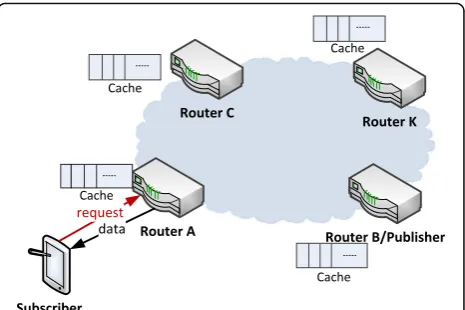
Figure 1 gives the abstract architecture of caching framework based on ICN, in which caches are usually placed at every CR.
Some ICN architectures are constructed since 2007 [1, 7] including DONA, 4WARD, PSIRP, COMET, CON-VERGENCE, NDN/CCN, PURSUIT, SAIL, MobilityFirst, ANR Connect, CBMEN, NDN-NP, MobilityFirst-NP, Green-ICN, I-CAN, COMIT, POINT, UMOBILE, RIFE, BONVOYAGE, etc. [8–14].
From the perspective of relevant projects, most of the projects which have launched from 2007 to 2012 focus on theoretical research such as architecture, naming, routing, forwarding and security. While the majority of the projects launched since 2013 are concentrated on specific application scenarios to enhance the architec-tures, such as Internet access, opportunistic communica-tions as well as multimodal transport. The business models for ICN and the migration strategies are also concentrated which are compatible with TCP/IP, such as IP over ICN. Consequently, the study on ICN has been shifted from theoretical research to some specific appli-cations practice [7]. Since the main topic of this paper is on mobile caching framework and caching optimization, and information centric caching and its mobility support mechanisms are distinct depending on various ICN ar-chitectures, in this section, caching and mobility support are surveyed based on several typical ICN architectures.
DONA [1, 15] is one of the first complete ICN archi-tectures with flat names proposed by UC Berkeley. DONA supports on-path caching by Resolution Handler (RH) infrastructure. A RH which decides to cache a re-quested data object can replace the source IP address of an incoming FIND request with its own IP address be-fore it forwards the message to the next RH. Once the response traverses the current RH, the data returned would be cached. If path-labels are used, the data always return via the intermediate RHs, which can make a caching decision or not. If a subsequent FIND message requesting the same object reaches a caching RH, the RH can directly return the data to the subscriber. Infor-mation may also be replicated off-path if the inforInfor-mation through its local RH is registered. A RH receiving mul-tiple REGISTER messages for the same information maintains (and propagates upwards) only the pointers to the best available copy. Mobile subscribers can simply send new FIND messages from their current location relying on the RH infrastructure to provide them with
the closest copy of the information. Mobile publishers can also unregister and re-register their information when changing their network location [1].
CCN [1, 16] architecture is the other fully-fledged ICN architecture presented by PARC. NDN [17] project funded by the US Future Internet Architecture project develops the CCN architecture. NDN supports on-path caching, since each CR first consults its Content Store (CS) whenever it receives an INTEREST message and caches all information objects carried by DATA mes-sages. A CS just caches every incoming Data packets [18, 19] temporarily in order to avoid packet losses and satisfy requests for the same data subsequently. NDN supports Off-path caching by delivering an INTEREST to any data source that may be hosting the requested in-formation object. Subscriber mobility is implemented by sending new INTEREST messages from its current loca-tion for the informaloca-tion objects it has not received yet. Publisher mobility is enabled by Forwarding Information Base which requires advertising the name prefixes for the information it is hosting via the routing protocol again [1].
As one of the important architectures proposed by EU Framework 7 Programme, PURSUIT constructs architec-ture with a publisher-subscriber protocol stack. PURSUIT supports both path and off-path caching. In the on-path caching, forwarded packets are cached at Forwarding Nodes to serve subsequent requests. However, on-path caching may not be very effective because name resolution is decoupled from data routing. In the off-path caching, caches act as publishers by advertising the available infor-mation to the Rendezvous Network. Mobility is facilitated by multicast and caching [20]. Four types of mobility cases are considered. Local subscriber mobility can be handled via multicast and caching, while Publisher mobility is harder to support since the publisher’s new position infor-mation in the network need to be notified to the topology management function. In PURSUIT, Publish-Subscribe systems are organized as a collection of autonomous com-ponents [21], so clients act either as publishers who pub-lish new events in the network or as subscribers who subscribe events they are interested in.
The SAIL architecture supports on-path caching at the CRs. In SAIL, the caches are regarded as publishers by envisaging the deployment of large scale information object caching and replication mechanisms cooperative with the Name Resolution System (NRS). SAIL considers a hierarchy of caches in which local caches are part of a tree which includes a small number of caching servers at the root. The caches which are in the higher level of the hierarchy have larger storage space in order to store popular objects, which would have been evicted by local caches because of their limited storage size. Cache re-placement policies are also investigated on which
popular objects are dynamically moved to caches that are closer to the consumers. Host mobility is enabled by maintaining topological information for each registered host by the NRS. Upon a change of location, the moving host updates the topological information in the NRS where it is registered and a notification is issued to the nodes which are communicating with the mobile host [1, 22].
COMET supports on-path and off-path caching. On-path caching originates from name resolution. Register-ing cached copies with the Content Resolution System is required in Off-path caching. In COMET, two novel schemes are proposed which are different from NDN’s “cache everything” on-path caching, one is the Prob-Cache, which is a probabilistic caching scheme [18], the other is the Centrality scheme based on the observation that Content-aware Routers (CaRs) locating on shortest paths are more likely to obtain a cache hit, thus an infor-mation object should only be cached by the CaR with the highest centrality in its path. Mobility-aware CaRs are deployed at the edge of the access networks to sup-port user mobility, and track the mobility of users and context information and can predict their future loca-tions [1].
In CONVERGENCE, on-path caching is supported in a manner similar to NDN. Off-path caching and replica-tion are facilitated by registering addireplica-tional copies of an information object stored at Internal Nodes to the NRS. CONVERGENCE supports subscriber mobility via new requests as in NDN, and Publisher mobility relies on un-specified name resolution system [1, 23].
MobilityFirst supports on-path caching passing mes-sages at intermediate CRs opportunistically, and allows subsequent requests for the same Globally Unique Identi-fier (GUID) to be replied with the locally cached copy. In addition, once an information object is cached off-path or replicated, the Global Name Resolution Service (GNRS) is notified of the change in order to update the correspond-ing GUID entry with the additional network addresses. Despite of the“slow-path”operation which the GNRS can be repeatedly consulted as a message traverses the net-work, each CR can adopt its own policy and decide when to consult with the GNRS for additional cached copies. Addressing host, information, and entire network mobility is another important objective in MobilityFirst. Host mo-bility is primarily handled by GNRS when a network at-tached object changes its point of attachment. Network mobility is also supported. Mobility causes disconnections and variable link conditions in networks, which can be solved by a storage-aware routing mechanism exploited at the intra-domain level by deploying local storage as in delay-tolerant networking [1, 24].
summarized. Besides, some performances of the archi-tectures are investigated based on the ICN archiarchi-tectures surveyed above in the aspect of scalability of control plane, content based caching protocol, information cen-tric context networking and domain clustering based networking. In the following, some improved architec-tures and mechanisms are presented based on the afore-mentioned ICN architectures.
A scalable area-based hierarchical architecture (SAHA) for intra-domain communication is proposed to address the control plane scalability problem in Software defined information centric networking (SD-ICN) in [25]. The SAHA supports scalable awareness of network resources and content resources, and it also guarantees efficient interest matching and resource adaptation.
A decentralized content-based publish/subscribe (CBPS) network for large-scale content distribution is proposed in [26]. The fundamental idea for CBPS net-works to reach the large-scale is to convert the current exhaustive filtering service model into a service model capturing the quantitative and qualitative heterogeneity of information consumer requirements, where a sub-scription has to select every relevant publication. A ser-vice model is designed addressing the consumers’ requirements for content-based information retrieval and the relevant protocols are provided. The proposed approach is evaluated, and different content and interest forwarding strategies as well as caching policies are com-pared in terms of resource efficiency and QoS metrics in realistic workload scenarios.
In [27], an information and context oriented network-ing framework (ICON) is presented to support the de-ployment of pervasive networks by combining two networking paradigms that are highly correlated to the efficiency of data sharing: namely data-centric network-ing and opportunistic networknetwork-ing. ICON incorporates four components, namely Decision Engine, Data Engine, Context Engine and Network Engine. In ICON, data is shared taking into account users’social affinities instead of the capability of devices by using a data-centric for-warding algorithm, which is based on a utility function that reflects the probability of encountering nodes with a certain interest among the ones that have similar daily social habits. The reason to use social proximity with content knowledge is that nodes with similar daily habits have higher probability of having similar content inter-ests; and social proximity metrics allow a faster dissem-ination of data by taking advantage of more frequent and longer contacts between socially closer nodes. How-ever, ICON lacks of evaluation considering node mobil-ity and traffic models.
In order to deal with extensive delivery latency, an ICN based networking method integrated with hash-routing and domain clustering techniques is presented
in [28]. The network is represented as a graph which consists of the sets of routers and communication links and each node of the graph enables to cache and for-ward a request to corresponding caching nodes. Domain clustering technique is used to partition the set of routers of the large domain into clusters containing the subset of routers, and a hash function is implemented at the nodes of each cluster to determine both the content placement and the request-to-cache routing process, thus reducing the retrieval delay.
2.2 Caching Framework based on Mobile Cellular Networks
In general, mobile clients access the network by con-necting to one or multiple APs to obtain mobile multi-media services (e.g. audio and video), when their position changes, they change the AP which they con-nect to. In mobile cellular networks, the APs contain NodeBs in 3G networks and eNBs in 4G LTE networks [29, 30], macro base stations(MBSs)and small cell base stations(SBSs) which are proposed in heterogeneous cel-lular network(HCN) [4, 30–35], as well as Wi-Fi access points and worldwide interoperability for microwave ac-cess (WiMAX) base stations [30].
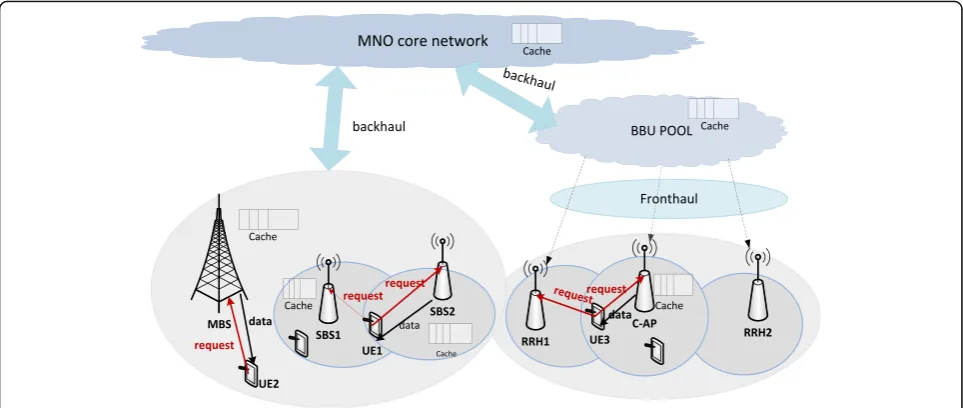
Figure 2 gives the typical architectures and scenarios of caching framework in mobile cellular networks. In mobile cellular network, caches can be deployed either in the core network or in the access networks, and also can be deployed both in the core network and access networks. The MBS and the SBSs are cooperative to cache contents in order to relieve the backhaul traffic load and improve hit rate of contents of mobile users. In cache-based Cloud Radio Access Networks(C-RAN), caches are deployed not only in base-band units (BBU) pool but also in some edge elements such as content ac-cess points(C-APs) and user equipments (UEs).
In this section, the research issues focusing on the caching frameworks based on mobile cellular network are addressed.
In [4], a two-layer cellular caching framework is con-structed to investigate cache aware user association policies. The architecture consisting of a single MBS and a set of SBSs is provided as the cache-enabled architecture based on SBSs, such as picocells, micro-cells or femtomicro-cells overlaid on existing macro-cellular wireless systems. The request is sent to the SBS at first, and if the SBS owns a copy of the requested item, the request can be satisfied locally; otherwise, the re-quest that cannot be satisfied by the SBS is routed to the MBS [32, 34].
In [29], a cooperative cell caching system consisting of some content providers(CPs) and a great number of cells is presented, CPs are outside the mobile network opera-tor(MNO), while cells are inside the MNO network and covers the whole service area. Caching cooperation among cells are used to reduce the transmission latency due to short distance between the cells and mobile users, and redundant data streams are offloaded from the CPs at the same time, therefore heavy burdens on the backhaul channels are alleviated.
The authors in [35] propose a mobile caching frame-work based on the underlying HCN topology. A factor graph is used to represent the framework, where vertex set consists of factor nodes and variable nodes. Each fac-tor node is related to a mobile user and each variable node is related to a SBS.
With the development of cloud computing and virtualization, C-RAN has become a new solution in cel-lular access network. In C-RAN, distributed remote radio heads (RRHs) connect to the BBU pool via fronthauls, while the BBU pool connects to the content cloud through backhaul. According to the C-RAN archi-tecture, a cooperative caching framework is proposed in [36] based on Distributed Cloud Service Network archi-tecture, in which several distributed cloudlets with local caches cooperate and share contents with each other. [37, 38] proposes a cluster content caching structure in Edge Cloud-Radio Access Networks (EC-RANs), in which baseband signal processing and control functions are par-tially decentralized in the edge equipments, such as base stations and UEs with cache, and a common local con-tent cache is deployed in BBU so that cache can be shared by the RRHs within the cluster. A fog computing based RAN (F-RAN) architecture is proposed in [39]
which user plane and control plane are decoupled. In F-RAN, MBSs are provided for control signal interaction on the control plane, while RRHs are deployed to enhance high speed data transmission on the user plane. Besides, F-RAN explores the potential of caching in the edge cach-ing APs as well as the edge equipments, and UEs supports cooperative caching through device to device (D2D), therefore, the burden of the fronthaul and BBU pool can be alleviated. In [40], a survey of C-RAN and fog network is presented to investigate architecture harmonization of C-RAN with fog computing network.
Caching-as-a-Service (CaaS) is proposed in [41] as a caching virtualization framework which makes caching more flexible. CaaS instances can be created, migrated, scaled (up or down), shared and released adaptively in the mobile clouds depending on the user demands and requirements from 3rd-party service providers.
2.3 Caching Framework based on wireless ad hoc networks
Wireless Ad Hoc Networks (WAHNs) consist of autono-mous mobile nodes, these nodes cooperate with each other to exchange information by multiple-hop communi-cation. Although each node has limited transmitting range, some nodes behave as ad-hoc routers and forward information (e.g. requests) from other nodes. Cache can be deployed either on each node or on some selected nodes to leverage cooperation [42]. Figure 3 is a typical il-lustration of caching framework based on WAHNs, in which caching nodes cooperate to cache contents and re-trieve requested contents in a multiple-hop fashion.
In this section, some research issues are investigated based on information-centric caching frameworks in wireless ad hoc network.
A cooperative caching framework for mobile nodes is proposed in [43], in which the buffer storage of each mobile node is divided into three parts: namely self, friends and strangers. Each cache node stores its most frequently accessed data items in the self part. The mo-bile nodes with higher contact frequency are considered as friends to the cache node. Each cache node helps its friends to store data items according to friends’ prefer-ence in the friends’part, in addition, the cache node ran-domly caches a subset of the remaining data items in the strangers’part.
In [44], a novel cooperative caching strategy is pro-posed for mobile ad-hoc networks (MANETs) named Administrative Cluster-Based Cooperative Caching (ACCC). The network is divided into a set of overlap-ping clusters, and each cluster is managed by a Cluster Manager and a ClusterBackup. In order to improve the reliability of the cooperative caching system, at most two copies of the cached data items in each cluster are kept.
In [45], a holistic cooperative-caching mechanism in WAHNs is proposed to reduce average query-solving time and network traffic, and improve query-solving rate considering data request-frequency, presence-index, and cache-splitting (popular and non-popular).
In [46], an interest-based cooperative insertion policy is presented in a multi-hop wireless network adopting CCN-like cooperative caching. In a wireless network
consisting of a server and several nodes interconnected through a multi-hop linear topology, each node is asso-ciated with a unique user, and every user device acts as a caching node and only stores the contents according to the interest. The social relationship among users is quantitated as degree of similarity, and the user interest for a specific content is modeled by degree of interest based on a social space model.
In wireless multi-hop networks, content servers are generally located outside a wireless multi-hop network and a user accesses these servers through a gateway node (GW). As popular contents have a tendency to be stored in cache storage, and when a content request en-counters cached content on the way to the GW, content download is launched from this encountered node. So wireless cache networks are expected to reduce concen-tration of content request and content traffic of popular contents around GW. Since caching networks (not only wired network but also wireless network) have a band-width limitation along default-path, two solutions are provided to make cached contents not along default-path, namely explicit cache coordination and implicit cache coordination. In [47], a mechanism guide for cached contents called Breadcrumbs is evaluated in WAHNs as an implicit cache coordination approach. The results show that Breadcrumbs in WAHNs is effi-cient in leveraging the limitation of cache availability on a default-path in caching network.
An intelligent group caching scheme called Dynamic Group Caching is presented which allows grouping of mobile hosts at one hop distance [48], in which Head and Group Master are elected to manage the group.
2.4 Caching Framework based on Hybrid Network
WAHN is appealing in many places such as battlefields and disaster areas, because mobile nodes are available to communicate in a multi-hop manner without infrastruc-ture. However, with the aim to cover a wider area with less fixed infrastructure, sometimes WAHN combining with infrastructural network is a useful approach to form a hy-brid network [49]. A typical solution of the hyhy-brid net-works is composed of MANET nodes and cellular infrastructural networks, which constructs hybrid net-works supporting both mobile cellular communication and ad hoc communication. Besides the hybrid network of cellular and ad hoc network mentioned above, usually, the
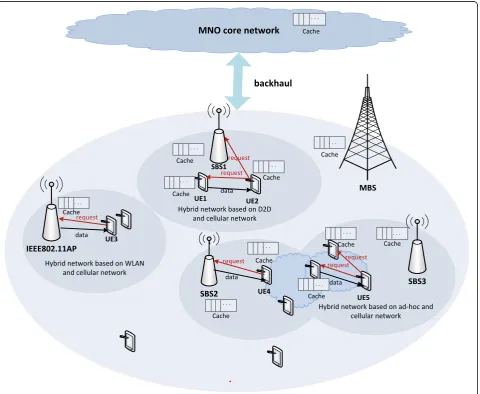
typical hybrid networks involve hybrid network based on cellular network and WLAN/D2D, hybrid network based on ICN and ad hoc network (ICMANET), etc. Projects re-lated include I-CAN, UMOBILE, RIFE, and, GreenICN etc. [8, 11, 12, 50]. Figure 4 presents the typical caching framework based on hybrid networks, in which caches are placed in MBSs, SBSs, APs and user devices in radio ac-cess networks. In this section, research issues on caching enabled hybrid network are addressed.
I-CAN is presented to advance the integration of cel-lular (licensed spectrum) and wireless (license-exempt) access technologies in [3, 5]. In I-CAN, proactive cach-ing exploitcach-ing mobility and content prediction, in-network caching and replication, multipath/multisource transport and traffic engineering are investigated in inte-grated cellular and Wi-Fi networks.
A cache-enabled hybrid network is formed by cellular network and autonomous nodes in military network
[51]. In the hybrid network, the back-end server cache all the needed content, the in-MANET cluster nodes are equipped with caches and decide which content to cache. On the one hand, back-end server can provide the requested contents via the cellular network; on the other hand, cluster nodes may offer the contents.
As IEEE802.11 supports massive throughput and high transmission rate, and IEEE802.11 APs are widely de-ployed without additional infrastructure, most mobile devices are equipped with IEEE 802.11 series. The idea of ICN-enabled IEEE 802.11 wireless APs as nano data centers is introduced to reduce traffic load and oper-ational cost [52].
In [53], a caching framework is addressed combining a cellular network and an opportunistic network of D2D communication. The cellular network provides pervasive network coverage and a global communication channel for all mobile nodes and it is mainly used for control message exchange. Content delivery traffic is offloaded through D2D communication between nearby mobile nodes to re-duce content delivery cost. The links used for D2D com-munication can be Wi-Fi Direct, Bluetooth, LTE/LTE-A, etc. Seeds and relays are chosen as helpers to contribute their storage as content caches and allow other nodes to download content from their caches through D2D links.
In [54], an ad hoc based caching framework integrated with NDN is proposed in the highway VANET scenario by using ad hoc Wi-Fi 802.11a, and NDN stack is in-stalled in each vehicle and RSU. A highway-customized ICN-based cooperative caching mechanism named ICoC is provided aiming at maximizing video playback quality without excessive startup delay and minimizing the play-back freezing ratio.
In [55], content-centric data transmission is investi-gated in the context of short opportunistic contacts based on CCNx framework content-centric networking architecture in wireless mesh network.
All of the literatures above indicate that mobile caching network frameworks can be distinguished in network type and cache location. Based on the re-search on information centric mobile caching frame-works mentioned, a summary on the main research issues is provided in Table 1.
3 Content Cache Policy
Content cache policy determines which objects are to be placed at which cache nodes, and it can be classified into two categories based on the operations to caches which include cache insertion policies and cache eviction policies. Content cache policy can be used in wired communication and wire-less communication networks. Because of the constrained transmission bandwidth and mobility of users in mobile wireless communication networks, the main factors affecting the performance of mobile content cache policies include caching granularity, content popularity, caching redundancy, policy complexity, mobility of caching networks and whether caching nodes cooperate with each other or not.
The performances of caching policy involve two aspects, one is to improve quality of experience of users, and the evaluation metrics are usually hit ratio and access delay; the other is to improve network performance, the involved criteria usually include reducing network traffic load and alleviating the burden on the network server. In mobile caching network, the network traffic load is usually trans-formed to the traffic load of backhaul, fronthaul as well as link traffic among end users. Intelligent caching policies are developed in order to optimize network centric or user centric performance metrics.
Since some research issues focus either on the caching insertion or caching eviction policies, while some of the caching schemes involve both of the caching insertion and caching eviction policy, in this section, cache inser-tion policies, cache evicinser-tion policies and cache manage-ment schemes including content insertion and eviction are analyzed respectively.
3.1 Cache insertion policies
Cache insertion policy refers to the strategy of cache en-abled equipments to insert contents according to some factors related to routing, content popularity and social relation of the users, etc.
The state-of-the-art cache insertion policies mainly consists of Caching Everything Everywhere (CEE) [56](refer to “ALL-CACHE” in[46],“leave copy every-where (LCE)”in [57]), Leave Copy Down (LCD) [46, 56, 57], Caching with Probability (Prob(p)) [46, 56, 57], ProbCache [18], WAVE [58], Breadcrumbs [47], Ditto
Table 1Mobile wireless caching frameworks and related research issues
Network Cache location Main Works
ICN based network Every router(on path and off path) [1,2,6,8–28,58,60–62,65,68,70,80–82,88,90,94–102,104, 105]
Cellular/wireless based network
Edge based caching (in MBSs, SBSs, APs and user devices)
[4,29–41,93,103,106,107]
Ad hoc based network Edge based caching( in every node and in the server) [42–48,59,89,92]
[59], Partial Cache [60], Interest-based cooperative cach-ing (ICC) [46], Proactive Content Pushcach-ing Scheme (PCP) [61], Hierarchical Cooperative Caching(HCC) [43] and Mobility/Popularity-Based Caching Strate-gy(MPCS)[62],etc. The principles of the cache inser-tion policies are summarized below.
CEE:CEE is the default cache decision policy in CCN/NDN, and it aims to reduce user access latency and frequent downloading from the original content servers. In CEE, a requester sends out an Interest packet which is forwarded to the server, and Data packet flows back along the reverse path and it is cached at every CR along the path. It is clear that this approach is simple but has the disadvantage of caching redundancy because every CR holds the copy of the Data packet, which causes the low utilization of caching resource.
LCD:LCD is designed to reduce caching redundancy in ICN. In LCD, a caching suggestion flag bit is added at the Data packet header whose state determines whether CRs along the downloading path should cache the Data packet. When a cache hit occurs in a cache node, only its direct
downstream node caches the content, which prevents other CRs along the downloading path from caching the same object. The frequently requested contents tend to be cached in CRs close to end users. Therefore, LCD is a cooperative policy which considers the contents’ access frequencies.
Prob(p):Prob(p) is used to reduce caching redundancy and improve cache efficiency. In Prob(p), cache decision is made for each CR along the downloading path with probability p, which means each CR does not cache the requested content with probability 1-p, then if a content is requested for many times, the probability that all CRs do not cache the content is low, namely, popular contents are more likely to be cached in routers in this scheme.
ProbCache:ProbCache aims to reduce caching redundancy and achieve efficient utilization of available cache resources along a delivery path. For each CR, the probability of caching incoming chunks is influenced by caching capability of paths and the distance between the CR and the user. The probability is proportional to the caching capability of the CR and inversely proportional to the distance between the CR and the user. If a CR with a big cache is close to the user, the probability of caching contents is high, while if a CR with a small cache is far from the user, the chance to cache incoming contents is little. The scheme guarantees fair load
distribution and fair content flow multiplexing between contents that travel to different destinations in terms of path length.
WAVE:In WAVE, contents are segmented into chunks. The number of chunks to be cached is adjusted based on the popularity of the content. An upstream node recommends the number of chunks to be cached to its downstream CRs by adding caching suggestion flag bit in data packets in order to help them make caching decisions.
Breadcrumbs: Breadcrumbs aims at efficiently utilizing content caches located outside of the default path. When a content request arrives at a content server and a content is downloaded, each router along the download path stores a pointer called Breadcrumbs. This pointer points to the direction in which the content was sent. When a content request eventually encounters Breadcrumbs for the corresponding content along the default path, it is redirected towards Breadcrumbs direction. Ditto: It is an on-path opportunistic caching policy
which caches overheard data at the granularity of small chunks to improve subsequent transfer throughput and reduce traffic load on the gateways in wireless mesh networks. If userirequests a video object but it can not be hit by nearby routers, then the request is sent to the gateway node, the gateway node returns the video object on the reverse path. Ditto caches the object at routers on the path, and it also overhears and caches part of the video at routers which are off the path within radio range of routers on the path. If userj subsequently requests the same video file, the request can be satisfied by the routers in radio range which overhears the transfer instead of traveling multiple hops to the gateway node.
Partial Cache:It is also a chunk based caching policy in NDN. In partial cache policy, the requested content is divided into several data chunks and transmitted along the routing path, and when a user requests a multimedia named content published by a provider, the multimedia content can be partially cached in an intermediate node or a proxy node. That is to say, each neighboring node partially caches different chunks of named multimedia content. In fact, the grouped neighboring NDN nodes will keep a whole cache of named multimedia content in order to serve the next same content request from the neighboring region.
models to evaluate similarity of interests among users and the user’s interest for a content based on the behavior of the user, the insertion policy of ICC at user u’s cache simply stores the contentcif their social distance is below a threshold.
PCP: It is a caching insertion policy in NDN to reduce the service disruption time due to the content provider mobility. In PCP, interest and data packets are exchanged between the content
providers and content consumers. When a handover trigger is detected by the content provider, the content provider sends an unsolicited DATA packet containing the selected contents for pushing. Then, the NDN routers receive the pushed contents and store the contents in their content caches. After completing the handover, the content consumer sends an interest packet. Since the requested content has been already pushed to NDN routers, the content consumer can retrieve the content from the NDN routers instead of the content provider. HCC:It is a caching insertion policy based on the
social relations with the mobile user. The cache space is divided into three levels: namely self cache space, friends’cache space and strangers’cache space. The self cache space is used for the mobile user to store the data items according to his/her preference. The friends’cache space is remained to help his/her friends to cache some data items, and the strangers’cache space is for the mobile user to store cache data items randomly.
MPCS: It often happens in the real world that users leave one site without finishing the current
download due to the large size of contents (e.g. a video clip). On the movements between sites, users usually turn on cellular network interface to continue downloading, and may switch to Wi-Fi networks when arriving at the next hotspot. For the
unfinished download, a request for the same content will be generated at the new site. In this case, these requests are dependent on the download at the previous sites, thus the content request rate at each site is affected by other sites due to the user mobility. By taking advantage of both the popularity of contents and the mobility pattern of users for ICN, MPCS consists of two caching strategies, one is called MOC(Mobility-Oblivious Caching), in which the most popular contents at any site will be cached locally to get an optimized cache hit rate, and the other is called MAC(Mobility-Aware Caching), in which the cached contents are chosen from the popularity rank list considering both the popularity ranks and the site transition matrix of mobile users.
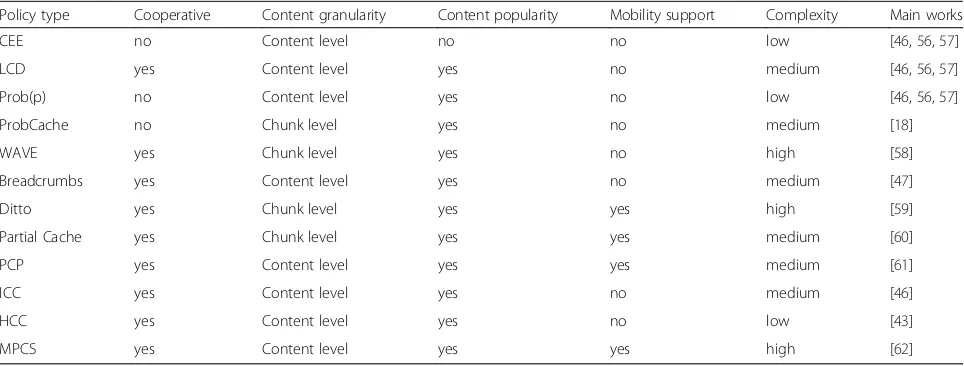
From the schemes of the caching insertion policies surveyed above, the features of the policies differentiate in content granularity, content popularity, mobility sup-port, complexity and cooperation among cache-enabled network elements. Table 2 illustrates the comparison of different cache insertion policies.
3.2 Cache eviction policies
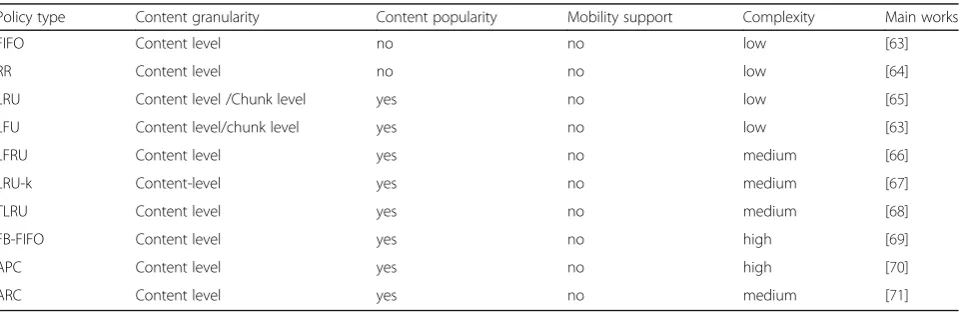
The cache eviction policy refers to the policy to remove contents from cache due to caching space limitation. The state-of-the-art cache eviction policies mainly include FIFO [63], simple Random Replacement (RR) [64], LRU[65], LFU[63], Least Recently/Frequently Used (LFRU)[66], LRU-k[67], Time Aware Least Recent Used (TLRU) [68], Frequency-Based-FIFO(FB-FIFO)[69], Aging popularity-based caching scheme (APC)[70] and Adaptive Replacement Cache(ARC)[71],etc. The processes of the cache eviction policies are analyzed as following.
FIFO: FIFO is the simplest policy for content eviction. The content item which has been in the
Table 2The comparison of different cache insertion policies
Policy type Cooperative Content granularity Content popularity Mobility support Complexity Main works
CEE no Content level no no low [46,56,57]
LCD yes Content level yes no medium [46,56,57]
Prob(p) no Content level yes no low [46,56,57]
ProbCache no Chunk level yes no medium [18]
WAVE yes Chunk level yes no high [58]
Breadcrumbs yes Content level yes no medium [47]
Ditto yes Chunk level yes yes high [59]
Partial Cache yes Chunk level yes yes medium [60]
PCP yes Content level yes yes medium [61]
ICC yes Content level yes no medium [46]
HCC yes Content level yes no low [43]
cache for longest time is evicted to make room for a new content item. The popularity of contents and expiration time of content availability are not considered.
RR: It is designed to evict a content item randomly in the cache to make room for a new content. In RR,Ncontents already in the cache are sampled and from the samples the content with least usefulness content is replaced which is mainly determined according to its recentness, frequency of use and size. The nextM < Nsamples are retained for the succeeding iteration. When the next new content arrives,N-Mnew contents in the cache are sampled, and the least useful content from theN - Mnew samples and theMold samples are replaced. LRU: It is a typical cache eviction policy often used
in caching system. Upon arrival of a request, if the requested contentkis not the one already in the cache(namely, a new content), the least recently used content(the bottom content) in the cache is evicted to make room for the new content item. If the requested contentkis already in the cache, then it is brought to the first position and contents previously cached above the contentkare moved one position down.
LFU: Assuming the content popularity is known a-priori, LFU statically stores theCmost popular contents in the cache. When the cached content is requested, the counter value is added by one; when a content item is needed to be evicted, the content with the minimum counter value is selected. LFRU: the LFRU policy is proposed by associating a
value with each lock in the buffer, which is called the Combined Recency and Frequency value and quantifies the likelihood that the block will be referenced in the near future. Each reference to a block in the past contributes to this value and a reference’s contribution is determined by a weighing functionF(x), wherexis the time span from the reference in the past to the current time. There exists a spectrum of implementations of the LRFU that again subsumes the LRU and LFU
implementations. This spectrum is dictated by how much weight is given to recent and older histories and the time complexity of the implementations lies betweenO(1)(the time complexity of LRU) and O(log2n)(the time complexity of LFU), wherenis the number of blocks in the buffer.
LRU-K: LRU-K algorithm keeps track of the times of the lastKreferences to popular database pages, and uses this information to statistically estimate the interarrival times of references on a page by page basis. The LRU-1 (classical LRU) algorithm can be thought of as taking such a statistical approach by
keeping in memory only those pages that seem to have the shortest interarrival time.
TLRU: TLRU is an extension of simple LRU. In TLRU,TTUis defined as a time stamp of a content which stipulate the usability time for content based upon the locality of content and content publisher announcement.TTUijis calculated for arriving content based on composite function, and if the average request timetijis smaller thanTTUij, then save the arriving content in cache; otherwise, apply LRU on a content set which the less popular contents are contracted.
FB-FIFO: In FB-FIFO, a variable-size protected segmentSpis created in the cache for content items which are requested more than once within a short time span, and the remaining cache is considered as an unprotected segmentSU. Assuming that both cache segments are managed separately with the FIFO algorithm, when a new content item is requested, the item is moved toSUas the newest content item. IfSUis full, the content item that was brought into earliest will be evicted from the cache; If an item inSUexperiences a cache hit, the item is moved toSpas the newest item; IfSpis full, the item that was brought into earliest will be moved back to SUas the newest item.
APC: It is an online caching eviction policy. In APC, each node maintains a table of interested content objects, where each content object is attached by an aging key which is used to indicate the popularity of the object. The value of the key is updated periodically in order to track the change of content popularity effectively. When all the cache space of the CR has been occupied, the tagged object with the least value of aging key in the cache will be evicted.
and continually balancing between workload re-cency and frequency features.
Some cache management schemes include content in-sertion and eviction, such as q-LRU, k-LRU, k-Random [63] and Split-Cache [45].
Both q-LRU and k-LRU differ from LRU for the inser-tion policy, but are identical to LRU for evicinser-tion policy. In q-LRU, upon arrival of a request, a new content item is inserted into the cache with probability q. In k-LRU, the cache is managed by a virtual cache. The requests have to traverse a chain of k−1 virtual caches, which store only content item hashes and perform meta-cache operations before the content item is stored in the phys-ical cache indexed by k. When a cache request arrives, the request enters cache iif its hash is already stored in cachei-1 (or ifi= 1).
k-Random works like k-LRU, the only difference is that the eviction policy of each cache is random.
In Split-Cache scheme, the cache C is splitted into two parts C1 and C2 for popular and less popular items spectively. Some percent of the most frequently re-quested items are cached in C1, and the rest are cached in C2. Every nodeukeeps track of the number of unique requests for a data item i (request frequency). Informa-tion of the presence of itemiin its neighborhood is also kept, and a presence index for each data item is com-puted. Merit Function is formulated by using estimated cumulative presence index and request frequency coun-ter. If a new data itemncomes to nodeuand the cache is full, then u first uses the request frequency of n to identify which cache (C1 or C2) itemnshould be put in. Thenuperforms the eviction procedure using the Merit function value and the corresponding merit values of the other items in the cache, and removes the item with the highest merit value in the process.
From the procedures of cache eviction policies, it is necessary to categorize the policies according to content granularity, content popularity, mobility support and
complexity. Table 3 gives the comparison of the cache eviction policies described aforesaid.
4 Research issues based on mobile Caching network
ICN enables caching of content pieces that can be re-used by other end users requesting the same content. Ubiquitous in-network caching means caching all con-tent fragments that traverse it, that is to say, if a match-ing request is received while a fragment is still in its cache store, it will be forwarded to the requester from that network element, avoiding the requester going all the way to the hosting server. As one of the typical ar-chitectures in ICN, CCN [16] advocates such content caching. Such a universal caching strategy is unnecessar-ily costly and sub-optimal. Since the motivation of cach-ing in networks aims to realize the followcach-ing goals: (1) lower the content delivery latency whereby a cached content near the client can be fetched faster than from the server, (2) reduce traffic and congestion since con-tent traverses fewer links when there is a cache hit lo-cally and (3) alleviate server load as every cache hit means serving one less request, it is significant to model the behavior of the caching system, understand the fundamentals of caching strategies pertinent to caching network topology and network scalability, and design the optimal caching policies based on the dif-ferent caching frameworks, then make optimization analysis on the caching network based on the specific optimization objectives in order to enhance the over-all content delivery performance in terms of network bandwidth cost, retrieval delay reduction and server burden alleviation [19].
In this section, we focus on research issues analyzing the performance and optimization of information-centric mobile caching networks.
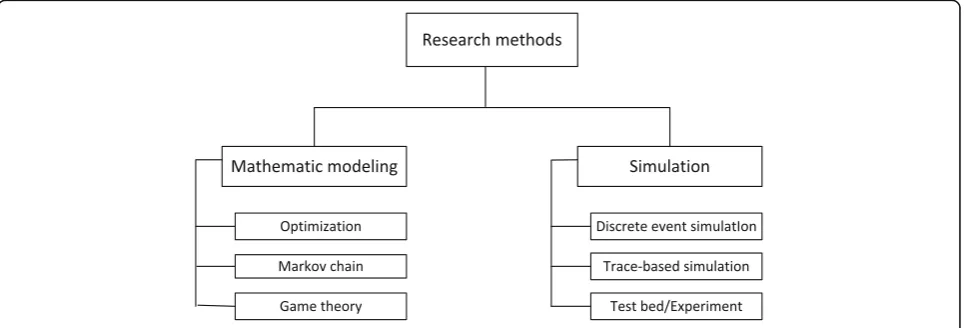
The research methods include mathematic modeling and simulation. In research issues based on mathematic modeling, optimization theory, Markov chain and game
Table 3The comparison of cache eviction policies
Policy type Content granularity Content popularity Mobility support Complexity Main works
FIFO Content level no no low [63]
RR Content level no no low [64]
LRU Content level /Chunk level yes no low [65]
LFU Content level/chunk level yes no low [63]
LFRU Content level yes no medium [66]
LRU-k Content-level yes no medium [67]
TLRU Content level yes no medium [68]
FB-FIFO Content level yes no high [69]
APC Content level yes no high [70]
theory are usually used. In research papers based on simulation, discrete event simulation, trace-based simu-lation and test bed/experiment are used. The taxonomy of research methods for information centric mobile caching network is summarized in Fig. 5.
The main contributions of research issues can be clas-sified into two respects, one is modeling behaviors and evaluating performances of caching system, the other is the optimization on information centric mobile caching network. The optimization objective is either network centric objective or user centric objective. Modeling be-havior and performance analysis of caching system is surveyed in 4.1, and optimization of mobile caching net-work based on netnet-work centric and user centric objec-tives is analyzed in 4.2.
4.1 Modeling behavior and performance analysis of caching system
When a caching system is working, the content objects are inserted and evicted by the system, and the contents are required by users. Since the contents may be stored in any of the caching locations in the network, the con-tents are retrieved in the whole caching network and can be found at a low cost. According to the behavior of the caching system during the time when it is working, the performance of a caching system is related to its caching architecture, caching behavior, content request pattern and content features. Figure 6 illustrates a typical caching system based on caching behavior.
Caching architecture depends on the caching network topology. The typical topology includes hierarchy [72, 73], tandem [74] and arbitrary topology [75].
Caching behavior is often defined as the caching state concerning cache node, cache space, the total number of contents and content location in the cache, caching con-tent insertion policy and concon-tent eviction policy. The content which is inserted or evicted from one of the
cache nodes would cause the state transition of the caching system. Caching behavior involves steady state behavior and transient behavior.
For content request pattern, content requests are usu-ally assumed to arrive in the network exogenously and the content request arrival process usually follows the Poisson process. The independent reference model (IRM) is often used to capture the notion of page refer-ence frequencies [76]. Under IRM, requests received at different times are stochastically independent when modeling content request pattern.
The Zipf discrete distribution is often used in the litera-ture to represent the popularity of Internet contents since it is shown that it is an adequate model [77]. Content re-quests for different content follows Zipf-distribution [77]
withX
R
r¼1
C=rα¼1 , where the probability of a request for
ther-thpopular content isC/rαwithαbeing the popular-ity factor, where R is the total number of content units. The caching insertion and eviction policy can be selected according to the popularity of contents.
When a cache store is full, the selected content will be evicted according to the caching eviction policy in the event of an arrival of a new uncached content, and the new content is inserted into the cache according to the content insertion policy.
In order to evaluate the efficiency of finding the con-tents in the caching system, cache hit is used to record for a request finding a matching content along the con-tent delivery path. Otherwise, a cache miss is recorded. In the event of a cache miss, the content request tra-verses the full content delivery path to the content nodes with the content or to the server.
The analysis of modeling behavior and performance of caching system relates to the architecture of caching sys-tem. The performance is also different depending on whether the caches are cooperative. Some works study
the caching behaviors by taking mobility into account, and some works only involve the caching schemes. In this section, research issues are addressed on caching be-havior modeling and performance analysis.
Che et al. analyze the performance of two-level web hierarchy caches which a single cache is deployed at the root level and a set of caches are set at the leaf level. LRU algorithm is used at each cache locally [72, 73]. A stochastic model is proposed to characterize the unco-operative hierarchical caching system. An approximation technique is employed and the miss ratio is obtained to match the exact results accurately, which is called Che’s approximation. A characteristic time for a given cache is identified as a function of the request processes, the cache size and the request pattern. Additionally, a cache can be viewed roughly as a lowpass filter with its cutoff frequency which is the inverse of the characteristic time, so contents with access frequencies lower than the cutoff frequency will have good chances to pass through the cache with the result of cache misses. According to the above idea, the cache tree can be considered as a tan-dem of lowpass filters at different cutoff frequencies. Based on the concept of filtering defined by the charac-teristic time, the hierarchical caching principles are then presented to guide the design of a cooperative hierarch-ical caching architecture.
Since caches are usually organized in a hierarchical manner, the cache of each level needs to serve the
miss sequence from the preceding level cache, it is important to study the performance properties of tan-dem caches. [74] analyzes the miss stream from one single cache since it represents the input to the next level cache, and miss stream from one single cache is approximated by the superposition of a number of asymptotically independent renewal processes. Ap-proximation of a renewal sequence is provided for predicting the fault probability in the second cache, which proves to be more accurate than IRM by ex-periments. The analysis can be used to rigorously characterize the performance of tandem caches. How-ever, from a practical perspective, experiments indi-cate that the difference in fault probabilities in the second cache obtained by comparing the independent reference model approximation and the actual miss stream is not large, although measurable. Hence, using the IRM approximation for dimensioning net-works of caches may be acceptable.
caching policies, and then expressions for cache hit probability, response time perceived by the users, and the size of the Pending Interest Table are derived. Apply-ing the model proposed in [78], the traditional cachApply-ing policies such as LRU, FIFO, and RANDOM can also be analyzed.
In [79], the performance of two families of replace-ment algorithms FIFO(m) and RANDOM(m) under the IRM model is studied by decomposing caches into lists. Explicit expressions for miss probability are presented by analyzing the steady state probabilities. Furthermore, the authors develop an algorithm with a time complexity that is polynomial in the cache size and linear in the number of items to compute the overall and per content item miss probabilities of the FIFO (m) and RANDOM (m) algorithm. Lower and upper bounds on the overall miss probability of RAN-DOM (m) are presented.
An analytical model of ICN storage and bandwidth sharing is proposed under fairly general assumptions on total demand, topology, content popularity and limited network resources in [80–82]. Given the assumptions that the caching network topology is a linear and binary tree, each user implements a receiver-driven flow control protocol yielding fair and efficient bandwidth utilization along the path to the content repository, and caches are managed by LRU per-packet replacement policy. A closed-form expression for expected stationary delivery time is derived as a function of hit/miss probabilities on network caches, content popularity and cache sizes. The research results can be applied to a class of content ori-ented receiver-driven packet-based communication net-works with in-network storage. The analytical results supported by packet level simulations can be used to analyze fundamental trade-offs of ICN architectures. An essential building block for the design and evaluation of ICN protocols is also provided.
In ICN, since caching becomes a ubiquitous function-ality available at each router, it is of paramount import-ance to develop efficient tools for the performimport-ance analysis of large-scale interconnected caches for content distribution. However, the complexity of evaluating the performance of cache networks grows exponentially with increase of the cache size and the number of contents, especially in constructing exact models of a specific multi-cache system.
The authors of [63] propose a unified methodology to analyze the hit probability of caches (both isolated and interconnected) for caching eviction policies (e.g. LRU, q-LRU, K-LRU, RANDOM, FIFO) and caching insertion policies (e.g. LCE, LCD). In [63], a simple closed-form expression of cache hit probability is obtained by ex-tending Che’s approximation under the small cache re-gime, which reveals superiority of the k-LRU policy by
considering traffic model as renewal traffic and the effects of temporal locality (e.g. if a content is re-quested at a given point in time, then the content will be requested again with great probability in the near future).
In [75], an algorithm called a-NET is proposed to approximate the behavior of multi-cache networks by leveraging existing approximation algorithms for isolated LRU caches. Graph is used to denote the network of caches with arbitrary topology. The aver-age rate of requests for a content at a cache consists of a Poisson stream of exogenous requests and miss streams of the cache’s neighbors. The miss probabil-ity of each cache and the average number of re-sponse hops are used to evaluate the accuracy of a-NET.
The behavior of caches can be modeled by Markov chains or Markov Process. Several works characterize the content dynamics in a single cache or caching net-work by Markov chain [65, 69, 75, 83, 84].
The authors in [75] also use a discrete Markov chain to model the behavior of a tagged content k at a generic cache with sizeN. Markov chain consists of states (i, j),i represents the number of cache misses for contents ex-cept tagged content k, since k entered the cache,j repre-sents the state ofk, wheniis not greater than N, kis in thei-thlocation of the cache. Otherwisekmight experi-ence eviction state, miss state and absorbing state. The Markov Model is used to measure distribution of the number of requests between two requests for contentk.
In [83], a cache network is modeled as a discrete-time Markov chain with state spaceΩ0, in which the content
inserted or evicted from one of the cache nodes would cause the state transition of the system. Supposing that the network has m cache nodes, each cache space is N and the total number of contents isn. The system state iss,s= (s[1],s[2],…,s[j] ,…,s[m]), wheres[j] corresponds to states space of the j-th cache node. The state space
Ω0has cardinality Nn N!
m
.
In [65], the work process of LRU replacement policy is modeled as a homogeneous Markov chain. The state of the chain represents the corresponding content position in the cache. Supposing that each content has the same size and the cache space is N. The Markov chain states of content fi is Ω= {0, 1, …, N}, where state 0 denotes
the content fi is not in the cache, and state j denotes
content fiis at the j-th position of the cache. According
In [69], an analytical model is presented for estimating the instantaneous hit ratio of a single cache for both LRU and FIFO. Markov chain is used to model each ob-ject in the cache. The state representation is obtained, and the instantaneous hit ratio of object is presented.
In [84], CCN is modeled using Markov chains. For a single router, the state of the chain represents the exact slot that the packet currently occupies in the cache, and the Packet of Interest (PoI) arrives as a Poisson process with rateλ. Statei(1≤i≤N) denotes the PoI is in theith position of router, and stateN+ 1 denotes the packet is not in the cache. The requests for packets in cache, but further down than the PoI or not in cache are assumed to arrive as a Poisson process with rateμ. All states (ex-cept state 1) have a transition to state 1 with rate λ. All states i (1≤i≤N) have a transition to state i+ 1 with rate μ. The chain can be trivially shown to be ergodic, and the equilibrium probability of PoI in every state is obtained, and the modeling can be extended to the mul-tiple router system. The system of two routers is ana-lyzed as a use case.
Some works analyze the caching behavior considering user mobility [62, 85–87].
In [62], user mobility is characterized by a stationary Markov model. The transition matrix is calculated based on the real trace data of mobile users. The statistics from the trace-based data indicates that it is a finite, ir-reducible and ergodic Markov chain. For a mobile user, staying on each site represents a state. Let Ti,j denotes
the probability of transition from sitei to sitej. The re-quest rate Rk,j for content k at site j is derived, and a
thresholdεis set to stop the iteration process if the vari-ance ofRk,jis small enough.
[85] provides an analytical modeling on Information-Centric MANETs supporting mobility. The model of content retrieval for ICMANETs in 1-dimensional case is presented, which extracts locations, nodes, and con-tents as three basic objects. The nodes’location distribu-tion on the generalized mobility model is analyzed and the close-form expression for the location distribution model is derived under a stationary moving process. Then, the process of content retrieval in ICMANETs is analyzed and the expression of the miss probability at a location is obtained. The closed-form expressions for ac-curately estimating the throughput and delay of content retrieval are derived which are used to evaluate the per-formance of content retrieval in ICMANETs. However, the analytical model only covers 1-dimensional case which is meaningful in the actual scene in the paper.
In [86], the model is extended from 1-dimensional case in [85] to 2-dimensional case by constructing an analytical model of content retrieval for ICMANETs based on the content hit/miss probability called PRCRM in [85]. The model is divided into node space, content
space and session space. By investigating the distribution of content popularity, receiver-driven mechanism, content insertion and eviction mechanism and generalized mobil-ity model in 2-dimensional space, PRCRM can be used to estimate the content retrieval-related performance.
In [87], a publish-subscribe system exploiting CCN system in MANET is investigated including CCN func-tionality, data dissemination, in-network caching, multi-casting and delay tolerant delivery. Different design approaches are provided. The topic based publish-subscribe CCN system is evaluated in an emulated envir-onment based on Linux virtual machines. The results show that Pull and Push are the two dissemination models on which publish-subscribe CCN systems may be based. Pull approach can be developed by using the CCN architecture without modifying, but requires poll-ing, which in general leads to an undesirable overhead. However, in case of MANETs, polling is also used to re-fresh the topology of the dispatching multicast tree, which otherwise should be done with other means. The evaluation also reveals that the effectiveness of the CCN functionality increases with the area side and the num-ber of subscrinum-bers.
4.2 Optimization based on information-centric mobile caching network
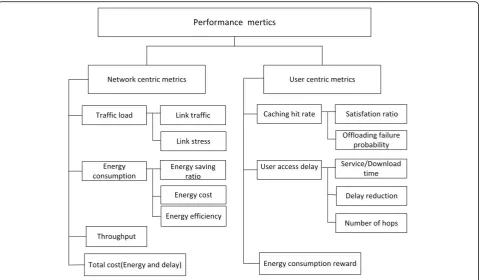
Optimization based on caching networks can be catego-rized into two classes depending on the optimization ob-jectives, namely network centric optimization and user centric optimization. In the view point of network optimization, reducing capital expenses (CAPEX) and operation expenses (OPEX) of content delivery, wireless access networks, as well as core networks are the goals of operators, therefore the metrics are usually traffic load, link traffic, energy consumption (or energy saving rate, energy cost, energy efficiency) and throughput, some of the issues addresses the joint optimization by using total cost or utility function. In the aspect of user centric optimization, in order to improve the QoS of mobile users, user access delay and content hit rate are the evaluation metrics which are most often used.
The taxonomy of the performance metrics is provided in Fig. 7 on the optimization in information-centric mo-bile caching networks. In the following section, network centric optimization based on caching networks is ad-dressed in 4.2.1, and user centric optimization based on caching networks is analyzed in 4.2.2, respectively.
4.2.1 Network centric optimization based on caching networks
and game theory. Some optimization on caching schemes and caching architectures are evaluated by simulation.
Optimization theory is applied in [31, 70, 88–94] to obtain network performance improvement, while game theory is considered in [4, 95, 96].
In [31], the three-tier heterogeneous wireless caching network is modeled in order to analyze the energy sav-ing of the system. Cachsav-ing storages are available in both the relays and some of the users. The impacts of net-work characteristics such as the heterogeneity of multi-media contents, node density and the limited caching capacity are elaborated. The locations of the base sta-tions, relays and device-to-device pairs are modeled as mutually independent Poisson point processes (PPPs), and four content access cases in the three-tier network model are provided. The average energy consumption of the network based on network architecture and the con-tent access protocol is formulated. Numerical results show that the proposed mobile caching system has sig-nificant performance gain compared with the system in which neither users nor relays have caching ability con-sidering the influence of the content size and popularity. By analyzing the influence of node density, the results reveal that there exists optimal node density arrange-ment to make full use of the caching resource through switching off or waking up some relays.
In [93], a cache-enabled wireless heterogeneous net-work framenet-work based on software defined features is
presented, in which content delivery strategy is com-bined with SDN to facilitate the management of the var-iety of user behaviors. Macro cells and small cells are modeled as independent homogeneous PPPs, and they are cooperative to cache contents based on the popular-ity ranking. The hit probabilpopular-ity, the coverage probabilpopular-ity, throughput, and energy efficiency are derived as closed-form expressions or the functions of the SINR ratio threshold, path loss exponent, transmission power and density of macro and small cells, cache ability, content popularity, and backhaul capacity. Numerical results show that the proposed cache-enabled framework has much higher throughput and improved energy efficiency than that of current LTE networks.
The energy efficient caching for CCN is studied in [70]. The energy consumption model is defined includ-ing energy consumption for transmission, cachinclud-ing and devices. The objective of energy optimization is trans-formed into the problem of minimizing average response hops. An energy-efficient aging popularity-based caching scheme is designed to improve energy efficiency and re-duce network traffic.