R E S E A R C H
Open Access
Performance analysis and power control
for full-duplex relaying with large-scale
antenna array at the destination
Liang Han
1,2*, Bin Shi
2and Weixia Zou
3Abstract
Full-duplex relaying can increase the spectral efficiency by allowing the relay to transmit and receive at the same time and over the same frequency. To overcome the challenge that the destination treats the source-destination link as interference, we employ large-scale antenna array at the destination. By using the fact that the source-destination channel vector and relay-destination channel vector become pairwise orthogonal, the source-destination link can be converted to useful signal. We first derive the achievable rates and outage probabilities for direct transmission, half-duplex relaying, and full-duplex relaying, respectively. Two relaying protocols, i.e., amplify-and-forward (AF) and decode-and-forward (DF), are considered. Then, based on the channel state information (CSI) availability, the optimal transmit power of the full-duplex relay node is obtained by maximizing the achievable rates or minimizing the outage probabilities of full-duplex relaying. Numerical results show that the full-duplex relaying performs better than
half-duplex relaying when the residual self-interference is small, and the performance of full-duplex relaying can be improved by using power control.
Keywords: Full-duplex relaying, Amplify-and-forward, Decode-and-forward, Achievable rate, Outage probability, Power control
1 Introduction
In recent years, the fourth-generation (4G) mobile com-munication system has been deployed and used world-wide. However, with an explosion of wireless devices and services, there is growing demand for data traffic that cannot be accommodated by 4G. Therefore, the fifth-generation (5G) mobile communication system, which is expected to be commercially available by 2020, has become a hot research topic in both academia and indus-try [1, 2].
As one of the most promising technique for the 5G mobile communication system, large-scale antenna array or massive multiple-input multiple-output (MIMO) has drawn significant research interests [3–6]. The concept of massive MIMO was first proposed by Marzetta [7],
*Correspondence: [email protected]
1Tianjin Key Laboratory of Wireless Mobile Communications and Power Transmission, Tianjin Normal University, Tianjin 300387, China 2College of Electronic and Communication Engineering, Tianjin Normal University, Tianjin 300387, China
Full list of author information is available at the end of the article
showing that by employing unlimited number of anten-nas at a base station (BS), the effect of thermal noise and small-scale fading can be averaged out, the channel vectors between the users and the BS become pairwise orthogonal, and the inter-user interference can be elimi-nated. In [8], the authors compared two linear precoding schemes, i.e., conjugate beamforming and zero forcing (ZF), with respect to spectral efficiency and energy effi-ciency in a single-cell downlink scenario, and showed that for high spectral efficiency and low energy efficiency, ZF outperforms conjugate beamforming, while at low spec-tral efficiency and high energy efficiency, the opposite holds. In [9], the transmit power scaling laws and lower capacity bounds for maximum ratio combining (MRC), ZF, and minimum mean-square error (MMSE) detection were derived. It was shown that when the number of BS antennasMgrows without bound, the transmitted power of each user could be reduced proportionally toMif the BS has perfect channel state information (CSI) and 1/M if CSI is estimated from uplink pilots. In [10], the authors
investigated how massive MIMO performs in real prop-agation environments and showed that the performance is close to that in independent and identically distributed (iid) Rayleigh channels, so the theoretical advantages of massive MIMO can be obtained in real channels.
On the other hand, encouraged by the advance in self-interference cancelation (SIC) algorithms [11, 12], full-duplex relaying, which can transmit and receive at the same time and over the same frequency, has also attracted great research interests. In [13], the authors proposed a full-duplex relay system which shares the time resource as well as the antennas at the relay node and elimi-nates the underlying interferences using precoding. In [14], the exact outage probability of full-duplex decode-and-forward (DF) relay systems was derived by consid-ering the self-interference as a Rayleigh fading channel. It was shown that the full-duplex relaying is superior to half-duplex relaying in terms of the outage probability as the signal-to-interference ratios (SIRs) are higher and the signal-to-noise ratio (SNR) is lower. Riihonen et al. derived an optimal gain control scheme for full-duplex amplify-and-forward (AF) relaying which considered the effect of residual loop interference in [15], investigated three spatial domain SIC solutions for full-duplex MIMO relay systems in [16], and proposed a hybrid relaying which could switch between full-duplex and half-duplex mode in [17]. Reference [18] derived the outage perfor-mance of multi-hop full-duplex relaying by considering all the inter-relay interference and echo-interference. Refer-ence [19] investigated the power and location optimiza-tion for full-duplex DF relay systems. From the above references, it is clear that there are two main challenges facing the use of full-duplex relaying. The first challenge is how to mitigate or cancel the self-interference at the relay due to signal leakage between the relay transmit and receive antenna [12–19], and the second challenge is how to deal with the signal from the source since the destina-tion always treats the direct link from the source to the destination as interference [14, 17–19].
Since low complexity linear signal processing would achieve near optimal performance in massive MIMO sys-tems, some researchers have introduced massive anten-nas into full-duplex relay systems. In [20], the authors investigated a multi-pair full-duplex relay system, where the relay is equipped with massive arrays and uses ZF and MRC/MRT to process the signals, and showed that the large number of spatial dimensions available can be effectively used to suppress the loop interference in the spatial domain. In [21], the authors studied the hardware impairments aware transceiver design for massive MIMO full-duplex relaying, where multiple source-destination pairs communicate simultaneously with the help of a full-duplex relay equipped with very large antenna arrays. Note that these works assume the relay is equipped with
massive arrays, and there is no work considering the desti-nation is equipped with massive arrays in full-duplex relay systems.
In this paper, we investigate the performance of full-duplex AF and DF relaying with large-scale antenna array at the destination. Since the source-destination chan-nel vector and relay-destination chanchan-nel vector become pairwise orthogonal, the destination can treat the source-destination link as useful signal and therefore the perfor-mance can be improved. Furthermore, we optimize the transmit power of the full-duplex relay node by max-imizing the achievable rates or minmax-imizing the outage probabilities.
2 System model
We consider a three-node relay channel, where a single-antenna source communicates with anN-antenna desti-nation through a full-duplex relay, as depicted in Fig. 1. We assume the relay is equipped with two antennas, one for receiving and the other for transmitting. In cellular net-works, the source can be a user and the destination can be a BS.
Denote the channel of the relay, source-destination, and relay-destination links ashsr,hsd ∈CN×1,
andhrd ∈ CN×1, respectively, which are modeled to be
frequency flat and quasi static. All the channel elements are assumed to be zero-mean complex Gaussian random variables (Rayleigh fading), and the variance forhsr, each
element of hsd, and each element of hrd are given as ηsr, ηsd, andηrd, respectively. Since the self-interference
cannot be completely canceled, we denote the residual self-interference channel ashrr, which is also assumed to
be zero-mean complex Gaussian random variables with varianceηrr.
The transmit signals from the source and the relay in time slot t are denoted asxs(t) andxr(t), respectively.
We assume the transmit power of the source and the relay are Ps and Pr, respectively, i.e., E
For the direct transmission, the source transmit the sig-nal directly to the destination. In time slott, the received signal at the destination is given as
yd(t)=hsdxs(t)+nd(t), (1)
where nd(t) denotes the complex additive white
Gaus-sian noise (AWGN) at the destination with zero-mean and covariance matrixEnd(t)nd(t)H
=σd2IN.
2.2 Half-duplex relaying
Fig. 1System model for full-duplex relaying with large-scale antenna array at the destination
odd), the source transmits a signal to the relay and the des-tination. The received signal at the destination is the same as (1), and the received signal at the relay is given as
yr(t)=hsrxs(t)+nr(t), (2)
where nr(t) denotes the AWGN at the relay with
zero-mean and covarianceσr2. In the time slott+1, the relay transmit a signal to the destination, and the received signal at the destination is given as
yd(t+1)=hrdxr(t+1)+nd(t+1). (3)
When the AF protocol is used, the relay amplifies the received signal yr by a scaling factor β, so the
trans-mit signal at the relay isxr(t+1) = βyr(t). To satisfy
the instantaneous transmit power at the relay, the scaling factor is chosen as
β =
Pr Ps|hsr|2+σ2
r
. (4)
When the DF protocol is used, the relay decodes its received signal and checks if it is correct. If the relay can decode the received signal successfully, the transmit signal at the relay isxr(t+1)=
Pr
Psxs(t).
2.3 Full-duplex relaying
For the full-duplex relaying, the received signal at the relay and the destination in time slottare given by
yr(t)=hsrxs(t)+hrrxr(t)+nr(t), (5)
and
yd(t)=hsdxs(t)+hrdxr(t)+nd(t), (6)
respectively.
When the AF protocol is used, the processing at the relay is similar to that in the half-duplex mode. As the
instantaneous received power at the relay isEyr(t)2
= Ps|hsr|2+Pr|hrr|2+σr2, the scaling factor is chosen as
β =
Pr
Ps|hsr|2+Pr|hrr|2+σ2 r
. (7)
Assume the processing delay at the relay isτ time slot, then the transmit signal at the relay isxr(t)=βyr(t−τ ).
When the DF protocol is used, the processing at the relay is also similar to that in the half-duplex mode except there is processing delay τ. If the relay can decode the received signal successfully, then the transmit signal at the relay isxr(t)=
Pr
Psxs(t−τ ).
3 Performance analysis
In this section, we analyze the performance of the direct transmission, half-duplex relaying, and full-duplex relay-ing, respectively. We assume matched filter (MF) process-ing is used at the destination, i.e., the destination processes the signal vector by multiplying the conjugate-transpose of the channel [4]. For largeN, the channel vectorshsdand
hrd are asymptotically orthogonal, so we havehHsdhsd → Nηsd,hHrdhrd →Nηrd,hHsdhrd→0 andhHrdhsd →0.
3.1 Direct transmission
When MF is used at the destination, we have
hHsdyd(t)=hHsdhsdxs(t)+hHsdnd(t)
≈Nηsdxs(t)+hHsdnd(t). (8)
Therefore, the achievable rate is given by
RDT=log2 1+
NPsηs,d σd2
=log21+Nγ¯s,d
, (9)
whereγ¯s,d=Psηs,d
Outage probability is defined as the probability that the achievable rate falls below a target transmission rateR0, so
the outage probability can be given by
poutDT=
0, ifRDT≥R0,
1, ifRDT<R0. (10)
3.2 Half-duplex relaying
In the odd time slott, the processing at the destination is the same as in (8). In the even time slott+1, by using MF, we have
hHrdyd(t+1)=hHrdhrdxr(t+1)+hHrdnd(t+1) ≈Nηrdxr(t+1)+hHrdnd(t+1). (11)
We assume the maximum ratio combining (MRC) is applied at the destination, then the end-to-end instanta-neous SNR for the AF protocol is given as
γHD,AF=Nγ¯sd+ achievable rate for the AF protocol is given as
RHD,AF= The outage probability for the AF protocol is given as
poutHD,AF=Pr
Similarly, the end-to-end instantaneous SNR and achievable rate for the DF protocol are given as
γHD,DF=min{max{γsr,Nγ¯sd},Nγ¯sd+Nγ¯rd}, (16)
respectively. The outage probability for the DF protocol is given as
we havepoutHD,DF=1; otherwise, we have
poutHD,DF =1−Pr(γsr≥δHD)
At the relay, the signal-to-interference-plus-noise ratio (SINR) can be written as
γr=
Ps|hsr|2 Pr|hrr|2+σ2
r
(20)
At the destination, by using MF to (6), we can obtain
hHsdyd(t)=hHsdhsdxs(t)+hHsdhrdxr(t)+hHsdnd(t) ≈Nηsdxs(t)+hHsdnd(t), (21)
hHrdyd(t)=hHrdhsdxs(t)+hHrdhrdxr(t)+hHrdnd(t) ≈Nηrdxr(t)+hHrdnd(t). (22)
When the AF protocol is used, (22) can be further written as
The destination can delay (21) by τ time slots and combine it with (23), then the end-to-end instantaneous equivalent SNR and achievable rate are given as
γFD,AF=Nγ¯sd+
respectively. The outage probability is given as
Similarly, the end-to-end instantaneous equivalent SNR and achievable rate for the DF protocol are given as
γFD,DF=min{max{γr,Nγ¯sd},Nγ¯sd+Nγ¯rd}, (28)
respectively. The outage probability for the DF protocol is given as we havepoutFD,DF=1; otherwise, we have
poutFD,DF=1−Pr(γr≥δFD)
3.4 Condition for the superiority of full-duplex relaying over half-duplex relaying
In this subsection, we derive the condition that full-duplex relaying outperforms half-duplex relaying based on the outage probability. Five cases are considered.
• Case 1:Nγ¯sd≥δHD. In this case, we have
poutHD,AF=poutHD,DF =poutFD,AF=poutFD,DF=0, which means that full-duplex relaying and half-duplex relaying will obtain the same outage performance.
• Case 2:Nγ¯sd+Nγ¯rd< δFD. In this case, we have
poutHD,AF=poutHD,DF =poutFD,AF=poutFD,DF=1, which means that full-duplex relaying and half-duplex relaying will obtain the same outage performance.
• Case 3:δFD≤Nγ¯sd< δHD. In this case, we have
poutFD,AF=poutFD,DF=0andpoutHD,AF=poutHD,DF >0, so full-duplex relaying outperforms half-duplex relaying.
• Case 4:δFD≤Nγ¯sd+Nγ¯rd< δHD. In this case, we
havepoutHD,AF=poutHD,DF=1andpoutFD,AF=poutFD,DF<1, so full-duplex relaying outperforms half-duplex relaying.
• Case 5:Nγ¯sd+Nγ¯rd≥δHDandNγ¯sd< δFD. In this
case, full-duplex relaying outperforms half-duplex
relaying whenpoutFD,AF≤poutHD,AFfor AF protocol and
poutFD,DF≤poutHD,DFfor DF protocol. Using the results (15) and (27), the average residual self-interference for AF protocol should satisfy
¯
Using the results (19) and (31), the average residual self-interference for DF protocol should satisfy
¯
In this section, we propose power control to improve the system performance. We assume independent power con-straint at both the source and the relay, i.e.,Ps ≤ Pmaxs
andPr≤Pmaxr . For half-duplex relaying, it is obvious that
the system performance is optimized when the source and the relay use the maximum allowed transmit power, so we focus on power control for full-duplex relaying.
For full-duplex relaying, the source should also use the maximum transmit power because as Ps increases, the
achievable rates (25) and (29) increase and the outage probabilities (27) and (31) decrease. As such, we concen-trate on power control for the relay. Two scenarios are considered based on the CSI availability.
4.1 Instantaneous CSI ofhsrandhrr
In this scenario, we assume the relay has the instanta-neous CSI ofhsrandhrr, and the statistical CSI ofhsdand
hrd, then the power control is to maximize the achievable
rates.
For the AF protocol, the power control can be formu-lated as an optimization problem
maximize Pr
Nγ¯rdγr Nγ¯rd+γr+1
subject to 0<Pr≤Prmax (34)
By taking the first derivative of object function with respect toPrand setting the first derivative equal to zero,
we obtain the only one positive root
P∗r =
Therefore, the optimal transmit power of the relay is Propt=min
Pr∗,Prmax.
For the DF protocol, the power control can also be formulated as an optimization problem
maximize Pr
min{γr,Nγ¯sd+Nγ¯rd}
subject to 0<Pr≤Prmax (36)
The optimal solution should satisfy
By solving this equation, we can obtain the only one positive root
P∗r =
Psηsd
2ηrd − σr2
2|hrr|2
2
+ Ps|hsr|2σd2 N|hrr|2ηrd
−Psηsd
2ηrd − σr2
2|hrr|2. (38)
Similarly, the optimal transmit power of the relay for DF protocol isPoptr =min
P∗r,Pmaxr .
4.2 Statistical CSI ofhsrandhrr
In this scenario, we assume the relay only has the statisti-cal CSI ofhsr,hrr,hsd,andhrd, then the power control is to
minimize the outage probabilities. Note that power con-trol does not help ifNγ¯sd ≥δFDorNγ¯sd+Nγ¯rd < δFD, so we only need to consider the case thatNγ¯sd < δFDand Nγ¯sd+Nγ¯rd≥δFD.
For the AF protocol, minimizing the outage probabil-ity (27) is equivalent to minimizing−ln1−poutFD,AF, so the power control can be formulated as an optimization problem
minimize Pr
(Nγ¯rd+1) ¯
γsr(cγ¯rd−1)+
ln
1+γ¯rr(Nγ¯rd+1)
¯
γsr(cγ¯rd−1)
subject to δFDσ
2 d ηrdN −
Psηsd
ηrd <Pr≤P max
r (39)
where c = N(δFD−Nγ¯sd). By taking the first
deriva-tive with respect toPrand setting the first derivative equal
to zero, we can obtainP∗r. However, it is difficult to find
the closed form solution, so we need to use iterative root-finding algorithms such as the bisection method or the Newton’s method to find the numerical solution.
For the DF protocol, to ensureNγ¯sd+Nγ¯rd ≥δFD, we
should set the transmit power at the relay as high as pos-sible. However, afterNγ¯sd+Nγ¯rd ≥ δFD is satisfied, the outage probability increases as Pr increases. Therefore,
the optimal transmit power of the relay is
P∗r = δFDσ 2 d ηrdN −
Psηsd
ηrd . (40)
5 Numerical results
In this section, we present some numerical results to val-idate our analysis. For simplicity, we assume N = 100, Pmaxs = 1,Pmaxr = 1,ηsd = 10−7, ηrd = 2× 10⁻⁶, σd2=σr2=10−6, andR0=5 bps/Hz.
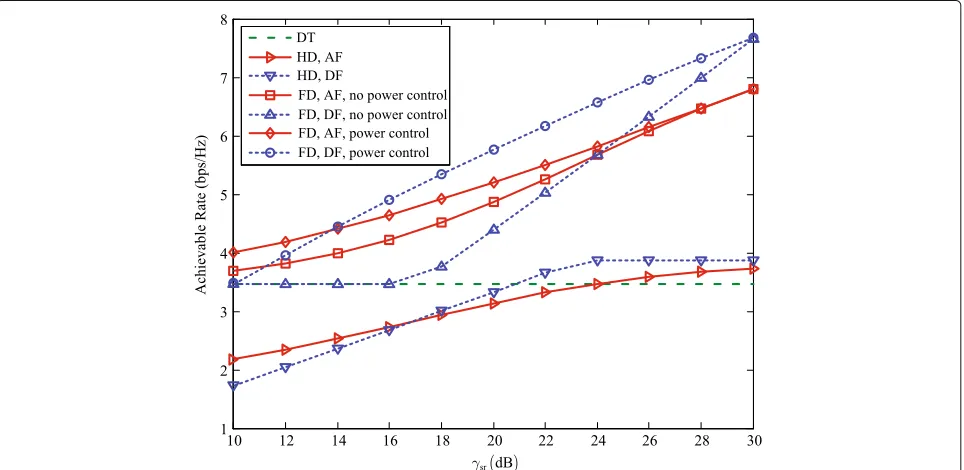
In Fig. 2, we plot the achievable rates as a function of γsrfor direct transmission, half-duplex relaying, and
full-duplex relaying, where|hrr|2=4×10⁻⁶. From Fig. 2, we can see that (1) the achievable rates of both half-duplex relaying and full-duplex relaying increase asγsrincreases;
(2) the duplex AF relaying perform better than full-duplex DF in the low SNR regime, but perform worse than full-duplex DF in the high SNR regime; and (3) the achiev-able rates of full-duplex relaying can be improved by using power control.
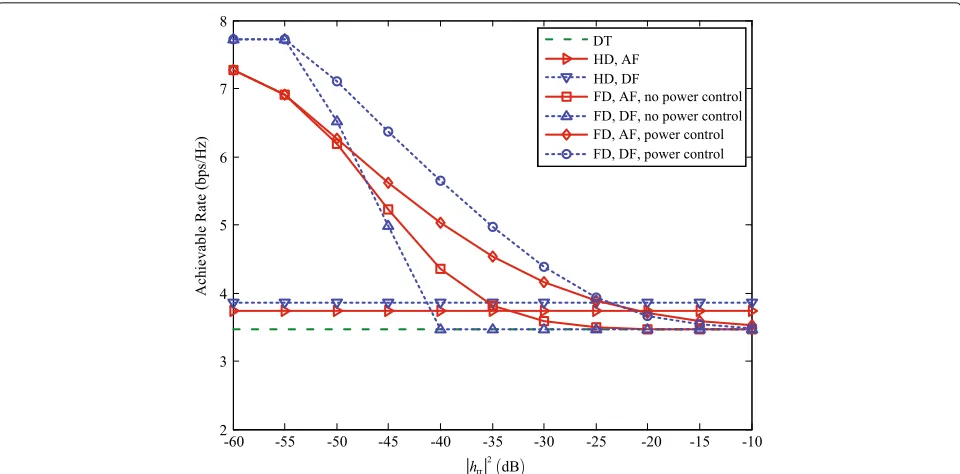
In Fig. 3, we plot the achievable rates as a function of
|hrr|2 for direct transmission, half-duplex relaying, and full-duplex relaying, where γsr = 30 dB. It is observed
from Fig. 3 that as|hrr|2increases, the achievable rates of
Fig. 3Achievable rates versus|hrr|2for direct transmission, half-duplex relaying, and full-duplex relaying, withγsr=30 dB
full-duplex relaying decrease significantly. When|hrr|2is high enough, the achievable rates of half-duplex relaying will outperform that of full-duplex relaying. Moreover, we can also see that power control can improve the achievable rates of full-duplex relaying.
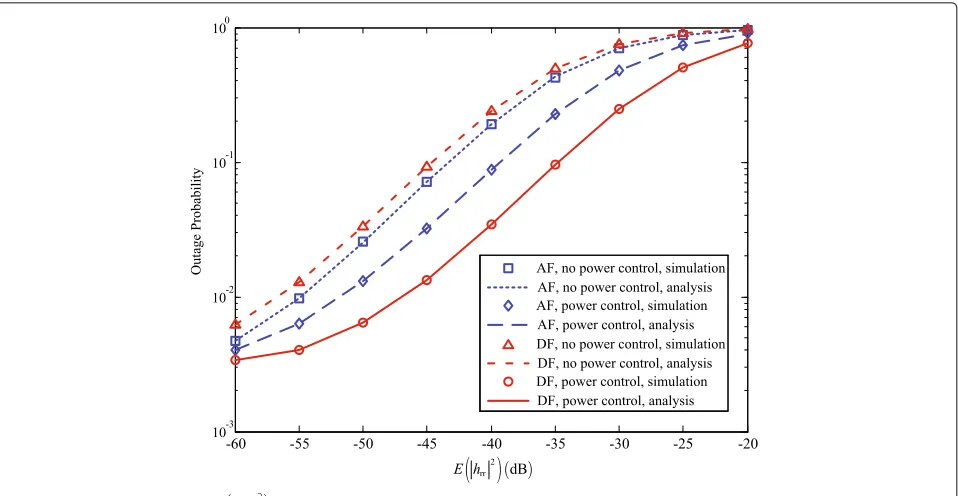
Figure 4 shows the outage probabilities versus γ¯sr for full-duplex relaying with E|hrr|2 = 4 × 10⁻⁶, while
Fig. 5 shows the outage probabilities versus E|hrr|2 for full-duplex relaying with γ¯sr = 40 dB. Note that NPmax
s ηsd
σd2 + NPmax r ηrd
σd2< δHD, so the outage
probabilities for half-duplex relaying equal to 1. From Figs. 4 and 5, we can see that (1) the outage probabilities of full-duplex relaying decrease asγ¯srincreases and increase asE|hrr|2increases; (2) the full-duplex DF relaying with
Fig. 5Outage probability versusE|hrr|2for full-duplex relaying, withγ¯sr=40 dB
power control will obtain the best performance and the full-duplex DF relaying without power control will obtain the worst performance; and (3) the outage probabilities of full-duplex relaying can be improved by using power control.
6 Conclusions
In traditional full-duplex relaying, the destination always treats the source-destination link as interference, which degrades the system performance. In this paper, we inves-tigated the system performance of full-duplex relaying by considering large-scale antenna array at the destina-tion. Using the property that the source-destination chan-nel vector and relay-destination chanchan-nel vector become pairwise orthogonal, we converted the source-destination link to useful signal. We derived the achievable rates and outage probabilities for direct transmission, half-duplex relaying, and full-half-duplex relaying, respectively. By maximizing the achievable rates or minimizing the outage probabilities based on the CSI availability, we obtained the optimal transmit power of the full-duplex relay node. Numerical results showed that the perfor-mance of full-duplex relaying is determined by the resid-ual self-interference, and power control can improve the performance of full-duplex relaying.
Acknowledgements
This work was supported by the 863 Program of China (2015AA01A703), the Fundamental Research Funds for the Central Universities (2014ZD03-02), the National Natural Science Foundation of China (61571055), the China Scholarship Council (201508120012), and the Doctoral Foundation of Tianjin Normal University (5RL135).
Competing interests
The authors declare that they have no competing interests.
Author details
1Tianjin Key Laboratory of Wireless Mobile Communications and Power Transmission, Tianjin Normal University, Tianjin 300387, China.2College of Electronic and Communication Engineering, Tianjin Normal University, Tianjin 300387, China.3Key Lab of Universal Wireless Communications, MOE, Beijing University of Posts and Telecommunications, Beijing 100876, China.
Received: 31 December 2016 Accepted: 21 February 2017
References
1. JG Andrews, S Buzzi, W Choi, SV Hanly, et al., What will 5G be?. IEEE J. Sel. Areas Commun.32(6), 1065–1082 (2014)
2. M Agiwal, A Roy, N Saxena, Next generation 5G wireless networks: a comprehensive survey. IEEE Commun. Surveys Tuts.18(3), 1617–1655 (2016)
3. F Boccardi, RW Heath, A Lozano, TL Marzetta, P Popovski, Five disruptive technology directions for 5G. IEEE Commun. Mag.52(2), 74–80 (2014) 4. F Rusek, D Persson, BK Lau, EG Larsson, TL Marzetta, et al., Scaling up
MIMO: opportunities and challenges with very large arrays. IEEE Signal Process. Mag.30(1), 40–60 (2013)
5. E Larsson, O Edfors, F Tufvesson, TL Marzetta, Massive MIMO for next generation wireless systems. IEEE Commun. Mag.52(2), 186–195 (2014) 6. L Lu, GY Li, AL Swindlehurst, A Ashikhmin, Z Rui, An overview of massive MIMO: benefits and challenges. IEEE J. Sel. Topics Signal Process.8(5), 742–758 (2014)
7. TL Marzetta, Noncooperative cellular wireless with unlimited numbers of base station antennas. IEEE Trans. Wireless Commun.9(11), 3590–3600 (2010)
8. H Yang, TL Marzetta, Performance of conjugate and zero-forcing beamforming in large-scale antenna systems. IEEE J. Sel. Areas Commun. 31(2), 172–179 (2013)
9. HQ Ngo, EG Larsson, TL Marzetta, Energy and spectral efficiency of very large multiuser MIMO systems. IEEE Trans. Commun.61(4), 1436–1449 (2013)
11. S Hong, J Brand, C Jung, et al., Applications of self-interference
cancellation in 5G and beyond. IEEE Commun. Mag.52(2), 114–121 (2014) 12. M Heino, D Korpi, T Huusari, et al., Recent advances in antenna design
and interference cancellation algorithms for in-band full duplex relays. IEEE Commun. Mag.53(5), 91–101 (2015)
13. H Ju, E Oh, D Hong, Improving efficiency of resource usage in two-hop full duplex relay systems based on resource sharing and interference cancellation. IEEE Trans. Wireless Commun.8(8), 3933–3938 (2009) 14. T Kwon, S Lim, S Choi, D Hong, Optimal duplex mode for DF relay in terms
of the outage probability. IEEE Trans. Veh. Techol.59(7), 3628–3634 (2010) 15. T Riihonen, S Werner, R Wichman, Optimized gain control for
single-frequency relaying with loop interference. IEEE Trans. Wireless Commun.8(6), 2801–2806 (2009)
16. T Riihonen, S Werner, R Wichman, Mitigation of loopback self-interference in full-duplex MIMO relays. IEEE Trans. Signal Process.59(12), 5983–5993 (2011)
17. T Riihonen, S Werner, R Wichman, Hybrid full-duplex/half-duplex relaying with transmit power adaptation. IEEE Trans. Wireless Commun.10(9), 3074–3085 (2011)
18. TK Baranwal, DS Michalopoulos, R Schober, Outage analysis of multihop full duplex relaying. IEEE Commun. Lett.17(1), 63–66 (2013)
19. B Yu, L Yang, X Cheng, R Cao, Power and location optimization for full-duplex decode-and-forward relaying. IEEE Trans. Commun.63(12), 4743–4753 (2015)
20. HQ Ngo, HA Suraweera, M Matthaiou, EG Larsson, Multipair full-duplex relaying with massive arrays and linear processing. IEEE J. Sel. Areas Commun.32(9), 1721–1737 (2014)
21. X Xia, D Zhang, K Xu, et al., Hardware impairments aware transceiver for full-duplex massive MIMO relaying. IEEE Trans. Signal Process.63(24), 6565–6580 (2015)
Submit your manuscript to a
journal and benefi t from:
7 Convenient online submission
7 Rigorous peer review
7 Immediate publication on acceptance
7 Open access: articles freely available online
7 High visibility within the fi eld
7 Retaining the copyright to your article