DEVELOPMENT AND EVALUATION OF FLOATING TABLET OF METOPROLOL SUCCINATE FOR
INCREASED BIOAVAILABILITY VIA IN VIVO STUDY
KAUSER FATEMA
1*, SADHANA SHAHI
21Department of Pharmaceutical Technology, Y.B. Chavan College of Pharmacy, Aurangabad, Maharashtra, India. 2Department of Pharmaceutical Technology, Government College of Pharmacy, Aurangabad, Maharashtra, India. Email:[email protected]
Received: 16 March 2018, Revised and Accepted: 19 April 2018
ABSTRACT
Objective: This study was performed to formulate a floating tablet using hydrophobic glyceryl behenate (GB) and hydrophilic hydroxypropyl methylcellulose polymers, optimization of the same for retention in stomach and sustained drug delivery over a period of 20 h from upper gastrointestinal tract so as to increase its oral bioavailability.
Methods: Granules of GB with the metoprolol succinate (MS) was formulated and compressed with the other ingredients to formulate a floating tablet. Physiochemical parameters of an optimized formulation along with its in vitro buoyancy study, dissolution study, in vivo studies in rabbit, and stability studies were performed.
Results: Differential scanning calorimetry data show no interaction between polymers and the drug MS. A 32 factorial design was applied for optimization purpose, and from ANOVA and surface response plot the best formulation (F3) was obtained. In vitro dissolution study shows sustained drug release for 20 h for all the formulations and in vivo studies using rabbit model show increased bioavailability of an optimized formulation F3 as compared to the marketed sustained release formulation of MS (25 mg). Stability study shows no comparable differences in physical parameters and the drug release of initial formulation and the one which is kept for accelerated stability testing.
Conclusion: Hence, we can conclude that a floating tablet containing a combination of hydrophilic and hydrophobic polymers can be used for gastric retention for more than 20 h which will increase the oral bioavailability of MS.
Keywords: Gastroretentive formulation, Metoprolol succinate, Glyceryl behenate, Improved bioavailability.
INTRODUCTION
Gastroretentive drug delivery system is a type of sustained drug delivery system in which dosage form is retained in the upper gastrointestinal region, used mainly for drugs which are absorbed from the stomach or which are degraded in colon, so as to improve its therapeutic effects and patient compliance. Poor bioavailability of many drugs is due to its unfavorable physicochemical characteristics or absorption in a well-defined part of the gastrointestinal tract referred as “absorption window” [1]. According to biopharmaceutics classification system, metoprolol succinate (MS) is classified under
Class I: With high solubility, high permeability [2] and used as a β1-selective adrenoreceptor blocking agent for treatment of hypertension and coronary heart diseases. Its poor bioavailability of <50% is due to rapid first-pass metabolism and degradation in the colon [3,4]. The half-life of it is 3–4 h [3]; therefore, multiple doses are required to maintain constant plasma levels of the drug, which can be achieved by sustaining the drug release for desired therapeutic effects in the upper gastrointestinal region to improve its oral bioavailability.
Many attempts have been taken to study sustained release (SR) matrix tablets of MS, using different polymer combinations and fillers.
Sabahuddin et al. studied the effect of hydroxypropyl methylcellulose (HPMC) and ethylcellulose on drug release of MS and oral bioavailability of it in rabbits by formulating SR matrix tablets [5].
Here, we used a combination of hydrophilic HPMC and hydrophobic glyceryl behenate (GB) with other fillers to formulate a floating tablet of MS which will release the drug for more than 20 h from the stomach and thereby improves the oral bioavailability of the formulation.
The objective of this study is to develop an optimized floating tablet of MS and to understand the drug release from such systems with hydrophilic (HPMC) and hydrophobic (Glyceryl behenate) polymers, optimization of formulation by design expert software, stability testing of an optimized formulation, evaluation of an optimized formulation for its oral bioavailability in rabbits and its comparison with that of a marketed SR tablet.
MATERIALS AND METHODS Materials
MS was obtained as a gift sample from Wockhardt Limited, Aurangabad, India. HPMC K100M, GB, mannitol, polyvinylpyrrolidone (PVP), sodium bicarbonate (NaHCO3), magnesium stearate, and MCC were obtained as a gift sample from Colorcon, Pvt., Ltd., Goa, India. All other solvents and reagents were purchased from Thermo Fischer scientific Pvt., Ltd., Mumbai, India, and were of analytical grade.
Method
Calibration curve for MS was obtained in 0.1 N HCL. Between the linearity range of 2–10 µg/ml and correlation coefficient (r2) of determination were obtained at 222 nm (R=0.9985), using an ultraviolet (UV)-visible spectrophotometer (Shimadzu UV-1800, Japan). The calibration curve in 0.1N HCl was used for dissolution studies [6].
Tablet formulation
Here we have made a combination of hydrophilic and hydrophobic polymers, to do so the granules of glyceryl behenate and mannitol with the drug was made by melting glyceryl behenate and adding MS and mannitol to the molten mass of glyceryl behenate which was allowed to solidify to form granules. These granules were passed from sieve © 2018 The Authors. Published by Innovare Academic Sciences Pvt Ltd. This is an open access article under the CC BY license (http://creativecommons. org/licenses/by/4. 0/) DOI: http://dx.doi.org/10.22159/ajpcr.2018.v11i8.25979
of appropriate mesh size, other polymers and fillers such as HPMC K100M, PVP, MCC except lubricant, and gas-generating agent were dry mixed and added to the above-prepared granules, finally, NaHCO3 and magnesium stearate were added to the mixture just before compression. Mixing continued for another 5 min, and finally, the mixed powder blend was compressed using punches of 8.5 mm on single rotary compression machine (Make: Rimek, Model: R and D model), to produce the desired tablets. The hardness of the tablet was adjusted at 3–4 kg/cm2 using a Monsanto hardness tester. The effects of selected variables on drug release were studied using 32 factorial designs, in which the effect of the two variables, i.e., GB and HPMC on percent drug release was observed. Other variables such as amount of MS, NaHCO3, PVP, MCC, and magnesium stearate were kept constant. The three-level
set includes lower level (−1), middle level (0), and upper level (+1).
Formulation design: Formulation design study is important for selection of appropriate excipients for preparing tablets.
Full factorial design
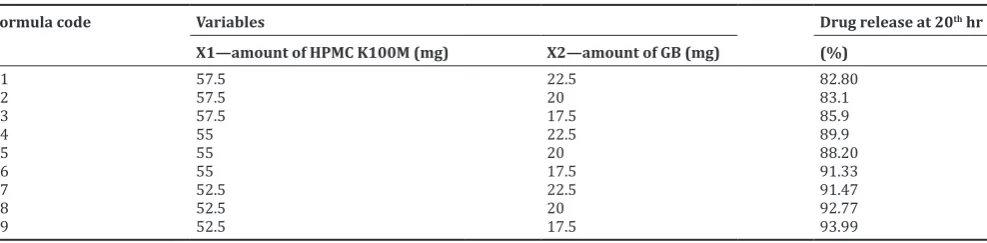
A 32 randomized full factorial design was constructed to study. In this design, two factors were evaluated, each at 3 levels and experimental trials were performed at all 9 possible combinations which are shown in Table 1. The amount of HPMC K100M (X1) and GB (X2) was selected as independent variables. The dependent variable chosen was percentage drug release at 20th h [7].
All other ingredients, such as MS=23.5 mg, mannitol= 25 mg, NaHCO3=15 mg, MCC=60 mg, PVP=15 mg, and magnesium stearate=2.5 mg were kept constant in all the formulations.
Determination of pre-compression and post-compression parameters
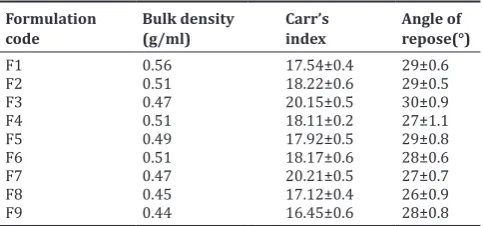
Tap density of granules was determined by a measuring cylinder. Bulk density of granules, percent compressibility (Carr’s index), and angle of repose was determined.
The tablets were stored at least for 7 days at room temperature before characterization. 10 samples of each formulation were chosen randomly for conducting each test.
The thickness of tablet was determined using Vernier Caliper. Three tablets from each formula were used, and average values were calculated as±standard deviation (SD) [8].
Hardness test
The hardness of the tablet (Kg/cm2) was determined using hardness tester. In which three tablets from each formula were tested and the average reading±SD was recorded [9].
The weight variation of the prepared floating tablet was determined by weighing 20 prepared floating tablets individually and then calculated its average weight and comparing the weight of each tablet to the average weight [10].
Friability test
Weight 20 tablets and placed them in the friabilator and the device was rotated at 25 rpm for (4 min). After revolutions, the tablets then de-dusted and weighed again. The acceptable percentage weight loss
or percentage friability should be ˂1%. The percentage friability was
determined using the following formula:[11].
% Friability=(initial weight−final weight/initial weight) ∗100
Drug content
Ten tablets of an equal weight of the prepared tablets were selected and powdered using mortar and pestle. Then, powder equivalent to the average weight of the prepared tablet was weighed and dissolved in HCl solution (pH1.2).
The solution was filtered and about 1 ml of the filtrate was appropriately diluted and analyzed for MS content using UV spectrophotometer at 222 nm as the wavelength of maximum absorption [12]. Data are tabulated in Tables 2 and 3.
In vitro buoyancy studies
In a beaker of 100 ml, 0.1N HCL was taken, and a formulation was dropped in it and observed for floating lag time (FLT), total floating time (TFT), and for tablet’s matrix integrity (MI).
The test was done by placing the tablet in 100 ml beaker containing HCl solution (pH1.2), and the temperature of the medium is maintained at 37±0.5°C. The time between the introduction of tablet and its buoyancy in HCl solution (pH1.2) is the FLT, while the time during which the tablet remains buoyant in the solution is the TFT [13].
In vitro dissolution studies
It was carried out in a dissolution test apparatus Electrolab TDT-06L for more than 20 h, according to united state pharmacopeia [14]. Each vessel containing about 500 ml of 0.1N HCL was taken, and the paddle apparatus with a speed of 75 rpm was used, while the temperature was kept constant at 37°C±0.5°C. At every time interval, 5 ml of media was withdrawn, filtered, diluted, and measured by UV-visible spectrophotometer at 222 nm. Furthermore, 5 ml of 0.1N HCL was replaced into the vessel to keep the volume constant. The dissolution was taken in triplicate for each formulation and percentage release was calculated using PCP diss. Software. ANOVA was performed for optimization purpose.
Differential scanning calorimetry (DSC)
The DSC was done for MS, GB, and formulation F3, using a SHIMADZU DSC-60 plus DSC. The system was calibrated with a high purity sample of Indium. MS was scanned at the temperature rate of 10°C/min over a range of 50–250°C under a nitrogen atmosphere using aluminum pans. Peak transitions and enthalpy of fusion were determined for the samples using TA60 integration software. Curves for them are interpreted below.
Table 1: Development of floating tablets prepared by 32 factorial design and their response
Formula code Variables Drug release at 20th hr
X1—amount of HPMC K100M (mg) X2—amount of GB (mg) (%)
Accelerated stability studies
Accelerated stability study was carried out for 6 months according to international conference on Harmonization (ICH) guidelines- Q1A(R) stability testing of new drug substance and finished products. (Now referred to as the parent guideline) to propose a retest period or shelf life, under specified conditions of temperature and humidity of around 40°C±2°C/75% RH±5% RH for 6 months. To find out the quality of finished product that is the optimized formulation F3 under a variety of conditions. For this, the tablets were packed in an aluminum packaging and kept in a stability chamber. At the end of every month, the samples were withdrawn and evaluated for hardness, drug content, floating characteristics (FLT and MI), and percentage drug release at 20th h.
Biopharmaceutical evaluation
This study was done to determine the bioavailability of MS in a rabbit model and was performed according to the guidelines of CPCSEA, ministry of social justice and empowerment, Government of India. The pro forma B having protocols for animal study was approved by the Institutional Animal Ethical Committee, Y.B Chavan College of Pharmacy, Aurangabad, Registration no: 844/ac/04/CPCSEA. For this six healthy male rabbits were selected and divided into two groups of three each, labeled as A and B. Group A was fed with optimized formulation of our study and Group B was fed with the marketed formulation of MS (Met-XL 25 mg tab). Before giving the dose, the animals were acclimatized for 1 week in the animal house and taken care of their diet. Humidity and temperature of the room were controlled. After giving the dose of MS tablets to each group, blood sample was removed from the marginal ear of each animal into a pre added K3 EDTA Accuvet at a predetermined intervals of time, i.e., m at 0h (before giving dose) then at 1, 2, 3, 4, 6, 8, 10, 12, 16, 18, 20, and 24, minimum 2 ml of blood was collected at each interval of time and was centrifuged immediately for 10 min at 2500 rpm to separate plasma from it, this plasma was collected into another set of tubes and was frozen until assayed.
For analysis of MS concentration in blood plasma of rabbits, we used HPLC method. For this standard, HPLC method was developed by preparing a mixture of phosphate buffer and acetonitrile in a ratio of 80:20, respectively, as a mobile phase and was used at a flow rate of 1 ml/min. The linearity range was found between 5 and 100 ng/ml and the correlation coefficient was found to be 0.9991. Before analysis of plasma by HPLC method, the plasma was filtered through 0.25 µm membrane filter and 0.2 ml of filtered plasma was taken and diluted Table 2: Characterization of granules of MS
Formulation
code Bulk density (g/ml) Carr’s index Angle of repose(°)
F1 0.56 17.54±0.4 29±0.6
F2 0.51 18.22±0.6 29±0.5
F3 0.47 20.15±0.5 30±0.9
F4 0.51 18.11±0.2 27±1.1
F5 0.49 17.92±0.5 29±0.8
F6 0.51 18.17±0.6 28±0.6
F7 0.47 20.21±0.5 27±0.7
F8 0.45 17.12±0.4 26±0.9
F9 0.44 16.45±0.6 28±0.8
MS: Metoprolol succinate
Table 3: Post-compression parameters Formula
code Tablet thickness (mm) Tablet weight (mg) Floating lag time (min) Drug content (%) Tablet Friability (%) Crushing Strength (kg·f ) Total floating duration (h)
F1 2.1±0.01 216.2±0.9 4.12±0.11 98.45±0.66 0.58 3.5 >18
F2 2.2±0.02 212.6±0.8 4.16±0.35 99.21±0.36 0.69 3 >20
F3 1.9±0.03 213.1±0.5 3.55±0.55 100.14±0.86 0.87 3.5 >19
F4 1.8±0.01 211.9±0.6 3.89±0.12 98.33±0.98 0.65 3.5 >20
F5 2.3±0.02 217.6±0.8 3.45±1.22 102.36±0.36 0.35 3 >19
F6 2.4±0.03 215.1±0.8 3.48±0.045 98.96±0.25 0.64 3.5 >20
F7 2.1±0.01 216.2±0.5 3.89±1.54 99.12±0.65 0.54 4 >18
F8 2.2±0.02 218.3±0.6 3.66±0.56 101.32±0.86 0.46 3.5 >17
F9 2.1±0.03 215.8±0.9 3.22±0.66 100.24±0.84 0.84 3 >18
Fig. 1: (a-c) Dissolution profile of factorial batches from F1–F9 in 0.1 N HCL (dissolution medium)
a b
with 1 ml of acetonitrile and again centrifuged to obtain a supernatant. This supernatant was evaporated under nitrogen, and the residue was mixed with 0.3 ml of HPLC mobile phase. Now, this is the final sample to be injected into the column of HPLC (XDB-C18, 150 mm×4.6 mm, and 5 µm) with UV detector at a wavelength of 223 nm.
Data obtained from this study were plotted as plasma concentration versus time and bioavailability was determined from AUC.
RESULTS AND DISCUSSION Selection of polymers
As we chose to use a combination of hydrophilic and hydrophobic polymers, various grades of HPMC were tested for its viscosity, as lower grades of HPMC disintegrates faster because of its lower viscosity, which is again due to less water sorption to relax its polymeric chain.
Therefore, higher viscosity grades of HPMC, i.e., HPMC K100M were preferred for our study. Further, GB was found to be used as a matrix forming agent for the controlled release of water-soluble drugs. It has also been investigated for use in the preparation of sustained-release tablets [15–20]. Hence, it was selected in our study.
Formulation and optimization of floating tablets of MS
As GB is waxy in nature it was melted in a porcelain dish and mixed with a diluent that is mannitol because granulations containing mannitol are easily dried [21]. Then, this mass was passed through sieve no.18, and the granules were dried for some time at room temperature. To these granules were added some other excipients such as HPMC K100M, PVP, and MCC and were dry mixed in a poly bag for 10 min. Then, just before compression NaHCO3 and magnesium stearate were added to the above mixture and finally compressed in a tablet compression machine using
punches of 8.5 mm. (Make: Rimek, Model: R and D model), to produce the desired tablets.
Various trial batches were prepared using a different concentration of selected polymers to obtain an optimized tablet of around 3–4 kg/cm2 hardness and which can retard the drug release for 20 h in acidic media that is under floating conditions. Finally, a formulation containing 20 mg of GB and 55 mg of HPMC K100M was found to give the desired results with 15 mg of NaHCO3. Hence, a 32 factorial design was applied to this formulation, where X1-HPMC and X2-G.B were selected as independent variables, and its effect was studied on drug release at 20th h. Pre-compression and post-Pre-compression parameters are tabulated in Table 2.
In vitro buoyancy studies
After fixing the amount of polymers to be taken for retardation of drug release for almost more than 20 h in the stomach, the amount of NaHCO3 was taken so as to achieve minimum FLT and maximum floating duration or time. It was found that 15 mg of NaHCO3 was sufficient to give the desired results.
Most of the prepared floating tablet formulas had acceptable FLT and TFT due to the presence of the gas generating agent within the formulas, when this agent become in contact with the acidic dissolution media (HCl solution, pH1.2) it generates carbon dioxide gas which entrapped within the gelling layer of the hydrophilic polymer. Furthermore, due to the swelling of the hydrocolloid particle on the surface after exposure to the aqueous gastric fluids, this sequentially results in an increase bulk volume and provides buoyancy to the floating tablet dosage forms [22].
In vitro drug release
Percent drug release for all nine formulations was determined and plotted against time (h), from Fig. 1 it was concluded. That F1 showed a very less release of 82.8% at 20 h with slight increase in percentage release from F2 to F3, maybe because of high percentage of both the polymers in F1 and as the concentration of G.B decreases percentage drug release increases to a very low extent which, in turn, shows that a decrease in concentration of GB has not much effect on drug release of the formulations. Again there is a significant increase in percentage drug release of F4, F5, and F6 formulations because of a decrease in concentration of HPMC K100M which plays a major role in drug release mechanism of our formulations and finally, we can conclude that as the concentration of HPMC K100M decreases the percentage drug release increases to a significant amount.
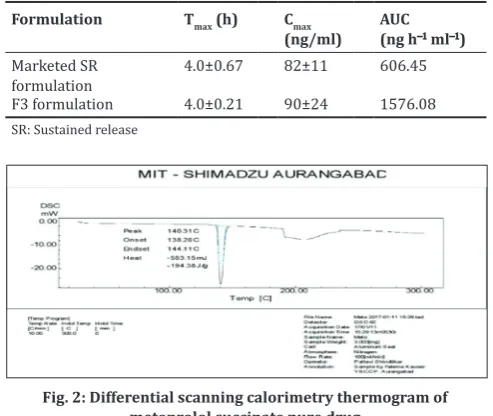
DSC
The DSC thermogram of MS indicates a sharp peak at 140.31°C which corresponds to the melting point of MS (Fig. 2). The thermogram of F3 formulation also exhibited the characteristic endotherm of MS, indicating the crystalline state of the drug and no interaction with other excipients. In the thermogram of F3 formulation (Fig. 3), the endotherm observed at 73.09°C corresponds to melting of GB, while the endotherm at 166.36°C is attributed to degradation of NaHCO3.
ANOVA for response surface linear model
The Table 4 of analysis of variance shows that the Model F-value of 46.93 implies the model is significant. Values of “p> F”<0.0500 indicate model terms are significant.
Table 4: Analysis of variance table
Source Sum of squares df Mean square F value p value p>F
Model 125 2 62.4 46.9 <0.0001 Significant
A-HPMC K100M 116 1 116. 87.6 <0.0001
B-GB 8.28 1 8.28 6.24 0.0371
Residual 10.6 8 1.33
Lack of fit 10.6 6 1.77
Pure error 0.000 2 0.000
Cor total 135 10
HPMC: Hydroxypropyl methylcellulose, GB: Glyceryl behenate
Table 5: Pharmacokinetic parameters and bioavailability of F3 formulation and marketed SR formulation
R1 is a response (that is, percent drug release at 20 h); negative sign on both the independent variable indicates that as the percentage of them decreases, drug release increases. Further, higher magnitude of A shows that polymer A has a greater impact on drug release. That means a small change in concentration of polymer A has a significantly large impact on percentage drug release. Hence, we can conclude that polymer A has greater impact as compared to variable B in our formulation study.
Response surface plot for release in 20 h Fig. 4 shows response surface plot.
Accelerated stability studies
Accelerated stability study was carried out for 6 months at a specified range of temperature and humidity of 40°C±2°C/75% RH±5%, respectively, as specified under ICH guidelines-Q1A(R) stability testing of new drug substance and finished products. A study carried out under such condition shows that the optimized formulation F3 is stable for 6 months as there are negligible changes in some parameters such as hardness, drug content, floating characteristics FLT, and percentage drug release at 20thh.
Bioavailability study of floating tablet of MS
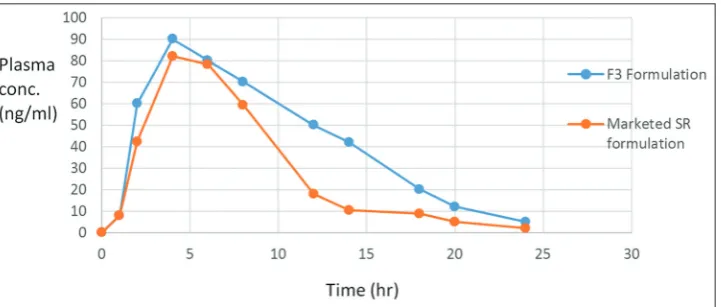
After in-vivo studies the analysis of plasma was carried out by HPLC. The data were obtained and plotted against time, i.e., plasma concentration versus time. This gives a curve shown in Fig. 5 from which various pharmacokinetic parameters were studied and reported below.
The extent of absorption gives an idea about bioavailability and is a characteristic of any formulation.
Here, we have compared the bioavailability of our optimized formulation with that of the marketed formulation. As the AUC of the studied formulations were significantly different, we can conclude that our optimized formulation has improved bioavailability than the marketed preparation. Thus, AUC can be used for comparative study of two formulations.
The Table 5 shows that Tmax, t1/2, and Cmax were slightly different for the two studied formulations.
CONCLUSION
From the experimental data and the results, we can conclude that a combination of hydrophilic and hydrophobic polymers can be used to formulate a floating tablet of MS which can release the drug for more than 20 h with improved bioavailability. Further, DSC analysis confirms no interaction between the polymers and drug. Accelerated stability study reveals that the formulation was stable for 6 months. Hence, we can conclude that the studied formulation could release the drug in the upper part of GIT for more than 20 h and has increased bioavailability as compared to the marketed preparation and is stable under specific Fig. 3: Differential scanning calorimetry thermogram of F3
Formulation
Fig. 4: Response surface plot, showing the response of polymer composition on “drug release in 20 h” (Rel20th h) from floating
tablet
Fig. 5: The plasma concentration versus time profile of F3 formulation and the marketed SR formulation
In this case, A and B are significant model terms. Values >0.1000 indicate the model terms are not significant.
The “Pred R-squared” of 0.8557 is in reasonable agreement with the “Adj R-squared” of 0.9018; i.e., the difference is <0.2. “Adeq Precision” measures the signal to noise ratio. A ratio >4 is desirable. Our ratio of 18.540 indicates an adequate signal. This model can be used to navigate the design space.
Final equation in terms of coded factors
conditions of temperature and humidity. Successful in vivo studies encouraged for further study in human volunteers.
AUTHOR’S CONTRIBUTION
Each author has contributed to the best of our knowledge for the research work carried out in this article.
CONFLICTS OF INTEREST
The authors declared that they have no conflicts of interest.
ACKNOWLEDGMENTS
The financial assistance of the Maulana Azad National Fellowship “University Grant’s Commission” Delhi, India, towards this research is hereby acknowledged
REFERENCES
1. Shahi S, Sonawane A, Vanamore S, Zadbuke N. Formulation and
in‑vitro characterization of acyclovir floating matrix tablets: A factorial design study. J Appl Pharm Sci 2013;3:65.
2. Dipti P, Ganesh P, Nilesh B, Ashawat MS. Extended release formulation of BCS class i drugs. World J Pharm Pharm Sci 2015;4:1676-88. 3. Kendall MJ, Maxwell SR, Sandberg A, Westergren G. Controlled release
metoprolol. Clinical pharmacokinetic and therapeutic implications. Clin Pharmaco Kinet 1991;21:319-30.
4. Hwang SJ, Park H, Park K. Gastric retentive drug-delivery systems. Crit Rev Ther Drug Carrier Syst 1998;15:243-84.
5. Sabahuddin S, Anirbandeep B, Jasmina K. Modulation of drug (metoprolol succinate) release by inclusion of hydrophobic polymer in hydrophilic matrix. Drug Dev Inds Pharm 2011;37:1016-25.
6. Kauser F, Shahi SR. Development and validation of spectrophotometric and rp-hplc method for determination of metoprolol succinate. Int J Chem Tech Res 2018;11:78-88.
7. Audumbar DM, Ritesh SB. Development and evaluation of gastro retentive floating tablets of a quinapril HCL by direct compression technique. Int J Pharm Pharm Sci 2017;9:35-46.
8. Rahi FA, Thomas LM. Formulation and in vitro evaluation of
mucoadhesive antimicrobial vaginal tablets of ciprofloxacin hydrochloride. Al-mustansiriyah. J Pharm Sci 2012;12:200-13.
9. Elbary AA, Ramadan AA, Bendas IR, Mostafa DA. Formulation and evaluation of taste masked rapidly disintegration tablet containing flupentixol dihydro chloride. Int J Pharm 2011;2:58-64.
10. Kumar S, Das M, Gupta KS, Kumar R, Chongdar A, Ghosh LK. Design, development, optimisation and evaluation of gastro-retentive floating tablets of atenolol. Scholars Res Library 2013;5:436-56. 11. Singh S, Prajapati K, Pathak AK, Mishra A. Formulation and evaluation
of floating tablet of captopril. Int J PharmTech Res 2011;3:333-41. 12. Sharma VK. Meloxicam loaded floating sustained release matrix tablet.
J Adv Pharm Educ Res 2012;2:18-24.
13. Kavitha K, Puneeth KP, Mani TT. Development and evaluation of rosiglitazone maleate floating tablets. Int J Appl Pharm 2010;2:6-10. 14. United States Pharmacopoeia Revision Bulletin Official August 1.
National Formulary. Rockville: USP Convention; 2012.
15. El-Sayed GM, El-Said Y, Meshali MM, Schwartz JB. Kinetics of theophylline release from different tablet matrices. STP Pharma Sci 1996;6:390-7.
16. Pascal P, Cauture E, Piccerelle PH, Kalantzis G, Joachim J. Evaluation of some protective agents on stability and controlled release of oral pharmaceutical forms by fluid bed technique. Drug Dev Ind Pharm 1997;23:817-26.
17. Achanta AS, Adusumilli PS, James KW, Rhodes CT. Hot-melt coating: Water sorption behavior of excipient films. Drug Dev Ind Pharm 2001;27:241-50.
18. Achanta AS, Adusumilli PS, James KW, Rhodes CT. Thermodynamic analysis of water interaction with excipient films. Drug Dev Ind Pharm 2001;27:227-40.
19. Hariharan M, Wowchuk C, Nkansah P, Gupta VK. Effect of formulation composition on the properties of controlled release tablets prepared by roller compaction. Drug Dev Ind Pharm 2004;30:565-72.
20. Obaidat AA, Obaidat RM. Controlled release of tramadol hydrochloride from matrices prepared using glyceryl behenate. Eur J Pharm Biopharm 2001;52:231-5.
21. Raymond CR, Paul JS, Marian EQ. Handbook of Pharmaceutical Excipients. 6th ed. USA: Pharmaceutical Press and American
Pharmacists Association; 2009. p. 286-7.