R E S E A R C H
Open Access
Training sequence based frequency-domain
channel estimation for indoor diffuse wireless
optical communications
Jun-Bo Wang
1,2*, Xiu-Xiu Xie
1, Yuan Jiao
1and Ming Chen
3Abstract
Channel estimation is a key technology for wireless optical communication (WOC) systems. Based on the training sequence (TS), this article develops three frequency domain (FD) channel estimation approaches for diffuse wireless optical channels. Considering the propagation property of light and the characteristics of optical modulation, this article establishes a link model for the indoor WOC systems. Using the established link model, three FD channel estimation methods, such as the LS method, the minimum mean square error (MMSE) method and the ORL-MMSE method are proposed. The computational complexity analysis gives time complexities of the three channel estimation methods in FD. This article also evaluates the performance of the proposed three methods by computer simulation, measuring in terms of MSE and BER, respectively. Further more, based on the Cramer–Rao Bound theorem, optimal TSs are found and tabulated for different channel responses and TS lengths. By using the optimal TSs, channel estimation errors measured by BER performance are also investigated.
Keywords: Diffuse wireless optical communication (WOC), Frequency-domain (FD) channel estimation, Training sequence (TS), Mean square error (MSE), Cramer–Rao Bound (CRB)
1 Introduction
Wireless optical communication (WOC) is an interesting technology combining the radio frequency communica-tions with the traditional infrared communicacommunica-tions [1]. Using a light emitting diode (LED) for data transmission, WOC systems can offer several potential advantages over their radio frequency and infrared counterparts, such as security at the physical level, high-data-rate, cost-effective, wide-bandwidth [2]. Therefore, there has been a growing interest in WOC systems in recent years. Despite these advantages, WOC systems for indoor applications are still having many critical issues to be resolved. Generally speaking, influenced by the complicated optical propaga-tion environment, the propagapropaga-tion path between trans-mitter and receiver is not always unobstructed. Transmit lights were diffusely reflected by reflecting surface, such
*Correspondence: [email protected]
1College of Electronic and Information Engineering, Nanjing University of Aeronautics and Astronautics, Nanjing 210016, China
2State Key Laboratory of Integrated Services Networks, Xidian University, Xi’an 710071, China
Full list of author information is available at the end of the article
as the ceiling, the wall or some other shiny surfaces before they reached to the receiver [3,4]. Therefore, the indoor WOC system can be termed as diffusive propaga-tion system. The diffusive WOC system image is drawn in Figure 1. Such diffuse propagation may cause the inter-symbol-interference (ISI), which is a primary impediment to communication at high speeds [5,6]. In order to elimi-nate the effects of ISI, the instantaneous channel impulse response must be obtained before the recovery of the transmitted information. Obviously, channel estimation plays a critical role in diffuse WOC systems.
To the best of the authors’ investigation, a preamble training sequence (TS) is often used to estimate the chan-nel impulse response in digital communication systems (as seen in Figure 2). For TS-based channel estimation in high speed wireless communications, there mainly are two different ways to estimate the channel impulses, i.e., time-domain (TD) method and frequency-domain (FD) method [7,8]. As a typical channel estimation method, TD channel estimation has been discussed extensively for conventional radio communications [9,10]. However,
LED
LED
Figure 1Diffuse WOCs.
only a few works have been done for the channel estima-tion for diffused WOC systems [11-13]. In [11], TS-based channel estimation for WOC systems has been investi-gated, and the optimal TSs for a better channel estimation performance have been found by computer search in [12]. Based on the “two-sided” channel estimation, Wang et al. [13] focuses on the complementary sets of sequences for estimating a channel impulse response in WOC sys-tems. Since channel estimation methods in TD are time consuming and the search strategy for optimal TSs based on TD method incurs high computational complexity, a recently proposed channel estimation method based on FD techniques has received enormous attention in radio frequency communications [14,15]. Different with the channel estimation in TD, FD channel estimation denotes the channel impulse response was estimated in the FD, fol-lowed by inverse discrete Fourier transform (DFT). To the best of the authors’ knowledge, no similar results for chan-nel estimation in WOC systems are available in the open literature.
Motivated by the research [7-15], this article focuses on the TS-based channel estimation methods in FD for WOC systems. Considering the propagation property of light and the characteristics of optical modulation, this article establishes the mathematical channel model for
indoor WOC systems. Further, based on the established link model, three FD channel estimation methods, such as the LS method, the minimum mean square error (MMSE) method and the modified MMSE method which can be called optimal low-rank MMSE (OLR-MMSE) are pro-posed. In addition, this article compares the complexity of the three methods. Furthermore, the performance of the proposed three methods are studied and compared, measuring in terms of Mean square error (MSE) and bit error ratio (BER), respectively. Based on the Cramer–Rao Bound (CRB) theorem, optimal TSs are found and tabu-lated for different channel responses and TS lengths. By using the optimal TSs, channel estimation errors mea-sured by BER performance are also investigated.
The rest of this article is organized as follows: the mathematical model for WOC systems is described in Section 2. Three channel estimation methods in FD for WOC channels using a know sequence are proposed in Section 3. Section 4 analyzes the com-putational complexity of the proposed FD channel estimation algorithms. The simulation results of per-formance of the proposed three channel estimation methods are provided in Section 5. Based on the CRB theorem, Section 6 investigates a valid performance metric for determining optimal TSs. In Section 7,
N D
DATA TS
Time
TS
N D
DATA
optimal TSs are obtained by enumerative search and the simulation results of BER performance are shown. Conclusions are drawn in Section 8.
2 Mathematical model in frequency domain (FD)
for diffuse WOCs
Consider the IM/DD modulation for WOC systems, in which the desired waveform is modulated onto the instantaneous power of the carrier and a photo-detector produces a current proportional to the received instanta-neous power. The binary information is modulated into “0” and “1”. As illustrated in Figure 1, the received signal of the WOC systems is given by [1]
y(t)=a(t)∗h(t)+n(t) t≥0 (1) where ∗denotes convolution, a(t) ∈ R+∪ {0} denotes the instantaneous power in the transmitter,h(t) ∈ R+∪
{0}is the impulse response of the channel, andn(t)∈Ris the optical channel noise. Digital sampling the continuous signals in the Equation (1), the signal of theith sampling instant with the sampling periodTscan be expressed as
y(iTs)=
m
h(mTs)a(iTs−mTs)+n(iTs). (2) Assuming the channel is represented as a finite impulse response filter withJtaps. The channel impulse is given by
h(t)=
channel impulse response. Let the initial transmit sequence is{am∈ {0, 1} |m=0, 1,. . .,N−1}. Therefore,
the received samples described by (2) can be further expressed as
the M-point DFT of the received signal samples can be denoted asY = [Y0,Y1,. . .,YM−1]T. Defining the input matrixA¯ = diag({Ak}), the system model in (4) can be described in FD as
Y= ¯AH+N. (6)
whereH=[H0,H1,. . .,HM−1]T,N=[N0,N1,. . .,NM−1]T is the Gaussian noise with varianceσ2.
3 TS based FD channel estimation method
In data aided channel estimation, the known information to the receiver is inserted in information symbols so that the current channel state can be estimated. By analyzing the relationship between the known TS and the received symbols, the instantaneous channel impulse response can be estimated [16].
3.1 Least-squares (LS) estimation
LS channel estimation is commonly used in radio fre-quency communications when a TS is available. The opti-mality criterion of this method is to minimize the least square errors to find an optimal estimator to the unknown parameters [9]. It is widely used in practice due to its salient feature that no probabilistic assumptions are made about the parameters. For the channel statistical model in FD as described in (6) for WOC systems, the sum of square error of channel estimation in FD can be defined as
ε (H)=Y− ¯AH2=Y− ¯AHHY− ¯AH, (7) where·denotes the norm of a vector,(x)His the Hermi-tian transposition ofx. Therefore, the optimality criterion can be defined as
ˆ
HLS=arg min
H
ε (H). (8) By differentiating with respect to each channel coeffi-cientHand setting the result to zero, i.e.
∂ ∂H
Y− ¯AHHY− ¯AH=0. (9)
The closed-form expression for the LS channel estimate in FD can be obtained as
ˆ Substituting Equation (6) into Equation (10), the LS channel estimate can be expressed as
ˆ
HLS=H+ ¯A−1N (11)
where H is the objective of the channel estimation, ¯
3.2 MMSE estimation
Unlike the LS approach, the optimality criterion of MMSE method is to minimize the MSEs to find an optimal estimator to the unknown parameters. Define the linear estimator that achieves the MMSE as
ˆ
HMMSE=VY (12)
whereVis the linear estimation operator [17]. From the Equation (12), the MSE of the channel estimation for WOC systems can be described as
δ (V)=EH− ˆHMMSE 2
=EH− ˆHMMSE 2
(13)
where E [·] denotes the expectations operator. To obtain the expression of the FD channel estimation, it is expected that the estimation operatorVmust be determined at first. Obviously, the optimal operatorVshould be satisfying the function as follows
ˆ
V=arg min
V δ (V). (14)
By differentiating with respect toVand setting the result to zero, i.e.
∂ ∂VE
(H−VY) (H−VY)H=0. (15) After solving the Equation (15), the close form of expres-sion of operatorVcan be written as
ˆ
HHHdenotes the autocovariance matrix of channel coefficient in FD,RN=E
NNHis the covari-ance matrix of the noise,(·)−1denotes the inverse oper-ation of a matrix. Therefore, the MMSE channel estimate in FD can be expressed as follows
ˆ
From the Equation (17), the MMSE approach can alle-viate the effect of channel noise in some degree when compared with the LS approach. However, the MMSE channel estimation requires prior knowledge of the chan-nel coefficient covariance matrixRHand noise covariance matrixRH, which means that the MMSE method is more complicated than the LS approach.
3.3 OLR-MMSE estimation
The MMSE estimator, as described in (17), is of consider-able complexity since a matrix inversion is needed every time the data inA¯ changes. We can reduce the complex-ity of this estimator by averaging over the transmitted data [15].
The first simplification of MMSE estimator is to
replace the term A¯A¯H −1 in (17) with its
expecta-. Assuming the transmitted symbols
draw equal-probably. Then, we have
E
whereIis the identity matrix. Defining the average signal to noise ratio (SNR) as
SNR=E|Ak|2
/σ2. (19) The estimator can be simplified by
ˆ
. To further reduce the complexity of the estimator, we proceed with the OLR approximations below.
Rank reduction is achieved by using the singular value decomposition (SVD). The SVD of the channel autoco-variance matrix is
RH=UUH (21)
whereUis a unitary matrix containing the singular vec-tors and is a diagonal matrix containing the singular valuesλ1 ≥ λ2 ≥ · · · ≥ λM on its diagonal. The SVD also dramatically reduces the calculation complexity of matrices.
The system first determines the number of ranks required by the estimator, denoted byp, which should be no smaller thanJ+1 [18]. Then, given the noise variance and the channel autocovariance matrixRH, the receiver pre-calculatesβ, SNR, the unitary matrixU, and the sin-gular values λks. It thus obtains the M × M diagonal
matrixpwith entries
δk=
During the transmission, using the transmitted pilotA¯ andY, theHˆLSis calculated according to (10), and the OLR-MMSE estimator with rankpis given by
ˆ
4 Computational complexity analysis
Even when an algorithm is computationally feasible in principle, it may not be realizable in practice if the algo-rithm requires an inordinate amount of resources (such as running time, storage space, and communication band-width) to obtain the solution. Thus, the computational complexity of an algorithm is an important factor for the realization. Moreover, running time is of primary concern in most cases. Generally, the running time needed by an algorithm expressed as a function of the size of the input parameters is called the time complexity of the algorithm [19]. In this section, the computational complexities of the proposed three FD channel estimation algorithms are analyzed in terms of time complexity.
To avoid the effect of running speed, the running time of an algorithm is usually measured by the number of operations needed by the algorithm to obtain the solution. However, in most cases, it is very difficult to determine the exact number of operations of an algorithm. Therefore, using the big-Onotation, the time complexity of an algo-rithm is usually expressed in an asymptotic upper bound on the number of operations [20].
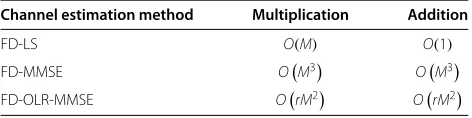
For simplicity, only major computational blocks of the proposed FD estimation algorithms are considered to evaluate the time complexity. Moreover, except for the operations related to the data processing, operations required for matrix formulation, loop counters, assign-ments of values to variables, etc., are not taken into account. In other words, the time complexity will be mea-sured based on the numbers of multiplication and addi-tion in the major computaaddi-tional blocks. Assuming that the length of TS is N, the time complexity is analyzed in Table 1. For a large-enough size of input parameters, the lower order terms of time complexity can be ignored. Therefore, from Table 1, we observe that the LS method is the most time efficient method among the FD algorithms. MMSE algorithm with a highest complexity and the OLR-MMSE is efficient than OLR-MMSE by reducing the rank of the channel correlation matrix.
5 Quality measure of FD channel estimate
To evaluate the performance of the proposed FD chan-nel estimation schemes, the proposed three methods are studied and compared by computer simulation. Here, two comparisons are considered. Firstly, the proposed three methods are compared in terms of MSE, which denotes
Table 1 Complexity comparison
Channel estimation method Multiplication Addition
FD-LS O(M) O(1)
FD-MMSE OM3 OM3
FD-OLR-MMSE OrM2 OrM2
the accuracy of the channel estimation. Secondly, the three methods are compared, measuring by BER, which denotes the system performance influenced by channel estimation.
In the first comparison, one way of quantifying chan-nel estimation performance is by MSE matrix [9], also referred to as the error covariance. The MSE matrix can be defined as Without lose of generality, we assume that the length of TS used in channel estimationN=26 and the number of channel tapsJ=3.
Figure 3 depicts the MSE performance versus the SNR with different FD channel estimation methods. It can be seen from Figure 3 that the MSE performance is decreases with the increase of the SNR. In addition, the best and worst MSE performances are achieved by the proposed MMSE channel estimation and the LS estimation algo-rithm, respectively. Also, for OLR-MMSE estimator, a degraded performance is shown due to the loss of channel information by reducing the rank of the channel correla-tion matrix. Moreover, since the LS method is sensitive to the signal noise power, the required SNR is 5 dB higher than the OLR-MMSE method with the MSE constraint and is set to be 10−2.
Figure 4 shows the MSE performance versus SNR with different estimation errors. With the LS channel estima-tion method, the MSE performances are free from the effects caused by the coefficient covariance matrix RH. However, the MSE increases significantly with the exis-tence of the estimation error of RH when used MMSE channel estimation method. With the increase of the error variance ofRH, the performance getting worse. Even though the SNR is high, the MSE performance for MMSE estimation is worse than LS estimation when there exits the estimation error forRH.
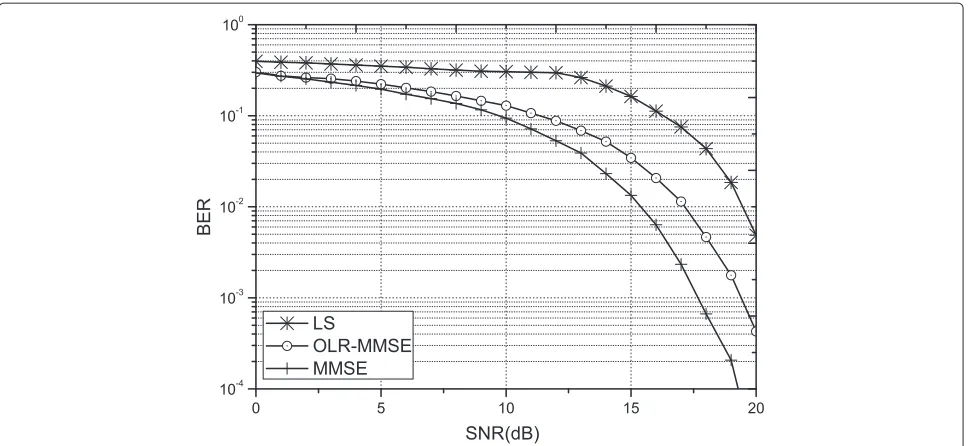
Figure 5 shows the second comparison. In Figure 5, the BER performance versus the SNR is depicted for the proposed three FD channel estimation schemes over the diffuse channel of WOC systems. It can be seen from Figure 5 that the BER performance is decreases with the increase of the SNR. The MMSE estimation method yields the best performance, and LS yields the worst. Also, for the OLR-MMSE estimator, a BER floor is shown due to loss of channel information by reducing the rank of the channel correlation matrix.
6 TS optimization
Figure 3MSE performance versus the SNR with different FD channel estimation methods.
estimator can obtain. The CRB for random channels has been wildly used as a performance measure for the design of optimal TSs [17,18]. In this section, we first derive a closed-form expression for the CRB for the estimation ofH.
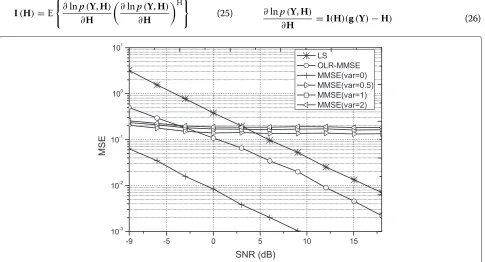
Based on the CRB theorem, the Fisher information matrix (FIM)I(H)is given as follows [21]
I(H)=E
∂lnp(Y,H) ∂H
∂lnp(Y,H) ∂H
H
(25)
where xH is the Hermitian transposition of x, p(Y,H)
is the joint probability density function of received sig-nal sequences and channel coefficients, the derivatives are evaluated at the true value of H and the expectation is taken with respect top(Y,H).
As described in the CRB theorem, it is sometimes possi-ble to determine the minimum variance unbiased (MVU) estimator if the equality constraints of the CRB theorem are satisfied.Hˆ =g(Y)will be the MVU estimator if
∂lnp(Y,H)
∂H =I(H)(g(Y)−H) (26)
Figure 5BER performance versus the SNR with different FD channel estimation methods.
for some functiong. Furthermore, the covariance matrix ofHˆ will beI−1(H). For the linear channel model of (6),
then the left part of the Equation (27) can be derived as
∂lnp(Y,H)
whereσ2is the variance of the Gaussian noise. Using the identities
∂bHH
∂H =b (29a)
∂bHSH
∂H =2Sb. (29b)
Table 2 Complexity comparison
Optimal TS search method Multiplication Addition
FD method OMlog2M OMlog2M
TD method O(M+ 1)J2 O(M+ 1)J2
The simpler expression of Equation (28) can be expressed as
which is exactly in the form of (26) with
ˆ
Hence, the MVU estimator ofHis given by (32a), and its covariance matrix is
CHˆ =I−1(H)=σ2
¯
AHA¯ −1. (33)
Further, the CRB of channel estimation in FD is given by
Table 3 Hexadecimal value of optimal TS
Channel TS length (N)
orderJ 2J 2J+ 1 2J+ 2 2J+ 3 2J+ 4
J= 2 F 13 27 3D BC
J= 3 3D 5E 97 0B7 35F
J= 4 ED 08B 20B 3DD F59
J= 5 3DD 765 DAB 1677 2A6F
J= 6 EB7 0F35 36A3 6D77 B3AF
J= 7 32A6 2B67 F36A 15B67 23597
where tr()means the sum of the main diagonal elements of matrix . Obviously, (34) can be used to evalute the performance of different TSs. Therefore, the optimal TS can be obtained as
TSF−OP=arg min
a∈{0,1}N
σ2
M−1
k=0 1 |Ak|2
. (35)
Based on (35) optimal binary sequences are found by exhaustive computer search. The resulting sequences offer the best performance of error covariance at the output of the channel estimator.
Table 2 compares the time complexity of the search methods in FD and TD, respectively. For simplicity, only major computational block of the proposed FD search strategy and TD search strategy are considered to eval-uate the time complexity. Comparing the search strate-gies described in [12] for TD channel estimation method with the FD method described in (35), we can see from the table that the optimal TSs search strategy in FD
can significantly reduces the complexity of the search. In other words, the procedure of searching for optimum sequences in FD is time consuming than that of TD method.
7 Enumerative computer search for optimal TSs
As the placement ofNclusters of pilot symbols is shown in Figure 2, a computer search has been performed to find the FD optimal TSs satisfying the Equation (35) for a given number of channel orderJand TS lengthN.
Table 3 lists the optimal sequences found up to length 18. The sequences are binary and are represented in hexadecimal form for compactness. The most signifi-cant bit corresponds to the first symbol of the TS to be transmitted. The length of the preamble is uniquely determined by its location in the table. If the sequence length is not a multiple of four, as many zeros as is necessary are added or neglected to obtain the correct preamble length.
0 5 10 15 20
10-4 10-3
10-2
10-1 100
BER
SNR(dB) Proposed Optimal TSs in FD, J=4 Optimal TSs in TD, J=4
Proposed Optimal TSs in FD, J=5 Optimal TSs in TD, J=5
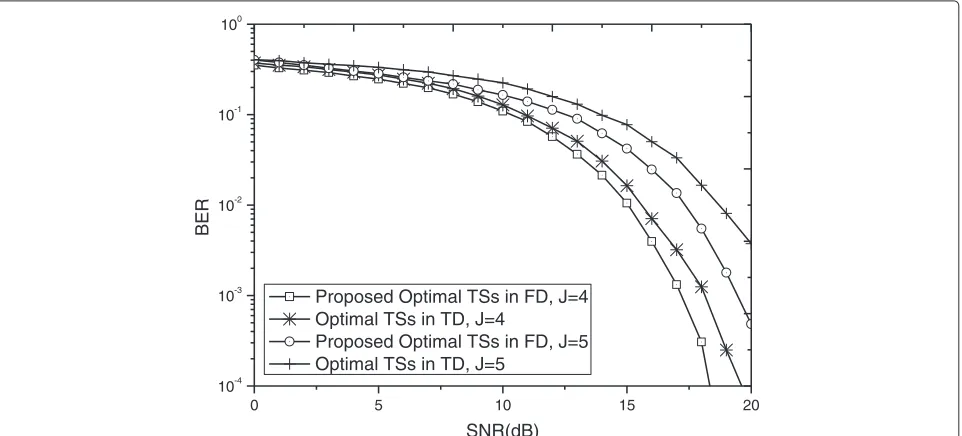
Figure 7BER performance versus the SNR by using proposed optimal TS in FD.Channel stateJ= 3.
To evaluate the performance, it is desired to compare our proposed optimal TSs in FD with the optimal TSs in TD for FD-LS channel estimation in terms of the BER via computer simulations, respectively. Although no TSs in TD have been proposed in published articles for WOC system, in our former research, we have investigated the optimal TSs for TD channel estimation for WOC systems [14].
Figure 6 compares the BER versus the SNR for the FD-LS channel estimation methods with proposed opti-mal TS and optiopti-mal TS in TD, respectively. The number of channel taps areJ=4 andJ=5. The TS length isN=12. It can be seen from Figure 6 that the BER decreases with the increase of the SNR. With the same length of chan-nel taps, the proposed FD optimal TS with the FD chanchan-nel estimation can obtained a better BER performance com-pared with the optimal TS in TD method. In other words, the optimal TS in FD can get a better performance with the same channel state. It should be noted that the maxi-mum value is obtained by the channel estimation method with a higher channel taps when the TS length hold fixed.
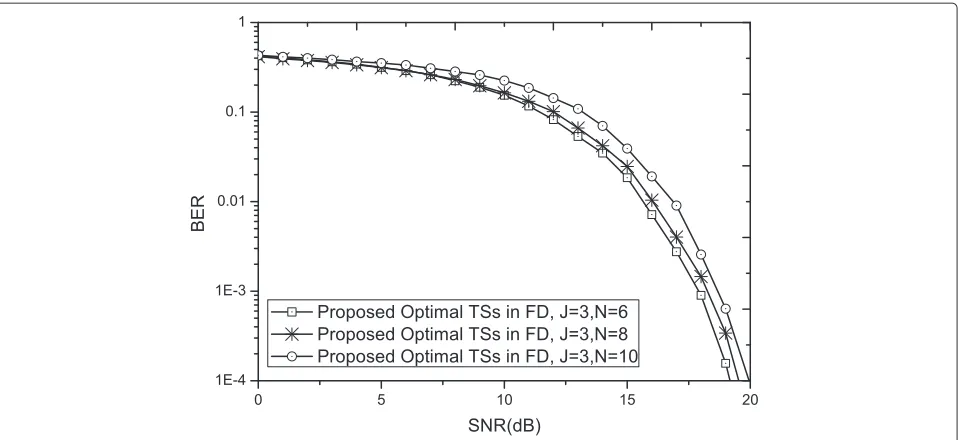
Figure 7 depicts the BER versus the SNR by using opti-mal TS in FD with the same number of channel taps but different number of TS symbols. The number of channel taps wasJ=3, but the TS lengths areN=6, 8, 10, respec-tively. It can be seen from Figure 7 that the BER decreases with the increase of the SNR. It should be noted that, the optimal TS with the less number of symbols can obtain the better BER performance under circumstances of the number of channel taps held fixed.
8 Conclusions
This article investigates the TS-based channel estimation in FD for indoor WOC systems. Firstly, the mathemati-cal model is established for indoor WOC systems. Based on the established link model, three channel estimation methods, such as the LS method, the MMSE method and the ORL-MMSE method are proposed. Moreover, this article evaluates the performance of the proposed three methods by computer simulation, measuring in terms of MSE and BER, respectively. The mathematical analysis and the simulation results show that the LS estimator per-forms the worst of all methods and it has a lowest compu-tational complexity, however. The MMSE estimator yields the best performance with its relatively higher complex-ity. The OLR-MMSE estimator gives the best trade off between performance and complexity. Based on the CRB theorem, a performance measure has been proposed to assess the quality of pilot symbols for FD channel estima-tion. Then, optimal TSs are found by a computer search. It has been demonstrated that the proposed method for searching the optimal TSs based on FD techniques invites a lower complexity search strategy compared with TD techniques. It should be noted that the optimal TSs in FD have a better BER performance compared to the TSs in TD. The minimum value is obtained by the channel esti-mation method with a lower channel taps when the TS length hold fixed. Moreover, with the number of channel taps held fixed, the longer the TS length is, the better the channel estimation performance can be obtained.
Competing interests
Acknowledgements
This work is supported by National Nature Science Foundation of China (No. 61102068, No.61172077 and No. 60972023), China Postdoctoral Science Foundation (No. 20110490389), Research Fund of National Mobile Communications Research Laboratory, Southeast University (No. 2012A06), the Research Fund for the Doctoral Program of Higher Education (No. 20113218120017), the open research fund of the State Key Laboratory of Integrated Services Networks, Xidian University (ISN12-11), NUAA Research Funding (NS2011013) and the Fundation of Graduate Innovation Center in NUAA (No.kfjj20110213 and No.kfjj20110129).
Author details
1College of Electronic and Information Engineering, Nanjing University of
Aeronautics and Astronautics, Nanjing 210016, China.2State Key Laboratory of
Integrated Services Networks, Xidian University, Xi’an 710071, China.3National
Mobile Communications Research Laboratory, Southeast University, Nanjing 210096, China.
Received: 2 September 2011 Accepted: 23 September 2012 Published: 30 October 2012
References
1. JM Kahn, JR Barry, Wireless infrared communications. Proc. IEEE.85(2), pp. 265–298 (1997)
2. K Langer, J Grubor, Recent developments in optical wireless communications using infrared and visible light, inInternational
Conference on Transparent Optical Networks,vol. 3, Rome, July 2007)
pp. 146–151
3. K Nishida, S Miyamoto, K Tsukamoto, N Morinaga, A proposal of multi-beam transmitter for non-directed diffuse indoor optical wireless communication system, inSeventh IEEE International Symposium on
Personal, Indoor and Mobile Radio Communications,vol. 1, Taipei, Oct 1996)
pp. 242–246
4. FJ Lopez-Hernandez, CF Pozuelo, AS Galdon, Diffuse optical wireless communications for domotic indoor networks, inIEEE International
Symposium on Consumer Electronic, Reading UK, Sept 2004) pp. 169–173
5. JB Carruthers, P Kannan, Iterative sitebased modeling for wireless infrared channels. IEEE Trans. Antenn. Propag.50(5), pp. 759–765 (2002) 6. JR Barry, JM Kahn, EA Lee, DG Messerschmitt, High-speed nondirective
optical communication for wireless networks. IEEE Netw. Mag.5(6), pp. 44–54 (1991)
7. P Hoeher, S Kaiser, P Robertson, Pilot-symbol-aided channel estimation in time and frequency, inIEEE GLOBECOM, New York, 1997) pp. 90–96 8. W Chen, U Mitra, Training sequence optimization: comparisons and an
alternative criterion. IEEE Trans. Commun.48(12), pp. 1987–1991 (2000)
9. H Arslan, GE Bottomley, Channel estimation in narrowband wireless communication systems. Wirel. Commun. Mobile Comput.1(2), pp. 201–219 (2001)
10. SN Crozier, DD Falconer, SA Mahmoud, Least sum of squared errors (LSSE) channel estimation. IEE Proceedings F Radar and Signal Processing. 138(4), pp. 371–378 (1991)
11. JB Wang, Y Jiao, XY Dang, M Chen, XX Xie, LL Cao, Training sequence based channel estimation for indoor visible light communication system. Optoelectron. Lett.7(3), pp. 213–216 (2011)
12. JB Wang, Y Jiao, M Chen, Optimal training sequences for wireless optical communications. J. Opt. A: pure and applted optics.14(1), p. 015401 (2011)
13. JB Wang, Y Jiao, XY Song, XB Zhao, M Gu, M Chen, XX Xie, M Sheng, Complementary-sequences-based channel estimation for diffuse wireless optical communications. Opt. Eng.50(7), pp. (075003)1–6 (2011) 14. C Tellambura, MG Parker, YJ Guo, Optimal sequences for channel estimation using discrete fourier transform techniques. IEEE Trans. Commun.47(2), pp. 230–238 (1999)
15. Li Ye, Pilot-symbol-aided channel estimation for OFDM in wireless systems. IEEE Trans. Vehicular Tech.49(4), pp. 1207–1215 (2000) 16. JD Zhang, BY Zheng, Overview of pilot-aided channel estimation in
OFDM. J. China Inst. Commun.24(11), pp. 116–124 (2003)
17. H-N Lee, GJ Pottie, Fast adaptive equalization/diversity combining for time-varying dispersive channels. IEEE Trans. Consum. Electron.46(9), pp. 1146–1162 (1998)
18. SQ Wang, A Abdi, A periodic complementary sets of sequences-based MIMO frequency selective channel estimation. IEEE Commun. Lett.9(10), pp. 891–893 (2005)
19. AV Aho, JE Hopcroft, JD Ullman,The design and analysis of computer
algorithms. (Addison-Wesley, Reading, MA, 1974)
20. TH Cormen, CE Leiserson, RL Rivest,Introduction to Algorithms. (MIT Press, Cambridge, 1994)
21. SM Kay,Fundamentals of Statistical Signal Processing: Estimation Theory. (Prentice-Hall, NJ, 1993)
doi:10.1186/1687-1499-2012-326
Cite this article as:Wanget al.:Training sequence based frequency-domain channel estimation for indoor diffuse wireless optical communications.
EURASIP Journal on Wireless Communications and Networking20122012:326.
Submit your manuscript to a
journal and benefi t from:
7 Convenient online submission
7 Rigorous peer review
7 Immediate publication on acceptance
7 Open access: articles freely available online
7 High visibility within the fi eld
7 Retaining the copyright to your article