R E S E A R C H
Open Access
Exponentially practical stability of
impulsive discrete time system with delay
Sirilak Wangrat and Piyapong Niamsup
**Correspondence: [email protected] Department of Mathematics, Chiang Mai University, Chiang Mai, 50200, Thailand
Abstract
In this paper we investigate an impulsive discrete time system with delay. By using Lyapunov stability theory and a Razumikhin type technique, some new criteria for the exponentially practical stability of impulsive discrete time system with delay are established. A numerical example is given to show the effectiveness of our theoretical results.
Keywords: discrete time system; delay; impulse; exponentially practical stability
1 Introduction
According to a study, a discrete time system is a more natural way to represent systems such as networked control system, numerical analysis, and population models [–]. In most physical dynamic systems, abrupt state changes at certain moments often occur. It is natural to assume these changes to happen instantaneously. Such dynamical systems with these changes are called impulsive systems. Impulsive systems arise in many fields and there are several studies on stability of impulsive systems [–, , –]. Moreover, the real processes in our world always involve time delay systems; for example, manufacturing processes, digital control systems, population dynamics, and the electronic implementa-tion of analog neural networks, etc. It is well known that time delay might cause instability, divergence behavior, and oscillation of dynamic systems. Therefore, the stability of impul-sive system with time delay has been investigated extenimpul-sively over the past decades [–]. Recently, the stability analysis of time delay system has been investigated extensively in many areas [–, , , , , ]. There are important types of stability of dynami-cal systems, namely exponential stability and practidynami-cal stability. In the case of exponen-tial stability, it is required that all solutions starting near an equilibrium point not only stay nearby, but tend to the equilibrium point very fast with exponential decay rate; see [–, , , , , ]. Meanwhile, for practical stability, one only needs to stabilize a system in a region of phase space, namely the system may oscillate close to the state, in which the performance is still acceptable. There are several results on the practical sta-bility for continuous time systems with delay [, , ] and without delay [, , ]. On the other hand, there are few results on practical stability for discrete time systems with delay [, ]. Moreover, there are several practical applications of impulsive discrete time system with delay such as BAM neural networks [], Nicholson’s blowflies model [], and switched systems with delays [–]. Therefore, it is important to investigate
the practical stability problem of impulsive discrete time system with delay. In [, ], the authors have studied discrete time delayed dynamic systems with impulsive effects. By employing Lyapunov stability theory and a Razumikhin type technique, exponential sta-bility criteria of impulsive discrete time system with delay have been derived. In [], an asymptotically practical stability condition of impulsive discrete systems with time de-lays has been provided by using Lyapunov stability theory and a Razumikhin type tech-nique. However, the stability criteria depend onτ, namely,τsupm∈Z+{km+–km}< +∞,
wherekmare impulsive moments. Obviously, exponential stability implies exponentially
practical stability but not conversely. However, in several practical applications, one only needs to stabilize a system in a region of phase space, namely the system may oscil-late near the equilibrium point, in which the performance is still acceptable. Motivated by the above discussions, in this paper, we derive novel exponentially practical stability criteria of impulsive discrete time systems with delay by using Lyapunov stability the-ory and a Razumikhin type technique. To the best of our knowledge, it is the first re-sult on the exponentially practical stability of impulsive discrete time systems with de-lay. Moreover, comparing to [] which proposed an asymptotically practical stability con-dition, our technique can be used to derive an exponentially practical stability condi-tion if it is more desirable. Furthermore, the obtained condicondi-tion is not required that
supm∈Z+{km+–km}< +∞, where km are impulsive moments which is imposed in [].
The paper is organized as follows. In Section , we introduce some notations, definitions, and a proposition. In Section , we give new criteria for exponentially practical stabil-ity of impulsive discrete time systems with delay. In Section , a numerical example is given to show the effectiveness of our theoretical results. Our conclusion is given in Sec-tion .
2 Preliminaries
Let Rn denote the ndimensional Euclidean space, x is the Euclidean norm of
vec-tor x. Given a positive integer τ, for any function φ :N–τ −→Rn, we define φ=
maxθ∈N–τ{φ(θ)},N={, , , . . .}andN–τ={–τ, –τ– , . . . , –, }. Consider the following impulsive discrete time system with delay:
⎧
Definition . ([, ]) The trivial solution of system (.) is exponentially practically
that
x(k;k,φ)
p
≤Mφpe–λ(k–k)+r.
The following proposition will be used in the proof of our main results. The proofs are straightforward and will be omitted.
Proposition . Letγ,β be positive real numbers and <λ< .If one of the following conditions holds:
(i) γ ≥and γγe–e <β< , (ii) γ < and e–e <β< ,
thenmax{( –β)eλ, ( –β)γeλ}< .
3 Main results
We first consider the exponentially practical stability problem of system (.) in the case
γ ≥.
Theorem . If there exist positive numbers a,c,c,p,γ,q,β,η;q>γ≥,γγe–e <β< ,γ > –β,η<min{a–aγγ+aγ β,βa}and a Lyapunov function V(k,x(k))such that the following conditions hold:
(i) cx(k)p≤V(k,x(k))≤cx(k)p+a,∀k≥k
–τ,x∈Rn,
(ii) ifV(k+s,x(k+s)) <qV(k+ ,x(k+ ))withs∈N–τ,then
V(k,x(k)) =V(k+ ,x(k+ )) –V(k,x(k))≤–βV(k,x(k)) +ηholds, (iii) V(km,x(km)) =V(km,x(km)) +Im(km,x(km))≤γV(km,x(km)),m∈N,x∈Rn,
then the trivial solution of system(.)is exponentially practically stable in the pth moment.
Proof Sinceq>γ ≥, there exists <λ< such that
q>γeλ(τ+)≥eλ(τ+).
From (i), fork∈[k–τ,k], we get
Vk,x(k)≤cxp+a≤cxpe–λ(k–k)+a≤cφpe–λ(k–k)+a. (.)
We claim that
Vk,x(k)≤cφpe–λ(k–k)+a, k∈[km–+ ,km]. (.)
Now, we will prove (.) by using mathematical induction. First, we show that (.) holds form= , namely
Vk,x(k)≤cφpe–λ(k–k)+a, k∈[k+ ,k]. (.)
We assume (.) were not true, then there exists k∈[k+ ,k] such thatV(k,x(k)) > cφpe–λ(k–k)+a. Letk∗=min{k∈[k
+ ,k]/V(k,x(k)) >cφpe–λ(k–k)+a}. From (.) and the definition ofk∗, we have
Vk,x(k)≤cφpe–λ(k–k)+a, k∈ k–τ,k∗–
We will consider two possible cases fork∗∈[k+ ,k].
(I) k∗∈[k+ ,k– ].
In this case, for anys∈N–τ, we have
Vk∗– +s,xk∗– +s≤cφpe–λ(k∗–+s–k)+a
=cφpe–λ(s–)e–λ(k∗–k)+a
≤ceλ(τ+)φpe–λ(k
∗–k)
+aeλ(τ+)
=eλ(τ+) cφpe–λ(k∗–k)+a
<qVk∗,xk∗.
Let k =k∗ – , then we get V(k +s,x(k+s))≤qV(k + ,x(k+ )). By (ii), we have V(k,x(k))≤–βV(k,x(k)) +ηholds. Thus, we have
Vk∗,xk∗≤( –β)Vk∗– ,xk∗– +η
≤( –β) cφpe–λ(k∗––k)+a+η
≤( –β)eλcφpe–λ(k∗–k)+a–βa+η.
By assumption ofηand Proposition ., we getV(k∗,x(k∗))≤( –β)eλcφpe–λ(k∗–k)+ a–βa+η, which contradicts the definition ofk∗. Hence (.) holds.
(II) k∗=k.
In this case, we haveV(k,x(k)) >cφpe–λ(k–k)+aand for anys∈N–τ, we get
Vk– +s,x(k– +s)
≤cφpe–λ(k–+s–k)+a
=cφpe–λ(s–)e–λ(k–k)+a
≤ceλ(τ+)φpe–λ(k–k)+aeλ(τ+)
=eλ(τ+) cφpe–λ(k–k)+a
<eλ(τ+)Vk,x(k)
<eλ(τ+)γVk,x(k)
<qVk,x(k).
Letk=k–, then we getV(k+s,x(k+s))≤qV(k+,x(k+)). By (ii), we have V(k,x(k))≤ –βV(k,x(k)) +η, which gives
γV
k,x(k)≤Vk,x(k)
≤( –β)Vk– ,x(k– )
+η.
Thus, we obtain
Vk,x(k)≤( –β)γVk– ,x(k– )
+ηγ
≤( –β)γ cφpe–λ(k––k)+a+ηγ
By assumption ofηand Proposition ., we getV(k∗,x(k∗))≤( –β)γeλcφpe–λ(k∗–k)+ aγ –aγ β+ηγ, which contradicts the definition ofk∗=k. Hence (.) holds.
Next, we assume (.) holds form∈N, namely
Vk,x(k)≤cφpe–λ(k–k)+a, k∈[km–+ ,km].
Then we will show that
Vk,x(k)≤cφpe–λ(k–k)+a, k∈[km+ ,km+]. (.)
We assume (.) were not true, then there exists
k∗=mink∈[km+ ,km+]/V
k,x(k)>cφpe–λ(k–k)+a.
Fork∈[km+ ,k∗– ], we haveV(k,x(k))≤cφpe–λ(k–k)+a. We will consider two
pos-sible cases fork∗∈[km+ ,km+]. (I) k∗∈[km+ ,km+– ].
In this case, for anys∈N–τ, we have
Vk∗– +s,xk∗– +s≤cφpe–λ(k∗–+s–k)+a
=cφpe–λ(s–)e–λ(k∗–k)+a ≤ceλ(τ+)φpe–λ(k
∗–k)
+aeλ(τ+)
=eλ(τ+) cφpe–λ(k∗–k)+a
<qVk∗,xk∗,
thusV(k+s,x(k+s))≤qV(k+ ,x(k+ )) and from (ii), we have V(k,x(k))≤–βV(k, x(k)) +η, which contradicts the definition ofk∗. Hence (.) holds.
(II) k∗=km+.
In this case, we haveV(km+,x(km+)) >cφpe–λ(km+–k)+a. Then, for anys∈N–τ, we get
Vkm+– +s,x(km+– +s)
≤cφpe–λ(km+–+s–k)+a
=cφpe–λ(s–)e–λ(km+–k)+a ≤ceλ(τ+)φpe–λ(km+–k)+aeλ(τ+)
=eλ(τ+) cφpe–λ(km+–k)+a
<eλ(τ+)Vk,x(km+)
<eλ(τ+)γVk,x(km+)
<qVk,x(km+)
.
Let k =km+ – , then we get V(k +s,x(k+s))≤qV(k+ ,x(k+ )). By (ii), we have V(k,x(k))≤–βV(k,x(k)) +η, which gives
γV
km+,x(km+)
≤Vkm+,x(km+)
≤( –β)Vkm+– ,x(km+– )
Thus, we obtain
Vkm+,x(km+)
≤( –β)γVkm+– ,x(km+– )
+ηγ
≤( –β)γ cφpe–λ(km+––k)+a+ηγ
≤( –β)γeλcφpe–λ(km+–k)+aγ –aγ β+ηγ.
By assumption onηand Proposition ., we getV(k∗,x(k∗))≤( –β)γeλcφpe–λ(k∗–k)+ aγ –aγ β+ηγ, which contradicts the definition ofk∗=km+. Hence (.) holds.
Thus, for allk≥k, we have
Vk,x(k)≤cφpe–λ(k–k)+a.
From (i), we obtain
cx(k)
p
≤Vk,x(k)≤cφpe–λ(k–k)+a,
which implies that
x(k)p≤c c
φpe–λ(k–k)+ a c .
Therefore, the trivial solution of system (.) is exponentially practically stable in thepth
moment.
Next, we give an exponentially practical stability condition of system (.) for the case <γ< .
Theorem . If there exist positive numbers a,c,c,p,γ,q,β,η;q> >γ > ,e–e <β < , γ > –β,η<min{a–aγγ+aγ β,βa}and a Lyapunov function V(k,x(k))such that the fol-lowing conditions hold:
(i) cx(k)p≤V(k,x(k))≤cx(k)p+a,∀k≥k
–τ,x∈Rn,
(ii) ifV(k+s,x(k+s)) <qV(k+ ,x(k+ ))withs∈N–τ,then
V(k,x(k)) =V(k+ ,x(k+ )) –V(k,x(k))≤–βV(k,x(k)) +ηhold, (iii) V(km,x(km)) =V(km,x(km)) +Im(km,x(km))≤γV(km,x(km)),m∈N,x∈Rn,
then the trivial solution of system(.)is exponentially practically stable in the pth moment.
Proof Sinceq> >γ > , there exists <λ< such that
q>eλ(τ+)≥γeλ(τ+).
From assumption ofηand Proposition ., by using a similar argument as in the proof of Theorem ., we may show thatx(k)p≤c
cφ
pe–λ(k–k)+ a
c,∀k≥k. Therefore, the trivial solution of system (.) is exponentially practically stable in thepth moment.
Remark . We now provide a direct and effective solving algorithm corresponding to Theorems . and . as follows:
. First, we choose an appropriate Lyapunov function candidate. Then we make an estimate forc,candasatisfying condition (i).
. Next, find an estimation ofγ which satisfies (iii).
. Finally, with estimates ofc,c,aandγ in and , we choose appropriateq,β, andη which satisfy condition (ii).
4 Numerical example
Example . Consider the following impulsive discrete time system with delay:
⎧
wherec,dare arbitrary constants andγ is positive constant, which is considered in []. Leta> be given. If there exist positive numbersc,c,p,γ,q,β,ηsuch thatη= ( –|c|– |d|)a,β≤min{ ––||cd||q,γ––||cd||q}, then the trivial solution of system (.) is exponentially practically stable in thepth moment.
= –
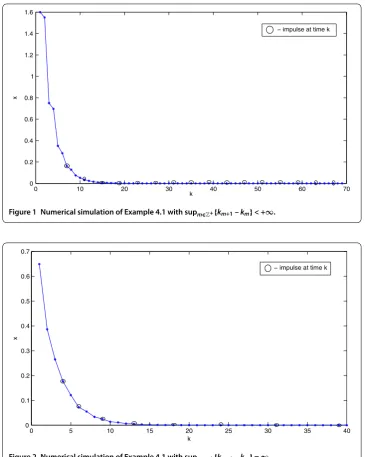
Therefore, from Theorem ., we conclude that the system (.) is exponentially practi-cally stable in thepth moment. For simulation purposes, we leta= .,|c|= .,|d|= .,λ= .,q= .,γ = .. We choose the Lyapunov functionV(k,x(k)) =|x(k)|+ .. Then Theorem . is satisfied with the parametersc=c= ,a= .,p= ,β= .,γ = ., andη= .. Therefore, we havex(k) ≤.e–.k+ .,∀k≥. In Figure and
Fig-ure , with initial conditions given byx(–) = .,x() = ., the trajectories of solutions of (.) with impulsive momentskm= k+ ,m∈Nin whichsupm∈Z+{km+–km}= < +∞
andkm={, , , , , , . . .}in whichsupm∈Z+{km+–km}=∞, are shown, respectively.
It is worth noting that, in [], the asymptotically practically stable criterion requires
τ supm∈Z+{km+–km}< +∞. On the other hand, this restriction is not required in
The-orem .. Therefore, our result is less conservative than the result obtained in [].
5 Conclusion
Figure 1 Numerical simulation of Example 4.1 with supm∈Z+{km+1–km}< +∞.
Figure 2 Numerical simulation of Example 4.1 with supm∈Z+{km+1–km}=∞.
Comparing to some existing results in the literature the obtained criterion is not required thatsupm∈Z+{km+–km}< +∞, wherekmare impulsive moments. A numerical example is given to show the effectiveness of our theoretical results.
Competing interests
The authors declare that they have no competing interests.
Authors’ contributions
All authors have equal contributions to the writing of this paper. All authors have read and approved the final version of the manuscript.
Acknowledgements
Received: 22 June 2016 Accepted: 18 October 2016
References
1. Liu, B, Marquez, H: Razumikhin-type stability theorems for discrete delay systems. Automatica43(7), 1219-1225 (2007) 2. Li, C, Duan, S, Wu, S, Liao, X: Exponential stability of impulsive discrete systems with time delay and applications in
stochastic neural networks: a Razumikhin approach. Neurocomputing82, 29-36 (2012)
3. Wu, K, Ding, X: Impulsive stabilization of delay difference equation and its application in Nicholson’s blowflies model. Adv. Differ. Equ.2012, 88 (2012)
4. Zhang, K, Liu, X: Global exponential stability of nonlinear impulsive discrete systems with time delay. In: 2013 25th Chinese Control and Decision Conference (CCDC), pp. 148-153 (2013)
5. Sun, L, Liu, C, Li, X: Practical stability of impulsive discrete systems with time delays. Abstr. Appl. Anal.2014, 954121 (2014)
6. Xiang, M, Xiang, Z: Exponential stability of discrete time switched linear positive systems with time delay. Appl. Math. Comput.230, 193-199 (2014)
7. Zhang, Q, Liu, W, Su, Z: Practical stability and controllability for a class of nonlinear discrete systems with time delay. Nonlinear Dyn. Syst. Theory10(2), 161-174 (2010)
8. Liu, X, Zhang, Z: Uniform asymptotic stability of impulsive discrete systems with time delay. Nonlinear Anal.72, 4941-4950 (2011)
9. Zhang, Y, Sun, J, Feng, G: Impulsive control of discrete systems with time delay. IEEE Trans. Autom. Control54, 830-834 (2009)
10. Ellouze, I, Hammami, MA: Practical stability of impulsive control systems with multiple time delays. Dyn. Contin. Discrete Impuls. Syst., Ser. A Math. Anal.20, 341-356 (2013)
11. Yan, J, Shen, J: Impulsive stabilization of functional differential equations by Lyapunov-Razumikhin functions. Nonlinear Anal.37, 245-255 (1999)
12. Dlala, M, Hammami, MA: Uniform exponential practical stability of impulsive perturbed systems. J. Dyn. Control Syst. 13, 373-386 (2007)
13. Wang, Q, Liu, X: Impulsive stabilization of delay differential systems via the Lyapunov-Razumikhin method. Appl. Math. Lett.20, 839-845 (2007)
14. Peng, SG, Zhang, Y: Razumikhin-type theorems onpth moment exponential stability of impulsive stochastic delayed differential equations. IEEE Trans. Autom. Control55(8), 2795-2805 (2010)
15. Fu, X, Li, X: Razumikhin-type theorems on exponential stability of impulsive infinite delay differential systems. J. Comput. Appl. Math.224, 1-10 (2009)
16. Hamed, BB, Ellouze, I, Hammami, MA: Practical uniform stability of nonlinear differential delay equations. Mediterr. J. Math.8, 603-616 (2011)
17. Wu, B, Han, J, Cai, X: On the practical stability of impulsive differential equations with infinite delay in terms of two measures. Abstr. Appl. Anal.2012, 434137 (2012)
18. Sun, G, Zhang, Y: Exponential stability of impulsive discrete-time stochastic BAM neural networks with time-varying delay. Neurocomputing131, 323-330 (2014)
19. Huang, S, Li, X, Xiang, Z: Anti-windup design and l2-gain analysis for a class of discrete-time impulsive switched systems with actuator saturation. Trans. Inst. Meas. Control38(4), 425-434 (2016)
20. Li, X, Xiang, Z: Observer design of discrete-time impulsive switched nonlinear systems with time-varying delays. Appl. Math. Comput.229, 327-339 (2014)
21. Li, X, Xiang, Z, Karimi, HR: Asynchronously switched control of discrete impulsive switched systems with time delays. Inf. Sci.249, 132-142 (2013)
22. Li, Z, Fang, J, Miao, Q, He, G: Exponential synchronization of impulsive discrete-time complex networks with time-varying delay. Neurocomputing157, 335-343 (2015)
23. Ghanmi, B, Hammami, MA, Hadj Taied, N: Growth conditions for exponential stability of time-varying perturbed systems. Int. J. Control89(6), 1086-1097 (2013)
24. Benabdallah, A, Ellouze, I, Hammami, MA: Practical stability of nonlinear time-varying cascade systems. J. Dyn. Control Syst.15, 45-62 (2009)