R E S E A R C H
Open Access
On certain inequalities and their applications
in the oscillation theory
Blanka Baculíková and Jozef Džurina
* *Correspondence:[email protected] Department of Mathematics, Faculty of Electrical Engineering and Informatics, Technical University of Košice, Letná 9, Košice, 042 00, Slovakia
Abstract
In the paper, we offer a set of inequalities involving delayed argument and offer their application for higher-order differential equations of the form
x(n)(t) +q(t)x
(τ
(t))
= 0to be oscillatory. The conditions obtained essentially improve many other known results.
MSC: 34K11; 34C10
Keywords: higher order differential equations; delay argument; oscillation
1 Introduction
The paper is organized as follows. In the first part we consider only properties of functions and their derivatives, and later we connect the estimate obtained with properties of solu-tions of differential equasolu-tions. We shall investigate the properties of a couple of funcsolu-tions τ(t)∈C(I) andx(t)∈C(I),I= [t
,∞).
Lemma Assume thatis a positive integer such that
x(t) > , x(t) > , . . . , x()(t) > , x(+)(t) < , (C¯)
eventually.Then for any constantλ∈(, )and for every i= , , . . . ,,
tix(i)(t)
i! < λ
i
x(t), (.)
eventually.
Proof Assume that (C¯) holds fort≥t. Using the monotonicity ofx()(t), it is easy to see
that for anyk∈(, ),
x(–)(t) >
t
t
x()(s) ds≥(t–t
)x()(t)≥ktx()(t), (.)
eventually, let us say, fort≥t≥t. We define a sequence of functions{ρi(t)}as follows:
ρ(t) =x(–)(t) –ktx()(t),
ρ(t) = x(–)(t) –ktx(–)(t),
.. .
ρ(t) =x(t) –ktx(t).
It follows from (.) thatρ(t) > . An integration of this fromttotyields
x(–)(t)[ +k] –ktx(–)(t)≥c=kx(–)(t) –tx(–)(t)
.
On the other hand, sincex(–)(t)→ ∞ast→ ∞, we see that
x(–)(t)[ –k] >c.
Combining the last two inequalities, we conclude that
ρ(t) > .
Proceeding as above, we verify thatρi(t) > , eventually, for alli= , , . . . ,– . Therefore,
x(t) >ktx(t),
(– )x(t) >ktx(t),
.. .
x(–)(t) >ktx()(t),
or in other words
tx(t) < kx(t),
tx(t) <
k(– )x(t),
.. .
tx()(t) < k!x(t).
Settingλ=k, the last inequalities imply (.) and the proof is complete.
Lemma Assume thatτ(t)≤t and thatis a positive integer such that(C¯)holds.Then,
for any constantλ∈(, ),
xτ(t)≥λ
τ(t) t
x(t), (.)
Proof Taylor’s theorem implies that
The proof is complete.
The obtained estimates can be used,e.g., in the theory of functional equations. In the paper, we present their application in discussing oscillatory and asymptotic properties of higher-order delay differential equations.
2 Main results
We consider higher-order delay differential equation
x(n)(t) +q(t)xτ(t)= , (E)
where
(H) q(t) > ,τ(t)≤t.
Denote byN the set of all nonoscillatory solutions of (E). It follows from the classical lemma of Kiguradze [] that the setN has the following decomposition:
N =N∪N∪ · · · ∪Nn–, n-odd,
N =N∪N∪ · · · ∪Nn–, n-even,
where the nonoscillatory solutionx(t), let us say positive, satisfies
x(t)∈N ⇔
Kondratiev and Kiguradze, we say that (E) has property (A) provided that
N =N, n-odd,
N =∅, n-even.
essentially contributed to the subject and presented a very useful comparison technique for studying the properties of a delay differential equation from those of a differential equa-tion without delay. A new impetus to investigaequa-tion in this direcequa-tion was given by papers of Chanturia and Kiguradze [], Kusano and Naito [] and Koplatadzeet al.[, ]. See also [–]. In the paper, we employ Lemma to establish new criteria for oscillation of (E).
It is interesting to note that the condition
∞
τn–(t)q(t) dt=∞ (.)
is necessary for property (A) of (E). This fact has been observed in [] and [].
Theorem Assume that(E)has a solution of degree> ,then for anyλ∈(, )so does the ordinary equation
x(n)(t) +λ
τ(t) t
q(t)x(t) = . (E)
Proof Assume that (E) possesses a nonoscillatory solutionx(t)∈N. We may assume that
x(t) is positive. Then condition (.) of Lemma implies thatx(t) is a positive solution of the differential inequality
x(n)(t) +λ
τ(t) t
q(t)x(t)≤.
On the other hand, it follows from Theorem of [] that the corresponding equation (E)
has also a solution of degree. The proof is complete.
So, if we eliminate solutions of degreeof equations (E), we get property (A) of
stud-ied equation (E). To do it, we recall the following comparison result which is due to Chanturia [].
Theorem Assume that
∞
t
q(s) ds≥
∞
t
p(s) ds. (.)
If the differential equation
x(n)(t) +p(t)x(t) =
has no solution of degree,neither does the equation
x(n)(t) +q(t)x(t) = .
In view of Theorem , we apply this comparison theorem to equations (E) and the Euler
equation
x(n)(t) + a
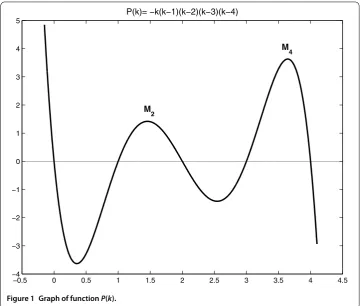
Figure 1 Graph of functionP(k).
to obtain new criteria for property (A) of (E). Properties of (.) are connected with prop-erties of the polynomialPn(k) = –k(k– )· · ·(k–n+ ). Let us denote
Mj= max k∈(j–;j)
Pn(k),
wherej= , , . . . ,n– fornodd, while j= , , . . . ,n– forneven. In other words,Mj represents all local maxima of the polynomialPn(k) (see Figure ). Then it is easy to verify (see also []) that the following criterion for theNto be empty holds true.
Lemma Let> .If
a>M, (.)
where= , , . . . ,n– for n odd and= , , . . . ,n– for n even,then(.)has no solution of degree.
Employing Theorem to (.) and (E), in view of Theorem , one gets the following
theorem.
Theorem Assume that
lim inf
t→∞ t n–
∞
t
τ(s) s
n–
q(s) ds> Mn–
(n– ). (P)
Proof Assume that n is odd. Observing that τ(t)≤ t and Mn–> M for every =
ing (.) into account, Theorem ensures that (E) has no solution of degree. Finally,
Theorem guarantees that (E) has property (A). The proof is complete.
Forτ(t) =αt, <α≤, the previous result simplifies to the following.
Then the delay differential equation
x(n)(t) +q(t)x(αt) = , <α≤, (E∗)
has property(A).
Theorem Let n be odd.Assume that(E)has property(A).Then every nonoscillatory
solution x(t)of (E)satisfies
lim
t→∞x(t) = .
Proof First note that property (A) of (E) implies (.). Moreover, it follows from the defini-tion of property (A) that every nonoscillatory soludefini-tionx(t)∈N, which implies that there
existslimt→∞x(t) =c≥. We claim thatc= . If not, thenx(τ(t))≥c> . An integration
Having repeated this procedure, we are led to
x(t)≥
which contradicts (.) and we conclude thatc= .
Example Consider the fifth-order delay differential equation
x()(t) + a
tx(αt) = , a> , <α< . (Ex)
The graph of the polynomialP(k) = –k(k– )(k– )(k– )(k– ) that corresponds to the fifth-order equation is presented in Figure . Employing Matlab, we easily evaluate that
M= ..
Consequently, criterion (P∗) for property (A) of (E) reduces for (Ex) to
aα> ..
3 Comparison
Theorem essentially improves Chanturia’s test [] that guarantees property (A) of
x(n)(t) +q(t)x(t) = , (E)
provided that
lim sup
t→∞ t
∞
t
sn–q(s) ds> (n– )!.
Kiguradze’s test [] that for property (A) of (E) requires
∞
t
sn––εq(s) ds=∞ for someε> ,
and Koplatadze’s test [] for property (A) of (E) that claims the condition
lim sup
t→∞
τ(t)
∞
τ(t)
τn–(s)q(s) ds+
t
τ(t)
τn–(s)q(s) ds
+ τ(t)
τ(t)
t
sτn–(s)q(s) ds
> (n– )!, (.)
whereτ(t) is nondecreasing.
We provide details while comparing those criteria with our one.
Example Consider once more the fifth-order delay differential equation (Ex). It is easy
to see that Chanturia’s test can be applied only whenα= and requires
a> !
for property (A) of (Ex). Kiguradze’s test fails. On the other hand, Koplatadze’s test
sim-plifies forα= andα= . to
respectively, while our criterion needs only
a> . and a> .,
respectively.
Competing interests
The authors declare that they have no competing interests.
Authors’ contributions
The authors have made the same contribution. All authors read and approved the final manuscript.
Acknowledgements
This work was supported by the Slovak Research and Development Agency under the contract No. APVV-0008-10.
Received: 1 March 2013 Accepted: 23 May 2013 Published: 11 June 2013 References
1. Kiguradze, IT: On the oscillation of solutions of the equationdm u dtm+a(t)|u|
nsignu= 0. Mat. Sb.65, 172-187 (1964) (Russian)
2. Sturm, JCF: Mémoire sur les équations différentielles linéaires du second ordre. J. Math. Pures Appl.1, 106-186 (1836) 3. Mahfoud, WE: Oscillation and asymptotic behavior of solutions ofnth order nonlinear delay differential equations.
J. Differ. Equ.24, 75-98 (1977)
4. Kiguradze, IT, Chaturia, TA: Asymptotic Properties of Solutions of Nonautonomous Ordinary Differential Equations. Kluwer Academic, Dordrecht (1993)
5. Kusano, T, Naito, M: Comparison theorems for functional differential equations with deviating arguments. J. Math. Soc. Jpn.3, 509-533 (1981) Zbl 0494.34049
6. Koplatadze, RG: On differential equations with a delayed argument having properties A and B. Differ. Uravn. (Minsk)
25, 1897-1909 (1989)
7. Koplatadze, RG, Kvinkadze, G, Stavroulakis, I: Properties A and B ofnth order linear differential equations with deviating argument. Georgian Math. J.6, 553-566 (1999)
8. Agarwal, RP, Grace, SR, O’Regan, D: Oscillation Theory for Difference and Functional Differential Equations. Kluwer Academic, Dordrecht (2000)
9. Baculíková, B, Džurina, J: Oscillation of third-order neutral differential equations. Math. Comput. Model.52, 215-226 (2010)
10. Baculíková, B, Graef, J, Džurina, J: On the oscillation of higher order delay differential equations. Nonlinear Oscil.15, 13-24 (2012)
11. Baculíková, B, Džurina, J: Oscillation of third-order nonlinear differential equations. Appl. Math. Lett.24, 466-470 (2011)
12. Baculíková, B: Properties of third order nonlinear functional differential equations with mixed arguments. Abstr. Appl. Anal.2011, Article ID 857860 (2011)
13. Baculíková, B, Džurina, J, Rogovchenko, Y: Oscillation of third order trinomial differential equations. Appl. Math. Comput.218, 7023-7033 (2012)
14. Baculíková, B, Džurina, J: Property (A) and oscillation of third order differential equations with mixed arguments. Funkc. Ekvacioj55, 239-253 (2012)
15. Džurina, J: Comparison theorems for nonlinear ODE’s. Math. Slovaca42, 299-315 (1992)
16. Erbe, L, Kong, Q, Zhang, BG: Oscillation Theory for Functional Differential Equations. Dekker, New York (1995) 17. Ladde, GS, Lakshmikantham, V, Zhang, BG: Oscillation Theory of Differential Equations with Deviating Arguments.
Dekker, New York (1987)
18. Zafer, A: Oscillation criteria for even order neutral differential equations. Appl. Math. Lett.11, 21-25 (1998) 19. Meng, FW, Xu, R: Oscillation criteria for certain even order quasi-linear neutral differential equations with deviating
arguments. Appl. Math. Comput.190, 458-464 (2007)
20. Li, T, Han, Z, Zhao, P, Sun, S: Oscillation of even-order neutral delay differential equations. Adv. Differ. Equ.2010, Article ID 184180 (2010)
doi:10.1186/1687-1847-2013-165