IMPACT OF ROTATORY VESTIBULAR STIMULATION AND
CURCUMA LONGA
ON SPATIAL
LEARNING AND MEMORY IN WISTAR ALBINO RATS
DEVI NP
1, MUKKADAN JK
2*
1Research Scholar, Department of Physiology, Little Flower Medical Research Centre, Angamaly, Kerala, India. 2Research Director, Department of Physiology, Little Flower Medical Research Centre, Angamaly, Kerala, India. Email: [email protected]
Received: 07 December 2015, Revised and Accepted: 15 December 2015 ABSTRACT
Objective: This study was aimed at investigating the effect of rotatory vestibular stimulation and the capacity of the powerful antioxidant curry spice
Curcuma longa (turmeric) on neuromorphological and brain cholinesterase activity in rats to analyze the behavioral changes and cognition in healthy
Wistar albino rats.
Methods: A total of 72 adult male Wistar albino rats were randomly assigned into four groups. For Group A (control group) neither vestibular stimulation nor the turmeric was administered, Group B (rotatory vestibular stimulated group), rotatory vestibular stimulation was given for 5 minutes in a rotatory vestibular apparatus at a rate of 50 revolutions per minute in clockwise direction for 30 days, Group C (turmeric alone) treated with 2 mg/kg of turmeric for 30 days, Group D (turmeric+vestibular), treated with 2 mg/kg of turmeric followed by 5 minutes of rotatory vestibular stimulation for 30 days.
Results: Group B shows improvement in learning via a reduction in number of trails for acquisition and retention, and an increase in dendritic branching points and intersections and also a reduction in acetylcholinesterase level.
Conclusion: Rotatory vestibular stimulation provides improvement in cognition via neuromorphological and biochemical changes than rotatory vestibular stimulation and turmeric in combination and turmeric alone, though there is no significant difference between the treated groups. Rotatory vestibular stimulation in combination with turmeric (Group D) shows a nonsignificant increase in dendritic arborization ensures a long lasting promising effect in cognition enhancement through a long period of treatment. Further detailed study on combination of rotatory vestibular stimulation and turmeric is required to explore the mechanism of therapeutic action of this intervention as a useful remedy for the management of cognitive disorders.
Keywords: Rotatory vestibular stimulation, Turmeric, Learning and memory, Hippocampal neurons
INTRODUCTION
In traditional practices of Ayurvedic and Chinese medicine, numerous plants have been used to treat cognitive improvement, disorders, including neurodegenerative diseases such as Alzheimer’s disease due to certain natural polyphenols and anticholinesterase alkaloids present in them. The popular Indian spice Curcuma longa (turmeric), a member of the ginger family (Zingiberaceae) possess such natural polyphenolic alkaloids such as curcumin, desmethoxycurcumin and bis-desmethoxycurcumin which are responsible for the yellow of turmeric. The yellow pigment curcumin, extracted from the rhizome of turmeric is a polyphenolic non-flavonon compound is the pharmacologically active substance of turmeric has potent anti-inflammatory and antioxidant activity that reduces the oxidative damage and cognitive deficits associated with aging. The potency of curcumin to protect the brain from free radical induced damage is thought to be several times stronger than that of vitamin E [1] and equivalent to vitamin C [2]. The antioxidant activity of curcumin may be due to the two electrophilic alpha and beta unsaturated carbonyl groups, in its structure, which can react with nucleophiles such as glutathione. Another crucial characteristic of curcumin is the capacity to cross the blood brain barrier to produce the neuroprotection directly [3]. The supplementation of curcumin normalizes the protein levels of brain derived neurotrophic growth factor (BDNF), which mediates the effects of curcumin on cognitive function. BDNF is synthesized predominantly by neurons located in the hippocampus, the area of brain intimately associated with the processing of cognitive function [4]. The mechanism of curcumin that improves learning and memory may be related with the upregulation of BDNF. Controlled
rotatory vestibular stimulation induces the release of acetylcholine, a neurotransmitter known to facilitate long term potentiation (LTP), in the hippocampus. This enhancement of LTP depends on the activation of hippocampal cholinergic neurons [5]. Rotatory vestibular stimulation enhances learning and memory via reducing the level of acetylcholinesterase (AChE) the hydrolyzing enzyme of acetylcholine and also alters the neuromorhology of rats by increasing the dendritic arborization [6]. There are many studies carried out on the anti-inflammatory effects of curcumin and stress relieving effects of controlled vestibular stimulation, and here we are trying to explore the ability of rotatory vestibular stimulation in combination with turmeric for the enhancement of learning.
METHODS Subjects
Animals
A total of 72 adult male Wistar albino rats 120±30 g, were used for the study and each group consists of 18 number of rats (n=18). The rats were bred and maintained at the central animal research facility (Rodent house Register number: 496/01/a/CPCSEA) of the Little Flower Medical Research Centre (LFMRC), Angamaly. They were housed in groups in polypropylene cages in an acclimatized (25-27°C) room and were maintained on a 12 hrs light/dark cycle. Food and water was given ad-libitum. They were randomly assigned into four groups.
Group A: Control group - Neither vestibular stimulation nor the curcumin was administered. Group B: Rotatory vestibular stimulated
group - Rotatory vestibular stimulation was given for 5 minutes in a rotatory vestibular apparatus at a rate of 50 revolutions per minute in clock wise direction for 30 days Group C: Turmericgroup - Treated with 2 mg/kg of turmeric for 30 days. Group D: (turmeric+vestibular group) - Treated with 2 mg/kg of turmeric followed by 5 minutes of rotatory vestibular stimulation in a rotatory vestibular apparatus at a rate of 50 revolutions per minute in clockwise direction for 30 days.
Drug
Turmeric were dried and minced with distilled water (2 mg/kg) and used for oral administration to rats.
Apparatus used for the study: Radial arm maze
The behavioral experiments included in the study were radial arm maze task. The details of the procedure and apparatus used are same as described in the previous papers from our research center [7]. However in this study instead of score and error the numbers of trials taken for attaining the correct entries were recorded.
Rotatory vestibular stimulation instrument
Rotatory vestibular stimulation was applied using a device, designed at our research center. This instrument was made out of fiber frame with three fiber cages with it. The fiber cages were of about 15 cm length and 10 cm width. Only one animal can occupy comfortably in one cage without any entrapment stress. The device works on electricity and speed of rotation was fixed at 50 revolutions per minute by trial and error method [6].
Experimental design
All the rats were subjected for behavioral studies after 30 days of rotatory vestibular stimulation and turmeric juice administration, in radial arm maze. The behavioral experiments were carried out in three phases, viz. Orientation and Training Session, Learning Performance Test (Acquisition Test), and Memory Performance Test (Retention test). The rats were semi starved for 48 hrs before the start of behavioral experiments, conducted in the same room, with the same allocentric cues such as doors, windows, posters, and the experimenter. Experimenter always maintained same position throughout the whole of the experiment. During the 3 days of orientation, the semi starved rats were allowed to familiarize themselves with the radial maze. After the orientation phase, the behavioral task was performed, where all the eight arms of the maze were baited with food pellets and then the rat was placed in the center of the maze and allowed to freely explore the maze. The rats were required or trained to take the food pellet from each arm without making a reentry in to the already visited arm. The training or trial was terminated when the animal takes the food reward from the all eight arms or after 10 minutes if all the eight arms were not visited. Six trials per day was given with an inter trial interval of 1 hr. After acquisition phase all the trained rats were kept for consolidation of the learned task for 10 days. After 10 days of acquisition, the retention test was carried out until the rats attaining the learning criteria. For the assessment of learning and memory the number of trails taken for attaining the task were recorded. For analyzing the LTP, the retention test was repeated for 7 times with 10 days of gap in between each test. Control group rats were under gone the same procedure of behavioral task without providing any drug or stimulation. Rats of Group B received rotatory vestibular stimulation for 30 days before the beginning of the behavioral task and also 15 minutes before the start of acquisition phase as well as each retention test, the rats of Group C was administered with turmeric juiceorally for 30 days before the beginning of the behavioral task and also 15 minutes before the start of acquisition phase as well as each retention test. Rats of Group D were provided with rotatory vestibular stimulation after 15 minutes of turmeric juice administration for 30 days continuously before the behavioral task and also before each acquisition and retention test.
Oral administration of turmeric to rat
Behavioral analysis in radial arm maze
Rotatory vestibular apparatus
Ethical approval
This study was approved by Institutional Animal Ethical Committee of LFMRC in 2012.
Neuromorphological analysis of pyramidal neurons for dendritic quantification
and the brain was shelled out and the hippocampus dissected and processed through Rapid Golgi staining method. Briefly, the tissues for fixed for 5 days in Golgi fixative and impregnated with 0.75% aqueous silver nitrate solution for 48 hrs, sections of 120 µm thickness were taken with microtome, dehydrated, cleared, and mounted with Distrin plasticizer xylene mounting media. Then, 10 pyramidal neurons were randomly selected from hippocampal area and traced using mirror type camera Lucida and the dendritic arborization was studied using Sholl analysis method.
Biochemical analysis – analysis of AChE activity
12 rats from each group were used for the analysis of acetyl cholinesterase activity. After dissecting out the brain, the hippocampus were isolated and processed to estimate the activity of acetyl cholinesterase by Elman et al. method [8].
RESULTS
Behavioral analysis
Acquisition
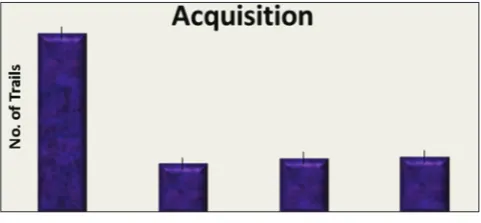
The mean number of trials taken for acquisition in all the treated Groups viz.: B, C, and D, were decreased significantly (p<0.001) when compared with control (Group A). It is observed that, Group B shows a non-significant decrease in number of trails when compare with Group C and Group D, respectively. It may be concluded that all the treated groups viz., rotatory vestibular treated group (Group B), turmeric treated group (Group C), and turmeric+vestibular group (Group D) shows an improvement in learning, respectively (Fig. 1).
Retention
Memory on the 10th day after acquisition
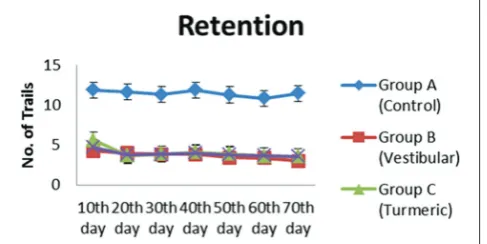
When compared to control (Group A), the vestibular (Group B), turmeric (Group C), and turmeric+vestibular (Group D) are shows a significant decrease in the number of trials (p<0.01). It shows a significant decrease in number of trials in Group B compared to Group C (p<0.05) and a non-significant decrease in number of trials compared to Group D and also a non-significant decrease in number of trials in Group D when compared with Group C. From the observation, it is clear that Group B (vestibular), Group D (turmeric+vestibular) and Group C (turmeric) are good in retention, respectively.
Memory on the 20th day after acquisition
When compared to Group A, the other groups, B, C, and D are shows significant decrease in number of trials (p<0.01). However in Group C, there is a non-significant reduction in number of trials when compared with Group B and Group D, respectively, and there is a non-significant decrease in number of trials in Group C when compared with Group D. Here the result says that a better reduction in number of trials is shown by Group C (turmeric), Group D (turmeric+vestibular) and Group B (vestibular) consecutively.
Memory on the 30th day after acquisition
When compared to Group A, the other groups, B, C, and D are shows significant decrease in number of trials (p<0.01). However, Group B and Group D show similar insignificant reduction in number of trials
when compared with Group C. From this, it is clear that both Group B (vestibular) and Group D (turmeric+vestibular) are better in retention than Group C (turmeric).
Memory on the 40th day after acquisition
When compared to Group A, in the other groups B, C, and D, observed a significant decrease in number of trials (p<0.01). Group B shows a non-significant decrease in number of trials in comparison with Group C and Group D and there is a non-significant reduction in number of trials in Group D when compare with Group C. On the 40th day of retention
Group B (vestibular) shows a comparatively better result, followed by Group D (turmeric+vestibular) and Group C (turmeric).
Memory on the 50th day after acquisition
When compared to Group A, the other groups, B, C, and D showed a significant decrease in number of trials (p<0.01). There is a non-significant decrease in number of trials in Group B compared with Group C and D. There is a non-significant decrease in number of trials shown by Group D when compare with Group C. Though there is no significant difference between Group B, C, and D, Group B shows a more decrease in number of trials in retention followed by Group D and Group C, respectively.
Memory on the 60th day after acquisition
When compared to Group A, the other groups, B, C and D showed a significant decrease in number of trials (p<0.01), it shows a non-significant decrease in number of trials in Group B when compared with Group C and Group D. The Group C also shows a non-significant reduction in number of trials when compared with Group D. Results on the 60th day says that Group B (vestibular) shows a great improvement
in retention and Group C (turmeric) and Group D (turmeric+vestibular) follows.
Memory on the 70th day after acquisition
When compared to Group A, the other groups, B, C, and D showed a significant decrease in number of trials (p<0.01). Though there is no significant difference between Group B, C, and D, it shows a non-significant decrease in number of trials in Group B when compare with Group C and D. The Group C and Group D show equal number of trials on the 70th day of retention. It is observed that Group B (vestibular)
shows better improvement in retention and there is no difference between Group C (turmeric) and Group D (turmeric+vestibular).
From the analysis, it is observed that, all the treated Groups (B, C, and D) shows significant decrease in number of trials taken for retention when compared with the control (Group A), (p<0.01). In particular, on the 10th day, Group B shows a significant difference with Group C and on the
20th day Group C shows better results in retentionand on the 30th day
of retention Group B and D shows a similar results, and however from the 40th day of retention onwards Group B shows a non-significant a
decrease in number of trials when compared with Group C and D, but there is no significant difference between Group C and D in any of the retention period. On the 70th day, Group C and Group D show a similar
result. Hence, it can be concluded that vestibular stimulated Group (Group B) is better in retention followed by turmeric+vestibular group (Group D) and turmeric treated group (Group C) (Fig. 2).
Neuromorphological analysis
Dendritic branching points
In 0-20 concentric circle: When compared to control (Group A), in all the treated groups the dendritic branching points are significantly increased (p<0.01). There is significant increase in dendritic branching points between Group D, Group B, and Group C, respectively (p<0.01). In 20-40 concentric circle: When compared to Group A, the Groups B, C, and D shows a significant increase in dendritic branching points (p<0.01). There is a significant increase in dendritic branching points in Group D when compared with Group B and Group C respectively (p<0.01). In 40-60 concentric circle: When compared to Group A, the groups B, C, and D shows a significant increase in dendritic branching Fig. 1: Number of trails taken for acquisition by different groups
points (p<0.01). There is a significant increase in dendritic branching points in Group B when compared with Group C (p<0.01) and Group C when compare with Group D (p<0.01). However, the difference between Group B and D is not significant. In 60-80 concentric circle: When compared to Group A, the Groups B, C, and D shows a significant increase in dendritic branching points (p<0.01). There is a significant increase in dendritic branching points in Group D when compared with Group B and Group C, respectively (p<0.01). In 80-100 concentric circle: When compared to Group A, the groups B, C, and D shows a significant increase in dendritic branching points (p<0.01). There is a significant increase in dendritic branching points in Group D when compared with Group B and Group C, respectively (p<0.01). In 100-120 concentric circle: When compared to Group A, the Groups B, C, and D shows a significant increase in dendritic branching points (p<0.01). There is a significant increase in dendritic branching points in Group D when compared with Group B and Group C respectively (p<0.01) (Fig. 3).
Dendritic intersections
In 20 µm concentric circle: When compared to control (Group A), the number of dendritic intersections in all the treated groups viz. vestibular (Group B), turmeric group (Group C), and turmeric+vestibular (Group D) has been increased significantly, (p<0.01). There is significant increase in the number of dendritic intersections in Group D when compared with Group B and Group C (p<0.01). However, the Group B and Group C show an insignificant difference in dendritic intersection. In 40 µm concentric circle: When compared to control (Group A), the vestibular (Group B), turmeric Group (Group C), and turmeric+vestibular (Group D) showed a significant increase in the number of dendritic intersections (p<0.01). There is significant increase in the number of dendritic intersections between Group B and C (p<0.05) but no significant difference between Group B and D. And there is a significant increase in the number of dendritic intersections in Group D when compared with Group C (p<0.01). In 60 µm concentric circle: When compared to control (Group A), the vestibular (Group B), turmeric group (Group C), and turmeric+vestibular (Group D) showed a significant increase in the number of dendritic intersections (p<0.01), yet there is no significant difference between any of the treated groups in the case of dendritic intersection. In 80 µm concentric circle: When compared to control (Group A), the vestibular (Group B), turmeric group (Group C), and turmeric+vestibular (Group D) showed a significant increase in the number of dendritic intersections (p<0.01), yet there is no significant difference between any of the treated groups in the case of dendritic intersection. In 100 µm concentric circle: When compared to control (Group A), the vestibular (Group B), turmeric group (Group C), and turmeric+vestibular (Group D) showed a significant increase in the number of dendritic intersections (p<0.01), yet there is no significant difference between any of the treated groups in the case of dendritic intersection. In 120 µm concentric circle: When compared to control (Group A), in vestibular (Group B), turmeric group (Group C), and turmeric+vestibular (Group D) the dendritic intersections were significantly increased (p<0.01). Although there is no significant increase in dendritic intersections in Group B in comparison with Group C, a significant increase is shown by Group B when compared with Group D (p<0.05). There is a significant difference between Group C and D (p<0.01) (Fig. 4).
From the Sholl analysis, it is clear that all the treated groups shows an increase in dendritic intersections when compared with control. It is observed that in every concentric circle except 80 µm, Group D shows better dendritic intersection followed by Group B but except in 100 µm, where it shows a non-significant increase in number of dendritic intersection in Group C than Group B. So it can be point out that rotatory vestibular stimulation along with turmeric juice as well as rotatory vestibular stimulation alone is good for increased dendritic intersection.
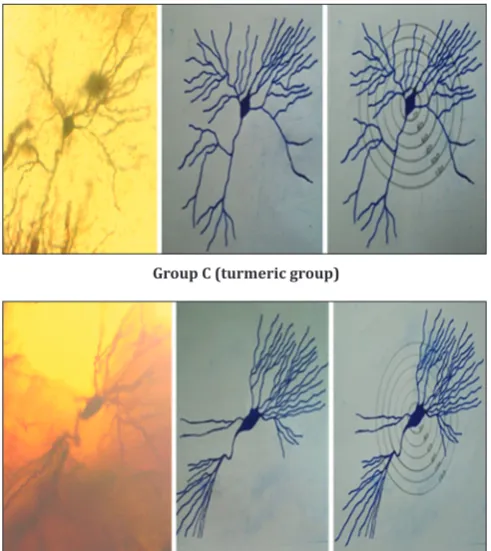
Microphotograph and camera Lucida tracings of hippocampal pyramidal neurons in different groups of rats.
Group A (control)
Group B (rotatory vestibular group)
Fig. 3: Dendritic branching points in different groups (n=6) of rats
Fig. 4: Dendritic intersection in different groups (n=6) of rats Fig. 2: Number of trails taken for different groups (n=18) of rats
Group C (turmeric group)
Group D (turmeric+rotatory vestibular group)
Hippocampal region Bio-chemical analysis
AChE level
When compared to control (Group A), the level of AChE is significantly decreased in the vestibular (Group B), and turmeric+vestibular (Group D) and turmeric (Group C), respectively (p<0.01). However, there is no significant difference in AChE level among the treated groups. From the result, it is clear that Group B is better in reducing the level of AChE and thereby enhancing learning and memory (Fig. 5).
DISCUSSION
Vestibular stimulation and other sensory information are transmitted to and processed in the hippocampus to facilitate spatial navigation via activating septohippocampal cholinergic neurons that release acetylcholine in the hippocampus, modulating hippocampal synaptic transmission and plasticity [9]. Vestibular stimulation by passive whole body rotation stimulates septohippocampal cholinergic input, leads to the enhancement of LTP in hippocampus of rats as the septohippocampal neurons are important in formation of spatial memory and also for
sensorimotor processing in which activation of the vestibular system provides a sensory signal to assist in motor planning [10].
Increased breakdown of acetylcholine can leads to dementia, while oxidative stress were increased. Curcumin administration and vestibular stimulation were found to restore memory deficits, while insulin activity, AChE activity and oxidative stress were managed significantly. Curcumin attenuated the neuropathological changes in the hippocampus and inhibits apoptosis which leads to neuronal loss [11]. In addition curcumin prevented the adverse changes in the dendritic morphology of pyramidal neurons in the hippocampus, as assessed by the changes in dendritic branching points and dendritic intersections. During early development, the expression of AChE is greatly correlated with neurite outgrowth and low synaptic levels of acetylcholine resulting from loss of cholinergic neurons leads to cognitive decline. In addition, the distribution of brain AChE is significantly altered with very little left in the normal axons and an intense activity in the neuritic plaques and neruofibrillary tangles [12].
The impaired cognition due to traumatic brain injury or various other reasons is linked with the dysfunction in molecular systems which supports synaptic plasticity such as BDNF [13] and oxidative stress, the hallmark of major brain injuries which results in protracted neuronal function and plasticity, and thus oxidative stress and synaptic plasticity are interrelated events and hence the compromised function of BDNF which facilitate synaptic transmission and neuronal excitability in the brain weaken the molecular substrates which maintains the normal neuronal function [14,15] such that its action appears to be crucial for maintaining molecular processes underlying cognitive function such as LTP [16].
The supplementation of curcumin in the diet normalized BDNF levels in the hippocampus [17] as BDNF promotes the synthesis and phosphorylation of synapsin 1, which is a nerve terminal phosphor-protein involved in neurotransmitter release, axonal elongation and maintenance of synaptic contacts [18]. Curcumin reduces the deleterious effects of traumatic brain injury on synaptic plasticity and congnition, and this in accordance with the notion that oxidative stress plays a major role on the cognitive dysfunction and curcumin supplementation in the diet reduced the elevated protein carbonyl levels after brain damage [17].
Carbonyl levels are indicative of protein oxidation associated with free radical formation and the accumulation of free radicals is associated with cognitive deficits in aging [19,20] remarked that curcumin is a potent free radicals scavenger and it reduces the oxidative damage and Alzheimer pathology. The two electrophilic alpha and beta-unsaturated carbonyl groups of curcumin provides the antioxidant activity, react Fig. 5: Level of acetylcholinesterase in different groups (n=12) of
with nucleophiles such as glutathione. Thus, curcumin inhibit lipid peroxidation and neutralize reactive oxygen and nitric-oxide-based free radicals [21] The capacity of curcumin to cross the blood brain barrier to produce its neuroprotection directly, one another important characteristic feature of curcumin [3].
Curcuminoid mixture possesses AChE inhibitory activity in the hippocampus and frontal cortex, suggests the ability to cross the blood brain barrier and inhibit AChE enzyme providing longer time for acetylcholine to stimulate post synaptic muscarinic receptors [22].
Curcuminoids as a mixture might be penetrating better through blood brain barrier, because of some synergistic interaction between the individual components, when they are present in a formulation, close to the natural form and the interesting thing regarding the plant extract is that, plant extract or fractions which are known to contain multiple chemical entities have been shown to possess synergistic or side effect neutralizing potential [23]. By replacing the methoxy group on benzene ring with hydroxyl group increases AChE inhibitory activity, as bisdemethoxycurcumin being the most active amongst the curcuminoids [24]. Interestingly, various other studies also have similar observation where the number of hydroxyl groups in polyphenols and tannic acid bisdemethoxycurcumin possess a strong link with the anti-amyloidogenic and fibril-destabilizing activities [25]. BDNF is synthesized predominantly by hippocampal neurons, and synaptic transmission can be facilitated by the BDNF [4]. There are evidences suggest that the dietary supplementation of curcumin provides neuro protection as well as enhancement of learning and memory by reducing inflammation or counteracting the harmful effects of oxidative stress, and also by up-regulating the expression of molecular systems related to BDNF. All these are attributed to the capacity of curcumin to cross the blood brain barrier, and curcumin is readily brain penetrant. Application of Curcumin improves the learning and memory ability in memory impaired rats induced by Gp 120, a viral protein cause’s neuronal injury. In such rats high dose curcumin provides better learning condition by increasing the BDNF. Curcumin improves the antioxidative enzyme ability, eliminates the free radical, lessens the lipid peroxidation effect, inhibits the oxidative damage, all these effects curcumin finally results in the improvement of cognition [4].
All the authors reasoned that one possible mechanism of the curcumin extract in cognition enhancement is the property to enhance tolerance to stress and also curcumin prevents the degeneration of cells in the hippocampus. Animals treated with curcumin also shows significant differences in neurotransmitter levels compared to untreated animals, indicates that turmeric positively influence the neurotransmitter production and the methoxy group on the phenyl ring is one of the functional groups important for this compound’s antioxidant property [26]. The neurotoxicity induced by Pb (lead) can be reduced by curcuminoids from the plant C. longa and turmeric has medicinal properties to prevent or reduce neurodegenerative disorders and is very beneficial for heavy metal poisoning [27] and also stated that the antioxidants properties of the curcuminoids reduce the protein oxidation as well as the lipid peroxidation and enhances cell viability and protects the neurons of the hippocampus from degeneration and thereby improves learning and memory.
In 2006, Tze-Pin conducted a study in normal elderly Asian subjects to investigate the association between usual curry consumption level and cognitive function in elderly. In his study to examine the subjects the researcher adopted the Mini-Mental State Examination, a widely used instrument that provides a global measure of domains of cognitive function included memory, attention, language, praxis, and visuospatial ability [28]. It is interesting to know that even with the low and moderate levels of curry consumption better cognitive performance was observed. It is also stated the association of cognition with the dose-response relation. The higher levels of curry consumption are not associated with increasingly better cognitive performance, while the low dose of curcumin reduced the beta-amyloid and plaque burden [28].
These observations also suggest that the potential cognitive enhancing effect of curry is feasible in subjects with lowered cognitive functioning due to other causes. Devi and Mukkadan in 2015 suggests a possible role of rotatory vestibular stimulation along with nutmeg extract in learning and memory, due to some structural and biochemical changes occurred in the brain of rats [29].
Turmeric, the dried rhizome powder from which curcumin is extracted, is the principal ingredient of curry and is consumed by millions of people, in the Indian Subcontinent and the Indo-China archipelago, and it has been reported that the prevalence of Alzheimer’s disease in India among elderly is 4-fold less than that of United States [30].
CONCLUSION
Application of rotatory vestibular stimulation and turmeric improved LTP, which was accorded with the behavior consequences and all of those consequences were confirmed that both rotatory vestibular stimulation and turmeric could improve learning and memory and also cognitive dysfunctions. In the present study, both vestibular stimulation and turmeric extract showed significant differences in AChE level and alters the neuromorhology when compared with the control group which indicates that both rotatory vestibular stimulation and turmeric has a potent ability to inhibit the level of AChE and thereby positively influence neurotransmitter production also to increase the dendritic arborization to enhance learning and memory.
REFERENCES
1. Martín-Aragón S, Benedí JM, Villar AM. Modifications on antioxidant capacity and lipid peroxidation in mice under fraxetin treatment. J Pharm Pharmacol 1997;49(1):49-52.
2. Blumenthal M, Goldberg A, Brinkman J. Herbal Medicine, the Expanded Commission E Monographs. Newton, MA: Integrative Medicine Communications; 2000. p. 330-4.
3. Yang F, Lim GP, Begum AN, Ubeda OJ, Simmons MR, Ambegaokar SS,
et al. Curcumin inhibits formation of amyloid beta oligomers and fibrils, binds plaques, and reduces amyloid in vivo. J Biol Chem 2005;280(7):5892-901.
4. Drapeau E, Mayo W, Aurousseau C, Le Moal M, Piazza PV, Abrous DN. Spatial memory performances of aged rats in the water maze predict levels of hippocampal neurogenesis. Proc Natl Acad Sci U S A 2003;100(24):14385-90.
5. Tai SK, Leung LS. Vestibular stimulation enhances hippocampal long-term potentiation via activation of cholinergic septohippocampal cells. Behav Brain Res 2012;232(1):174-82.
6. Devi NP, Mukkadan JK. The impact of rotatory vestibular stimulation and Centella asiatica on spatial learning and memory in wistar albino rats - Standardisation of a novel method. Res J Pharm Biol Chem Sci 2015;6:911-9.
7. Veetil PK, Mukkadan JK. Evaluation of allocentric spatial learning in rats using a novel “alternated dual task”. Indian J Physiol Pharmacol 2009;53(3):235-42.
8. Ellman GL, Courtney KD, Andres V Jr, Feather-Stone RM. A new and rapid colorimetric determination of acetylcholinesterase activity. Biochem Pharmacol 1961;7:88-95.
9. Berthos A. How does the cerebral cortex process and utilize vestibular signals? In: Baloh R, Halmagyi G, editors. Disorders of the Vestibular System. Oxford: Oxford University Press; 1996. p. 113-25.
10. Bland BH, Oddie SD. Theta band oscillation and synchrony in the hippocampal formation and associated structures: The case for its role in sensorimotor integration. Behav Brain Res 2001;127(1-2):119-36. 11. Pan R, Qiu S, Lu DX, Dong J. Curcumin improves learning and
memory ability and its neuroprotective mechanism in mice. Chin Med J (Engl) 2008;121(9):832-9.
12. Vijayalakshmi, Adiga S, Bhat P, Chaturvedi A, Bairy KL, Kamath S. Evaluation of the effect of Ferula asafoetida Linn. gum extract on learning and memory in wistar rats. Indian J Pharmacol 2012;44(1):82-7. 13. Wu A, Molteni R, Ying Z, Gomez-Pinilla F. A saturated-fat diet
aggravates the outcome of traumatic brain injury on hippocampal plasticity and cognitive function by reducing brain-derived neurotrophic factor. Neuroscience 2003;119(2):365-75.
1996;273(5238):1402-6.
15. Bolton MM, Lo DC, Sherwood NT. Long-term regulation of excitatory and inhibitory synaptic transmission in hippocampal cultures by brain-derived neurotrophic factor. Prog Brain Res 2000;128:203-18. 16. Korte M, Carroll P, Wolf E, Brem G, Thoenen H, Bonhoeffer T.
Hippocampal long-term potentiation is impaired in mice lacking brain-derived neurotrophic factor. Proc Natl Acad Sci U S A 1995;92(19):8856-60.
17. Wu A, Ying Z, Gomez-Pinilla F. Dietary curcumin counteracts the outcome of traumatic brain injury on oxidative stress, synaptic plasticity, and cognition. Exp Neurol 2006;197(2):309-17.
18. Brock TO, O’Callaghan JP. Quantitative changes in the synaptic vesicle proteins Synapsin I and p38 and the astrocyte-specific protein glial fibrillary acidic protein are associated with chemical-induced injury to the rat central nervous system. J Neurosci 1987;7(4):931-42.
19. Fukui K, Omoi NO, Hayasaka T, Shinnkai T, Suzuki S, Abe K, et al.
Cognitive impairment of rats caused by oxidative stress and aging, and its prevention by vitamin E. Ann N Y Acad Sci 2002;959:275-84. 20. Frautschy SA, Hu W, Kim P, Miller SA, Chu T, Harris-White ME,
et al. Phenolic anti-inflammatory antioxidant reversal of Abeta-induced cognitive deficits and neuropathology. Neurobiol Aging 2001;22(6):993-1005.
21. Butterfield DA, Lauderback CM. Lipid peroxidation and protein oxidation in Alzheimer’s disease brain: Potential causes and consequences involving amyloid beta-peptide-associated free radical oxidative stress. Free Radic Biol Med 2002;32(11):1050-60.
22. Ahmed T, Gilani AH. Inhibitory effect of curcuminoids on acetylcholinesterase activity and attenuation of scopolamine-induced amnesia may explain medicinal use of turmeric in Alzheimer’s disease. Pharmacol Biochem Behav 2009;91(4):554-9.
23. Gilani AH, Rahman AU. Trends in ethnopharmocology. J Ethnopharmacol 2005;100(1-2):43-49.
24. Dairam A, Limson JL, Watkins GM, Antunes E, Daya S. Curcuminoids, curcumin, and demethoxycurcumin reduce lead-induced memory deficits in male wistar rats. J Agric Food Chem 2007;55(3):1039-44. 25. Ono K, Hamaguchi T, Naiki H, Yamada M. Anti-amyloidogenic effects
of antioxidants: Implications for the prevention and therapeutics of Alzheimer’s disease. Biochim Biophys Acta 2006;1762(6):575-86. 26. Sreejayan N, Rao MN. Free radical scavenging activity of curcuminoids.
Arzneimittelforschung 1996;46(2):169-71.
27. Ng TP, Chiam PC, Lee T, Chua HC, Lim L, Kua EH. Curry consumption and cognitive function in the elderly. Am J Epidemiol 2006;164(9):898-906.
28. Lim GP, Chu T, Yang F, Beech W, Frautschy SA, Cole GM. The curry spice curcumin reduces oxidative damage and amyloid pathology in an Alzheimer transgenic mouse. J Neurosci 2001;21(21):8370-7. 29. Devi NP, Mukkadan JK. Impact of rotatory vestibular stimulation and
Myristica fragrans on spatial learning and memory in wistar albino rats. JIPBS 2016;3:17-32.