Privacy-Preserving Minimum Spanning Trees through Oblivious
Parallel RAM for Secure Multiparty Computation
Peeter Laud Cybernetica AS [email protected]
November 25, 2014
Abstract
In this paper, we describe efficient protocols to perform in parallel many reads and writes in private arrays according to private indices. The protocol is implemented on top of the Arithmetic Black Box (ABB) and can be freely composed to build larger privacy-preserving applications. For a large class of secure multiparty computation (SMC) protocols, we believe our technique to have better practical and asymptotic performance than any previous ORAM technique that has been adapted for use in SMC.
Our ORAM technique opens up a large class of parallel algorithms for adoption to run on SMC platforms. In this paper, we demonstrate how the minimum spanning tree (MST) finding algorithm by Awerbuch and Shiloach can be executed without revealing any details about the underlying graph (beside its size). The data accesses of this algorithm heavily depend on the location and weight of edges (which are private) and our ORAM technique is instrumental in their execution. Our implementation is probably the first-ever realization of a privacy-preserving MST algorithm.
1
Introduction
In Secure Multiparty Computation (SMC),kparties compute (y1, . . . , yk) =f(x1, . . . , xk), with
the partyPi providing the input xi and learning no more than the outputyi. For any
function-alityf, there exists a SMC protocol for it [Yao82, GMW87]. A universally composable [Can01] abstraction for SMC is the arithmetic black box (ABB) [DN03]. The ideal functionality FABB
allows the parties to store private data in it, perform computations with data inside the ABB, and reveal the results of computations. This means that the ABB does not leak anything about the results of the intermediate computations, but only those values whose declassification is explicitly requested by the parties. Hence, any secure implementation of ABB also protects the secrecy of inputs and intermediate computations. There exist a number of practical imple-mentations of the ABB [BDNP08, DGKN09, BLW08, BSMD10, HKS+10, MK10], differing in the underlying protocol sets they use and in the set of operations with private values that they make available for higher-level protocols.
These ABB implementations may be quite efficient for realizing applications working with private data, if the control flow and the data access patterns of the application do not depend on private values. For hiding data access patterns, oblivious RAM (ORAM) techniques [GO96] may be used. These techniques have a significant overhead, which is increased when they are combined with SMC. Existing combinations of ORAM with SMC report at least O(log3n) overhead for accessing an element of ann-element array [KS14].
the protocols provided by ABB implementations often have significant latency. We can exploit this parallelism in designing oblivious data access methods, by trying to bundle several data accesses together. In the following, we assume that we have private vector ~v of m elements (the numberm is public, as well as the sizes of other pieces of data). We provide two protocols on top of ABB: for reading its elements n times, and for writing its elements n times. These protocols receive as an input a vector of indices (of length n) and, in case of writing, a new vector of values, and return a vector of selected elements of~v, or the updated vector~v. The asymptotic complexity of both protocols is O((m+n) log(m+n)), while the constants hidden in the O-notation should be reasonable. These protocols could be interleaved with the rest of the SMC application in order to provide oblivious data access capability to it.
To demonstrate the usefulness of our protocols in privately implementing algorithms with private data access, and to expand the set of problems for which there exist reasonably efficient privacy-preserving protocols, we provide a protocol for finding the minimum spanning tree (MST) of a weighted graph. The protocol is implemented on top of ABB, i.e. the are no assumptions on which computing party initially knows which parts of the description of the graph. Kruskal’s and Prim’s algorithms [CLRS01], the best-known algorithms for finding MST (without privacy considerations), are unsuitable for direct implementation on top of ABB, because of their inherent sequentiality. In this paper, we consider a parallel algorithm by Awerbuch and Shiloach [AS87] (itself an adoption of a MST algorithm by Bor˚uvka [NMN01]) that runs on priority-CRCW PRAM in time logarithmic to the size of the graph, using as many processors as the graph has edges. Hence the workload of this algorithm is asymptotically the same as Kruskal’s. We adapt it to run on top of our ABB implementation, using the ORAM protocols we’ve developed. The adoption involves the simplification of the algorithm’s control flow, and choosing the most suitable variants of our protocols at each oblivious read or write. The efficiency of the resulting protocol is very reasonable; our adoption only carries the cost of an extra logarithmic factor. We believe that the adoption of other PRAM algorithms for SMC is a promising line of research.
This paper has the following structure. After reviewing the related work in Sec. 2 and providing the necessary preliminaries, in particular the ABB model of SMC in Sec. 3, we give the actual protocols for parallel reading and writing in Sec. 4 and discuss both their theoretical and practical performance in Sec. 5. We will then move on to solving the MST problem, reviewing a parallel MST algorithm in Sec. 6 and describing its adoption to privacy-preserving execution in Sec. 7, again quantifying its performance. We conclude in Sec. 8.
2
Related work
Secure multiparty computation (SMC) protocol sets can be based on a variety of different techniques, including garbled circuits [Yao82], secret sharing [Sha79, GRR98, BNTW12] or homomorphic encryption [CDN01]. A highly suitable abstraction of SMC is the universally composable Arithmetic Black Box (ABB) [DN03], the use of which allows very simple security proofs for higher-level SMC applications. Using the ABB to derive efficient privacy-preserving implementations for various computational tasks is an ongoing field of research [DFK+06, CS10, ACM+13, LT13], also containing this paper.
Protocols for oblivious RAM [GO96] have received significant attention during recent years [SCSL11, KLO12, SvDS+13]. The overhead of these protocols is aroundO(log2m) when accessing an
In this paper, we use SMC techniques to achieve oblivious data access in SMC applications. This goal has been studied before, by implementing the client’s computations in an ORAM protocol on top of a secure two-party computation protocol set [GKK+12, GGH+13, LHS+14, GHJR14], or over an SMC protocol set [DMN11, KS14]. For these protocol sets, the overhead of at least O(log3m) is reported. Recently, optimizing ORAM to perform well in the secure computation setting has become a goal of its own [WHC+14].
The ORAM constructions often allow only sequential access to data, as the updating of the data structures maintained by the server cannot be parallelized. Recently, Oblivious Parallel RAM [BCP14] has been proposed, which may be more suitable for SMC protocol sets where the computations have significant latency.
Our parallel reading protocol essentially builds and then applies an oblivious extended per-mutation (OEP) [KS08, HEK12, MS13, LW14] (see Sec. 4.1 for details). Our OEP application protocol is more efficient (both in practice and/or asymptotically) than any other published construction built with SMC techniques. The building of an OEP in composable manner has only been considered in [LW14]; our construction is more efficient than theirs.
We are aware of no previous attempts to compute the MST of a graph in a privacy-preserving manner. For graph algorithms, there exist privacy-preserving protocols for single-source shortest paths and for maximum flow [BS05, ACM+13, KS14].
3
Preliminaries
Universal composability (UC) [Can01] is a framework for stating security properties of systems. It considers an ideal functionality F and its implementation π with identical interfaces to the intended users. The latter isat least as secure as the former, if for any attackerAthere exists an attacker AS, such that πkA and F kAS are indistinguishable to any potential user of π /
F. The value of the framework lies in the composability theorem: if π is at least secure as F, then ξπ is at least as secure as ξF for any system ξ that uses π / F. We say that such ξ is implemented in the F-hybrid model.
Thearithmetic black box is an ideal functionalityFABB. It allows its users (a fixed numberp of parties) to securely store and retrieve values, and to perform computations with them. When a party sends the command store(v) toFABB, where v is some value, the functionality assigns
a new handle h (sequentially taken integers) to it by storing the pair (h, v) and sending h to all parties. If a sufficient number (depending on implementation details) of parties send the commandretrieve(h) toFABB, it looks up (h, v) among the stored pairs and responds withvto all
parties. When a sufficient number of parties send the commandcompute(op;h1, . . . , hk;params)
toFABB, it looks up the values v1, . . . , vk corresponding to the handlesh1, . . . , hk, performs the
operation op (parametrized with params) on them, stores the result v together with a new handleh, and sendshto all parties. In this way, the parties can perform computations without revealing anything about the intermediate values or results, unless a sufficiently large coalition wants a value to be revealed. In this paper our protocols are given in theFABB-hybrid model.
The existing implementations of ABB are protocol sets πABB based on either secret
shar-ing [DGKN09, BLW08, BSMD10] or threshold homomorphic encryption [DN03, HKS+10]. De-pending on the implementation, the ABB offers protection against a honest-but-curious, or a malicious party, or a number of parties (up to a certain limit). E.g. the implementation of the ABB by Sharemind [BLW08] consists of three parties, providing protection against one
honest-but-curious party.
When estimating the (asymptotic) complexity of protocols built on top of ABB, it is typical to disregard the costs of computing of linear combinations. Other operations, e.g. comparison, can be built on top of addition and multiplication [DFK+06, NO07], or the ABB implementation may have dedicated protocols for these operations [BNTW12]. In this paper, we require the ABB implementation to provide protocols also for equality and comparison operations. In the protocols we present, we let JxK denote that some value has been stored in the ABB and is accessible under handle x. The notation JzK ← JxK⊗JyK means that the operation ⊗ is performed with values stored under handles x and y, and the result is stored under handle z. In ABB implementations this involves the invocation of the protocol for⊗.
We also require the ABB to provide oblivious shuffles — private permutations of values. For certain ABB implementations, these can be added as described in [LWZ11]. A more general approach is to use Waksman networks [Wak68]. Given an oblivious shuffle JσKform elements, and a private vector (Jv1K, . . . ,JvmK), it is possible to apply this shuffle to this vector, permuting its elements and resulting in the vector (Jvσ(1)K, . . . ,Jvσ(m)K). It is also possible tounapply the shuffle to this vector, performing the inverse permutation of its elements. The complexity of the protocols implementing these ABB operations is either O(m) or O(mlogm) (for constant number of parties).
With oblivious shuffles and comparison operations, vectors of private values (of length m) can be sorted in O(mlogm) time, where the size of the constants hidden in the O-notation is reasonable [HKI+12]. In our protocols, we let JσK← sort(J~vK) denote the sorting operation applied to the private vector J~vK. This operation does not actually reorder~v, but produces an oblivious shuffle JσK, the application of which to ~v would bring it to sorted order. We require the sorting to be stable and the sorting protocol to be universally composable. In effect, this makessort a yet another operation provided by the ABB.
4
Oblivious data access
4.1 Protocol for reading
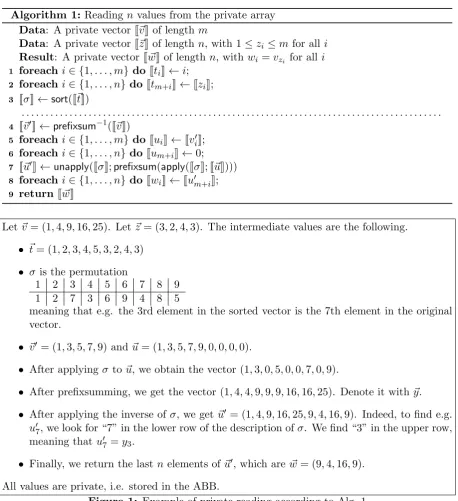
In Alg. 1, we present our protocol for obliviously reading several elements of an array. Given a vector ~v of length m, we let prefixsum(~v) denote a vector w, also of length~ m, where wi =
Pi
j=1vj for all j ∈ {1, . . . , m}. Computing prefixsum(J~vK) is a free operation in existing ABB implementations, because addition of elements, not requiring any communication between the parties, is counted as having negligible complexity. We can also define the inverse operation prefixsum−1: ifw~ =prefixsum(~v) then~v=prefixsum−1(w). The inverse operation is even easier~ to compute: v1=w1 and vi=wi−wi−1 for all i∈ {2, . . . , m}.
We see that in Alg. 1, the permutation σ orders the indices which we want to read, as well as the indices 1, . . . , n of the “original array”~v. Due to the stability of the sort, each index of the “original array” ends up before the reading indices equal to it. In apply(σ, ~u), each element vi0 of~v0, located in the same position as the indexiof the “original array” in sorted~t, is followed by zero or more 0-s. The prefix summing restores the elements of~v, with the 0-s also replaced with the element that precedes them. Unapplyingσ restores the original order of~uand we can read out the elements of~v from the latter half of~u0. A small example is presented in Fig. 1.
The protocol presented in Alg. 1 clearly preserves the security guarantees of the implemen-tation of the underlying ABB, as it applies only ABB operations, classifies only public constants and declassifies nothing. Its complexity is dominated by the complexity of the sorting oper-ation, which is O((m+n) log(m+n)). We also note that the round complexity of Alg. 1 is O(log(m+n)).
Algorithm 1:Reading nvalues from the private array Data: A private vector J~vKof length m
Data: A private vector J~zKof length n, with 1≤zi ≤m for all i Result: A private vectorJw~Kof length n, withwi=vzi for all i 1 foreach i∈ {1, . . . , m}do JtiK←i;
2 foreach i∈ {1, . . . , n} doJtm+iK←JziK;
3 JσK←sort(J~tK)
. . . . 4 J~v0K←prefixsum−1(J~vK)
5 foreach i∈ {1, . . . , m}do JuiK←Jv
0
iK;
6 foreach i∈ {1, . . . , n} doJum+iK←0; 7 J~u0K←unapply(JσK;prefixsum(apply(JσK;J~uK))) 8 foreach i∈ {1, . . . , n} doJwiK←Ju
0
m+iK;
9 return Jw~K
Let~v= (1,4,9,16,25). Let ~z= (3,2,4,3). The intermediate values are the following.
• ~t= (1,2,3,4,5,3,2,4,3)
• σ is the permutation
1 2 3 4 5 6 7 8 9
1 2 7 3 6 9 4 8 5
meaning that e.g. the 3rd element in the sorted vector is the 7th element in the original vector.
• ~v0 = (1,3,5,7,9) andu~ = (1,3,5,7,9,0,0,0,0).
• After applying σ to~u, we obtain the vector (1,3,0,5,0,0,7,0,9).
• After prefixsumming, we get the vector (1,4,4,9,9,9,16,16,25). Denote it with~y.
• After applying the inverse ofσ, we get ~u0= (1,4,9,16,25,9,4,16,9). Indeed, to find e.g. u07, we look for “7” in the lower row of the description ofσ. We find “3” in the upper row, meaning that u07 =y3.
• Finally, we return the lastnelements of ~u0, which arew~ = (9,4,16,9).
All values are private, i.e. stored in the ABB.
Figure 1: Example of private reading according to Alg. 1
the presented protocol could also be used to read the private values from a dictionary, the elements of which are indexed with (private) Jj1K, . . . ,JjmK. In this case, in line 1, JtiK is not initialized withi, but withJjiK. Note that in this case, the algorithm cannot detect if all indices that we attempt to read are present in the dictionary.
Note that in Alg. 1, the argument J~vK is only used after the dotted line. At the same time, the step that dominates the complexity of the protocol — sorting ofJ~tKin line 3 — takes place before the dotted line. Hence, if we read the same positions of several vectors, we could execute the upper part of Alg. 1 only once and the lower part as many times as necessary. In Sec. 7, we will denote the upper part of Alg. 1 withprepareRead(with inputsJ~zKand m, and output
Anextended permutation[MS13] frommelements tonelements is a mapping from{1, . . . , n}
to {1, . . . , m} (note the contravariance). The application of an extended permutation φ to a vector (x1, . . . , xm) produces a vector (y1, . . . , yn), where yi = xφ(i). An oblivious extended permutation (OEP) protocol preserves the privacy of ~x, ~y and φ. The prepareRead protocol essentially constructs the representationJφKof an OEP and theperformReadprotocol applies it, with better performance than previous constructions.
4.2 Protocol for writing
For specifying the parallel writing protocol, we have to fix how multiple attempts to write to the same field are resolved. We thus require that each writing request comes with a numeric
priority; the request with highest priority goes through (if it is not unique, then one is selected arbitrarily). We can also give priorities to the existing elements of the array. Normally they should have the lowest priority (if any attempt to write them actually means that they must be overwritten). However, in case where the array element collects the maximum value during some process (e.g. finding the best path from one vertex of some graph to another), with the writes to this element representing candidate values, the priority of the existing element could be equal to this element. This is useful in e.g. the Bellman-Ford algorithm for computing shortest distances.
Thus assume that there exists an algorithm compute priority which, when applied to an element JwiK of the vector Jw~K, as well as to its index i, returns the priority of keeping the current value of wi. The parallel writing protocol is given in Alg. 2. The writing algorithm
receives a vector of values J~vKto be written, together with the indices J~jKshowing where they have to be written, and the writing prioritiesJ~pK. Alg. 2 transforms the current vector Jw~K(its indices and priorities) to the same form and concatenates it with the indices and priorities of the write requests. The data are then sorted according to indices and priorities (with higher-priority elements coming first). The operation zip on two vectors of equal length transforms them to a vector of pairs; the ordering on these pairs is determined lexicographically. The vector J~bK is used to indicate the highest-priority position for each index: bi = 0 iff the i-th element in the vector ~j0 is the first (hence the highest-priority) value equal to ji0. Note that all equality checks in line 10 can be done in parallel. Here and elsewhere,foreach-statements denote parallel execution. Performing the sort in line 11 moves the highest-priority values to the firstm positions. The sorting is stable, hence the values correspond to the indices 1, . . . , m in this order. We thus have to apply the shuffles induced by both sorts to the vector of values ~v0=~vkw, and take the first~ melements of the result.
Algorithm 2:Obliviously writing nvalues to a private array
Data: Private vectors J~jK,J~vK,J~pKof length n, where 1≤ji ≤m for alli
Data: Private array Jw~Kof length m
Result: Updatedw: values in~ ~v written to indices in~j, if priorities in ~pare high enough 1 foreach i∈ {1, . . . , n} do
2 Jji0K←JjiK
3 Jp0iK← −JpiK
4 foreach i∈ {1, . . . , m}do 5 Jjn0+iK←i
6 Jp0n+iK← −compute priority(i,JwiK) 7 JσK←sort(zip(J~j0K,J~p0K))
8 J~j00K←apply(JσK;J~j0K) 9 Jb1K←0
10 foreach i∈ {2, . . . , N} doJbiK←Jji00K=? Jji00−1K; 11 JτK←sort(J~bK)
. . . . 12 foreach i∈ {1, . . . , n} doJvi0K←JviK;
13 foreach i∈ {1, . . . , m}do Jvn0+iK←JwiK;
14 Jw~0K←apply(JτK;apply(JσK;J~v0K)) 15 foreach i∈ {1, . . . , m}do JwiK←Jwi0K; 16 return Jw~K
4.3 Sorting bits
Alg. 2 makes two calls to the sorting protocol. While the first one of them is a rather general sort, the second one in line 11 only performs a stable sort on bits, ordering the “0” bits before the “1” bits (and the sort does not actually have to be stable on the “1”-bits). In the following we show that the second sort can be performed with the complexity similar to that of a random shuffle, instead of a full sort. Our method leaks the number of 0-s among the bits, but this information was already public in Alg. 2 (being equal to the length ofw). The sorting protocol is given in~ Alg. 3. Here random shuffle(n) generates an oblivious random shuffle for vectors of length n. The protocol ends with a composition of an oblivious and a public shuffle; this operation, as well as the generation of a random shuffle, is supported by existing implementations of shuffles.
We see that the most complex operations of Alg. 3 are the applications of the oblivious shuffle JτK. If the communication complexity of these is O(m) and the round complexity of these is O(1), then this is also the complexity of the entire protocol. The protocol declassifies a number of things, hence it is important to verify that the declassified values can be simulated. The vector~b0 is a random permutation of 0-s and 1-s, where the number of 0-bits and 1-bits is the same as inJ~bK. Hence the number of 0-bits is leaked. But beside that, nothing is leaked: if the simulator knows the numbern of 0-bits, then~b0 is a uniformly randomly chosen bit-vector withn bits “0” and (m−n) bits “1”.
Algorithm 3:Stable sorting of 0-bits in a bit-vector
Data: Vector of private values J~bKof length m, where eachbi ∈ {0,1}
Result: Oblivious shuffleJσK, such that apply(JσK;J~bK) is sorted and the order of 0-bits is not changed
Leaks: The number of 0-bits in J~bK 1 foreach i∈ {1, . . . , m}do JciK←1−JbiK; 2 J~xK←prefixsum(J~cK)
3 JτK←random shuffle(m) 4 ~b0 ←retrieve(apply(JτK;J~bK)) 5 J~x0K←apply(JτK;J~xK) 6 foreach i∈ {1, . . . , m}do 7 yi←if b0i= 0 then retrieve(Jx
0
iK) elsem+ 1
8 Let ξ be a public shuffle that sorts~y 9 JσK←JτK◦ξ
10 return JσK
of Alg. 3 consists of invoking the functionality of the ABB or manipulating public data.
5
Performance and applicability
Using our algorithms, the cost ofnparallel data accesses isO((m+n) log(m+n)), wherem is the size of the vector from which we’re reading values. Dividing byn, we get that the cost of one access isO((1 +mn) log(m+n)). In practice, the cost will depend a lot on our ability to perform many data accesses in parallel. Fortunately, this goal to parallelize coincides with one of the design goals for privacy-preserving applications in general, at least for those where the used ABB implementation is based on secret sharing and requires ongoing communication between the parties. Parallelization allows to reduce the number of communication rounds necessary for the application, reducing the performance penalty caused by network latency.
Suppose that our application is such that on average, we can access in parallel a fraction of 1/f(m) of the memory it uses (where 1≤f(m)≤m). Hence, we are performingm/f(m) data accesses in parallel, requiringO(mlogm) work in total, orO(f(m) logm) for one access. Recall that for ORAM implementations over SMC, the reported overheads are at least O(log3m). Hence our approach has better asymptotic complexity for applications where we can keepf(m) small.
Parallel random access machines (PRAM) are a theoretical model for parallel computations, for which a sizable body of efficient algorithms exists. Using our parallel reading and writing protocols, any algorithm for priority-CRCW PRAM (PRAM, where many processors can read or write the same memory cell in parallel, with priorities determining which write goes through) can be implemented on an ABB, as long as the control flow of the algorithm does not depend on private data. A goal in designing PRAM algorithms is to make their running time polylog-arithmic in the size of the input, while using a polynomial number of processors. There is even a large class of tasks, for which there exist PRAM algorithms with logarithmic running time.
10 20 40 100 200 400
1000 2000 4000 10000 20000 40000
100000 200000 400000 1000000 2000000 4000000 1ms
10ms 100ms 1s 10s 100s 103s
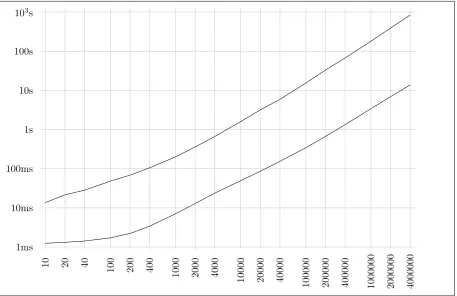
Figure 2: Times for preparing (upper) and performing (lower) a parallel read, depending on m+n
fraction of their memory at each step (e.g. the Bellman-Ford algorithm for finding shortest paths in graphs; for which also the optimization described above applies), the overhead is even smaller.
Experimental results
We have implemented protocols in Sec. 4 on the Sharemind secure multiparty
computa-tion platform (providing security against passive attacks by one party out of three in to-tal) [BNTW12] and tested their performance. We measured the time it took to read n values from a vector of length m, or to write n values to a vector of length m. Due to the structure of the algorithms, the timings almost completely depend only on m+n and this has been the quantity we have varied (we have always picked m=n).
Our performance tests are performed on a cluster of three computers with 48 GB of RAM and a 12-core 3 GHz CPU with Hyper Threading running Linux (kernel v.3.2.0-3-amd64), connected by an Ethernet local area network with link speed of 1 Gbps. The execution time of the reading protocol on this cluster for various values ofm+n is depicted in Fig. 2. We have split the running time into two parts, for preparing the read and for performing the read. We see that for larger values ofm+nthe preparation is slower by almost two orders of magnitude, hence in the design of privacy-preserving algorithms one should aim for reuse of the results of preparation.
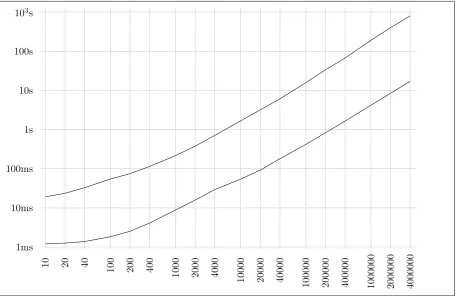
Similarly, the performance measuring results of the parallel writing are depicted in Fig. 3. Again, we distinguish the running times for preparing and performing the write, with similar differences in running times.
10 20 40 100 200 400
1000 2000 4000 10000 20000 40000
100000 200000 400000 1000000 2000000 4000000 1ms
10ms 100ms 1s 10s 100s 103s
Figure 3: Times for preparing (upper) and performing (lower) a parallel write, depending on m+n
seconds. This makes 0.5 ms per access, which is almost two orders of magnitude faster than the times reported in [KS14]. Of course, such efficiency is possible only if the overlying application supports parallelism to this level. Also, active security is achieved in [KS14], whileSharemind
only provides passive security. On the other hand, the protocols of [KS14] also require an expensive preprocessing phase, while nothing of that sort is required for our constructions.
6
Parallel algorithms for MST
Let G = (V, E) be an undirected graph, where the set of vertices V is identified with the set
{1, . . . ,|V|} and the set of edgesE with a subset of V ×V (the edge between vertices u andv occurs inEboth as (u, v) and as (v, u)). We assume that the graph is connected. Letω :E→N give the weights of the edges (ωmust be symmetric). Aminimum spanning tree ofGis a graph T = (V, E0) that is connected and for which the sum P
e∈E0ω(e) takes the smallest possible
value.
Kruskal’s and Prim’s algorithms are the two most well-known algorithms for finding the MST of a graph. These algorithms work in timeO(|E|log|V|) orO(|E|+|V|log|V|) [CLRS01]. They are inherently sequential and therefore unsuitable for an SMC implementation.
Other algorithms for MST have been proposed. Bor˚uvka’s algorithm [NMN01] works in iterations. At the beginning of each iteration, the set of vertices V has been partitioned into V1∪ · · ·˙ ∪˙ Vk and for each Vi, the minimum spanning tree has already been found (at the start
of the algorithm, each vertex is a separate part). For each i, letei be a minimum-weight edge
connecting a vertex in Vi with a vertex in V\Vi. We add all edges ei to the MST we are
constructing and join the parts Vi that are now connected. We iterate until all vertices are in
drops to at most half during each iteration.
Bor˚uvka’s algorithm seems amenable for parallelization, as the edges ei can all be found
in parallel. Parallelizing the joining of parts is more involved. Awerbuch and Shiloach [AS87] have proposed a parallel variant of Bor˚uvka’s algorithm that introduces data structures to keep track of the parts ofV, and delays the joining of some parts. Due to the delays, the number of iterations may increase, but it is shown to be at most log3/2|V|. Each iteration requires constant time, when executed by|E|processors on priority-CRCW PRAM. The algorithm assumes that all edges have different weights (this does not lessen the generality). The rest of this section describes their algorithm.
Algorithm 4:MST algorithm by Awerbuch and Shiloach Data: Connected graph G= (V, E), edge weights ω Result: E0 ⊆E, such that (V, E0) is the MST of G 1 foreach (u, v)∈E do
2 T[{u, v}]←false 3 A[(u, v)]←true
4 foreach v∈V do 5 F[v]←v 6 W[v]←NIL
7 while ∃(u, v)∈E :A[(u, v)]do
8 foreach(u, v)∈E where A[(u, v)]do 9 if in star(u)∧F[u]6=F[v]then
10 F[F[u]]←F[v] with priority ω(u, v) 11 W[F[u]]← {u, v} with priority ω(u, v)
12 Synchronize
13 if W[F[u]] ={u, v} thenT[{u, v}]←true; 14 if u < F[u]∧u=F[F[u]]then F[u]←u; 15 Synchronize
16 if in star(u) then 17 A[(u, v)]←false
18 else
19 F[F[u]]←F[u]
20 return {(u, v)∈E| T[{u, v}]}
Algorithm 5:Checking for stars in Alg. 4 Data: A set V, a mapping F :V →V
Result: PredicateSt on V, indicating which elements of V belong to stars 1 foreach v∈V doSt[v]←true;
2 foreach v∈V do
3 if F[v]6=F[F[v]] then 4 St[v]←false
5 St[F[F[v]]]←false
The Awerbuch-Shiloach algorithm [AS87] is presented in Alg. 4. It uses the arrayT to record which edges have been included in the MST. For keeping track of the partitioning of V, Alg. 4 uses a union-find data structure — the arrayF that for each vertex records its current “parent”. At each moment,F defines a forest of rooted trees, with the vertices vsatisfyingv=F[v] being the roots. The trees of this forest correspond to the parts in the current partitioning. A rooted tree is called astar if its height is at most 1.
The arrayA records which edges are “active”. The algorithm iterates as long as any active edges remain. The body of thewhile-loop is multi-threaded, creating one thread for each active edge. The changes a thread makes in common data are not visible to other threads until the next Synchronize-statement. In particular, the reads and writes of F in line 10 by different threads do not interfere with each other.
The Awerbuch-Shiloach algorithm joins two parts in the current partitioning of V or, two rooted trees in the forest defined byF, only if at least one of them is a star. Computing, which vertices belong in stars, can be done in constant time with|V|processors. At each iteration of Alg. 4, before executing the lines 9 and 16, the algorithm Alg. 5 is invoked and its output is used to check whether the vertexu belongs to a star.
An iteration of Alg. 4 can be seen as a sequence of three steps, separated by the Synchro-nize-statements. In first step, the edges to be added to the tree are selected. For each star with root r ∈ V, the lightest outgoing edge is selected and stored in W[r]. This selection crucially depends on the prioritized writing; the writing with smallest priority will go through. Also, the star is made a part of another tree, by changing the F-ancestor of r. In the second step, we break theF-cycles of length 2 that may have resulted from joining two stars. Independently, we also record the edges added to the MST. In the third step, we decrease the height ofF-trees, as well as deactivate the edges that attach to a component that is still a star at this step. These edges definitely cannot end up in the MST.
Alg. 5 for checking which vertices belong in stars is simple. If the parent and the grandparent of a vertex differ, then this vertex, as well as its grandparent are not in a star. Also, if a parent of some vertex is not in a star, then the same holds for this vertex.
7
Privacy-preserving MST
Let the ABB store the information about the structure of a graph and the weights of its edges. This means that there are public numbersnand m, denoting the number of vertices and edges of the graph. The vertices are identified with numbers 1,2, . . . , n. The structure of the graph is private — the ABB storesm pairs of values, each one between 1 andn, giving the endpoints of the edges. For each edge, the ABB also stores its weight. The preamble of Alg. 7 specifies the actual data structures (arrays) and the meaning of their elements.
Thanks to working in the ABB model, it is unnecessary to specify which parties originally hold which parts of the description of the graph. No matter how they are held, they are first input to the ABB, after which the privacy-preserving MST algorithm is executed. Even more generally, some data about the graph might initially be held by no party at all, but be computed by some previously executed protocol. The benefit of working in the ABB model are the strong composability results it provides.
The algorithms in Sec. 4 can be used to implement Alg. 4 in privacy-preserving manner, if the dependencies of the control flow from the private data (there is a significant amount of such dependencies, mostly through the array A) could be eliminated without penalizing the performance too much. Also, when implementing the algorithm, we would like to minimize the number of calls to prepareReadandprepareWrite algorithms, due to their overheads.
relatively simple structure. Its privacy-preserving version is depicted in Alg. 6. It receives the same mapping F as an input, now represented as a private vector JF~K. As the first step, the protocol finds F◦F in privacy-preserving manner, and stores in inJG~K. To find JG~K, we have to read from the arrayJF~Kaccording to the indices also stored inJF~K. This takes place in lines 1–2 of Alg. 6. We can now privately compare whether the parent and grandparent of a vertex are equal (in parallel for all i, as denoted by the use of foreach). The result is stored in J~bK which serves as an intermediate value for the final result J−→StK. After line 3 of Alg. 6, the value of J~bKis the same as the value of −→St after the assignments in lines 1 and 4 of Alg. 5.
Algorithm 6:Privacy-preserving checking for stars
Data: Private vectorJF~Kof length n, where 1≤Fi ≤n
Result: Private predicateJ−→StK, indicating which elements of {1, . . . , n} belong to stars according to F~
1 JσK←prepareRead(JF~K, n) 2 JG~K←performRead(JF~K,JσK)
3 foreach i∈ {1, . . . , n} doJbiK←JFiK=? JGiK; 4 Jbn+1K←false
5 foreach i∈ {1, . . . , n} doJaiK←JbiK? (n+ 1) :JGiK;
6 J~b0K←obliviousWrite(J~aK,
−−→
false, ~1,J~bK)
7 J~pK←performRead(J~b0K,JσK) // Ignore b0n+1
8 foreach i∈ {1, . . . , n} doJStiK←Jb
0
iK∧JpiK;
9 return J−→StK
As next, we prepare to privately perform the assignment in line 4 of Alg. 5. We only want to perform the assignment if JFiK6= JGiK, hence the number of assignments we want to perform depends on private data. Algorithm 2 presumes that the number of writes is public. We overcome this dependency by assigning to a dummy position each time Alg. 5 would have avoided the assignment in its line 5. We let the vectorJ~bKto have an extra element at the end and assign to this element for each dummy assignment. In line 5 we compute the indices of vector J~bK wherefalse has to be assigned. Here the operation ? : has the same semantics as in C/C++/Java — it returns its second argument if its first argument is true (1), and its third argument if the first argument is false (0). It can be easily implemented in the ABB:JbK?JxK:JyK is computed asJbK·(JxK−JyK) +JyK.
In line 6 of Alg. 6, the oblivious write is performed. The arguments of obliviousWriteare in the same order as in the preamble of Alg. 2: the vector of addresses, the vector of values to be written, the vector of writing priorities, and the original array. All arguments can be private values. All public values are assumed to be automatically classified. In line 6, all values to be written are equal tofalse, as in Alg. 5. Hence the priorities do not really matter; we make them all equal to 1 (with the assumption that the priorities for existing elements of J~bK, output by compute priority in line 6 of Alg. 2, are equal to 0). The result of the writing is a private vector
J~b
0
Kof lengthn+ 1 that is equal toJ~bKin positions that were not overwritten.
Lines 7 and 8 of Alg. 6 correspond to the assignment in line 6 of Alg. 5. First we compute
St[F[v]] for all v (in terms of Alg. 5) by reading from J~bK according to the indices in JF~K. In line 1 we prepared the reading according to these indices. As JF~K has not changed in the meantime, this preparation is still valid and can be reused. Hence we apply performRead to first nelements of J~b0K. The conjunction is computed in line 8.
Algorithm 7:Privacy-preserving minimum spanning tree Data: Number of vertices n, number of edges m
Data: Private vectorJE~Kof length 2m (endpoints of edges, i-th edge is (Ei, Ei+m)) Data: Private vectorJ~ωKof length m(edge weights)
Result: Private boolean vector JT~Kof length m, indicating which edge belongs to the MST
1 foreach i∈ {1, . . . ,2m}do 2 Jωi0K← −JωimodmK 3 JEi0K←JE(i+m) mod 2mK 4 foreach i∈ {1, . . . , n+ 1} do 5 JFiK←i
6 JWiK←(m+ 1)
7 foreach i∈ {1, . . . , m+ 1}do JTiK←false;
8 JσeK←prepareRead(JE~K, n)
9 for iteration number := 1 to blog3/2nc do 10 J
− →
StK←StarCheck(JF~K)
11 JF~eK←performRead(JF~K,JσeK) // Ignore Fn+1
12 J−→SteK←performRead(J
− → StK,Jσ
e K)
13 foreachi∈ {1, . . . , m}do JdiK←JF e
iK ? =JFe
i+mK;
14 foreachi∈ {1, . . . ,2m} do
15 JaiK←JSteiK∧ ¬JdimodmK?JFieK: (n+ 1)
16 (JσvK,JτvK)←prepareWrite(J~aK,J~ω
0
K, n+ 1)
17 JF~K:=performWrite(JσvK,JτvK,JE~0K,JF~K) 18 JW~K:=performWrite(Jσ
v K,Jτ
v
K,(imodm) 2m i=1,JW~K)
19 JT~K:=obliviousWrite(JW~K,−−→true, ~1,JT~K) 20 JσfK←prepareRead(JF~K, n+ 1)
21 JG~K←performRead(JF~K,JσfK) 22 JH~K←performRead(JG~K,JσfK) 23 foreachi∈ {1, . . . , n} do 24 Jc(1)i K←i=? JGiK
25 Jc(2)i K←i ? <JFiK
26 Jc(3)i K←JFiK=? JHiK∧JFiK ? <JGiK
27 JFiK:=
i, ifJc(1)i K∧Jc(2)i K
JFiK, ifJc (1)
i K∧ ¬Jc (2)
i K
JFiK, if¬Jc (1)
i K∧Jc (3)
i K
JGiK if¬Jc (1)
i K∧ ¬Jc (3)
i K
28 return (JT1K, . . . ,JTmK)
to something more suitable. One could keep track of the number of edges already added to the MST, or to execute the main loop of the algorithm sufficiently many times. We opt for the second solution, as otherwise we may leak something about the graph through the running time of the algorithm.
Alg. 7 first copies around some input data, effectively making the set of edgesE symmetric. Throughout this algorithm we assume thatxmodmreturns a value between 1 andm. In line 2 we negate the weights, as lower weight of some edge means that it has higher priority of being included in the MST. In lines 4 to 7 we initialize JF~K, JW~K and JT~K similarly to Alg. 4. All these vectors have an extra element in order to accommodate dummy assignments. InJW~K, the value (m+ 1) corresponds to the valueNIL in Alg. 4 — the elements ofJW~Kare used below as addresses to write intoJT~Kand (m+ 1) indicates a dummy assignment.
Before starting the iterative part of the algorithm, in line 8 we prepare for reading according to the endpoints of edges. The actual reads are performed in each iteration.
As mentioned before, the number of iterations of Alg. 7 (line 9) will be sufficient for all edges of the MST to be found. As discussed before,blog3/2ncis a suitable number. All iterations are identical; the computations do not depend on the sequence number of the current iteration.
An iterations starts very similarly to Alg. 4, running the star checking algorithm and finding for each endpoint u of each edge e the values F[u] and St[u] (in terms of Alg. 4). In line 9 of Alg. 4, a decision is made whether to update an element ofF~ and an element of W~. The same decision is made in lines 13–15 of Alg. 7: we choose the address of the element to update. If the update should be made then this address is JF
e
iK. Otherwise, it is the dummy addressn+ 1. In lines 16–18 the actual update is made. As the writes to bothJF~Kand JW~Kare according to the same indices J~aKand prioritiesJ~ω0K, their preparation phase has to be executed only once. If the write has to be performed, we write the other endpoint of the edge toF~ and the index of the edge toW~. In line 19 we updateJT~Ksimilarly to line 13 of Alg. 4.
Compared to Alg. 4, we have redesigned the breaking of F-cycles and decreasing the height of F-trees, in order to reduce the number of calls to algorithms in Sec. 4. In Alg. 4, the cycles are broken (which requires data to be read according to the indices inF~, and thus the invocation of prepareRead, as F~ has just been updated), and then the F-grandparent of each vertex is taken to be its F-parent (which again requires a read according to F~ and another invocation of prepareRead). Instead, we will directly compute what will be the F-grandparent of each vertex after breaking theF-cycles, and take this to be its new F-parent.
For this computation, we need the F-parents of each vertex, which we already have in the vectorF~. We also need their F-grandparents which we store in G, and~ F-great-grandparents, which we store in H. We only need a single call to~ prepareRead to find both JG~K and JH~K. After breaking the cycles, theF-grandparent of the vertex ican be eitheri,Fi orGi. It is not
hard to convince oneself that the computation in lines 24–27 finds the F-grandparent of i and assigns it to JFiK. As before, the computations for different vertices are made in parallel. The
case-construction in line 27 is implemented as a composition of ? : operations.
Finally, we return the private boolean vectorJT~Kindicating which edges belong to the MST, except for its final dummy elementJTm+1K.
Alg. 7 is UC-secure for the same reasons as Alg. 1 and Alg. 2 — it only applies the oper-ations of ABB, classifies only public constants and declassifies nothing. The amount of work it performs (or: the amount of communication it requires for typical ABB implementations) is O(|E|log2|V|). Indeed, it performs O(log|V|) iterations, the complexity of which is domi-nated by reading and writing preparations requiringO(log|E|) =O(log|V|) work. For typical ABB implementations, the round complexity of Alg. 7 isO(log2|V|) — each private reading or writing preparation requiresO(log|V|) rounds.
10 20 50 100 200 500
1000 2000 5000 10000 20000 50000
100000 200000 1s
10s 100s 103s
104s
105s
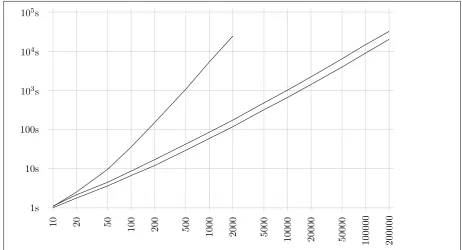
Figure 4: Running times for the private MST algorithm, depending on the number of vertices n. Number of edges ism= 3n (lower line),m= 6n(middle line),m=n(n−1)/2 (upper line)
Hence we can say that for this algorithm the overhead of our private data access techniques is only O(logm).
Experimental results
We have also implemented Alg. 7 (and Alg. 6) on theSharemindSMC platform and tested its
performance on the same setup as described in Sec. 5. We have varied the number of vertices n and selected the number of edges m based on it and on the most likely applications of our private MST protocol.
We believe the most relevant cases for our protocol to be planar graphs and complete graphs. Planar graphs have m ≈3n, if most of its faces are triangles. Complete graphs have m = n(n−1)/2. We have also considered the case m = 6n as a “generic” example of sparse graphs.
The results of our performance tests are depicted in Fig. 4. These will serve as the baseline for any further investigations in this direction.
8
Conclusions
We have presented efficient privacy-preserving protocols for performing in parallel many reads or writes from private vectors according to private indices. We have used these protocols to provide a privacy-preserving protocol for finding the minimum spanning tree in a graph; no protocols for this task have been investigated before. To achieve these results, this paper makes use of several novel ideas.
index (with the intent to run many copies of this protocol in parallel). It is sufficient to look for protocols that are efficient only when performing many reads or writes in parallel.
Second, we have noticed that the operations available relatively cheaply in existing ABB implementations allow us to construct such protocols. Our protocols in Sec. 4 are somewhat inspired by the techniques first appearing in [LW14], but are significantly more efficient.
Third, we have noticed that many PRAM algorithms become amenable to privacy-preserving implementations without too much overhead, if the protocols in Sec. 4 are available. In this sense, the private MST protocol of Sec. 7 serves just as an example. We have chosen this example because it is very difficult to imagine it to be implemented without the ideas in this paper.
Performance-wise, we have certainly obtained impressive results: a graph with 200,000 ver-tices and 1,200,000 edges can be processed in nine hours. Also, the set-up of our performance tests is realistic — LAN speeds between servers under control of different parties can easily be achieved through a co-located hosting service that provides physical barriers to the access of individual servers.
References
[ACM+13] Abdelrahaman Aly, Edouard Cuvelier, Sophie Mawet, Olivier Pereira, and Math-ieu Van Vyve. Securely solving simple combinatorial graph problems. In Ahmad-Reza Sadeghi, editor, Financial Cryptography, volume 7859 of Lecture Notes in Computer Science, pages 239–257. Springer, 2013.
[AS87] Baruch Awerbuch and Yossi Shiloach. New connectivity and MSF algorithms for shuffle-exchange network and PRAM. IEEE Trans. Computers, 36(10):1258–1263, 1987.
[BCP14] Elette Boyle, Kai-Min Chung, and Rafael Pass. Oblivious parallel ram. Cryptology ePrint Archive, Report 2014/594, 2014. http://eprint.iacr.org/.
[BDNP08] Assaf Ben-David, Noam Nisan, and Benny Pinkas. FairplayMP: a system for secure multi-party computation. In CCS ’08: Proceedings of the 15th ACM conference on Computer and communications security, pages 257–266, New York, NY, USA, 2008. ACM.
[BLW08] Dan Bogdanov, Sven Laur, and Jan Willemson. Sharemind: A framework for fast privacy-preserving computations. In Sushil Jajodia and Javier L´opez, edi-tors,ESORICS, volume 5283 ofLecture Notes in Computer Science, pages 192–206. Springer, 2008.
[BNTW12] Dan Bogdanov, Margus Niitsoo, Tomas Toft, and Jan Willemson. High-performance secure multi-party computation for data mining applications. Int. J. Inf. Sec., 11(6):403–418, 2012.
[BS05] Justin Brickell and Vitaly Shmatikov. Privacy-preserving graph algorithms in the semi-honest model. In Bimal K. Roy, editor,ASIACRYPT, volume 3788 ofLecture Notes in Computer Science, pages 236–252. Springer, 2005.
[Can01] Ran Canetti. Universally composable security: A new paradigm for cryptographic protocols. In FOCS, pages 136–145. IEEE Computer Society, 2001.
[CDN01] Ronald Cramer, Ivan Damg˚ard, and Jesper Buus Nielsen. Multiparty computa-tion from threshold homomorphic encrypcomputa-tion. In Birgit Pfitzmann, editor, EU-ROCRYPT, volume 2045 of Lecture Notes in Computer Science, pages 280–299. Springer, 2001.
[CLRS01] Thomas H. Cormen, Charles E. Leiserson, Ronald L. Rivest, and Clifford Stein.
Introduction to Algorithms, chapter 23.2 The algorithms of Kruskal and Prim, pages 567–574. MIT Press and McGraw-Hill, 2nd edition, 2001.
[CS10] Octavian Catrina and Amitabh Saxena. Secure computation with fixed-point num-bers. In Radu Sion, editor,Financial Cryptography and Data Security, volume 6052 of LNCS, pages 35–50. Springer, 2010.
[DFK+06] Ivan Damg˚ard, Matthias Fitzi, Eike Kiltz, Jesper Buus Nielsen, and Tomas Toft. Unconditionally secure constant-rounds multi-party computation for equality, com-parison, bits and exponentiation. In Shai Halevi and Tal Rabin, editors, TCC, volume 3876 ofLecture Notes in Computer Science, pages 285–304. Springer, 2006.
[DGKN09] Ivan Damg˚ard, Martin Geisler, Mikkel Krøigaard, and Jesper Buus Nielsen. Asyn-chronous Multiparty Computation: Theory and Implementation. In Stanislaw Jarecki and Gene Tsudik, editors,Public Key Cryptography, volume 5443 ofLecture Notes in Computer Science, pages 160–179. Springer, 2009.
[DMN11] Ivan Damg˚ard, Sigurd Meldgaard, and Jesper Buus Nielsen. Perfectly secure obliv-ious ram without random oracles. In Yuval Ishai, editor, TCC, volume 6597 of
Lecture Notes in Computer Science, pages 144–163. Springer, 2011.
[DN03] Ivan Damg˚ard and Jesper Buus Nielsen. Universally composable efficient multi-party computation from threshold homomorphic encryption. In Dan Boneh, edi-tor,CRYPTO, volume 2729 of Lecture Notes in Computer Science, pages 247–264. Springer, 2003.
[GGH+13] Craig Gentry, Kenny A. Goldman, Shai Halevi, Charanjit S. Jutla, Mariana Raykova, and Daniel Wichs. Optimizing oram and using it efficiently for secure computation. In Emiliano De Cristofaro and Matthew Wright, editors, Privacy Enhancing Technologies, volume 7981 ofLecture Notes in Computer Science, pages 1–18. Springer, 2013.
[GHJR14] Craig Gentry, Shai Halevi, Charanjit Jutla, and Mariana Raykova. Private database access with he-over-oram architecture. Cryptology ePrint Archive, Report 2014/345, 2014. http://eprint.iacr.org/.
[GKK+12] S. Dov Gordon, Jonathan Katz, Vladimir Kolesnikov, Fernando Krell, Tal Malkin, Mariana Raykova, and Yevgeniy Vahlis. Secure two-party computation in sublinear (amortized) time. In Ting Yu, George Danezis, and Virgil D. Gligor, editors, the ACM Conference on Computer and Communications Security, CCS’12, Raleigh, NC, USA, October 16-18, 2012, pages 513–524. ACM, 2012.
[GO96] Oded Goldreich and Rafail Ostrovsky. Software Protection and Simulation on Obliv-ious RAMs. J. ACM, 43(3):431–473, 1996.
[GRR98] Rosario Gennaro, Michael O. Rabin, and Tal Rabin. Simplified vss and fact-track multiparty computations with applications to threshold cryptography. In PODC, pages 101–111, 1998.
[HEK12] Yan Huang, David Evans, and Jonathan Katz. Private set intersection: Are garbled circuits better than custom protocols? InNDSS. The Internet Society, 2012.
[HKI+12] Koki Hamada, Ryo Kikuchi, Dai Ikarashi, Koji Chida, and Katsumi Takahashi. Practically efficient multi-party sorting protocols from comparison sort algorithms. In Taekyoung Kwon, Mun-Kyu Lee, and Daesung Kwon, editors, ICISC, volume 7839 of Lecture Notes in Computer Science, pages 202–216. Springer, 2012.
[HKS+10] Wilko Henecka, Stefan K¨ogl, Ahmad-Reza Sadeghi, Thomas Schneider, and Immo Wehrenberg. TASTY: tool for automating secure two-party computations. InCCS ’10: Proceedings of the 17th ACM conference on Computer and communications security, pages 451–462, New York, NY, USA, 2010. ACM.
[KLO12] Eyal Kushilevitz, Steve Lu, and Rafail Ostrovsky. On the (in)security of hash-based oblivious RAM and a new balancing scheme. In Yuval Rabani, editor,Proceedings of the Twenty-Third Annual ACM-SIAM Symposium on Discrete Algorithms, SODA 2012, Kyoto, Japan, January 17-19, 2012, pages 143–156. SIAM, 2012.
[KS08] Vladimir Kolesnikov and Thomas Schneider. A practical universal circuit construc-tion and secure evaluaconstruc-tion of private funcconstruc-tions. In Gene Tsudik, editor, Financial Cryptography, volume 5143 of Lecture Notes in Computer Science, pages 83–97. Springer, 2008.
[KS14] Marcel Keller and Peter Scholl. Efficient, Oblivious Data Structures for MPC. Cryptology ePrint Archive, Report 2014/137, 2014. http://eprint.iacr.org/.
[LHS+14] Chang Liu, Yan Huang, Elaine Shi, Jonathan Katz, and Michael Hicks. Automating Efficient RAM-Model Secure Computation. In Proceedings of 2014 IEEE Sympo-sium on Security and Privacy. IEEE, 2014.
[LT13] Helger Lipmaa and Tomas Toft. Secure equality and greater-than tests with sublin-ear online complexity. In Fedor V. Fomin, Rusins Freivalds, Marta Z. Kwiatkowska, and David Peleg, editors, ICALP (2), volume 7966 of Lecture Notes in Computer Science, pages 645–656. Springer, 2013.
[LW14] Peeter Laud and Jan Willemson. Composable Oblivious Extended Permutations. Cryptology ePrint Archive, Report 2014/400, 2014. http://eprint.iacr.org/.
[LWZ11] Sven Laur, Jan Willemson, and Bingsheng Zhang. Round-Efficient Oblivious Database Manipulation. In Proceedings of the 14th International Conference on Information Security. ISC’11, pages 262–277, 2011.
[MK10] Lior Malka and Jonathan Katz. Vmcrypt - modular software architecture for scalable secure computation. Cryptology ePrint Archive, Report 2010/584, 2010.
[MS13] Payman Mohassel and Seyed Saeed Sadeghian. How to Hide Circuits in MPC: an Efficient Framework for Private Function Evaluation. In Thomas Johansson and Phong Q. Nguyen, editors, EUROCRYPT, volume 7881 of Lecture Notes in Computer Science, pages 557–574. Springer, 2013.
[NMN01] Jaroslav Neˇsetˇril, Eva Milkov`a, and Helena Neˇsetˇrilov`a. Otakar Bor˚uvka on mini-mum spanning tree problem; Translation of both the 1926 papers, comments, his-tory. Discrete Mathematics, 233(1-3):3–36, 2001.
[NO07] Takashi Nishide and Kazuo Ohta. Multiparty computation for interval, equality, and comparison without bit-decomposition protocol. In Tatsuaki Okamoto and Xiaoyun Wang, editors, Public Key Cryptography, volume 4450 of Lecture Notes in Computer Science, pages 343–360. Springer, 2007.
[SCSL11] Elaine Shi, T.-H. Hubert Chan, Emil Stefanov, and Mingfei Li. Oblivious RAM with o((logn)3) worst-case cost. In Dong Hoon Lee and Xiaoyun Wang, editors,
Advances in Cryptology - ASIACRYPT 2011 - 17th International Conference on the Theory and Application of Cryptology and Information Security, Seoul, South Korea, December 4-8, 2011. Proceedings, volume 7073 ofLecture Notes in Computer Science, pages 197–214. Springer, 2011.
[Sha79] Adi Shamir. How to share a secret. Commun. ACM, 22(11):612–613, 1979.
[SvDS+13] Emil Stefanov, Marten van Dijk, Elaine Shi, Christopher W. Fletcher, Ling Ren, Xiangyao Yu, and Srinivas Devadas. Path ORAM: an extremely simple oblivious RAM protocol. In Ahmad-Reza Sadeghi, Virgil D. Gligor, and Moti Yung, edi-tors,ACM Conference on Computer and Communications Security, pages 299–310. ACM, 2013.
[Wak68] Abraham Waksman. A permutation network. J. ACM, 15(1):159–163, 1968.
[WHC+14] Xiao Shaun Wang, Yan Huang, T-H. Hubert Chan, abhi shelat, and Elaine Shi. Scoram: Oblivious ram for secure computation. Cryptology ePrint Archive, Report 2014/671, 2014. http://eprint.iacr.org/, to appear at ACM CCS ’14.
[Yao82] Andrew Chi-Chih Yao. Protocols for secure computations (extended abstract). In