_____________________________________________________________________________________________________
www.sciencedomain.org
An Analytical Study of Retesting of Retained
Sample Results
Shyamali Pal
1*1
JMD Diagnostics Pvt Ltd P-336, C I T Road Scheme VI M Kolkata-700054, India.
Author’s contribution
The sole author designed, analyzed and interpreted and prepared the manuscript.
Article Information
DOI: 10.9734/BJMMR/2015/13629 Editor(s): (1)Chan-Min Liu, School of Life Science, Xuzhou Normal University, Xuzhou City, China.
Reviewers: (1) Anonymous, Minia University, Egypt. (2)Anonymous, Pamukkale University, Turkey. (3)Anonymous, Hamedan Islamic Azad University, Iran. Complete Peer review History:http://www.sciencedomain.org/review-history.php?iid=722&id=12&aid=7271
Received 26th August 2014 Accepted 3rd November 2014 Published 15th December 2014
ABSTRACT
Aims: The sample retention policy for Clinical Chemistry analytes in accredited medical laboratories as per ISO 15189:2012 is 24 hrs. Serum/ plasma to be separated in aliquot within 20 minutes of collection unless the primary containers are gel vacutainers. Rigorous maintenance of such procedure is difficult and as a result the possibility of deviation from such schedule may not be very uncommon. The 1 year Turn Around Time (TAT) analysis of the laboratory is a good guide to find out time lag from sample collection to sample processing & average time of collecting samples in aliquot for retained sample testing. The laboratory retested 22 common analytes on the basis of such time lag and evaluated the deviation from 1st observation. The accumulated data has helped to evaluate and implement sample retention policy.
Study Design: The average time lag from collection to completion of test performance of a batch is 4hrs± 30 minutes. The analytes were retested in the time lag. After accumulation of sufficient data the time lag increased to 6 hours±30 minutes which is the average lag from sample collection to end of the day duty personnel. In the 3rd phase total retention time ie, 24 hrs has been considered as time interval of retained sample retesting. But the samples remained at room temperature for 6hrs±30minutes before being preserved at 2°C-8°C. Hence time lag was (6hrs±30min) at room temperature and 17hrs ±30min at 2°C-8°C. The samples always retested from primary container.
Place and Duration of Study: The study took place in JMD Diagnostics Private Limited, Kolkata,
India. The duration of study is 2 yrs.
Methodology: The analytes were tested in Cobas Integra 400plus system. The tests have been performed as routine tests and considered as 1st observation. 2nd observation values obtained after the specified time lag. The results obtained were compared using statistical software. Comparison of 1st and 2nd results and bias of all analytes were studied. Electrolytes have been eliminated from the study as the electrolytes are preferred to be retested from freshly collected sample. Labile parameters like L-Lactate, ammonia, bicarbonate were also not considered for the same reason. Conclusion: Only 3 analytes, total protein, total calcium and inorganic phosphorus cannot be preserved in primary containers. The analytes also need not to be separated within 20 minutes of collection. Upto 4hrs±30 minutes all the parameters have shown excellent correlation coefficient. Hence, the laboratory earns a time lag between collection to preservation of samples for these analytes. For other 19 analytes sample may be kept in primary container.
Keywords: Retesting; additional test; clinical biochemistry; regression co-efficient(r).
ABBREVIATIONS
TAT; CLSI; NABL.
1. INTRODUCTION
The guideline of Indian Laboratory Accreditation Body, NABL 112 [1] and CLSI [2] have certain instructions for the maintenance of quality of testing and procedures for accredited laboratories. The retention period of a sample after collection is 24 hrs [1,2]. The retained sample is preserved for additional/ repeat test on request. Preservation criteria are at 2°C-8°C for 24 hrs (from the time of collection). It has been observed that there is a time lag from sample collection to receiving time of the laboratory. From receipt of the laboratory till processing a time lapse also has been noted. The total time interval is not less than 4 hrs (4hrs±30minutes).
The data obtained from Turn Around Time (TAT) analysis of 1 year from the authors laboratory. Therefore, to maintain quality of test performance the tests need to be repeated after the lag to check the deviation from 1st result.
The optimum storage time of clinical biochemistry analytes were standardized by Marjini et al. [3], Ali L et al. [4] and the studies proved the stability of some of the analytes upto 9 days. The storage temperature was 2°C-8°C. The serum samples were separated by centrifugation in aliquot within 20 minutes of collection. But in a busy routine clinical biochemistry laboratory with approximate sample load 100/day preservation of samples in aliquot within 20 minutes of collection is difficult, rather impossible. The average time of separating serum /plasma in aliquot is 6-7hours, obtained from TAT (generally before charge handover of
laboratory personnel). So, an accredited laboratory should accept the practical situation and the deviation from 1st result after such lag should be checked.
Though after retention of 6hrs the aliquots are being preserved, the author felt a 3rd phase observation of 24 hrs may help the laboratory personnel. If the samples are kept in primary container instead preserving in aliquot and the deviation is within acceptable limit then the laboratory may validate their own preservation policy. The validation of policy saves time of pouring samples in aliquot, saves the laboratory from the personal error during the process and unnecessary procurement of microcentrifuge tubes needed to preserve the serum/plasma in aliquot. As total retention time is 24 hours so for the 3rd phase study of deviation the time lag should be 6hrs±30minutes at room temperature and at 2°C-8°C for 17hrs± 30minutes. Hence, the study of deviation is actually a study of deviation when samples are stored in primary container only.
The author decided to select 5 analytes for retesting in every month so that each parameter is being retested at least 6 times in a month giving the option of statistical calculation of deviation. Minimum deviation reflects ambience of room temperature, efficiency of the instrument and reagents and quality of the evacuated primary container. Stress has been given to tight capping of the primary container immediately after performance to prevent deviation due to evaporation of serum sample.
patients. Moreover, if less expensive primary container can satisfy the criteria of deviation of the retention period, it should be accepted by the laboratory.
2. MATERIALS AND METHODS
2.1 Study Materials
Patient samples were selected at random. The retesting of retained sample analysis is one of the quality assurance criteria for the tests under the scope of Indian Accreditation body. So, for the study of analysis of test results patient consent is not needed. Result analysis neither discloses patient identity. So, integrity and confidentiality of patient information are protected. Samples are collected in evacuated containers with additive/no additive. Gel vacutainers are not in use.
2.2 Methods
The analytes tested are plasma glucose, serum urea, creatinine, uric acid, Total Protein, Albumin, Total Cholesterol, HDLC, LDLC, TG, AST, ALT, ALP, Amylase, Lipase, Total Calcium, Inorganic Phosphorus, CPK, LDH, GGT, Total Bilirubin and Direct Bilirubin. The tests were performed in Cobas Integra 400 Plus automated system. The objective of retained sample testing is to check repeatability performance of the laboratory. The criteria is, a single test to be repeated in the same method and system by two different laboratory personnel to eliminate personal bias. The laboratory selected 5 parameters on every month based on method mode (end point, kinetic etc). As a result for each parameter the laboratory is getting at least 5x2=10 observations per month per analyte. Hence after 2 years the evaluations of deviations of 22 analytes have been done. Time lag between two observations in the 1st phase was 4hrs±30minutes which is the lag between collection to completion of processing of samples. In the 2nd phase 6hrs±30 minutes, the lag of collection to the end of day duty ie, before handover of the charges. In the 3rd phase total 24hrs±60minutes(at 23°C-25.8°C for 6hrs±30minutes then 17hrs ±30 minutes at 2°C-8°C). After 24 hrs the samples are disposed as per National regulation of Waste Disposal. The lag periods obtained from TAT analysis data of the laboratory.
2.3 Statistical Calculations
The samples have been randomly chosen. The mean of 1st and 2nd observation of every analyte
in every phase is calculated. Difference from first observations and bias evaluated. Mean of the deviation for every analyte in each phase, Mean X (mean of 1st observations), Mean y (mean of 2nd observations) have been calculated. CV% have been evaluated as follows:
CV% = Mean of deviation x 100/Mean of 1st observation (all results).
Regression coefficient have also been calculated from Winks SDA – online statistical data analysis calculator. The parameters with regression coefficient 0.95-1.02 have been chosen as validated parameter for preservation in primary container.
3. RESULTS AND DISCUSSION
Results of 1st, 2nd and 3rd phase are given in Tables 1, 2 and 3.
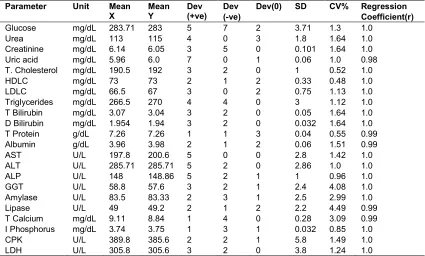
Table 1 data confirms excellent repeatability of all analytes at above mentioned time lag.
Both CV% and regression coefficient correlated with each other [5]. Mean X and Y are mean of all 1st & 2nd observations of an analyte at a particular time lag which is necessary to calculate the regression co efficient. SD reflects the mean of deviations obtained from different patient results which is unlike of SD determination of Internal Quality Control sample where same sample is being tested and deviation is being calculated. The SD and CV% obtained from such analysis shows negligible deviation from 1st results. Deviations from 1st observation have also been observed. Zero deviation indicates same result after retained sample test, deviation (+ve) indicates raised value and deviation (-ve) low value during retesting. The deviations are taken into account to observe bias of an analyte after retaining the sample in primary container.
Table 1. Time lag 4hrs ±30 minutes
Parameter Unit Mean X Mean Y Dev (+ve) Dev (-ve)
Dev(0) SD CV% Regression Coefficient(r)
Glucose mg/dL 283.71 283 5 7 2 3.71 1.3 1.0
Urea mg/dL 113 115 4 0 3 1.8 1.64 1.0
Creatinine mg/dL 6.14 6.05 3 5 0 0.101 1.64 1.0
Uric acid mg/dL 5.96 6.0 7 0 1 0.06 1.0 0.98
T. Cholesterol mg/dL 190.5 192 3 2 0 1 0.52 1.0
HDLC mg/dL 73 73 2 1 2 0.33 0.48 1.0
LDLC mg/dL 66.5 67 3 0 2 0.75 1.13 1.0
Triglycerides mg/dL 266.5 270 4 4 0 3 1.12 1.0
T Bilirubin mg/dL 3.07 3.04 3 2 0 0.05 1.64 1.0
D Bilirubin mg/dL 1.954 1.94 3 2 0 0.032 1.64 1.0
T Protein g/dL 7.26 7.26 1 1 3 0.04 0.55 0.99
Albumin g/dL 3.96 3.98 2 1 2 0.06 1.51 0.99
AST U/L 197.8 200.6 5 0 0 2.8 1.42 1.0
ALT U/L 285.71 285.71 5 2 0 2.86 1.0 1.0
ALP U/L 148 148.86 5 2 1 1 0.96 1.0
GGT U/L 58.8 57.6 3 2 1 2.4 4.08 1.0
Amylase U/L 83.5 83.33 2 3 1 2.5 2.99 1.0
Lipase U/L 49 49.2 2 1 2 2.2 4.49 0.99
T Calcium mg/dL 9.11 8.84 1 4 0 0.28 3.09 0.99
I Phosphorus mg/dL 3.74 3.75 1 3 1 0.032 0.85 1.0
CPK U/L 389.8 385.6 2 2 1 5.8 1.49 1.0
LDH U/L 305.8 305.6 3 2 0 3.8 1.24 1.0
Table 2. Time lag 6hrs ±30 minutes
Parameter Unit Mean X Mean Y Dev (+ve)
Dev (-ve)
Dev(0) SD CV% Regression Coefficient(r)
Glucose mg/dL 197 198 2 2 2 1.33 0.67 1.0
Urea mg/dL 52.83 53 3 2 1 1.5 2.84 1.0
Creatinine mg/dL 1.3 1.35 1 5 0 0.05 3.84 1.0
Uric acid mg/dL 7.69 7.67 4 2 0 0.095 1.23 1.0
T. Cholesterol mg/dL 171.4 174 3 1 1 3 1.75 1.0
HDLC mg/dL 46 46 0 2 3 0.4 0.87 1.0
LDLC mg/dL 106.16 108 3 0 3 1.66 1.56 1.0
Triglycerides mg/dL 181.6 184 4 1 0 3.6 1.98 1.0
T Bilirubin mg/dL 4.04 3.97 2 5 1 0.07 1.71 1.0
D Bilirubin mg/dL 0.674 0.655 2 5 1 0.02 2.97 1.0
T Protein g/dL 7.33 7.46 5 1 1 0.13 1.77 0.95
Albumin g/dL 4.58 4.61 2 0 4 0.033 0.72 1.0
AST U/L 25.43 26 2 1 4 0.86 3.38 0.98
ALT U/L 31.94 32 2 1 4 0.34 1.06 1.0
ALP U/L 98 100 7 0 0 2 2.04 1.0
GGT U/L 362.66 368.53 4 2 0 6.86 1.89 1.0
Amylase U/L 51.6 51.14 2 2 3 1.86 3.6 1.0
Lipase U/L 49.14 50.2 4 0 1 0.86 1.75 1.0
T Calcium mg/dL 8.88 8.85 4 2 0 0.33 3.71 0.9
I Phosphorus mg/dL 4.97 5.02 4 0 1 0.078 1.57 1.0
CPK U/L 1383 1400 3 3 0 19 1.38 1.0
LDH U/L 211 212 4 2 0 3.33 1.58 1.0
After 24 hrs it is being observed that though CV% is acceptable in all 22 analytes, regression coefficients of TProtein, Inorganic Phosphorus and T Calcium are not within the acceptable limit.
Table 3. Time lag 6hrs ±30 minutes at room temperature and 17hrs±30 minutes at 2°C -8°C
Parameter Unit Mean X Mean Y
Dev (+ve)
Dev (-ve)
Dev(0) SD CV% Regression coefficient(r)
Glucose mg/dL 199 199 4 4 5 1.71 0.86 1.0
Urea mg/dL 45.11 47 8 1 0 3 6.65 1.0
Creatinine mg/dL 1.92 1.96 4 3 1 0.068 3.54 1.0
Uric acid mg/dL 6.59 6.5 6 6 0 0.161 2.44 1.0
T. Cholesterol mg/dL 175.6 178 12 1 2 2.86 1.63 1.0
HDLC mg/dL 35.2 36 5 0 0 1.2 3.41 0.99
LDLC mg/dL 106.2 105 3 1 1 3.4 3.2 0.99
Triglycerides mg/dL 150.66 153 8 2 2 2.66 1.76 1.0
T Bilirubin mg/dL 1.46 1.46 5 7 0 0.04 2.67 1.0
D Bilirubin mg/dL 0.253 0.248 4 6 2 0.0116 4.58 0.99
T Protein g/dL 7.15 7.13 3 4 1 0.2 2.79 0.91
Albumin g/dL 4.42 4.37 2 2 2 0.08 1.81 0.99
AST U/L 23.2 24.27 10 1 0 1.27 5.47 0.98
ALT U/L 67.09 66.72 4 4 3 1.82 2.71 1.0
ALP U/L 114.22 116.55 7 1 1 2.33 2.04 1.0
GGT U/L 105.62 108.37 5 3 0 4 3.94 1.0
Amylase U/L 84.86 91 6 0 1 2.74 3.23 1.0
Lipase U/L 30.6 31.4 2 0 3 1.2 3.92 0.98
T Calcium mg/dL 9.93 9.81 3 4 0 0.34 3.42 0.71
I Phosphorus mg/dL 3.2 3.54 9 0 0 0.115 3.59 0.9
CPK U/L 935.28 809.28 4 3 0 42.37 4.53 1.0
LDH U/L 229.33 210 2 4 0 6.4 2.79 0.99
The pictorial presentation of all the parameters (Fig. 1) presents results of 1st and 2nd observation. Results of 1st performance are along Y-axis and repeat test results are along X-axis. The pictorial presentation has shown retesting results of retained samples of all three lag periods. Graphical presentations (Fig. 1) of three separate lag periods for 22 parameters were not given to prevent unnecessary occupancy of space. As the results have shown good regression correlation the same was not felt to be necessary.
Previous observations regarding storage time of analytes are all recent. Samples stored at -20°C and Q-probe study showed good repeatability after 7 days for 19 analytes [4,6]. The observations were excellent but not relevant in the present scenario. The samples were preserved within 20 minutes of collection. But the objective of present study is to determine maximum retention time of samples in primary container.
The study reflects efficiency of the automated
system, reagents, ambience of room
temperature, quality of primary sample container, efficient maintenance of TAT and competence of laboratory personnel. Deviation from any of such factors is suggestive of re- evaluation. The CV%
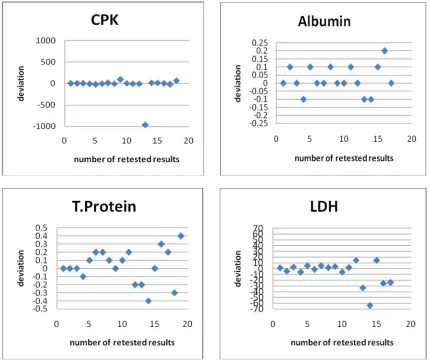
of all 22 analytes show deviations which are within clinically acceptable limit but the laboratory decided to follow the correlation coefficient. The laboratory decided to find out bias for every analytes and the distribution patterns are shown in Fig. 2.
The distribution data analysis (Tables 1, 2, 3, Fig. 2) gives the impression of bias of an analyte. Regression and bias curves of all analytes were done after accumulation of all lag period values.
Fig. 1. Retesting of retained sample
Previous works suggested that stability have been observed for 25 analytes (included electrolytes also) at 25°C in human serum upto 48 hrs [6,7]. Serial study at 4°C, 22°C, -20°C for 48hrs to 14 days were performed showing stability for such a long period [6,7]. Differences in data were stated to be negligible. Only one study mentioned increase in inorganic phosphorus, uric acid, HDLC, triglycerides and decrease in bilirubin total and direct, CPK, AST, LDLC when stored at room temperature [8]. The storage time was 48hours to 14 days. The study included electrolytes also but as per accreditation guideline electrolytes are preferably to be performed from fresh collection as contact with RBC raises potassium value. Present observations are in accordance with previous
observation for some analytes like uric acid, triglycerides and bilirubin total and direct.
So, for similar study, correlation coefficient to be considered as the determinant instead CV%. The study is specifically useful for paediatric samples
Fig. 2. Bias evaluation
4. CONCLUSION
The validation study may be used as a guideline for sample preservation. But the validity is dependent on certain factors like laboratory environment, time lag between collection and receipt by the laboratory, instrument, reagents, competence of laboratory personnel and quality of primary container. Any deviation from such factor/factors needs re evaluation. The presenting authors laboratory has decided to continue this study as part of quality control procedure so that any deviation may be noted and corrective and preventive action may be implemented.
CONSENT
Not applicable.
ETHICAL APPROVAL
Not applicable.
ACKNOWLEDGEMENT
1. The Director - JMD Diagnostics Private Limited
2. The laboratory personnel - JMD Diagnostics Private Limited
COMPETING INTERESTS
Author has declared that no competing interests exist.
REFERENCES
Document NABL. 112;21:2007(Guidebook of Indian Accreditation Body).
2. Wayne PA. CLSI procedures for the handling and processing of blood specimens for common laboratory tests: Clinical and Laboratory Standards Institute. 4th Ed; 2010.
3. Marjani A. Effect of storage time and temperature on serum analytes. American Journal of Applied Sciences. 2008;5:1047. 4. Ali L, Siddiqui I. Q probes study of replicate
specimen at the clinical laboratory. Journal of Pakistan Medical Association. 2004;54(2):1-5.
5. Passing H, Bablok W. A general regression procedure for method
transformation. J Clin Chem Clin Biochem. 1988;26:783-790.
6. Heins M, Heil W, Withhold W. Storage of serum or whole blood samples? Effects of time and temperature on 22 serum analytes. Eur J Clin Chem Clin Biochem. 1995;33:231-238.
7. Donnelly JG, Soldin SJ, Nealon DA, Hicks JM. Stability of twenty five analytes in human serum at 22°C, 4°C and -20°C. Paeditr. Pathol Lab Med. 1995;15(6):869-874.
8. Ono T, Kitaguchi K, Takehara M, Shiiba M, Hayami K. Serum constituent analysis: effect of duration and Temperature of storage of clotted blood. Clin Chem. 1981;27(1):35-38.
© 2015 Pal; This is an Open Access article distributed under the terms of the Creative Commons Attribution License (http://creativecommons.org/licenses/by/4.0), which permits unrestricted use, distribution, and reproduction in any medium, provided the original work is properly cited.
Peer-review history: