Distributed Group Authentication for
RFID Supply Management
Mike Burmester,
Senior member, IEEE,
and Jorge Munilla
Abstract—We investigate an application of Radio Frequency Identification (RFID) referred to in the literature asgroup scanning, in which an RFID reader device interrogates several RFID tags to establish “simultaneous” presence of a group of tags. Our goal is to study the group scanning problem in strong adversarial settings and show how group scanning can be used in distributed applications for supply chain management. We present a security framework for group scanning and give a formal description of the attending security requirements. Our model is based on the Universal Composability framework and supports re-usability (through modularity of security guarantees). We propose two novel protocols that realize group scanning in this security model, based on off-the-shelf components such as low-cost (highly optimized) pseudorandom functions, and show how these can be integrated into RFID supply-chain management systems.
Index Terms—Distributed RFID systems, supply-chain management, grouping-proofs, authentication.
F
1
INTRODUCTION
T
HE term “Internet of Things” (IOT) was coined in 1999 by Kevin Ashton, a co-founder of the Auto-ID Center [1] whose mission was to create a global RFID (Radio Frequency Identification) based product identification system for inventory and sup-ply management. There are several advantages of RFID technology over barcodes: RFID is wireless, does not require direct line-of-sight, and RFID tags can be interrogated at greater distances, faster and concurrently [2]. This makes the IOT a wireless net-work of objects and sensors that collect and process information autonomously. RFID tags and sensors enable computers to observe/identify/understand for situational awareness without the limitations of a human in the loop.RFID is presently a mature technology that is widely deployed for supply-chain management, re-tail operations, inventory management and automatic identification. A typical RFID deployment involves three main components: i) tags or transponders, which are electronic data storage devices attached to objects to be identified; ii) readers or interrogators, which manage tag population, read data from and write data to tags; and iii) a back-end server, the verifier, which is a trusted entity that exchanges tag information with the readers and processes data ac-cording to specific task applications.
• M. Burmester is with the Department of Computer Science, Florida State University, Tallahassee, FL, 30302.
E-mail: [email protected]
• J. Munilla is with the Communication Engineering Department, Universidad de M´alaga, Spain, 29070.
This work has been partially supported by Ministerio de Ciencia e Inno-vacin (Spain) and the European FEDER Fund under project TIN2011-25452.
Most RFID tags are passive and do not have power of their own but get the energy needed to operate from an RFID reader. Thus, tags are inactive until activated by the electromagnetic field generated by a reader that is tuned to their frequency.
Although initial designs of RFID identification pro-tocols focused on performance with little attention paid to resilience and security, this technology has found use in many applications that require the im-plementation of security mechanisms that:i)take into account features such as the vulnerability of the radio channel, the constrained power of the devices, the low-cost and limited functionality of tags and the request-response operation mode; andii)make them resistant to privacy/confidentiality threats, malicious traceability and loss of data integrity. The recent ratification of the standard Gen2v2 highlights these security concerns [3].
When RFID technology is used for supply-chain management, concerns regarding the monitoring of tags and transfer of ownership or control of tags need to be addressed. If the transfer is permanent, or even temporal, ownership transfer protocols can be used, for which the rights of an owner are securely transferred to a new owner [4], [5]. However, there are cases when the owner does not want to cede control, even though this may be temporal. For example, a manufacturer may use the services provided by a car-rier who, in turn, uses other carcar-riers to transport their products. In such cases it is desirable that the owner and the carrier can periodically check the integrity of a consignment. This requirement is referred to as
group scanning, or agrouping-proofin the literature, and involves multiple tags proving simultaneous presence in the range of an RFID reader [6], [7].
grouping-proofs can substantially expand the capabilities of RFID-based systems. For example, some products may need to be shipped together in groups and one may want to monitor their progress through the supply-chain—e.g., hardware components of a system or kits. A different scenario would be to support enforcement of safety regulations requiring that drugs be shipped, or dispensed, with information leaflets. However, as public key cryptography is beyond the capability of most RFID tags, such proofs can only be checked by a verifier that shares private information with every tag. As a result the carrier may not be able to check directly the integrity of a group.
Our main contributions in this paper are to: a) Analyze a recently proposed grouping-proof
and discuss the challenges of securing such proofs.
b) Present a framework for RFID grouping-proofs that addresses practical settings, in particular supply-chain management, and that allows for side-to-side comparisons with alternative pro-posals.
c) Present grouping-proofs of integrity that are generated by the tags of the group without sharing any private information with the reader. These can be verified by the owner but also, if needed, by a custodian who has no control over the tags.
The organization of this paper is as follows. In Sec-tion 2 we review the literature and analyze a recently proposed grouping-proof. In Section 3 we discuss RFID deployments for supply-chain management and present a high-level description of the security re-quirements and procedures for group scanning, in particular for compiling evidence during a group interrogation, and discuss the threat model. In Sec-tion 4 we propose two RFID protocols for group scanning: a non-anonymous grouping-proof and a version that adds support for anonymity. We then show in Section 5 how these can be integrated into RFID supply-chain management. We summarize our main results in Section 6. In the Appendix we formally define the functionality of our two protocols and show that these are realized in the Universal Composability framework.
2
BACKGROUND
Ari Juels introduced in 2004 the security context of a new RFID application—which he called a yoking-proof [8], that generates evidence of simultaneous presence of two tags in the range of an RFID reader. This first protocol was later found to be insecure [9], [10] but, the simultaneous scanning application trig-gered a considerable interest in the research commu-nity. Yoking-proofs have been extended to grouping-proofsin which multiple tags prove simultaneous pres-ence in the range of an RFID reader—see e.g. [11].
Burmester et at. presented in [12] a protocol which achieved anonymity by using randomized pseudonyms for the group identifer, and forward-security by updating the secret keys and the group keys after each season. This protocol is essen-tially a proof-of-concept, and not appropriate for lightweight applications. Huang and Ku [13] pre-sented a grouping-proof for passive low-cost tags that uses a pseudorandom number generator to authenti-cate flows and a cyclic redundancy code to randomize strings. The protocol has several weaknesses, some of which were addressed by Chien et al. [14] who, in turn, proposed a new grouping-proof. Peris-Lopez et al. [15] found other security flaws in these protocols and proposed guidelines for securing them as well as a yoking-proof protocol (for two tags).
More recently, Liu et al. proposed in this journal [6] a grouping-proof for multiple readers and tags. In this proof the reader is a contributing party that shares a private key with the tags of the group. There are several security issues with this proof that we discuss below, and will serve as guideline for designing se-cure grouping-proofs.
Liu et al.’s Grouping-Proof
This proof is vulnerable to de-synchronization and privacy leaks. De-synchronization occurs when the adversary succeeds in disrupting the protocol by partitioning the group into two parts with one part updating its state while the other does not.
The Liu et al. protocol uses an invertible pseudoran-dom number generator P RN G. Authentication data is obfuscated by using bitwise operations: XOR (⊕), OR (∨) and modular addition (+), operations that have been shown to be insecure [16]. In this particular case private key information leaks.
Since the description of the Liu et al. protocol is quite complex, here we describe only the case when there are two tagsTA,TBand a single readerR, which is sufficient for our arguments. The tags share a secret keyswithR.
Step 1.R generates a pseudorandom numberr0, and sends it together with a pseudorandom flagFRtoTA andTB.
R→TA, TB: r0, FR
Step 2.TA, TBcheckFR. If it is not correct, the protocol terminates. Otherwise, the tags send to R their flags
FTA, FTB.
TA, TB →R: FTA, FTB
Step 3.Rchecks the flags and if correct links the tags.
R→TA, TB: TA, TB are linked
Step 4. TA updates its flag: FT′A ← FTA, computes
MA= (PIDTA⊕FT′A)∨r0,NA=P RN G(FR∨PIDTA) and sends these toR.
Step 5. Upon receiving this message, R updates the flag:FT′
B ←FTB, selects a pseudorandom numberr1, and computes MR= (P IDTB∨FR)⊕(s+r1), NR= (gid⊕FT′
B)∨r1, wheregidis a group identifier.
R→TB: MR||NR||NA
The protocol continues:TB updates its flag in Step 6 and Rcomputes FT′
A in Step 7.
In this protocol, parties update their flags indepen-dently. This leads to a synchronization problem. For example, if the protocol is interrupted after Step 4,
TA will have updated FTA but R will not, so R will be unable to recognize TA in the next interro-gation in Step 2. The interruption may have a natural origin (communication problems) or may be caused intentionally by an adversary: physically, or by first impersonating TA in Step 1 to get r0, FR and then impersonating Rto getTA.
Assume now that to overcome this problem the flags are not updated independently, but only when each party has made certain that the other has up-dated. In this case, because of the bitwise operations, secret key information leaks (as in [5]). In fact, if flags remain static, an adversary can impersonate the tags to the reader, by replaying these flags, to get different values of MR (MR′, MR′′, . . .) and NR (NR′, NR′′, . . .)). The computed values can be written:
MR=KA⊕(s+r1) and NR=KB∨r1,
whereKA,KB are constant andr1 varies with every execution (r1, r′1, r′′1, . . .). The value of KB can be easily retrieved by observing different NR. Once KB is known, many bits of differentr1’s also get known (those for which the corresponding bits of KB are zero). For the bits of r1 that are known, the corre-spondingi-th least significant bitsi, can be retrieved as follows:
1) Get two pairs:(r1, MR)and (r′1, MR′).
2) Compute:R=r1⊕r1′ and C=MR⊕MR′ ⊕R. 3) Fori= 1 :length(s),si is computed:
If Ci = 1and Ri= 0 thensi=ri
1⊕Ci+1;
Elseif Ci= 0and Ri= 1 thensi =ci⊕Ci+1 provided that ci can be computed, with
ci= (ci−1∧(ri−1
1 ⊕si−1))∨(r i−1 1 ∧si−1) for i >1and c1= 0.
ElseBit icannot be retrieved for these pairs. 4) Return to Step 1 until every bit of s (for those
positions ofr1 that are known) is disclosed.
Finally, as mentioned earlier, the proof is not gener-ated by the tags themselves, but requires the reader to check and compute authentication data for the tags.
3
FRAMEWORK
ASSUMPTIONS
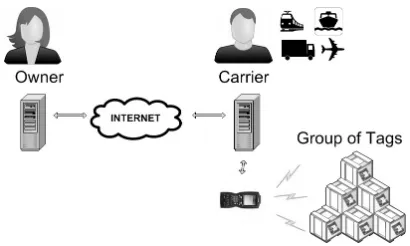
A typical deployment of an RFID supply-chain in-volves three types of legitimate entities—see Figure 1:
Fig. 1. An RFID Supply-Chain Scenario
a) Agroup of tags(GoT).
b) The owner of GoT, who keeps the digital rights of the tags; in particular she knows the private information stored by the tags. However, the GoT may not be in the physical range of the owner.
c) Thecarrier, whose services are contracted by the owner. He has physical possession of the GoT and can access the GoT through his reader, but does not have control over it, other than, when allowed, verifying its integrity.
We consider two modes for supply-chain man-agement: Mode A, where the owner monitors the integrity of a GoT via a carrier, and Mode B where the carrier directly monitors the GoT.
3.1 RFID Deployments
We assume the following regarding the environment that characterizes RFID group scanning applications.
3.1.1 RFID tag capabilities
Passive UHF tags are the most common for supply-chain applications. They have no power of their own, operate in the far field, and use backscatter communication [17]. Such tags work at greater dis-tances (than inductive tags) but the delivered power is low, and therefore lightweight cryptographic tools should be utilized [18]. However, we can assume that tags are able to perform basic symmetric-key crypto-graphic operations such as selecting pseudorandom numbers and evaluating a pseudorandom function
f : {0,1}∗ → {0,1}n (e.g., a pseudorandom hash function that is one-way and collision resistant [19]). Public key cryptography, tamper-resistant shield-ing and on-board clocks are beyond the capabilities of most tags. However, the activity time span of a tag during a single session can be limited using techniques such as measuring the discharge rate of capacitors, as described in [8].
3.1.2 RFID Reader and verifier/server capabilities
device, with two communication ports: one for the tags in range, the other for the rest of the high-level entities.
In our model these entities are independent. In par-ticular, readers will just manage the communication between tags (Section 3.2, Assumption 2) and interface between the verifier and the GoT.
3.1.3 RFID communication channels
Direct communication between passive RFID tags is not possible. Such tags can only communicate with readers that are in wireless range (they backscatter the reader’s electromagnetic signal). However readers can establish logical wireless channels that link the tags of a group.
To establish a channel, the tags must provide the reader with identifying origin information to establish an association with the reader. After the tags get identified (not necessarily authenticated), they get linked with a wireless communication channel via the reader (in practice: origin and destination tag information is appended to all exchanged messages). We shall not discuss physical/link layer details such as the coupling design, the power-up and collision arbitration processes. For details on these issues the reader is referred to [3], [20].
RFID wireless channels are particularly vulnera-ble because tags are restricted to lightweight cryp-tographic protection. By contrast, the communication channel between high level entities (i.e. readers and verifiers) is secure since fully-fledged cryptographic techniques can be used. However, these channels may enjoy continuous connectivity (e.g., if they are implemented on the same device), or may not (e.g., if they link the carrier’s reader and the owner’s verifier).
3.2 Grouping-proof assumptions
A grouping-proof encompasses evidence that corrob-orates the presence of a GoT during a reader interro-gation. The evidence consists of records of temporal events from which a verifier can infer the presence of the tags of a group.
Let G a GoT and R an authorized reader. There are two basic requirement regarding the interrogation evidence and how it is compiled to get a proof of simultaneous presence.
• (Completeness) If all tags ofGare in the range of
R then a grouping-proof is generated.
• (Soundness) If whenR interrogates the tags of G
a grouping-proof is generated then all tags of G
were scanned byR.
The evidence for a grouping-proof is generated us-ing symmetric-key operations since public-key cryp-tography goes beyond the capabilities of lightweight tags (Section 3.1.1). Consequently grouping-proofs are not “proofs” in the sense that they are not transferable
and can only be validated by those who share the private keys used to generate them.
During an interrogation the verifier can be online or offline, and different solutions for the grouping-proof problem are required in each case. We further distinguish between fully-interactive online and batch online [7]. In batch mode the interactions of the verifier are restricted to: i) broadcasting a challenge that is valid for a (short) time span and,ii)collecting responses from the tags (via intermediate readers) to check the simultaneous presence of the tags of a group. The verifier in batch mode never unicasts messages to specific tags.
In contrast in the fully-interactive mode the verifier can send/receive messages to/from specific tags throughout the protocol execution. It is straight-forward to check the integrity of a GoT in this mode. Indeed it is sufficient for individual tags to authenticate themselves to the verifier, who will then decide on the validity of the grouping-proof by using auxiliary data,e.g.,an identifier of the GoT. Therefore, in this paper, we focus on offline solutions.
Assumption 1. The verifier is either offline or batch online.
The interrogating reader may, or may not share private keys with the GoT. In the first case we further distinguish two cases: the reader may or may not be trusted. If the reader is trusted then it can share the private information of the tags, thus becoming a de facto online verifier. This violates Assumption 1. If the reader is not trusted, then it should not share any private information with GoT. Consequently we focus on grouping-proofs that are generated independently by the GoT.
Assumption 2.The reader is a communication enabler that links the GoT with reliable channels, but is not involved in any tag computation and does not share any private keys with the GoT.
We view a grouping-proof as an independent pro-cess in which the GoT generates corroborative evi-dence given a certain input. A GoT consists, in turn, of tags with similar characteristics, none of which requires special features or is assigned an unbalanced computation load. In particular, no tag of GoT will assume the role of a “centralized” verifier; i.e., the proof should be distributed.
Assumption 3. The tags of a group have similar hardware capabilities and the computation load per tag for generating a grouping-proof is balanced.
conversely force a grouping-proof to be generated when GoT is not complete.
Assumption 4.The tags of a GoT are not compromised.
The motto “all for one and one for one” extends to private shared keys and the definition of a grouping-proof. Indeed since a group of tags is compromised if any of its tags gets corrupted, from the perspective of generating a grouping-proof there is no reason for tags to have different keys. However these keys are restricted to a specific GoT.
Assumption 5. The tags of a GoT share the same private information.
Assumption 6.Grouping-proofs apply to specific GoT: for a subgroup or extensions a different, independent proof should be sought.
RFID readers broadcast messages, but as pointed out in Section 3.1.3, if the tags get identified then the reader can link them via unicast/multicast channels. To enhance privacy we may wish to consider grouping-proofs for which the tags are not identified
by the reader, and only broadcast communication is used. In this case tags broadcast messages via the reader that are checked by all tags in range (possible destination). There are two cases to consider: i)only tags listed as destination tags respond, and ii) all tags respond (possibly with not-valid messages). The former reveals membership in a group, and does not provide any advantage as we shall see in Section 4.3.2. The latter, by contrast, has the potential to offer complete anonymity, but leads to an ever-increasing number of broadcast messages which hinders its implementation.
Assumption 7. The tags of a group get identified by the reader and linked via the reader to allow for unicast/multicast communication.
RFID communication is a sequential process and therefore the concept of interrogation simultaneity can only be captured by an “exposure-time” window. That is, events are considered as happening simultaneously only if they take place within this window.
Assumption 8. Grouping-proofs use session numbers (or timestamps) to define interrogation time windows for simultaneity.
Finally, we distinguish two ways in which the verifier can request evidence for the presence of a GoT. The verifier can request evidence for all GoT in range, or evidence for an specific group. In our protocols we shall use the first, which is more general and provides stronger anonymity. However, both cases can be accommodated in the general architecture described in Section 5.
Assumption 9. The verifier requests evidence for any GoT present in the range of the reader.
3.3 Threat Model for RFID Group Authentication
We discuss the components of grouping-proofs and their vulnerabilities.
3.3.1 The RFID-air interface
Wireless channels are particularly vulnerable to ad-versarial threats. We shall assume the Dolev-Yao threat model [21] in which the adversary controls the communication channels, and may eavesdrop, block, modify and or inject messages in any communication between tags and readers.
However, in practice, reader-tag (forward) channels are easier to intercept than tag-reader (backward) channels, since the signal in the latter case is much weaker.
3.3.2 RFID Readers and tags
We shall assume that (authorized) readers provide reliable communication channels for all tags in their range, when requested, and do not share any private information with a GoT (Section 3.2, Assumption 4). Authorized readers use a pseudorandom number obtained from the verifier to challenge a GoT. This serves as an identifier for authorized sessions, and defines the corresponding validity period.
Tags are computationally constrained, restricted to the air interface and have no clocks other than timers. The tags of a GoT are bounded by Assumptions 3, 4, 5, 7 and 8.
3.3.3 Attacks on RFID Systems
Several types of attacks against RFID systems have been described in the literature. Some are well known in other platforms. In particular, the adversary may attempt to perform impersonation, DoS, interleaving and reflection attacks and other passive or active attacks. Additionally, the unique aspects of RFID applications highlight other vulnerabilities such as unauthorized tracking, a privacy concern in which the adversary tries to trace and/or recognize tags or GoTs. There are also attacks on RFID systems that are usually excluded from the security model used, such as online man-in-the-middle relay attacks [22],side channelorpower analysis[23] attacks (cf.Section 3.1.1). In particular, if no distance-bounding mechanism [24] is used, our protocols in Section 4 will be subject to active attacks that involve relaying flows between tags faster than the time window of tag timers. These attacks affect all RFID protocols [25], including grouping-proof protocols [26], and can only be addressed by making certain that precise timing mechanisms are used.
3.3.4 Supply-Chain Management
carrier we distinguish two cases, depending on the supply-chain management mode. For Mode A, when the owner monitors the integrity of a GoT in transit via the carrier, the carrier is not trusted. For Mode B, the carrier monitors the integrity of the GoTs and should be trusted.
3.3.5 Universal Composability, Modularity
A protocol that is secure in isolation may become vulnerable under concurrent execution (with other protocols or instances of itself—seee.g., [27]). To guar-antee security against such attacks it is necessary to model security in a concurrency-aware model. In the Appendix we shall use the Universal Composability framework to capture security, which in addition to capturing threats arising from concurrency, allows for secure protocol re-use, e.g., as a building block for more complex applications.
4
GROUP
AUTHENTICATION
We describe two grouping-proof protocols that can be integrated into a supply-chain management system. The first (Section 4.2) does not provide anonymity. For this protocol the messages the tags send to the RFID reader include a group identifier IDgp. The second (Section 4.3) uses pseudonymsPSthat depend on the group identifier, but the dependency is known only to the tags. The pseudonyms are updated with every interaction, providing “session unlinkability”, a form of anonymity that will be defined later.
Our grouping-proofs are generated distributively, without the verifier being involved, and can be seen as an independent process that compiles temporal corroborative evidence given a certain input.
There are two reasons why we present different protocols. First, prior work on group scanning has considered both the anonymous and non-anonymous settings. Since anonymizing protocols requires addi-tional computaaddi-tional steps and correspondingly larger tag circuitry, simpler alternatives are preferred when-ever anonymity is not a concern. Second, the introduc-tion of protocols of increasing complexity facilitates their understanding.
The parties involved in our proofs are the GoT and the reader. The reader manages the communication between the tags and interfaces with the verifier. The reader does not share any information with the GoT, other than an input it receives from the verifier (Section 3.2, Assumption 2).
In our protocols a specific tag of the group, the
authenticator, generates the proof after checking that all the tags in its group are accounted for. We assume that the tags of a group store in non-volatile memory a shared secretgroup keyKused to prove membership in the group, and that the authenticator tag has also an additional keykshared with the verifier (discussed in Section 5), and used to generate a confirmation. Tags instances are denoted astagi,i= 1,2, . . ..
4.1 Compiling Evidence: the Domino Effect
Our proofs are based on temporal corroborative ev-idence provided by authenticators generated by the tags of a group. It is sometimes contended (e.g., [6], [11], [15]) that to guarantee simultaneous presence of a group of tags, the values that each tag computes should beexplicitlylinked to the values the other tags in the group compute. Our protocols use a different approach in which the values that the tags compute (the authenticators) areimplicitlylinked via a causality relation. This approach makes the verification much simpler and does not require that tags of a group share different private information (Section 3.2, As-sumption 5). We shall now discuss this approach and justify it from a theoretical point of view.
The evidence that corroborates a grouping-proof consists of records of temporal events. There are several ways to compile such records. Clearly one may discard records that can be inferred from others. There are several ways to further reduce the number of such records needed for a grouping-proof. Here we describe one such approach. Suppose that a linear causality relation on the event space that defines a grouping-proof can be established:
event(n)⇒event(n−1)⇒ · · · ⇒event(1).
Then onlyevent(1)is needed to corroborateevent(i),
i = n, . . . ,2. This “domino” chain can be linear (as above), or more generally tree-based: it is character-ized by events that cause other events, leading to a root event.
The following illustration captures our approach for compiling temporal evidence. Suppose that the verifier has access to records of the state of an interro-gated GoT as captured by an exposure time window that only shows a root event. Then, if we assume an appropriate causality structure for the events, the verifier can infer the simultaneous presence of the tags of GoT during an interrogation by just observing the state of the root.
4.2 A Non-Anonymous Grouping-Proof
Our first protocol is presented in Figure 2, with the tags arranged in a logical ring:(tag1, tag2, . . . , tagn), withtag1the authenticator tag. There are three phases. In the first, the reader challenges the tags in its range with a pseudorandom number rsys, and the tags respond with their group identifier IDgp except for
tag1which also includes a random session numbersn. In the second, the tags ofIDgp get linked by channels through the reader (Assumption 7, Section 3.2).
In the third phasetag1 computes an authenticator
aut2 for tag2, and the other tags generate authentica-tors in reverse order starting from tagn, that sends to tagn−1 the authenticator autn. Each tagi, where
Fig. 2. A non-anonymous grouping-proof
Parties: READER:[rsys] AUTHENTICATORTAG(tag1): [1,IDgp, k, K] tagi: [i,IDgp, K], i= 2, . . . , n
Phase 1. a) READER→ ∗: rsys (a random number is broadcast) b) tag1: Generate a random numbersn, set timer
tag1→READER: 1, sn,IDgp
c) For each1< i≤n
tagi →READER: i,IDgp
Phase 2. The READERlinks the tags ofIDgp: for each1≤i≤n . READER→tagi:sn,IDgp is linked,
Phase 3. tag1: Computeaut2=f(K;IDgp||rsys||sn||2)
a) tagn: Computeautn=f(K;IDgp||rsys||sn||n),
tagn →READER→ tagn−1: i, autn; timeout
b) For each1< i≤n−1
tagi: Set timer; computeautj=f(K;IDgp||rsys||sn||j),j=i, i+ 1 If(i+ 1, Xi+1)is received withXi+1=auti+1then
tagi →READER→ tagi−1: i, auti ; timeout
else timeout
c) tag1: If(2, X2)is received withX2=aut2 then computemac=f(k;IDgp||rsys)
tag1 →READER:mac; timeout
else timeout
READER : If an authenticator is received from thetag1 then compile:
M AC= (IDgp, rsys, mac)
ring while the second is sent totagi−1. The authentica-tors are obtained by evaluatingf(K;IDgp||rsys||sn||j),
j = i, i+ 1, where f is a pseudorandom function (Section 3.1.1). Each tag checks that the authenticator it received is correct before sending its authenticator. Eventually tag1 gets aut2. If this is correct then it sends to the reader a message authentication code
mac=f(k;IDgp||rsys). Finally the reader compiles the grouping-proof:M AC= (IDgp, rsys,mac). To validate the proof, the verifier who keeps in a databaseDpairs of values (k,IDgp) first retrieves k from D and then checksM AC.
Each phase of the protocol can be executed concur-rently with all tags in the group (this includes com-puting authenticators:e.g.,tag2can evaluateaut2,aut3 immediately after being linked), except for Phase 3. The phases cannot be consolidated without loss of some security feature, or worse, of determinate out-come. Indeed, the first phase incorporates random-ness provided by the verifier’s challenge rsys and the randomness provided by the session number sn, which prevent replay attacks. The random challenge defines the scanning period for the verifier, and the session number the interrogation period of the GoT. In particular, the verifier cannot (without further as-sumptions) determine simultaneity of a group scan to a finer time interval than the scanning period. Phase 2 is used to define and link the group. Phase 3 consists of three rounds of communication, and each one is crucial to provide the data for the grouping-proof. If we were to suppress the exchange of auti, auti+1, or
did not implement timeout, then replay attacks would be successful.
In this protocol the verifier is not authenticated which, in this particular case and from a theoretical point of view (provided that f is secure), is not a concern because the integrity of the GoT is captured by a message authentication code for the verifier, who provides the challenge.
We assume that the identifier IDgp, the challenge
rsys, the keys K, k, the session number sn, and the authenticatorsaut1, . . . , autn,mac, all have the same (bit) length κ, which is the security parameter of the protocol.
This protocol can be implemented very efficiently: it is distributed, each tag needs only to compute two values (tagn only one), and the verifier just needs to perform one check. For efficient hardware imple-mentations of pseudorandom functions the reader is referred to [18], [28].
Due to its sequential nature, the time taken to identify all the tags of the group is linear inn, which could lead to problems when n is large. In the next subsection, we capture concurrency by modifying Phase 3.
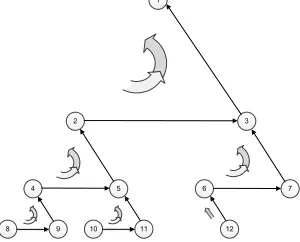
4.2.1 A Concurrent Grouping-Proof
2 3
4 5 6 7
10 11
8 9 12
Fig. 3. A binary tree arrangement for 12 tags and authentication flows for a concurrent execution
triangles of the tree at layerj,j=m−1, . . . ,1:
⟨leftchild(taga),rightchild(taga), taga⟩
authenticated concurrently. Left-children of the last layer start concurrently (as tagn did in the sequen-tial case). Each tag sets a timer and waits until it receives an authenticator from its right-child and/or left-sibling, depending on its position in the tree. When the authenticator(s) is (are) received, if it is (they are) correct and the timer has not expired, the tag sends its own authenticator to either its right-sibling or its parent. Thus, when all the tags in a layer get authenticated the previous layer can get authenticated. Until only one triangle rooted at tag1 is left, or at timeout. If any authentication fails (one of the tags is not authenticated) the process cannot be completed. For the concurrent protocol, the tags need compute at most three values, with the tags at the last layer computing either one or two values. The verifier still performs only one check.
4.2.2 Analysis
This protocol is secure in the Universal Composability (UC) framework (details are given in Appendix A). Here we discuss informally the most common attacks.
Replay attacks. The first pass of the protocol, withrsys and sn, prevents replay attacks. The verifier will not re-use the same challenge rsys and the authenticator will not re-use the same session number sn.
Impersonation attacks on tags are prevented by using private keys. Impersonation attacks on an authorized reader will not yield a valid proof: only authorized readers have access to the verifier’s challengersys.
DoS attacks. It is not possible to de-synchronize a GoT since the state of a tag is defined by IDgp and its private keyK, that are immutable.
4.3 An Anonymous Grouping-Proof
For our second grouping-proof the identifier IDgp is
replaced by a randomized group pseudonymPS, see Figure 4. Again the tags are arranged in a ring with
tag1 the authenticator. Tags store a private counter
cnti, and initially all counters have the same value.
We use a Blum-Micali encryption [29] (that simulates a one-time-pad) to obfuscate the value of counters.
In Phase 1, tag1 updates cnt1 ← cnt1 + 1, com-putes the pseudonym PS = f(K;IDgp||cnt1) and the session number SN = f(K;PS)⊕cnt1, sets the timer and sends the pair (SN,PS) to the reader, which in turn, broadcasts this pair. Then, each tagi,
1< i≤n,computescnt=SN⊕f(K;PS)and checks that cnt > cnti. If so, tagi verifies the pseudonym
PS = f(K;IDgp||cnt); if it is correct, it updates
cnti ←cnt′i and sends the pair (i,PS)to the reader. The reader links those tags whose responses include this pseudonym (Phase 2).
Phase 3, with sn = SN, is identical to the cor-responding phase of the non-anonymous grouping-proof except for the compilation, in which IDgp is
removed. That is, M AC = (rsys,mac), with mac =
f(k;IDgp||rsys). The verifier keeps in a database D pairs of values(k,IDgp), and therefore is able to match
the group by exhaustive search over all pairs using
macand rsys.
4.3.1 A Protocol Amendment
There are two privacy concerns with this proof. The first involves the number of participating tags in an interrogation. This cannot be addressed without violating Assumption 7 of Section 3.2. We shall discuss this in Section 4.3.3 where we will prove that full anonymity cannot be achieved in our grouping-proof framework. The second involves the order i of a specific tagi in the group. This concern can addressed if it is an issue. Below we sketch a modified protocol that randomizes the order of tags, including the authenticator.
Phase 1. In Step b (Figure 4), tag1 selects a random number t ∈ [1 : n], a nonce r1, computes PS =
f(K;IDgp||(t||cnt1)),SN = f(K;PS)⊕(t||cnt1), and then send to READER:(r1,SN,PS)(tis a short string of length≪κ). In Step d, eachtagi computest||cnt=
SN⊕f(K;PS), checks thatcnt > cnti and thatPS is correct, and if so, selects a nonceri, sets cnti ←cnt, and sends to READER:(ri,PS).
Phase 2. The READER assigns to each tagi a unique number ji ∈ [1 : n], with j1 = 1, and sends to each
tagi:(ri, ji,PS)is linked.
Phase 3. Eachtagi assumes position ji in the group, and includes this together witht in its authenticator. After sending its authenticator tagt assumes the role of authenticator in subsequent interrogations. Upon sending mac, tag1 relinquishes its role as authenticator.
If the interrogation is not completed then we may get a collision with two (or more) candidates (tag1,
Fig. 4. An anonymous grouping-proof
Parties: READER:[rsys] AUTHENTICATORTAG(tag1): [IDgp, k, K, cnt1] tagi: [i,IDgp, K, cnti], i= 2, . . . , n
Phase 1. a) READER→ ∗: rsys (a random number is broadcast)
b) tag1 : Setcnt1←cnt1+ 1; computeP S=f(K;IDgp||cnt1)andSN =f(K;P S)⊕cnt1; set timer
tag1 →READER: SN,PS
c) READER→ ∗: SN,PS
d) For each 1< i≤n
tagi : Set timer; computecnt=SN⊕f(K;PS) Ifcnt > cnti
IfP S=f(K;IDgp||cnt)then setcnti←cntand
tagi →READER: i,PS
else timeout else timeout
Phase 2. READERlinks the tags with pseudonymPS: for each1≤i≤n .
READER→tagi: PS is linked,
Phase 3. It is identical to that of the non-anonymous case withsn=SN (Figure 2), except for the compilation: READER: If an authenticator is received from thetag1then compile:
M AC= (rsys, mac)
two different groups, but only the pseudonymPSthat corresponds to the highest value will be accepted by all the tags of the group.tag1ortagtwill take part in a grouping-proof that uses aP Swith acntvalue higher than its own, and relinquish its role as authenticator tag after sending its authenticator.B)tag1,tagtshare the same counter value. The same pseudonym PS
is used and it is up to the READER to appoint an authenticator tag (by selecting a corresponding nonce) and request this tag to send a newP S(computed with an updatedcnt). We now proceed as in the first case.
4.3.2 Session Unlinkability
We cannot thwart the physical tracing carried out by an adversary who stays in contact with the tags. While the adversary is physically tracing a GoT, the adver-sary can determine which executions of the protocol are linked to this GoT. The concept of untraceability is then related to the capability of an adversary to link interrogations once this physical contact is temporar-ily interrupted.
For groups of a specific order n, our protocol provides session unlinkability. Formally, session unlinkability is defined in terms of an experiment ExpbO,b∈ {0,1}, involving a probabilistic polynomial-time (PPT) observer O and the RFID system. Let
G0 and G1 be two GoTs of size n. O has access to a history of earlier tag interrogations and is given a group interrogation int1 involving G0, and an interrogation int2, such that either i) int1 took place before1 int
2 and int1 completed normally (successfully), or ii) an intermediate interrogation
1. A temporal relationship, as observed byO. Note that if two interrogations that overlap in time are observed, then it can be asserted that they do not belong to the same tag, since tags are currently technologically limited to single-threaded execution.
involvingG0 completed normally.
Exp0O corresponds to the event thatG0was involved in
int2 whileExp1O corresponds to the event that G1 was involved in int2.
Definition.A grouping proof providessession unlink-abilityif the advantage of any PPT observerO:
AdvO =|Prob[Exp0O = 1]−Prob[Exp1O = 1]|
is negligible (in terms of the security parameter κ), where the probabilities are taken over the coin tosses ofO.
This means that in any experimentExpbO involving the interrogationsint1 andint2, the observer cannot decide with probability better than negligible whether the group involved is the sameG0 or anotherG1.
4.3.3 Impossibility of Full Unlinkability
It is easy to show that under our assumptions in Section 3.2 it is not possible to capture full unlink-ability. Assume by contradiction that there is a secure grouping-proof that provides full unlinkability, and that the group G has only two tags: tag1, tag2. Let
4.3.4 Analysis
This protocol is secure in the Universal Composability (UC) framework (details are given in Appendix B). Here again we discuss informally the most common attacks.
Our earlier comments regarding replay attacks and impersonation attacks in Section 4.2.2 apply here as well. Thus we focus on de-synchronization attacks (DoS attacks) and traceability.
De-synchronization attacks. If a protocol execution completes successfully, then all tags will share the same counter value. As a result, no tag will accept any previously used PS, which guarantees session unlinkability. Even if the tags do not share the same counter value, there are no synchronization concerns; though some tags (that did not update their counter) will accept a previously usedPS.
Traceability. If an adversarial reader interrupts an in-terrogation preventing some tags from updating their counter, and then re-uses the same values against the non-updated tags, it is able to link these tags to the previous interrogation. However, the power of this attack is limited because after a successful execution, group unlinkability is restored.
Additionally, as mentioned in Section 4.3.1 our pro-tocols leak information about the size of a group—that cannot be prevented easily, and the order of a tag in the group—that can be prevented.
5
SUPPLY-CHAIN
MANAGEMENT
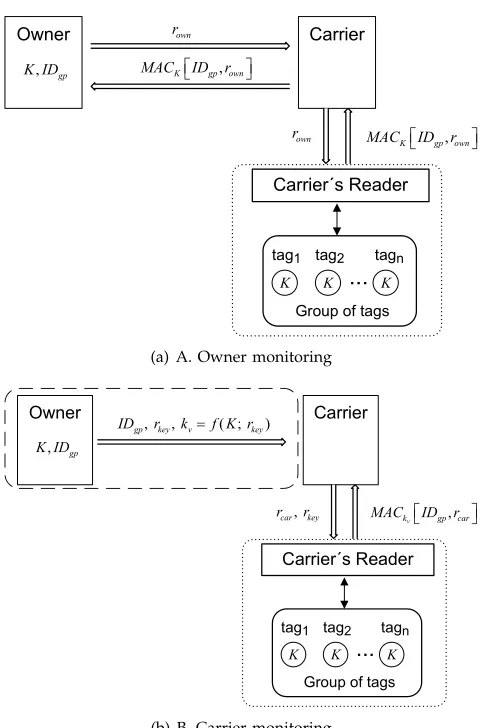
This section describes how grouping-proofs can be used as modules in a high-level setting for supply-chain management. Two operation modes are consid-ered: Mode A in which the owner of tags wants to verify the integrity of a set of tagged goods given to a custodian (carrier), and Mode B in which the custodian wants to verify integrity directly.
Figure 5 describes protocols for the two modes. For simplicity, the carrier’s reader and the GoT are con-sidered as a single entity which generates a grouping-proof according to the protocols described in Sec-tion 4. The owner and tags share secret informaSec-tion (the key K), while the carrier does not have any information about the tags other than that given by the owner (and that derived during the execution of the protocol). The owner stores in a database for each GoT an identifier and a private key: (IDgp, K). The
arrows “=⇒” correspond to secure communication channels. These are trusted channels between high level entities. In mode A, the carrier is an untrusted entity that may try to deceive the owner by forging a proof.
Mode A
In this mode the owner wants to check the integrity of a consignment that is handled by the carrier, while
own
r
own
r
Owner Carrier
, K gp own
MAC ID r
...
tag1
K
K K
tag2 tagn
Group of tags Carrier´s Reader , gp
K ID MACKIDgp,rown
(a) A. Owner monitoring
,
car key
r r
, , ;
gp key v key
ID r k = (f K r )
Owner
, gp
K ID
Carrier
, v
k gp car
MAC ID r
...
tag1
K
K K
tag2 tagn
Group of tags Carrier´s Reader
(b) B. Carrier monitoring
Fig. 5. Supply-Chain Management Modes
the carrier is an enabler that just relays messages from the owner to the GoT via his reader. In this mode batch connectivity between the owner and carrier is required. The protocol has four passes:
Pass A1-2. The owner selects a random session numberrown and sends it to GoT via the carrier:
Owner⇒Carrier⇒GoT : rown
Pass A3-4. The reader interrogates tags in its range and the GoT executes a grouping-proof protocol (Section 4) with: rsys = rown and k = K. If the interrogation is successful (all tags are present), a proof is generated and sent to the owner, via the carrier:
GoT⇒Carrier⇒Owner : M ACK[IDgp, rown].
Upon receiving the proof, the owner searches in her database for the group identifer—the search in the non-anonymous case is direct while in the anonymous case an exhaustive search is required, and then verifies the proof.
In this mode the carrier wants to verify the integrity of a GoT directly.
Pass B0. The owner selects a random number rkey, computes the private key kv =f(K;rkey) and sends these together withIDgp to the carrier:
Owner⇒Carrier : (IDgp, rkey, kv).
This phase (boxed in the figure) only needs to take place once. The carrier can then challenge the GoT and get a grouping-proof as follows:
Pass B1. The carrier stores the pair(IDgp, kv), selects a random number rcar and sends this along with
rkey to GoT:
Carrier⇒GoT : (rcar, rkey).
Pass B2. The authenticator tag of GoT computes kv using rkey, executes a grouping-proof protocol with
rsys = rcar and k = kv, and sends the proof to the carrier.
GoT→Carrier : M ACkv[IDgp, rcar].
Upon receiving the proof, the carrier finds the pair (IDgp, kv)in his database, and verifies the proof.
6
CONCLUSION
Several RFID grouping-proofs have been proposed in the literature. Most assume communication models and capabilities which either are not properly defined or are not practical.
In this paper we addressed the group scanning problem in a strong adversarial setting. Our contribu-tion was threefold. First, we reviewed the literature related to grouping-proofs and analyzed the Liu et al.’s protocol, recently presented in this journal. Then, we defined a comprehensive framework for grouping-proofs, that includes basic assumptions and criteria for designing practical group scanning. Finally, we proposed two novel grouping proofs that are gener-ated by the tags in a distributed way, without sharing any private information with the reader, and that can be integrated into RFID supply-chain management systems. The security of these protocols is proven in the Universal Composability framework which addresses security under concurrent executions and supports re-usability.
APPENDIX
A
THE NON
-ANONYMOUS GROUPING-PROOF
The formal security specifications of a grouping-proof capture the requirements for a proof of simultaneous presence of the tags of a group. Since RFID tags are often used as components of more complex systems, we use a security framework that supports compos-ability.
The Universal Composability (UC) framework de-fines the security of a protocol in terms of its simulata-bility by an idealized functionality F, and supports robust composability with arbitrary protocols [30], [31], [32], [33]. A protocolρ UC-realizesFif, for every probabilistic polynomial-time adversary A there is a simulator S that translates runs of ρ in the real world in the presence of A into runs controlled by the functionalityF in an ideal world in the presence of an ideal world adversary Ab in such a way that: no probabilistic polynomial-time environment Z can distinguish with non-negligible probability whether it is interacting with an instance of ρ with A or an instance ofF withA.b
Group authentication is captured by parties having ideal access to the functionality Fgp (Figure 6). We
first describe its basic components and attributes and then its behavior.
Parties.There are three types: verifier, reader and tag. In each subsession, there is a single instance of type reader and arbitrarily many instances of tag. A and Z are not UC parties, though Amay control several protocol parties. Upon successful completion of a subsession, the reader generates a grouping-proof.
Sessions. A single session spans the entire life-time (simulation instance) of the grouping-proof. It consists of several concurrent subsessions, initiated by protocol parties upon receiving input INITIATE from Z. All parties in any subsession are given a unique session identifiersidbyZ. While the reader and tags initiate subsessions, A controls the concurrency and interaction between these subsessions.
Group authentication. Successful group authentication in the real world is a result of sharing common secrets. The choice of group partners is decided by A, who has full control of the network. In the ideal world, this is emulated by invocations of the commands AUTHENTICATE and PROVE.
Activation sequence.Zis the first entity to be activated, and the last to halt.ZactivatesAand initializes all the protocol parties. The parties instantiate the protocol in the real world. In our protocol and functionality, the receiving party of any message or subroutine output is activated next. If no outgoing message or output is produced in the processing of an incoming message, then by conventionZ is activated.Fgp only
specifies the behavior of parties that are not controlled by the adversary, and is activated by an INITIATE input from a reader. For such parties it generates and stores locally messages of type init(s,reader), init(s′,ID) or init(s′,ID, i), where s, s′ are newly created subsession identifier labels andID =IDgp is
a group identifier. These messages are released to the adversary, see Figure 6.
Session identifiersid(effectuated byZ)
Upon inputINITIATEat reader:If reader is adversarial, ignore. Else: delete anyinitrecord of reader; generate a unique ssid
s; record and output:init(s, reader).
Upon inputINITIATEat tag1 :Iftag1 is adversarial, ignore. Else: delete anyinit,autorconfrecord oftag1; generate an
ssids′; record and output:init(s′, ID).
Upon input INITIATE at tagi, i > 1 :If tagi is adversarial, ignore. Else: if there is a record init(s′, ID) then delete any recordsinit,aut, conf oftagi and record and output: init(s′, ID, i).
Upon input AUTHENTICATE at tagn : If there is a record
init(s′,ID, n)then record and output:aut(s′,ID, n); delete
theinitrecord oftagn.
Upon inputAUTHENTICATEattagi:i=n−1, . . . ,2.If there are recordsinit(s′,ID, i)and aut(s′,ID, i+ 1) then record and output:aut(s′,ID, i); deleteinit(s′,ID, i).
Upon inputCONFIRMattag1:If there are recordsinit(s′,ID)
andaut(s′,ID,2)then record and output:conf(s′,ID); delete
init(s′,ID)and allautrecords.
Upon request PROVE(s, s′,ID): If there are records
init(s, reader), conf(s′,ID) then record and output:
proof(s, s′,ID); delete theconfrecord.
Upon request IMPERSONATE(s, s′, tagi): If there is a record
init(s, reader)andtagiis an adversarial tag ofIDthen record
and output:proof(s, s′,PS).
Upon inputVERIFY(proof(s, s′,ID))at verifier:If there is a recordproof(s, s′,ID)then output:valid.
Fig. 6. FunctionalityFgp
coming from protocol parties, called inputs, and messages coming from the adversary, called requests, and for simplicity use the abbreviation ssid for subsession identifiers. A grouping-proof is generated by invoking Fgp with the command PROVE. This
only succeeds if all tagi, i > 1, in the group are AUTHENTICATEDin the same subsessions, s′andtag1 has CONFIRMED this, in which case proof(s, s′,ID) is generated. Finally the adversary can attempt to impersonate tags in the ideal world and forge a proof by using the command IMPERSONATE(s, s′, tag); this only succeeds if the impersonated tag is controlled by the adversary. We shall now show that:
Theorem A.1: The non-anonymous grouping-proof UC-realizes the functionalityFgp.
Proof: We summarize the key features of the non-anonymous grouping-proof, which represent real world protocol flows:
• The challenge rsys of the reader is a random number generated by the verifier.
• The choice of authenticator tag1 in any group is hard-coded in tags. Only one tag in a group is the authenticator.
• Tags transmit group identifiers IDgp.
• Communication among tags is mediated by the reader. A may disrupt/modify traffic on the reader-tag channels of adversarial readers.
• Acannot tamper with the contents of the reader-verifier channel of a non-adversarial reader.
• Timeouts are implemented on tags.
To emulate real world protocol runs the simulatorS performs the following actions:
• Simulates copies:verifier\,reader\,tagci,A, and thenb activatesA.b
• Adds/removes keys in a database Db of verifier\
that contains keys of adversarial/non-adversarial tags.
• Faithfully translates real world protocol flows into their ideal world counterparts for all protocol parties, including actions of the adversary.
• Simulates interactions withZ, i.e.,the externally visible part of the protocol. More specifically, S invokesFgp with the call INITIATE to instantiate
parties, and simulates the ideal world protocol flows invoking Fgp with calls: AUTHENTICATE,
CONFIRM, PROVE, IMPERSONATE and VERIFY to generate the corresponding responses (Figure 6), which are then forwarded to the ideal world counterparts of the real world parties, as shown in Figure 7. The request PROVE(s, s′,ID)is used when the real world adversary A forwards un-modified inputs between honest tags and the reader, and the request IMPERSONATE(s, s′, tagi) is used whenAsucceeds in authenticating the ad-versarially controlledtagi. Note that keys shared between the verifier and the tags are not under the control of the adversary.
• Prevents non-adversarial readers from outputting proof(s, s′,IDgp) in the ideal world when
A tampers with messages created by non-adversarial tags.
The main difference between the ideal and real world simulations is that in the ideal world, the (non-persistent) values exchanged in tag subsessions are uniformly random and independent, since a true random function is used to evaluate the authenticators and confirmation (Figure 7), whereas in the real world a pseudorandom functionf is used.
The specification ofFgpmake several security
UponINITIATEatreader\ fromAb:input this toFgp; on output
init(s, reader)select a fresh random numberrsysfrom a list
in databaseDband sendrsys toAb.
UponINITIATE ontagcifromAb:input this toFgp; on output
init(s′,ID)assign totagcikey(K, k)wheni= 1orKwhen
i >1obtained fromDb, and select a numbersnfromDb. Send (i,ID, sn)toA.b
Upon AUTHENTICATE on tagci, i > 1, from A:b input this to Fgp; on outputaut(s′,ID),tagci computes auti as in the non-anonymous grouping-proof, but using a random function instead off, and sends this toreader\ andA.b
UponCONFIRMontagc1fromAb:input this toFgp; on output
conf(s′,ID), tagci computes mac as in the non-anonymous
grouping-proof but using a random function instead off, and sends this toreader\ andA.b
Upon PROVE(s, s′,IDgp) at reader\ from A:b input this to Fgp; on outputproof(s, s′,IDgp),reader\sends(ID, rsys, mac) toAb.
UponIMPERSONATE(s, s′, tagi)ontagifromA:input this to Fgp; on outputproof(s, s′,IDgp), send this toA.b
UponVERIFY(proof(s, s′,ID)onverifier\:input this toFgp; on outputvalid, send this toAb.
Fig. 7. The simulatorS
that can distinguish between real and ideal world simulations.
Observe that if the function f is assumed to be true random, then the transcripts exchanged in tag subsessions are uniformly random and mutually in-dependent. Under this assumption, the real and ideal simulations might differ only when S intervenes to prevent PROVE in the ideal-world, that is, when A tampers with messages from honest parties (via reflec-tion, re-play, mangling, injecreflec-tion, delay, etc.) and man-ages to reproduce valid random values (a forgery), which result in a proof in the real-world. This can only happen if there is a collision between the outputs off:
i.e., if it generates the same valid value from unequal inputs (valid and invalid). However, since f is truly random (by assumption), the adversary cannot count on that happening with more than negligible proba-bility. In particular, for each given reader subsession
rsys divergence happens with probability at most
2−κmℓ, whereκis the security parameter,mthe total number of groups managed by the verifier, andℓthe number of interrogations during this subsession. This is because to get a valid proof when one or more of the tags of a group are not present, the adversary A must select the correct value for the confirmation
mac, or the authenticator auti, and the probability for this event is 2−κ. For the concurrent grouping-proof we get the same probability, because again A must select the correct value ofmacoraut. Therefore the probability of simulation distinguishability for the grouping-proof is bounded by 2−κmL, where L
Session identifiersid(effectuated byZ)
Upon inputINITIATEat reader:If reader is adversarial, ignore. Else: delete anyinitrecord of reader; generate a unique ssid
s; record and output:init(s, reader).
Upon input INITIATE at tag1:Iftag1 is adversarial, ignore. Else: delete any init,aut or conf record of tag1; generate
an ssid s′ and a random number PS; record and output: init(s′,PS).
Upon input INITIATE attagi, i >1 :If tagi is adversarial, ignore. Else: delete anyinit,autrecord oftagi; if there is a recordinit(s′,PS)then record and output:init(s′,PS, i).
The actions for inputs AUTHENTICATE, CONFIRM, VERIFYand requests PROVE, IMPERSONATEare similar to
those ofFgp (Figure 6) withIDreplaced byPS.
Fig. 8. FunctionalityFangp
is the number of interrogations through the entire simulation. This is negligible in the security parameter
κ.
It follows that if the environmentZ can distinguish real simulations with a pseudorandom function f
from ideal simulations then it can also distinguish real simulations with a pseudorandom function from real simulations with a random function. This contradic-ticts the definition of pseudorandomness since Z is polynomial-time.
APPENDIX
B
ANONYMOUS GROUPING-PROOF
The functionality Fangp of our second protocol
comprises the behavior expected of a grouping-proof with session unlinkability. This is similar to Fgp
(Figure 6) except that in this case the tags return pseudonymsPS instead of the identifierIDgp.Fangp
is described in Figure 8. To maintain synchrony, the tags of a group must share a “loose-synchronized” counter cnt which, for session unlinkability, is refreshed by all tags with each complete interrogation. There are seven inputs/requests:
INITIATE, AUTHENTICATE, CONFIRM, PROVE,
IMPERSONATEand VERIFY. We shall now show that:
Theorem B.1: The anonymous grouping-proof UC-realizesFangp.
This occurs when the adversary A succeeds in de-synchronizing the tags by modifying some values in the channels (via reflection, re-play, mangling, injection, delay, etc.) and sending the tags valid messages (PS, C) that force them to update their state to an invalid state (e.g., by setting a very high value tocnt).
As in Theorem A.1, if we assume that f is true random then this can only happen if there is a col-lision between the outputs off, which only happens with negligible probability (bound by2−κmL). So the probability of simulation distinguishability is neglible. If follows that if Z can distinguish real simulations with a pseudorandom function from ideal simulations then it can also distinguish real simulations with a pseudorandom function from real simulations with a random function. This is not possible since Z is polynomial-time.
ACKNOWLEDGMENTS
The authors would like to thank...
REFERENCES
[1] K. Ashton, “That ’Internet of Things’ Thing,” RFID Journal, 2009.
[2] K. Finkenzeller,RFID Handbook : Fundamentals and Applications in Contactless Smart Cards and Identification, 2nd ed. John Wiley & Sons, May 2003.
[3] EPC Global, “UHF Air Interface Protocol Standard Genera-tion2/Version2,”
http://www.gs1.org/gsmp/kc/epcglobal/uhfc1g2.
[4] G. Kapoor and S. Piramuthu, “Single RFID Tag Ownership Transfer Protocols,” IEEE Transactions on Systems, Man, and Cybernetics, Part C, vol. 42, no. 2, pp. 164–173, 2012.
[5] F. G. Jorge Munilla and W. Susilo, “Cryptanalysis of an EPCC1G2 Standard Compliant Ownership Transfer Protocol,” Wireless Pers Commun, no. 72, pp. 245–258, 2013.
[6] H. Liu, H. Ning, Y. Zhang, D. He, Q. Xiong, and L. T. Yang, “Grouping-proofs-based authentication protocol for dis-tributed rfid systems,”IEEE Trans. Parallel Distrib. Syst., vol. 24, no. 7, pp. 1321–1330, 2013.
[7] M. Burmester and J. Munilla, Security and Trends in Wireless Identification and Sensing Platform Tags: Advancements in RFID. IGI Global, 2013, ch. RFID Grouping-Proofs.
[8] A. Juels, ““Yoking-proofs” for RFID tags,” inPERCOMW ’04: Proceedings of the Second IEEE Annual Conference on Pervasive Computing and Communications Workshops. Washington, DC, USA: IEEE Computer Society, 2004, pp. 138–142.
[9] J. Saito and K. Sakurai, “Grouping proof for RFID tags,” in19th International Conference on Advanced Information Networking and Applications, AINA 2005., vol. 2, March 2005, pp. 621–624. [10] A. Juels, “Generalized “yoking-proofs” for a group of RFID
tags,” inMOBIQUITOUS 2006, 2006.
[11] S. Piramuthu, “On existence proofs for multiple RFID tags,” in IEEE International Conference on Pervasive Services, Workshop on Security, Privacy and Trust in Pervasive and Ubiquitous Computing – SecPerU 2006, IEEE. Lyon, France: IEEE Computer Society Press, June 2006.
[12] M. Burmester, B. de Medeiros, and R. Motta, “Provably Secure Grouping-Proofs for RFID Tags,” in CARDIS, ser. Lecture Notes in Computer Science, G. Grimaud and F.-X. Standaert, Eds., vol. 5189. Springer, 2008, pp. 176–190.
[13] H.-H. Huang and C.-Y. Ku, “A rfid grouping proof protocol for medication safety of inpatient,”Journal of Medical Systems, 2008.
[14] H.-Y. Chien, C.-C. Yang, T.-C. Wu, and C.-F. Lee, “Two rfid-based solutions to enhance inpatient medication safety,” Jour-nal of Medical Systems, 2009.
[15] P. Peris-Lopez, A. Orfila, J. C. Hernandez-Castro, and J. C. A. van der Lubbe, “Flaws on rfid grouping-proofs. guidelines for future sound protocols,”J. Netw. Comput. Appl., vol. 34, no. 3, pp. 833–845, May 2011. [Online]. Available: http://dx.doi.org/10.1016/j.jnca.2010.04.008
[16] Z. Ahmadian, M. Salmasizadeh, and M. Aref, “Recursive linear and differential cryptanalysis of ultralightweight au-thentication protocols,”Information Forensics and Security, IEEE Transactions on, vol. 8, no. 7, pp. 1140–1151, 2013.
[17] D. Paret,RFID and Contactless Smart Card Applications. John Wiley & Sons, 2005.
[18] International Organization for Standardization, “ISO/IEC 29192-1:Information Technology- Security Techniques -Lightweight cryptography - Part 1: General. ISO/IEC, 2012.” [19] A. Menezes, P. van Oorschot, and S. Vanstone,Handbook of
Applied Cryptography. CRC Press, 1996.
[20] ISO/IEC, “Standard # 18000 – RFID Air Interface Standard,” http://www.hightechaid.com/standards/18000.htm. [21] D. Dolev and A. C.-C. Yao, “On the Security of Public Key
Protocols,” IEEE Transactions on Information Theory, vol. 29, no. 2, pp. 198–207, 1983.
[22] S. Bengio, G. Brassard, Y. Desmedt, C. Goutier, and J.-J. Quisquater, “Secure implementations of identification sys-tems,”J. Cryptology, vol. 4, no. 3, pp. 175–183, 1991.
[23] S. Mangard, T. Popp, and M. E. Oswald,Power Analysis Attacks - Revealing the Secrets of Smart Cards. Springer, 2007, vol. (ISBN: 0-387-30857-1).
[24] C. H. Kim, G. Avoine, F. Koeune, F.-X. Standaert, and O. Pereira, “The Swiss-Knife RFID Distance Bounding Proto-col,” inICISC, ser. Lecture Notes in Computer Science, P. J. Lee and J. H. Cheon, Eds., vol. 5461. Springer, 2008, pp. 98–115. [25] J. Munilla, A. Ortiz, and A. Peinado, “Distance Bounding Protocols with Void-Challenges for RFID,” in Workshop on RFID Security – RFIDSec’06. Graz, Austria: Ecrypt, July 2006. [26] D. N. Duc and K. Kim, “On the security of rfid group scanning protocols.”IEICE Transactions, vol. 93-D, no. 3, pp. 528–530, 2010.
[27] M. Burmester, B. de Medeiros, J. Munilla, and S. Peinado., “Secure EPC Gen2 Compliant Radio Frequency Identication,” International Association for Cryptological Research, Tech. Rep. E-print #2009/147, 2009. [Online]. Available: http://eprint.iacr.org/2009/149
[28] T. V. Le, M. Burmester, and B. de Medeiros, “Universally composable and forward-secure RFID authentication and au-thenticated key exchange,” inASIACCS, F. Bao and S. Miller, Eds. ACM, 2007, pp. 242–252.
[29] M. Blum and S. Micali, “How to generate cryptographically strong sequences of pseudo-random bits,” SIAM J. Comput., vol. 13, no. 4, pp. 850–864, 1984.
[30] O. Goldreich, S. Micali, and A. Widgerson, “How to play any mental game,” in19th Symposium on Theory of Computing (STOC 1987). ACM Press, 1987, pp. 218–229.
[31] D. Beaver, “Foundations of secure interactive computing,” in Proc. Advances in Cryptology (CRYPTO 1991), ser. LNCS, vol. 576. Springer, 1991, pp. 377–391.
[32] R. Canetti, “Security and composition of multi-party crypto-graphic protocols,”Journal of Cryptology, vol. 13:1, pp. 143–202, 2000.