
_____________________________________________________________________________________________________
*Corresponding author: E-mail: [email protected];
www.sciencedomain.org
Positive Correlation of Thyroid Gland Volume with
Isthmus Dimensions and with Anthropometric
Parameters through a Cross Sectional Study on
Karachi Population
Mahrukh Kamran
1*, Iffat Raza
2, Sahrish Mukhtair
3, Sanabor Bughio
4and Hira Waseem
51
Department of Anatomy, Dow University of Health and Sciences, Pakistan.
2
Department of Anatomy, Hamdard University, Pakistan.
3
Department of Anatomy, Jinnah Medical and Dental College, Pakistan.
4
Department of Radiology, Ziauddin Hospital, Karachi, Pakistan.
5
Department of Statistics, Liaquat National Medical College, Pakistan.
Authors’ contributions
This work was carried out in collaboration between all authors. Author MK designed the study, wrote the protocol, and wrote the first draft of the manuscript. Authors IR and SM managed the literature search and critical analysis of the study. Author SB supported the study technically and clinically. Author HW participated in study design, data analysis and interpretation. All authors read and approved the final manuscript.
Article Information
DOI: 10.9734/BJMMR/2016/29710 Editor(s): (1) E. Umit Bagriacik, Department of Immunology, Gazi University, Turkey. Reviewers: (1) Jose Francisco de Sales Chagas, Medical School Catholic University Campinas, Brazil. (2)Ertan Şahin, Namık Kemal University, Turkey. Complete Peer review History:http://www.sciencedomains.org/review-history/16636
Received 25th September 2016 Accepted 17th October 2016 Published 22nd October 2016
ABSTRACT
Objective: Diverse variation in normal thyroid gland volume (TGV) among populations is mainly
due to age, gender, anthropometric parameters and genetic factors. This study was carried out to determine the correlation between TGV with isthmus dimensions and with anthropometric parameters in a subset of Karachi population.
Place of the Study: It was a cross-sectional study.
Karachi, between April 2013 to March 2014.
Methodology: TGV of 208 euthyroid subjects was evaluated by 2 dimensional ultrasonography.
Serum TSH was the screening test used to recruit euthyroid subjects for the study. Non parametric tests were applied to determine the correlation of TGV with anthropometric parameters and with isthmus dimensions.
Results: TGV was significantly and positively correlated with, height, weight, body surface area
(BSA) and lean body mass (LBM) but not with body mass index (BMI). Similarly, significant and positive correlation was observed between TGV and Isthmus transverse dimension but not with isthmus antero-posterior (A-P dimension.
Conclusion: Among all the studied anthropometric parameters diverse variation in TGV are mainly
due to variation in height, weight, BSA and LBM. LBM was found to be the most crucial determinant influencing TGV in this studied population. TGV has also correlated significantly and positively with isthmus transverse dimension.
Keywords: Thyroid gland; anthropometry; ultrasonography; correlation study; population.
1. INTRODUCTION
Previous studies reported that many body organs demonstrate diverse variation in their volume as they depend greatly on the anthropometric parameters of that population. Kratzer et al. in 2003 reported that, liver size depend greatly on body mass index (BMI) and height among Germans [1]. A cross sectional study conducted by Mehraban et al in 2006, reported significant correlation of penile length with index finger length and with height in Iranian population [2]. Splenic volume correlated significantly with height, weight, BMI and body surface area (BSA) among Jordanians [3]. In Central India retinal nerve fiber layer thickness was found to correlate significantly with BMI [4]. Prostate gland volume was also found to correlate significantly and positively with weight and BMI among Bengalis [5].
Thyroid gland (TG) dimensions, just like other organs, also vary from population to population due to the characteristic anthropometric parameters of every population [6-9]. Anatomically TG is one of the main cervical organ that is located in the anterior triangle of neck. TG is encapsulated and consists of two lobes. The lobes of TG are connected to each other by means of isthmus.The gland weights about 25 gm. Each lobe of TG measures approximately 5 cm in length, 3 cm in width and 2cm in thickness. Due to the anatomical deviation of esophagus slightly to the left, right lobe of thyroid is slightly greater in size than the left lobe of the TG [10].
It is well recognized that appropriate physical growth, proper mental development and metabolic homeostasis; depend greatly on normally functioning TG and on adequate intake of iodine [11]. Thyroid gland volume (TGV) is
also an important indicator for normally functioning TG [12]. Known physiological factors that cause variation in normal TGV include age, gender, anthropometric parameters, iodine intake and genetic dissimilarities [6-9,13,14].
It is now becoming progressively important for every population to determine the reference range of their normal TGV. Firstly, for diagnosing goiter and thyroiditis, [15] than to calculate the dose of radioiodine, this is needed for the treatment of thyrotoxicosis and also to evaluate the response of suppression treatment. Determination of reference range of normal TGV is also vital for minimally invasive thyroid surgery. As for minimally invasive thyroid gland surgery TGV should not exceed 20 ml [16]. World health organization (WHO) in 2001 has recommended that normal range of TGV of a population is a prerequisite for large scale iodine monitoring programmes in that population [15].
This study was carried out to determine the correlation between TGV with isthmus dimensions and with anthropometric parameters in a subset of Karachi population. TGV was determined through Ultrasonography.
2. MATERIALS AND METHODS
It was a cross-sectional study that was carried out at Radiology Department of Ziauddin University Hospital Clifton, Karachi. The study was approved by the Ethical Review Board of the Ziauddin University Hospital Clifton Karachi. All subjects agreed and signed an informed consent form for participating in the study. The exclusion criteria were applied. Subjects with a personal or family history of thyroid disease or with signs of thyroid disease were excluded from the study.
Furthermore, we excluded women during menstruation, pregnancy and women who had delivered within the last 12 months as these conditions may affect thyroid size.
A total of 230 healthy subjects of aged between 21 years and onwards were taken through convenient sampling technique. Subjects were asked to fill a proforma based on demographic profile including age, gender, and socioeconomic status. Anthropometric parameters were measured of each subject. Height was measured in centimeters (cm), weight was measured in kilogram (Kg), Body mass index (BMI) was calculated by weight/height2 formula and was measured in (Kg/m2) [20]. Body surface area (BSA) was calculated by DuBios formulas = (W0.425 x H0.725) X 0.007184 [21]. Lean body mass (LBM) was calculated by James formula:
LBM (males) = (1.10xweight (kg))-128 x (weight2/ (100 x Height (m))2).
LBM (Females) = (1.07 x weight (kg))-148 x (weight2/(100 X Height (m))2).
Physical examination of TG was performed and signs and symptoms of hypo and hyper thyroidism were also noted. 17 out of 230 subjects were excluded due to palpable thyroid gland or thyroid nodule on physical examination.
Serum thyroid stimulating hormone (TSH) Level of 213 subjects was measured to select euthyroid subjects for the study. Reference range of TSH was 0.23 – 4.0 µIU/ml as used by the laboratory of Ziauddin University Hospital. 5 subjects were excluded due to deranged serum TSH level.
Ultrasonography of thyroid was done to measure the total TGV by combining the volume of both the lobes obtained by using formula for prolate ellipsoid in 208 subjects. Age specific reference values for thyroid volume were obtained. Ultrasonography of TG was done with ultrasound machine Toshiba model SSA-590A with a 7.5-11 MHz transducer and 6 cm linear probe. Ultrasound of TG was performed by a single radiologist. Subjects were examined in supine position, with pillow under their shoulders to hyperextend the neck. Ultrasound gel was applied over the thyroid area. The probe was placed directly on the skin over the thyroid gland. An image of each lobe was obtained. Mediolateral and antero-posterior dimensions were noted in transverse plane. Craniocaudal dimension of each lobe was noted in longitudinal plane. Transverse and antero-posterior dimension of isthmus was also taken into the account.
Volume of each lobe was calculated by WHO recommended formula: Antero-posterior X Cranio-caudal X Medio-lateral X 0.479 (correction factor). Total TGV was taken by summing up the volume of both lobes. Isthmus dimensions were not included in the formula as recommended by WHO [12].
2.1 Statistical Analysis
Statistical analyses were performed using SPSS version 21. The logarithmic transformation was applied to normalize the distribution of TGV and TSH. The kolmogorov-smirnov test was applied to check normality before correlation was done. As the database validate normality assumption Spearman correlation was applied to determine the correlation between TGVs with isthmus dimensions and with anthropometric parameters. Independent Sample Mann Whitney U-Test was applied to determine the significance between TGV and isthmus dimensions with genders.
P-value < 0.05 was considered as significant.
3. RESULTS
Among 208 healthy subjects, 106(51%) were males and 102(49%) were females. Mean age of healthy subjects was 39.39 ±14.63 year. Mean and standard deviations of anthropometric parameters was shown in Table 1.
dimension and transverse dimension was significantly greater in males as compare to the female (P <0.05) Table 2.
Table 1. Descriptive statistics of anthropometric parameters
Mean Minimum Maximum
Height (cm) 164.66±9.47 145 185 Weight (kg) 69.19±20.62 33 280 BMI (kg/m²) 25.52±7.27 13.22 99.2 BSA (m²) 1.75±0.22 1.20 3.23 LBM (Kg) 47.37±8.84 27.68 109.76
BMI= body mass index, BSA= body surface area and LBM= Lean body mass
Mean isthmus transverse dimension revealed positive and significant correlation with total TGV, right and left lobe volume. However mean isthmus antero-posterior dimension demonstrated insignificant correlation with TGV Table 3.
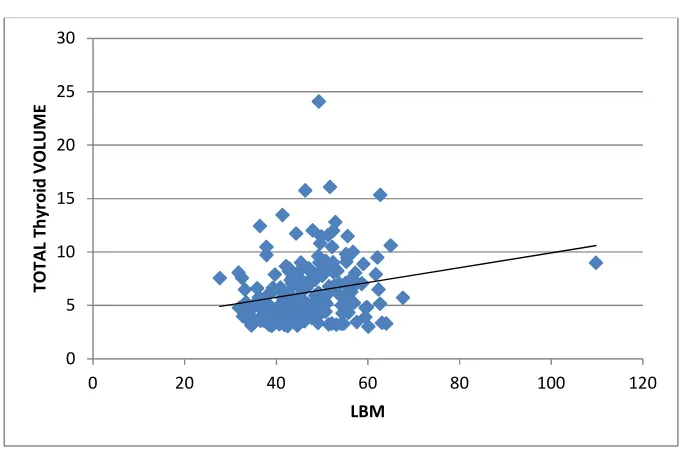
Total thyroid volume has significantly correlated with anthropometric parameters include height, weight, BSA and LBM. Thyroid volume best correlated with LBM (r=0.277, P=0.001). Thyroid volumes has also demonstrated a positive correlation with BSA (r=0.255 P=0.001), weight
(r=0.202, P=0.01) and height (r=0.229, P=0.001)
of the individual. Right and left lobe volumes also have positively correlated with height, weight, BSA and LBM. Isthmus AP dimension was insignificantly correlated with weight, BMI, BSA and LBM while isthmus transverse dimension was significantly and positively correlated with height, weight, BMI, BSA and LBM. Correlation of thyroid volumes, isthmus antero-posterior and transverse dimensions with anthropometric measurements was shown in Table 4. Scatter diagram of total TGV with LBM and BSA is shown in Figs. 1 and 2.
4. DISCUSSION
Many countries are now determining the reference value for their normal TGV as there is
diverse variation in TGV due age, gender, anthropometric parameters and numbers of genetic and environmental factors. In Pakistani population it was noted to be 6.26 ± 2.9 ml,[22] in Sudanese it was noted to be 6.44 ± 2.44 ml [8], among Cuban it was reported 6.6 ±0.26 ml and BSA was the only anthropometric parameter that correlated significantly with TGV [7]. In Nepalese it was noted to be 6.629 ± 2.5 ml and was found to correlate significantly and positively with height, weight, BMI and BSA [9]. In healthy Chinese adults it was noted to be 7.7 ± 3.3 ml and was significantly and positively correlated with body weight and BMI [23], in Iranian it was noted to be 8.34 ± 2.37 ml with significantly positive correlation with height and BSA and no correlation with BMI [24]. Among Nigerian healthy adults it was noted to be 8.55 ± 1.82 ml [25], in Croatian it was noted to be 10.68 ± 2.83 ml with significant correlation with height and BSA [13]. Among Danish it was noted to be 11.9-13.6 ml [26] and in Turkish healthy individuals it was noted to be 12.98 ± 2.53 ml and was found to correlate significantly with height, weight, BMI, BSA and Isthmus thickness [6,27]. Gomez et al. in 2000 also demonstrated significant correlation between thyroid gland volume and height, weight, BMI, BSA and LBM among Spanish [28].
In this study TGV has significantly and positively correlated with height, weight, BSA and LBM. LBM was found to be the robust factor influencing TGV (r=0.277 P=<0.001). Keeping the change in iodine status of Pakistan by the international council for the control of iodine deficiency disorders 2013 in consideration[29], these results are very much in accordance to the study done by Bergout et al. in 1987 [30]. Bergout concluded that lean body mass is one of the most important factor influencing total thyroid gland volume in an iodine sufficient areas, Amsterdam. Weshi MF in 1998 also reported significantly positive correlation of TGV with LBM, weight and height in Netherland. Like Bergout, he also reported LBM as the strongest determinant for TGV (r=0.64, P-value <0.0001) [31].
Table 2. Descriptive statistics of thyroid volumes
Total volume (ml)
Right lobe volume (ml)
Left lobe volume (ml)
Isthmus A-P dimension (cm)
Isthmus T dimension (cm)
Males (n=106) 6.7 ±3.11 3.5±1.8 3.2±1.47 0.37 ±0.18 1.59± 0.44 Females (n=102) 5.8 ±2.5 3±1.46 2.7±1.18 0.29 ±0.137 1.34±0.354
P-Value 0.021* 0.008* 0.022* 0.001** 0.001**
Table 3. Correlation of thyroid gland volumes with isthmus antero-posterior and transverse dimensions
Isthmus A-P dimension
Isthmus transverse dimension
Total volume (ml) r 0.056 0.213 P - value 0.423 0.002** Right lobe volume (ml) r 0.056 0.191
P -value 0.420 0.006** Left lobe volume (ml) r 0.040 0.202
P-value 0.568 0.004**
A-P= Antero-Posterior, r =regression; *Significant at P- value< 0.05; **Significant at P- value< 0.01
Table 4. Correlation of thyroid volumes, isthmus antero-posterior and transverse dimensions with anthropometric measurements
Total volume Right lobe volume
Left lobe volume Isthmus AP dimension
Isthmus T dimension
Height 0.229** 0.234** 0.174* 0.126 0.181*
P-value 0.001 0.001 0.012 0.07 0.009
Weight 0.202** 0.180* 0.177* 0.200** 0.207**
P-value 0.003 0.005 0.01 0.004 0.003
BMI 0.73 0.049 0.084 0.164* 0.142*
P-value 0.29 0.49 0.23 0.019 0.041
BSA 0.255** 0.241** 0.210** 0.195* 0.226**
P-value 0.001 0.001 0.002 0.005 0.001
LBM 0.277** 0.269** 0.229** 0.219** 0.259**
P-value 0.001 0.001 0.001 0.002 0.001
BSA= Body Surface Area, LBM= Lean Body Mass, A-P=Antero-Posterior, T=Transverse; *Significant at P- value< 0.05; **Significant at P- value< 0.01
Correlation between Total Thyroid Gland Volume and Lean body Mass
Fig. 1. Scatter plot for correlation between total thyroid volume and lean body mass LBM= Lean Body Mass [R=0.277and P=<0.001]
0 5 10 15 20 25 30
0 20 40 60 80 100 120
T
O
T
A
L
T
h
y
ro
id
V
O
LU
M
E
Correlation between Total Thyroid Gland Volumes and Body Surface Area
Fig. 2. Scatter plot for correlation between total thyroid volume and body surface area BSA= Body Surface area [R=0.255 and P=<0.001]
In this study no significant correlation was demonstrated between TGV and BMI. These results are very much similar to neighboring country Iran where Abidi et al was also failed to report significant correlation between TGV and BMI [32]. Anthropometric, geographical and genetic similarities between the two neighboring countries may attribute to these similar results. However Gomez et al. in 2000 and Barrere et al. in 2009 reported significantly positive correlations between TGV and BMI in Spanish (r=0.13 P=
0.02) and French (P=0.001) populations
respectively [28,33].
Mean isthmus thickness (A-P dimension) in males and females reported in this study (P=
<0.001) was found to be very close to the
isthmus thickness reported by Seker et al in Turkish males and female (0.342 ± 0.114 cm and 0.310 ± 0.105cm (P= <0.05) respectively [27]. Isthmus thickness (A-P dimension) showed no-correlation with TGV and anthropometric parameters in this study. However Isthmus transverse dimension which was significantly greater in males as compared to the females for the reasons unidentified. Isthmus transverse dimension was also found to correlate significantly and positively with total TGV, right and left lobe volume and also with all the anthropometric parameters which were used in this study.
Due the tremendous development in the field of medical technology results of the study, would have been more appropriate with the use of 3 dimensional ultrasonography. However due to the very limited availability of 3 dimensional ultrasound in this region, this study was limited to the use of 2 dimensional ultrasound. Screening test used in the study has a very high sensitivity and specificity; however serum TSH along with urinary iodine excretion test would have evaluated euthyroid subjects more specifically.
5. CONCLUSION
In this study TGV correlates significantly and positively with height, weight, BSA, LBM and with isthmus transverse dimension. TGV did not correlate with isthmus A-P dimension and with BMI. We recommend isthmus transverse dimension and LBM as the most important factor influencing TGV. We further conclude that similar studies should be conducted on larger sample size that would be representing the population from different regions of Pakistan.
ETHICAL APPROVAL
The study was ethically approved by Ethical Review Committee of Ziauddin University, Karachi, Pakistan.
0 5 10 15 20 25 30
0 0.5 1 1.5 2 2.5 3 3.5
T
O
T
A
L
T
H
Y
RO
ID
V
O
LU
M
E
ACKNOWLEDGEMENTS
Valuable support of Dr. Nuzhat Hassan, Dr. Mohammad Ali and Ziauddin Laboratory Clifton is highly appreciated.
COMPETING INTERESTS
Authors have declared that no competing interests exist.
REFERENCES
1. Kratzer W, Fritz V, Mason RA, Haenle MM, Kaechele V. Factors affecting liver size: A sonographic survey of 2080 subjects. J Ultrasound Med. 2003;22(11):1155-61. 2. Mehraban D, Salehi M, Zayeri F. Penile
size and somatometric parameters among Iranian normal adult men. International journal of impotence research. 2007; 19(3):303-9.
3. Badran DH, Kalbouneh HM, Al-Hadidi MT, Shatarat AT, Tarawneh ES, Hadidy AM, et al. Ultrasonographic assessment of splenic volume and its correlation with body parameters in a Jordanian population. Saudi Medical Journal. 2015;36(8):967. 4. Jonas JB, Nangia V, Gupta R, Agarwal S,
Matin A, Khare A, et al. Retinal nerve fibre layer cross‐sectional area, neuroretinal rim area and body mass index. Acta Ophthalmologica. 2014;92(3):e194-e9. 5. Monowara M, Ahmed AU, Mohiuddin AS,
Taher MA, Nasrin Z, Hossain MM. Correlation between transabdominal sonographically measured prostate volume with anthropometric factor in normal healthy subjects. BIRDEM Medical Journal. 2012;2(1):29-32.
6. Şahin E, Elboğa U, Kalender E. Regional reference values of thyroid gland volume in Turkish Adults. Srpski arhiv za celokupno lekarstvo. 2015;143(3-4):141.
7. Turcios S, Lence-Anta JJ, Santana J-L, Pereda C, Velasco M, Chappe M, et al. Thyroid volume and its relation to anthropometric measures in a healthy Cuban population. European Thyroid Journal. 2015;4(1):55-61.
8. Yousef M, Sulieman A, Ahmed B, Abdella A, Eltom K. Local reference ranges of thyroid volume in sudanese normal subjects using ultrasound. Journal of thyroid research. 2011;2011.
9. Kayastha P, Paudel S, Shrestha D, Ghimire R, Pradhan S. Study of thyroid volume by ultrasonography in clinically euthyroid patients. Journal of Institute of Medicine. 2010;32(2):36-43.
10. Moore KL, Dalley AF, Agur AM. Clinically oriented anatomy: Lippincott Williams & Wilkins; 2013.
11. Hall JE. Guyton and Hall textbook of medical physiology: Elsevier Health Sciences; 2015.
12. Organization WH. Assessment of iodine deficiency disorders and monitoring their elimination: A guide for programme managers; 2007.
13. Ivanac G, Rožman B, Škreb F, Brkljačić B, Pavić L. Ultrasonographic measurement of the thyroid volume. Collegium antropologicum. 2004;28(1):287-91. 14. Mohammadi A, Amirazodi E, Masudi S,
Pedram A. Ultrasonographic Prevalence of Thyroid Incidentaloma in Bushehr, Southern Iran. Iranian Journal of Radiology. 2009;6(2).
15. WHO U. ICCIDD. Assessment of the iodine deficiency disorders and monitoring their elimination. WHO, Geneva. 2001;1-107.
16. Hegazy MA, Khater AA, Setit AE, Amin MA, Kotb SZ, El Shafei MA, et al. Minimally invasive video-assisted thyroidectomy for small follicular thyroid nodules. World journal of surgery. 2007; 31(9):1743-50.
17. Blum M. Ultrasonography of thyroid. Thyroid manager; 2012 [updated September 28 2015; cited 2016 August 29 2016]
Available:www.thyroidmanager.org/chapter /ultrasonography-of-the-thyroid
18. Cooper DS, Doherty GM, Haugen BR, Kloos RT, Lee SL, Mandel SJ, et al. Revised american thyroid association management guidelines for patients with thyroid nodules and differentiated thyroid cancer: The American Thyroid Association (ATA) guidelines taskforce on thyroid nodules and differentiated thyroid cancer. Thyroid. 2009;19(11):1167-214.
19. Organization WH, Disorders ICfCoID, UNICEF. Indicators for assessing iodine deficiency disorders and their control through salt iodization; 1994.
21. Du Bois D, Du Bois E. A formula to estimate the approximate surface area if height and weight be known. 1916. Nutrition (Burbank, Los Angeles County, Calif). 1989;5(5):303.
22. Mahrukh Kamran NH, Mohammad Ali, Farah Ahmad, Farheen Raza, Nosheen Zehra, Sanobar Bughio. Correlation of thyroid gland volume with age and gender in a subset of Karachi Population Pakistan Journal of Medicine and Dentistry [Orignal article]. 2014;3(2).
23. Hsiao Y, Chang T. Ultrasound evaluation of thyroid abnormalities and volume in Chinese adults without palpable thyroid glands. Journal of the Formosan Medical Association. Taiwan yi zhi. 1994;93(2):140-4.
24. Moghadam RN, Shajari A, Afkhami-Ardekani M. Influence of physiological factors on thyroid size determined by ultrasound. Acta Medica Iranica. 2011; 49(5):302.
25. Tahir A, Ahidjo A, Yusuph H. Ultrasonic assessment of thyroid gland size in Maiduguri, Nigeria. West African Journal of Ultrasound. 2002;3(1).
26. Rasmussen LB, Ovesen L, Bülow I, Jørgensen T, Knudsen N, Laurberg P, et al. Relations between various measures of iodine intake and thyroid volume, thyroid nodularity, and serum thyroglobulin. The
American Journal of Clinical Nutrition. 2002;76(5):1069-76.
27. Şeker S, Taş İ. Determination of thyroid volume and its relation with isthmus thickness; 2011.
28. Gómez JM, Maravall FJ, Gómez N, Gumà A, Soler J. Determinants of thyroid volume as measured by ultrasonography in healthy adults randomly selected. Clinical Endocrinology. 2000;53(5):629-34.
29. National Iodine Status in 2013. 2013; Available: http://Www.Iccidd,Org
30. Berghout A, Wiersinga W, Smits N, Touber J. Determinants of thyroid volume as measured by ultrasonography in healthy adults in a non‐iodine deficient area. Clinical Endocrinology. 1987;26(3):273-80. 31. Wesche MF, Wiersinga WM, Smits NJ.
Lean body mass as a determinant of thyroid size. Clinical Endocrinology. 1998; 48(6):701-6.
32. Adibi A, Sirous M, Aminorroaya A, Roohi E, Mostafavi M, Fallah Z, et al. Normal values of thyroid gland in Isfahan, an iodine replete area. Journal of Research in Medical Sciences. 2008;13(2):55-60. 33. Barrère X, Valeix P, Preziosi P, Bensimon
M, Pelletier B, Galan P, et al. Determinants of thyroid volume in healthy French adults participating in the SU. VI. MAX cohort. Clinical Endocrinology. 2000;52(3):273-8. _________________________________________________________________________________
© 2016 Kamran et al.; This is an Open Access article distributed under the terms of the Creative Commons Attribution License (http://creativecommons.org/licenses/by/4.0), which permits unrestricted use, distribution, and reproduction in any medium, provided the original work is properly cited.
Peer-review history:
![Fig. 2. Scatter plot for correlation between total thyroid volume and body surface area BSA= Body Surface area [R=0.255 and P=<0.001]](https://thumb-us.123doks.com/thumbv2/123dok_us/1722570.1219585/6.612.134.481.109.323/scatter-correlation-total-thyroid-volume-surface-body-surface.webp)
