37
Structural Behavior for Composite Cylindrical
Tank under Seismic Load
Marwa Gh. Kareem, Mohammad Q. Abdullah and Hatem R. Wasmi
Mechanical Dep. /College of Engineering/University of Bagdad, Iraq.
Abstract:
This paper focuses on the structural behavior of composite cylindrical(Glass-polyesters) tank. The boundary conditions of the tank fixed along the coordinate system (x, z) and is free in y-axis. In this work used four composite cylindrical tank were different filling ratio by oil (10,9,6,4and 3)m and determine the maximum stress, maximum compressive stress and maximum wave height during first natural vibration period and compression between them by the Finite Element Method(Ansys software).
1- Introduction:
38
and later accomplished their work assuming nonlinear free surface boundary conditions using finite element method. Larbi et al.[11] presented the theoretical and finite element formulations of piezoelectric composite shells of revolution filled with compressible fluid. In the present study, the finite element method along with the modal analysis technique used to derive the equations governing the structural dynamics of the laminated composite tank. The dynamic behavior of cylindrical open top ground-supported water tanks is investigated by Moslemi and Kianoush[12]. The main focus of this study is to identify the major parameters affecting the dynamic response of such structures and to address the interaction between these parameters.
In this study, the vibration of the cylindrical tank used in the industry is examined. The tank is made of glass-polyester to obtain the maximum stress and compressive stress is the purpose of this study. To finding the effect of maximum wave height for four types of composite cylindrical tanks. It was different filling ratio by oil.
2- Finite Element Modeling:
2-1- Geometry and mechanical properties :
The basic materials properties determined are displayed in Table 1
The SOLID46 element in the finite element package ANSYS used for modeling and analysis of composite materials. The shell99 element was used for meshing the tank . in other hand, solid187 element was meshed the oil. The cylindrical tank contains oil with density of (970 kg/mP
3
P
). The geometry of the tank (Diameter, D =20m, Height ,H=12m and thickness ,t=8mm)
Table 1 mechanical properties for composite material (glass-polyester)
Mechanical properties Glass-polyester
𝑬𝟏 (Mpa) 24800
𝑬𝟐 (Mpa) 4485
𝑮𝟏𝟐 (Mpa) 1466
𝝂𝟏𝟐 0.302
𝝂𝟐𝟏 0.059
𝑽𝒇 0.3
Efor polyester(Mpa) 2958.93
2-2 Boundary Conditions:
Figure 1 shown the boundary conditions of the tank that one bases fixed and another base fixed in directions x and z coordinates. We’ve meshed the model, after
39
Fig. 1-1 boundary condition for composite cylindrical tank
2-3- Ansys Results:
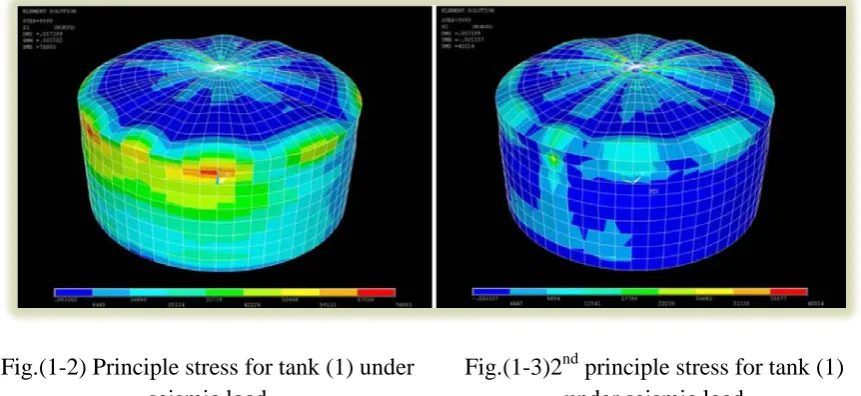
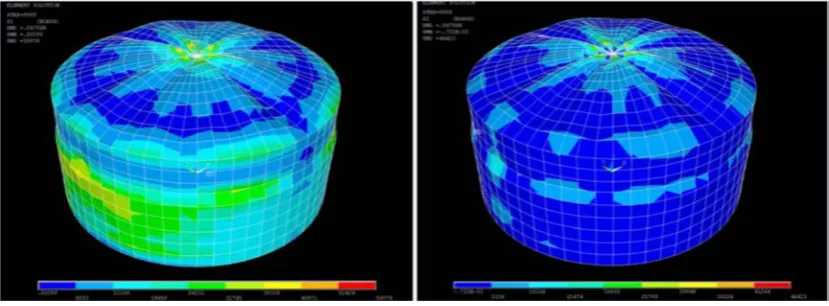
The FEM analysis results focus on the generated principal stresses and the maximum wave height resulting from earthquake loading. Figures(1-2 to 1-5 show the two principal stresses (σ1 and σ2) and Figures(1- 6 and1- 9) the maximum wave height of the tanks. Table 2 summarizes the maximum values of the stresses (tensile and compressive) and the maximum wave height as well as the first natural vibration period of the studied tanks.
Fig.(1-3)2P
nd
P
principle stress for tank (1) under seismic load
40
Fig.(1-9) Wave height for tank(1)under seismic load
Fig.(1-8) Wave height for tank(2) under seismic load
Table (2)Maximum tensile stresses, compressive stresses and wave height due to
Fig.(1-5) 2P
nd
P
principle stress for tank (3) under seismic load
Fig.(1-4) principal stress for tank
(3) under seismic load
Fig.(1-7)wave height for tank(3) under seismic load
41
earthquake loading presented together with the first natural vibration period of the analyzed tanks (FEM analysis).
First natural vibration period (sec) Maximum wave height(m) Maximum compression stress(MPs) Maximum tensile stress (MPs) Oil level Tank 6.5 0.93 4.8 262.8 12 1 8.10 0.82 11.6 210 9 2 9.54 0.65 11 178 6,4 3 12 026 17 98 3 4 12.9 0.18 15 89 2 5
Fig(1-10) maximum wave height with the first natural vibration of period of the analyzed composite tanks (FEM).
Conclusions:
the tensile stresses increase with the increase of oil level, whereas more mass is being vibrated and the hydrodynamic forces are greater. The location of maximum tensile stress is close to the oil surface, because it is influenced by the pressure resulting from the generated wave. The compressive stresses on the other hand generally reduce with increasing oil level The maximum wave height increases with the oil level, as a result of the reduction in the sloshing period as shown (1-10). It should also be noted that the first natural vibration modal shape for each analyzed case is very similar to the figures depicting the maximum wave height (Figure 1-7 and Figure 1-8).
References:
1. Damatty AA El, Korol RM, Mirza FA. Stability of elevated liquid-filled conical tanks under seismic loading, part i–theory. Earthquake EngStructDynam. 1997; 26:1191–208. 0 2 4 6 8 10 12 14 1 2 3 4 5
42
2. Mansouri A, Aminnejad B. Investigation of oil reservoir vibration under the impact of earthquake in proper and corrosion-occurred tanks. Am J CivEng Architect. 2013; 1(6):181–99.
3. Sweedan AMI, Damatty AA El. Experimental identification of the vibration modes of liquid-filled conical tanks and validation of a numerical model. Earthquake EngStructDynam. 2003; 32:1407–30.
4. Amabili M. Nonlinear vibrations of circular cylindrical shells with different boundary conditions. AIAA Journal. 2003; 41:1119–30.
5. Amabili M. Theory and experiments for large-amplitude vibrations of empty and fluid-filled circular cylindrical
Indian J ournal of Science and Technology 219 Vol 8 (S7) | April 2015 | www.indjst.org
6. Amabili M. Comparison of different shell theories for large-amplitude vibrations of empty and fluid-filled circular cylindrical shells with and without imperfections: lagrangian approach. J Sound Vib. 2003; 264:1091–25.
7. Karagiozis KN, Amabili M, Paidoussis MP, Misraa AK. Nonlinear vibrations of fluid-filled clamped circular cylindrical shells it. J Fluid Struct. 2005; 21:579–95. 8. Zhou D, Liu W. Hydro elastic vibrations of flexible rectangular tanks partially filled with liquid. Int J Numer Meth Eng. 2006; 71(2):149–74.
9. DehghanManshadi SH, Maheri Mahmoud R. The effects of long-term corrosion on the dynamic characteristics of ground based cylindrical liquid storage tanks. Thin-Walled Structures. 2010; 48: 888–96.
10. Pal NC, Bhattacharyya SK, Sinha PK. Non-linear coupled slosh dynamics of liquid-filled laminated composite containers: a two dimensional finite element approach. J Sound Vib. 2003; 261:729–49.