ISSN 2348 – 7968
AN EFFICIENT STRATEGY TO INCREASE NETWORK
LIFETIME FOR LARGE WSN
Gowri K1, DrChandrasekaran M.K2 and Kousalya K3
1
PG scholar Dept of CSE, Angel College Of Engineering And Technology, Tiruppur, Tamilnadu, India
2
Head Of The Department, CSE, Angel College Of Engineering And Technology, Tiruppur, Tamilnadu, India
3
PG scholar Dept of CSE, Angel College Of Engineering And Technology, Tiruppur, Tamilnadu, India
Abstract
In WSN, due to continuous message passing, congestion and energy minimization are the primary issues which must be resolved. The base study deals with the efficient path selection for the mobile sink, which collects the data only from the rendezvous points (RP) in the WSN. The nodes which are not RPs will send the data to the nearest RP. Here the mobile sink travels in a specific path, so that nodes which are far from the RPs are unable to deliver the data (packet loss), because of which metrics like throughput, reliability and efficiency gets decreased. In the proposed technique, a novel scheme called HRP (Heuristic based Representative Point selection), a Grid based Dynamic Routes with multiple mobile sinks is proposed for periodic data collection from WSN. Unlike the existing solutions, it improves the data delivery performance by employing multiple mobile sinks and reduces the congestion considerably, the proposed scheme does not allow packet drop at such situation. Thus the reduction in packet loss ratio reduces the number of retransmission, which saves the energy of sensor node and improves the network lifetime. It aims to optimize the trade-off between nodes energy consumption and data delivery.
Keywords: WSN, Multiple Mobile Sinks, Data collection and Energy consumption
.
1. Introduction
A Wireless sensor network is a group of specialized transducers with a communications infrastructure intended to monitor and record conditions at diverse locations. Commonly monitored parameters are temperature, humidity, pressure, wind direction and speed, illumination intensity, vibration intensity, sound intensity, power-line voltage, chemical concentrations, pollutant levels and vital body functions. It is composed of a large number of tiny low-cost devices, denoted as nodes (or motes), and one or few general purpose computing devices referred to as base stations (or sinks). Nodes are equipped with a communication unit, processing unit, battery and
ISSN 2348 – 7968
used to visit the near optimal travelling tour to visit all RP. Here one fundamental problem is that each data packet must be delivered to the sink node within a given deadline. If mobile sink was not able to visit the RP within the given deadline then packet loss will occur. In a wide sensor field using a single mobile sink to collect all the sensed data might cause data loss. If a sensor node is far from all RPs then the sensed data of that node cannot send to the RP, which might also cause the packet loss. Due to packet loss, number of retransmission will increase, so that congestion in network gets increase. To avoid the packet loss and to increase the energy consumption we propose, multiple mobile sinks. Using the grid based clustering technique the sensing area is partitioned and for each partition a cluster head is selected. Mobile sinks are allotted to a particular region to collect the data without any packet loss. Hence the energy consumption of sensor nodes is increased and it minimizes data collection delays from the cluster heads. Also it reduces the number of data retransmissions.
2. Literature Review
In WSN, data gathering causes more energy consumption. Several ideas where introduced for energy conservation approaches in the wireless sensor networks. Some approaches have benefited for conserving the energy in the single-hop network, but network have to provide benefits to multi-hop networks also. In the following, we review the challenges faced by the existing protocols. Hamidreza Salarian[1] analysis the problems in delay sensitive applications. An approach proposed to address this challenge is to form a hybrid moving pattern in which a mobile-sink node only visits rendezvous points (RPs), as opposed to all nodes. Sensor nodes that are not RPs forward their sensed data via multihopping to the nearest RP. The fundamental problem then becomes computing a tour that visits all these RPs within a given delay bound. Identifying
the optimal tour, however, is an NP-hard problem. To address this problem, a heuristic called weighted rendezvous planning (WRP) is proposed, whereby each sensor node is assigned a weight corresponding to its hop distance from the tour and the number of data packets that it forwards to the closest RP. WRP is validated via extensive computer simulation, and our results demonstrate that WRP enables a mobile sink to retrieve all sensed data within a given deadline while conserving the energy expenditure of sensor nodes. More specifically, WRP reduces energy consumption by 22% and increases network lifetime by 44%, as compared with existing algorithms. Here one fundamental problem is that each data packet must be delivered to the sink node within a given deadline. If mobile sink was not able to visit the RP
within the given deadline then packet loss will occur. In a wide sensor field using a single mobile sink to collect all the sensed data might cause data loss. If a sensor node is far from all RPs then the sensed data of that node cannot send to the RP, which might also cause the packet loss. Due to packet loss, number of retransmission will increase, so that congestion in network gets increase.
Abdul Waheed Khan[2] proposed a novel Virtual Grid based Dynamic Routes Adjustment (VGDRA) scheme that incurs least communication cost while maintaining nearly optimal routes to the latest location of the mobile sink. In wireless sensor networks, exploiting the sink mobility has been considered as a good strategy to balance the nodes energy dissipation. Despite its numerous advantages, the data dissemination to the mobile sink is a challenging task for the resource constrained sensor nodes due to the dynamic network topology caused by the sink mobility. For efficient data delivery, nodes need to reconstruct their routes toward the latest location of the mobile sink, which undermines the energy conservation goal. VGDRA scheme partitions the sensor field into a virtual grid and constructs a virtual backbone structure comprised of the cellheader nodes. A mobile sink while moving around the sensor field keeps on changing its location and interacts with the closest border-line cell-header for data collection. Using a set of communication rules, only a limited number of the cellheaders take part in the routes reconstruction process thereby reducing the overall communication cost. In terms of nodes energy consumption, the simulation results reveal improved performance of VGDRA scheme for different network sizes. But here they have not included the actual data delivery model. It does not impose many constraints on part of the resource constrained sensor motes.
ISSN 2348 – 7968
In this article, a new TDMA-based wireless sensor network for military monitoring, MILMON, is proposed. Design objectives of the new system are energy efficiency, delay, fault tolerance, and scalability. There are three main components of MILMON. These are Synchronization with A High Range Transmitter (hr-FTSP), Data Indicator Slot Mechanism (DISM), and Fault Tolerant Distributed Time Slot Assignment Algorithm (ft_DTSM). hr-FTSP which is based on the sink with a high range transmitter is proposed to minimize the energy consumption. Data indicator slot mechanism (DISM) helps to reduce the energy consumption. ft_DTSM is also proposed for the new military monitoring system. ft_DTSM uses tiny time slots instead of contention based periods. It has delay handling and a fault tolerance mechanism. The energy consumption performance of MILMON is investigated by the help of analytic and simulation models. Analytic and simulation models have shown that the energy consumption of MILMON is superior to Sync WUF, D-MAC, and FLAMA for lower system loads. However, if the system load is lower than a certain point, Sync WUF can save more energy than MILMON. The delay performance of MILMON is compared to D-MAC, Sync WUF, and FLAMA. While the system can produce up to 6 times lower delay than Sync WUF and FLAMA, D-MAC can produce lower delay than the system. MILMON is very sensible against faulty nodes. Fortunately, it has a fault tolerance mechanism to produce a more reliable network. The fault tolerant slot assignment mechanism can improve fault tolerance of the system. While Sync WUF can save more energy than the system for low system loads, MILMON can produce much lower delay than Sync WUF. DMAC can reduce delay more effectively than MILMON, but MILMON can save much more energy than D-MAC. Although there are WSN systems that perform better than the system for only energy consumption or for only delay, MILMON realizes a balance on energy, delay, and fault tolerance.
3. HRP(Heuristic based Representative Point
selection) Scheme
In this section, it gives detailed description of the HRP scheme, including how to construct the grid infrastructure and how to maintain fresh routes towards the latest location of the mobile sink. this designs a grid infrastructure by partitioning the sensor field into a virtual grid of uniform sized cells where the total number of cells is a function of the number of sensor nodes. A set of nodes close to centre of the cells are appointed as cell-headers which are responsible for keeping track of the latest location of the mobile sink and relieve the rest of member
nodes from taking part in routes re-adjustment and the cluster heads should collect data from the cell members. Nodes other than the cell-headers associate themselves with the closest cell-headers and report the observed data to their cell-headers. Adjacent cell-headers communicate with each other via gateway nodes. The set of cell-headers nodes together with the gateway nodes constructs the virtual backbone structure.
3.1 Network Characteristics
Before describing the methodology of HRP scheme, it is worthwhile to highlight the various assumptions of the sensor networks. We assume the following network characteristics:
1. Nodes are randomly deployed and all nodes are dynamic.
2. All the nodes are of homogeneous architecture and know their location information.
3. Each cluster head(CH) node has sufficient storage to buffer all sensed data.
4. The mobile sink is aware of the location of each CH.
5. All nodes are connected, and there are no isolated sensor nodes.
6. Sensor nodes have a fixed data transmission range.
7. Each sensor node produces one data packet with the length of b bits in time interval D. 8. The mobile sink performs periodic data
collection from sensor nodes while moving along the periphery of the sensor field and maintains communication with the closest border-line cell-headers for data collection.
3.2 Scheduling
The HRP process performs customized scheduling for every sensor node in the sensor network. The scheme utilizes initiated time and customized clock time to collect data from the sensor node.
Algorithm 1
The HRP algorithm
1 begin
2 recognize node Ni…Nn 3 timestamp of Ni
4 collected value from upper node of Ni
5 set clock time Nc for N1,N2…Nn
6 if Nc already set
7 Update (Nc);
8 Else do 5
ISSN 2348 – 7968
collecteed data Ag=Ag(t) .., Ag(t+1)
10 verify the synchronization and find nearest Mobile sink Ms
11 if ( Ms found) then 12 update
13 else
14 Trace (MS det) and declare Ni= 1
15 if (ni=1) then
17 braodcast ni to all CH
18 else
19 end
20 send Ni(data-> MS)
21 end
4. Result And Analysis
The result analysis gives the comparative analysis of existing and proposed system in terms of Qos. The graph shows that the existing system achieved the improved QoS.
4.1 Packet Delivery Ratio (PDR)
The ratio of number of packets send from source and number of packets reach the destination. The ratio of the number of packets received and the number of packets expected to be received. So the ratio is the total number of received packets over the multiplication of the group size and the number of originated packets.
The packet delivery ratio is calculated as follows:
PDR = (No of packets Received / No of packets send) * 100
80 85 90 95 100
1 2 3 4
%
Number of packets
PDR Comparison
Existing system Proposed system
Fig 1:PDR comparison
From the above chart it shows the performance measure based on the packet delivery ratio of the Proposed system using HRP.
In the existing system the packet delivery ratio decreases due to improper aggregation, and insufficient
scheduling. The proposed system uses aggregation and compression with HRP based data scheduling schemes to send the packet from source to destination thus the packet delivery ratio increases.
4.2 Delivery Time
The proposed system schedules the message in optimal path and the message reach the destination in any of the available best nodes and paths .Thus Delivery time of proposed system increases when compared to the existing system. Delivery time is calculated as follows:
Delivery Time = Receiving time – Sending time
0 10 20
1 2 3 4
tim
e i
n
sec
Number of Nodes
Delay Comparison
exisitng system proposed system
Fig 2: Delay Comparison
4.3 Bandwidth Utilization
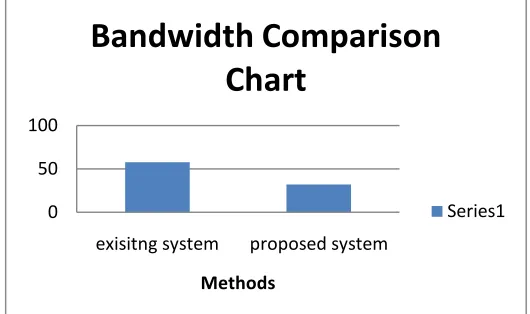
The bandwidth refers to the bandwidth or energy consumption of the link. The proposed system spread the message in the available virtual nodes and paths by proper utilization of bandwidth in each path with the use of VDVH.
0 50 100
exisitng system proposed system
Methods
Bandwidth Comparison
Chart
Series1
Fig 3: Bandwidth Comparison
4.4 Energy Consumption
ISSN 2348 – 7968
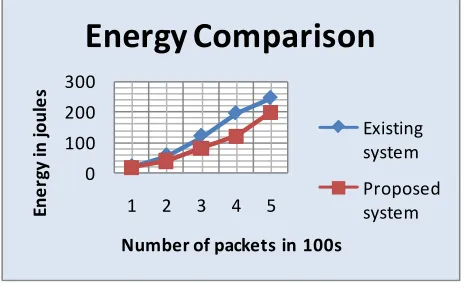
measured by quantitative metrics like average energy consumption. A random network of size 100 nodes where each node has an initial energy of 100J was considered. Further the number of data packets transmitted for each transaction is set at 500 and the data message size is fixed at 100 bytes of which 25 bytes represent the length of the packet header, 75 bytes for the sensed data. The simulation is done for the network where all nodes are assigned an initial energy of 100J. the following table and diagram shows the average energy consumption for every 100 packets.
0 100 200 300
1 2 3 4 5
En
er
gy
in
jo
ul
es
Number of packets in 100s
Energy Comparison
Existing system Proposed system
Fig 4: Energy Comparison
5. Conclusion
In this paper we have presented a novel scheme called HRP (Heuristic based Representative Point selection), a Grid based Dynamic Routes with multiple mobile sinks for periodic data collection from WSN. Unlike the existing solutions, it improves the data delivery performance by employing multiple mobile sinks and reduces the congestion considerably, the proposed scheme does not allow packet drop at such situation. Thus the reduction in packet loss ratio reduces the number of retransmission, which saves the energy of sensor node and improves the network lifetime. The results gives that the proposed technique reduces the energy consumption, bandwidth utilization and delay and it improves the packet delivery ratio.
References
[1] Hamidreza Salarian and Kwan-Wu Chin, "An Energy Efficient Mobile Sink Path Selection Strategy For Wireless Sensor Network", IEEE transactions on vehicular technology, vol. 63, no. 5, June 2014.
[2] Abdul Waheed Khan and Abdul Hanan Abdullah, “VGDRA: A Virtual Grid-Based Dynamic Routes Adjustment Scheme for Mobile Sink-Based Wireless Sensor Networks”, IEEE sensors journal, vol. 15, no. 1, january 2015
[3] I. Bekmezci and F. Alagz, “Energy efficient, delay sensitive, fault tolerant wireless sensor network for military monitoring,” Int. J. Distrib. Sens.Netw., vol. 5, no. 6, pp. 729–747, 2009. [4] A. Mainwaring, D. Culler, J. Polastre, R. Szewczyk, and J. Anderson, “Wireless sensor networks for habitat monitoring,” in
Proc. 1st ACM Int. Workshop Wireless Sens. Netw. Appl., New York, NY, USA, Sep. 2002, pp. 88–97.
[5] J. Zhang, W. Li, Z. Yin, S. Liu, and X. Guo, “Forest fire detection system based on wireless sensor network,” in Proc. 4th IEEE Conf. Ind. Electron. Appl., Xi’an, China, May 2009, pp. 520–523.
[6] M. Ma and Y. Yang, “Data gathering in wireless sensor networks with mobile collectors,” in Proc. IEEE Int. Symp. Parallel Distrib. Process., Miami, FL, USA, Apr. 2008, pp. 1–9. [7] S. Arora, “Polynomial time approximation schemes for euclidean traveling salesman and other geometric problems,” J. ACM, vol. 45, no. 5, pp. 753–782, Sep. 1998.
[8] G. Xing, T. Wang, Z. Xie, and W. Jia, “Rendezvous planning in wireless sensor networks with mobile elements,” IEEE Trans. Mobile Comput., vol. 7, no. 12, pp. 1430–1443, Dec. 2008. [9] K. Almi’ani, A. Viglas, and L. Libman, “Energy-efficient data gathering with tour length-constrained mobile elements in wireless sensor networks,” in Proc. 35th IEEE Conf. LCN, Denver, CO, USA, Oct. 2010, pp. 582–589.
[10] R. C. Shah, S. Roy, S. Jain, and W. Brunette, “Data MULEs: Modeling and analysis of a three-tier architecture for sparse sensor networks,” in Ad Hoc Netw., vol. 1. 2003, pp. 215–233.
[11] S. R. Gandham, M. Dawande, R. Prakash, and S. Venkatesan, “Energy efficient schemes for wireless sensor networks with multiple mobile base stations,” in Proc. IEEE Global Telecommun. Conf. (GLOBECOM), vol. 1. Dec. 2003, pp. 377–381.
[12] A. W. Khan, A. H. Abdullah, M. H. Anisi, and J. I. Bangash, “A comprehensive study of data collection schemes using mobile sinks in wireless sensor networks,” Sensors, vol. 14, no. 2, pp. 2510–2548, 2014.