31 AN ANALYSIS OF IN STORE ENVIRONMENT AMBIENCE FACTOR INFLUENCE ON CONSUMER BEHAVIOUR
AN ANALYSIS OF IN STORE ENVIRONMENT AMBIENCE
FACTOR INFLUENCE ON CONSUMER BEHAVIOUR
Ndeh Patience Abimnwi & Reuben Kinyuru Njuguna
Abstract
Despite studies that exist on in store environment affecting consumer behaviour, there are still contradictory findings on propositions presented. In view of the contradictory findings, this study depicts the consumer behaviour in East Africa, Kenya and prevailing aspects in supermarkets. This study proposes an integrative conceptual model on how ambience characteristics could ensure positive consumer behaviour among retail customers. The study recommends that supermarket in Kenya should endeavour to initiate programs that will emphasize on scent as opposed to music and lighting as the latter do not affect consumer behaviour while scent does.
Keywords: Ambience, Scent, back ground music, consumer behaviour
Introduction
Several of previous studies have indicated varying consumers’ reactions to in-store environments, for instance, Donovan and Rossiter (1982) while investigating the relationship between consumer behaviour and store environment established that environmental stimuli influenced consumers’ emotional states that in turn determined whether they purchase or avoid certain products. Specifically, they established that environmental stimuli affected consumers’ patronage of retail stores, the associations they made with store-staff, the stores they searched for and their conduct while in the stores. Xu (2007) on the other hand established that most modern-day US citizens engage in impulse buying because of the influence of store-environment on consumers.
Teller and Dennis (2012) conducted a critical review of researches that had established the
effect ambient scent had on consumer’s perceptions, emotions, and behaviour on a local mall in UK. They established contradictory results to previous studies-that ambient scent did not affect consumer behaviour. This indicated how same environmental cues could influence varying consumer behaviours. As such, Teller and Dennis proposed that rigorous research be conducted to elaborate the effectiveness of atmospheric stimuli to consumers’ behaviour, as they felt that the results of their study could be replicated in other environmental/atmospheric variables.
Others like Donovan, Rossiter, Marcoolyn, and Nesdale (1994) established that though the store environment could generally affect consumers’ emotional responses while in store, it was difficult to tell whether consumers experienced huge arousal when the store environment was highly pleasant. Their skeptism also led the proposition that other types of stores could be studied to establish whether merchandise perception and emotional responses independently contributed to extra time and unplanned shopping.
Ndeh Patience Abimnwi, Kenyatta University, Nairobi, Kenya
32 AN ANALYSIS OF IN STORE ENVIRONMENT AMBIENCE FACTOR INFLUENCE ON CONSUMER BEHAVIOUR
Yalcin and Kocamaz (2003) investigated the effects store atmosphere had on loyalty of hypermarket and supermarket customers in Turkey with a focus on grocery sector. Their study established that customers preferred to shop in stores whose environment was decent and conducive. They argued that marketers who do not offer these services end up losing customers, hence, threatening their profits. Vida (2008) while investigating how music in store environment affected shoppers’ behaviour in Slovenia established that atmospheric music and store image played a significant role in influencing shoppers’ behaviour while in the store environment-‘fit’ music in the store encouraged shoppers to spend more time and money. However, their findings were not conclusive in establishing whether spending more time in stores led to increased shopping. Mohan, Sivakumaran, and Sharma (2013) investigated the impact store environment had on impulse buying of retail customers in India. With a focus on music played within the store, the store’s lighting, its layout, and the employees, their study established that the store environment motivated Indian consumers’ impulse buying tendencies. Positive factors in the store-environment significantly influenced whether these consumers bought on impulse or not. Tinne (2011) while investigating the factors
that drive impulse buying in Bangladesh concluded that the display of products on the shelves of a store and the conduct exhibited by the sales people influence shoppers’ buying behaviour like impulse buying.
In Africa, a study by Dhurup, Mafini, and Mathaba (2013) investigated the store image factors influencing store choice among sportswear consumers in South Africa and found store atmospherics, sales assistance, in-store induced appeals, store accessibility and promotion/brand availability as the environmental factors that influenced consumer behaviour. Thus, Dhurup et al. recommended marketers of sports apparel stores to enhance these factors as a way of increasing sales.
Tlapana (2009) investigated how store layout impacted consumer purchasing behaviour at convenience stores In Kwa Mashu, South Africa and found significant relationship between store layout and purchasing behaviour. Mariri and Chipunza (2009) also studied how in-store environment affected impulse purchasing among South Africans and established a strong relationship. In Ghana, Anning-Dorson (2013) also did a study on how store-atmosphere factors influenced Ghanaian shoppers to choose the mall to shop at and established that store display and store-personnel were the main factors that drew shoppers to choice malls.
Literature Review
Ambience relates to nonvisual elements of a store’s environment like lighting, smell/scent, temperature, noise, and music (Tlapana, 2009). These factors have also been found to influence people’s behaviour. Generally, studies like Xu (2007) have found ambience to have significant positive impact on pleasure of shoppers though the study is limited by the fact that it targeted a specific age group hence its findings cannot be generalised to the entire population with varying age groups.
Xu (2007) while investigating store environment effects on impulse purchasing of adult
33 AN ANALYSIS OF IN STORE ENVIRONMENT AMBIENCE FACTOR INFLUENCE ON CONSUMER BEHAVIOUR
and interviewed using a questionnaire. Similar to Xu (2007), this study only focused on impulse buying and cannot be generalised on non-impulse buying behaviour that consumers exhibit.
Vida (2008) studied the effect in-store background music has on consumer behaviour in retail stores in Ljubljana, Slovenia by intercepting shoppers at the checkout areas as they exited two major hypermarkets and 3 specialty retail stores that deal in sports equipment and apparels. The researcher used experimentation method to conduct the study. Both planned and unplanned background music were used and the study went on for two weeks, which resulted in 259 respondents being interviewed. A questionnaire was used to collect data and the maximum likelihood estimation technique used to analyse the data. Findings showed that when shoppers perceived the background music as fit, they developed positive experiences that led them browse store merchandize favourably, hence, spent more finances and time within the store. Additionally, the study established that stores whose background music was planned received high music-fit scores from customers than stores with unplanned music. Based on the limited scope to background music and specialty retail stores/hypermarkets, the study proposed further investigation on foreground music and using a wide scope of retail stores.
Yalcin and Kocamaz (2003) studied the effects store atmosphere attributes have on loyalty intentions of hyper/supermarkets in Istanbul, Turkey dealing in food retailing. Using descriptive survey, the study targeted 500 shoppers but only received 317 dully-filled questionnaires. Snowballing was used to identify shoppers of the target retail stores while correlation was used to analyze the data. The findings indicate that loyalty of consumers had a significant positive correlation with in-store atmospherics. The study measured atmospherics based on colour, scent, temperature, hygiene, and lighting.
Olahut, El-Murad, and Plaias (2012) conducted an empirical review of studies published on the relationship of atmospherics and consumer behaviour across the world with an aim of establishing the gaps to be filled. The study identified the articles to be reviewed based on key words: dimensions of atmospherics, atmospherics, shopping behaviour, S-O-R model. The findings showed that music was an effective tool in influencing consumers’ moods with louder music was characterized by longer shopping times when compared to softer music. Loud music triggered more memory traces that enhanced the retrospective approximations of time. Additionally, the study established that people’s cognitive processes influence how music shapes the attitude towards stores and salespeople. When other cognitive stimulations were low, soothing music was found to enhance the cognitive processes. Modern-day retailers have also discovered the relevance of using music to differentiate their stores from competitors, hence, give their stores a certain image.
Olahut et al. (2012) further found that music can dictate the pace at which shoppers move in a store, define a store image and attract or direct the attention of shoppers. However, managers should not overdo their music when aspiring to meet these objectives. For instance, since faster music can enhance shoppers’ movement in a store, it is not wise to put music that has an overly faster tempo as it may influence behaviour that was not intended. Generally, the music ought to be slow, soothing, or classical. Such music encourages shoppers to slow down their movements in the store, relax, and take a good survey of the goods on sale.
34 AN ANALYSIS OF IN STORE ENVIRONMENT AMBIENCE FACTOR INFLUENCE ON CONSUMER BEHAVIOUR
attitudes towards the merchandize on sell as well as the store (Olahut et al., 2012).
According to Morrison, Gan, Dubelaar, and Oppewal’s (2011) study “In-store music and aroma influences on shopper behaviour and satisfaction retailers,” that experimentally examined the effect loud/soft music and presence or absence of vanilla scent had on consumer behaviour, the volume of music and aroma of in-store environment were found to have significant effect to shoppers’ emotions and extents of satisfaction.
Hui, Dube, and Chebat (1997) using experimentation where respondents’ psychological and behavioural responses to waiting time were measured, studied the effects music had on shoppers’ reactions while waiting for services and found that music directly and indirectly affected the perceived wait duration by triggering an emotional reaction to the wait. Music affected perceived waiting time through shoppers’ affect and cognition. Although positively valanced music also increases perceived wait period, the latter has no significant effect on consumers' behavioural response to the service organization. The study used the case of a bank branch, and only sampled 116 undergraduate students who were pursuing business at Canadian University. Yalch and Spangenberg (2000) conducted a study in the US where consumers were exposed to music according to familiarity in a simulated shopping experiment. Shoppers’ perception of shopping period, commodity evaluations, and emotions were then measured. Findings showed that subjects thought they took long time to shop when familiar music was played but in reality, they spent more time shopping when the music played was not familiar to them.
Elsewhere in the Northeastern part of USA, Michon, Chebat, and Turley (2005) investigated the intervening effect of in-store scent on consumer emotions, perceptions of in-store environment and perception on quality of merchandize on offer in different in-store retail
densities. Respondents were intercepted while shopping in urban malls and interviewed through a questionnaire. A total of 279 subjects were interviewed and the data collected from them analyzed using structural equation modelling (SEM). Findings showed that ambient scent only had a positive relationship with shoppers’ perception of the retail atmosphere in average retail densities. In low or high densities, scent had a negative effect on shoppers’ perception of retail atmosphere. Moreover, ambient scent had a small positive effect on shoppers’ emotions when the density was medium. Michon et al. (2005) appreciate that their study findings are limited in terms of generalizability as they only focused on community malls, which may largely attract convenience shoppers. As such, they recommend studies that enlarge the scope of study beyond community malls.
Another study done in a major city in the US investigated the influence in-store lighting had on the aspects of consumer behaviour. The study used a two-month experimentation design to establish the effects bright and soft/less bright light had on shoppers’ behaviour. The lighting system was varied during this time of experimentation and its effects recorded. The set up was a major wine store in the target city and consumers were sampled conveniently. Observation was used to collect findings, which were analyzed using ANOVA. The study established that shoppers browsed more merchandize when exposed to bright in-store lighting. However, the lighting and its increased effects on merchandize browsing did not reflect in increased sales. The study recommended managers to alter their in-store lighting to enhance a functional environment hence contribute to their brand perception. Since it focused on wine stores, the study recommended studies on other merchandize retail stores (Areni & Kim, 1994).
35 AN ANALYSIS OF IN STORE ENVIRONMENT AMBIENCE FACTOR INFLUENCE ON CONSUMER BEHAVIOUR
Customer Value in an Emerging Market Condition” found that olfactory factors like scent and temperature were significant determinants of customer value while lighting, music, and colour affected customer value to a smaller extent. Both relationships were, however, positive; that is, enhanced olfactory factors increased customer value. This study was done in Delhi, India and used exploratory design. The study targeted single and multi-brand stores and discount stores and measured not less than 1000square feet. Respondents were intercepted while shopping or after completing their shopping experience while exiting the store. A
questionnaire was used to collect data and 450 respondents whose age ranged from 20 to 40 years were interviewed. Factor analysis was used to analyse the data. The study recommended a similar replication in other geographical areas. Conceptual Framework
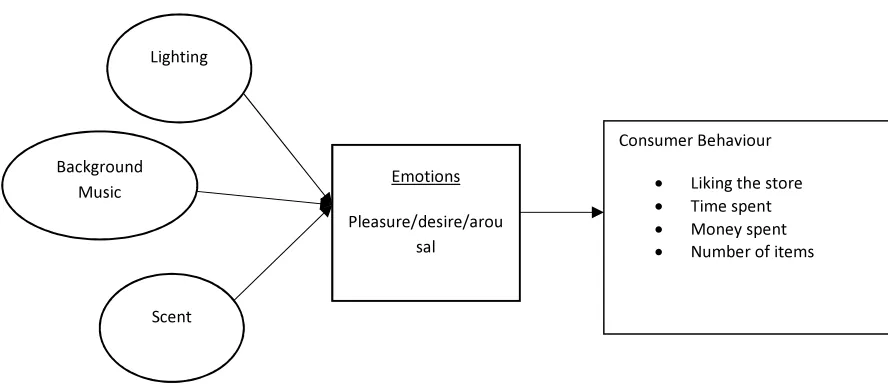
Based on the various arguments the framework proposed here takes account of the multiple effects that store ambience environment could have on shopping behaviours. This research examined individual ambience ambient factors such as background characteristics, lighting, music and ambient scent;
Figure 1. An integrative Framework In store environment ambience influence on consumer behaviour
Research Methodology
The research design used in this study was explanatory research using cross-sectional survey design. The explanatory research was ideal to describe the characteristics of the variables and at the same time investigate the cause effect relationship between variables (Malhotra & Birks 2003). The choice of cross-sectional allowed collection of quantitative data from a population in an economical way (Mugenda & Mugenda 2003; Saunders et al.,
2009). This design was archetypal because of its suitability in elaborating the characteristics of a
particular individual or group of individuals (Kothari, 2006). The target population for this study comprised all shoppers from the five major supermarkets in Nairobi Central Business District namely Tuskys, Naivas, Nakumatt, and Uchumi. The study used two sampling strategies: stratified and convenience sampling. Stratified sampling was used to enable the researcher target a specific number of shoppers from each supermarket so as to enhance inclusivity. To get respondents who meet this criterion required the researcher to sample them according to
Lighting
Background Music
Scent
Emotions Pleasure/desire/arou
sal
Consumer Behaviour
36 AN ANALYSIS OF IN STORE ENVIRONMENT AMBIENCE FACTOR INFLUENCE ON CONSUMER BEHAVIOUR
convenience as they exited the target supermarkets. Using convenience sampling, the researcher intercepted any shopper exiting the target stores for interviewing. Thus, the sample size for this study was 100. The sample was distributed per supermarket as indicated in Table 1.
The unit of analysis of this study will include all shoppers of the above named supermarkets. Utilizing them as the unit of analysis would no doubt improve the findings of the study (Stock & Black, 2002)
Table 1. Sample Size
Stratum Sample
Tuskys Imara 25
New Naivas Ronald Ngala 25
Nakumatt Moi Avenue 25
Uchumi Agha Khan Walk 25
Total 100
Source: Author (2015)
Research findings Background Music
Figure 4.1 shows the results of the tone of the music customers found being plaid in supermarkets.
Majority (97%) of the customers found background music in the store to have a soft tone and only 3% found the tones to be rough. Soft tones are characteristic of welcoming mood, as the nature of music is not irritative nor hash.
This result shows that supermarkets appreciated the importance of soft music to customers hence preferred to play such, as opposed to rough music, which symbolizes excitement/chaos/or tense moments similar to Olahut et al.’s (2012) submission on effect of soothing (low toned) music on shoppers’ behaviours.
Pitch of Background Music
As to whether the music was very loud or average, the results in figure 4.2 were collected.
37 AN ANALYSIS OF IN STORE ENVIRONMENT AMBIENCE FACTOR INFLUENCE ON CONSUMER BEHAVIOUR
pitch. This means that the music was not very loud to annoy or very low not to be heard. As such, this indicates that supermarket managers also paid attention to the amount of noise the
music made to customers. Low-pitched music is characterized with peaceful atmosphere that is conducive for shopping.
This result disagrees with Olahut et al.’s (2012) findings that louder music was more preferred to shoppers than soft music and that the louder music was more effective in influencing shopping times.
Tempo of Background Music
Majority (56%) of customers perceived the music being played as slow while 30% said some of the songs were slow while others were faster. Only 5% said the music was faster while 8% said the music was neither slow nor fast. Slow music has
been characterized by slowing down customer’s movement in the store so that they can browse more merchandize. Thus, by implementing the slow music, the managers were showing their need towards enhancing customer stay in the store so that they may be influenced to buy more. This discussion concurs with Olahut et al.’s (2012) that the speed of music can dictate the pace at which shoppers move in a store, define a store image and attract or direct the attention of shoppers.
38 AN ANALYSIS OF IN STORE ENVIRONMENT AMBIENCE FACTOR INFLUENCE ON CONSUMER BEHAVIOUR
General Perception of the Music and its effect on Shoppers
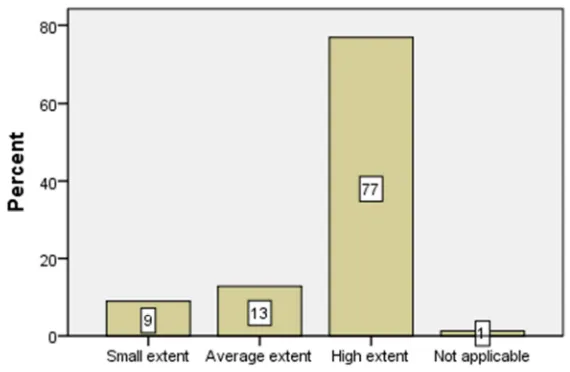
The study then investigated the general perception customers had towards the music that played in the supermarkets. The customers were required to indicate the extent to which they agreed with the music and the results in figure 4.4 collected.
Majority (77%) of the customers said the music was appealing (good) to them to a high extent, 13% said the music was appealing to an average extent while only 9% said the music was
appealing to a small extent. Generally, the results show that the music played in the supermarkets was acceptable to customers. This could be attributed to the soft tone, slow tempo and average pitch, which are basically neutral and acceptable to many people.
The study then investigated how the general perception of the music influenced customer behaviour. The collected results were as shown in the regression coefficients’ outputs in table 4.1
Figure 4.4: General Perception of Music
Table 4.1: Relationship between Music and Consumer Behaviour
Unstandardized
Coefficients
Standardized
Coefficients
t Sig.
B Std.
Error
Beta
Music made waiting time at the counter look shorter
.024 .049 .057 .480 .633
Music made me explore the supermarket's merchandize
.048 .097 .059 .496 .622
Music influenced the number of goods bought in the supermarket
-.067 .097 -.086 -.693 .491
I am likely to return to the supermarket because of the music
-.120 .072 -.224 -1.658 .102
a. Dependent Variable: Extent to which the music was appealing (good)
As indicated in table 4.1 at 95% confidence level, music had no significant relationship with
39 AN ANALYSIS OF IN STORE ENVIRONMENT AMBIENCE FACTOR INFLUENCE ON CONSUMER BEHAVIOUR
increased number of goods, or likelihood of being a return customer since p>0.05. This indicates that the behaviour of shoppers of Nairobi’s supermarkets cannot be explained based on the background music played in the supermarkets. As such, the findings disagree with those by researchers like Vida (2008); Mariri and Chipunza’s (2009); Xu (2007); Olahut
et al. (2012); Morrison et al. (2011) that music
had an effect on the shopping behaviour of consumers.
In store lighting
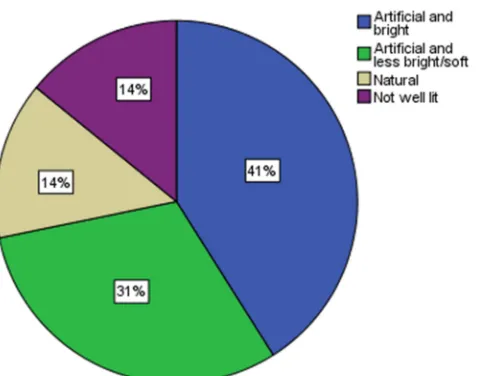
The researcher enquired on the kind of lighting found in store supermarkets during the study. The results were as presented in figure 4.5.
Figure 4.5: In Store lighting
Majority (41%) of customers said the supermarkets had artificial and bright light, 31% said the lighting was artificial but soft (less bright) and 14% said the lighting was natural and the other 14% was not well lit. It should be indicated that the tall buildings in the CBD block natural light from accessing all buildings adequately hence creating darkness that requires additional artificial lighting for customers to clearly observe merchandize. This could be the main reason why artificial lighting was observed in most supermarkets. Supermarkets preferred bright light to soft light, perhaps, due to the fact that bright light enhanced chances of clear merchandize view hence had a higher chance of increasing shopper browsing of merchandize. The effect the lighting had on the behaviour of consumers was then presented in table 4.11.
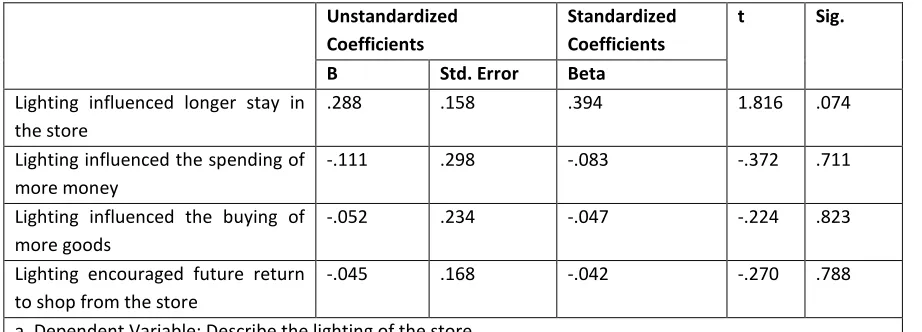
The results in table 4.11 shows that at 95% significance level, lighting in supermarkets in
40 AN ANALYSIS OF IN STORE ENVIRONMENT AMBIENCE FACTOR INFLUENCE ON CONSUMER BEHAVIOUR
Table 4.11: Effect of Lighting on Consumer Behaviour
Unstandardized Coefficients
Standardized Coefficients
t Sig.
B Std. Error Beta
Lighting influenced longer stay in the store
.288 .158 .394 1.816 .074
Lighting influenced the spending of
more money
-.111 .298 -.083 -.372 .711
Lighting influenced the buying of more goods
-.052 .234 -.047 -.224 .823
Lighting encouraged future return to shop from the store
-.045 .168 -.042 -.270 .788
a. Dependent Variable: Describe the lighting of the store
In store scent
Respondents were asked to describe the scent they encountered in the supermarket. The responses in figure 4.6 were collected. Majority (68%) of the customers surveyed found the supermarket stores to have a pleasant scent while 28% found the stores naturally scented and only 4% perceived the scent in the store as unpleasant. Pleasant scent creates an environment that is tolerable for people to stay in, as such the implementation of a pleasant environment by supermarkets was so as to create a conducive environment within which shoppers would be encouraged to conduct their shopping needs.
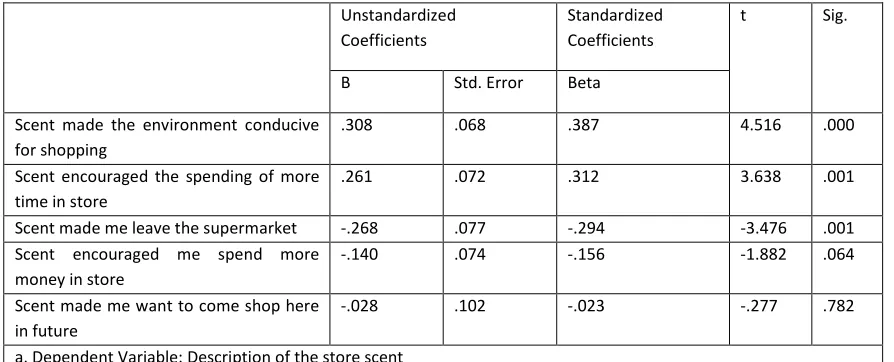
Table 4.12 and 4.13 presents the effect of store scent on the shoppers’ shopping behaviour. The results of R=0.754 indicate that the relationship between scent and consumer behaviour was linear and strong and the R-square value of 0.568 shows that in-store scent caused 56.8% of the behaviour shoppers exhibited while in the store/supermarket. Table 4.13 shows the specific shopper behaviours influenced by store scent.
Figure 4.6: Nature of Store Scent
41 AN ANALYSIS OF IN STORE ENVIRONMENT AMBIENCE FACTOR INFLUENCE ON CONSUMER BEHAVIOUR
Model R R Square Adjusted R Square Std. Error of the Estimate
1 .754a
.568 .536 .615
a. Predictors: (Constant), Scent made me want to come shop here in future, Scent made me leave the supermarket, Scent encouraged me spend more money in supermarket, Scent encouraged me to spend more time in supermarket, Scent made the supermarket environment conducive for shopping
Table 4.13: Relationship between Consumer Behaviour and Scent
Unstandardized Coefficients
Standardized Coefficients
t Sig.
B Std. Error Beta
Scent made the environment conducive for shopping
.308 .068 .387 4.516 .000
Scent encouraged the spending of more time in store
.261 .072 .312 3.638 .001
Scent made me leave the supermarket -.268 .077 -.294 -3.476 .001 Scent encouraged me spend more
money in store
-.140 .074 -.156 -1.882 .064
Scent made me want to come shop here in future
-.028 .102 -.023 -.277 .782
a. Dependent Variable: Description of the store scent
The results show that the pleasant scent in the store supermarket had positive significant relationship with making the store environment conducive for shopping based on the coefficient value of 0.308 and a p-value of 0.000 which is significant at 99% confidence level (p<0.01). This indicates that a unit increase in the pleasantness of the scent in the store enhanced the conduciveness of the shopping environment by 0.308 units. This means that shoppers were attracted to stores with scents that were pleasant. The results in the table also shows that the pleasantness of the scent in the store had a direct and significant relationship with the time consumers spend in the supermarket (coefficient = 0.261 and p<0.01). This shows that when the pleasantness of the scent in supermarket stores increased by a unit, customers were encouraged to spend 0.261 more of their time in the store. This finding could be attributed to the fact that pleasant scent attracts customers, as it is good to their sense of smell.
The relationship between scent and desire of customers to leave the supermarket store was negative but significant at 99% level (coefficient = -0.268 and p<0.01). This means that when
scent’s pleasantness increased by a unit, the desire of shoppers leaving the supermarket reduced by 0.268. As such, consumers were attracted to the pleasant scent to stay in the supermarket. This could also be attributed to the fact that pleasant scent attracted shoppers owing to its good smell. These findings are in agreement with the findings that pleasant scent created conducive and appealing atmosphere environment that resulted into positive customer value to the stores (Michon et al.,
2005; Kumar et al., 2010; Morrison et al., 2011). The standardized Beta values show that the scent available in supermarket stores has greater effect on the store environment. Scent has the least effect on shoppers’ return to the supermarkets in future.
42 AN ANALYSIS OF IN STORE ENVIRONMENT AMBIENCE FACTOR INFLUENCE ON CONSUMER BEHAVIOUR
commodities they were to buy and their respective costs and, as such, secondary things like scent would not make them change their intention. Additionally, at 95% confidence level, there was no significant relationship between the pleasantness of store scent and its effect on consumers desire to return to shop from the store in future since the calculated p-value (0.782) was greater than 0.05. This means that
scent was not a contributor to the loyalty of customers, hence, disagreeing with the findings by Yalcin and Kocamaz (2003) who found positive correlation between scent and customer loyalty. Perhaps this means that supermarket customers did not consider secondary factors like scent when determining the supermarket to be loyal to. As such, non-scent factors could be playing a role in loyalty.
Conclusion
The findings show that the background music played in supermarkets in Kenya is characterised by a soft tone, an average pitch, and a slow tempo. Generally, customers perceived the background music played in supermarkets in Kenya as appealing (good) to listen to. However, the study found that the background music played had no relationship with customers’ shopping behaviour. The background music did not have any effect on the waiting time at the counter, the time spent browsing merchandize in the store, the number of goods purchased, and the likelihood of returning to shop from the supermarket in future.
On lighting, the study found that the common form of lighting in supermarkets was artificial and bright light. The lighting in supermarkets in Kenya has no statistical significance with the behaviour consumer’s exhibit while shopping. Specifically, lighting does influence longer stay in the supermarket, but does not influence the amount of money spent in the store and the purchasing of an increased number of goods. Majority (68%) of the customers surveyed found the supermarket stores to have a pleasant scent, which correlated strongly with consumer behaviour. Pleasant scent in the supermarket made the shopping environment conducive to shoppers. The study also found that the pleasantness of the scent in the store directly and significantly related with the time consumers spend in the supermarket. Pleasant scent also negatively affected the desire to leave the supermarket. Additionally, the study found
that scent has no significance with the desire to spend more money in the supermarkets or the desire to return to shop from the store in future. Supermarkets in Kenya play background music that is characterized by soft tones, average pitch, and slow tempo. Generally, the background music played in these supermarkets appeal or impress shoppers. However, music is not an influencer of consumer behaviour among shoppers of supermarkets in Kenya. Kenyan supermarkets use artificial bright lighting for their stores. However, the lighting has no influence on consumer behaviour among shoppers to those supermarkets. Additionally, supermarkets in Kenya spray their internal atmospheres with pleasant fragrances (scents). Pleasant scents in the supermarkets make the atmospheres conducive for shopping. Pleasant scents increase the time consumers spend in supermarkets in Kenya. The study also concludes that pleasant scent reduces the chances of customers leaving the supermarket hence encouraging customers to browse more merchandize.
Recommendations
Supermarkets in Kenya should endeavour to initiate programs that will educate or equip their employees with skills for being friendlier, having courtesy, and being helpful to customers so as to enhance the effect employees have on customer behaviours.
43 AN ANALYSIS OF IN STORE ENVIRONMENT AMBIENCE FACTOR INFLUENCE ON CONSUMER BEHAVIOUR
supermarkets, they should concentrated upon to offer complimentary aspects to shoppers experience to ambience to provide a holistic appeal to a consumer. Although ambience had the highest factor of influence, it should not be the only factor under consideration in improving consumer behaviour in a retail store. Though Supermarkets should, adopt appealing/pleasing fragrances/scents in their atmospheres to attract and increase shopper activities in the stores.
Areas for Further Study
The findings in this study clearly depict the case of city supermarkets. As such, generalising these findings to other non-supermarket retail stores or even supermarkets in small towns may be challenging. Therefore, a study that will enlarge the scope of study in investigating how store-environment affects consumer behaviour is needed. In view of the contradictory findings, more studies need to test the congruence proposition.
REFERENCES
Anning-Dorson, T. (2013). Shop Selection at the Mall: Key Selection Attributes and Demographic Effects. International Journal of Advances in Management and Economics (IJAME), 2(5), 132-143.
Areni, C. S., & Kim, D. (1994). The influence of in-store lighting on consumers' examination of merchandise in a wine store. International Journal of Research in Marketing, 11(2), 117– 125.
Babbie, E. R. (2010). The Practice of Social Research (12th
ed.). California: Wadsworth-Cengage Learning.
Brown, T. & Suiter, T. (2012). MR: A student-tested faculty-approved approach to teaching and learning marketing research. Mason, OH: South-Western Cengage Learning.
Dhurup, M., Mafini, C., & Mathaba, R. L. (2013). Store Image Factors Influencing Store Choice among Sportswear Consumers: Baseline Findings from South Africa. Mediterranean Journal of Social Sciences, 4(14), 359-370.
Donovan, R. J., Rossiter, J. R., Marcoolyn, G., & Nesdale, A. (1994). Store Atmosphere and Purchasing Behaviour. Journal of Retailing, 70(3), 283-294.
Donovan, R., & Rossiter, J. (1982). Store atmosphere: An environmental psychology approach. Journal of Retailing, 58, 34–57.
Grimes, D. A., & Schulz, K. F. (2002).Descriptive studies: What they can and cannot do. The Lancet, 359, 145–49.
Hui, M. K., Dube, L., & Chebat, J. C. (1997). The Impact of Music on Consumers' Reactions to Waiting for Services. Journal of Retailing, 73(1), 87-104.
Kumar, I., Garg, R., & Rahman, Z. (2010). Influence of Retail Atmospherics on Customer Value in an Emerging Market Condition. Great Lakes Herald, 4(1), 1-13. Retrieved from http://www.greatlakes.edu.in/pdf/Herald/Vol5/ Article-1.pdf.
Mariri, T. & Chipunza, C. (2009). In-store shopping environment and impulsive buying.
African Journal of Marketing Management, 1(4), 102-108.
Michon, R., Chebat, J., & Turley, L. W. (2005). Mall atmospherics: the interaction effects of the mall environment on shopping behaviour.
Journal of Business Research, 58, 576 – 583.
Mohan, G., Sivakumaran, B., & Sharma, P. (2013). Impact of store environment on impulse buying behaviour. European Journal of Marketing, 47(10), 1711 – 1732.
44 AN ANALYSIS OF IN STORE ENVIRONMENT AMBIENCE FACTOR INFLUENCE ON CONSUMER BEHAVIOUR
Mugenda, O. & Mugenda. A (2003). Research Methods: Quantitative and Qualitative
Approaches. Nairobi Acts Press. Nairobi: M & 0 Data Experts Training and Consultants.
Njuguna, R. K., Makau, M. S., & Kerre, F. P. (2014). The moderating effect of industrial context on the relationship between brand equity and consumer choice in branded
bottled water nairobi, kenya. European Scientific Journal, 10(4).
Olahut, M. R., El-Murad, J., & Plaias, I. (2012). Store atmosphere: Conceptual issues and it's impact on shopping behaviour. The Proceedings of the International Conference "Marketing-from Information to Decision," 317-343. Cluj-Napoca: Babes Bolyai University. Retrieved from http://search.proquest.com/docview/13308605 81?accountid=45049.
Teller, C., & Dennis, C. (2012). The effect of ambient scent on consumers’ perception, emotions, and behaviour: A critical review.
Journal of Marketing Management, 28(1–2), 14– 36.
Tinne, S. W. (2011, January-June). Factors Affecting Impulse Buying Behaviour of
Consumers at Superstores in Bangladesh. ASA University Review, 5(1).
Tlapana, T. P. (2009). Store layout and its impact on consumer purchasing behaviour at convenience stores In Kwa Mashu, South Africa. Masters’ dissertation submitted to Durban University of Technology.
Vida, I. (2008). The impact of atmospherics on consumer behaviour: the case of the music fit.
Economic and Business Review, 10(1), 21-35.
Xu, Y. (2007). Impact of Store Environment on Adult Generation Y Consumers’ Impulse Buying.
Journal of Shopping Center Research, 14(1), 39-56.
Yalch, R. F. & Spangenberg, E. R., (2000). The Effects of Music in a Retail Setting on Real and Perceived Shopping Times. Journal of Business Research, 49, 139.147.