Comparative Study between Leach
,
Leah-E-Genetic Algorithm and Elliptic Curve
Cryptography Techniques to Secure Against
Sybil Attack In WSN
Omar Badeea Baban
#1#
Department of Computer Engineering
Sinhgad College of Engineering, Pune-41,Pune, India
Abstract
—
Wireless Sensor Networks (WSNs) can be defined
as
a self-configured and infrastructure-less wireless networks to
monitor physical or environmental conditions,
such as
temperature, sound, vibration, pressure, and motion. A Wireless Sensor Network (WSN) contains a large number of sensor nodes. The sensor nodes can communicate
among themselves using radio signals. A wireless sensor node is
equipped with sensing and computing devices, radio transceivers
and power components. The sensor nodes depend upon battery power. Sensor nodes utilize more energy compared to a normal node.
Typically in WSN, sensor nodes are attached to one or more base stations. As Wireless sensor networks continues to grow, they become vulnerable to attacks and hence they need for effective security mechanisms, The Sybil attack is one of the dangerous attacks against sensor and ad-hoc networks, where a node illegitimately claims multiple identities. Identification of suitable cryptography for wireless sensor networks is an important challenge due to limitation of energy, computation capability and storage resources of the sensor nodes. Symmetric based cryptographic schemes do not scale well when the number of sensor nodes increases. Hence public key based schemes are widely used.
To keep away from various vulnerable attacks, we propose a novel encryption schema based on Elliptic Curve Cryptography (ECC) and homomorphic encryption to secure data transmission in WSN , The proposed encryption schema takes less memory, reduces the computation time, provides great security and flawlessly suitable for low power devices like mobile nodes. The aim of this work is to provide security to the wireless sensor network using elliptical curves cryptography along with genetic algorithm.
Keywords
—
Wireless Sensor Networks, Sybil attacks, Genetic Algorithm, Leach-e, Leach-e-ga, Cluster head, Base Station, Elliptic Curve Cryptography.
I. I
NTRODUCTIONA wireless Sensor Network (WSN) is a distributed
network of small sensor nodes deployed in large numbers
to monitor the environment or other systems by the
measurement of physical parameters such as temperature,
pressure, or relative humidity.
These nodes by monitoring, collect detailed information
about the physical environment in which they are installed,
and then transmit the collected data to the Base Station (BS).
BS is a gateway from sensor networks to the outside world.
Fig.1 Wireless Sensor Networks [5]
The BS has a very large storage and large data processing
capabilities. It passes the data it receives from sensor nodes
to the server from where end-user can access them.
Security in WSN is a greater challenge due to the processing
limitations of sensor nodes and nature of wireless links.
Extensive use of WSNs is giving rise to different types of
threats. To defend against the threats proper security schemes
are required. Traditionally security is implemented through
hardware or software and is generally achieved through
cryptographic methods. Limited area, nature of links, limited
processing, power and memory of WSNs leads to strict
constraints on the selection of cryptographic techniques.
In this paper, we propose a novel encryption schema based
on Elliptic Curve Cryptography (ECC) and homomorphic
encryption to secure data transmission in WSN. The
proposed encryption schema is built upon GASONeC
algorithm (Elhoseny et al., 2014) that uses genetic algorithm
to build the optimum network structure in the form of
clusters.
ECC is used to exchange public and private keys due to its
ability to provide high security with small key size. The
proposed encryption key is 176-bit and is produced by
combining the ECC key, node identification number, and
distance to its cluster head (CH).
Several energy conserving security architectures have
been proposed in wireless sensor networks where Key
distribution and Key management mechanisms are basic
problem of them. RSA, DSA and Elliptic curve
cryptography (ECC) are three most widely adopted
cryptosystems. ECC is considered as the one which has
the highest security quality in per bit key among current
public key cryptosystems. compared with the other
mechanisms Elliptic Curve Cryptography (ECC) is the
best due to its smaller key size. High security despite of
smaller key size results in area and power efficient
cryptosystems.
The major characteristics of the sensor node used to
evaluate the performance of WSN are:
1. Fault tolerance: Each node in the network is prone to
unanticipated failure. Fault tolerance is the capability to
maintain sensor network functionalities without any break
due to sensor node failures.
2.
Mobility of nodes: In order to increase the
communication efficiency, the nodes can move anywhere
within the sensor field based on the type of applications.
3. Dynamic network topology: Connection between
sensor nodes follows some standard topology. The WSN
should have the capability to work in the dynamic
topology.
4. Communication failures: If any node in the WSN fails
to exchange data with other nodes, it should be informed
without delay to the base station or gateway node.
5. Heterogeneity of nodes: The sensor nodes deployed in
the WSN may be of various types and need to work in a
cooperative fashion.
6. Scalability: The number of sensor nodes in a sensor
network can be in the order of hundreds or even
thousands. Hence, WSN designed for sensor networks is
supposed to be highly scalable.
7. Independency: The WSN should have the capability to
work without any central control point.
8. Programmability: The option for reprogramming or
reconfiguring should be available for the WSN to become
adaptive for any dynamic changes in the network.
9. Utilization of sensors: The sensors should be utilized
in a way that produces the maximum performance with
less energy.
10. Impracticality of public key cryptosystems: The
limited computation and power resources of sensor nodes
often make it undesirable to use public key algorithms.
11. Lack of a prior knowledge of post-deployment
configuration:
If a sensor network is deployed via random distribution,
the protocols will not be aware of the communication
status between each node after deployment.
The following metrics are used to evaluate the performance
of a WSN: network coverage, node coverage, efficiency in
terms of system lifetime, effortless deployment, data
accuracy, system response time, fault tolerance, scalability,
network throughput, sample rate, security, the cost of the
network and network architecture used. The individual sensor
node in the WSN is evaluated using flexibility, robustness,
computation, communication, security, synchronization, node
size and cost.
In comparison with sensor networks, Ad Hoc networks will
have less number of nodes without any infrastructure. The
differences between WSN and Ad hoc Networks are
presented in the Table 1. [9]
Wireless sensor networks (WSNs) are consist of a large
number of sensor devices that can communicate with each
other via wireless channels, with limited energy and
computing of such environment is a challenging algorithmic
and technological task. These WSNs are powerful in that
they are amenable to support a lot of very different
real-world applications; they are also a challenging research and
engineering problem because of this very flexibility.
Accordingly, there is no single set of requirements that
clearly classifies all WSNs, and there is also not a single
technical solution that encompasses the entire design space.
Research on sensor networks was originally motivated by
Parameters Wireless Sensor
Networks
Ad Hoc Networks Number of sensor
nodes
Large Medium
Deployment Densely
deployed Scattered
Failure rate Prone to
failures Very rare
Topology Changes very
frequently Very rare
Communication paradigm
Broadcast communication
Point-to-Point communications
Battery Not
replaceable / Not rechargeable
Replaceable
Identifiers No unique
identifiers Unique identifiers
Centric Data centric Address centric
Fusion / aggregation
Possible Not suitable
Computational capacities, and memory
Limited Not limited
Data rate Low High
Redundancy High Low
Table 1. Wireless Sensor Networks Vs Ad hoc Networks [9]
military applications. Early research was done
by military
using sensor networks for defence dealing with events at
contiguous levels. Around 1980 modern research on
sensor networks started with the distributed sensor
networks program at the US Defence Advanced Research
Projects Agency (DARPA). During this period
Universities and Institutes did an intensive research in
technology components for sensor networks about
designing acoustic sensors, protocols to link processes of
working on a common application in a network,
self-location algorithms, distributed software and developing
test beds.
In 1990s there was an important shift of sensor network
research due to advances in computing and
communications. Small size, low cost sensors are designed
to be based upon Micro Electro Mechanical Systems
(MEMS) technology, wireless networking and low power
processors, which make sensors possible to be deployed in
a wireless fashion. This leads and influences the latest
research on networking and information processing
techniques of sensor networks.
A WSN can be generally described as a network of nodes
that cooperatively sense and may control the environment
enabling interaction between persons or computers and the
surrounding environment. Today, Wireless Sensor
Networks are widely used in the commercial and industrial
areas such as for e.g. environmental monitoring, habitat
monitoring, healthcare, process monitoring and
surveillance. For example, in a military area, we can use
wireless sensor networks to monitor activity. If an event is
triggered, these sensor nodes sense it and send the
information to the sink node by communicating with other
nodes. The use of WSNs increasing day by day and at the
same time it faces the problem of energy constraints in
terms of limited battery lifetime. As each node depends on
energy for its activities, this has become a major issue in
WSNs. The failure of one node can interrupt the entire
system or application. Every sensing node can be in active
(for receiving and transmission activities), idle and sleep
modes. In active mode nodes consume energy when
receiving or transmitting data. In idle mode, the nodes
consume almost the same amount of energy as in active
mode, while in sleep mode, the nodes shutdown the radio
to save the energy. [14]
In order to design a completely secure wireless sensor
networks, security must be integrated to every node of the
system. The reason is that a component implemented
without any security could be easily become a point of
attack. It indicates that a security must permeate through
every aspects of design of wireless sensor networks.
Wireless sensor networks (WSNs) are subject to various
attacks because of the vulnerable environment, limited
recourse, and open communication channel. Wireless
networking has witnessed a strong interest in the recent
past due to the applications in mobile and personal
communications. Wireless network architectures can be
categorized into infrastructure wireless network
architectures and ad hoc wireless network architectures.
Sometimes wireless networks are extended from existing
wired network. As per the research studies, Wireless
sensor networks are becoming very popular now a day as
they offer economically feasible and real-time monitoring
solutions. While establishing the Wireless Sensor Network,
the sensor nodes can be easily deployed in the unreceptive
environments. [11]
Many routing protocols based on clustering method for
WSNs have appeared in the literature,
In the LEACH and
LEACH-E (AlakeshBraman et al. 2014) protocols, the
communication between cluster heads and the base station
requires more energy than the non-cluster nodes. This means
increasing the number of clusters-heads can increase the
energy consumption of the whole network and shorten the
network lifetime. Therefore, it is necessary to select the
optimal number of cluster heads to make the energy
consumption minimum. The original LEACH-E algorithm,
selects the cluster heads at random with fixed round time for
the selection. It considers the remnant power of the sensor
nodes in order to balance network loads and changes the
round time depending on the optimal cluster size. In
LEACHC (Shuo Shi et al. 2012;Petre-CosminHuruial et al.
2010; Raed M. Bani Hani andAbdalraheem A. Ijjeh. 2013)
protocol, each node transmits its information to the
corresponding base station and the sink node makes the
choice of selecting the cluster head and how to divide
clusters. Then the cluster head sends this information to BS.
In Hierarchy routing protocol a CH collect a data from its
cluster members, aggregates all data and forward to the BS
that might be located far away from it. If the CH is
compromised then it will be dropped. The compromised CH
will become ineffective, because the data aggregated by
cluster head will never reach the base station.
V-LEACH (BaniYassein. M et al. 2009) protocol, besides
having a CH in the cluster, also has a vice-CH that takes the
role of the CH when the CH is dropped/compromised. The
vice-cluster nodes forward data directly to the BS. Messy
GAs solve (Goldberg . D et al.1989) problems of coverage of
local maxima by the optimal search. To choose the best CH,
minimizing the energy consumption and latency is obtained
by choosing the best nodes in the network. A genetic
algorithm is executed on a central BS and the results are send
to the nodes (Goldberg . D et al.1989).
Hierarchical routing protocol (Vikram Mehta andDr.Neena
Gupta. 2012) due to a battery replacement or recharging is
not realistic.
Choosing the routing protocol is, it must be energy-efficient
to improve the network lifetime (Yang Yu et al 2006;
Manimozhi. B , Santhi.B.2013). The optimal set of protocols
is proposed to show the optimization in genetic algorithm
metrics for WSNs with the QoS requirements (JiaXu,Ning et
al. 2012). Cluster-based LEACH routing protocol in WSN
has greater energy efficiency and the information such as
nodes residual energy and geometric distance send to BS, to
elect CH nodes. The CH node is one hop to the BS to
consume less energy than other nodes because
communication of data consumes the more energy. CH nodes
not only consider the residual energy of the nodes and also
distance between the CH and BS also examined (Jin Fan and
Parish D .J. 2007). Trust-based LEACH protocol in (Nguyen
Duy Tan et al. 2012) discussed the cluster-head-assisted
monitoring control.
Basic classification of routing protocols in WSNs
(Petre-CosminHuruial et al. 2010) has named LEACH as the
most energy efficient protocol giving its advantages and
disadvantages. [17]
Choi et al. [4] investigated the feasibility of various
cryptographic algorithms, AES, Blowfish, DES, IDEA,
MD5, RC4, RC5, SEED, SHA-1 and SHA-256, for their
use in WSN utilising MICAz type motes running TinyOS.
The usage of resources including memory, computation
time and power for each cryptographic algorithm were
experimentally analysed. As a result, RC4 and MD5
turned out as the most suitable algorithms for MICAz-type
motes.
Gura et al. [12] Implemented ECC on an 8 bit
microcontroller by using elliptic curves GF(p) over prime
integer field. They selected Elliptic Curves GF(p) over
prime integer fields since binary polynomial field
arithmetic specifically multiplication is insufficiently
supported by current microprocessors and would thus lead
to lower performance. The point multiplication of an
integer and point on an elliptic curve decomposed into
sequence of point additions and point doublings.
Wander et al. [25] quantified the energy cost of
authentication and key exchange based on public-key
cryptography; RSA and ECC on an 8-bit microcontroller
platform; Atmel ATmega128 processor. A comparison has
been presented on two public key algorithms, RSA and
Elliptic Curve Cryptography (ECC), and considers mutual
authentication and key exchange between two un-trusted
parties such as two nodes in a wireless sensor network.
The ECC-based signature is generated and verified with
the Elliptic Curve Digital Signature Algorithm (ECDSA).
The results have shown that ECDSA signatures are
significantly cheaper than RSA signatures. The
experiments were conducted on the Berkeley/Crossbow
motes platform, specifically on the Mica2dots. The
implementation of RSA and ECC cryptography on Mica2
nodes further proved that a public key-based protocol is
viable for WSNs.
Batina et al. [3] proposed a low cost public key
cryptography scheme for sensor networks providing
service such as key distribution and authentication. They
proposed a custom hardware assisted approach to
implement Elliptic Curve Cryptography (ECC) in order to
obtain stronger cryptography as well as to minimize the
power. The low-power ECC processor contains a modular
arithmetic logical unit (MALU) for ECC field arithmetic.
Szczechowiak et al. [22] presented results on
implementing ECC, as well as the related emerging field
of Pairing-Based Cryptography (PBC), on two of the most
popular sensor nodes MICA2 and Tmote Sky. They
showed that ECC over prime field is not always the best
option as pairings over GF (2m) seem to be more efficient
on this type of architecture. They argued that fast pairing
computation enables Identity Based Encryption and thus
opens new ways for achieving security in sensor networks
which was also argued by Oliveira et al., 2007.
Yeh et al. [27] proposed ECC-based user authentication
protocol that resolves some weaknesses. The proposed
protocol provide mutual authentication to protect inside
security and outside security. Also, it not only inherits the
merits of ECC based mechanism but also enhances the WSN
authentication with higher security than other protocols.
Therefore, the proposed protocol is more suited to WSNs
environments. [10]
Wireless sensor networks are dynamic in nature and data
transmitted through various numbers of intermediate nodes.
Due to the mobility and dynamic nature of the sensor nodes,
the intermediate nodes may change after route discovery and
route-link failure occurs. Also, any intruders can join as the
intermediate node in the route. Clustering is an important
mechanism in large multihop wireless sensor networks for
obtaining scalability, reducing energy consumption and
achieving better network performance.
Most of the research in this area has focused on
energy-efficient solutions, but has not thoroughly analyzed the
network performance, e.g. in terms of data collection rate and
time. It is evident that by organizing the sensor nodes in
groups i.e., clusters of nodes, we can reap significant network
performance gains.
LEACH is the first network protocol that uses hierarchical
routing for wireless sensor networks to increase the life time
of network.
All the nodes in a network organize themselves into local
clusters, with one node acting as the cluster-head. All
non-cluster-head nodes transmit their data to the non-cluster-head,
while the cluster-head node receive data from all the cluster
members, perform signal processing functions on the data
(e.g., data aggregation), and transmit data to the remote base
station. Therefore, being a cluster head node is much more
energy-intensive than being a non-cluster head node. The
biggest challenge for the LEACH-E protocol is that they go
through topological changes in the networks and thereby their
energy gets drained. To conserve energy and increase network
lifetime, the node should minimize the energy dissipation and
optimize communication. Changing behaviour of the node is
identified by the proposed LEACH-E Genetic Algorithm
using its fitness functions and thus makes the node as a
trustable node. Once the nodes trustiness is identified, the
transmission takes place efficiently in a secured manner.
A- Sybil
Attack
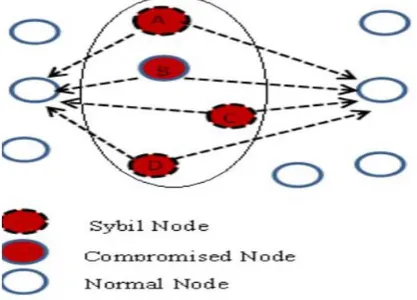
Sybil node is the process of creating two or more duplicate
nodes with similar identity i.e. same node id as shown in
Figure 2.
Particularly, wireless sensor networks are more prone to
Sybil attack because of the open and broadcast
communication medium and the same frequency is being
shared among all nodes. In Sybil attack, attacker makes
multiple illegitimate identities in sensor networks either by
fabricating or stealing the identities of legitimate nodes.
So the base station cannot distinguish the legitimate and
the forged node. This confuses the base station and other
nodes and the network performance degrades. It is very
important to know about the different forms of
Sybil attack, which have targeted the network to get
confused or damaged. Sybil attack Taxonomy is three
dimensional taxonomy:
1. Direct vs. Indirect Communications
2. Fabricated vs. Stolen Identities.
3. Simultaneity.
In direct method of Sybil attack, legitimate nodes
communicates directly with nodes however in case of
indirect method, communication in between legitimate
node and nodes is done via malicious nodes. Sybil attack
may also include fabricated and stolen identities.
In case of fabricated identity, nodes create similar
fabricated ID for it on the basis of structure of legitimate
nodes ID. nodes may also steal the legitimate nodes ID
and can use it as its own ID.
Such attacking nodes will not be identified till stolen ID is
destroyed. If the Sybil attack is simultaneous, all identities
will participate in network at same time. In non
simultaneous Sybil attack, attacker presents a large
number of identities over a period
of time.
Fig.2 Sybil Attack [16]
Main types of Sybil attacks are Distributed Storage,
Routing, Data Aggregation, Voting, Fair Resource
Allocation and Misbehaviour Detection. In case of
Distributed Storage, there is Sybil attack on replication
and
fragmentation mechanism.
Sybil attack on routing can also results multipath or disparity
routing in, seemingly disjoint paths can go through a single
malicious node presenting identities. Data Aggregation Sybil
attack affect on some sensor network protocols to aggregate
the reading of sensors in order to conserve energy rather than
returning individual readings. Fair Resource Allocation Sybil
attack can be used in fair resource allocation which will allow
a malicious node to obtain unfair share of resources. In
Misbehaviour Detection nodes can be used to spread the
blame in a misbehaviour detection network.
B. Existing Detection Methods
A. Radio Resource Testing This method is based on the radio
capability of each node of the network which already have
got assigned a single radio randomly to broadcast and listen.
Let’s assume that in network any physical device has only
one radio and radio is incapable of simultaneously sending or
receiving on more than one channel. Now every node is
assigned a different channel to broadcast and different
channel to listen. If the neighbour with assigned channel is
legitimate then:
let s is the total number of nodes and n is number of nodes
then:
Prob. of detection = s/n
Prob. Of non-detection = (n-s)/n
For r rounds: Prob. of non-detection = ((n-s)/n)r
In case there are no enough channels for assignment to the
nodes then this method can face problem.
B. Registration Registration may be one of the effective
solutions to prevent from Sybil attack. There may be one
trusted central authority to know the nodes identity. This can
help in identifying the legitimate node as it to be checked in
known good list. But registration list which contains known
identities has to be protected from malicious nodes. If any
attacker could add its identity in this list then identity will be
treated as known-good.
C. Position Verification In this method it is assumed that the
nodes are immobile and will not be changing their position.
This is one of the effective method for detecting Sybil attack.
If any such attack is created by a malicious node,
corresponding position of the node will be changed and will
be detected as Sybil attack as network had already recorded
nodes initial positions.
D. RSSI Based In this method, localization algorithm is
used. By having the position of nodes on signal strength,
presence of attack in network can be calculated. Upon
receiving a message, the four detector nodes compute the
location of sender and associate this location with the
sender-ID included in the message. But location calculation is costly.
C. Disadvantages of the Detection Methods
Each of the defenses against the Sybil attack that we have
examined has different tradeoffs. Most defenses are not
capable of defending against every type of Sybil attack.
Additionally, each defense has different costs and relies on
different assumptions. The radio resource verification
defense may be breakable with custom radio hardware,
and validation may be expensive in terms of energy.
Position verification can only put a bound on the number
of Sybil nodes an attacker can generate unless it is able to
very precisely verify node positions. Node registration
requires human work in order to securely add nodes to the
network, and requires a way to securely maintain and
query the current known topology information. [19]
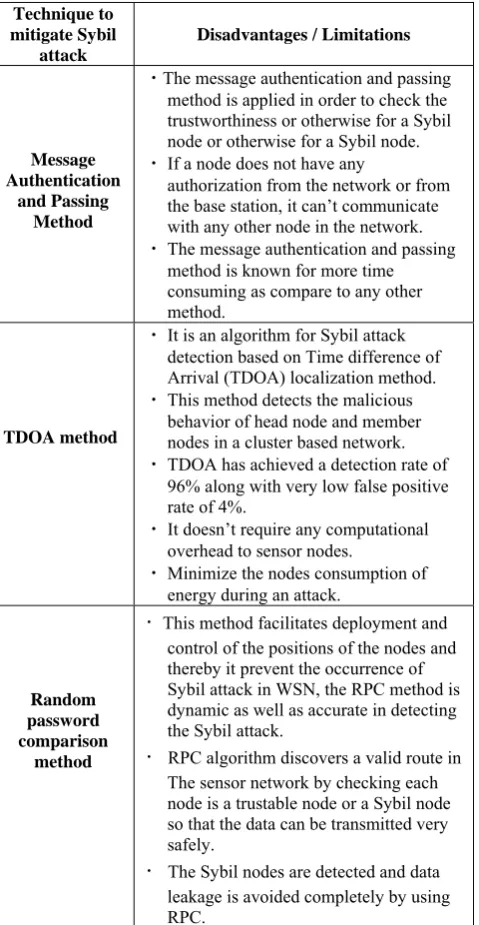
Table 2: Comparative analysis of the techniques to prevent
and mitigate the Sybil attack and their disadvantages [18].
Technique to mitigate Sybil
attack
Disadvantages / Limitations
Message Authentication
and Passing Method
・The message authentication and passing
method is applied in order to check the trustworthiness or otherwise for a Sybil node or otherwise for a Sybil node.
・ If a node does not have any
authorization from the network or from the base station, it can’t communicate with any other node in the network.
・ The message authentication and passing
method is known for more time consuming as compare to any other method.
TDOA method
・ It is an algorithm for Sybil attack
detection based on Time difference of Arrival (TDOA) localization method.
・ This method detects the malicious
behavior of head node and member nodes in a cluster based network.
・ TDOA has achieved a detection rate of
96% along with very low false positive rate of 4%.
・ It doesn’t require any computational
overhead to sensor nodes.
・ Minimize the nodes consumption of
energy during an attack.
Random password comparison
method
・This method facilitates deployment and
control of the positions of the nodes and thereby it prevent the occurrence of Sybil attack in WSN, the RPC method is dynamic as well as accurate in detecting the Sybil attack.
・ RPC algorithm discovers a valid route in
The sensor network by checking each node is a trustable node or a Sybil node so that the data can be transmitted very safely.
・ The Sybil nodes are detected and data
leakage is avoided completely by using RPC.
Neighbourhood RSS based
approach
・ This lightweight scheme use of
neighbourhood RSS to differentiate between the legitimate and Sybil identities.
・This scheme has a high level of accuracy
with detection process gives us the high true positive rates up to 80% with low false positive rates that ranges to 16%.
SYBILSECURE technique
・ Experimental results show that Sybilsecure
consumes less energy as compare to the existing defences mechanisms.
・ Sybilsecure is based on sending and
acknowledging the query data packets.
・ The proposed solution is basically based on
sending to and responding from the query sent by the cluster head. The cluster head has a list of its sub nodes parameters, these parameters are identities and their locations. The cluster head broadcasts query packet to all sub- nodes in such a way that it expects a reply from all the sub nodes, so that they must send their id and location.
Two-hop messages approach
・ This algorithm is based on broadcasting two-
hop messages
・ In this algorithm by sending two hop
messages, each node finds its two hop neighbours and common neighbours between itself and each of its two hop neighbours. The number of common neighbours is one of the good indicator to detect Sybil nodes.
・ Experimental results by authors show that
the proposed algorithm outperforms similar other existing algorithms with respect to true and false detection rates.
PDAP approach
・ This algorithm is used in Vehicular adhoc
networks (VANETs), In VANETs; most privacy-preserving schemes are vulnerable to Sybil attacks, in which a malicious user can pretend to be multiple vehicles.
・ In the proposed scheme, malicious node can
be detected in a distributed manner. This is done through passive overhearing by set of fixed nodes called road-side boxes (RSBs). The detection of Sybil attacks does not require any vehicle to disclose its identity in the network; hence privacy is preserved for at all times.
TIME-TOTIME MESSAGE
model
・ Every node in the WSN will maintain the
observation table, used for storing node id along with location to detect the Sybil node.
・ The simulation results by author showed that
Compare and Match
Approach
・This approach is used to verify the
position to prevent Sybil attacks.
・ A malicious node can be a Sybil node if
and only if it knows the complete information about the other nodes. A Sybil node can have any duplicate ID and duplicate information after obtaining this information.
・A node can only communicate with other
nodes after authorization by the network or from base station. According to authors, CAM is very effective and efficient as compare to other existing methods.
Threshold Elgamal Key Management
Scheme
・ To defend against the Sybil attack
Proposed scheme validate each node identity to the only identity presented by the corresponding physical node, There are basically two ways to validate an identity. The first type is the direct validation in which a node directly tests another node identity. The second type is indirect one in which already verified nodes allowed to vouch for or refute other nodes.
・ In the proposed approach Elgamal based
key management scheme is used. The Elgamal encryption scheme is an asymmetric key encryption algorithm used for public-key cryptography, which is based on the Diffie– Hellman key exchange.
・A Threshold ElGamal-based key
management scheme is used in this paper for protection against Sybil attack.
Optimized secure routing protocol
・ The mechanism used in the paper is set
up to detect Sybil attack based on the distance and hop count between the nodes.
・ The prevention is done based on
Encryption technique which uses unique identities of the nodes.
・ The authors also calculate performance
parameters energy consumption. The results shows the efficiency of the proposed protocol.
・The proposed work help in preventing
the wireless sensor network from the security risk due to Sybil attack. The encryption technique used in the paper is based on the binomial distribution.
Energy and Hop based
Detection
・ The detection of malicious node is done
in three phases, where in the first phase of method the node energies are compared with the threshold value. In the second phase the distance between suspected Sybil nodes is calculated and finally, the route followed by the packets are checked for confirmation of a Sybil node.
・ It is observed from the results that, the
proposed scheme increase the Packet delivery ratio along with throughput of
the network.
Channel- Based Detection
・ An enhanced physical-layer authentication
scheme to detect Sybil attacks is proposed in.
・ This exploits the spatial variability of radio
channels in the environments with rich scattering. Authors build a hypothesis test in order to detect Sybil clients for both narrowband and wideband wireless systems, Based on existing channel estimations mechanisms, proposed method can be easily implemented with low overhead. This can be done either independently or combined with other physical-layer security methods.
・ The performance of proposed Sybil detector
in the paper is verified, via both a propagation modelling software. A field measurement using a vector network analyzer is also used for typical indoor environments. Authors claim that their evaluation examines numerous combinations of system parameters such as bandwidth, number of channel estimates, signal power, number of total clients, number of Sybil clients, and number of the access points. According to authors, both the false alarm rate and the miss rate of Sybil attacks are below 0.01, pilot power of 10 mW, with three tones, and a system bandwidth of 20 MHz.
UWB ranging based
information
・ This scheme proposes development of a
defences scheme against direct, simultaneous Sybil attacks with derivation of a rigorous analytic framework for the determination of the system performance.
・ This scheme focuses on a rule-based
anomaly detection system. This system is called RADS, which monitors and timely detects Sybil attacks in large-scale WSNs. The proposed expert system relies on an ultra-wideband (UWB) ranging-based detection algorithm. This algorithm usually operates in a distributed manner that require no information sharing or cooperation between the sensor nodes in order for performing the anomaly detection tasks.
D. System Overview
1. Leach-E Protocol
LEACH-E protocol improves the CH selection procedure. Sensor node’s residual energy is the main concern, which decides whether the node become a CH or not after the first round (BaniYassein .M et al2009). Like LEACH protocol, LEACH-E is divided into rounds (Shankar .M et al. 2012). In the first round, all the nodes have the same probability of being a CH. At the end of the first round, the node, which has more residual energy, is elected as CH. LEACH–E protocol improves the cluster head selection procedure.
2. Leach-E-GA (Leach-Energy-Genetic Algorithm)
This work uses the LEACH—E-Genetic algorithm (GA) that would enhance the WSN response time, network life and minimize the delay. The Genetic algorithm proposed by (Goldberg et al in 1975; Wu Xinhua and Wang Sheng. 2010) improves the cluster heads selection process. Selecting the minimum number of cluster heads in the WSN is determined based on the square root of the total number of sensor nodes, to minimize the total energy consumption. The LEACH-E Genetic algorithm is shown in figure 3 selects an unsupervised node, which allows the network to achieve maximum coverage distance with minimum energy consumption.
Fig. 3 GA Hierarchical Clustering [21]
Genetic algorithm optimizes the behaviour of the node based on its request and response, energy level, mobility and comparison with its record of previous transmissions. A node, whose behaviour is changed and not fit to the fitness function, is considered to be the Sybil node. The node is dropped from the network to improve the quality of the network for future communication. (Wu Xinhua Wang Sheng. 2010) enhanced the HCR protocol using GA, which determines the clusters, CHs, Cluster-members and the schedules for transmission. In Leach-E-GA protocol the Leach-E-GA can be used at any place in the network like base station CH, or in administration and it provides more energy efficiency by identifying the Sybil nodes to the optimizer. In each round of routing discovery, GA is applied. The optimizer chooses the best trusted neighbour nodes using the GA fitness function. The fitness function is based on the node behaviour, direct distance to destination node, and energy and trust value of the nodes in the route. LEACH-E is enhanced by GA at the base station. GA creates the energy efficient clusters for more numbers of transmissions. In terms of GA representation, nodes are called [assigned] as chromosomes.
Genetic Algorithm ( )
・ Initialize population and Objective Function Value- [OFV].
・ Define the Fitness function.
・ Selection.
・ Cross over.
・ Mutation.
・ Repeat the above steps until reaching the solution.
A population contains a group of individuals named chromosomes, which represents a finished solution for a derived problem. Each chromosome is a sequence of values of the attribute [node-energy, node-trust value, and node-distance]. [17]
Fig. 4 GA Flowchart used for WSN [17]
Once an initial population is randomly generated, the algorithm evolves through three operators:
A. Selection: This equates to survival of the fittest. B. Crossover: This represents mating between individuals. C. Mutation: This introduces random modifications.
A. Selection Operator
・ Give preference to better individuals, allowing them to pass on
their genes to the next generation.
・ The goodness of each individual depends on its fitness.
・ Fitness may be determined by an objective function or by a
subjective judgment.
B. Crossover Operator
Fig. 4 Crossover [22]
C. Mutation Operator
Mutation consists of securing the procedure of reproduction and Crossover efficiently without much loss of the potentially helpful genetic material. Mutation is by itself a random walk through the string space and offers for occasional interference in the crossover operation by introducing one or more genetic elements during reproduction. This operation assures diversity in the genetic strings over large period of time and prevents stagnation in the emergence of optimal individuals. Bit wise mutation changes 1 to 0 and vice versa. The above specified operations of selection, crossover and mutation are repeated until the best individual is detected.
Fig.5 Mutation [22]
3. ECC Cryptography
Elliptic Curve Cryptography was first projected by victor Miller and independently by Neal Koblitz in the mid-1980s and has evolved into a mature public-key cryptosystem. Compared to its traditional counterparts, ECC offers the equal level of security using much smaller keys. This result in faster computations and reserves in memory, power and bandwidth those are especially important in constrained environments. More significantly, the advantage of ECC over its competitor’s increases, as the security needs increase in excess of time. ECC operates over a group of points on an elliptic curve defined over a finite field.
Algorithm:
1. At first we will take a curve in the form y2 = x3+ax+b Where, a and b are curve parameters.
2. Choose a prime number.
3. Using point adding and point doubling we compute the points on the curve.
4. Select a generating point out of those points whose order should be large.
5. Take a random number less than order of generating point as a private number for each entity. This will be a secret key. 6. Generate its public key by multiplying the generating number with the secret number and will publish the point.
Encryption: The first task in this system is to encode the plaintext message m to be sent as an x-y point Pm. It will be the point Pm that will be encrypted as a cipher text and subsequently decrypted. As with the key exchange system, an encryption and decryption system requires a point G and an elliptic group Ep (a, b) as parameters. 1. Each user A selects a private key nA and generates a public key PA= nAXG.
2. To encrypt and send a message Pm to B, A chooses a random positive integer x and produces the cipher text Cm consisting to the pair of points.
3. Cm= xG,Pm+xPB (A uses Bs public key PB to encrypt the message.)
Decryption: To decrypt the cipher text, B multiplies the first point in the pair by B’s secret key and subtracts the result from the second point:
Pm+xPB - nB(xG) Pm+xBG - nB(*xG)
Pm, which is the original message or plaintext. [11]
PROPOSED WORK FLOW
Fig. 6 Work flow [6]
The proposed methodology has implemented to provide the security in the wireless sensor network using Genetic Algorithm first and then elliptical curves cryptography. We have implemented the project using NS2 platform. Network Simulator-2, NS2 Network simulator is the part of software that predicts the performance of the network without a real network
being there. It is a vital simulation tool for networks which
contains, Lists of events and executes one event after another;
Single thread of control so no blocking or race conditions, Otcl
adds object orientation to TCL, Transport layer protocols like TCP and UDP as a Traffic Agent.
As we know for the simulation it offers various benefits like: • Provides a graphic interface.
• Compatible with many platforms.
Fig. 6 Work flow [11]
The project has gone through the following phases:
1. Deployment of the Sensor Nodes: In this, we have created the wireless sensor nodes which are randomly generated.
2. Topology Formation: These nodes are scattered randomly and have formed the structure, we can call it as topology. 3. Clustering: After deployment of random nodes, we have created clusters of the nodes.
We use LEACH-E Genetic algorithm (GA) for our network architecture to provide the security to the network as it is used to identify the node best trusted neighbours for communication using its optimization capability which would enhance the WSN response time, network life and minimize the delay. The Genetic algorithm improves the cluster heads selection process. Selecting the minimum number of cluster heads in the WSN is determined based on the square root of the total number of sensor nodes, to minimize the total energy consumption.
4. Security Implementation: For security implementation in the network, we have used elliptical curve cryptography to encrypt the messages sent from the sender to the receiver side. After deployment and clustering of the wireless sensor network, we have implemented the security among the each node to be
communicated. Each sensor node will have routing table. Each
sensor node is having their id and some relevant information like their public key which has been used in the process of encrypting the data or message to be transmitted.
The private keys are randomly generated which are used to decrypt the message at the receiver side.
Consider the standard elliptic curve equation as,
(E.q. 1)
Ex:
E = y^2 = x^3 + 4x + 20, defined over F29 with the constants where, a = 4 and b = 20 which have been checked to satisfy that E is an elliptic curve.
The 37 randomly generated points in E (F29) are as following: {O, (0, 7), (0, 22), (1, 5), (1, 24), (2, 6), (2, 23), (3, 1), (3, 28), (4, 10), (4, 19), (5, 7), (5, 22), (6, 12), (6, 17), (8, 10), (8, 19), (10, 4), (10,25), (13, 6), (13, 23), (14, 6), (14, 23), (15, 2), (15, 27), (16, 2), (16, 27), (17, 10), (17, 19), (19, 13), (19, 16), (20, 3), (20, 26), (24, 7), (24, 22), (27, 2), (27, 27)}.
These points can be represented on the elliptical curve are as follows:
Fig. 7 Elliptic Curve Point Representation [11]
Consider the points,
1).The point (x=1, y=5) in E (F29) satisfies the equation elliptic curve as:
y2 mod p = x3 + 4x + 20 mod p 25 mod 29 = 1 + 4 + 20 mod 29 25 = 25 this satisfies the equation of EC.
2) The point (x=3, y=1) in E (F29) satisfies the equation elliptic curve as:
y2 mod p = x3 + 4x + 20 mod p 1 mod 29 = 27 + 12+ 20 mod 29 1 = 1 this satisfies the equation of EC.
3) The point (x=15, y=2) in E (F29) satisfies the equation elliptic curve as:
y2 mod p = x3 + 4x + 20 mod p 4 mod 29 = 3375 + 60+ 20 mod 29 4=4, this satisfies the equation of EC. [11]
i. Numerical Illustration
Population of Nodes
All nodes in the network are considered as chromosomes. The CH and CM nodes are represented as X and Y respectively. The fitness of a chromosome is evaluated by many parameters, such as node energy, distance, node trust value. Population P consists of several chromosomes. For example, the population P is initialized as P =50 and it is generated randomly. According to the fitness the population transforms into the future generation.
Fitness Parameters
Where all the attributes are used as notation in the above objective constrains to represent the fitness function and it is described in the following table-3. If the node satisfied in terms of OBF, then there will be a link provides between X, Y, where X represents the node and the Y represents the cluster. Each chromosome is evaluated according to the fitting parameters and update in each round, and it can be written as:
Δfi = fi – (fi-1) ...(E.q 2)
δf denotes the changes in the fitness parameter values.
wi = (wi -1) + ciΔfi ...(E.q 3)
Where, (ci = 1/1+exp – fi) Improves the weight value compared with the previous value.
Each time the nodes attribute are evaluated by the fitness function and check the arbitrary weight value. If the arbitrary weight value is the best OFV, then that chromosome is chosen as the best neighbour for transmitting data and grouped into clusters. If the node parameter has not satisfied the fitness constraints, then apply cross over on the chromosomes. Then apply mutations and compute the OFV. Repeat the same above fitness calculation until reaching the objective value.
Else, replace all the bad solution based chromosomes with the newly generated chromosomes randomly for the optimization process. Also, in this project, it is considered to minimize latency, which means minimizing travel time of data from the end nodes to BS (Goldberget al.,1989).When each CH node sends data directly using one hop to the BS, the time is reduced, but the node consumes more energy.
Minimizing energy consumption involves finding solutions where nodes communicate information on distances as short as possible and between as few nodes as possible. The results where cluster heads are equally spread, it is found that the energy consumption is uniformly distributed in the network. [17]
Table 3. Nomenclature [17]
ii. Mathematical Model
A mathematical model is an abstract model that uses mathematical language to describe the behaviour of the system. Set theory and mathematical model for A Mechanism of Preventing Sybil Attack in WSN by Using Elliptic Curve Cryptography with Genetic Algorithm is described.
1. Let, S be the system defined as- S = {I, O, F}
2. I is main set of inputs of the system. I = {S, BS, A}
3. S is main set of Normal Nodes like s1, s2, s3.... S = {s1, s2, s3, …………..., sn}
4. A is main set of Cluster Head nodes like a1, a2, a3.... A = {a1, a2, a3,…… …….., an}
5. O is main set of Accused Nodes or Attack Nodes like c1, c2, c3.... O = {c1, c2, c3, ………….., cn}
6. Let F be the set of processing function. F = {Ffit, Fecc}
7. Ffit is Fitness function defined as: Ffit = {C, DD, Entry, SD, TV} 8. Let C be the set of cluster.
9. Let DD be the set of distance.
10. Let Entry be the set of Energy.
11. Let SD be the set of cluster distance with deviation.
12. Let TV be the set of trust values of nodes.
13. Fecc is elliptic curve cryptography function defined as:
Fecc encrypt =
Where, Cm is cipher text message. Pm is plain text or original message.
x is random integer selected by the sender of the message, A sender. G is a point of a,b.
PB is B’s public key.
Fecc decrypt = Pm + xPB – nB(xG) Pm + xBG – nB(xG)
nB is B’s private key.
14. Fs is the successful case defined as-
Fs= Malicious nodes are detected and place them out of the network. In short, network contains no malicious node. Normal nodes are differentiated from malicious nodes using fitness function and elliptic curve cryptography.
15. Fi is the failure case defined as- Fi = Network consist of malicious node.
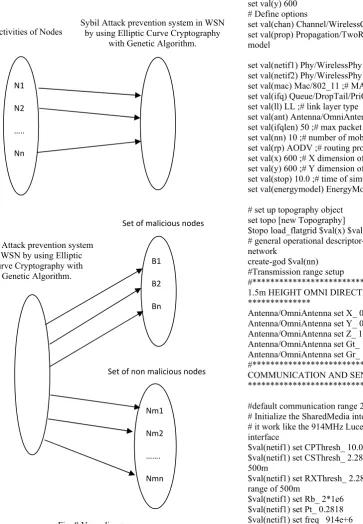
Figure 8 shows Venn diagram for Sybil attack prevention system in WSN by using Elliptic Curve Cryptography with Genetic Algorithm.
N1
N2
…..
Nn
B1
B2
Bn
Nm1
Nm2
…….
Nmn
Activities of Nodes Sybil Attack prevention system in WSN by using Elliptic Curve Cryptography with Genetic Algorithm.
Sybil Attack prevention system in WSN by using Elliptic Curve Cryptography with
Genetic Algorithm.
Set of malicious nodes
Set of non malicious nodes
Algorithms
Cluster Formation Algorithm in NS2:
#Filename: sample18.tcl
#****************SENSOR NETWORK ************ #******************ENERGY MODEL **********88 #************Multiple node Creation and communication model using
UDP (User Datagram Protocol)and CBR (Constant Bit Rate) ***************************88
# Simulator Instance Creation set ns [new Simulator]
#Fixing the co-ordinate of simulation area set val(x) 600
set val(y) 600 # Define options
set val(chan) Channel/WirelessChannel ;# channel type set val(prop) Propagation/TwoRayGround ;# radio-propagation model
set val(netif1) Phy/WirelessPhy ;# network interface type set val(netif2) Phy/WirelessPhy ;# network interface type set val(mac) Mac/802_11 ;# MAC type
set val(ifq) Queue/DropTail/PriQueue ;# interface queue type set val(ll) LL ;# link layer type
set val(ant) Antenna/OmniAntenna ;# antenna model set val(ifqlen) 50 ;# max packet in ifq
set val(nn) 10 ;# number of mobilenodes set val(rp) AODV ;# routing protocol set val(x) 600 ;# X dimension of topography set val(y) 600 ;# Y dimension of topography set val(stop) 10.0 ;# time of simulation end set val(energymodel) EnergyModel ;#Energy set up
# set up topography object set topo [new Topography] $topo load_flatgrid $val(x) $val(y)
# general operational descriptor- storing the hop details in the network
create-god $val(nn) #Transmission range setup
#********************************** UNITY GAIN, 1.5m HEIGHT OMNI DIRECTIONAL ANTENNA SET UP **************
Antenna/OmniAntenna set X_ 0 Antenna/OmniAntenna set Y_ 0 Antenna/OmniAntenna set Z_ 1.5 Antenna/OmniAntenna set Gt_ 1.0 Antenna/OmniAntenna set Gr_ 1.0
#********************************** SET UP COMMUNICATION AND SENSING RANGE ***********************************
#default communication range 250m
# Initialize the SharedMedia interface with parameters to make # it work like the 914MHz Lucent WaveLAN DSSS radio interface
$val(netif1) set CPThresh_ 10.0
$val(netif1) set CSThresh_ 2.28289e-11 ;#sensing range of 500m
$val(netif1) set RXThresh_ 2.28289e-11 ;#communication range of 500m
interface
$val(netif2) set CPThresh_ 10.0
$val(netif2) set CSThresh_ 8.91754e-10 ;#sensing range of 200m
$val(netif2) set RXThresh_ 8.91754e-10 ;#communication range of 200m
$val(netif2) set Rb_ 2*1e6 $val(netif2) set Pt_ 0.2818 $val(netif2) set freq_ 914e+6 $val(netif2) set L_ 1.0
# configure the first 5 nodes with transmission range of 500m $ns node-config -adhocRouting $val(rp) \
-llType $val(ll) \ -macType $val(mac) \ -ifqType $val(ifq) \ -ifqLen $val(ifqlen) \ -antType $val(ant) \ -propType $val(prop) \ -phyType $val(netif1) \ -channelType $val(chan) \ -topoInstance $topo \
-energyModel $val(energymodel) \
-initialEnergy 10 \
-rxPower 0.5 \ -txPower 1.0 \ -idlePower 0.0 \ -sensePower 0.3 \ -agentTrace ON \ -routerTrace ON \ -macTrace OFF \ -movementTrace ON
# Node Creation set energy(0) 1000
$ns node-config -initialEnergy 1000 \ -rxPower 0.5 \
-txPower 1.0 \ -idlePower 0.0 \ -sensePower 0.3 set node_(0) [$ns node] $node_(0) color black
# configure the remaining 5 nodes with transmission range of 200m
$ns node-config -adhocRouting $val(rp) \ -llType $val(ll) \
-macType $val(mac) \ -ifqType $val(ifq) \ -ifqLen $val(ifqlen) \ -antType $val(ant) \ -propType $val(prop) \ -phyType $val(netif2) \ -channelType $val(chan) \ -topoInstance $topo \
-energyModel $val(energymodel) \ -initialEnergy 10 \
-rxPower 0.5 \ -txPower 1.0 \ -idlePower 0.0 \ -sensePower 0.3 \ -agentTrace ON \ -routerTrace ON \ -macTrace OFF \ -movementTrace ON
for {set i 1} {$i < 3} {incr i} { set energy($i) [expr rand()*500]
$ns node-config -initialEnergy $energy($i) \ -rxPower 0.5 \
-txPower 1.0 \ -idlePower 0.0 \ -sensePower 0.3 set node_($i) [$ns node] $node_($i) color black }
The proposed schemes have been experimented in the simulation environment in NS2. The simulation parameters are shown in Table 4. All the parameters such as the size of the network, what kind of propagation is going to use in the routing protocol. Which MAC layer rules are applied and the type of the antenna is used in the network model. The time duration of the entire simulation and the nodes deployment method with the number of nodes and number of clusters mention in the simulation settings. Finally, the node initial energy, size of the data packet used in data transmission is given in Table 4.
Parameter Level
Area 500m*500m
Propagation Model Two-ray ground reflection
Number of Nodes 101
MAC 802.11
Antenna Omni directional
Simulation Time 100 s
Placement Random
Number of Cluster 13
Node Initial Energy 100 J
Equal energy (Start up) Yes
Packet Size 1000
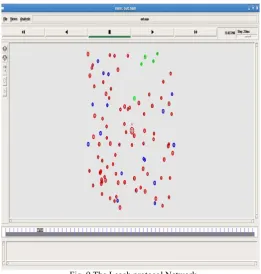
The network is deployed with 101 nodes and each of them communicates with each other by using Leach protocol.
Fig. 9 The Leach protocol Network
Table 4 Simulation Parameters
Then Leach-e-ga algorithm is implemented, we have selected the Base Station, Cluster heads and the normal nodes of each cluster. The base station or sink node (BS) is shown by red colour and 13 cluster heads are shown by blue colour and remaining nodes for the respective nodes are acting as cluster members for their respective cluster heads. During the simulation Sybil Attack nodes will be detected and removed from the network by using Leach-e-ga algorithm. And this will provide the required security to the network.
Fig. 10 Leach-e-ga algorithm
Then the transmission range is defined between the sensor nodes. And node 54 starts to communicate with node 93 and transfer the data.
Fig. 11 Transmission range of sensor nodes
Then the Elliptic curve cryptography is implemented to secure data transmission between the sensor nodes and to provide more security to the network.
Fig. 14 Elliptic curve cryptography to communicate between the nodes
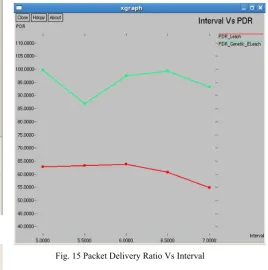
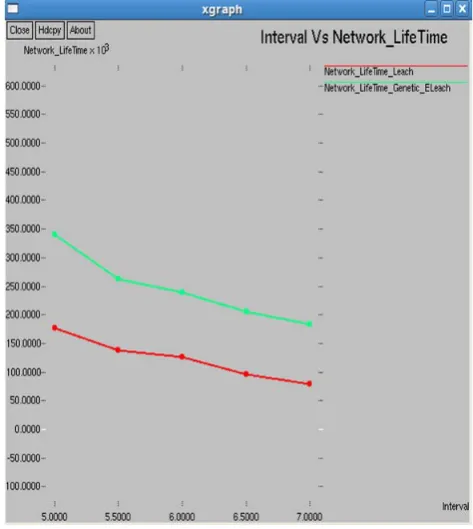
The following graphs show the improvements of network quality of service (Qos) parameters like Packet Delivery Ratio, Packet Drooping Ratio, Jitter, Throughput, Network Life Time and Security
ratio using RSA and ECC.
Fig. 15 Packet Delivery Ratio Vs Interval
Fig. 16 Drooping Ratio Vs Interval
Fig. 17 Jitter Vs Interval
Fig. 18 Throughput Vs Interval
Fig. 19 Network Life Time Vs Interval
Fig. 15 represents the graph plotted against Packet Delivery Ratio Vs interval considering the implemented methodologies. Fig. 16 represents the graph plotted against Drooping Ratio Vs interval, Fig. 17 represents the graph plotted against jitter Vs interval, Fig. 18 represents the graph plotted against Throughput Vs interval, Fig. 19 represents the graph plotted against Network Life Time Vs interval and Fig. 20 represents the graph plotted against Number of nodes Vs Security ratio using RSA and ECC for the implemented methodology.
The comparison between the ECC and RSA is represented in the following table 5:
Table 5 Comparison of RSA and ECC
Sr. No.
Parameters RSA ECC
1. Key Size Large Small
2. Security Weak Strong
3. Key Generation Fast
4. Encryption Fast Slow
5. Decryption Slow Fast
6. Power Usage High Low
7. Throughput Average High
8. Response Time Average
9. Latency High Low
10. Protocol Performance Average
EXPECTED
OUTCOME
Random Password Comparison [RPC] technique is added to leach-e-GA to provide more accuracy and thereby improve data transmission in the network also it will increase the throughput. RPC algorithm discovers a valid route in the sensor network by checking each node is a trustable node or a Sybil node so that the data can be transmitted very safely. The Sybil nodes are detected and data leakage is avoided completely by using RPC. As the Sybil nodes are detected in the discovery stage of finding initial route, they enable continuation of further transmission without any fear of attack.
V.
CONCLUSION
In wireless sensor networks, the energy limitations of nodes play a crucial role in designing any protocol for implementation. The wireless sensor networks continue to grow and become widely used in many applications. So, the need for security becomes vital. However, the wireless sensor network suffers from many constraints such as limited energy, processing capability, and storage capacity, etc. There are many ways to provide security, one is cryptography.
In this work, it is aimed to select nodes for clustering using LEACH-E-GA in order to improve the energy efficiency with trusted nodes. Before, clustering all the nodes are optimized by the Genetic Algorithm and LEACH-E do clustering and CH election. The nodes are optimized using their attributes such as
energy value, distance, and trust value.
Then we apply our cryptography scheme to provide security services in WSNs. Public Key based cryptographic schemes were introduced to remove the drawbacks of symmetric based approaches. In this work, we have studied two schemes ECC and RSA. At the analysis, it is found that Leach-e-ga with ECC is more advantageous compared to normal leach in terms of Network Qos like Packet Delivery Ratio, Packet Drooping Ratio, Jitter, Throughput, Network Life Time and Security ratio using RSA and ECC.
ECC is more advantageous compared to RSA, due to low memory usage, low CPU consumption and shorter key size compared to RSA. Though, the operations in RSA are comparatively faster than ECC. In RSA key generation and encryption are faster whereas decryption is slower. On the other hand in ECC key generation and encryption are slower whereas the decryption is faster. From this conclusion RSA is faster but it is said that security wise ECC is stronger than RSA.
Vi
.
FUTURE
WORK
Among varieties of routing schemes LEACH-E-GA along with ECC routing protocols offer better choices to researchers to achieve more improvements of Network efficiency and Network security. The best performance to provide security can be obtained by improving the existing system based on LEACH-E-GA with ECC for wireless sensor networks with the following approach of requirement of security level and selection of appropriate ECC parameters set, selection of cryptographic scheme and formats for network transfer of keys.
ACKNOWLEDGMENT
Foremost, I would like to express my sincere gratitude to lecturer J.E. Kamalasekaran for the continuous support during my work, for her motivation, enthusiasm, and immense knowledge. Her guidance helped me in all the time of research and writing of this research. I would like to thank the Department of Computer Engineering SCOE, especially the management Prof. M. P. Wankhade, Head of Computer Engineering Department and those members of Seminar Review committee for their input, valuable discussions and accessibility. In particular, I would like to thank Prof. M. P. Wankhadeand Prof. D.D. Gatade for their support, expertise and patience, Prof. G.T.Chavan, ME Coordinator he has been always there for guidance and give advice. I am deeply grateful to him for his continuous encouragement and guidance. I thank all my fellow lab mates and my friends in the college.
Last but not the least; I would like to thank my family: my parents, my wife for supporting, encouraging me spiritually throughout my life.
R
EFERENCES[1] Alakesh, B., & Umapathi, G. R. (2014). A Comparative Study on Advances in LEACH Routing Protocol for Wireless Sensor Networks. A survey International Journal of Advanced Research in Computer and Communication Engineering, 3(2).
[2] Bani, Y. M. et al. (2009). Improvement on LEACH Protocol of Wireless Sensor Network(VLEACH).
International Journal of Digital Content Technology and its Applications, 3(2).
[3] Batina, L., Mentens, N., Sakiyama, K., Preneel, B., Verbauwhede, I, “Low-cost elliptic curve cryptography for wireless sensor networks” Lecture Notes in Computer Science, 4357: 6 17, 2006. [4] Choi, K., Song, J., “Investigation of feasible cryptographic
algorithms for wireless sensor network”, 8th ICACT-2006, 2, 2006.
[5] Dr. Shu Yinbiao, Dr. Kang Lee, Mr. Peter Lanctot,” Internet of Things: Wireless Sensor Network” White Paper2014 International Electrotechnical Commission-IEC, China. (http://www.iec.ch).
[6] Elhoseny, M., Yuan, X., Yu, Z., Mao, C., El-Minir, H., Riad, A., 2014. Balancing energy consumption in heterogeneous wireless sensor networks using genetic algorithm. In: IEEE Commun. Lett. PP (99), 1.
[7] Fan, J., & Parish, D. J. (2007). Using a Genetic Algorithm to Optimize the Performance of a wireless Sensor Network. ISBN: 19025-6016-7 2007 PGNet.
[8]
Goldberg, D. et al. (1989). Messy genetic algorithms: Motivation, analysis, and first results. The Clearing house for Genetic Algorithms (TCGA), Report 89003.[9] http://shodhganga.inflibnet.ac.in/bitstream/10603/22912/7/07_ chapter_01.pdf
[10] Jai Prakash Prasad and Dr. Suresh Chandra Mohan “Security Enhancement of N-Tier Grid Protocol Using Elliptical Curve Cryptography for WSN” International Journal of Computer Networks and Wireless Communications (IJCNWC), Vol.5, No 6, December 2015, ISSN: 2250-3501
[11] Ms. Reena S. Satpute, Prof. R. S. Mangrulkar,and Prof. A. N. Thakare” Performance Analysis of Wireless Sensor Networks using Elliptical Curves Cryptography” B.D.C.O.E., Seagram Maharashtra, India- Pin Code-442001. International Journal of Engineering Research & Technology (IJERT) Vol. 3 Issue 7, July - 2014 ISSN: 2278-0181
[12] N. Gura, A. Patel, and A. Wander, "Comparing elliptic curve cryptography and RSA on 8-bit CPUs,"in Proceedings of the 2004 Workshop on Cryptographic Hardware and Embedded Systems (CHES), August 2004.
[13] Nguyen, D. T. et al. (2012). An Improved LEACH Routing Protocol for Energy-Efficiency of Wireless Sensor Networks. Smart Computing Review, 2(5).
[14] P. R. Gundalwar, Dr. V. N. Chavan,” A literature review on Wireless Sensor Networks (WSNs) and its Diversified Applications” International Journal of Advanced Research in Computer Science (IJARCS 2012), Volume 3, No. 7, Nov-Dec 2012 ISSN No. 0976-5697
[15] Petre-Cosmin, H. et al. (2010). Hierarchical Routing Protocol based on Evolutionary Algorithmsfor Wireless SensorNetworks. 9th RoEduNet IEEE International Conference 2010.
[16] Prabhjotkaur, Aayushi Chada, Sandeep Singh,” Review Paper of Detection and Prevention of Sybil Attack in WSN Using Centralizedids”, International Journal of Engineering Science And Computing (IJESC), July 2016, Volume 6 Issue No. 7 [17] R. Amuthavalli and R. S. Bhuvaneswaran, ”Genetic Algorithm
Enabled Prevention of Sybil Attacks for LEACH-E”, in Modern Applied Science Vol. 9, No. 9; 2015, Published by Canadian [18] Rupinder Singh, Dr. Jatinder Singh, and Dr. Ravinder Singh,”
SYBIL ATTACK COUNTERMEASURES IN WIRELESS SENSOR NETWORKS”, International Journal of Computer Networks and Wireless Communication, Vol.6, No 3, May-June 2016, ISSN: 2250-3501(IJCNWC 2016)
[19] S.Sharmila, G Umamaheswari. (2012). ”DETECTION OF SYBIL ATTACK IN MOBILE WIRELESS SENSOR NETWORKS”. INTERNATIONAL JOURNAL OF ENGINEERING SCIENCE ADVANCED TECHNOLOGY, Volume-2, Issue-2, 256, 262,ISSN: 22503676 (IJESAT 2012)
[20] Shankar, M. et al. (2012). Performance Evaluation of LEACH Protocol in Wireless Network. International Journal of Scientific & Engineering Research, 3(1).
[21] Shigenobu Sasaki, Sabah M. Ahmed, Mohammed Abo-Zahhad, and Nabil Sabor. “A New Energy-Efficient Adaptive Clustering Protocol Based on Genetic Algorithm for Improving the Lifetime and the Stable Period of Wireless Sensor Networks” International Journal of Energy, Information and Communications, Vol.5, Issue3 (IJEIC 2014)
[22] Shilpa Goyal, Ms. Nisha Pandey, Computer Science and Engineering Department Shri Ram College of Engg Mgmt Palwal, India, Detection and Mitigation of Sybil Attack by Implementing Extended Genetic Algorithm, in International Journal on Recent and Innovation Trends in Computing and Communication IJRITCC June 2016 Volume: 4 Issue: [23] Szczechowiak, P., Oliviera, L., Scott, M., Collier, M., Dahab, R.,
“NanoECC: Testing the limits of Elliptic Curve Cryptography in Sensor Networks EWSN 2008’, 4913: 305 320, LNCS, Springer- Verlag, 2008.
[24] Vikram, M., & Neena, G. (2012). Performance Analysis of QoS Parameters for Wimax Networks. International
Journal of Engineering and Innovative Technology (IJEIT), 1(5). [25] Wander, A., Gura, N., Eberle, H., Gupta, V., Shantz, S., “Energy
analysis of public-key cryptography for wireless sensor networks,” 3rd IEEE International Conference on Pervasive Computing and Communication, 2005.
[26] Wu, X. H., & Wang, S. (2010). Performance Comparison of LEACH and LEACH-C Protocols byNS2. Ninth International Symposium on Distributed Computing and Applications to Business, Engineering and Science.
[27] Yeh, H., Chen, T., Liu, P., Kim, T., Wei, H., “A Secured Authentication Protocol for Wireless Sensor Networks Using Elliptic Curves Cryptography”, Sensors, 4767-4779, 2011.
[
28] Yu, Y., Viktor, K., & Prasanna, B. K. (2006). Introduction to Wireless Sensor Networks. Information Processing and Routing in wireless sensor networks, World Scientific Publishing Co.,Pte.Ltd. Retrieved from http://www.worldscibooks.com/compsci/6288.html[3]
[4]
![Table 1. Wireless Sensor Networks Vs Ad hoc Networks [9]](https://thumb-us.123doks.com/thumbv2/123dok_us/7877480.1306892/2.595.301.550.281.562/table-wireless-sensor-networks-vs-ad-hoc-networks.webp)
![Fig. 6 Work flow [6] first and then elliptical curves cryptography. We have](https://thumb-us.123doks.com/thumbv2/123dok_us/7877480.1306892/9.595.66.271.70.203/fig-work-flow-elliptical-curves-cryptography.webp)