A practical forgery and state recovery attack on
the authenticated cipher PANDA-s
?Xiutao FENG, Fan ZHANG and Hui WANG
Key Laboratory of Mathematics Mechanization, Academy of Mathematics and Systems Science, CAS, China (e-mail: [email protected])
Abstract. PANDA is a family of authenticated ciphers submitted to CARSAR, which consists of two ciphers: PANDA-s and PANDA-b. In this work we present a state recovery attack against PANDA-s with time complexity about 241 under the known-plaintext-attack model, which
needs 137 pairs of known plaintext/ciphertext and about 2GB memories. Our attack is practical in a small workstation. Based on the above attack, we further deduce a forgery attack against PANDA-s, which can forge a legal ciphertext (C, T) of an arbitrary plaintext P. The results show that PANDA-s is insecure.
Keywords: CAESAR, PANDA, state recovery attack, forgery attack.
1
Introduction
Authenticated cipher is a cipher combining encryption with authentication, which can provide confidentiality, integrity and authenticity assurances on the data simultaneously and has been widely used in many network session proto-cols such as SSL/TLS [1, 2], IPSec [3], etc. Currently a new competition, namely CAESAR, is calling for submissions of authenticated ciphers [4]. This competi-tion follows a long tradicompeti-tion of focused competicompeti-tions in secret-key cryptography, and is expected to have a tremendous increase in confidence in the security of authenticated ciphers.
PANDA is a family of authenticated ciphers designed by D. Ye et al and has been submitted to the CAESAR competition [5]. PANDA consists of two ciphers: PANDA-s and PANDA-b, and both are based on a simple round func-tion. PANDA-s is similar to authenticated encryption (in short AE) with sponge structures [6] and is a mixture of a stream cipher and a MAC. PANDA-b is an online cipher like APE [7] with a permeation. In [8] Y. Sasaki et al present a forgery attack against PANDA-s under the condition of nonce reuse. It should be pointed that the nonce is usually a counter and is used once, thus it is easy to avoid launching Y. Sasaki et al’ attack in practice. As for PANDA-s, in this work we present a practical state recovery attack with time complexity about
?
241 under the known-plaintext-attack model, which needs 137 pairs of known
plaintext/ciphertext and about 2GB memories. What is more, based on the above attack, we further deduce a forgery attack against PANDA-s which can forge a legal ciphertext (C, T) of an arbitrary plaintextP. The results show that PANDA-s is insecure.
The rest of this paper is organized as follows: in section 2 we recall PANDA-s briefly, and in section 3 we provide a state recovery attack and an evaluation of the time, data and memory complexity of our attack. Finally we further deduce a forgery attack against PANDA-s in section 4.
2
Description of PANDA-s
In this section we recall PANDA-s briefly. Since our attack does not involve in the initialization and the process of associated data of PANDA-s, thus here we omit them, and more details of PANDA-s can be found in [5].
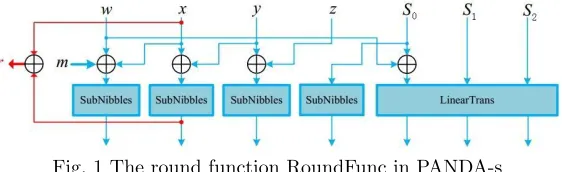
PANDA-s takes in a 128-bit key K, a 128-bit nonce N, a variable-length associated data A and a variable-length plaintext P and outputs a variable-length ciphertext (C, T), where T is a 128-bit authentication tag. The main part of PANDA-s is a round function RoundFunc, which is a bijection from an eight 64-bit-block input to an eight 64-bit-block output. The state of PANDA-s is seven 64-bit blocks, which is a part of the input and output of RoundFunc. RoundFunc consists of four non-linear transformations SubNibbles and a linear transformation LinearTrans, as shown in Fig. 1.
Fig. 1 The round function RoundFunc in PANDA-s
Let (w, x, y, z, S0, S1, S2, m) and (w0, x0, y0, z0, S00, S10, S02, r) be the input and
the output of RoundFunc respectively. Then the specific process of RoundFunc is defined as follows:
RoundFunc(w, x, y, z, S0, S1, S2, m)
w0←SubNibbles(w⊕x⊕m)
x0←SubNibbles(x⊕y) y0 ←SubNibbles(y⊕z) z0←SubNibbles(S0)
(S00, S10, S20)←LinearTrans(S0⊕w, S1, S2)
r←x⊕x0
2.1 SubNibbles
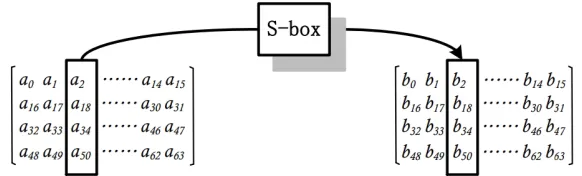
SubNibbles is a nonlinear transformation from a 64-bit input to a 64-bit output, and is shown in Fig. 2. Leta0a1· · ·a63andb0b1· · ·b63be the input and the
out-put of SubNibbles respectively. Thenbibi+16bi+32bi+48 =S(aiai+16ai+32ai+48),
whereS(·) represents a 4×4 S-box and is defined as in [5],i= 0,1,· · ·,15.
Fig. 2 SubNibbles acts on the individual columns of its input block
2.2 LinearTrans
The linear transformation uses the operations of a finite field. The finite field
F264 is defined by an irreducible polynomialp(x) =x64+x30+x19+x+ 1, i.e., F264 =F2(θ), where θ is a root of p(x). The block a0a1· · ·a63 corresponds to
a0+a1θ+· · ·+a62θ62+a63θ63∈F264. The linear transformation LinearTrans is defined as LinearTrans(S0, S1, S2)=(S0, S1, S2)A, where the matrix
A=
0 1 0 0 0 1 1α α+ 1
7
andα=θ32∈
F264.
2.3 Encryption
Letp0p1· · ·pm−1 be the plaintext and statebe the internal state of PANDA-s
after initialization. Then the encryption is described as below: (state, r)←RoundFunc(state,0)
fort= 0 tom−1 ct←pt⊕r
(state, r)←RoundFunc(state, pt)
2.4 The tag T
Usetemptito updatestatewith RoundFunc 14 times, and then output the XOR
of some of state bits as the authentication tagT, wheretempti=adlen wheni
the associated data and the plaintext repectively. More specifically, fori= 0 to 13
state←RoundFunc(state, tempti)
T ←(w⊕y, x⊕z)
3
A state recovery attack on PANDA-s
In this section we assume that an attacker has known a phase of the plaintextpt+i
corresponding to the ciphertextct+iafter timet≥0, wherei= 0,1,· · ·, m−1,
andmis large enough for the attacker to launch his attack. Sincert+i=pt+i⊕
ct+i for i ≥ 0, thus the attacker knows the key words {rt+i}0≤i≤m−1 as well.
Below we first introduce some notations.
Let (w, x, y, z, S0, S1, S2) be the registers of PANDA-s and (wt, xt, yt, zt, S0,t,
S1,t, S2,t) be the state of these registers at time t ≥0. For an arbitrary 64-bit
wordx=x0x1· · ·x63, we denote
x[j] =xjxj+16xj+32xj+48,
where 0 ≤j ≤15. Observe the update of the state of PANDA-s, and we have the following conclusion:
Lemma 1 1. If xt[j] is known for some 0 ≤ j ≤ 15, then all the sequences
{xt+i[j]}i≥0,{yt+i[j]}i≥0,{zt+i[j]}i≥0 and{S0,t+i[j]}i≥0 are known; 2. If both xt[j] and wt[j] are known for some 0 ≤ j ≤ 15, then the sequence
{wt+i[j]}i≥0 is known.
Proof. It is noticed thatxt+i+1[j] =xt+i[j]⊕rt+i[j] for anyi≥0, thus we have
xt+i+1[j] =xt[j]⊕ i M
k=0
rt+k[j].
Ifxt[j] is known, then the whole sequence{xt+i[j]}i≥0is known.
By the definition of the SubNibbles, we have
yt+i[j] =S−1(xt+i+1[j])⊕xt+1[j], (1)
zt+i[j] =S−1(yt+i+1[j])⊕yt+1[j], (2)
S0,t+i[j] =S−1(zt+i+1[j]), (3)
thus the sequences {yt+i[j]}i≥0,{zt+i[j]}i≥0and{S0,t+i[j]}i≥0are known.
Item 2 follows directly fromwt+i+1[j] =S(wt+i[j]⊕pt+i[j]⊕xt+i[j]) for any
3.1 A state recovery attack
In this section we will provide a state recovery attack against PANDA-s. The details are described as below:
1. Get equations on{wt+i}i≥0 and {S0,t+i}i≥0.
By the definition of the LinearTrans, we need only three equations got at three distinct times to eliminate the variablesS1,t andS2,t. More precisely,
the process is shown below:
First we get three equations at timet+ 1,t+ 2 and t+ 2:
S0,t+1= (S0,t⊕wt, S1,t, S2,t)Ae1, (4)
S0,t+2= ((S0,t⊕wt, S1,t, S2,t)A2+ (wt+1,0,0)A)e1, (5)
S0,t+3= ((S0,t⊕wt, S1,t, S2,t)A3+ (wt+2,0,0)A+ (wt+1,0,0)A2)e1, (6) wheree1= (1,0,0)0 is a basic column vector.
Second, we eliminate the variablesS1,t and S2,t from the above equations
and get
wt+2⊕C5wt+1⊕C6wt=C0, (7)
whereC0=C1S0,t+3⊕C2S0,t+2⊕C3S0,t+1⊕C4S0,t, andC1, C2,· · · , C6are
constants as defined in Appendix A.
2. Find a multiple ofx2⊕C
5x⊕C6 with coefficients 0 or 1.
It is noticed that the computation of the S-boxes in the SubNibbles can be done in parallel, we need to find a nonzero multiple ofx2⊕C5x⊕C6 with
coefficients 0 or 1 inF264 in order to solve equation (7) faster. Indeed we do it easily. One can check the following polynomialf(x)
f(x) =M
i∈I
xi
such thatx2⊕C5x⊕C6|f(x), where
I={ 0, 4, 6, 7, 8, 10, 11, 14, 15, 17, 18, 19, 21, 23, 26, 30, 31, 32, 33, 34, 35, 37, 39, 43, 45, 46, 47, 49, 50, 51, 52, 55, 59, 61, 63, 64, 67, 68, 70, 72, 73, 74, 77, 78, 79, 83, 85, 89, 91, 94, 96, 97, 99,100,101, 103,105,106,107,108, 109,110,112,113,115,117, 118,119,122,124,125,127}.
So we have
M
i∈I
wt+i =Ct, (8)
where Ct is a linear relation of S0,t+i (i = 0,1,· · ·127), or is viewed as an
3. Set up the tablesTj in order to solvewt and xt faster.
SetWt=Li∈Iwt+i. First we subdivide equation (8) into 16 equations:
Wt[j] =Ct[j], 0≤j≤15. (9)
For each equation, for example j, by Lemma 1, the left Wt[j] depends on
wt[j] andxt[j], and the right Ct[j] depends onxt[j] (j = 0,1,· · ·,15). Let
k be a positive integer such thatk ≤ 15. We consider the case j = 0 and further rewriteCt[0] as below:
Ct[0] =Ft⊕Gt,
where Ft relies on S0,t+i[0], S0,t+i[1],· · · , S0,t+i[k−1], that is, xt[0], xt[1],
· · ·,xt[k−1], andGtrelies onS0,t+i[k], S0,t+i[k+ 1],· · ·, S0,t+i[15], that is,
xt[k], xt[k+ 1],· · · , xt[15], 0≤i≤15. Hence we have
Wt[0] =Ft⊕Gt.
Considerk+ 1 successive times t, t+ 1,· · ·,t+k, and we get an equation system
Wt[0]⊕Ft=Gt
Wt+1[0]⊕Ft+1=Gt+1
· · ·
Wt+k[0]⊕Ft+k−1=Gt+k
(10)
and write it asE(wt[0], xt[0],· · ·, xt[k−1]) = (Gt, Gt+1,· · ·Gt+k) in short.
For any (k+ 1)-tuple (Gt, Gt+1,· · ·, Gt+k), we set up a table T0 to record
(wt[0], xt[0],· · ·, xt[k−1]), where
E(wt[0], xt[0],· · · , xt[k−1]) = (Gt, Gt+1,· · ·Gt+k).
On the other hand, for any 1≤j ≤ 15, we set up a tableTj whose input
is (xt[j], Ct[j]) and output iswt[j], wherewt[j], xt[j], Ct[j] meet equation (9).
4. Recover the state by looking up the tables Tj.
After the tablesTjare set up, we can recover the state (wt, xt, yt, zt,S0,t, S1,t,
S2,t) by looking up the tablesTj. More precisely, the process is shown below:
(a) FOR each possible value of (xt[k],· · · , xt[15]), DO:
(b) Compute the (k+ 1)-tuple (Gt,· · ·, Gt+k); Look up the table T0 to
recoverwt[0] andxt[0],· · · , xt[k−1];
(c) Recoveryt,zt,S0,t and computeCtbyxt;
(d) Look up the tableTj to recover wt[j] byxt[j] andCt[j] for 1≤j≤15;
(e) RecoverS1,tand S2,tby the LinearTrans.
(f) Check whether the recovered state (wt, xt, yt, zt,S0,t, S1,t, S2,t) is correct
3.2 The time, data and memory complexity
In our attack we take k = 6. The most time-consuming operations in our attack mainly include the establishment of the table T0 and the traversal of
(xt[6],· · · , xt[15]). As for the former, namely, establishing the tableT0, we first
set up a temporary table temp which records (wt[0], xt[0], xt[1], xt[2]) for any
(G0t, G0t+1, G0t+2, G0t+3), where (wt[0], xt[0], xt[1], xt[2]) meets the following
equa-tions:
Wt[0]⊕Ft0=G0t
Wt+1[0]⊕Ft0+1=G0t+1
Wt+2[0]⊕Ft0+2=G0t+2
Wt+3[0]⊕Ft0+3=G0t+3
,
where Ft0 means an expression only on xt[0], xt[1], xt[2] split from Ft. At the
worst case, for any (G0t, G0t+1, G0t+2, G0t+3), we go through all possible values of (wt[0], xt[0], xt[1], xt[2]) and get the correct one, whose time complexity is at
most (24×4)2= 232. Second, we set up the tableT
0by means of the temporary
ta-bletemp. For any (Gt,· · ·, Gt+6), we guess the possible value of (xt[3], xt[4], xt[5])
and look up the temporary tabletempto recover (wt[0], xt[0], xt[1], xt[2]). Then
we further check whether the recovered solution (wt[0], wt[0],· · ·, wt[5]) meets
the rest 3 equations in (10) or not, and record the correct one. The time complex-ity of the second step is about 24×(3+7) = 240. Finally we delete the temporary
table tempas soon as the tableT0 is set up. Thus the total time complexity of
setting up the table T0 is about 240+ 232≈240. As for the latter, namely, the
traversal of (xt[6],· · · , xt[15]), since it has totally 24×10 = 240 possible values,
thus the time complexity of the traversal of (xt[6],· · ·, xt[15]) is about 240. So
the total time complexity of our attack is about 240+ 240= 241.
As for the data complexity, in order to compute Gt, we need to compute
S0,t+i[6],· · ·, S0,t+i[15] (i = 0,1,2,· · · ,127). The latter needs about 131 pairs
of known plaintext/ciphertext. Further we need more 6 pairs of known plaintex-t/ciphertext for computing Gt+1,· · ·, Gt+6. Thus we need totally 137 pairs of
known plaintext/ciphertext, and it is very low.
As for the memory complexity, in order to store the tableT0, we need about
7×24×7B≈231B = 2GB memories, and store the tablesTj (j = 1,2,· · ·,15),
we need 15×28B<4KB. Thus the memory complexity is about 2GB.
4
A forgery attack
since the update of the state of PANDA-s is invertible, he further recovers the initial state of PANDA-s in the process of encryption and decrypts the ciphertext Cto get the whole plaintextP; finally, the attacker chooses an arbitrary plaintext P0 and encrypts them with the recovered initial state to get C0 and further generates the tagT0. The attacker sends the message (C0, T0) to a legal receiver (note: he has the legal secret key). The receiver decrypts C0 and verifiesT0 to getP0.
References
1. A. Frier, P. Karlton, and P. Kocher, The SSL 3.0 Protocol, Netscape Commu-nications Corp., 1996. http://home.netscape.com/eng/ssl3/ssl-toc.html. 2. T. Dierks and C. Allen, The TLS Protocol, RFC 2246, 1999.
3. S. Kent and R. Atkinson, Security Architecture for the Internet Protocol, RFC 2401, 1998.
4. CAESAR: http://competitions.cr.yp.to/index.html.
5. PANDA v1: D. Ye, P. Wang, L. Hu, L. Wang, Y. Xie, S. Sun, P. Wang, submission to CAESAR, available from: http://competitions.cr.yp.to/round1/pandav1.pdf. 6. G. Bertoni, J. Daemen, M. Peeters, G. Assche, Duplexing the sponge: Single-pass authenticated encryption and other applications, SAC 2011, LNCS 7118, pp. 320-337, 2011.
7. E. Andreeva, B. Bilgin, A. Bogdanov, A. Luykx, B. Mennink, N. Mouha, K. Ya-suda, APE: Authenticated permutation-based encryption for lightweight cryp-tography, http://eprint.iacr.org/2013/791.
8. Y. Sasaki and L. Wang, A Forgery Attack against PANDA-s,
http://eprint.iacr.org/2014/217.
A
The constants
C
1, C
2,
· · ·
, C
6The bit representation is with regard to the primitive element θ, and the most significant bit is at the left.
C1=1000001101110000100010001100100001011000011010000001001101001001
C2=1110010101000110011111001001101111011101111110011110011001011000
C3=0011100010111000001010101111110111000011110100011001100101011001
C4=1000001101110000100010001100100001011000011010000001001101001001
C5=1100110000010111011110011111000010001000110010110001110011110011