AGO Field Manual
Dartmouth College LF-HF Receiver
1
1 Introduction
Many studies of radiowave propagation have been performed in the LF/MF/HF radio bands, but relatively few systematic surveys have been made of natural emissions in this part of the spectrum. The predominance of man-made signals in this frequency range requires a remote location and a radio receiver of specialized capabilities in order to search for natural emissions. For instance, a receiving system must be capable of both detecting very weak signals, and be able to step around or null out the known sources of interference, such as AM broadcast stations. Furthermore, a receiving system must be able to operate at remote locations with only limited human intervention.
The Automatic Geophysical Observatory (AGO) receiver was designed to run unattended for periods as long as one year constrained by severe power and data acquisition limitations.
2 Radio Receiving General Principles
3
3 Antenna and Preamplifier
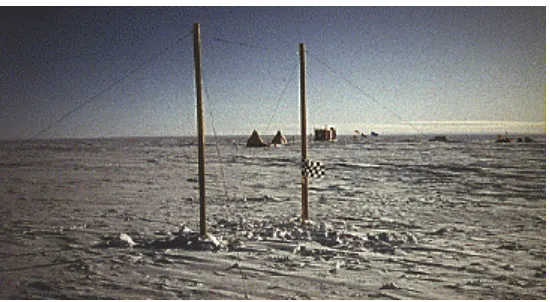
The AGO LF/MF/HF receiver employs a magnetic loop antenna which is less susceptible to locally generated noise than an electric dipole, especially when oriented to null out the strongest local signal. The loop consists of a single turn of wire arranged in a square between two vertical 12-foot-long 4 x4 posts placed 3 m apart. One horizontal wire runs along the snow, and the other connects the tops of the posts, so that the area of the loop antenna is 10 square meters. Figure 3 shows the antenna as deployed at AGO-P2. The preamplifier is buried in the snow at the base of the antenna, with a pole or flag installed to make it easy to retrieve. A schematic of the most recent version of the preamplifier is included in the schematics portion of this manual. A critical component of the preamplifier is the calibration circuit, which allows the absolute level of the received signals to be calibrated. For this purpose, a broadband calibration signal designed to be near the top of the instrument s range is injected approximately hourly. This signal is detected by the receiver with its nominal gain, and then detected with the gain reduced by 20 dB. Using both of these detections, the gain and offset of the instrument can be accounted for, and the signals from the various AGO s can be compared. Figure 2 shows the effective calibration circuit. (The 600-Ohm resistor represents the input impedance of the preamplifier.)
The voltage at the antenna terminals of the loop antenna is related to the electric field of the impinging EM radiation:
dt dE c A
V = (1)
where A is the antenna area (10 m2), E is the electric field strength, and c is the velocity of light. Assuming that the antenna can be considered a perfect inductor at the
frequencies of interest,
dt dI L
V = (2)
where I is the current in the antenna, this leads to the following relation after integration
E c A
4
5
If a calibration resistor Rcal is placed in series with the antenna such that I =VcalRcal, the calibration voltage (voltage at the antenna terminals) becomes
E cL AR
V cal
cal = (4)
For our 102 loop antenna, the electric field strength (V/m) and Vcal are related through the following equation,
cal
V
E=0.01 (5)
which was obtained by substituting the appropriate measured quantities into the above equations.
The least detectable signal of this receiving system corresponds to Vcal ≈50µV . Therefore, the power spectral density of the received signal at the loop antenna is
2 1
/
5nV mHz , assuming a 10 kHz bandwidth.
4 Receiver
The AGO LF/MF/HF receiver is located in the observatory, 300-500 feet distant from the antenna. Figure 4 shows a block diagram of the AGO receiver. Power from the DAU comes in on the specified connector and is converted to the required ±10 Volts and ±5 Volts DC on the power supply board. The mixing of the signals occurs on the receiver board; the LO signal used in the mixing is produced on the local oscillator board. The signals are compressed and prepared for the DAU on the compression board.
7
The receiver as currently configured measures 116 frequencies from 30 kHz to 4.5 MHz. The frequencies are not spaced linearly but are arranged to optimize reception of known natural signals such as auroral hiss and auroral roar. Furthermore, the
frequencies are arranged in two sets of 58 frequencies with each of these subsweeps ranging from the low end of the frequency range to the high end but consisting of
frequencies slightly offset. Using sub subsweeps provides higher effective time resolution for detection of relatively broadband signals. Table 1 at the end of this section gives the list of the 116 frequencies sampled. The 58 frequencies in the left column are sampled first, then the 58 frequencies in the right column are sampled. The 20-Hz data rate (with compression) implies that a full sweep of 116 frequencies is obtained each 5.8 s, and a subsweep of 58 frequencies is obtained each 2.9 s.
Data compression is critical to the performance of the AGO LF/MF/HE receiver. The compression works by transmitting periodically a reference sweep of 120 bytes which provides 8-bit measurements of the logarithm of the received signal strength of each of the 116 frequencies (plus two sync-byte plus two filler bytes). Following the reference sweep, 44 delta-sweeps are transmitted. In these, only the change in each signal strength is transmitted, compressed to a 4-bit number. Hence these 44 sweeps are require only 2640 bytes (44 times 60; two sync-bytes are attached to each delta-sweep). Following these delta sweeps, another reference is transmitted (which requires 120 bytes), then 44 more delta-sweeps, and so on. Once an hour, a calibration sweep is performed, consisting of 120 bytes: an 8-bit sample of the calibration signal at each of the 116 frequencies, with the receiver at full gain for even samples and with gain reduced by 20 dB for the odd samples; plus two unique sync-bytes, plus two filler bytes. Thirteen blocks consisting of a reference and 44 delta-sweeps are transmitted between each calibration sweep; the result is a package of 36000 bytes transmitted to the DAU every hour, providing exactly the quantity of data (0.1 byte per second) allotted to the
LF/MF/HF receiver.
8
The output of the receiver is available as an analog signal on the front of the receiver box, and instructions in this manual tell how a two-channel oscilloscope can be used to produce an image on the screen of power versus frequency. Furthermore, a computer program has been written for DOS, which decodes the digital output of the receiver and produces a power-versus-frequency plot on the computer screen, which updates in real time. To use this program, the digital output of the receiver must be connected to the serial input of the computer. Figure 5 shows an example of a spectrum generated using this program in combination with one of the AGO LF/MF/HF receivers in the lab at Dartmouth. A version of this program is being prepared which will review a file of LF/MF/HF data extracted from the DAU. If a file can be produced which contains sequentially the bytes provided by the LF/MF/HF receiver, these bytes can be decoded and displayed on the screen as power versus frequency, updated either by the operator or at a rate fixed to the computer clock. All three of these tools will enable the operators in the field to determine whether the receiver is functioning.
10
Table 1: Sequence of frequencies measured in the current version of the AGO LF/MF/HF Receiver. The sequence runs down the first column, then down the second column (116 frequencies total). All Frequencies in