Progress In Electromagnetics Research Letters, Vol. 85, 131–135, 2019
Performance Evaluation of OADM for Super Dense Wavelength
Division Multiplexing System
Chakresh Kumar1, * and Ghanendra Kumar2
Abstract—Performance of optical add-drop multiplexer (OADM) for 400 channels with data rate of 20 Gbps for super dense wavelength division (SD-WDM) multiplexing system has been investigated in terms of varying transmission distance from 50 km to 250 km and 80 km to 240 km for enhancing optical communication. Long haul amplification is maintained by RAMAN-EDFA hybrid optical amplifier (HOA). Evaluation is carried out in terms of bit error rate (BER) and dispersion.
1. INTRODUCTION
Fiber nonlinearity and generating miss matching signals such as cross phase modulation (XPM), self-phase modulation (SPM), four-wave mixing (FWM), and cross talk are the main issues in super dense wavelength division multiplexing (SD-WDM) system, which have been resolved at major level using hybrid optical amplifier (HOA) with dispersion management techniques to enhance the system capacity for better communication. In recent year, a model for crosstalk analysis has been evaluated to examine the impact of power penalty with received low power. In fact, as the load on optical networks steadily grows, demand of new super dense optical fiber infrastructure is required for maintaining data traffic with negligible effect of unwanted signals. So many research groups intend to enhance transmission pattern with different aspects [1, 2]. The required flexible super dense optical nodes must be capable to deliver terabit per second of data for future super dense communication systems [3]. Different super channel systems are recommended with small spectral guard band for future optical network to maintain the least effect of crosstalk and dispersion for long haul super dense optical communication system [4– 12]. Performance of super dense channel is further upgraded using high performance optical filter with guardband as in [4] for maintaining high quality signals [13, 14].
Optical add-drop multiplexers (OADMs) with optical switches are advanced routing circuit technology with low power consumption for next generation MANs [15–18].
In this paper for the first time to the best of my knowledge, performance of OADM for a super dense wavelength division multiplexing (SD-WDM) system has been evaluated using hybrid optical amplifier (HOA) for a long haul optical communication system. Structure of this paper is given with description of experimental setup in Section 2, discussion of result in Section 3, and final outcome with analysis in Section 4, respectively.
2. SETUP
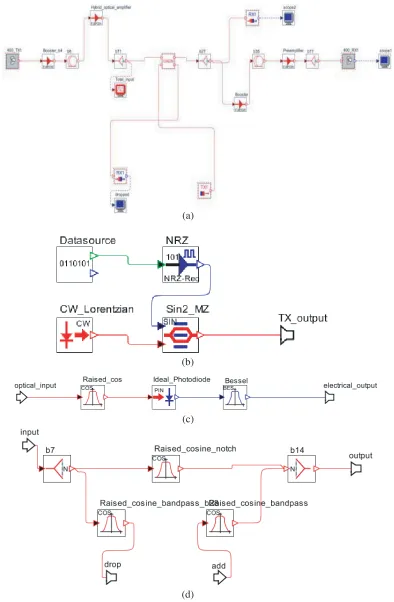
Experimental setup of 400 channels with data rate of 20 Gbps for super sense wavelength division multiplexing (SD-WDM) system is shown in Fig. 1 with arrangement of different internal components. Channels spacing is set at 25 GHz with guardband between channels to overcome the effect of crosstalk
Received 25 February 2019, Accepted 25 June 2019, Scheduled 8 July 2019 * Corresponding author: Chakresh Kumar ([email protected]).
1 University School of Information, Communication & Technology, Guru Gobind Singh Indraprastha University, New Delhi 110078,
(b)
(c)
(d) (a)
and intersymbol interference (ISI). Signal is modulated with the help of CW laser source for single transmitter. In this way, 400 channels are arranged in compound component which is shown in Fig. 1(a). A combination of RAMAN-EDFA hybrid optical amplifier (HOA) with suitable pump power at 980 nm is placed in optical medium for uniform amplification. Basic parameters of HOA are arranged as range of gain operation up to 17 dB with eye safety 1M using RS232 or 12C communication protocols.
OADM is placed after the distance of 25 km for add and drop signals using transmitter and receiver. Drop signal is traced using PIN photodiode with a low-pass filter, and for adding the signal, same set of components which are shown in Fig. 1(b) is placed at OADM. Internal arrangements of receiver and OADM are shown in Fig. (c) and Fig. (d), respectively.
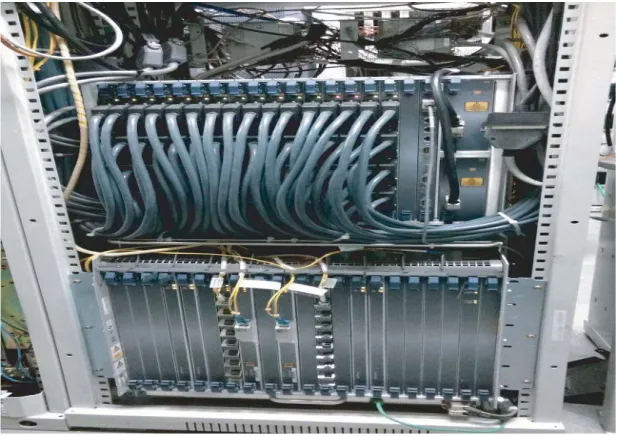
In fact, this research is devoted to analysis of the effect of proposed approach with the support of HOA from 400 channels experimental setup which is shown in Fig. 4. Further, internal arrangement of this research is also shown in Fig. 1 for exploration and help to the researcher.
3. RESULT AND DISCUSSION
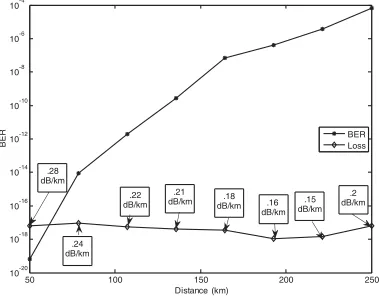
Performance of the proposed system in terms of bit error (BER) rate with respect to transmission distance has been analyzed from Fig. 2 to Fig. 3. BER is the prime parameter for super dense optical system which directly and indirectly influces the transmission performance. Least value of BER directly indicates the outcome in terms of better quality factor with good rating eye opening. It is observed from the outcome of Fig. 2 and Fig. 3. Further, BER decreases due to HOA with increasing the transmission distance. Acceptable rating is maintained at distances of 240 and 250 km with dispersion rating of .02 dB/km and .2 dB/km, respectively. This indicates a better transmission communication for long haul distance.
50 100 150 200 250
10-20 10-18 10-16 10-14 10-12 10-10 10-8 10-6 10-4
Distance (km)
BE
R BER
Loss
.15 dB/km .22
dB/km .28
dB/km
.24 dB/km
.21
dB/km dB/km.18 .16
dB/km
.2 dB/km
80 100 120 140 160 180 200 220 240 10-26
10-24 10-22 10-20 10-18 10-16 10-14 10-12 10-10 10-8 10-6
Distance (km)
BER
BER Loss
.26 dB/Km
.25 dB/Km
.22 dB/Km
.01 dB/Km
.02 dB/Km
.20 dB/Km .24 dB/Km
Figure 3. Bit error rate (BER) with respect to transmission distance from 80 km to 240 km.
Figure 4. Experimental set up for OADM system for 400 channels.
4. CONCLUSION
REFERENCES
1. Liu, X., S. Chandrasekhar, and P. J. Winzer, “Digital signal processing techniques enabling multi-Tb/s superchannel transmission: An overview of recent advances in DSP-enabled superchannels,” IEEE Signal Process. Mag., Vol. 31, No. 2, 16–24, Mar. 2014.
2. Xia, T. J., S. Gringeri, and M. Tomizawa, “High-capacity optical transport networks,” IEEE Commun. Mag., Vol. 50, No. 11, 170–178, Nov. 2012.
3. Sano, A., H. Masuda, E. Yoshida, T. Kobayashi, E. Yamada, Y. Miyamoto, F. Inuzuka, Y. Hibino, Y. Takatori, K. Hagimoto, T. Yamada, and Y. Sakamaki, “30 ×100-Gb/s all-optical OFDM transmission over 1300 km SMF with 10 ROADM nodes,”Eur. Conf. Opt. Commun., Paper PD.1.7, Berlin, Germany, 2007.
4. Chen, Y., J. Li, C. Zhao, L. Zhu, F. Zhang, Y. He, and Z. Chen, “Experimental demonstration of ROADM functionality on an optical SCFDM superchannel,”Photon. Technol. Lett., Vol. 24, No. 3, 215–217, 2012.
5. Goldfarb, G., G. Li, and M. G. Taylor, “Orthogonal wavelength division multiplexing using coherent detection,”Photon. Technol. Lett., Vol. 19, No. 24, 2015–2017, 2007.
6. Sano, A., E. Yamada, H. Masuda, E. Yamazaki, T. Kobayashi, E. Yoshida, Y. Miyamoto, R. Kudo, K. Ishihara, and Y. Takatori, “No-guard-interval coherent optical OFDM for 100 Gb/s long-haul WDM transmission,”J. Lightw. Technol., Vol. 27, No. 16, 3705–3713, Aug. 2009.
7. Shieh, W. and C. Athaudage, “Coherent optical orthogonal frequency division multiplexing,” Electron. Lett., Vol. 42, No. 10, 587–589, 2006.
8. Ellis, A. D. and F. C. G. Gunning, “Spectral density enhancement using coherent WDM,” Photon. Technol. Lett., Vol. 15, No. 2, 504–506, 2005.
9. Poti, L., G. Meloni, G. Berrettini, F. Fresi, M. Secondini, T. Foggi, G. Colavolpe, E. Forestieri, A. D’Errico, F. Cavaliere, R. Sabella, and G. Prati, “Casting 1 Tb/s DP-QPSK communication into 200 GHz bandwidth,” Eur. Conf. Exhib. Opt. Commun., Paper P4.19, Amsterdam, The Netherlands, 2012.
10. Palkopoulou, E., G. Bosco, A. Carena, D. Klonidis, P. Poggiolini, and I. Tomkos, “Nyquist-WDM-based flexible optical networks: Exploring physical layer design parameters,” J. Lightw. Technol., Vol. 31, No. 14, 2332–2339, Jul. 2013.
11. Bosco, G., V. Curri, A. Carena, P. Poggiolini, and F. Forghieri, “On the performance of Nyquist-WDM terabit superchannels based on PM-BPSK, PM-QPSK, PM-8QAM or PM-16QAM subcarriers,”J. Lightw. Technol., Vol. 29, No. 1, 53–61, Jan. 2011.
12. Pincemin, E., M. Song, J. Karaki, A. Poudoullec, N. Nicolas, M. Van der Keur, Y. Jaouen, P. Gravey, M. Morvan, and G. Froc, “Multiband OFDM transmission with sub-band optical switching,”Eur. Conf. Opt. Commun., Paper Th.2.A.1, London, UK, 2013.
13. Winzer, P. J., “An opto-electronic interferometer and its use in subcarrier add/drop multiplexing,” J. Lightw. Technol., Vol. 31, No. 11, 1775–1782, Jun. 2013.
14. Taylor, M. G., “Coherent optical channel substitution,” U.S. Patent 8 050 564, Nov. 1, 2011. 15. Zervas, G., et al., “Multi-granular optical cross-connect: Design, analysis, and demonstration,”
IEEE/OSA J. Opt. Commun. Netw., Vol. 1, No. 1, 69–84, Jun. 2009.
16. Furukawa, H., H. Harai, T. Miyazawa, S. Shinada, W. Kawasaki, and N. Wada, “Development of optical packet and circuit integrated ring network testbed,”Opt. Exp., Vol. 19, No. 26, B242–B250, Dec. 2011.
17. Chiaroni, D., et al., “Packet OADMs for the next generation of ring networks,”Bell Labs Tech. J., Vol. 14, No. 4, 265–283, 2010.