Available online: https://edupediapublications.org/journals/index.php/IJR/ P a g e | 2860
Analysis of Prevalence of LBP effects of selecting some specific sports
professionals and spinal mobilization exercise
THANVIR AHAMMED T and Dr. JASMINE ANANDABAI
OPJS University, Churu, Rajasthan-India
Abstract
This study aimed at muscles activation analysis of lower Back pain (LBP) and spinal
mobilization’ that cervical mobilization permits early treatment by means of gentle oscillatory
movements which have the effect of decreasing muscle spasm and pain and thus gradually
improving mobility. The main goal of preventive or rehabilitation programme is to “attain
adequate musculoligamentous control of lumbar spine forces to eliminate repetitive injury to the
intervertebral discs, facet joints, and related structures. The emphasis is on training with specific
lumbar stabilization exercise incorporating muscle fusion to protect the motion segments from
repetitive microtrauma and excessive loads.
Keywords: LBP, Range of motion (ROM).
1 Introduction:
Pain is an "unpleasant sensory and emotional experience associated with actual or potential
tissue damage." In chronic pain, the sensorial process becomes abnormal, leading to detectable
changes in central nervous system data processing, motor control, and the experience of pain
itself. Pain may lead a person to stop working or exercising. Recent studies reveal the beginning
exerciser to be more likely to be injured due to initial poor shape and mistakes in conditioning. If
there is a desire to compete, it is the athlete in transition from level to level of competition that is
at greatest risk. Injury risk also doubles in changing from an alternating to everyday exercise
program me. Heavy framed men with poor flexibility and tight muscles.
Sport injury rehabilitation
Exercise is a vital part of the rehabilitation process for most sporting injuries. The idea that an
Available online: https://edupediapublications.org/journals/index.php/IJR/ P a g e | 2861 outdated. Instead, when athletes visit physios, in conjunction with receiving a course of
treatment, they will be set specific strengthening and flexibility exercises. Exercises are included
in rehabilitation programmes to ensure the injury site returns to a fully functional state and/or to
ensure that the original cause of the injury is eliminated.
2. Analysis of Specific sports
Baseball
Studies examining the incidence and distribution of baseball injuries are limited, despite the
popularity and large number of participants at all level. Spine injury in baseball may result from
head-first slides, sudden twists, improper swing mechanics, or sudden bursts of muscular
activity. The most common diagnosis was back muscle strains and spondylolysis. In their 3 year
analysis, 12 players were treated for LBP and six lost time from their sport. The investigators
stated that defining injury as time lost or as altered participation underestimates the actual
occurrence of injury.
Basketball
Back injury is one of the commonest injuries in basketball players. A rudimentary analysis
suggests that basketball requires running, cutting, jumping, landing, twisting and physical
contact. It was noted that in players in the National Basketball Association the knee and ankle
injuries ranked number one and two respectively. In a 5 year retrospective study of female
basketball athletes found that injuries to the lumbar spine was the second most frequently
occurring injury. The researcher suggested that the high incidence of low back injury occurring
in this study might be due to the elite nature of the squad and the emphasis placed on weight and
strength training.
Football
The game of football presents many opportunities for different types of injuries to the lumbar
spine. Repetitive flexion, extension, and torsion stresses to the lumbar spine predispose the
Available online: https://edupediapublications.org/journals/index.php/IJR/ P a g e | 2862 stresses from a variety of directions; therefore, the type of lumbar spine injury is dependent on
not only the point of impact but also the direction and magnitude of force. It has been estimated
that up to 30% of football players lose playing time because of LBP.
Golf
Low back pain is a common golf-related injury in amateurs. In a survey reported that back
problems announced for nearly half of all ailments. Low back pain is also the most common area
of complaint among male golfers. 90% of the professional golfer’s tour injuries involve the
cervical or lumbar spine. In the ladies golfer, injury to the spine ranked second, with injury to the
wrist as the most prevalent injury. It should be noted, however, that stress fractures of the ribs in
golfers may sometimes be incorrectly diagnosed as back strain.
Gymnastics
In a prospective study conducted in this research, it was found that the body part most frequently
injured in competitive female gymnasts was wrist; however, the second most frequently injured
body part was the lower back. Most of these gymnastic injuries were classified as repetitive
stress or overuse injuries. Although most of the researchers in gymnastics concerns LBP in
female gymnasts may be as high as 75%, but one study reported that male gymnasts had twice as
much as disc degeneration as male control subjects.
Racquet sports
The occurrence of LBP and injury in racquet sports differs depending on the sport in question.
The least injurious racquet sport to the lower back is racquetball, followed by badminton and
squash. Of the racquet sports, back pain is the most common in tennis, with a reported incidence
as high as 43%. In a 6 year study of the researcher, 16% of the injuries were the back.
Rowing
Low back pain is one of the most common complaints of rowers, and its incidence is far greater
Available online: https://edupediapublications.org/journals/index.php/IJR/ P a g e | 2863 comprise the modern style of rowing have been implicated in the sudden increase in injury
incidence in this sport.
Track and field
The incidence of LBP in a study on high school track and field athletes was 7.3% of all injuries,
and the 5th ranked injury occurrence. Because a direct correlation was found between
performance level and the incidence of injury, it would appear that as an athlete pushes toward
excellence in a competitive events, the chance for injury increases. Because the events in track
and fields are so diverse, field events are presented first and then running events are presented.
Field events
Field events often involve asymmetric movements that may predispose an athlete to develop
LBP and trauma. These injuries frequently involve unilateral spondylolysis with structural
changes of the isthmus on the opposite side cases of spondylolysis have been found in throwers,
high jumpers, triple jumpers and hurdlers.
Running events
The incidence of LBP and trauma among runners has been reported to range from 2 to 8% of all
running injuries. Runners may be predisposed to injury because of the repetitive stress and
accumulative impact loading that occur with this activity. Nevertheless back injuries in runners
are commonly seen with at least one other injury related factor asymmetry with respect to leg
length, foot strike etc.
Diving
The researcher investigated the incidence of LBP in divers; of the 60 active and former divers,
back pain was reported in 50%. The 18 to 27 age group showed an 81.3% incidence of back
pain; 17 of these athletes were selected for plain radiographs, and 14 of the 17 exhibited spinal
abnormalities of the lumbar spine.
Available online: https://edupediapublications.org/journals/index.php/IJR/ P a g e | 2864 The incidence of LBP and trauma in swimming is common but not as prevalent as that seen in
diving. It has been reported that every fifth competitive swimmer will incur chronic back pain, in
particular butterfly swimmers. The primary cause of spinal injury in swimming, as might be
expected, is from repetitive microtrauma. It is reported that 15.8% of all swimmers had some
form of spine abnormalities.
Weight training
I observed that most injuries occur during the aggressive use of free weights; they reported that
more than 17,000 cases of weight lifting injuries requiring emergency room visits occur annually
among athletes between the ages of 10 and 19 years. The lower back has been reported as the
most common site of injury during weight training among children and adolescents. Lack of
proper instruction and supervision are factors relating to the high incidence of weight training
injuries in young individuals.
I evaluated the occurrence of LBP in top ranked heavy weight lifters and wrestlers 20 years after
retirement from their sport. The incidence of LBP among the weight lifters was 23%; there was
also a significant decrease in disc height among the weight lifters. Decreases in disc height have
been shown from single sessions of weight training; this ‘spinal shrinkage’ is due to extrusion of
tissue fluid through the disc wall when the applied load exceeds the imbibitions pressure of the
disc and the osmotic gradients across the disc membrane.
3. Lumbar stabilization exercise programme:
Take an object with which to exert pressure (eg a tennis ball) and place it under your back as you
lie on the floor facing the ceiling with your knees bent and feet flat on the floor. Make sure the
object is in the soft muscular areas on either side of the spine and above the bony edge of the
pelvis. Feel it sink into the tight and sore area. Take the same side knees and hold it with both
hands. Now use this as a lever to press your back gently down on to the object as you pull your
knee up slowly towards your chest. Spend 10 minutes pressing into all the tight TPs and should
make a huge difference to how loose the area feels. You might even get closer to touching your
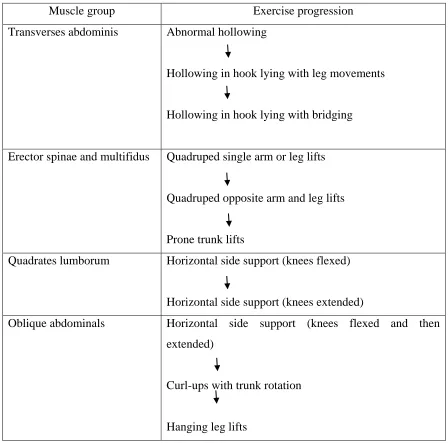
Available online: https://edupediapublications.org/journals/index.php/IJR/ P a g e | 2865 Table 1: Components of the Lumbar stabilization exercise programme
Muscle group Exercise progression
Transverses abdominis Abnormal hollowing
Hollowing in hook lying with leg movements
Hollowing in hook lying with bridging
Erector spinae and multifidus Quadruped single arm or leg lifts
Quadruped opposite arm and leg lifts
Prone trunk lifts
Quadrates lumborum Horizontal side support (knees flexed)
Horizontal side support (knees extended)
Oblique abdominals Horizontal side support (knees flexed and then
extended)
Curl-ups with trunk rotation
Hanging leg lifts
Baseball
Flexibility and strength: For pitching and throwing, muscle coordination and trunk strength
should be the focus of preventive and injury management training. Trunk, hip and thigh strength
facilitate a synchrony of motion between the upper and lower extremities and the controlled
Available online: https://edupediapublications.org/journals/index.php/IJR/ P a g e | 2866 Basketball
Flexibility and strength: Hyperlordotic and hypolordotic posturing can result from tight hip
flexors and tight hamstrings, respectively. As emphasized at the iliofemoral joint can be an
important safeguard against having LBP. As in any rehabilitation programme, it behooves the
basketball player to have strong lateral abdominal muscles to enable him or her to brace the trunk
and counteract rotational stresses. This is not to suggest that the spine muscles are not important;
on the contrary, it has been contended that back strengthening is often ignored in basketball
players.
Football
Flexibility and strength: Flexibility is a significant consideration in the prevention of injuries to
the low back for the football player and can be important rehabilitation. To reemphasize a point
stressed throughout this research, if either the hip flexors or the hip extensors (e.g. hamstrings)
are tight, the trunk musculature cannot control the attitude of the pelvis. Thus, if a player has
tight hamstrings, he can be operating near end ROM for posterior pelvic rotation; in such a
scenario, there would be very little give in his hip joint musculature to rotate the pelvis antiriorly
should an overwhelming stress occur.
Golf
Flexibility and strength: Flexibility and stability must be increased to allow for the Range of
motion (ROM) and efficient muscle firing, which are needed to complete a safe and effective
swing. Exercises that would appear to help golfers the most would be those that enable them to
maintain their spines in the neutral position. However, before the neutral spine can be attained,
the golfer must have adequate ROM at the hip joint. Full ROM in the back, hip, hamstrings, and
shoulders and strengthening of the back, hips, legs, shoulders and wrists allow for more
explosive shots over a longer period without fatigue. These muscles provide an antitorsion
moment to counter the rotational forces.
Available online: https://edupediapublications.org/journals/index.php/IJR/ P a g e | 2867 Flexibility and strength: The traditional role of flexibility may be unimportant as a cause of LBP
in gymnasts because they typically have an exceptional amount of flexibility. Nevertheless,
reduction in flexibility due to pathology such as spondylolysis would be symptomatic of a
problem. Exercises recommended for the development of strengths in the abdominal and
iliopsoas groups are various bent hip and knee curl-ups and leg raises from a hanging position,
respectively. For the leg raises, the gymnasts can begin by lifting with bent knees to half position
and from there begin to extend one leg at a time and then progress to lifting with straight legs.
Racquet sports
Flexibility and strength: In tennis players, both flexibility and strength are important attributes.
Poor flexibility in the hamstrings will preclude hinging at the iliofemoral joint, and this in turn
will place greater stress on the lumbar spine and lead to repetitive stress at end ROM. As
previously mentioned, lower extremity fatigue may compromise hip and knee flexion; this could,
for example, force flexion to occur in the lumbosacral area when executing ground strokes,
thereby putting the spine at additional risk. Increasing the strength of the lateral abdominal
musculature could theoretically lessen the torsion stresses placed on the spine in tennis. In tennis
matches, muscle endurance seems to play an important role, for as the tennis player becomes
more fatigued, body mechanics suffers, and the individual becomes more vulnerable to injury.
Rowing
Flexibility and strength: Adequate flexibility and strength for trunk flexion, extension and
rotation are essential. A flexibility program should be designed to increase ROM of the low back
and hamstrings to extend the catch or to reach it more comfortably. Hyperflexion of the lumbar
spine may be needed to achieve full rowing motion; this enables rowers to reach farther forward
and increases the available ROM to generate power during the drive. However, hyperflexion is
strongly related to injury and could eventually impede performance. Stretching joints that are
already hyper mobile should be avoided; instead, special emphasis should be on developing
extensor flexibility and strength.
Available online: https://edupediapublications.org/journals/index.php/IJR/ P a g e | 2868 Flexibility and Strength: Adequate flexibility in the lumbar spine and its surrounding
musculature, including the hip flexors and hamstrings, are essential. Abdominal strength and
back extensors strength are essential to protect the lumbar spine from trauma in track and field
events. Weak abdominal muscles can lead to abnormal pelvic tilt, thereby accentuating the
lumbar curve in the low back.
During periods when LBP and injury prevent an individual from performing regular running
workouts, running in water is highly recommended; this is followed by a gradual progression to
dry-land running.
Swimming
Flexibility and strength: The researcher identified vulnerable areas at the junction s between the
cervical/thoracic spine and thoracic/lumbar spine; these are transitional zones between more
mobile areas of the column. They also contended that back pain incidence relates to the specific
swim stroke performed. It is believed that LBP and spinal abnormalities have also been
connected to the breaststroke; in this stroke many swimmers tend to pull with earlier elbow
flexion and increased arm abduction. These excessive motions increase the stresses on both the
posterior and anterior elements of the lumbar spine.
LBP related to the butterfly stroke should focus on proper training and progression. Adolescents
are not recommended to engage in back extensor muscle work because these muscles are
generally well developed, and the strength imbalance between the abdominal muscles and back
extensors may predispose low back injuries. Adequate flexibility of the back, shoulder and hip
flexors will also serve to reduce trunk extension forces. Poor breathing technique may be a
source of LBP; therefore, focus should be on breathing tone of the lower back musculature.
Weight training
Flexibility and strength: Back and trunk flexibility and strength are essential in protecting the
lumbar spine against trauma, whether acute or chronic, during weight lifting. Increased muscle
Available online: https://edupediapublications.org/journals/index.php/IJR/ P a g e | 2869 overloads. In activities requiring repetitious movements of the spine, muscles with greater
endurance can provide the strength needed to reduce loads for longer periods without fatigue,
thereby reducing the risk of injury. Proper form and technique are paramount in preventing
injuries during specific exercises and when moving weights around the weight room. A stable
lifting position with a good grip, the weight close to the body, and using the hip and knee joint
musculature to perform the lifting are important fundamental principles of good lifting form.
4. Conclusion
As was indicated in the beginning of this research, there was no attempt to cover all sport.
Although those sports selected for inclusion differ considerably in the number of participants that
they attract, one thing in common is that low back injuries are prevalent in each. Although the
sports are different, there are often similarities between the movement patterns and the
mechanical stresses present. In addition to low back pain (LBP) presents as a major problem in
sports personnel, for dependent upon the sport, LBP is often seen across strata of skill levels,
whether they be seen in a weekend athlete or in a or in a highly toned professional athlete. LBP
is a condition that does not appear to be related to gender from the perspective of susceptibility,
thus although the incidence of LBP in sports such as tennis and swimming may be comparable
between genders, gymnastics may present more LBP for females and football would of course
present more back injuries for males.
5. References
1. Arendt-Nielsen, L., T. Graven-Nielsen, H. Svarrer and P. Svensson. 2015. The influence
of low back pain on muscle activity and coordination during gait: a clinical and
experimental study Pain. 64:231-240.
2. Battié, M.C., S.J. Bigos, L.D. Fisher, T.H. Hansson, M.E. Jones and M.D. Wortley. 2009.
Isometric lifting strength as a predictor of industrial back pain reports. Spine. 14:851-856.
3. Bernard, B. 2017. Musculoskeletal disorders and workplace factors: A critical review of
Available online: https://edupediapublications.org/journals/index.php/IJR/ P a g e | 2870 extremity, and low back. U.S. Department of Health and Human Services, NIOSH.
Cincinnati, USA.
4. Biering-Sørensen, F. 2014. Physical measurements as risk indicators for low back trouble
over a one-year period. Spine. 9:106-119.
5. Carmel, J. Muscle activation in the lumbar spine stability models. Abstracts, XVIIth ISB
Congress, Calgary, August 8-13th. 2009.
6. Cholewicki, J. and S.M. McGill. 2015. Mechanical stability of the in vivo lumbar spine:
implications for injury and chronic low back pain. Clinical Biomechanics. 11:1-15.
7. Croft, J., A.P. Simons and A. Radebold. 2010. Effects of external trunk loads on lumbar
spine stability. J. Biomech. 33:1377-1385.
8. Friedrich M, Gittler G, Halberstadt Y, Cermak T, Heiller I. Combined exercise and
motivation program: effect on the compliance and level of disability of patients with
chronic low back pain: a randomized controlled trial. Arch Phys Med Rehabil. 2018;
(79): 475-487.
9. Grabiner, M.D., T.J. Koh and A. el Ghazawi. 2012. Decoupling of bilateral paraspinal
excitation in subjects with low back pain Spine. 17:1219-1223.
10.Hodges, P.W. and C.A. Richardson. 2016. Inefficient muscular stabilization of the
lumbar spine associated with low back pain. A motor control evaluation of transversus