International Journal of Computer Science and Mobile Computing
A Monthly Journal of Computer Science and Information Technology
ISSN 2320–088X
IJCSMC, Vol. 3, Issue. 11, November 2014, pg.46 – 53
RESEARCH ARTICLE
A Comparative Study of Routing Protocols
for Mobile Ad-Hoc Networks
E. Edwin Lawrence
1, Dr.R.Latha
21Research Scholar, Research & Development Centre, Bharathiar University, Coimbatore, India
2Professor & Head, Department of Computer Applications, St. Peter’s University, Avadi, Chennai -600 054, India
Abstract— Mobile Ad hoc Network (MANET) is a collection of wireless mobile nodes that dynamically form a network temporarily without any support of central management. Routing in Mobile ad hoc network is extremely challenging because of its limited bandwidth, battery constraints, routing overhead, asymmetric link, speed, scalability, packet loss and quality of services. The widely accepted existing routing protocols are designed to accommodate the needs of such self-organized networks. The protocol to be chosen must cover all states of a specified network and never is allowed to consume too much network resources by protocol overhead traffic. This paper deals with the classification of Mobile ad hoc routing protocols and also presents some specified protocols according to that classification.
Keywords-- Adhoc networks, Routing protocols, MANET, DSR, DSDV, AODV, hybrid
I. INTRODUCTION
II. ROUTING PROTOCOLS
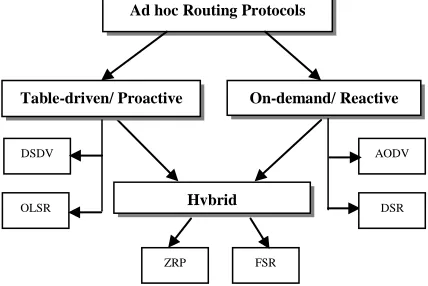
Routing is the process of selecting paths in a network for moving a packet of data from source to destination. A routing protocol composes of a routing algorithm with a set of rules that monitors the operations of the network [1]. The key issue in MANETs is that the routing protocols must be able to respond rapidly to topological changes of the network. Routing protocols are broadly classified into three types, table-driven, on-demand driven and hybrid protocols.
Figure 1: Classification of routing protocols
A. Proactive Protocols
In this type of routing protocol, each node in a network maintains one or more routing tables that are updated regularly which helps them to learn the topology of the network [5]. When a route is required to send data from source to destination, the route information is available immediately because each node sends a broadcast message to the entire network, if there is a change in the network topology. Since each node is required to maintain one or more tables to store up-to-date routing information, it incurs additional overhead cost [2]. These protocols have lower intermission because all the routes are maintained at all the times. DSDV (destination sequence distance vector), WRP (wireless routing protocol), GSR (global state routing), STAR (source tree adaptive routing), DREAM (distance routing effect algorithm for mobility) and OLSR (optimized link state routing protocol) are examples of Proactive protocols.
a) Destination Sequenced Distance Vector (DSDV) protocol
Developed by C. Perkins and P. Bhagwat, DSDV is based on bellman-ford shortest path algorithm with improvements such as including freedom from loops in routing table with the use of sequence numbers.
Bellman-Ford Equation (dynamic programming) • Define
dx(y) := cost of least-cost path from x to y • Then
dx(y) = min {c(x,v) + dv(y) } where min is taken over all neighbors v of x
Within adhoc networks, advertisements may propagate along many paths. Sequence numbers help to apply the advertisements in correct order which helps in avoiding the loops [3]. The routing table stores information such as, the next hop towards the destination node, the metric, the sequence number of the last advertisement and the time at which the path has been installed first [7].Whenever there is a change in network topology, each mobile node advertises routing information. The route labeled with the highest sequence number is always used as it helps in identifying the stale routes from the new ones, thereby avoiding the formation of loops. DSDV is not suitable for highly dynamic networks as a new sequence number is needed every time the topology of the network changes [1].
Ad hoc Routing Protocols
Table-driven/ Proactive On-demand/ Reactive
Hybrid
DSDV
OLSR
AODV
DSR
• Dx(y) = estimate of least cost from x to y • Distance vector: Dx = [Dx(y): y є N] • Node x knows cost to each neighbor v: c(x,v) • Node x maintains Dx = [Dx(y): y є N]
• Node x also maintains its neighbors’ distance vectors • For each neighbor v, x maintains
Dv = [Dv(y): y є N] b) Optimized Link State Routing (OLSR) Protocol
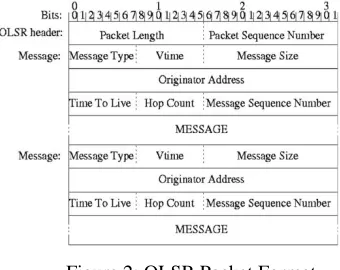
Like other table driven protocols, OLSR also exchanges topology information with other nodes of the network regularly. It is an optimization over the classical link state protocol. This protocol does not require reliable transmission of control messages [6]. Multi point relays (MPR) are selected by each node from its set of neighbor nodes. Only these MPRs are responsible for forwarding control traffic, intended for diffusion into the entire network [3].
Figure 2: OLSR Packet Format
OLSR protocol is well suited for those applications which do not allow long delays in the transmission of the data packets. The major disadvantage of this protocol is that it must maintain the routing table for all the possible routes, thus when the number of the mobile hosts increases, the overhead from the control messages also increases [6].
Parameters DSDV OLSR
Multicast Routes No Yes
Route Updates Periodic Periodic
Distributed Yes Yes
QoS Support No Yes
Routes Maintained Route table Route table
Route Metric Shortest path Shortest path
Overhead Low High
Table 1: DSDV vs. OLSR
B. Reactive Protocols
a) Ad Hoc On-Demand Distance Vector Routing (AODV) Protocol
AODV is capable of both unicast and multicast routing. AODV uses sequence numbers to ensure the freshness of routes and to prevent routing loop [4]. In AODV the source node and the intermediate nodes store the next-hop information for each data packet transmission whereas DSR uses source routing in which a data packet carries the complete path to be traversed. The major advantages of AODV are it is loop-free, self-starting, and scales to large numbers of mobile nodes [1].
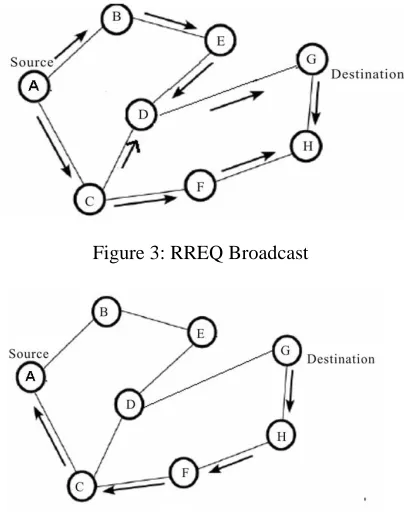
In AODV, Route discovery is done when there is no proper route is available to the destination. This is initiated by sending a R.REQ packet into the network. This request has the following fields, source address, request id, source sequence number, destination address, destination sequence number, hop count [1]. On checking the source address and route id the request will be forwarded or replied with a R.REP message. If the route entry is not up to date it will be rebroadcasted with incremented hop count. Every R.REQ carries a time to live (TTL) which specifies the number of times it should be re broadcasted. Hence the predefined values will be incremented on retransmission [4].
Figure 3: RREQ Broadcast
Figure 4: RREP Forward path
The drawbacks of this protocol are if the source sequence number is old and the intermediate nodes have a higher but not the latest destination sequence number, intermediate nodes can lead to inconsistent routes [6]. Also, multiple Route Reply packets in response to a single Route Request packet can lead to heavy control overhead. Another drawback is the unnecessary consumption of bandwidth due to periodic beaconing and each node expects to periodically receive messages from each of its outgoing nodes.
b) Dynamic Source Routing (DSR) Protocol
central administration and network setup. It differs from AODV by not maintaining periodic routing messages thus reduces bandwidth overhead and conserves battery power [7]. The problem with DSR is care must be taken to avoid collisions between route requests propagated by neighboring nodes. Other drawbacks include Network-wide flood, Reply storm problem and Stale cache problem in which an intermediate node may send Route Reply using a stale cached route, thus polluting other caches [4].
Parameters AODV DSR
Route Metric Newest Route Shortest path
Routes maintained in Route table Route cache
Overhead High High
Time Complexity (initialization) O(2d) O(2d)
Time Complexity (Post Failure) O(2d) O(2d) or O
Path Type Single Multiple
Loop free Yes Yes
Table 2: AODV vs. DSR
C. Hybrid Protocols
These protocols seek to incorporate the aspects of proactive and reactive protocols. It uses the route discovery mechanism of reactive protocol and the table maintenance mechanism of proactive protocol thereby overcoming the drawbacks like large overhead and latency [5]. Though it aims at eliminating the drawbacks, it has the disadvantage of the nodes that have high level topological information maintains more routing information, which leads to more memory and power consumption [2]. Hybrid protocol is suitable for large networks with large numbers of nodes. Some examples of Hybrid Routing Protocols include CEDAR, FSR, ZRP and SRP.
a) Fisheye State Routing (FSR) Protocol
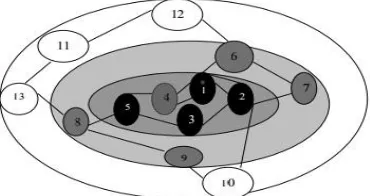
This protocol uses the fisheye technique proposed by Kleinrock and Stevens in which the size of the information required is reduced to represent graphical data. . The eye of a fish captures with high detail the pixels near the focal point. The detail decreases as the distance from the focal point increases. FSR maintains a topology map at each node [8]. Based on the up to date information received from neighboring nodes, a link state table is maintained. These tables are exchanged periodically only with their local neighbors. The update messages sent between the nodes could consume a lot of bandwidth, when the size of the network becomes bigger. To overcome this problem, the sizes of these messages are reduced using routing scopes. Scope is a set of nodes that can reach each other in given number of hops. Figure 5 shows the scope of the node 4. Since there is no flooding, FSR significantly reduces the consumed bandwidth [8].
b) Zone Routing Protocol (ZRP)
ZRP is suitable for large area networks and route creation is done using a query-reply mechanism. It uses Intrazone and Interzone routing to provide flexible route discovery and route maintenance in the multiple ad hoc environments [9]. Through reactive routing protocol, Interzone routing is performed globally and through proactive routing protocol, intrazone routing is performed locally to maintain up-to-date route information [5].
A node must first identify its neighbors with whom direct communication can be established. This would help in the creation of different zones in the network. During the forwarding of the query packet, a node identifies whether it is coming from its neighbor or not using the route information. If so, then it marks all of its known neighboring nodes in its same zone as covered [9]. A covered node is a node which belongs to the routing zone of a node that has received a route query. The query is relayed till it reaches the destination and the destination in turn sends back a reply message via the reverse path and creates the route [5]. ZRP performs route discovery more efficiently as it reduces the network overhead caused by proactive routing and also by handling the network delay caused by reactive routing protocols [9].
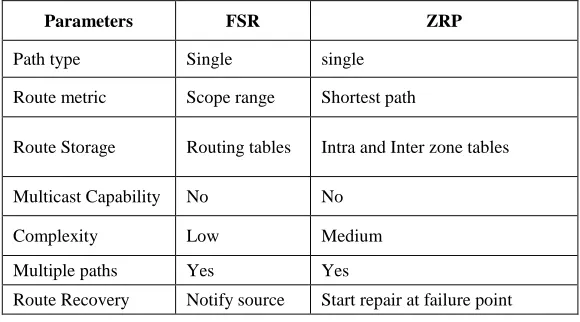
Parameters FSR ZRP
Path type Single single
Route metric Scope range Shortest path
Route Storage Routing tables Intra and Inter zone tables
Multicast Capability No No
Complexity Low Medium
Multiple paths Yes Yes
Route Recovery Notify source Start repair at failure point
Table 3: FSR vs. ZRP
III. COMPARISON OF PROACTIVE, REACTIVE AND HYBRID PROTOCOLS
Parameters Proactive Reactive Hybrid
Routing structure Both flat and
hierarchical Flat Hierarchical
Routing
information Stored in table Doesn’t store Depends on requirement
Route
availability Always available
Determined when
needed Depends on destination location
Storage
requirements High Lower than proactive Depends on size of the cluster
Periodic route
updates Required Not required Required inside each zone
Traffic control
Delay level Low high For local destinations small & high for interzone
Scalability Up to 100 nodes More than 100 More than 1000
Table 4: Comparison of Proactive, Reactive and Hybrid protocols
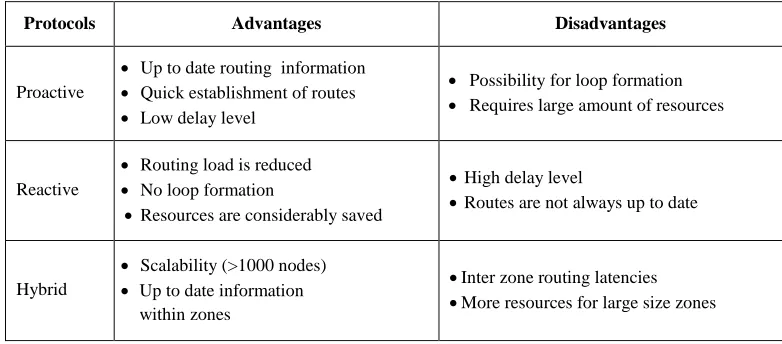
Table 5: Advantages and Disadvantages
IV. CONCLUSION & FUTURE WORK
In this paper, an attempt has been made to study and analyze six routing protocols (DSDV, OLSR, AODV, DSR, FSR & ZRP) and a comparison has been made between Proactive, Reactive and Hybrid protocols. It is a critical issue to select efficient and reliable protocol. FSR and ZRP are efficient in discovering and maintaining routes. DSDV and OLSR have faster connection times because routing information is already available when the first packet is sent. AODV performance is good considering its ability to maintain connection by periodic exchange of data’s. DSR will perform better when the number of nodes is less. Efforts can be made in the future to optimize DSR so that it performs well with a larger network.
REFERENCES
[1] Shilpa Shukla, Shelja Sharma,“study & analysis of dsdv, aodv & dsr” , International Journal of Advanced Research in Computer and Communication Engineering Vol. 2, Issue 5, May 2013
[2] Anuj K. Gupta, Harsh Sadawarti, and Anil K. Verma, “MANET Routing Protocols Based on Ant Colony Optimization” International Journal of Modeling and Optimization, Vol. 2, No. 1. February 2012
[3] S.A.Ade, P.A.Tijare, “Performance Comparison of AODV, DSDV, OLSR and DSR Routing Protocols in Mobile Ad Hoc Networks”, International Journal of Information Technology and Knowledge Management. July-December 2010, Volume 2,No. 2, pp. 545-548.
[4] K. A. Gupta, Harsh Sadawarti, K. A. Verma, “Performance analysis of AODV, DSR and TORA Routing Protocols,” International Journal of Engineering and hnology (IJET), ISSN: 1793-8236, Article No. 125, Vol. 2 No. 2, April 2010.
[5] K. Anuj Gupta, H. Sadawarti, K. Anil Verma, “A Review of Routing Protocols for Mobile Ad Hoc Networks,” WSEAS Transactions on communications, issue 11, volume 10, November 2011
[6] K. Sahadevaiah and O. Venkata Ramanaiah, "An Empirical Examination of Routing Protocols in Mobile Ad Hoc Networks" Int'l J. of Communications, Network and System Sciences, Vol. 3 No. 6, 2010.
Protocols Advantages Disadvantages
Proactive
Up to date routing information
Quick establishment of routes
Low delay level
Possibility for loop formation
Requires large amount of resources
Reactive
Routing load is reduced
No loop formation
Resources are considerably saved
High delay level
Routes are not always up to date
Hybrid
Scalability (>1000 nodes)
Up to date information within zones
Inter zone routing latencies
[7] Dr.S.S.Dhenakaran, A.Parvathavarthini, “An Overview of Routing Protocols in Mobile Ad-Hoc Network”,International Journal of Advanced Research in Computer Science and Software Engineering, Volume 3, Issue 2, February 2013
[8] Guangyu Pei;Gerla,M.;Tsu-Wei Chen; “Fisheye state routing: a routing scheme for ad hoc wireless networks,” IEEE International Conference on Communications, 2000.