A Combined Approach Using IoT and
Cloud for the Efficient Data Retrieval in
Medical Technology
Shaik Hussain S I
PG Scholar, Dept of CSE, Anna University Regional Centre, Coimbatore, Tamilnadu, India
ABSTRACT: IoT is one of the most rapid development technology and it helps to connect numerous smart objects via the internet. Recently numerous researchers found that there is a heterogeneous problem of the data in the IoT platform. There is a rapid use of IoT technology in the real time applications leads to store and access data is difficult and time consuming process. Hence the proposed solution shows that how the real time data can be easily stored and retrieve without any difficulty at easy manner. Here it is clearly shown that how the data can be collected, processed, and integrated for the IoT data flexibility mainly for the use of real time and medical emergency services. The results show that storage and retrieval is very effective in the complicated real time distributed heterogeneous environment.
KEYWORDS: IoT, Cloud Computing, Ubiquitous Data Accessing, Medical Services
I. INTRODUCTION
IoT is one of the most important and rapidly advanced technology in the day to day life. The advancements in the technology shows that ease of use for the real time scenario. This technology is mainly used in the medical servicing such that health care monitoring, medication checking, etc. This technology is very useful in accessing the very critical medical data easily via online services which helps the doctor to make the decisions very soon and also reduces the cost of accessing the information.
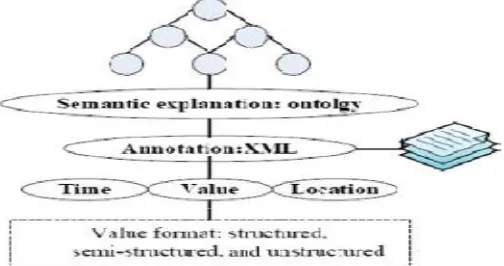
Accessing the data for medical services is the most challenging tasks in the day to day life. With the help of cloud environment today the medical data can be easily shared and accessed at any place at anywhere in the world. Even though the data can be accessed via online services instantly, most of the time it does not support for diagnosing where numerous data needs to be accessed very rapidly in a short span of time. In the past decade, large numbers of researches have been conducted in IoT technology to acquire data without any interruption and ubiquitous access to process data in the very short manner [1]. With the ease of this technology, M-health concepts which are a combination of mobile communication technology and IoT which uses 4G technology [10]. The metadata model for IoT note is shown in figure 1.
In the above diagram, the raw data is present variably at the top levels. The data has to be processed and stored in the form of XML format for further processing. Three main components that deals with the XML format are time, value and location. Finally all the data stored in the XML are value formatted for further processing and it is categorized into three broad categories namely 1) Structured 2) Semi-structured and 3) Unstructured. On the whole the processed data of a metadata model for the IoT note is obtained.
II. RELATED WORK
The research work related to these topics is yet to be identified in the reference. Already some of the work carried forward to check whether it achieves greater performance in terms of both cost and time. We will see some of the topics related to this technology.
A. RFID and GPS techniques
IoT technology is most need at any point of time in the medical serving process. Nowadays all medicines are efficiently bar-code labelled, so that is efficiently delivered to the patients. The most advancements in the technology are the GPS (Global Positioning System) and RFID (Radio frequency Identification) [3][4]. Nowadays all the ambulances operated widely in different parts are working on the GPS principles only. Also the additional RFID is connected to every ambulance and hence it is used to locate the ambulance very quickly.
The medical field is widely developed and let us take an example such that, all the ambulances are GPS connected. All the patients and the doctors using their ID which is used for identification. All the medicines used in the hospital are bar-code scanned for verification. Al the medical instruments and apparatus use RFID tags for exact location identification.
B. Meta Data Model for Ubiquitous data Accessing
The following are some of the functions of UBA (Ubiquitous Data Access) [5] for IoT. They are
1) Support for the access of the data in different heterogeneous environment.
2) For building numerous applications in the real time application system.
3) To ease of accessing the big data.
The three important layers in the metadata model are value, annotation and semantic explanation. The value shows that the range of data to be accessible for the patients. Annotation is the caption for the data retrieval [13]. Semantic explanation shows the important general information about the data. In IoT each IoT note comprises two important functionalities such that time tag and location tag. The time is used for real time applications and the location tag is used to identify the location of the medical instruments.
III.OUR CONTRIBUTION
Hence the propose data model which has a self explanation for each data part to access the data ubiquitously. Each data item of the IoT is given unique notation and defined in the XML format, such that the data can be accessed easily from the web [6]. Also, this shows that it has more advantage than the previous work tasks. The big data can be easily accessed through this technology. The data volume is very large for all IoT applications. Even though it is very large all the data item are successfully stored in the SQL database
B. Data Access in the IoT with Cloud
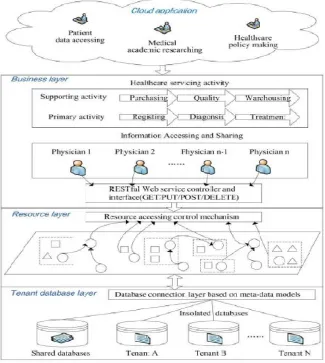
To maintain a large data set of the medical data, the cloud platform is herewith used with multitenant data management where the architecture compose of three layers namely, tenant database layer, data accessing control layer and business layer.
The tenant database layer, is the lowest layer which is used to share the multitenant databases. Control layer is the middle layer which is used to organize the distributed medical data [16]. The business layer is the topmost layer which is used to control the business activities and workflow management tasks. The four major activities take place in the retrieval of the medical data is as follows.
1) Cloud application sends the request to access the healthcare data.
2) If the request is approved, business layer checks the data access rights and finally send the request to the REStful web service.
3) The resource control mechanism provides the resource access request which is to be sent to the database
location where the database is processing the request.
4) Finally, with the help of the database connection, the
Database connecting layer retrieves the data from the shared and distributed databases.
C. Mapping between Business function and Transitive resource
The EOR and cEOR both models can be able to describe the attributes of the IoT but the functionality of the IoT are still needs to be identified which are very important for the IoT applications. Hence, to achieve this a new model is identified which is known as TOR (Transition Oriented Resources) [9]. The definition of TOR is shown below,
TOR: = (URI, Input: = (EORs / cEORs / Output : = (EORs / cEORs), Pre-condition, Effect : = (TORs))
The address of the TOR is accessed by the Uri. Post method is used to start the TOR service through HTTP protocol. During the execution process, DELETE method is used to cancel the execution of TOR [15]. Input is nothing but the resources which are activated during the transition resource. Similarly the output is the generated entity resource which is produced after the transitive resource service is executed. The effect is the identification or response needs to take place for the replacement activity
Fig 2. Cloud Platform for Multitenant Data storage
The general meaning of composition means nothing but the combination of some two or more resources. Here some other entity resources joined together to form a composite resource. Generally it is explained as compositing, aggregation and reference. The composed resources may either in the form of normal entity resources or composite entity resources. Let us consider the example, if the physical entity of the ambulance is called the entire information about the ambulance such as nurse, stretcher, oxygen cylinders, etc are accessed. If any medical instruments are out of access means, it is automatically decomposed or recomposed.
VI.PERFORMANCE EVALUATION AND RESULTS
A. Data Integrity
Generally the distributed database ensures the availability of data at each and every time during the retrieval by the users. It ensures that the data is available in a heterogeneous distributed manner and it can fetch during the emergency for the need of medical data. Hence this technique provides high integrity of data available for the medical users. The patient life safety alerts is shown in the figure 3.
The above pie-chart clearly describes that the patient’s life safety alerts from October 2014 to January 2015. Almost each and every field is equally distributed between all the functionalities. From the most to the least, life component fracture and sling problem is presented between all the other functionalities respectively. Electrical problem, hanger and ceiling lift detachment is approximately presented as 13%.
B. Average Waiting Time
The above bar diagram clearly shows the data fetch time in seconds in various different years depending upon the requirements of the users. Users fetch their data at different levels where the time is varied among them. On the whole the total required to fetch the data in the recent years are obviously decreased than the past years.
VII. CONCLUSION AND FUTURE WORK
By using this IoT along with the cloud, it is very easy to access the medical data stored in the heterogeneous distributed environment. Hence it creates great benefits for the doctors and medical consultants to access the data. In future the work can be elaborate it to some extent of very critical and large datasets in the real time distributed environment for accessing the healthcare medical data.
REFERENCES
1. Boyi Xu, li Da Xu, Hongming Cai Cheng Xie, JingyuanHu and Fenglin Bu “Ubiquitous data Accessing Method in IOT Based Information System for Emergency Medical Services,” IEEE transactions on Industrial Informatics, Vol 10, No 2, pp 417- 423,May 14.
2. R.L.Richesson and J.Krischer, “ Data Standards in Clinical research : Gaps , Overlaps, challenges and future directions” , J.Amer.Med.Informat.Assoc., Vol .14 no.6, pp.687-696, 2007.
3. O.S. Adewale, “An internet-based telemedicine system in Nigeria”, Int..J.Inf.Manag , Vol.24, no.3, pp.221-234, june 2004. 4. L.Xu, “Enterprise Systems : State-of –the-art and future trends” IEEE Trans. Ind.Informat., Vol 7, no.4,pp.630-640, Nov 2011.
5. R.T. Fielding and R.N.taylor, “Principled Design of the Modem Web architecture”,in Proc.22nd Int.Conf.Software Eng., pp. 407-416. 2000.
6. L.Xu, “Case based reasoning for AIDS Initial Assessment”, Knowl-based syst, Vol 8, pp.32-38, 1995.
7. L.Li,”Technology designed to combat fakes in the global supply chain”, Bus.Horiz, Vol . 56., no.23 , pp.167-177, 2013. 8. L.Xu, “Introduction : System science in Industrial Sectors”, Syst.Res. behave,Sci., Vol. 30., no.3., pp .211-213, 2013. 9. L.Xu. “Information architecture for supply chain quality management”, Int.J.Prod.Res., vol. 49.no.1., pp 183-198, 2011. 10. S.Wu,L.Xu and W.He, “Industry-oriented enterprise resource planning”, Enterp. Inf. Syst., Vol.3, no.4., pp. 409-424, 2009.
11. R. Gennaro, C. Hazay, and J. S. Sorensen. Text search protocols with simulation based security in 13th International Conference on Practice and Theory in Public Key Cryptography, pages 332–350, 2010.
12. Curtmola, R., Garay, J., Kamara, S., Ostrovsky, R.: Enhancing Definition and Efficient Constructions using Searchable Symmetric Encryption In: 13th ACM Conference on Computer and Communications Security, pp. 79–88 , 2006.
13. Boneh, D., Lynn, B., Shacham, H.: “Generate Short signatures Using weil pairing”. In Boyd, C. (ed.) ASIACRYPT 2001. LNCS, vol. 2248, pp. 514–532. Springer, Heidelberg , 2001.