ISSN(Online): 2320-9801 ISSN (Print): 2320-9798
I
nternational
J
ournal of
I
nnovative
R
esearch in
C
omputer
and
C
ommunication
E
ngineering
(An ISO 3297: 2007 Certified Organization)
Vol. 3, Issue 4, April 2015
Human Age Estimation through Fingerprint
Basavaraj Patil G.V, Mohamed Rafi
PG Student, Department of CSE, UBDTCE, Davangere, India Professor, Department of CSE, UBDTCE, Davangere, India
ABSTRACT: Fingerprints are the most widely used proofs for identifying the individuals.In this work, we used human
fingerprints as an evidence to determine the human age. Fingerprints are extensively used for identifying individual but age estimation is an emerging field. Encouraged by the fact that human fingerprint differs in width ranging from birth to middle age but patterns remain unchanged. The two methods 2D- Discrete Wavelet Transform (DWT) and Principal Component Analysis (PCA) are used in combination to extract the features of fingerprint, support vector machines(SVM) is used as classifier. The obtained fingerprint image goes through two steps of feature extraction process and results in separate feature vectors which are then combined to produce a final future vector. The SVM classifies the fingerprint image to a respected age class by comparing final future vector with the database fingerprints. This method can be useful in crime investigations to reduce the search space of suspects.
KEYWORDS: EPIDERMAL RIDGE;DISCRETE WAVELET TRANSFORM; PRINCIPAL COMPONENT ANALYSIS; SUPPORT VECTOR MACHINES
I. INTRODUCTION
A Fingerprint is the representation of the epidermis of a finger; it consists of a pattern of interleaved ridges and valleys. Fingertip ridges evolved over the years to allow humans to grasp and grip objects. Like everything in the human body, fingerprint ridges form through a combination of genetic and environmental factors. This is the reason why even the fingerprint of identical twins is different (Maltoni and Cappelli, 2006). The concept of fingerprint pattern being studied has been of significant use over time, when scanning it involves the conversion of fingerprint by small portion of light solid-state devices into alphanumeric formula (Galton, 1982) [1].After Memorandum on Dermatoglyphic Nomenclature (Penrose 1968, p. 1): “the true breadth of a ridge is defined as the distance between the center of one epidermal furrow and the center of the next furrow along a line at right angles to the direction of the furrows.” The definition refers to classical black-ink fingerprints on white paper. Black lines of a fingerprint are called epidermal ridges like the original structures of the skin. With Penrose and others, we have to distinguish ridge breadth and printed ridge (line) width since the black line is a mere negative of the ridge top[3].This paper is aimed in developing an improved technique for estimating the age through fingerprint obtained.
II. RELATED WORK
ISSN(Online): 2320-9801 ISSN (Print): 2320-9798
I
nternational
J
ournal of
I
nnovative
R
esearch in
C
omputer
and
C
ommunication
E
ngineering
(An ISO 3297: 2007 Certified Organization)
Vol. 3, Issue 4, April 2015
III. PROPOSED SYSTEM
Fig1: Block Diagram
The input to the fingerprint age estimating system can be provided through real time and from the database. The algorithm can be developed using MATLAB programming language. We use 2D- Discrete Wavelet Transform(DWT) ,Principal Component Analysis (PCA) and Singular Value Decomposition(SVD) combined to estimate a person’s age using his/her fingerprint. The obtained fingerprint goes through preprocessing stage for enhancement and removing the noise. After preprocessing the fingerprint goes through three levels of feature extraction. The next step is to combine the three vectors and this is compared with the database using the Support Vector Machines (SVMs) and classifies the fingerprint as to which class it lies.
A. Preprocessing:
Preprocessing step consists of removing noise from the image to improve the visual appearance of the image and to convert the image to a format best suited for analysis by a machine. Various Enhancements techniques like contrast enhancement, histogram equalization, biniarization, thinning and inverting are used as per the requirement of the image to be enhanced.The input image is resized to 512x512 is converted into binary from gray scale.
B. DWT Feature Extraction:
ISSN(Online): 2320-9801 ISSN (Print): 2320-9798
I
nternational
J
ournal of
I
nnovative
R
esearch in
C
omputer
and
C
ommunication
E
ngineering
(An ISO 3297: 2007 Certified Organization)
Vol. 3, Issue 4, April 2015
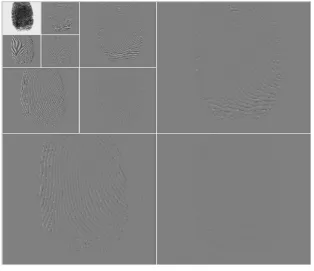
Fig. 2 Wavelet Decomposition
The fingerprint image after applying DWT results in the four dicomposedsubbands referred to as low–low (LL), low– high (LH), high–low (HL), and high–high (HH).Each of these subbands energy is calculated using the equation(1).
The energy of all the sub-band coefficients is used as feature vectors individually which is called as sub-band energy vector (Ek).All fingerprints in the database undergoes the decomposition and the energy vector of all the images is stored.
C. PCA Feature Extraction:
Principal Component Analysis(PCA) is the powerful tool for feature extraction and data representation. Principal Component Analysis (PCA) is a mathematical procedure that uses linear Transformations to map data from high dimensional space to low dimensional space. The low dimensional space can be determined by Eigen vectors of the covariance matrix[2].
The steps involved in PCA:
The mean valve Dm of the given data set” D” is Found.
Subtract the mean value say from D. from thesevalves a new matrix is obtained. Let say “B”
Covariance is obtained from the matrix i.e., C =BBT Eigen values are obtained from the covariance matrixes that are V1V2V3V4…VN,
Finaly Eigen vectors are calculated for covariancematrix C.
Any vector D or D - Dm can be written as linearcombination of eigen vectors.
ISSN(Online): 2320-9801 ISSN (Print): 2320-9798
I
nternational
J
ournal of
I
nnovative
R
esearch in
C
omputer
and
C
ommunication
E
ngineering
(An ISO 3297: 2007 Certified Organization)
Vol. 3, Issue 4, April 2015
Every fingerprint in the database undergoes the PCA for obtaining the eigenvector and is stored as another feature vector of the fingerprint.
D. Final Feature vector:
In the next step feature vectors obtained from the DWT and PCA are combined to form a final feature vector for a single fingerprint.Similarly for all the fingerprints in the database this procedure is followed and a database feature vector is created which contains all the feature vector of the images in the database.
E. Classification:
In this proposed method we used Support Vector Machine(SVM) as a classifier.Application of SVM in fingerprint image classification problem consists of two phases: training and testing.During training, the SVM takes as input fingerprint image data that consist of positive and negative samples and the problem of separating a set of training vectors belonging to two separate classes is solved by training algorithm. The algorithm searches for an optimal hyper plane such that the distance to the support vectors is maximized. Verification of query fingerprint image is determined by classify each of user query fingerprint feature as belong to any of the two classes. The decision is based on the distance of the query data from the hyper-plane.
IV. AGE ESTIMATION
All the fingerprints used are optical scanned images. For Age estimation we divide the database into different age groups like 15-20, 21-25, 26-30, 31-35, 36-40, 41-45, 46-50 and so on. The fingerprints of different age group are grouped and kept as the database fingerprints.Once the desired database is formed all the fingerprints in it undergoes the feature vector extraction as explained in the previous section.
Steps to be followed for Age estimation using the query fingerprint:
1. The fingerprint undergoes preprocessing and is resized according to requirement. 2. The fingerprint undergoes Wavelet Decomposition and the 19 feature vector is obtained.
3. The fingerprint from the preprocessing stage also undergoes PCA Eigen vector feature extraction. 4. Now the features vectors are combined to obtain a final vector.
5. This fingerprint feature vector is classified using the SVM classifier and this undergoes the Age estimation classification.
ISSN(Online): 2320-9801 ISSN (Print): 2320-9798
I
nternational
J
ournal of
I
nnovative
R
esearch in
C
omputer
and
C
ommunication
E
ngineering
(An ISO 3297: 2007 Certified Organization)
Vol. 3, Issue 4, April 2015
V. RESULTS
The result of the age estimation process is shown in the below fig.
Initially age estimation system trains the database fingerprints which store the feature vectors according to their age categories. The number of database prints is an important criterion to improve the accuracy of the system and also the combination of DWT and PCA given good success rate. Experimental results show that an overlap between the different age group fingerprints in some cases where fingerprint growth is abnormal with respect to their age.
VI. CONCLUSION
In this work, we have proposed a method for estimating age of the person through their fingerprints images. The Fingerprint goes through two levels of feature extraction one is frequency domain feature vector obtained by undergoing Wavelet decomposition and second is by spatial level undergoing PCA. The combination of both these features gives improved performance in age estimation.
REFERENCES
[1]. P. Gnanasivam& Dr. S. Muttan“ Estimation of Age Through Fingerprints Using Wavelet Transform and Singular Value Decomposition”
International Journal of Biometrics and Bioinformatics (IJBB), Volume (6) : Issue (2) : pp 58-67. 2012.
[2].Suganthy, M. and P. Ramamoorthy“ Principal Component Analysis Based Feature Extraction,Morphological Edge Detection and Localization for Fast Iris Recognition.” Journal of Computer Science 8 (9): 1428-1433, 2012 ISSN 1549-3636:pp 1-6.2012.
[3].KRÁLÍK M., NOVOTNÝ V. 2003. Epidermal ridge breadth: an indicator of age and sex in paleodermatoglyphics. Variability and Evolution, Vol. 11: 5–30, Tabs. 5, Figs. 9;2003.
[4] .RituKaur and SusmitaGhoshMazumdar “Fingerprint based gender identification using frequency domain analysis” International Journal ofAdvances in Engineering & Technology, Vol. 3, Issue 1, pp. 295-299, March 2012.
[5]. K. Thaiyalnayaki, S. A. Karim, P. V. Parmar, “Finger print Recogntion Using Discrete Wavelet Transform”, International Journal of ComputerApplications,Vol.1,No.24, pp.96-100, 2010
[6] RakeshVerma, AnujGoel ” Wavelet Application in Fingerprint Recognition” International Journal of Soft Computing and Engineering (IJSCE) ISSN: 2231-2307, Volume-1, Issue-4, pp:1-6;September 2011
[7] S. Adebayo Daramola, TolaSokunbi and A.U Adoghe” Fingerprint Verification System Using Support Vector Machine”,International Journal on Computer Science and Engineering (IJCSE), ISSN : 0975-3397 Vol. 5 No.pp:1-6 07 Jul 2013
[8] D. Maltoni, D. Maio, A. K. Jain, and S. Prabhakar, “Handbook of Fingerprint Recognition”, first ed., Springer, New York, 2003.