ISSN(Online): 2319-8753 ISSN (Print) : 2347-6710
I
nternational
J
ournal of
I
nnovative
R
esearch in
S
cience,
E
ngineering and
T
echnology
(A High Impact Factor, Monthly, Peer Reviewed Journal)
Visit: www.ijirset.com
Vol. 8, Issue 5, May 2019
Novel Approach to Construct QA Systems
Tushar Shedage, Honey Vyas, Anuja Zanje, Sanket Zurmure
B. E Students, Department of Information Technology, Sinhgad Academy of Engineering Kondhwa (Bk), Pune, India.
ABSTRACT-On web user post different question and get answer to that question by different view. Proposed system will work on to give answer to question within time and provide relevancy in answer by working on pairwise learning technique. To find the similar questions is very difficult in Question Answering (QA) System. Because each question in the returned candidate pool consists with multiple answers,here user has to wait for long time. To solve this problem proposed a novel approach a novel Pairwise Learning to rANk model i.e. PLANE which can quantitatively rank answer candidates from the relevant question pool. Specifically, it uses two components i.e. one offline learning component and one online search component. In the online searching system geta pool of answer candidates for the given question by means of discovering its comparable or similar questions by proposed algorithm. Teacher is verifying answer after sending verification request for answer from users.Student can view answer is verify right or wrong.
KEYWORDS: Answer Selection, Community-based Question Answering,Question-Answer pairs, Pairwise learning technique.
I. INTRODUCTION
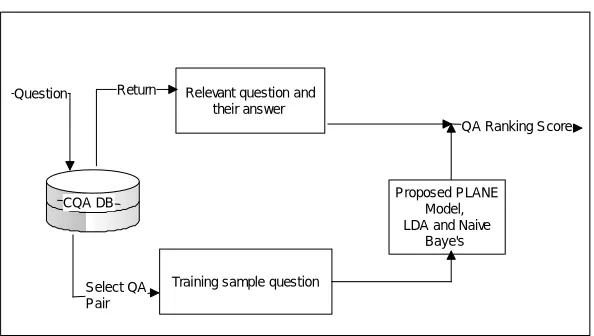
In the web user, often, the hunger for questions is probably due to several reasons: 1) the questions are poorly written, ambiguous or not at all interesting; 2) QA systems can hardly address the newly published questions to the appropriate respondents; and 3) potential respondents have the corresponding experience, but are not available or are overwhelmed by the large volume of incoming questions. This case often occurs in vertical QA forums, whereby only authorized experts can answer these questions. Regarding the first case, the quality model of the application has been well studied, which can assess the quality of the application and serve to remind the respondents to reformulate their questions. Routing applications work by exploring the resources of the current system, in particular human resources. Beyond that, we can reuse the resolved questions from the past to answer new questions. In fact, a large number of historical QA pairs, over time, have been archived in the QA databases. Therefore, information seekers have a good chance of getting direct answers looking for repositories, instead of waiting long. Inspired by this, they have transformed the quality control task into the task of finding relevant and similar questions. However, candidates returned from the main application are generally associated with multiple answers and research on how to choose the correct answers from the relevant question group are relatively poor. When a question is asked, instead of naively choosing the best answer to the most pertinent question, In this paper, we present a new Pairwise Learning to Run model, dubbed PLANE, which can quantitatively classify candidates from the relevant question group. Figure 1 show the workflow of the PLANE model, which consists of two components: offline learning and online research.
A.MOTIVATION:The main motivation is to overcome the problem of to find the similar questions, Because each question in the returned candidate pool consist with multiple answers, and hence users get trouble to browse a lot before finding the correct one. So we motivate to construct a novel approach a novel Pairwise Learning to rANk model i.e. PLANE which can quantitatively rank answer candidates from the relevant question pool.
II. REVIEW OF LITERATURE
ISSN(Online): 2319-8753 ISSN (Print) : 2347-6710
I
nternational
J
ournal of
I
nnovative
R
esearch in
S
cience,
E
ngineering and
T
echnology
(A High Impact Factor, Monthly, Peer Reviewed Journal)
Visit: www.ijirset.com
Vol. 8, Issue 5, May 2019
reliable, if the number of votes for the active question is not sufficient. The author solves this issue by analyzing two kinds of biases; position bias and appearance bias. To identify the existence of these biases and propose a joint click model for dealing with both of them [5].
2.The author designed Answer Selection in Community Question Answering. In this task, the systems are required to identify the good or potentially good answers from the answer thread in Community Question Answering collections. This system combines 16 features belong to 5 groups to predict answer quality. This final model achieves the best result in subtask A for English, both in accuracy and F1-score [6].
3.The author represents how to automatically answer questions posted to Yahoo! Answers community question answering website in real-time. This system combines candidates that extracted from answers to similar questions previously posted to Yahoo! Answers and web passages from documents retrieved using web search. The candidates are ranked by a trained linear model and the top candidate is given as the final answer. The ranking model is trained on question and answer (QnA) pairs from Yahoo! Answers archive using Pairwise ranking criterion. Candidates are represented with a set of features, which includes statistics about candidate text, question term matches and retrieval scores, associations between question and candidate text terms and the score returned by a Long Short-Term Memory (LSTM) neural network model[7].
4.The author proposes a three level scheme, which aims to generate a query-focused summary-style answer in terms of two factors, i.e., novelty and redundancy. Specifically, we first gets a set of QA’s to the given query, and then develop a smoothed Naive ayes model to identify the topics of answers, by exploiting their associated category information [1].
5.The author propose and developed a multivisual- concept ranking technique for image retrieval. The main idea is that an image can be displayed by several visual concepts, and a hyper graph is built based on visual concepts as hyper edges, where each edge contains images as vertices to share a specific visual concept. In the proposed hyper graph, the weight between two vertices in a hyper edge is incorporated, and it can be calculated by their affinity in the corresponding visual concept. A ranking technique is proposed to compute the association scores of images and the relevance scores of visual concepts by employing input query vectors to handle image retrieval [4].
6.The author developed a probabilistic method to jointly exploit three types of relations (i.e., follower relation, user-list relation, and user-list-user-list relation) for finding experts. Specifically, propose a Semi-Supervised Graph-based Ranking approach to offline calculate the global authority of users. In SSGR, employ a normalized Laplacian regularization method to jointly explore the three relations, which is subject to the supervised information derived from Twitter crowds. Then online compute the local relevant between users and the given query. By leveraging the global authority and local relevance of users, here rank all of users and find top-N users with highest ranking scores[1].
7.The author addresses the large-scale graph-based ranking problem and focus on how to effectively exploit rich heterogeneous information of the graph to improve the ranking performance. Specifically, propose an technique and effective supervised Page Rank (SSP) technique to parameterize the derived information within a unified semi-supervised learning framework (SSLF-GR), then simultaneously optimize the parameters and the ranking scores of graph nodes[2].
III. SYSTEM OVERVIEW
The proposed system, construct a novel Pairwise Learning to rANk model i.e. PLANE which can quantitatively rank answer candidates from the relevant question pool. Specifically, it comprises two components i.e. one offline learning component and one online search component.
1. In the offline learning component, , we first consequently set up the positive, neutral, and negative training samples in the forms of preference pairs guided by our data-driven results.
ISSN(Online): 2319-8753 ISSN (Print) : 2347-6710
I
nternational
J
ournal of
I
nnovative
R
esearch in
S
cience,
E
ngineering and
T
echnology
(A High Impact Factor, Monthly, Peer Reviewed Journal)
Visit: www.ijirset.com
Vol. 8, Issue 5, May 2019
within time user will get answer and relevancy of answer will be maintained.System recommends other user to answer the newly arrived question that has no available answer in database. That will reduce user waiting time to get answer.For that asker’s past question are matched with other asker’s past matched question and then system ask that question to matched asker’s by email .So it will reduce users waiting time to get result.
SYSTEM ARCHITECTURE
Fig. 1 System Architecture
IV. MATHEMATICAL MODEL
Notation
1.q=Entered question. 2.a1 be the votes of answer 3.C be the class of answer.
4. =be the j th answer of i’th question q 5. =be the best answer
6. =all similar question of q Equation:
=avg(feature (all matched question))---(1)
Gives similar question of entered questionusing Levenshtein Distance Algorithm. =avg(a1,C)---(3)
User gets best answer by applying Naïve Bayes’.
V. ALGORITHMS
1.Levenshtein distance algorithm.
The Levenshtein algorithm (also called Edit-Distance) calculates the least number of edit operations that are necessary to modify one string to obtain another string. The most common way of calculating this is by the dynamic programming approach.In proposed system we using this to match user entered question with available question in database.
Relevant question and their answer
Training sample question Disk
CQA DB CQA DB
Return Return Question
Question
Select QA Pair Select QA Pair
Proposed PLANE Model, LDA and Naive
Baye's
ISSN(Online): 2319-8753 ISSN (Print) : 2347-6710
I
nternational
J
ournal of
I
nnovative
R
esearch in
S
cience,
E
ngineering and
T
echnology
(A High Impact Factor, Monthly, Peer Reviewed Journal)
Visit: www.ijirset.com
Vol. 8, Issue 5, May 2019
Input: Get user entered question.
Working:
Step 1:Select user entered question
Step 2:Select all question from available database
Step3:Pass the distance to match entered question with available question.
System will check question with according to entered question with available question word by word with available answer.
Step4:One by one question will gets by visiting each question to specified distance. Output:Get matched similar questions.
2. Naive Bayes
This algorithm is used classify review is positive or negative that will used find best answer in plane model. This is used to get review is positive or negative according to that we get relevancy inanswer.
Input:Review
Output: Predicated class of review.
Working:
Step 1: Take review
Step 2: Preprocess the review Step 3: Pass to naive bayes class.
Step 4: Get positive and negative score according tospecify its dictionary. Step 5:Get max score and declare as positive or negative.
Step 6: Predicated class of all review.
VI. RESULT
ISSN(Online): 2319-8753 ISSN (Print) : 2347-6710
I
nternational
J
ournal of
I
nnovative
R
esearch in
S
cience,
E
ngineering and
T
echnology
(A High Impact Factor, Monthly, Peer Reviewed Journal)
Visit: www.ijirset.com
Vol. 8, Issue 5, May 2019
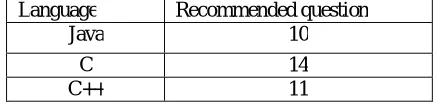
Explanation: The graph is trust based top recommendation analysis. That for each language top recommended question will display to user and that question will be new in that particular language. So here another user will analyze these language has arrived most newly question.
Table 1. Shows no. of recommended question for each language
VII. CONCLUSION
Present a novel scheme for answer selection in cqa system. It consists of one online learning and the online search component. In component online learning, instead of time consuming and labor-intensive annotation, automatically builds positive, Negative training samples. In the online search component, A particular question is, first of all, gathering a group of answers find candidates through their similar questions. We then use the offline model to classify candidate answers through Pairwise comparison.System recommendsother user to answer the newly arrived question that has no available answer in database.That will reduce user waiting time to get answer.
REFERENCES
[1]W. Wei, G. Cong, C. Miao, F. Zhu, and G. Li, “Learning to find topic experts in twitter via different relations,” TKDE, vol. 28, no. 7, pp. 1764– 1778, 2016
[2]W. Wei, B. Gao, T. Liu, T. Wang, G. Li, and H. Li, “A ranking approach on large-scale graph with multidimensional heterogeneous information,” TOC, vol. 46, no. 4, pp. 930–944, 2016.
[3]W. Wei, Z. Ming, L. Nie, G. Li, J. Li, F. Zhu, T. Shang, and C. Luo, “Exploring heterogeneous features for query-focused summarization of categorized community answers,” Inf. Sci., vol. 330, pp. 403–423, 2016.
[4]X. Li, Y. Ye, and M. K. Ng, “Multivcrank with applications to image retrieval,” TIP, vol. 25, no. 3, pp. 1396–1409, 2016.
[5]X. Wei, H. Huang, C. Lin, X. Xin, X. Mao, and S. Wang, “Reranking voting-based answers by discarding user behavior biases,” in Proceedings of IJCAI’15, 2015, pp. 2380–2386.
[6]Q. H. Tran, V. Duc, Tran, T. T. Vu, M. L. Nguyen, and S. B. Pham, “Jaist: Combining multiple features for answer selection in community question answering,” in Proceedings of SemEval’15. ACL, 2015, pp. 215C–219.
[7]Savenkov, “Ranking answers and web passages for non-factoid question answering: Emory university at TREC liveqa,” in Proceedings of TREC’15, 2015.
[8]A Joint Segmentation and Classification Framework for Sentence Level Sentiment Classification Duyu Tang, Bing Qin, Furu Wei, Li Dong, Ting Liu, and Ming Zhou.
[9] Q. Le and T. Mikolov, “Distributed representations of sentences and documents,” inProceedings of ICML’14. Morgan Kaufmann Publishers Inc., 2014, pp. 1188–1196.
[10] T. Joachims, L. Granka, B. Pan, H. Hembrooke, and G. Gay, “Accurately interpreting clickthrough data as implicitfeedback,” in Proceedings of SIGIR’05. ACM, 2005, pp. 154–161.
Language Recommended question
Java 10
C 14