Study of Face Recognition Methods Using
LBP and WLD
Amrutha T 1, Sunil Kumar B L 2, Ramesha Shettigar 3
PG student, Department of CSE, NMAMIT, Nitte, Udupi District, Karnataka, India1
Associate Professor & Head of the department, Department of ISE, CEC, Mangalore, Karnataka, India 2
Assistant professor, Department of CSE, NMAMIT, Nitte, Udupi District, Karnataka, India 3
ABSTRACT: To detect and recognize the human face is challenging task as all the faces have the same structure and there are lots of personal and environmental factors that affect the facial appearance. Large variability of the images because of illumination, changes in pose, cosmetics, expressions, presence of glasses, beard is the problem of face recognition. To eliminate all these problems with intrapersonal variations is to add training set images which consist of all these variations. This paper presents the study of face recognition using two novel methods i.e. local binary patterns and Weber local descriptor.
KEYWORDS: Face recognition, local binary pattern, Weber local descriptor
I. INTRODUCTION
Face recognition is the approach in which it involves recognizing people with their intrinsic characteristics. Other biometrics such as fingerprint, DNA, voice, face, face recognition is more natural, nonintrusive and may be used without the cooperation of the subject. Face recognition can be split in to two methods i.e. verification and identification. In verification system it involves either denying or confirming the identity claimed by a person whereas face identification system is the approach in which it establishes the identity of a person out of n people. When the identity of the person may not be in the database, this is called open set identification.
Although face detection has some problems because of the large diversity of the appearance in face, it is considered as a difficult pattern recognition task. Faces are dynamic objects, non-rigid with a large variability in shape, texture and colour, because of different factors such as posing, illumination, make-up, beard facial expressions and occlusions. Face verification is also affected in case of large variability in appearance of face. Lack of reference images may also lead to difficulty to train templates of face. The enrolment process must be done once and it must be fast in real life applications. Mismatch between training and testing conditions might happen if the training data is less and which is not sufficient to cover the intra-personal variability of the face. Finally, the performance of verification which is highly related to the face localization step quality.
II. AUTOMATICFACEVERIFICATION
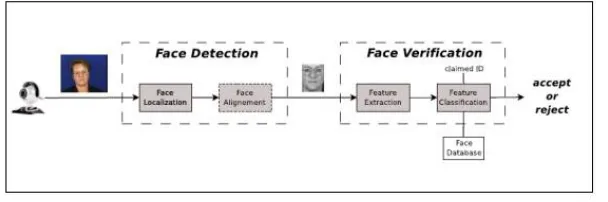
method, the face representation or extracted features in which the face model is compared to the claimed identity and the resulting face is either accepted or denied.
Figure 1: Automatic face verification system
III.LITERATURESURVEY
Face detection is the first module of the automatic face verification system illustrated in Figure. 1. In a verification process, we generally assume that the user will cooperate with the system, and thus that the detection module will deal with frontal faces. The following paragraphs discuss about the work in which the local binary pattern and other techniques used for face recognition
.
Radhey Shyam and Yogendra Narain Singh [1] describe a new method called “augmented local binary pattern (ALBP)” which is used in case of pose changes, expression of face and illumination conditions. This method is worked on combination of uniform and non-uniform patterns. Here the non-uniform patterns are replaced with maximum value of uniform patterns. In this approach the overhead of this method is that it may not perform well in case of severe pose changes, expression but it may perform better if the face images are susceptible or vulnerable to expression of the face, small changes in pose and illumination.
Shengcai Liao, Xiangxin Zhu, Zhen Lei, Lun Zhang, and Stan Z. Li [2] present a “Multi-scale Block Local Binary Pattern LBP) based operator for robust image representation”.The “Multi-scale Block Local Binary Patterns (MB-LBP)” instead of single pixel it uses average gray-values of sub-region for comparison. Feature extraction is speeded up using integral images. Considering these uniform patterns will not remain the same as those in local binary patterns [3].In this technique AdaBoost learning method has been applied to select the classifier which is s effective weak classifiers and construct a strong classifier.
A. Eigenface-based Recognition
In the Eigen faces are computed by analysing the face images. These eigen faces which consists eigenvectors. To identify the face and its identity is done by comparing the eigenfaces.Eigenfaces method is of five steps which are as follows. Firstly a set of training face images must be fed into the system and the system is initialized. Next it calculates the eigen faces if the face is present. By performing some statistical analysis and comparing with the known faces to determine whether there is a face in the given image or not. Then the identity of the face is identified for the known face image. Fifth step is optional in which if any unknown face is detected, the system may learn to recognize that face. Eigenface method is very simple and gives good results in controlled environments [4]. There are some disadvantages of this technique. This method does not perform well in case of illumination, distance and angle [7]. The system does not capture the actual size of the face that is in case of 2D recognition [6].
Ahilapriyadharshini, R., S. Arivazhagan, and M. Gowthami [9] present recognition of objects which is based on calculation of Weber local descriptor which is the feature extraction of an image patches. Salient points on the images are used to represent local properties of an image. This method is used when the images have varying illumination conditions, noise conditions.
Lian, Guoyun, Jianhuang Lai, and Yang Yuan [10] present the method fast pedestrian detection in which the modified WLD is used. Even the salient region detection method is also used. In this approach the whole image is scanned with the sliding window and then the salient region is also scanned so that the pedestrian detection is improved.
Hussain, Mutawarra, et al [11] presents about the image forgery detection which is done using the method “Multi resolution Weber local descriptor”. In this approach from the given colour image the WLD features are extracted. For classification purpose SVM is used.
IV.LOCALBINARYPATTERN
The main aim of face recognition is to identify the diversity features which are employed to differentiate between from one person to another. Local Binary Pattern is an efficient and simple which is used to obtain local features. The two main properties of LBP features are it is computationally simple and tolerance against various illumination conditions variations .Due to these properties LBP can be used in real time environments [12].
Creation of The LBP feature vector can be done in the following ways:
Firstly window is divided into cells i.e. eight blocks.
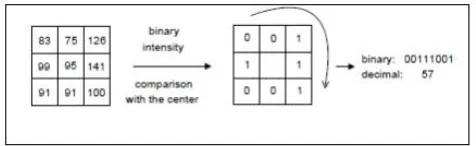
Next, pixel which is present at the centre is compared with the surrounding eight neighbours for each pixel present in the cell. This may be clockwise or counter clockwise.
If the centre pixel value is lesser than the neighbouring pixels value note down it as “0”. Else, note down as “1”.Thus the binary number is obtained which is of 8 digits and then it is converted to decimal.
B.LBP FEATURES
The LBP operator which is based on outlines non –parametric 3x3 kernels. “LBP is defined as an ordered set of binary comparisons of pixel intensities between the centre pixel and its eight surrounding pixels at a given pixel position ( ),”
Figure 2: LBP Operator
This can be represented as:
(1)
where is the centre pixel in to the 8 surrounding pixels, and function su is represented as:
(2)
For texture classification n the LBP approach, the histogram is formed by collecting the occurrence of the LBP codes. Then the classification is done by histogram similarities.
LBP histogram is computed by the following ways LBP code of an image is noted.
Then the image is split into several blocks.
Histogram of each block is calculated and then its combined to single vector.
Figure 3: LBP histogram
V. WEBERLOCALDESCRIPTOR
Weber local descriptor is based on Weber’s law which is simple and is robust local descriptor. It not only depends on the change of a stimulus but also the stimulus of the original intensity. Weber’s law states “that the ratio of the increment threshold to the background intensity is a constant,” which is expressed as
(3)
where ∆I1 is the increment threshold, I1 is the initial stimulus intensity and k1is the constant with respect to variations in I1.
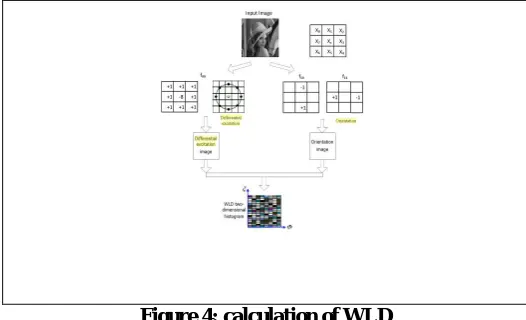
WLD has two components; they are “differential excitation” and “orientation”. The difference between the intensity of centre pixel and its surrounding neighbours is called as differential excitation. The other component is the orientation component which states that “the ratio of change of horizontal directions to that of vertical direction of an image”.
Figure 4: calculation of WLD
C. Differential excitation
D. Orientation
The orientation component which determines the changes in the ratio of horizontal to that of vertical direction of an image which is also called as gradient component .In this first the image is split into eight blocks and then the image is rotated about an angle of 90 degree. Thus the orientation image is obtained as mentioned in the Figure.4
E.WLD Histogram
WLD histogram is obtained by these two component values. Histogram is obtained by combining the differential excitation and orientation histogram which is plotted against x-axis and y-axis by using the pixel values.
VI.CONCLUSION
Finding the dissimilarity features which can be used to differentiate individuals for their recognition is the main objective of face recognition. Certain applications of this technology are now cost effective, reliable and highly accurate. As per the studies say that local binary pattern doesn’t give appropriate results in case of illumination, severe changes in poses. Hence LBP is not considered the better approach. Thus WLD is used overcome these problems.Recognition accuracy is improved by WLD. WLD feature extraction is performed by calculating the differential excitation and orientation component and the WLD histogram is plotted. WLD feature is robust to variations in illumination, facial expressions, partial occlusions and changes in pose and is accurate as per the studies.
REFERENCES
[1] Shyam, Radhey, and Yogendra Narain Singh. "Face recognition using augmented local binary pattern and Bray Curtis dissimilarity metric",IEEE 2nd International Conference on, Signal Processing and Integrated Networks (SPIN), pp. 779-784, 2015.
[2] Liao, Shengcai, Xiangxin Zhu, Zhen Lei, Lun Zhang, and Stan Z. Li. "Learning multi-scale block local binary patterns for face recognition",Springer Berlin Heidelberg, Advances in Biometrics, pp. 828-837, 2007.
[3] Ojala, Timo, Matti Pietikäinen, and Topi Mäenpää. "Multiresolution gray-scale and rotation invariant texture classification with local binary patterns", IEEE Transactions on 24, no. 7, Pattern Analysis and Machine Intelligence, 971-987, 2002.
[4] Gong, Dayi, Shutao Li, and Yin Xiang. "Face recognition using the Weber local descriptor" IEEE, In Pattern Recognition (ACPR), 2011 First Asian Conference on, pp. 589-592, 2011.
[5]Williams, Mark. "Better face-recognition software", Technology Review 30, 2007.
[6] Russ, Trina D., Mark W. Koch, and Charles Q. Little. "3D facial recognition: a quantitative analysis" ,IEEE 38th Annual 2004 International Carnahan Conference, Security Technology, pp. 338-344, 2004.
[7] Woodward Jr, John D., Christopher Horn, Julius Gatune, and Aryn Thomas. Biometrics: A look at facial recognition. RAND CORP SANTA MONICA CA, 2003.
[8] Hussain, Mutawarra, Ghulam Muhammad, and George Bebis. "Face recognition using multiscale and spatially enhanced weber law descriptor", IEEE Eighth International Conference, Signal Image Technology and Internet Based Systems (SITIS) , pp. 85-89, 2012. [9] Ahilapriyadharshini, R., S. Arivazhagan, and M. Gowthami. "Weber Local Descriptor based object recognition" ,IEEE International Conference on, Advanced Communication Control and Computing Technologies (ICACCCT), pp. 115-119, 2012.
[10] Lian, Guoyun, Jianhuang Lai, and Yang Yuan. "Fast pedestrian detection using a modified WLD detector in salient region", IEEE International Conference on, System Science and Engineering (ICSSE), pp. 564-569, 2011.
[11] Hussain, Mutawarra, Ghulam Muhammad, Sahar Q. Saleh, Anwar M. Mirza, and George Bebis. "Image forgery detection using multi-resolution Weber local descriptors", IEEE, In EUROCON, 2013 IEEE, pp. 1570-1577, 2013.