ISSN(Online): 2320-9801
ISSN (Print): 2320-9798
International Journal of Innovative Research in Computer
and Communication Engineering
(An ISO 3297: 2007 Certified Organization)
Vol. 3, Issue 8, August 2015
Comparative Analysis of Different
Modulation Techniques in Coherent Optical
Communication System
Amrinder Kaur , Sanjeev Dewra
M.Tech Student, Shaheed Bhagat Singh State Technical Campus, Moga Road (NH-95), Ferozepur, Punjab, India
Associate Professor, Department of ECE, Shaheed Bhagat Singh State Technical Campus, Moga Road (NH-95),
Ferozepur, Punjab, India
ABSTRACT: This paper presents the comparison of QAM, DPSK and PSK modulation techniques for coherent optical communication system to achieve better performance. Itis found that the signal can be transmitted with QAM modulation technique over a long distance without any degradation in the Q factor and BER. The acceptable value is achieved in terms of Q factor and BER at 60km distance with a bit rate of 10Gbps for different modulation techniques. By increasing the length of fiber, the signal points going to be closerin the constellation diagram. The power of QAM is constant, whereas the DPSK and PSK it exhibits fluctuations with time. The spectrum width of QAM is narrower than other techniques. QAM also provide highest Q factor of 12.11 and lowest BER of 4.66e-034 at 60km distance.
KEYWORDS: QAM, DPSK, PSK, BER, Q factor.
I. INTRODUCTION
ISSN(Online): 2320-9801
ISSN (Print): 2320-9798
International Journal of Innovative Research in Computer
and Communication Engineering
(An ISO 3297: 2007 Certified Organization)
Vol. 3, Issue 8, August 2015
Copyright to IJIRCCE DOI: 10.15680/IJIRCCE.2015. 0308009 7194
amplifiers set in a Mach–Zehnder interferometer design to determine the effectiveness of conversion [6]. This system uses coherent detection and it needs a local laser and an optical phase-locked loop in the receiver. Moreover, local laser is no longer required to complete coherent detection in QAM or DPSK system, which makes the structure of the system straightforward than homodyne BPSK based system but more complex than OOK based system [7]. A typical way of increasing data rate is to increase the number of constellation points. We note that the backward compatibility should be secured though the transmission scheme is modified when achieving these higher data-rates [8]. In optical fiber communication, to enhance the demand for greater transmission over optical fiber links, research has focused on spectral efficiency (SE) to allow greater transmission rates [9]. The spectral efficiency (SE) of the M-QAM signals is M0.5 times better than that of the binary phase-shift keying (BPSK) signal [10]. QAM channel using modulated AM-VSB video carriers has mostly been ignored [11]. It is well known that the DPSK modulation formats using a delay interferometer (DI) and a balanced receiver have about 3dB better receiver sensitivity than ON–OFF keying (OOK) modulation formats [12]. In spite of these advantages, PSK systems go through from various troubles, the most prominent one being imperfect phase estimation at the receiver [13].
Quadrature amplitude modulation (QAM) is widely used for the high-speed data transmission. Compared with other digital modulation techniques like PSK or PAM, QAM modulation has better anti-noise performance and could make full use of the bandwidth [14]. To accomplish such objective, many modulation schemes were proposed in the literature, as is the case of high- order quadrature amplitude modulation (QAM), which uses the available bandwidth in an efficient manner [15].
Till now, work is done on optical communication system based on various modulation techniques, but less work has been carried out to simulate this system based on QAM and DP-QPSK modulation technique with lesser transmission distance up to 50km [9]. In this paper, previous work has been extended by investigating proposed coherent optical communication system at bit rate of 10Gbps over maximum reachable distance up to 90km. So that optimization can be done as the increment in length and compare QAM with DPSK and PSK modulation techniques.
This paper is organized into four sections. Section 1 includes the introduction of the different modulation techniques. In section 2, the transmission performance, block diagrams of internal architecture of transmitter and receiver are described. The results of the coherent optical communication system with different modulation techniques are reported in section 3. Section 4 made the conclusion about the coherent optical communication system using different modulation techniques.
II. SYSTEM SETUP
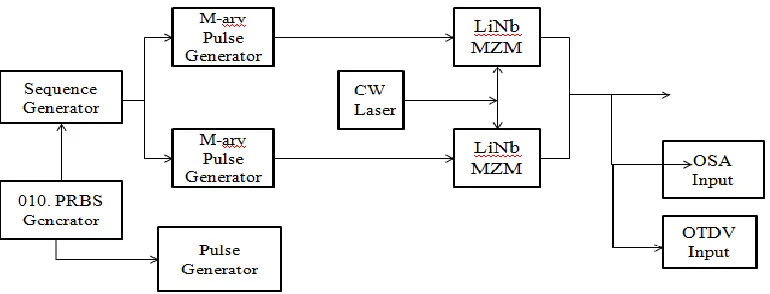
Fig. 1 shows the block diagram of the simulation set up of coherent optical communication system i.e. categorized into three main sections: Transmitter, Optical Fiber Link and Receiver. Firstly, the signal is send out through optical transmitter and then, the signal goes through a loop control (Number of loops=2). The signal from the loop control goes through an optical fiber with different length and a flat gain EDFA with a gain of 10dB and a noise figure of 4dB. After that the output signal is received at the end of the optical receiver.
ISSN(Online): 2320-9801
ISSN (Print): 2320-9798
International Journal of Innovative Research in Computer
and Communication Engineering
(An ISO 3297: 2007 Certified Organization)
Vol. 3, Issue 8, August 2015
Fig. 3 shows the internal architecture of optical receiver. To recoverthe transmitted signal using four photodetector PIN (Responsivity 1A/W & Dark Current 1nA) are used. Electrical amplifiers are used to adjust the signal intensity. After low pass Bessel filter, M-ary threshold detectors are used, resulting signal is decoded by Sequence decoder (QAM, DPSK, PSK) with bit per symbol-2 and subsequently the signal is passed to the hyperbolic-secant pulse generator.
Fig.1. Block Diagram of Optical Communication System
ISSN(Online): 2320-9801
ISSN (Print): 2320-9798
International Journal of Innovative Research in Computer
and Communication Engineering
(An ISO 3297: 2007 Certified Organization)
Vol. 3, Issue 8, August 2015
Copyright to IJIRCCE DOI: 10.15680/IJIRCCE.2015. 0308009 7196
Fig.3. Internal Architecture of Optical Receiver
The output of the simulation setup is visualized by the Electrical Constellation Visualizer, OSA and OTDV. The output of the Hyperbolic-secant pulse generator is analyzed by the BER Analyzer.
III. RESULTS AND DISCUSSION
ISSN(Online): 2320-9801
ISSN (Print): 2320-9798
International Journal of Innovative Research in Computer
and Communication Engineering
(An ISO 3297: 2007 Certified Organization)
Vol. 3, Issue 8, August 2015
Table 1: Results for QAM, DPSK, PSK and PAM.
Sequence Generator QAM DPSK PSK
Bit rate(Gbps) 10 10 10
Length(km) 60 60 60
Q factor 12.11 11.6 12.01
BER 4.66381e-034 1.02094e-031 4.64041e-033
Laser Power (dBm) -12 5 10
Table 1 shows the results for coherent optical transmission system using different modulation techniques. The value of Q factor and BER for the QAM, DPSK and PSK is accepetable with a bit rate of 10Gbps at 60km transmission distance. In the case of QAM, more Q factor and least value of BER is achieved than DPSK and PSK at 60km distance. For QAM laser source has less power as compare to DPSK and PSK. It has only -12dBm power for the successfully transmission of signal over a 60km distance whereas for DPSK and PSK laser source has 5dBm and 10dBm power.
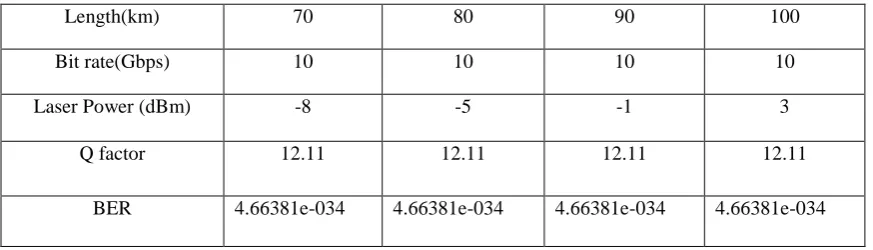
Table 2: Results for QAM at different fiber length.
Length(km) 70 80 90 100
Bit rate(Gbps) 10 10 10 10
Laser Power (dBm) -8 -5 -1 3
Q factor 12.11 12.11 12.11 12.11
BER 4.66381e-034 4.66381e-034 4.66381e-034 4.66381e-034
Table 2 shows the results for QAM with a bit rate of 10Gbps in terms of Q factor and BER at different transmission distance. QAM provides better peformance over large transmission distance with the increment in power of laser source. The results for Q factor (12.11) and BER (4.66381e-034) is same at different length and results changes are shown by the constellation diagrams and power spectrums. By increasing the length of fiber, the points must be closer and are thus more susceptible to noise and other corruption. After 60km distance DPSK and PSK not gives the results with same parameters, but QAM gives the accepetable results up to large distance with only increment in power of laser source.
ISSN(Online): 2320-9801
ISSN (Print): 2320-9798
International Journal of Innovative Research in Computer
and Communication Engineering
(An ISO 3297: 2007 Certified Organization)
Vol. 3, Issue 8, August 2015
Copyright to IJIRCCE DOI: 10.15680/ijircce.2015. 0308001 7198
(a) (b) (c)
Fig.4. Results of the electrical constellation visualizer at 60km distance of (a)QAM (b)DPSK (c)PSK.
QAM provides accepetable results with a bit rate of 10Gbps over large transmission distance in terms of Q factor (12.11) and BER (4.66381e-034) with the increase in power of laser source. Result changes with the increment in transmission distance are exposed by the electrical constellation visualizer. Fig. 5 obtained the output of the electrical constellation visualizer of the QAM at different fiber length (a)70km (b)80km (c)90km (d)100km. With the increment in transmission distance, irregularity between dots in all quadrant increases and the random noise is present.
(a) (b) (c) (d)
Fig.5. Results of the electrical constellation visualizer of QAM at (a)70km (b)80km (c)90km (d)100km.
The possibility of bit error rate is relative to the distance between the neighboring signal points in the constellation, this involves that a modulation scheme with a constellation that is densely packed is less energy efficient than a modulation scheme that has sparse constellation.
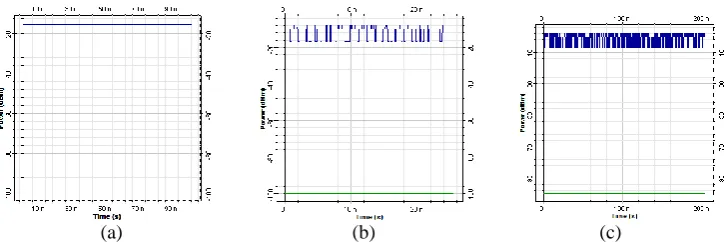
Fig. 6 shows the results of Optical Time Domain Visualizer (OTDV). The significant difference of the power for the different techniques can be observed here. The power variations is shown with respect to time at 60km distance. For the case of (a)QAM the power remains constant at a value of -15dBm, but fluctuations in power for the case of (b)DPSK between -5 dBm to -15dBm and (c)PSK between -5dBm to 5dBm are observed.
(a) (b) (c)
ISSN(Online): 2320-9801
ISSN (Print): 2320-9798
International Journal of Innovative Research in Computer
and Communication Engineering
(An ISO 3297: 2007 Certified Organization)
Vol. 3, Issue 8, August 2015
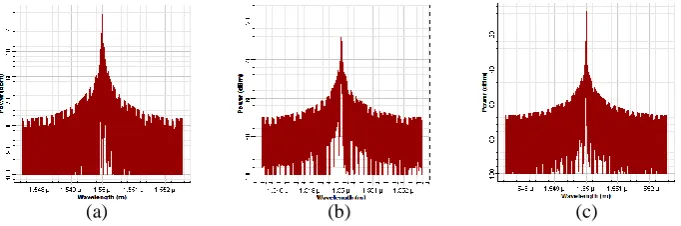
Fig. 7 shows the power spectrum of the different modulation techniques, where the spectrum is obtained at 60km transmission distance for (a)QAM between 1.549µ and 1.551µ, (b)DPSK between 1.548µ and 1.552µ and (c)PSK between 1.548µ and 1.552µ. This spectrum is visualized at OSA. Narrow spectrum shows the good transmission with low interferrence and noise.
(a) (b) (c)
Fig.7. Results of the OSA of (a)QAM (b)DPSK (c)PSK.
More Q factor, less BER and maximum eye opening means good transmission of the signal with poor noise performance. These results are almost same for different modulation techniques with bit rate of 10Gbps at 60km transmission distance however large difference in the power of local laser. For QAM power of laser source is very low over long transmission distance whereas for DPSK and PSK power of laser source is more.
Our results are coincidence with [9], where they compare QAM and DP-QPSK modulation techniques in terms of constellation diagram and power spectrum with bit rate of 10Gbps at 50km transmission distance. They have been not discussed about Q factor, BER and the effects of increases distance on the results. All these measures have been taken in this paper, to have the transmission of signal, as it passes through the optical fiber with bit rate of 10Gbps by comparing different modulation techniques at 60km transmission distance. QAM provide accepetable results up to large distance whereas DPSK and PSK at 60km distance under same parameters of the system except power of laser source. These results are analyzed in terms of Q factor, BER, constellation diagrams and power spectrums.
IV. CONCLUSION
In this paper, we have demonstrated the performance of the coherent optical communication system based on different modulation techniques operating at a bit rate of 10Gbps. It is observed that maximum transmission distance of 90km is achieved in case of QAM whereas in DPSK and PSK signal can travel up to 60km with acceptable Q factor and BER. In the constellation diagram, for QAM it is approximately square shaped and identical in all quadrants, whereas the DPSK and PSK it is also approximately square shaped but not the same in all quadrants at 60km distance. Many small dots are combined with each other in all quadrant with the increment in length of fiber up to 90km for QAM. For the OTDV input, the power of QAM is constant, whereas the DPSK and PSK power exhibits large fluctuations with time and for the OSA input, the spectrum width of QAM is narrower than the DPSK and PSK at 60km transmission distance. Narrow spectrum shows the better transmission of the signal with less noise power. QAM also provide highest Q factor of 12.11 and lowest BER of 4.66e-034 at 60km distance. On the other hand, DPSK provide Q factor of 11.6 and BER of 1.02e-031 and PSK provide Q factor of 12 and BER of 4.64e-033.
REFERENCES
[1] Khaled Alatawi, et.al “Performance Study of 1 Tbits/s WDM Coherent Optical OFDM System” Optics and Photonics Journal, Vol.3, pp.330-335, 3 August 2013.
[2] Rinky Phogat, et.al “ Non Data Aided Phase Estimation Techniques for QAM Communication System: A Review” ISSN: 2277 128X, Vol.3, pp.1133-1137, May 2013.
ISSN(Online): 2320-9801
ISSN (Print): 2320-9798
International Journal of Innovative Research in Computer
and Communication Engineering
(An ISO 3297: 2007 Certified Organization)
Vol. 3, Issue 8, August 2015
Copyright to IJIRCCE DOI: 10.15680/ijircce.2015. 0308001 7200
[5] Mengnan Li, et.al “Effect of partially coherent laser source on the performance of fiber- coupling DPSK receiver for optical communication” Journal of Optics Communications, Vol.350, pp.135-143, April 2015.
[6] Sanjeev Dewra and R.S. Kaler, “Performance analysis of optical network based on optical add drop multiplexers with different MZI techniques” Optik, Vol.124, pp.347-351, 2013.
[7] YunLiu, et.al “Gamma radiation impact on performance of OOK, DPSK and homodyne BPSK based optical inter-satellite communication system” Journal of Optics Communications, Vol.350, pp.276-282, April 2015.
[8] Dae-Ken Kwon, et.al, Member, IEEE “A Higher Data-Rate T-DMB System Based on a Hierarchical A-DPSK Modulation” IEEE Transactions
on Broadcasting, Vol.55, pp.42-50, March 2009.
[9] Anjali Gupta, Kamaljit Singh Bhatia and Harsimrat Kaur “Comparison of QAM and DP-QPSK in a coherent optical communication system” Optik, Vol.30, pp.3, May 2014.
[10] Yu-Chieh Chi, Yi-Cheng Li, and Gong-Ru Lin, Senior Member, IEEE, Senior Member, OSA “Specific Jacket SMA-Connected TO-Can Package
FPLD Transmitter With Direct Modulation Bandwidth Beyond 6 GHz for 256-QAM Single or Multisubcarrier OOFDM up to 15 Gb/s” Journal of Lightwave Technology, Vol.31, pp.28-35, 1Jan 2013.
[11] Shlomo Ovadia, Senior Member, IEEE “The Effect of Interleaver Depth and QAM Channel Frequency Offset on the Performance of
Multichannel AM-VSB/256-QAM Video Lightwave Transmission Systems” IEEE photonics technology letters, Vol. 10, pp.1174-1176, August 1998.
[12] Hodeok Jang, Sub Hur, Yonghoon Kim,and Jichai Jeong, Senior Member, IEEE “Theoretical Investigation of Optical Wavelength Conversion
Techniques for DPSK Modulation Formats Using FWM in SOAs and Frequency Comb in 10 Gb/s Transmission Systems” Journal of Lightwave Technology, Vol. 23, pp. 2638-2646, September 2005.
[13]Aniruddha Chandra, Ananya Patra and Chayanika Bose et.al “Performance analysis of PSK systems with phase error in fading channels: A
survey” Physical Communication, Vol.4, pp.63-82, 2011.
[14] Jo~ao Mendes Filho, Maria D. Miranda and Magno T.M. Silva “A regional multi modulus algorithm for blind equalization of QAM signals: Introduction and steady-state analysis” Journal of Signal Processing, Vol.92, pp.2643-2656, 2012.
[15] Aniruddha Chandra, Ananya Patra, et.al “Performance analysis of PSK systems with phase error in fading channels: A survey” Physical