ABSTRACT
KIMPS, NICHOLAS WADE. The First Report of Repellency of 2-Tridecanone in Ticks. (Under the direction of R. Michael Roe and Charles Apperson.)
The chemicals 2-tridecanone and 2-undecanone are both found naturally in the trichomes of wild tomato plants and are important in plant resistance to herbivory.
2-Undecanone recently was shown to be an effective tick repellent and is the active ingredient in the commercially available arthropod repellent, BioUD®®. The goal of this study was to examine, for the first time the, tick repellency of 2-tridecanone. Two-choice bioassays were conducted between 8% 2-tridecanone versus the repellent carrier, absolute ethanol and compared to similar choice studies with 8% 2-undecanone versus absolute ethanol. Unfed, host-seeking adult (mixed sexes) Amblyomma americanum and Dermacentor variabilis were used to evaluate repellency and time to repellent failure at room temperature on two different substrates. In filter paper assays, 2-Tridecanone was >70% repellent to A. americanum and D. variabilis for 12 and 15 h, respectively. In contrast, 2-undecanone was >70% repellent to
A. americanum and D. variabilis for only 2 h. In two choice assays on cheesecloth,
First Report of the Repellency of 2-Tridecanone in Ticks
by
Nicholas Wade Kimps
A thesis submitted to the Graduate Faculty of North Carolina State University
in partial fulfillment of the requirements for the Degree of
Master of Science
Entomology
Raleigh, North Carolina 2010
APPROVED BY:
_________________________ _________________________ Dr. Fred P. Hain Dr. Charles S. Apperson Co-Chair of Advisory Committee
DEDICATON
To all those people, big and small, who have influenced me over the years and helped make me the man I am today. Without you, I would be nothing! I also want to dedicate this to my sister, Emily, and my best friend, Jessica. You are my rocks and solidarity. I LOVE you both
BIOGRAPHY
I was born December 20, 1983 in Fairfax, VA to Robin and Melissa Kimps. I have one sibling, Emily, whom I love dearly. I have always had an interest in nature and science. I completely admit to being a nerdy child, but I just loved to learn, and wanted to soak up as much knowledge as possible. I read a lot in my youth, but oddly enough it was all science fiction. I loved to escape into other worlds and go on adventures with the characters. It is something I look fondly back upon, and often wish I could recapture that excitement and imagination. I went through a weird adolescence, but can think back and realize that my church, Good Shepherd, was one of the best places I could have been at that point in my life. I think life may have been very different if it were not for the people I met and activities I participated. I went to Thomas Stone High School and graduated with honors. I loved it a lot. I played trombone in marching band all four years. We were the first class to go to the
through that experience. It really opened my eyes to different people and different
backgrounds. I also held a job at Clearwater Nature Center in Clinton, MD. With this job, I was able to combine my love of nature and science with making money. I could not wait to go to work every day. That was my first realization that you could be smart, funny, and cool. Which, after being in graduate school, I know that to be true. I worked at both of these places mid-way through college. I owe much in the way of experience to them both. I graduated high school, and went straight to college. I knew by my junior year where I wanted to go, and that was the only place I applied, Methodist College (now Methodist University) in
ACKNOWLEDGEMENTS
TABLE OF CONTENTS
LIST OF FIGURES ………...…... viii
THE FIRST REPORT OF THE REPELLENCY OF 2-TRIDECANONE IN TICKS ……... 1
Introduction ... 1
Materials and Methods ... 4
Results ... 6
Discussion ... 8
LIST OF FIGURES
RESULTS
Figure 1. Mean percentage repellency of 2-undecanone vs. 2-tridecanone in A. americanum on filter
paper ………..……...….……… 18 Figure 2. Mean percentage repellency of 2-undecanone
vs. 2-tridecanone in D. variabilis on filter
paper ………..………...………… 19 Figure 3. Mean percentage repellency of 2-undecanone
vs. 2-tridecanone in A. americanum on cotton
cheesecloth ………...………...… 20 Figure 4. Pooled (over all replicates, n = 4) distribution of
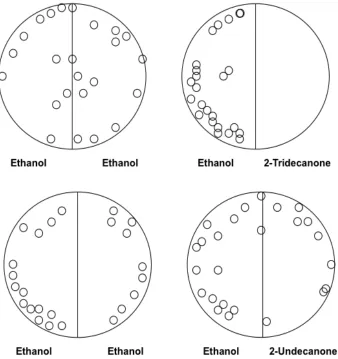
A. americanum adults in test arenas 3.5 h after
treatment ………....… 21 Figure 5. Pooled (over all replicates, n = 4) distribution of
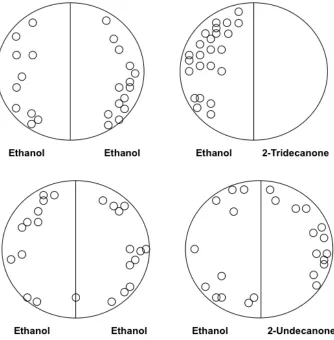
D. variabilis adults in test arenas 3.5 h after
INTRODUCTION
Ticks transmit the majority of vector-borne pathogens in the United States (US), and transmit a greater variety of pathogens than any other hematophagous arthropod. As people have inhabited rural areas, the incidence of tick-borne disease has increased (Spach et al., 1993; Nicholson et al., 2009). The lone star tick, Amblyomma americanum (L.) (Acari: Ixodidae), and the American dog tick, Dermacentor variabilis Say (Acari: Ixodidae), are commonly found attached to people in the Southern and Eastern US Atlantic states (Merten and Durden, 2000). In recent years, A. americanum has expanded its range to include parts of the Midwest, and as far north on the East Coast as New York. This tick is aggressive and all three post-embryonic life stages readily bite humans (Childs and Paddock, 2003). Also, it is the established vector of many bacterial pathogens, including two causative agents of ehrlichiosis, Ehrlichia chaffeensis and E. ewingii (Childs and Paddock, 2003; Nicholson et al., 2009). Dermacentor variabilis only bites humans during the adult stage and transmits Rickettsia rickettsii and Francisella tularensis, pathogens that cause Rocky Mountain spotted
fever and tularemia, respectively (Nicholson et al., 2009).
N, N-diethyl-m-toluamide (deet) (Novak and Gerberg, 2005; Frances, 2007). Deet is highly
effective against many species of mosquitoes, as well as being effective against other biting flies, chiggers, and ticks (Frances et al., 1998; Yap et al., 2000; Barnard and Xue, 2004; Frances, 2007). However, compared to other synthetic arthropod repellents like piperidine, deet is generally less efficacious against ticks (Evans et al., 1990; Schreck et al., 1995; Solberg et al., 1995). In spite of being used widely with few documented adverse health effects and being designated with low to very low toxicity by the US Environmental
Protection Agency (EPA) in its reevaluation in 1998 (Sudakin and Trevathan, 2003; Frances, 2007), there is still a general public concern about its safety (Aquino et al., 2004). Also, parents have expressed concern about repellents, in general, on children (Herrington, 2003). Only two repellents labeled for use on skin for tick control are currently recommended as alternatives to deet by the US Centers for Disease Control and Prevention (CDC); these are IR3535 (3-[N-butyl-N-acetyl]-aminopropionic acid, ethyl ester) and the piperidine, Picaridin (2-(2-hydroxyethyl)-1-piperidinecarboxylic acid 1-methylpropyl ester) (US EPA, 2007). Permethrin, a synthetic pyrethroid, is also available as a repellent and acaricide for use on clothing only (Nicholson et al., 2009) with the main activity attributed to its toxicity
(Breeden et al., 1982). With the paucity of available tick repellents and the avoidance of deet by some, new alternatives are needed.
on skin and clothing to control mosquitoes and ticks. Undecanone is involved in the resistance of the plant to 19 different herbivorous pests of the cultivated tomato,
Lycopersicon escuelentum Mill (Dimock and Kennedy, 1983; Farrar and Kennedy, 1987;
reviewed by Kennedy, 2003). In studies by Witting-Bissinger et al. (2008), BioUD® was repellent for at least 2.5 h on skin against D. variabilis, and ticks spent significantly more time on the 15% deet-treated side in a two-choice bioassay between deet and BioUD®. In subsequent studies, BioUD® was 2-4 times more repellent than deet against 3 species of ixodid ticks (A. americanum, D. variabilis, and I. scapularis) on filter paper (Bissinger et al., 2009a), and showed >90% repellency for 5 weeks on cotton cheesecloth against A.
americanum (Bissinger et al., 2009b). Against mosquitoes, BioUD® provided the same repellency, or was more efficacious, than 25 and 30% deet in the field (North Carolina, US and Ontario, Canada, respectively) for 6 h on human skin (Witting-Bissinger, 2008). Bissinger et al. (2009b) also found BioUD® was more effective on cloth than most of the current commercial repellents for tick control.
the objective of the study was to evaluate, for the first time, the repellent efficacy of 2-tridecanone against the ticks, A. americanum and D. variabilis on two different substrates (filter paper and cloth). Additionally, because BioUD® has been shown to be a long lasting tick repellent, the longevity of 2-tridecanone and 2-undecanone were compared.
MATERIALS AND METHODS
Ticks.
Ticks used in the trials were naïve, unfed, mixed-sex, adults that exhibited host-seeking behavior (as indicated by raised forelegs in response to human breath). Amblyomma americanum were collected from wild populations by flagging woodland vegetation in
Chatham and Lee Counties, NC on various dates in July 2009. Dermacentor variabilis were obtained from laboratory colonies of D. E. Sonenshine at Old Dominion University (Norfolk, VA) where they were reared as previously described (Sonenshine, 1993). Prior to bioassay, ticks were held in 30 mL plastic vials at ~28°C, ~75% relative humidity (RH), and a
photoperiod of 14-light: 10-dark, that included two 60 min dusk and dawn periods. Test Solutions.
Two-Choice Bioassays.
conducted 3, 12, 15, and 24 h after treatment of the substrate. Tests were conducted 3, 6, 9, 15, and 24 h after treatment for 2-tridecanone trials against D. variabilis. For 2-undecanone trials against both species, tests were conducted 0.5, 1, 2, 2.5, and 3 h after treatment. The different incubation periods were based on the repellent performance on the different ticks studied. At the time of bioassay, six ticks, chilled on ice five minutes prior, were placed in the arena at the junction of the test solution and ethanol-treated filter paper or cloth. Ticks were then activated (actively moving around the arena) by gently blowing on them. Tick distribution and position was recorded on a grid representative of the arena every five min from 5-30 min after introduction of the ticks into the arena at the end of the respective incubation periods. Four replicate trials were run simultaneously for each incubation period and repellent evaluated. Only naive ticks not previously exposed to repellents or utilized in prior bioassays were used for these studies.
Data Analysis.
SAS Institute, Cary, NC, USA) with treatments, time, and their interaction as fixed-effect factors was run, no significant difference (P> 0.05) was found between time and distribution of ticks relative to treatment. Since there was no correlation between time and distribution, the average number of ticks on treated and untreated substrates from all points in the 30 min time course were calculated. Mean percentage repellency was calculated by dividing the average number of ticks on the untreated side by total number of ticks in the arena.
RESULTS
Repellency of A. americanum in two choice filter paper assays. Mean percentage repellencies that were significantly different from the no choice ethanol controls at each incubation time post treatment for the 2-undecanone two-choice bioassays on filter paper ranged from 99% at 0.5 h to 74% at 2 h (Fig. 1A). In contrast, 2-tridecanone two-choice bioassays on filter paper had significantly different mean percentage repellencies ranging from 95% at 3 h to 87% at 12 h (Fig.1B). 2-undecanone at 8% in absolute ethanol was repellent against A. americanum on filter paper for up to 2 h (χ² = 5.684; P = 0.017) but was not repellent at 2.5 h (χ² = 0.042; P = 0.838), while the same concentration of 2-tridecanone was repellent for up to 12 h (χ² = 12.99; P = 0.0003) but was not repellent at 15 h (χ² = 3.125;P = 0.077). These results show that the time to 2-tridecanone failure was much greater than that for 2-undecanone by a factor of 6-fold.
2-undecanone two-choice bioassays on filter paper ranged from 100% at 0.5 h to 74% at 2 h (Fig. 2A). In comparison, 2-tridecanone two-choice bioassays on filter paper had
significantly different mean percentage repellencies ranging from 100% at 3 h to 72% at 15 h (Fig. 2B). Looking at the time to failure, 2-undecanone was repellent on filter paper for up to 2 h (χ² = 5.751; P = 0.017;) but was not repellent at 2.5 h (χ² = 1.798; P = 0.180) (Fig. 2A), while 2-tridecanone was repellent for up to 15 h (χ² = 6.836; P = 0.009) but was not repellent at 24 h (χ² = 1.231; P =0.267) (Fig. 2B). These results show that the time to failure for 2-tridecanone was much greater than that for 2-undecanone by a factor of 9.6-fold.
Repellency of 2-tridecanone against A. americanum in two choice cloth assays. Since repellents are often used on clothing and since this is the first time 2-tridecanone has been evaluated as a tick repellent, studies were conducted on cotton cheesecloth. These studies were conducted with A. americanum since these were field-collected ticks and would be relevant to the practical use of 2-tridecanone as a repellent. In these studies, 2-tridecanone in absolute ethanol was applied to cotton cheesecloth and was repellent against A. americanum for up to 6 h (χ² = 12.05; P = 0.0005) but not at 9 h after repellent treatment (χ² =2.238; P =0.135) (Fig. 3). The time to failure between filter paper and cloth was 15 and 9 h,
respectively, representing a 1.7-fold difference.
studied for all replicates for A. americanum and D. variabilis, respectively at 3.5 h post treatment. It can clearly be seen, even at 3.5 h, that 2-tridecanone was still repellent (most of the ticks were on the control surface as opposed to the repellent treated surface) while 2-undecanone had failed (the ticks were distributed on both surfaces and similar to the ethanol-treated, no choice assay).
DISCUSSION
Public opinion of deet and other synthetic repellents is negative, because of potential deleterious health effects (Herrington, 2003; Aquino, 2004). Regardless of the effectiveness of a repellent or whether it really is safe or not, if the perception is negative and there is a reluctance to use the repellent when needed, the risk of bites from arthropods that vector pathogens and the infections associated with them increases. For this reason, more
acceptable and yet effective alternatives are needed. This laboratory recently described the discovery of the repellent, BioUD® (Roe, 2004; Witting-Bissinger, 2008; Bissinger, 2009a,b), where the EPA registered active is 2-undecanone. 2-Undecanone is found naturally in the trichomes of wild tomato plants and along with 2-tridecanone is used by the plant to resist herbivory. BioUD® was registered as a biopesticide in contrast to most synthetic repellents, which are classified as chemical pesticides; efficacious studies by Witting-Bissinger et al. (2008) have shown under practical field conditions that BioUD® was equivalent to
direct comparisons was more effective than 100% deet. Similar results were obtained for comparisons with many common commercial repellents marketed for use on cloth (Bissinger et al. 2009b).
The current study was aimed at evaluating the relative efficacy and time to failure of 2-tridecanone, which has not been previously examined as a tick repellent. Comparison was made between unformulated 2-tridecanone and unformulated 2-undecanone, using choice assays to determine whether the former is a tick repellent and to examine its relative duration of activity to that of the already commercialized 2-undecanone found in BioUD®.
Unformulated materials were tested in this study to simply evaluate the characteristics of the potential plant actives separate from any modifications that might result from the addition of formulation technologies. Under laboratory conditions in filter paper assays, we showed for the first time that 2-tridecanone was an efficacious tick repellent, lasting 6 and 7.5 times longer than its glandular trichome counterpart, 2-undecanone, against A. americanum and D. variabilis, respectively. Our results also showed that 2-tridecanone is a repellent to A.
americanum when applied to cloth.
et al., 2009; Nerio et al., 2010). There must be balance in the unit molar activity of the compound whether on the treated surface or in the space adjacent to the treated surface in eliciting repellent behavior by the mosquito or tick, the persistence of the repellent on the site of treatment, and the rate of delivery of the compound from the treated site to receptors to elicit a repellent response. Of course this is affected by the relative importance of contact versus spatial repellency. The current study simply is showing under the conditions of the assays used, that 2-tridecanone is a tick repellent as is also the case for 2-undecanone and is significantly more persistent than 2-undecanone. Further studies will be needed to evaluate whether 2-tridecanone under more practical studies can be used with or without formulation as a repellent for use on human skin or on clothing with competitive activity to currently available, commercial repellents.
Many researchers, especially those testing botanicals as repellents, have found that formulation is essential for stability, persistence and activity (Jaenson et al., 2006; Carroll et al., 2007; Garboui et al., 2007; Moore et al., 2007; Fabbro et al., 2008). For example, Schreck et al. (1995) evaluated unformulated deet against nymphal A. americanum at an application rate of 0.3 mg/cm² on human skin and reported that repellency dropped to <90% around 2.7 h after treatment. In contrast, Carroll et al. (2008) reported that several cream formulations of 10 to 33% deet achieved close to 100% repellency out to 12 h post
and 15 h against A. americanum and D. variabilis, respectively. In general, many botanical repellents are too volatile and quickly lose repellency; the persistence of 2-tridecanone shown in the current study is encouraging and suggest further studies are needed to evaluate the use of this compound as an insect and tick repellent. The 8% unformulated 2-tridecanone retained repellency to A. americanum adults as long as the cream formulations of deet reported by Carroll et al. (2008) for A. americanum nymphs. Although, there is not a direct comparison that can be made, as there are substrate effects that may have influenced the results, it is still interesting that unformulated 2-tridecanone lasted so long. Other studies done by Carroll et al. (2007, 2009) showed A. americanum to be less sensitive to plant-derived compounds tested. This was also shown by Zhang et al. (2009) when they tested isolongifolenone and deet against nymphal I. scapularis and A. americanum. In the wild tomato trichomes, 2-tridecanone and 2-undecanone are found in the ratio of 4:1, respectively (Lin et al., 1987; Antonious, 2001). It would be interesting to examine potential synergism between mixtures of the two compounds in repellency potency and duration on a treated surface with the assumption that the co-evolution of plants and insects driven by the selective pressure of hebivory has produced in nature the optimum natural insect and tick repellent.
In summary, the current study demonstrates, for the first time, the tick repellency of 2-tridecanone and suggest its potential use as a potent insect and tick repellent. Studies showed that the compound was more persistent than the active in BioUD®, 2-undecanone, in laboratory assays against two species of ticks. 2-tridecanone was also effective and
assess the potential of using 2-tridecanone either alone or in combination with 2-undecanone and with or without additional formulation as a next generation, commercial repellent for the repellency of vector borne arthropods.
REFERENCES
Antonious, G.F. (2001). “Production and quantification of methyl ketones in wild tomato accessions,” Journal of Environmental Science and Health, B36(6), 835-848.
Aquino, M., M. Fyfe, L., MacDougall, and V. Remple (2004). “West Nile virus in British Columbia,” Emerging Infectious Disease, 10(8), 1499-1501.
Barnard, D.R., and R-D. Xue (2004). “Laboratory evaluation of mosquito repellents against Aedes albopictus, Culex nigripalpus, and Ochlerotatus triseriatus (Dipetera:
Culicidae),”.Journal of Medical Entomology, 41(4), 726-730.
Bissinger, B.W., Apperson, C.S., Sonenshine D.E., Watson, D.W., and R.M. Roe (2009a). “Efficacy of the new repellent BioUD against three species of ixodid ticks,” Experimental and Applied Acarology, 48(3), 239-250.
Bissinger, B.W., Zhu, J., Apperson, C.S., Sonenshine, D.E., Watson, D.W., and R.M. Roe (2009b). “Comparative efficacy of BioUD to other commercially available arthropod repellents against the ticks Amblyomma americanum and Dermacentor variabilis on cotton cloth,” American Journal of Tropical Medicine and Hygiene, 81(4), 685-690.
Bissinger, B.W. and R.M. Roe (2010). “Tick repellents: past, present, and future,” Pesticide Biochemistry and Physiology, 96(2), 63-79.
Breeden, G.C., Schreck, C.E., and A.L. Sorenson (1982). “Permethrin as a clothing treatment for personal protection against chigger mites (Acarina: Trombiculidae),” American Journal of Tropical Medicine and Hygiene, 31(3), 589-592.
Carroll, J.F., Benante, J.P., Klun, J.A., White, C.E., Debboun, M., Pound, J.M. and W. Dheranetra (2008). “Twelve-hour duration testing of cream formulations of three repellents against Amblyomma americanum,” Medical and Veterinary Entomology, 22(2), 144-151. Carroll, J.F., Paluch, G., Coats, J., and M. Kramer (2009). “Elemol and amyris oil repel ticks Ixodes scapularis and Amblyomma americanum (Acari: Ixodidae) in laboratory bioassays.” Experimental and Applied Acarology, in press, in press, DOI 10.1007/s10493-009-9329-0.
Chatzivasileiadis, E.A., and M.W. Sabelis (1997). “Toxicity of methyl ketones from tomato trichomes to Tetranychus urticae Koch,” Experimental and Applied Acarology, 21(6,7), 473-484.
Childs, J.E., and C.D. Paddock (2003). “The ascendancy of Amblyomma americanum as a vector of pathogens affecting humans in the United States,” Annual Review of Entomology, 48, 307-337.
Dimock, M.B., and G.G Kennedy (1983). “The role of glandular trichomes in the resistance of Lycopersicon hirsutum f. glabratum,” Entomologia Experimentalis et Applicata, 33(3), 263-268.
Evans, S.R., Korch, G.W. Jr., and M.A. Lawson (1990). “Comparative field evaluation of permethrin and DEET-treated military uniforms for personal protection against ticks (Acari),” Journal of Medical Entomology. 27(5), 829-834.
Fabbro, S. and F. Nazzi (2008). “Repellent effect of sweet basil compounds on Ixodes ricinus ticks,” Experimental and Applied Acarology, 45(3,4), 219-228.
Farrar, R.R., and G.G. Kennedy (1987). “2-Undecanone, a constituent of the glandular trichomes of Lycopersicon hirsutum f. glabratum: Effects on Heliothis zea and Manduca sexta growth and survival,” Entomologia Experimentalis et Applicata, 43(1), 17-23.
Frances, S.P., Cooper, R.D., and A.W. Sweeney (1998). “Laboratory and field evaluation of the repellents, deet, CIC-4 and AI3-37220, against Anopholes farauti (Diptera: Culicidae) in Australia,” Journal of Medical Entomology, 35(5), 690-693.
Frances, S.P. (2007). “Efficacy and safety of products containing DEET,” In: Debboun, M., Frances, S., andD. Strickman, eds. Insect Repellents Principles, Methods, and Uses. Boca Raton, FL: CRC Press, 311-326.
Gonçalves, M.I.F., Maluf, W.R., Gomes, L.A.A., and L.V. Barbosa (1998). “Variation of 2-tridecanone level in tomato plant leaflets and resistance to two mite species (Tetranychus sp.),” Euphytica, 104(1), 33-38.
Herrington JR., J.E. (2003). “Pre-West Nile virus outbreak: Perceptions and practices to prevent mosquito bites and viral encephalitis in the United States,” Vector-Borne and Zoonotic Diseases, 3(4), 157-173.
Innocent, E., Gikonyo, N.K., and M.H.H. Nkunya (2008). “Repellency property of long chain aliphatic methyl ketones against Anopheles gambiae s.s.,” Tanzania Journal of Health Research, 10(1), 50-54.
Jaenson, T.G.T., Garboui, S., and K. Pålsson, (2006). “ Repellency of oils of lemon eucalyptus, geranium, and lavender and the mosquito repellent MyggA Natural to Ixodes ricinus (Acari: Ixodidae) in the laboratory and field,” Journal of Medical Entomology, 43(4), 731-736.
Kennedy, G.G. (2003). “Tomato, pests, parasitoids, and predators: Tritrophic interactions involving the genus Lycopersicon,” Annual Review of Entomology, 48, 51-72.
Lin, S.Y. H., Trumble, J.T., and J. Kumamoto (1987). “Activity of volatile compounds in glandular trichomes of Lycopersicon species against two insect herbivores,” Journal of Chemical Ecology, 13(4), 837-850.
Merten, H. and L.A. Durden (2000). “A state-by-state survey of ticks recorded from humans in the United States,” Journal of Vector Ecology, 25(1), 102-113.
Moore, S.J., Lenglet, A., and N. Hill (2007). “Pant-based insect repellents,” Debboun, M., Frances, S., Strickman, D., eds. Insect repellents: Principles, Methods, and Uses. Boca Raton, FL: CRC Press, 273-303.
Nerio, L.S., Olivero-Verbel, J., and E. Stashenko (2010). “Repellent activity of essential oils: A review,” Bioresource Technology, 101(1), 372-378.
Nicholson, W.L., Sonenshine, D.E., Lane, R.S., and G. Uilenberg (2009). “Ticks (Ixodida),” In: Mullen, G., and L. Durden, eds Medical and Veterinary Entomology. San Diego:
Academic Press, 492-543.
Novak, R.J., and E.J. Gerberg (2005). “Natural-based repellent products: Efficacy for
military and general public uses,” Journal of American Mosquito Control Association, 21(4), 7-11.
SAS Institute (2000-2004). “SAS 9.1.3 Help and Documentation,” Cary, NC: SAS Institute. Schreck, C.E., Fish, D., and T.P. McGovern (1995). “Activity of repellents applied to skin for protection against Amblyomma americanum and Ixodes scapularis ticks (Acari:
Ixodidae),” Journal of American Mosquito Control Association, 11(1), 136-140.
Solberg, V.B., Klein, T.A., McPherson, K.R., Bradford, B.A., Burge, J.R., and R.A. Wirtz (1995). “Field evaluation of DEET and a piperidine repellent (AI3-37220) against
Amblyomma americanum,” Journal of Medical Entomology, 32(6), 870-875.
Sonenshine, D.E. (1993). “Biology of Ticks,” Vol. 2. New York: Oxford University Press. Spach, D.H., Liles, W.C., Campbell, G.L., Quick, R.F., Anderson, D.E., and T.R. Fritsche (1993). “Diseases in the United States,” New England Journal of Medicine, 329(13), 936-947.
Strickman, D., Frances, S.P., and M. Debboun (2009). Prevention of Bug Bites, Stings, and Disease. Oxford, NY, Oxford University Press, 131-205.
Sudakin, D.L., and W.R. Trevathan (2003). “DEET: a review and update of safety and risk in the general population,” Clinical Toxicology, 41(6), 831-839.
United States Environmental Protection Agency (2007). “Active ingredients found in insect repellents,” Available at: http//www.epa.gov/pesticides/health/mosquitoes/ai_insectrp.htm. Accessed January 28, 2010.
Weston, P.A., Johnson, D.A., Burton, H.T., and J.C.Snyder (1989). “Trichome secretion composition, trichome densities, and spider mite resistance of ten accessions of Lycopersicon hirsutum,” Journal of American Horticultural Science, 114(3), 492-498.
Williams, W.G., Kennedy, G.G., Yamamoto, R.T., Thacker, J.D., and J. Bordner (1980). “2-Tridecanone: A Naturally Occurring Insecticide from the Wild Tomato Lycopersicon hirsutum f. glabratum.” Science 207(4433), 888-889 .
Witting-Bissinger, B.E., Stumpf, C.F., Donohue, K.V., Apperson, C.S., and R.M. Roe (2008). “Novel tick repellent , BioUD, is an efficacious alternative to Deet,” Journal of Medical Entomology, 45(5), 891-898.
Figure 1. Mean percentage repellency (± 1 SEM; n = 4) for two-choice bioassays comparing
(A) 2-undecanone and ethanol control, and (B) 2-tridecanone and ethanol control on filter paper against A. americanum from time post treatment to 30 min after addition of ticks to arena (distribution recorded every 5 min and then averaged). Percentage repellency
Figure 2. Mean percentage repellency (1 ± SEM; n = 4) for two-choice bioassays comparing
(A) 2-undecanone and ethanol control and (B) 2-tridecanone and ethanol control on filter paper against D. variabilis from time post treatment to 30 min after addition of ticks to arena (distribution recorded every 5 min and then averaged). Percentage repellency calculated by dividing average number of ticks on untreated side by total number of ticks in arena (6). The no-choice ethanol control represents a two choice test in the absence of repellent.
Figure 3. Mean percentage repellency (± 1 SEM; n = 4) for two-choice bioassays comparing
Figure 4. Pooled (over all replicates, n = 4) distribution of A. americanum adults in test
Figure 5. Pooled (over all replicates, n = 4) distribution of D. variabilis adults in test arenas