Water Level and Leakage Detection System
with its Quality Analysis based on Sensor for
Home Application
Prof.Rucha Dixit1, Harshali Chaudhari2, Shital Jadhav3, Komal Jagtap4
Professor, Department of Computer, JSPM’s JSCOE, Pune, Maharashtra, India1
Student, JSPM’s JSCOE, Pune, Maharashtra, India2,3,4
ABSTRACT:Water is one of the basic need of human beings. They make a use of water for various daily activities. Water is pumped from ground storage to fill the top tank. The utilization of non-automated switch used to turn on and turn off a pumping machine, sometimes causes either the water overflow or a wastage of electrical consumption. The proposed system which indicate user about the level of water in tank which makes a use of microcontroller and notification is given through mobile network on mobile. Water quality (i.e. pH) is measured, if it is less than or more than normal values then notification is sent to user as SMS. Leakage detection takes place by using the water flow sensor which detects the flow of water. If there is a leakage then it notifies the user by SMS on mobile. It helps in saving a water and electrical consumption too.
KEYWORDS:Wastage of water, ultrasonic sensor, mobile calling and SMS, Water flow sensors, pH sensor.
I.INTRODUCTION
Water is the most important natural resources in human’s life. Human needs the water in almost all daily activities such as washing, cleaning, taking a bath, the irrigation, and the industry needs. However, the amount of clean water is decreasing, whereas the number of people in the world are always increasing.
Water a precious thing required everywhere, but because of its excess use the time says to use it carefully so that the next will faced minimum problem. Our world and community is facing excessive water usage either for domestic or commercial purposes and it is a serious issue, which affects the sustainability of our environment. Water shortages or scarcity may be caused by the current climate change, such as altered weather-patterns (including droughts or floods), increased pollution, and increased human demand and overuse of water. As water is one of the scarce natural resources, it is important to properly use and manage our usage in different sectors.
If we keep wasting water continuously it can be very dangerous problem in future. We should start saving a water from ourselves. There are various ways through which water get wasted. Consider a situation where water overflows when tank get full.so our approach is to reduce the wastage of water in this situation. Also, leakage is another concern i.e. whenever there is leakage somewhere we couldn’t get it in the initial stage but when it becomes a huge problem it causes large wastage of water. So it is better to take action immediately as soon as leakage takes place.
II.RELATEDWORK
1) Automatic water tank filling system controlled using Arduino based sensor for home application.
The system is Designed by applying Ultrasonic sensor and automatic switch module water flow sensor and Arduino microcontroller and pumping machine in order to automatically switch the water filling. Materials used to construct the automatic water tank filling system prototype.
The materials are (a) a water pump, (b) a relay SRD-05VDC-SL-C, (c) a home-made plastic box, (d) a 10 kΩ
potentiometer, (e) a printed circuit board (PCB), (f) male-to-female cable, (g) male-to-male cable, (h) An Arduino Uno microcontroller, (i) An LCD 16 × 2 display, and (j) An ultrasonic sensor HC-SR04 module.
It can help people to analyse water consumption. The prototype can be used to handle the water pump problems
Fig. Requirements IRMA Architecture
2) Innovative shunt measurement for residential micro leakage detection.
An innovative micro-leak detection system for domestic applications that utilizes an ultrasonic flow meter in a new shunt configuration is proposed. The micro-leak detection system is completely automated as,It employs a: USB-powered voltmeter, USBUSB-powered flow meter and USB-USB-powered switches. This system circumvents water leaks on any scale, anywhere in the world.
a)Measurement principle. (b) Probe board. (c) Flat surface PTFE housing. (d) Inline Tee fitting.
3) A design of water tanks monitoring based on mobile devices.
In this paper, an implementation of a system to monitor water tank levels is presented. The system is called: Interface for monitoring water tanks (IRMA) and consists of the following modules:
1) A set of electronic components consisting of one ultrasonic sensor (US) installed in the water tank, bound to an Arduino Microcontroller Board (AMB), connected to
2) The application service installed in a Server Machine (SM) to receive and manage the measurements of the water tank levels, to advice
3) The Mobile Interfaces.
The main purpose of IRMA is to automate the control of water tank, such as filling and monitoring commands.
When the user receives the notification message (via SMS or PNS), usually the user might response in a matter of seconds. If the user does not provide a response, then IRMA system is able to act on behalf the user, by closing the water supply. This task is possible due to an electric actuator to open or close valves, in order to control the flow of water and if a leak is detected, then the system can prevent the waste of water, to avoid further losses.
4) A Low-Cost Sensor Network for Real-Time Monitoring and Contamination Detection in Drinking Water Distribution Systems.
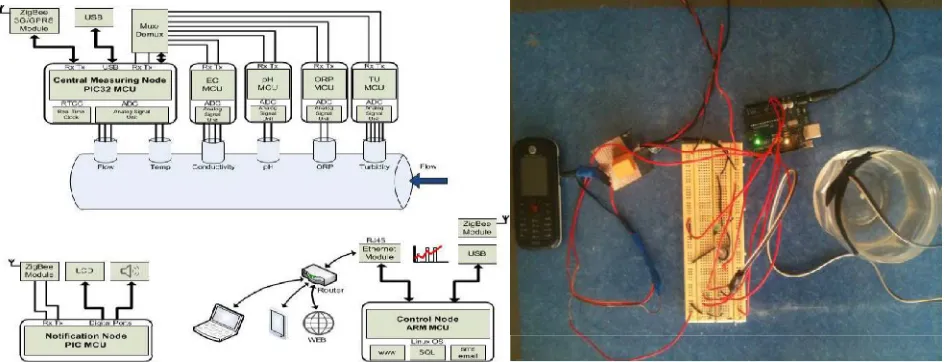
The system architecture is comprised of the following three subsystems: a central measurement node (PIC32 MCU based board) which works as a sensor node that collects water quality measurements from sensors, implements the algorithm to assess water quality and transmits data to other nodes.
A control node (ARM/Linux based platform) that stores measurement data received from the central measurement node in a local database and provides gateway to the internet, visualize data (charts), and sends email/SMS alerts and finally a tiny notification node(s) (PIC MCU based board) that receives information from the central measurement node through an interconnected ZigBee RF transceiver and provides local near-tap notifications to the user (water consumer) via several interfaced peripherals (LED, LCD, Buzzer).
Two event detection algorithms were developed to fuse online multi-sensor measurements in order to assess the water contamination risk when anomalies are detected. The objective of the event detection algorithms is to activate an alarm when normalized sensor outputs exhibit sudden and significant changes w.r.t drinking water quality standards. The first event detection algorithm is denoted as Vector Distance Algorithm (VDA), and the second event detection algorithm is denoted as Polygon Area Algorithm (PAA).
PIC32 MCU based board that collects water quality measurements from sensors. The developed system is low cost, low power.
5) Automatic Water Level Controller with Short Messaging Service (SMS) Notification.
System runs on battery power and comprises of four sub circuits working synchronously; Sensor circuit, controller circuit, SMS circuit and relay driver circuit. Sensor senses the level of the water in tank which is continuously fed to controller system. As the system encounters the empty level (A0) condition, status of load shedding is checked. Relay coil is energized and the pump operates when there is no load shedding.
SMS is only delivered if status of load shedding is encountered by the controller. Pump stop when the tank is full (A1). Arduino Uno, an open-source electronics, was used as controller of the system.
This system is deprived of any sort of noise and has effective switching action. The automatic water level controller system can be used in home, office sectors, swimming pool and even in industrial areas. Extra care needs to be given as water is used as conducting media.
6) Design and Implementation of Low Power Wireless Sensor System for Water Quality Monitoring.
The proposed wireless sensor system was composed of TB88-30 (Step Up DC to DC Converter), MPC82G516A (8-bit Microcontroller) is used to control the sensor devices toacquire the water quality parameters, and input voltage of TB88-30 by the using of ADC. It is also used to control nRF24L01, to perform receiving and re-transmitting of wireless signal. PIC12F629 (8-bit Microcontroller) PIC12F629 here is programmed as a timer.
When MPC82G516A and nRF24L01 are both in sleep mode, PIC12F629 starts to count until 5 minutes. After the counting is finish, PIC12F629 will trigger the external interrupt pin on MPC82G516A, wake up the MPC82G516A and return the nRF24L01 to normal mode., and nRF24L01 (2.4GHz Wireless Transceiver).
The input range of TB88-30 is from 0.9V to 3.0V, output voltage is fixed to 3.0V. Repeat node does not connect to any sensor device, but receives and transmits only.
III.PROPOSEDMETHODOLOGY
There are three modules implemented in this project. First module is water level detection in the tank using ultrasonic sensor. Second module is water leakage detection in tank using Water flow meter. Third module is Analysis of pH of water using pH sensor.
A) Water level detection
Water level detection requires tank for storing water, ultrasonic sensor for detecting level of water and GSM module for doing voice call to the user. Arduino is used for interfacing with ultrasonic sensor and GSM module for generating the results.
In this system is continuously checks the level of water using ultrasonic sensor. Ultrasonic sensor hasfour pins connected to the Arduino. Trigger pin of UV sensor is connected to Pin 7 of Arduino, Echo pin of UV sensor is connected to the Pin 8 of Arduino, Ground pin and VCC pin of UV sensor is connected to Ground and VCC pin of Arduino respectively.
Fig. 4 calling on level detection
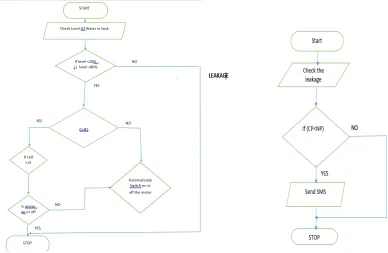
If water level is 80% of total length of tank then tank is empty then system will notify user to switch ON the motor as water level is reduced. When water level is up to the 20% of the total length of the tank then tank becomes full then system will notify user to switch OFF the motor as water level is up to its maximum level.
The notification is given to user by doing voice call to particular user. When water level is at 20% or 80% then GSM will call user. So that user will either switch ON the motor or switch OFF the motor depending on condition.
2) Water leakage detection
Water leakage detection system requires the water flow meter to detect the leakage in pipe, Arduino for interfacing with water flow meter, GSM module for doing text message.
In this, system calculates the flow rate of water flowing in pipe using water flow meter. Water flow meter contain cycles in it. When water pass through water flow meter these cycles starts rotating. By counting number of rotations done by cycle in one minute we are calculating the flow rate of water. Water flow meter has calibration constant 7.5/4.5.
For calculating flow rate of water, use formula Q=n/c,
Where, Q= liquid flow rate, c= calibration factor 7.5/4.5, n = no. of wheel rotations.
After detecting flow rate of water, system compares the current flow rate of water with normal flow rate of water. If current flow rate is less than the normal flow rate then system concludes that there is the leakage in pipe.
As soon as system detects the leakage in pipe it will notify the user by sending message that there is leakage in tank. This message is send by using GSM module.
3) Water Quality detection
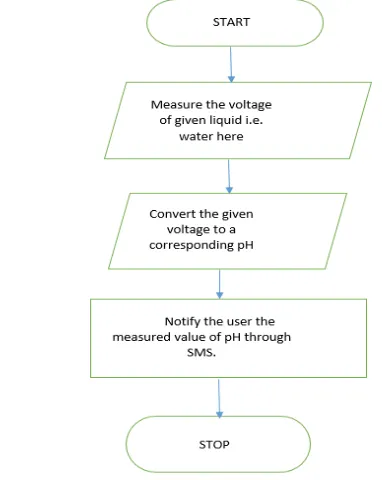
Water quality detection system requires the pH sensor probe to detect the pH value of water, the value measure by pH sensor and convert it into condition the signal appropriately we use the Arduino and GSM module for doing text message to user.
We can connect the A0 of pH to the 3 pin of Arduino and the GND pin of pH to the GND pin of Arduino.
Fig. Flow chart of quality detection
pH probe will measures the potential difference between two electrodes i.e. a reference electrode (silver / silver chloride) and a glass electrode that is sensitive to hydrogen ion. We have to use the electronic circuit to condition the signal appropriately and we can use this sensor with micro-controller such as Arduino.
The probe will oscillates between positive and negative values. The 0 represents a pH of 7.0. And to use it with Arduino this circuit will add an offset value to the value measured by the probe so the ADC will only have to take samples of positive voltage values.
IV.EXPERIMENTAL RESULTS
The three module declared above make use of following requirements and some of them are common in three modules that are, 1) Arduino Uno r3 for interfacing, 2) GSM module. And the other requirements are: 1) ultrasonic sensor, 2) Water flow sensor, 3) A pH sensor probe, 4) male to male jumper wires, 5) male to female jumper wires, 6) adapter, 7) BNC connector, 8) DC motor.
The above three modules are set as follows:
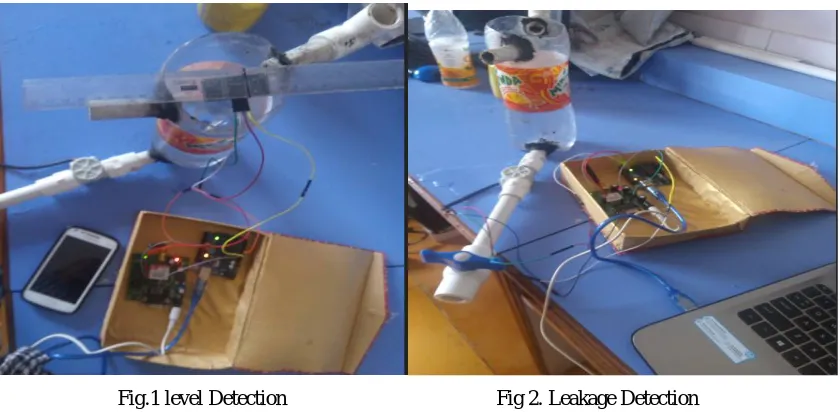
Fig. 1 Consist of setup of level detection, by using ultrasonic sensor it detects the level and as per set level it notify users by calling.
Fig.1 level Detection Fig 2. Leakage Detection
Fig. 2 Consist of setup of leakage detection, by using water flow rate it detects the leakage and notify user by sending message on user mobile.
Fig.3 Quality detection
Fig.5 SMS on Leakage detection Fig. 6 SMS on Ph detection
V. FUTURE SCOPE
The proposed system can be made more advance in future, as here we are using mobile for notification purpose to the user, and in future a mobile application can be used. Also in our system we are notifying to one or two users only but in future with the help of satellite we can give preference of number many user and notify only that user which is within the specified area range and near our system also in quality detection, we are detecting pH only but in future we can detect many other quality factors like chlorine, salinity, turbidity etc.
VI.CONCLUSION
This system will detect water level in tank and accordingly notify the user by calling on mobile so that user will turn on or off the pump. This will keep the user free. Also leakage system will notify user as soon as it takes place will help to recover further big problem. And analysis of water will help to keep health of user secure.
REFERENCES
[1] T. Lambrou, C. Anastasiou, C. Panayiotou, and M. Polycarpou, “A low-cost sensor network for real-time monitoring and contamination detection in drinking water distribution systems,” IEEE Sensors Journal, vol. 14, no. 8, pp. 2765–2772, 2014.
[2] L.A. Gama-Moreno, A. Corralejo, A. Ramirez-Molina, J. A. Torres- Rangel, C. Martinez-Hernandez, M.A. Juarez , “A Design of a Water Tanks Monitoring System Based on Mobile Devices”, IEEE 2016.
[3] EkaCahyaPrimaa,*, Siti Sarah Munifahab, Robby Salamb, Muhamad HaidzarAzizb, Agustin Tia Suryanic , “Automatic Water Tank Filling System Controlled using ArduinoTM based Sensor for Home Application”, Elsevier 2017.
[4] Salma A S. Alarefi, Prof. Stuart Walker, “Innovative Shunt Measurement for Residential Water Micro-Leakage Detection”, IEEE 2017. [5] SanamPudasaini*, Anuj Pathak*, SukirtiDhakal**, Milan Paudel*, “Automatic Water Level Controller with Short Messaging Service (SMS)