Face Recognition Approach for Obstructed
Image Using AAM
Mangala B S 1, Padmanayana 2
M. Tech Student, Department of Computer Science and Engineering, Srinivas Institute of Technology, Valachil,
Mangaluru, Karnataka, India1
Associate Professor, Department of Computer Science and Engineering, Srinivas Institute of Technology, Valachil,
Mangaluru, Karnataka, India2
ABSTRACT: In the real world applications of Face Recognition (FR) systems, it is required to solve the different types of problems like occlusion and changes appearing in face images. As compared with resolving the solutions for the interferences like illumination varying and changing pose of the face, occlusions in face has not attracted much attention yet. To deal with this problem in FR here a novel approach is proposed by using dynamic image-to-class warping (DICW), particle swarm optimization (PSO) with Support Vector Machine (SVM) and active appearance model (AAM). The face consists naturally ordered forehead, eyes, nose, mouth, and chin so the appearing of the occlusion in face images does not change this order. Thus, an obtained face image should be divided into patches, and then to form an ordered sequence it will be concatenated in the raster scan order. Between the query face and the enrolled subjects the optimal alignment will be calculated, by taking ordered information. By comparing with already existing methodologies, the proposed method can solve the problem of occlusions when it exist in both probe and gallery images. The proposed methods effectiveness have been tested for the different types of occlusions present in public face databases.
KEYWORDS:Face Recognition, Particle Swarm Optimization, DICW, SVM, AAM.
I. INTRODUCTION
Over the past few decades, in the field of computer vision and pattern recognition, the Face Recognition (FR) is represented as one of the most active research topic. Nowadays, in some of the controlled conditions, the term automatic FR system will results a significant progress. But these systems will give unsatisfactory outcome in some of the unconstrained conditions like varying in pose, illumination with large variations, expression etc. Faces are easily occluded by the subject itself in the real-world scenarios by active or passive ways, for example by using the facial accessories like mask, sunglasses, hat, and scarfs for a personal or traditional reasons. Sometimes the objects that is in front of the face, for example mobile phone, hand, other person face, food and pets will results occlusion in face. And some of the conditions like self-occlusion, extreme illumination and poor image quality like blurring, shadow are also the reason for the occlusion in the face image. According to crime or security reasons the subject tend to occlude their faces to hide their identity. And it will increase the difficulty of recognizing the face where the subject’s cooperation is not at all applicable. First of all the discriminative facial features are distorted by this occlusions and in the feature space same subjects two face images distance will be increases. By this the performance of the recognition will be decreases where the occlusion results the inter-class variations to become smaller than that of intra-class variations. And secondly the recognition rate will be degrade when we get registration errors while the facial landmarks have been occluded [2].
will be used and it is of skin colour and it is proposed by Jia and Martinez [4], [5]. In practical scenarios, we cannot predict the occlusion types. It is difficult for the face images while doing the segmentation for the occluded region because the size, shape and the locations are unknown. The faces with different specific types of occlusions are considered for the training of occlusion detectors because of that, in the real world environment for the occlusion with different types which can be generalised poorly.
Here in this approach recognition will be performed with the presence of the occlusions. And approaches for this problem is divided into two main categories. Among those the first category is the reconstruction based approaches and it mainly takes the occluded FR as the reconstruction problem [6]. The local matching based approaches is said to be second category [6], [7]. From the face’s local area, the facial features will be extracted, and for example, overlapping or non-overlapping the image patches, so from the face we can analyse affected and unaffected parts in isolation. Here in this proposed approach for the occluded FR, Dynamic Image-to-Class Warping [1] is used and it is coming under local matching based method. The Dynamic Time Warping (DTW) algorithm [8] motivates this current DICW approach and two time sequences elastic match will be allowed by this algorithm. In the area of the speech recognition [8] also this approach was applied successfully. In this presented approach the given face image will be divided into patches and then to form a correct sequence in the raster scan this will be concatenated. By doing the patch sequence representation each of this patch contains the facial features order information. Between all of the query sequence as well as that subjects enrolled sequences, the Image-to-Class distance will be calculated by DICW using the optimal alignment of those subjects.
In the proposed approach for the recognition of the partially occluded face images will consider the face’s geometry information which is defined by the facial order. In some of the scenarios where the subject’s cooperation is not there, then it will be difficult to collect the representative information of the samples of the training set and due to this problem the pre-processing of occlusion will be difficult. By comparing this, by the presence of the occlusions proposed method does the recognition directly and the training is not required for this. For the subjects different poses from face the Active Appearance Model [11] shows the effective integration as well as differentiation ability. To extract the face features, the AAM is used with a non-linear programming. And this extracted features will be classified by an intelligent classifier in the process of recognition. Hence this is a better FR application.
II. RELATEDWORK
H. Jia and A. M. Martinez, [4] have proposed face recognition with occlusions which are in the testing and training sets. In this proposed work, the problem of reconstruction from the occluded image will be posed. So in this presented approach, in every class, each of the test image is defined as the linear combination of the training samples. Here the class label is defined as the class samples which provides the best reconstruction of the occluded image. Here, the meaning of “best reconstruction” is the smallest matching error which is obtained by comparing the reconstructed and the test images with an appropriate metric. In this formulation the main key point is to solely base the reconstruction on the visible data in the testing and training sets. To improve the recognition rates the localization and warping process is used. Then obtained face images will be converted to gray-scale later resize will be done. And for the comparison with reconstruction process they have used the 1-norm and the .5-quasi-norm method.
H. Jia and A. M. Martinez, [5] have proposed the support vector machines in face recognition with occlusions. The SVM technique cannot be applied for the defined samples, when the feature vectors are missing in those samples. In given sample vector of class 1, if some of the p features are missing, then these are defined as an affine subspace of p dimensions. The main goal of the SVM, that between the vectors of the given class 1 and the class 2 on those dimensions with no missing elements, the margin will be maximized, and secondly at the same time, the margin between the vectors in class 2 and the affine subspace of class 1 will be maximized. The overlap between the subspace of solutions in class 1 and classification hyperplane will be minimized by using this second term of the SVM criterion that is because we do not make out which are the values in the subspace a test vector can take for the next process. The hyper plane which is used to minimizing this overlap is parallel to the missing dimensions. But, when maximizing the margin of the visible data its solution will generally contradict and this condition is too restrictive. To solve this obtained problem, to minimize the probability of overlap, a new criterion is defined.
have used Self-Organizing Map (SOM) instead of using a mixture of Gaussians for the learning of the subspace that will define each of the individual and here they have extended the previous local probabilistic approach which was presented by Martinez. Based on the training images localization, for learning the SOM topological space two strategies are proposed here, namely for all the samples, train a single SOM map and for each class train a separate SOM map, respectively. The outputs of the SOM topological space can effectively exploit by using a soft k nearest neighbour (soft k-NN) ensemble method, and also by this proposed method unlabelled subjects can be identified
A. V. Nefian and M. H. Hayes, [9] have proposed Hidden Markov Models for face recognition. In numerous commercial and law enforcement applications, face recognition became the active research area from the still images and video sequences. Because of the face recognition under the different conditions like facial expression, lighting and orientations the robust algorithms are required for these applications. Whenever the size of the face images or face orientation is changes the recognition rate of the methods like correlation, eigenface and linear discriminant methods will rapidly decreases. So a view based approach was developed in order to avoid these problems. In the first stage of these method is to determine the orientation or the facial expression of the face image and then using the database which is corresponding to the images that have the facial expression or the given orientation, recognition is performed. To characterize the statistical properties of the signal the Hidden Markov Models (HMM) are consists of statistical models. HMM which consist two processes which are interrelated those are:
An unobservable, underlying Markov chain, which consists of a state transition probability matrix, a finite number of states and an initial state probability distribution.
A set of probability density functions which is associated with each of the state.
T. Hosoi, S. Nagashima, K. Kobayashi, K. Ito, and T. Aoki, [10] have proposed restoring occluded regions using FW-PCA for face recognition. In this proposed method Fast Weighted Principal Component Analysis (FW-PCA) approach is employed, where only the effective pixels PCA is computed. In face images the occluded regions will be detected and restored by using the FW-PCA method. By using the public database effectiveness of the proposed method is demonstrated by comparing it through a set of experiments. By fitting the face models such as Active Appearance Model (AAM), is the model-based methods extract facial feature points, and according to the position of feature points on the face image the occluded regions are detected. If the model fitting is successfully applied then the accurate occluded regions can be detected, but the occluded regions in the face model is not robust against the model fitting approach.
III.PROPOSEDMETHOD
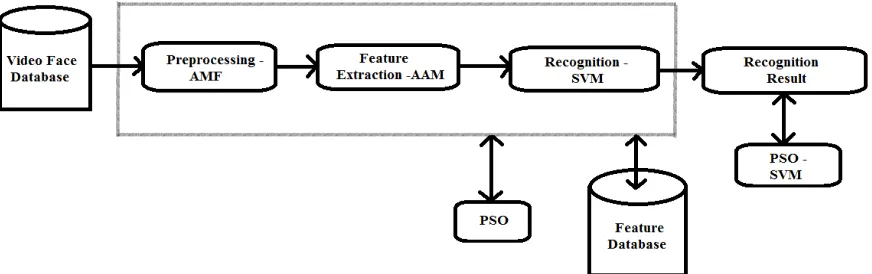
The proposed face recognition method which is used to develop an efficient technique to recognize the occluded face images. By using PSO with SVM techniques, it will be achieved. And here the proposed system mainly includes the four stages, those are (i) Adaptive Median Filtering for Pre-processing, (ii) AAM for Feature Extraction, (iii) Support Vector Machine (SVM) training and (iv) Testing. The face recognition will be done by consecutively performing these stages. The structure of the proposed face recognition system is illustrated in Figure 1.
A. Image Acquisition
Image capturing or image acquisition is the very first step of every image processing applications. Here in this proposed work, from the database video will be selected and that video will be converted into image frames and these image frames will be saved in some png, jpg or jpeg format in the database which are called as testing images.
B. Image Pre-processing
After converting the video into image frame, image pre-processing will be done which will helps to create an enhancement of these image frames. And this pre-processing will consisting of following steps.
1. Converting RGB to Gray image: Each of the pixel in the RGB color model consists of red, green and
blue, primary spectral component. RGB color model, which requires more time for processing as well as more space to storing and it is the main disadvantage of this model. So to recover this disadvantage the RGB image should be converted into Gray scale image.
2. Image Re-sizing: Changing the dimension of the given image is called as image re-sizing. Using some
re-sizing method the inputted image will be re-sized to meet the system requirements.
3. Image Filtering: From the inputted image, eliminating the unwanted portion is called as image
filtering, which will reduce the system complexity. Here in this proposed work Adaptive Median filtering is used, where it will replaces each of the entry with the neighbouring entries median so that noise reduction from the image frames will be possible.
C. Feature Extraction
Extracting the features from the image plays a main role in this work, where some of the image properties are considered. The properties include parameters of the Active Appearance Model, velocity, weight value of the shape parameter, appearance matrix and gray parameter of the model [11]. And these properties are used to train the Support Vector Machines data set.
D. Classification
Here in this module comparison between the occluded as well as unclouded images will be processed by using the dataset which is provided by the Support Vector Machine. To work with the feature space which has got high dimension, the SVMs has been enabled by using the kernel function. By using PSO technique optimization of the parameters of the Support Vector Machine (SVM) [5] will be done which will give a precise recognition.
E. Modelling
By defining a distance measurement between the sequences we can implement the face matching process and here for the classification distance is used as the basis. If the two sequences are similar to each other then we can expect only a small distance. The DICW [1] is mainly motivated by the algorithm known as DTW, where it will allow the elastic matching of successfully applied.
IV. EXPECTED OUTCOME
The face recognition technique which is described in this paper is expected to recognize the image frames which are stored in the database against the test images. The noise particles which are present in the image will be removed by using adaptive median filtering and filtered images will be given to feature extraction process. The AAM based features will be extracted in feature extraction process and it will be given to SVM. Then the PSO technique will optimize the SVM parameters. The evaluation of this method can be performed by taking more inputs.
V. CONCLUSION
when the occlusion is present in both probe and gallery set also in the condition where only limited number of samples stored in database.
REFERENCES
[1] X. Wei, C.-T. Li, Z. Lei, D. Yi, and S. Z. Li, ”Dynamic image-to-class warping for occluded face recognition,” IEEE Transactions on Information Forensics and Security, vol. 9, no. 12, pp. 2035 2050, Dec. 2014
[2] H. K. Ekenel and R. Stiefelhagen “Why is facial occlusion a challenging problem?” in Proc. IAPR 3rd Int. Conf. Biometrics (ICB), pp. 299308, 2009.
[3] R. Min, A. Hadid, and J.-L. Dugelay, “Improving the recognition of faces occluded by facial accessories,” in Proc. IEEE Int. Conf. Autom. Face Gesture Recognit. (FG), pp. 442447, Mar. 2011.
[4] H. Jia and A. M. Martinez, “Face recognition with occlusions in the training and testing sets,” in Proc. IEEE Int. Conf. Autom. Face Gesture Recognit. (FG), pp. 16, Sep. 2008.
[5] H. Jia and A. M. Martinez, “Support Vector Machines in face recognition with occlusions,” in Proc. IEEE Conf. Comput. Vis. Pattern Recognit. (CVPR), pp. 136141, Jun. 2009.
[6] A. M. Martinez, “Recognizing imprecisely localized, partially occluded, and expression variant faces from a single sample per class,” IEEE Trans. Pattern Anal. Mach. Intell., vol. 24, no. 6, pp. 748763, Jun. 2002.
[7] X. Tan, S. Chen, Z.-H. Zhou, and F. Zhang, ”Recognizing partially occluded, expression variant faces from single training image per person with SOM and soft k-NN ensemble,” IEEE Trans. Neural Netw., vol. 16, no. 4, pp. 875886, Jul. 2005.
[8] H. Sakoe and S. Chiba, ”Dynamic programming algorithm optimization for spoken word recognition,” IEEE Trans. Acoust., Speech, Signal Process., vol. 26, no. 1, pp. 4349, Feb. 1978.
[9] A. V. Nefian and M. H. Hayes, III, ”Hidden Markov models for face recognition,” in Proc. IEEE Int. Conf. Acoust., Speech Signal Process., vol. 5., pp. 27212724, doi: 10.1109/ICASSP.1998.678085, May 1998.
[10] T. Hosoi, S. Nagashima, K. Kobayashi, K. Ito, and T. Aoki, “Restoring occluded regions using FW-PCA for face recognition,” in Proc. IEEE Comput. Soc. Conf. Comput. Vis. Pattern Recognit. Workshops (CVPRW), pp. 2330, Jun. 2012 ,