ISSN(Online): 2320-9801
ISSN (Print): 2320-9798
I
nternational
J
ournal of
I
nnovative
R
esearch in
C
omputer
and
C
ommunication
E
ngineering
(An ISO 3297: 2007 Certified Organization) Vol. 3, Issue 6, June 2015
Design & Implementation of
Optimal Path Selection In Sleep Awake
Cycling In Wireless Sensor Network
Sarvjeet kaur, Er. Jasmeet Singh
Research Scholar, Department of ECE, JCDM Collage of Engineering, Sirsa, Haryana, India
Assistant Professor, Department of ECE, JCDM Collage of Engineering, Sirsa, Haryana, India
ABSTRACT: This paper presents an optimal path selection algorithm under sleep awake cycling in WSN. The main
issue is the energy wastage of unused nodes. So, to overcome this, it proposes an on demand asynchronous sleep awake protocol for reducing energy consumption. In this, optimal path selection is based on shortest distance between nodes which is to be calculated. In this, it covers different scenarios under sleep awake. It presents synchronous and asynchronous way of communication between nodes. The main objective is to provide energy efficiency in network & also reduce delay. We formulate the routing problem as time-dependent Bellman-Ford problem. In this, it presents a multipath routing protocol for data transmission. The projected mechanism is implemented with MATLAB.
KEYWORDS:Duty Cycle, Optimal Path Selection, Wireless Sensor Network, Sleep Cycle etc.
I. INTRODUCTION
A wireless sensor network consists of sensor nodes deployed over a geographical area for monitoring physical phenomena like temperature, humidity, vibrations, seismic events, and so on. A WSN is a collection of millimeter-scale, self-contained, micro-electro-mechanical devices. These tiny devices have sensors, computational processing ability (i.e. CPU power), wireless receiver and transmitter technology and a power supply. Wireless sensor networks have seen tremendous advances and utilization in the past two decades. Starting from petroleum exploration, mining, weather and even battle operations, all of these require sensor applications. One reason behind the growing popularity of wireless sensors is that they can work in remote areas without manual intervention. All the user needs to do is to gather the data sent by the sensors, and with certain analysis extract meaningful information from them. Usually sensor applications involve many sensors deployed together [4].
ISSN(Online): 2320-9801
ISSN (Print): 2320-9798
I
nternational
J
ournal of
I
nnovative
R
esearch in
C
omputer
and
C
ommunication
E
ngineering
(An ISO 3297: 2007 Certified Organization) Vol. 3, Issue 6, June 2015
Wireless Sensor Networks may consist of many different types of sensors such as seismic, low sampling rate magnetic, thermal, visual, infrared, acoustic and radar. They are able to monitor a wide variety of ambient conditions that include temperature, humidity, vehicular movement, lightning condition, pressure, soil makeup, noise levels, the presence or absence of certain kinds of objects, mechanical stress levels on attached objects, and the current characteristics such as speed, direction and size of an object. The three application classes we have selected are: environmental data collection, security monitoring, and sensor node tracking.
The use of wireless sensor networks is increasing day by day and at the same time it faces the problem of energy constraints in terms of limited battery lifetime. As each node depends on energy for its activities, this has become a major issue in wireless sensor networks. The failure of one node can interrupt the entire system or application. Every sensing node can be in active (for receiving and transmission activities), idle and sleep modes. In active mode nodes consume energy when receiving or transmitting data. In idle mode, the nodes consume almost the same amount of energy as in active mode, while in sleep mode, the nodes shutdown the radio to save the energy. In WSNs the only source of life for the nodes is the battery. Communicating with other nodes or sensing activities consumes a lot of energy in processing the data and transmitting the collected data to the sink. In many cases (e.g. surveillance applications), it is undesirable to replace the batteries that are depleted or drained of energy. Many researchers are therefore trying to find power-aware protocols for wireless sensor networks in order to overcome such energy efficiency problems.
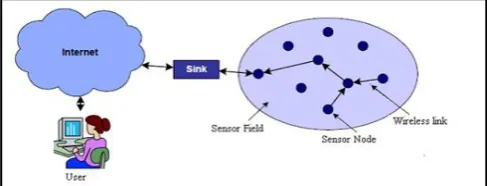
Figure 2: Wireless Sensor Network Schematic [1]
One reason behind the growing popularity of wireless sensors is that they can work in remote areas without manual intervention. All user needs to do is to fold the data sent by sensors, and with certain examination extract meaningful information from them. Usually sensor applications involve many sensors organized together. These sensors form a network and collaborate with each other to gather data and send it to the base station. The base station acts as the control centre where the data from the sensors are gathered for further analysis and treating. In a husk, a wireless sensor network is a system consisting of spatially dispersed nodes which use sensors to monitor physical or environmental circumstances. These nodes combine with routers and gateways to generate a WSN system [4].
The development of sensor networks requires technologies from three different research zones: sensing, communication, and computing (as well as hardware, software, and procedures). Thus, combined and separate progressions in each of these areas have driven investigation in sensor networks. Examples of early sensor networks comprise the radar networks used in air traffic regulator. The national power grid, with its numerous sensors, can be viewed as one large sensor system. These systems were recognized with specialized computers and communication capabilities, and before the term “sensor networks” came into vogue [5].
ISSN(Online): 2320-9801
ISSN (Print): 2320-9798
I
nternational
J
ournal of
I
nnovative
R
esearch in
C
omputer
and
C
ommunication
E
ngineering
(An ISO 3297: 2007 Certified Organization) Vol. 3, Issue 6, June 2015
II. SLEEP SCHEDULING IN WSN
The major design objective for wireless sensor network applications is to minimize the energy consumption in order to maximize network lifetime. To improve a sensor network's reliability and extend its longevity, sensor networks are deployed with high densities. However, if all sensor nodes in such a dense deployment scenario operate at the same time, energy will be consumed excessively. Also, packet collisions will increase as a result of the large number of packets being forwarded in the network. In addition, most of the data forwarded in the network will be redundant since when node density is high, sensing regions of the nodes will overlap and the data of adjacent sensor nodes will be highly correlated.
A practical sleep scheduling algorithm should both choose the minimum number of active nodes and satisfy user defined constraints. The non-sleeping nodes must be chosen so that they are connected to the sink and they provide some minimum coverage of the network field. User defined constraints may vary depending on the application type. F or instance, the user may want the network to be connected and provide some minimum coverage for as long as possible or the user may want the network to be connected and provide full coverage of the network field while ensuring some minimum delay in gathering data. The purpose of sleep scheduling techniques is to save energy and prolong network lifetime. Several protocols have been proposed to reduce the energy consumption using sleep scheduling methods. This section describes the fundamental asynchronous and scheduled sleep techniques.
Asynchronous sleep techniques
Asynchronous sleep techniques aim to keep the radio in default sleep mode and wake-up briefly to check for traffic or send/receive messages. The various asynchronous sleeping techniques are discussed:
The secondary wake-up radio concept uses a hardware solution to enable nodes to sleep by default and only awake when needed [4]. In the design, each sensor node is equipped with two radio transceivers. The primary (data) radio remains asleep by default. The secondary radio is a low-power wake-up radio that remains on at all times. When the secondary radio receives a wake-up signal from another node, it instructs the primary radio to wake up for data transmission. This method assumes that an extremely low power radio can be used as a secondary radio.
Sleep Scheduled Techniques
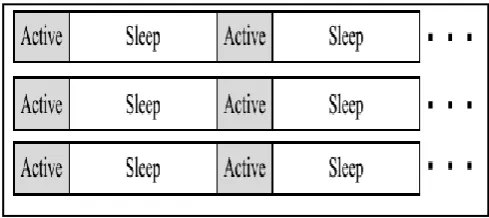
Figure 3: Sleep Scheduling in WSN
ISSN(Online): 2320-9801
ISSN (Print): 2320-9798
I
nternational
J
ournal of
I
nnovative
R
esearch in
C
omputer
and
C
ommunication
E
ngineering
(An ISO 3297: 2007 Certified Organization) Vol. 3, Issue 6, June 2015
III. PROPOSED OPTIMAL PATH SELECTION UNDER SLEEP AWAKE IN WSN
The network layer is accountable for routing information through the sensor network, which finds the most efficient lane for the packet to travel on its way to a specific destination. This deals with energy-saving methods at network level, the choice of data routing in the network and different protocols which will results in less energy consumption in the network. In minimizing the overall power consumption of the network, the data routing algorithm plays an important role.
Sensor nodes are assumed to be stationary in most of the network architecture. If not it is more challenging to route messages between moving nodes depending on the application: the sense event can be dynamic or static. Traffic is generated only when reporting has to be done in static events; on the other hand most application periodic reporting is required in dynamic events, resulting in the generation of significant traffic that has to be routed to the base station. One of the factors that affect the performance of routing protocols is the deployment of sensor nodes, which is either deterministic or self-organizing.
A. Power Management Protocol
The power management protocol for WSNs is one of the main energy conservation techniques available for a WSN. The power management protocol can be classified into two categories depending on the location of the power saving within the network layering. Each category of these power management protocols is best suited for a certain type of network topology .The two power management protocols are independent sleep-/wakeup protocols running at the network or application layer and integrated with the MAC protocol itself. Based on the specific sleep scheduling, the MAC protocol then optimizes the medium access functions which are used for power management. Independent sleep/wakeup protocols can be used in combination with any MAC protocol in order to reduce the energy consumption. Within these kinds of sleep/wakeup protocols a classification can be made into three main categories: on demand, scheduled rendezvous and asynchronous protocols.
1. The On-demand Protocol
First of the power management protocol that is introduced is the on-demand protocol. This procedure is based on the plan that a sensor node should be in the sleep mode or off when there is no data packet to broadcast and/or receive. As soon as there is a data packet that needs to be transmitted and/or received the sensor node shall become active. In this way sensor nodes alternate between active and sleep periods depending on network activity. The consequence is that the energy consumption is minimized since sensor do not waste energy by unnecessary transmissions and unnecessary sensing. But the main disadvantage of this protocol is that it is difficult to inform the sleeping sensor nodes if another sensor node wants to communicate with them.In order to combat this disadvantage the use of multiple radios is required. This requires two channels to work corporately, namely a data channel and a wakeup channel, the former one is used for normal data communication and the other one is for awaking neighbouring sensor nodes when needed.
2. The Scheduled Rendezvous Protocol
ISSN(Online): 2320-9801
ISSN (Print): 2320-9798
I
nternational
J
ournal of
I
nnovative
R
esearch in
C
omputer
and
C
ommunication
E
ngineering
(An ISO 3297: 2007 Certified Organization) Vol. 3, Issue 6, June 2015
Figure 4: The Sleep Scheduling for a Synchronous Protocol
3. The Asynchronous Protocol
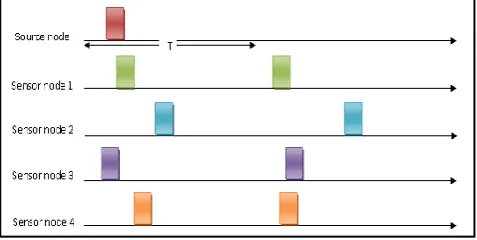
The last algorithm that can be used is the asynchronous protocol. The basic idea is that each node is allowed to wake up independently of the others by guaranteeing that neighbouring sensor nodes always have overlapped active periods of time within a specified number of cycles. According to this only sensor node 1 and sensor node 3 can receive the transmitted packet. Since the active period of the sensor nodes partially overlap with the active period of the source node. One of the advantages of this protocol is that a sensor node can wake up at anytime when it wants to communicate with its neighbouring sensor nodes.
Figure 5: The Sleep Scheduling for a Asynchronous Protocol
IV. SIMULATION RESULTS
In order to reduce the end-to-end latency with energy efficient data transmission proposed an Asynchronous Wakeup Schedule(AWS) in WSNs. Each node was assigneda particular color. Data transmission is an important topic of WSNs, as the distance between each sensornodes is different; the energy consumed by each sensor node is different. When thedistance between a sensor node and the base station is large the data transmissionfrom sensor node to base stations consumes more energy than in the case when thedistance is small. Hence the distance between sensor nodes among another and thedistance from sensor nodes to the base station impacts the lifetime of the WSNs.Datatransmissions can be classified into two categories, namely direct transmissions andindirect transmissions.
ISSN(Online): 2320-9801
ISSN (Print): 2320-9798
I
nternational
J
ournal of
I
nnovative
R
esearch in
C
omputer
and
C
ommunication
E
ngineering
(An ISO 3297: 2007 Certified Organization) Vol. 3, Issue 6, June 2015
node to theBS is also called multi-hop path. The advantage of this kind of transmission is thatthe high energy consumption problem in long distance transmission has been solved.
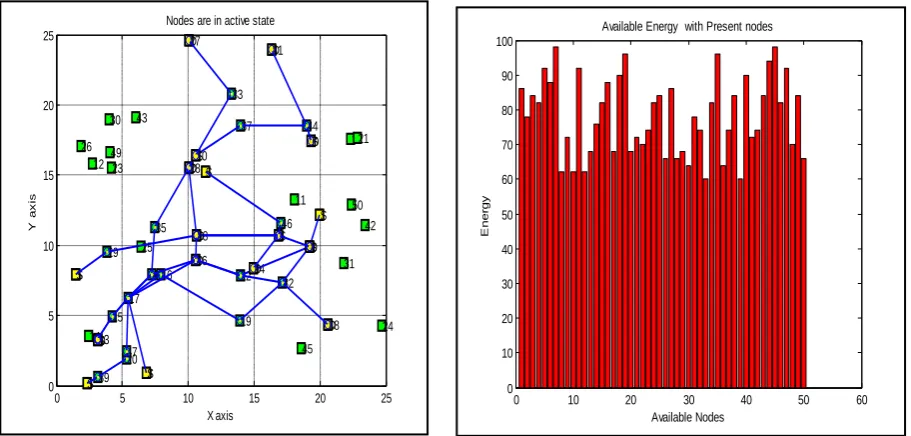
Figure 6:Placement of Nodes in Network
Broadcasting works that if a sensor node wants to transmit data it will broadcast the data to all its neighbouring nodes. The sensor nodes that received the packet from the source node shall further rebroadcast the packet to their respective neighbouring sensor nodes which the source node could not reach. In this way in a short time the entire network is reached. Although broadcasting has many advantages such as it is simple to implement, fast and robust, it also has some disadvantage.
Figure 7:Communication of Nodes in Network Figure 8:Energy Used by All Nodes
0 5 10 15 20 25
0 5 10 15 20 25 1 X axis Y a x is
placement of nodes in network
2 3 4 5 6 7 8 9 10 11 12 13 14 15 16 17 18 19 20 21 22 23 24 25 26 27 28 29 30 31 32 33 34 35 36 37 38 39 40 41 42 43 44 45 46 47 48 49 50
0 5 10 15 20 25
0 5 10 15 20 25 1 X axis Y a x is
Nodes are in active state
2 3 4 5 6 7 8 9 10 11 12 13 14 15 16 17 18 19 20 21 22 23 24 25 26 27 28 29 30 31 32 33 34 35 36 37 38 39 40 41 42 43 44 45 46 47 48 49 50 S D S D S D S D S D S D S D S D S D S D
0 10 20 30 40 50 60
ISSN(Online): 2320-9801
ISSN (Print): 2320-9798
I
nternational
J
ournal of
I
nnovative
R
esearch in
C
omputer
and
C
ommunication
E
ngineering
(An ISO 3297: 2007 Certified Organization) Vol. 3, Issue 6, June 2015
Figure 9: Delay Provided by All Nodes Figure 10: Energy Efficient Routing in Asynchronous Mode
Figure 11: Energy Output in Asynchronous Mode Figure 12:Proposed Routing in Network
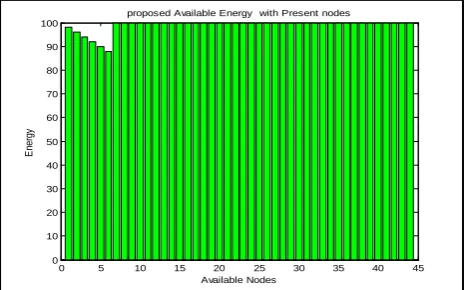
Figure 13:Energy Efficiency in Network
0 5 10 15 20 25
0 5 10 15 20 25 1 X axis Y a x is
Proposed On demand Event Driven mode
2 3 4 5 6 7 8 9 10 11 12 13 14 15 16 17 18 19 20 21 22 23 24 25 26 27 28 29 30 31 32 33 34 35 36 37 38 39 40 41 42 43 44 45 46 47 48 49 50 S D
0 5 10 15 20 25 30 35 40 45
0 10 20 30 40 50 60 70 80 90 100 E ne rg y Available Nodes
proposed Available Energy with Present nodes
0 10 20 30 40 50 60
0 5 10 15 20 25 30 35 40 45 50
Delay in scenario
total Number of Nodes
D el ay ( se c)
0 10 20 30 40 50 60
0 10 20 30 40 50 60 70 80 90 100 E n e rg y Available Nodes Available Energy with Present nodes
0 5 10 15 20 25
0 5 10 15 20 25 X axis Y a xi s
energy efficient routing in this mode
ISSN(Online): 2320-9801
ISSN (Print): 2320-9798
I
nternational
J
ournal of
I
nnovative
R
esearch in
C
omputer
and
C
ommunication
E
ngineering
(An ISO 3297: 2007 Certified Organization) Vol. 3, Issue 6, June 2015
V. CONCLUSION
In this work, it presents the sleep scheduling of nodes in WSN.In this, optimal path selection is based on shortest distance between nodes which is to be calculated. In this, it covers different scenarios under sleep awake. It presents synchronous and asynchronous way of communication between nodes. The main objective is to provide energy efficiency in network & also reduce delay. We formulate the routing problem as time-dependent Bellman-Ford problem. In this, it presents a multipath routing protocol for data transmission. The projected mechanism is implemented with MATLAB. All these are useful for reducing the energy consumption and improve the accuracy. In this, optimal path selection is based on shortest distance between nodes which is to be calculated.
REFFERENCES
[1] S. Ozdemira, Y. Xiao, “Secure data aggregation in wireless sensor networks: A comprehensive overview”, 2009.
[2] L.T Nguyen, X.Defago, R.Beuran, Y.Shinoda, “An Energy Efficient Routing Scheme for Mobile Wireless Sensor Networks”, 2008. [3] W.H Liao, H-H Wang, “An asynchronous MAC protocol for wireless sensor networks”, 28 July 2008.
[4] J. Zhua, K.L Hunga, B. Bensaoua, F.N Abdesselam, “Rate-lifetime tradeoff for reliable communication in wireless sensor networks”, 29 September 2007.
[5] H. Shih, J. Ho, B. Liao, “Fault Node Recovery Algorithm for a Wireless Sensor Network” IEEE Sensors Journal, Vol. 13, No. 7, 2013. [6] M. Masdari and M. Tanabi, “Multipath Routing protocols in Wireless Sensor Networks: A Survey and Analysis”, International Journal of
Future Generation Communication and Networking Vol.6, No.6, 2013.
[7] M. Sharawi, I.A Saroit, H. Mahdy, E. Emary, “Routing Wireless Sensor Networks Based On Soft Computing Paradigms: Survey”, International Journal on Soft Computing, Artificial Intelligence and Applications (IJSCAI), Vol.2, No.4, 2013.
[8] S. Sharma, Dr. P. Mittal, “Wireless Sensor Networks: Architecture, Protocols”, Volume 3, Issue 1, 2013.
[9] E.P.K Gilbert, B. Kaliaperumal and E.B singh, “Research Issues in Wireless Sensor Network Applications: A Survey”,International Journal of Information and Electronics Engineering, Vol. 2, No. 5, 2012.
[10] Ms. P. Tyagi, Ms. S. Jain, “Comparative Study of Routing Protocols in Wireless Sensor Network”, Volume 2, Issue 9, 2012. [11] O.D Incel, “A survey on multi-channel communication in wireless sensor networks”, 2011.
[12] L.D.P. Mendes, J.J.P.C. Rodrigues, “A survey on cross-layer solutions for wireless sensor networks”, 2011.
[13] C.Tana, J.Zoua, M. Wanga, R. Zhang, “Network lifetime optimization for wireless video sensor networks with network coding/ARQ hybrid adaptive error-control scheme”, 2011.
[14] M.A Yigitel, O.D Incel, C.Ersoy, “QoS-aware MAC protocols for wireless sensor networks: A survey”,2011.
![Figure 2: Wireless Sensor Network Schematic [1]](https://thumb-us.123doks.com/thumbv2/123dok_us/1484491.1181611/2.595.171.406.387.510/figure-wireless-sensor-network-schematic.webp)