University of Windsor University of Windsor
Scholarship at UWindsor
Scholarship at UWindsor
Electronic Theses and Dissertations Theses, Dissertations, and Major Papers
1-1-1995
FMS loading with reliability consideration.
FMS loading with reliability consideration.
Abi M. PhiliposeUniversity of Windsor
Follow this and additional works at: https://scholar.uwindsor.ca/etd
Recommended Citation Recommended Citation
Philipose, Abi M., "FMS loading with reliability consideration." (1995). Electronic Theses and Dissertations. 6744.
https://scholar.uwindsor.ca/etd/6744
FMS LOADING WITH RELIABILITY
CONSIDERATION
By
Abi M. Philipose
A thesis subm itted to the
Faculty o f Graduate Studies and Research through the Department o f Industrial and M anufacturing System s Engineering in partial fulfilm ent o f the requirements fo r
the Degree o f M aster o fA p p lied Science a t the University o f Windsor
UNIVERSITY OF WINDSOR
W indsor, O ntario, C anada
UMI Number: EC55039
INFORMATION TO USERS
The quality of this reproduction is dependent upon the quality of the copy
submitted. Broken or indistinct print, colored or poor quality illustrations
and photographs, print bleed-through, substandard margins, and improper
alignment can adversely affect reproduction.
In the unlikely event that the author did not send a complete manuscript
and there are missing pages, these will be noted. Also, if unauthorized
copyright material had to be removed, a note will indicate the deletion.
UMI Microform E C 5 5 0 3 9 Copyright 2010 by ProQuest LLC
All rights reserved. This microform edition is protected against unauthorized copying under Title 17, United States Code.
ProQuest LLC
789 East Eisenhower Parkway P.O. Box 1346
© A bi M . Philipose 1995
To
God
I hereby declare that I am the sole author of this thesis. I authorize the
University of Windsor to lend this thesis to other institutions or individuals for the
purpose of scholarly research.
Abi M. Philipose
I further authorize the University of Windsor to reproduce this thesis by
photocopying or by other means, in total or in part, at the request of other institutions
or individuals for the purpose of scholarly research.
The University of Windsor requires the signatures o f all persons using
ABSTRACT
Availability, flexibility, an d productivity are the m ajo r reasons luring
m anufacturers to o p t for Flexible M anufacturing Systems (FM Ss). Experience
has show n th a t the equipm ent and hardw are alone does n o t get the production
facility to this goal. Scheduling and production planning, especially loading,
plays a n im portant role in determ ining the efficiency o f the production facility.
T his research deals with loading a F M S, with reliability considerations.
It is desirable to ru n a production plant at 100% reliability. However, the
costs involved in increasing the reliability varies in a non-linear trend. Realising
the im portance o f the reliability facto r in production planning, three
m athem atical m odels were developed. Tw o o f the m odels were full loading
problem s, while the third is a partial loading problem . W ith the objective o f
m inim izing the tooling costs, the larger m odels p artitio n the dem and into
batches, assign batches to machines, assign tools to machines, and determine the
location o f the spare tools. The smaller m odel assumes th a t the batches are
assigned to m achines, by other m eans, and so this m odel assigns tools to
m achines an d determines optim al spares. A lthough newer an d true F M S have
tool sharing capability, the older systems do not. M athem atical m odels were
developed for b o th these cases.
F o r the first time, the reliability factor has been coupled directly w ith the
m athem atical loading m odel. H ypothetical, b u t realistic problem s have been
ACKNOWLEDGMENTS
I would like to express my appreciation to my supervisor Dr. S.M. Taboun, for
his advice, criticism, patience, and moral support during the course of this research.
I would like to thank to my committee members, Dr. M. Ahmadi and Dr. M. Wang, for
their time and advice.
I would like to thank Mr. Tom Williams, computer system manager, and Ms.
Jacquie Mummery, secretary of the Industrial and Manufacturing Systems Engineering,
for their help and assistance.
I wish to express my gratitude to all my friends, especially V.K. Damodran,
S.R.V. Majety, Alper Ozdemir and A. Atmani for their support, stimulating discussions
and friendship.
I would like to thank my parents for their love, support and encouragement
during the entire period of my education.
Finally, I thank my wife and children, who patiently endured difficult times, and
TABLE OF CONTENTS
A bstract vii
Acknowledgements viii
Table o f Contents ix
List o f Tables xii
L ist o f Figures xiv
CH A PTER 1 INTRODUCTION 1
1.1 An Overview 1
1.2 Objectives of the Research 4
1.3 Organization of the Research 6
CH A PTER 2 TERMS AND DEFINITIONS 6
2.1 Definitions 7
2.2 Useful Statistical Distributions 11
CH A PTER 3 LITERATURE SURVEY
3.1 Tool Life 15
3.2 Tool Management 20
3.3 Loading 24
3.3.1 Analytical Approach 24
3.3.2 Heuristic Approach 26
3.3.3 Simulation Approach 28
3.4 Analogous Literature 30
3.5 Reliability Studies 32
CH A PTER 4 MODELS 36
4.1 System Configuration 36
4.2 Nomenclature 39
4.3 Assumptions 43
4.4 Mathematical Modelling 44
4.4.1 Model I 44
4.4.1a Case 1, Tool Sharing Not Permitted 45
4.4.1b Case 2, Tool Sharing Permitted 47
4.4.2 Model II 50
4.4.2a Case 1, Tool Sharing Not Permitted 52
4.4.2b Case 2, Tool Sharing Permitted 54
4.4.3 Model III 57
4.4.3a Case 1, Tool Sharing Not Permitted 59
4.4.3b Case 2, Tool Sharing Permitted 61
CH APTER 5 NUMERICAL EXAMPLES 64
5.1 Model la, Tool Sharing Not Permitted 64
5.1.1 Analysis of Results 66
5.2 Model lb, Tool Sharing Permitted 67
5.3 Model 2a, Tool Sharing N ot Permitted 70
5.3.1 Analysis o f Results 71
5.4 Model 2b, Tool Sharing Permitted 72
5.4.1 Analysis o f Results 73
5.5 Model 3a, Tool Sharing N ot Permitted 74
5.5.1 Analysis of Results 75
5.6 Model 3b, Tool Sharing Permitted 82
5.6.1 Analysis o f Results 83
5.7 Simulations on Witness 89
5.7.1 Tool Sharing not Permitted 91
5.7.2 Tool Sharing Permitted 94
5.7.3 Discussion 95
C H A PT E R 6 CONCLUSIONS AND FUTURE W ORK 97
6.1 Conclusions 97
6.2 Future Work 98
R E FE R E N C E S 100
A P P E N D IX 1 106
A P P E N D IX 2 118
A P P E N D IX 3 140
V ita A uctoris 146
LIST OF TABLES
Table 2.1 Statistical Distributions useful in Reliability Engineering 12
Table 5.1 Process Plans and Processing Times, Model 1 Case 1 65
Table 5.2 Machine Capacities, Model 1 Case 1 65
Table 5.3 Tool Life and Tool Cost, Model 1 Case 1 66
Table 5.4 Dividing Demand into Batches and Assigning to Machines, M1C1 66
Table 5.5 Assigning Tools and Spares to Machines Model 1 Case 2 66
Table 5.6 Dividing Demand into Batches and Assigning to Machines M1C2 68
Table 5.7 Assigning Tools and Spares to Machines, Model 1 Case 2 69
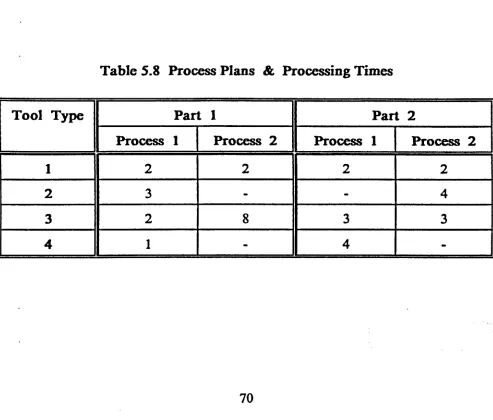
Table 5.8 Process Plans and Processing Times, Model 2 Case 1 70
Table 5.9 Machine Capacities, Model 2 Case 1 71
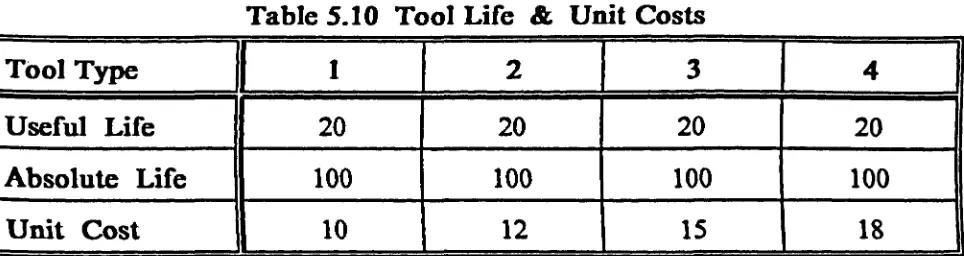
Table 5.10 Tool Life and Tool Costs Model 2 Case 1 71
Table 5.11 Assigning Tools and Spares to Machines Model 2, Case 1 71
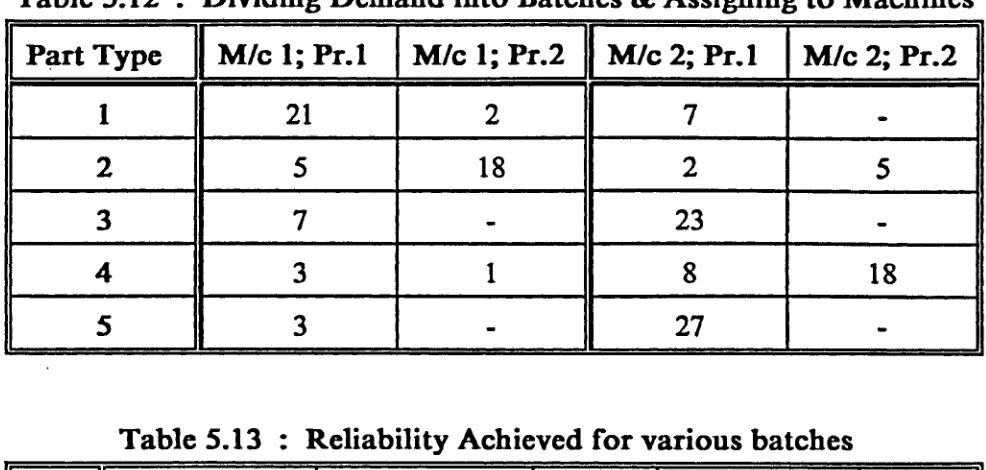
Table 5.12 Dividing Demand into Batches & Assigning to Machines 73
Table 5.13 Reliability Achieved for Various Batches 73
Table 5.14 Cycle Times of Operations in the System, Model 3 Case 1 76
Table 5.15 Effect of Required Reliability, on Total Cost and
Magazine Occupancy, Model 3, Case 1 77
Table 5.16 Redundancies used v/s Required Reliability, for Machine 1 80
Table 5.17 Redundancies used v/s Required Reliability, for Machine 2 80
Table 5.18 Redundancies used v/s Required Reliability, for Machine 3 81
Table 5.19 Redundancies used v/s Required Reliability, for Machine 4 81
Table 5.21 Effect of Required Reliability, on Total Cost and
Table 5.22 Redundancies used v/s Required Reliability 86
Table 5.23 Magazine Occupancy and Total Cost, Compared to Case 1 87
Table 5.24 Cycle Times for Operations in the System,
for Simulation Analysis 92
Table 5.25 Useful Tool life of Tools in the System 92
Table 5.26 Demand Partitioned into Batches, by the Mathematical Model 92
Table 5.27 Spares Used for Deterministic Cycle Times, Case 1 93
Table 5.28 Spares Used for Stochastic Cycle Times, Case 1 93
Table 5.29 Spares Used for Stochastic Cycle Times with
Catastrophic Failures, Case 1 93
Table 5.27 Spares Used for Deterministic Cycle Times, Case 2 95
Table 5.28 Spares Used for Stochastic Cycle Times, Case 2 95
Table 5.29 Spares Used for Stochastic Cycle Times with
Catastrophic Failures, Case 2 95
LIST OF FIG URES
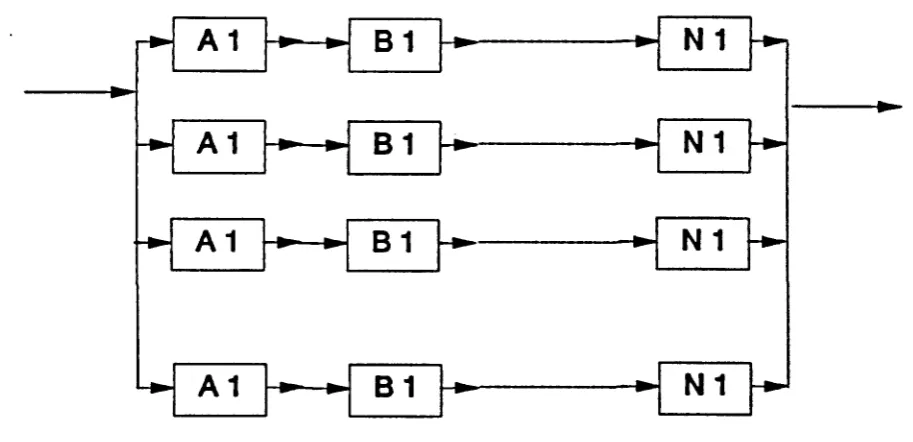
Figure 2.1 Representation of a Series System 13
Figure 2.2 Representation of a Parallel System 13
Figure 2.3 Standby Redundancy, with Switching Device 14
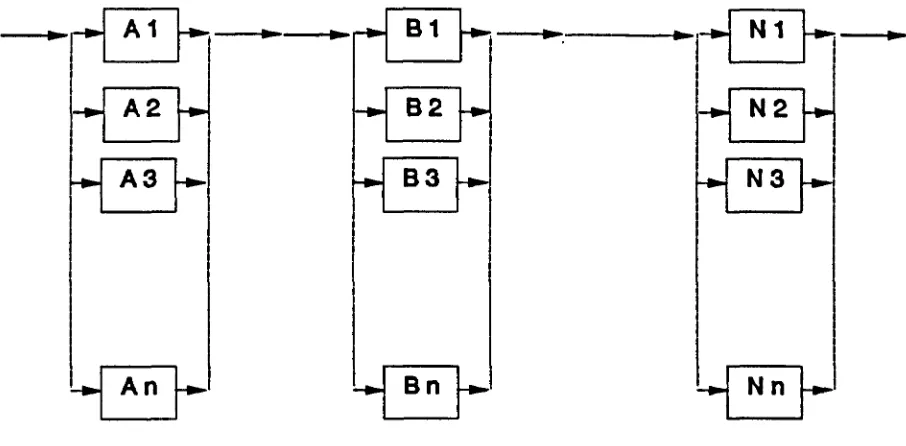
Figure 2.4 Representation of a Series System with Standby Redundancies 14
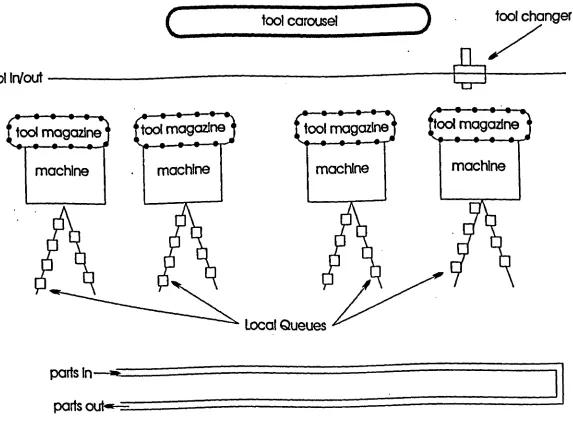
Figure 4.1 Typical Configuration of the System Being Studied 42
Figure 5.1 Effect of Reliability on the Total Cost 78
CHAPTER 1
INTRODUCTION
1.1 An Overview
Since the turn o f the century, the markets of the world are progressively
integrating into one global market. At the same time, the market has been steadily
drifting from a seller’s market to a buyer’s market. In the earlier days of the century,
a flourishing businessman stated, ’’people can order any colour of car as long as it is
black’’. Today, the company offers hundreds of colour and shade combinations for its
customers to choose. Besides variety, it is important to treat time as a critical source of
competitive advantage. So, trimming manufacturing lead time and product
development time are also of great importance. Thus, the changing market trend
demands efficiency, quality, flexibility and ingenuity from the manufacturers.
To compete in such a global economy, flexible manufacturing systems has
Flexible manufacturing has the potential to achieve the productivity of mass
production, while still offering a wide range o f flexibility. A Flexible Manufacturing
System (FMS) can be defined as a set of CNC machines and supporting workstations
that are interconnected by an automated material handling system and controlled by
a central computer (Askin 1993). Reduced labour, improved machine utilization,
improved operational control, improved product quality, reduced floor space
requirement and reduced inventory are some other benefits of using FMS.
Although FMS provides significant economic production in the long run, such
systems are highly capital intensive. Financial justification forms an integral part of an
FMS implementation. While too much or too soon creates excessive work in progress,
too little or too late leads to under-utilization of the facility. To maximize the return of
investment, one has to use the facility optimally. Flexible manufacturing being different
and similar to conventional manufacturing systems, it provides new and extensions of
older problems of operation research. The problems include designing the required
system, planning the operation to maximize the plant utilization, carrying sufficient
redundancies like tools, for an uninterrupted operation, and scheduling for the
production period. A high degree of system reliability is imperative in the operation of
In setting up an FMS, two groups of problems have to be addressed - Design and
Operational. The Operational problems can be further sub-divided into Planning,
Scheduling, and Control problems -(Stecke 1983). This research focuses on the loading
o f the FMS, which is a part of the planning sub-section o f the operational problem.
When FMS is employed for machining, assembly, or fabrication, they use a set
of tooling to perform the function. The system calls these tools sequentially, to perform
the desired operations. The tools wear out, break, or require resetting and maintenance,
from time to time, during the production run. Industrial data indicate that tooling
accounts for 25-30% of the fixed and variable cost of production in an automated
machining environment (Ayres 1988). Shaw (1980) described tool breakage as the
single most significant factor that reduces the productivity of manufacturing systems.
A key requirement for an efficient operation of an FMS is the existence of a
comprehensive tool management system. A certain level of reliability is required o f the
individual tools and the tooling system as a whole to ensure an uninterrupted,
production run. Sufficient redundancies must be foreseen at the preliminary production
planning stage, to cope with the various tool requirements. Whereas the cost of
redundancy is a negative factor, the additional reliability gained is a positive factor. So,
1.2 Objectives o f the Research
The objective o f this research is to develop a model for loading an FMS.
Machine Loading is defined as the decision associated with allocating jobs and the
required tools among the machining centres, subject to restrictions on the system. The
machine loading problem includes three entities; viz, the job, the tool and the machine.
A model taking care of all three entities would be a full machine loading model.
Otherwise, the problem is called a partial loading problem.
Flexible manufacturing systems in their complete form will allow tool sharing
between machines, via a gantry or monorail robot arm. However, tool sharing would
need additional investments in terms of equipment required, and more complicated tool
management policies. In practice, there are many FMS systems, where tool sharing is
not possible.
In this research, three sets of models have been considered. Each model is
formulated for two conditions. One, where tool sharing is permitted, and the other,
where tool sharing is restricted.
demand o f parts to be processed, process plans available to process the parts, number
o f machines available for the production period, the span of the production period,
capacities o f the tool magazines, and tool types available, the formulation divides the
demand into optimal batches, assigns process plans to the individual batches, assigns
batches to machines, assigns tool types to machines, determines their optimal spares
level, and the locates the spares in the different magazines. The objective is to minimize
the tooling costs.
A manufacturer always desires 100% reliability from the production shop.
However, higher reliability also costs more. The second model considers all the loading
problems and constraints mentioned above and then minimizes the tooling cost, and
also calculates the reliability with which an optimal batch is being processed by the
facility.
In many practical cases, the parts may not be assigned to the machines, based on
the similarity of their operations alone. In such cases, the demand will be partitioned
into batches and assigned to be processed by a particular process plan. Whereas the
second model made an evaluation of the reliability of processing a batch, this model
provides a generic solution to assigning tool types to machines, and optimizes the
minimum specified reliability. A linear program was developed that accommodated the
non linear reliability requirement.
Numerical problems were solved using the formulated models to test their
validity. The problems and their solutions have been provided.
Organization o f the Research :
The documentation of the research is organized as follows. A literature review
o f the past research works on tool life, tool life management, loading problems and
solutions in automated manufacturing, and analogous research is presented in Chapter
2. Some basic and important definitions, concepts and mathematics have been reviewed
in Chapter 3. Chapter 4 introduces the definition of the loading problem being
considered in this research. Nomenclature used have been shown. Later the three
models, each with two case scenarios have been derived. In Chapter 5, hypothetical, but
realistic numerical problems were taken up and solved using the derived mathematical
models. Some o f the results obtained were verified using a simulation model using
Witness simulation package. Conclusions and recommendations for future work have
been presented in Chapter 6. Various formulations done on Lindo, Lingo, Witness, and
CHAPTER 2
TERMS AND DEFINITIONS
Before taking up an FMS loading problem, with reliability considerations, and
building mathematical models, it would be advantageous to review some fundamental
concepts and definitions. A flexible m anufacturing system can be defined as an
arrangement of CNC machines, interconnected by an automated material handling
system, where the processing and movements o f the workpiece is controlled in
conjunction with a central computer. An FMS thus has the advantage of having the
capability to process a wide variety of products, in a near random order. One can now
visualize that the critical factor determining the performance of an F M S is ensuring the
optimal availability of machines and tools, as the demand for a certain workpiece comes
up, in a random order.
It is thus important to concentrate on the operational problems to achieve an
efficient operation. Loading is the focal point of production planning. Loading an
their attributes, and assigning the available machines and tools to process the demand.
Therefore there have been numerous research studies, dealing with loading an FMS.
Tool m anagem ent is the capability of having the required tools on the
appropriate machines, at the right time, so that the desired quantities of workpieces are
manufactured, while maintaining acceptable utilization of assets (Tomek 1986).
Gaalman (1987) described to o l sharing as a situation where the unavailable tool on a
machining centre, at a particular time, can be borrowed from other machining centres
in the system. Although a modem FMS would have tool sharing between machines,
there are older and lower capital systems where this facility does not exist. In this
research, both these scenarios were studied and modelled separately, and the numerical
results compared.
R eliability can be defined as, "the probability that an item (or system) will
perform its function adequately for the desired period of time when operated according
to the specified conditions." (Dhillon 1982). In other words, reliability is concerned with
determining the probability that a system consisting of many components will perform
its function. A system, where all constituent parts must function successfully, in order
to get a complete system performance is called a series system. Thus, in a system of this
at least one of the similar constituent parts has to function well for the system to
perform is called a parallel system. Schematic representation of a series and parallel
systems have been shown in Figure 2.1 and Figure 2.2.
Achieving higher reliability level often leads to the use of functional elements
that are interchangeable modular components, or redundancies. Redundancy could be
system level, or state level. System level of redundancy, also called high level
redundancy, often means higher capital costs and lower utilization levels. State level,
or component level is a more popular redundancy strategy. The state level redundancy,
or lower level redundancy can again be sub-divided into two categories, based upon the
presence or absence of the decision and switching devices. If the redundant components
are continuously in an operating state, and are employed in performing the system
function, the redundancy is called parallel redundancy. If the redundant components
do not perform any function, unless the primary component fails, the redundancy is
called standby redundancy. When a switching , or standby redundancy is employed, it
is necessary to have a device, capable of detecting the failure and switching to the
redundant component. A schematic representation of a system with standby
redundancies is shown in Figure 2.3. It is regrettably necessary, for mathematical
reasons, to assume that the sensing of failure is perfect, and replacement of the failed
unit is made instantaneously. Also, independence is assumed between the components,
and the components are assumed not to impede or interfere with one another.
While dealing with reliability engineering, it is important to know the relations
and differences between the terms Failure Distribution Function, Reliability Function,
Hazard Function, and Cumulative Hazard Function.
Failure D istribution Function F(t): Failure distribution function is defined as the
probability of failure of an element or component during the time interval [0,t].
Mathematically, probability of failure as a function of time can be represented as
P(0 <; /<; t) = F(t), t * 0 .
where /is a random variable denoting the failure time.
Reliability Function R(t): Reliability is defined as the probability that the system will
perform its intended function during the time interval [0,t]. Mathematically represented
as,
R(t) = 1 - F(t) = P (/ ^ t £ 0).
If the time to failure random variable /has a density function f(t), then:
H azard R ate h(t): The hazard rate is the conditional failure rate of the component
which is usually expressed in failure per unit time. That is, if /represents the time to
failure of a component, h(t) d tis the probability that a component that has survived up
to time / will fail in the next time interval d t The function h(t) can be defined by
Considering the above relationship, a general formula of reliability function in term of
hazard rate can be expressed by (Dhillon, 1982).
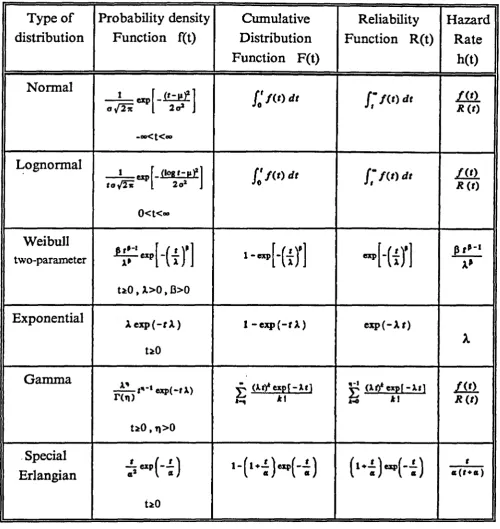
U S E F U L STA TISTICA L D ISTR IB U TIO N S
A number of statistical distributions have been used to model failure characteristics.
Table 2.1 summarises most of the more widely used distributions including those which
are applied more often in mechanical reliability assessment. The associated reliability
and failure functions, hazard rate, and the range of parameters variation are also listed.
(
2)
Type of distribution
Probability density Function f(t)
Cumulative Distribution Function F(t)
Reliability Function R(t)
Hazard Rate
h(t)
Normal
— p = « P
oi]2n
-00<
[ - ( ' - F f l 2o*
t<°°
S it
W i t m .* ( 0
Lognormal
1 cm (logl-p)2
SI
f W i t / V ( 0 dt / ( 0t o j l i
0<
2 o*
t<oo
R ( 0
Weibull
two-parameter
UO , X>0, B>0
k*
Exponential Aexp(-fX)
UO
1 -e x p (-f X) exp(-Xr)
X
Gamma
r ( n ) ,>
tiO , T)>0
£ (XD*expf-Xtl **n X1
g (X tfex p f-X il
W) ^ 1
m
j t ( oSpecial Eriangian
UO
’-HM'i)
HM ’i)
«(»♦«)t
Table 2.1 : Some Statistical Distributions Useful in Reliability Engineering.
A2
A3
An
System
F igure 2.1 : R epresentation o f a Series System
A 1
A 1 A 1
Bn
An N n
A 1
N 2 B2
A 3 B 3 N 3
A 2
Figure 2.3 : Series System with Standby Redundancies
A1
A2
An
CHAPTER 3
LITERATURE SURVEY
The basic objective of the FMS concept is to achieve the efficiency and
utilization of mass production, while retaining the flexibility of a job shop - (ideally).
To achieve this goal, the production has to be well planned for an optimal run.
Machine loading and tool allocation is considered as the lowest level of production
planning problem. Both mathematical programming models and simulations are
employed to solve loading problems in FMS. A detailed study of the literature on
flexible manufacturing system as a whole was done before concentrating on the
problem. This literature review can be divided into five groups, namely tool life, tool
management, loading models, analogous systems, and reliability evaluations.
3.1 T ool Life :
To model a loading problem, it is important to assess the life of a cutting tool
during which the quality of the workpiece is acceptable. The ability to effectively assess
the ‘useful life’ of a tool would result in diminished inventory costs, optimal replenishing
policies, fewer machine stoppages for tool changes, and reduced workpiece rejects. A
tool is considered ‘failed’ when it either will not cut, or cuts in a manner grossly different
from a sharp tool. The failure may be caused due to a ‘single-injury’ or due to a
‘gradual wear*. In the manufacturing shops a tool has to be removed from service when
it produces unsatisfactory jobs, or routinely removed prior to this point, if its ‘economic
tool life’ is reached.
Gradual tool wear can be of various types, like flank wear, notch wear, crater
wear, edge rounding, etc. There has been no universally acceptable physical explanation
for tool failures. An empirical study assumes that even though various wear
mechanisms come into play, gradual wear is produced by temperature-dependent
mechanisms, and temperatures are greatly affected by cutting speeds. Taylor (1907),
developed the relationship between average tool life and cutting velocity, through an
empirical study of tool wear. His tool life equation is :
VTn = k o r
Where:
T actual tool life of the cutting time between resharpening (minutes);
16
V cutting speed (feet/minute);
n ,k empirical constant;
Heat generation increases with the increase in undeformed chip thickness and the
chip width. Cook (1973) provided an extension to the above relationship relating the
feed, speed, and depth of cut for a given tool life value, given a s :
K
= —
(4)
d * f >
Where
Vt equivalent cutting speed (feet/minute) for a given tool life;
f feed per revolution (inches);
d depth of cut (inches);
x, y, k empirical constants;
These equations provide the expected values for a gradual wear. Tool life
however, depends also on the arrival of ‘single-injury* events. The underlying physics
o f tool wear being so complicated, for general purposes, a failure rate function is best
Tool life being highly case sensitive, there have been extensive studies, under
varied conditions addressing the problem. For a rational design of a flexible
manufacturing system, the statistical variability o f tool life would provide a better
understanding of the system. The literature indicates that standard distributions such
as Normal, Log-normal, Weibull, Exponential, and Gamma distributions as well as
their combinations, can be justified and fitted to describe the life of a tool under varied
machining conditions.
Wagner and Barash (1971) reported that for high-speed steel turning tools the
tool life values are subjected to a statistical distribution which can be approximated by
a normal distribution. Based on experimental investigation, Hitomi et al. (1979) have
suggested that the log-normal distribution conform for the tool-wear distribution.
Friedman and Zlatin (1974) studied the tool life variation for several metal and cutting
tool-workpiece combinations. Jeng and Yang (1992) derived a tool replacement model
that took a general modelling approach to accommodate wider applicability. The
expected part dimension was assumed to be a nonlinear function which had its effect
from the cutting tool wear. The uncertain effects were aggregated together and treated
as a random error. The wear process was divided into three periods, the initial wear
period, the steady or normal wear period, and the accelerated wear period. Optimal
A noteworthy contribution to the study of tool life was provided by Ramalingam
and Watson in their three part publication. Ramalingam and Watson (1977), presented
the results obtained in cases where the useful life of a tool is terminated by a single
catastrophic injury. It was shown that for a time-independent degradation, the tool life
distribution can be given as an exponential distribution, or in other words a Weibull
distribution with shape parameter, p= l. In the case of time-dependent degradation, the
distribution obtained was a general Weibull distribution. So in general, the tool life
distribution for both time-dependent and time-independent failure hazards is given by
a Weibull distribution, and p is an indication of the time-dependence of the degradation
process. Ramalingam (1977) addressed the case where the tool is considered to
deteriorate by a gradual wear and cumulative wear process. The tool reaches the end
o f its life when a specified volume of material is removed from a relevant surface (flank
surface or rake face) of the tool. It was shown that in the linear wear regime, the
approximation o f the life distribution by a normal distribution is not, in most cases,
unrealistic. In the non-linear case the distribution was more log-normal. Whereas the
first and the second parts o f the publication used an arbitrarily introduced hazard
function to account for the distributed tool life, Ramalingam et al. (1978) showed that
the hazard function has a physical basis and is determined by the interaction between
the properties of the tool material and the characteristics o f the loading environment in
new hazard function obtained now, the tool-life distribution for single injury tool failure
was shown to be a Weibull distribution, thus showing the previous modelling to be
physically meaningful and realistic.
3.2 T ool Management :
It has been seen that the productivity of a FMS can be severely limited, without
an efficient and well maintained tool-management system. FMS being capable of
performing a wider variety of operations, poses the problem of being supplied by a
varied types of tools, at different times during the production run. Typically, the
flexibility o f an FMS is constrained by pallets availability and tool magazine capacity.
An effective tool management policy should thus,
✓ provide sufficient redundant tools at the machine, to take care of tool breakages
and/or tool wear.
✓ use preset tools to avoid larger and excessive tool inventory.
✓ maximize the variety of jobs that can be produced by the machine, under the
given resource constrains
✓ minimize the movement of tools between machines, during a production run,
Hankins and Rovito (1984) compared two tool allocation and distribution
strategies through a case study. It was seen that for the case in study, the tooling
strategy affected the number of machines required, the level o f manpower required, and
the level o f tooling inventory. The strategies compared were bulk exchange and tool
migration at the completion o f workpiece. As for the tool distribution, the bulk
exchange strategy was matched with manual loading and unloading of the machine
matrix, while the migration strategy was matched with automated loading and
unloading. The comparison study was done, using a Simulation. The data used as the
input was the data gathered from metal working industries using this kind o f systems.
Kiran and Karson (1988) noted that even after flexible manufacturing systems
became operational, tool management studies were not given sufficient attention. After
some financial disasters, both the FMS users and the machine tool builders recognized
that tooling can have a major effect on the performance of FMS. Usually an FMS is
used in a medium variety / medium volume manufacturing environment. Tool
management would be even more important and complicated, as the systems find their
application in a low volume/high variety environments. The objective o f an effective
tool management system is to provide the required tools to every operations on the
scheduled machine at the right time, so that the desired quantities o f workpieces are
Hedlund et al. (1990) used simulation to model the complex manufacturing
operations and controlling algorithms of a flexible manufacturing cell. The study was
done to compare the tool delivery system for an actual FMC being installed. Since parts
to be machined included hardened steel, some tool lives were foreseen to be as small as
5 minutes, which in turn demands a very effective tool management. The system
investigated consisted of seven CNC machines with a tool magazine of 50 or 68 tools.
In addition, there were two carousels, each having a capacity of 140 tools. An overhead
monorail robot was used for the tool transfers between the machines and/or carousal.
In advance of parts being brought to a machine for processing, the first five tools were
allocated, and the tool magazine was checked for those tools. Three delivery options
were debated. To help in analyzing the behaviour of the system, multiple output
statistic screens were developed to monitor the system during the simulation process.
The simulation identified the bottlenecks in the system.
Kolahan (1993) emphasised the need for the reliability analysis of the tooling
system in FMS. Reliability based models were developed to evaluate the tooling system
by its performance under different tooling strategies. The models determined an
optimal set of spares of required tools, so that the system attributes were optimized,
with the objectives o f minimizing the tooling cost and the occupancy of the tool
and permitted, thus quantifying the difference between the strategies, in terms of tooling
costs. The non-linear reliability constraints were linearized to form a linearized 0/1
integer model. A machine in the system could perform all the operations assigned to the
workpiece, as long as the required tools were available at the required time. A tool was
considered to be within its useful life, as long as the cumulative hazard function o f the
tool was less than the threshold. The value of the required reliability o f the system, and
hence the threshold value of the cumulative hazard was considered as a management
policy. Since the life time of the tools were less than the required operation time during
a production period, sufficient redundancies would have to be carried. More so,
because a workpiece could have only one process plan for its operations, or the best
process plan would have to be selected outside the model. A part entering the system
was loaded on a machine, where different tool types performed their operations, one
after the other. Therefore the problem could be treated as a series system, with standby
redundancies. A magazine was allowed to have a maximum of only five redundancies
o f a tool type, and the examples cited were suited to the assumption. However, the
individual tools were allowed to have any of the three failure distributions. The
research also included a model for reliability optimization. A search algorithm was
developed, which minimizes the tooling cost by a criterion of getting maximum
reliability improvement per unit cost. The procedure was repeated until the desired
3.3 L oading :
Stecke (1984) partitioned the FMS problems as Design, Planning, Scheduling,
and Control problems. Planning problems appear after the FMS is implemented, and
is in production. As a part of the planning problem, the part types have to be grouped
together, and have to be assigned to the available machines, along with the required
tools to process it, while ensuring that the resource constraints are not violated and that
the returns are maximized. This subset of activities is termed as loading. Loading is an
important component o f the overall FMS operational problem. Therefore, loading has
been the focal point of numerous research studies. Some of the salient literature has
been cited below. The literature has been divided into three groups, based on the
approach to the solution of the problem undertaken, i.e., analytical approach, heuristic
approach, and simulation approach.
3.3.1 A nalytical Approach :
Stecke (1983) defined five production planning problems that have to be solved
for efficient use o f an FMS. The problems being part type selection, machine grouping,
production ratio, resource allocation, and loading. The paper addressed the problems
formulated, and linearization methods were presented. For common problem sizes, the
problems were solved optimally, within a reasonable time.
Kusiak (1985) formulated a model that took into account the limitation o f the
tool magazine and the tool life o f individual tools. A 0/1 mixed integer linear program
was proposed. The model however did not consider the tool sharing between machines
or machine and tool cribs during the batch production. The life o f the individual tools
was assumed to be constant, independent o f the batches being processed.
Sarin et al. (1987) formulated a model addressing machine loading and tool
allocation problem. Given a fixed number o f parts, which are to be processed by a
group of machines, which have tool magazines loaded with tools o f limited life, the
objective was to minimize the total machining cost. The costs included both the cost o f
tool wear, and the cost o f machine usage. The model assigned the required tools to
machines, which stayed there for the entire planning period. Tool sharing between the
machines was not considered. The parts were to have a unique process plan, or the best
process plan was selected outside the model. A tool was used by the system for the
duration o f its useful life. Useful life o f a tool was a duration, determined by previous
statistics. An assumption that many tools and machines are not compatible drastically
Liang (1991) pointed out that when part selection and machine loading problems
are dealt with separately, and linked thereafter, they could contradict each other, and
lead to less meaningful, and sometimes even infeasible solutions. His study was directed
towards the concurrent part selection and machine loading decision problem. A model
was developed for a situation where the demand could vary widely, and tool sharing
was not possible between the machines or the tool crib. Individual tool life was assumed
to be shorter than the batch production time, necessitating the need for standby
redundancies within the machine’s magazine.
3.3.2 Heuristic Approach :
Berrada and Stecke (1986) considered a loading problem of simultaneously
assigning machine tools, operation, and cutting tools to the part types. An operation
is assigned to only one machine. Since balancing the workload corresponded to
m axim ising the production rate, the objective of the model was to balance the workload,
constrained by the tool magazine, machine tool, and system capacities. A non-linear
integer program was formulated, which was solved by a branch and bound algorithm.
O’Grady and Menon (1987) examined a master scheduling problem for an
existing FMS in Scotland. A multiple criteria approach was used to choose a subset of
orders for processing, subject to resource constraints and potentially conflicting
objectives. SCICONIC/VM mathematical programming system, running on a VAX
was used to solve the problem. The solution adopted a compromise philosophy. It was
argued that this solution procedure avoided the computational limitations associated
with the pursuit of a global optimality using a 0/1 integer model.
Ventura et al. (1988) developed two mathematical models to load tools to
machines in a FMS environment. Two sets of heuristic algorithms for solving the
models were presented. The objective functions were to minimize the time-span
required to process all the parts in a batch, and to minimize the number of part
movements required to process the overall batch of parts. Tool processing times were
considered to be machine dependent in one case, and machine independent in the other.
It was found that the effectiveness of these algorithms is very much dependent on the
magazine tightness values.
Part and tool movement policies are among the basic approaches used in loading
problems in flexible manufacturing systems. Han et al. (1989) addressed a problem of
loading a set o f tools to different machining centres, where each part visits only one
machine for its entire processing. Every machine could process all the operations on all
the part types, as long as the corresponding cutting tools are available. A tool required,
but not available in the machine’s tool magazine could be borrowed from other
machines. When the required tools to process a part are not mounted in the tool
magazine, either the part may be sent to another machining centre where those required
tools are available or the required tools may be transported from another machining
centre. Tool movement policy was seen advantageous. Since parts do not move, there
is no need to reposition the workpiece or recalibrate the position of the tool head which
results in higher cutting precision. Also, a part is processed by only one machining
centre. So a part is delivered into the shop only when a machining centre becomes
available, thereby resulting in less work-in-process. However, tool movement policy
results in tool-move delay time, which will be higher when the tool to be borrowed is in
use at the other machining centre. They proposed a non linear programming model for
the loading of a set of tools to the different machining centres, where each part visits
only one of the machining centres for its entire processing. The quadratic objective
function is to minimize the amount of tool traffic among the machining centres and
between a machining centre and tool crib. A heuristic solution method was suggested.
Analytical and simulated solutions were compared to the solution from the algorithm.
3.3.3 Simulation Approach :
One of the earliest study on loading FMS was done by Kathryn Stecke and
James Solberg. Stecke and Solberg (1981) performed their study in a practical
environment of ‘Caterpillar Tractor Company*. The system consisted o f eleven
production machines and an inspection machine. The operating strategies considered
involved policies for loading (i.e. allocating operations and tooling to machines) and
real time flow control. A detailed simulation was employed to test alternatives. The
results were different from those of classical job shop scheduling studies, showing the
dependence of system performance on the loading and control strategies chosen to
operate the flexible manufacturing system. A 0/1 non linear mixed integer model was
developed, which was solved by linearizing thereafter. This model did not consider the
finite life of the tools.
Carrie and Perera (1986) studied the effect of tool variety, product variety and
product similarity on the frequency of tool changes due to product variety, and due to
tool wear. They based their study on a particular FMS. It was found that the number
o f tool changes due to product variety is small compared to those due to tool wear. For
the analytical study they used the model given by Menon and O'Gradey (1984), with
some variations. They made a post-processor which reads a file of work flow d a ta , and
by referring to the part routing and tool requirement file, maintains a list of tools which
would be present in the tool magazine. Thus, the occurrence of tool changes due to
Gyampah et al. (1992) compared four scheduling strategies in the presence of
three part selection rules, through a simulation of a five-machine FMS tool handling
system. The strategies compared were bulk exchange, tool migration, resident tooling,
and tool sharing. Significantly different outcomes were seen between the different
strategies. Resident tooling was favoured over other strategies. It was pointed out that
the study used long cycle times of parts, and the results could be different when parts
with relatively shorter cycles were to be processed.
3.4 Analogous Literature :
Damodaran et al. (1992) developed models for production planning and cell
design in cellular manufacturing systems. Parts were allowed to have more than one
process plan, and the operation on the part could be performed on more than one
machine. Cells had an upper limit to the number of machines it could accommodate.
A model was developed to simultaneously form machine groups and to assign part-
operations to the selected groups. Penalty costs were imposed on inter-cell movements.
The non-linear constrain was linearized using the method suggested by Glover and
Woolsey (1973). The models developed were mixed integer linear models.
resource utilization, when part families and machine groups are formed simultaneously.
A part could have more than more than one process plan and each operation could be
performed on alternative machines. Integer programming models were developed,
considering budget, floor space and capacity of machines to study the effect of
alternative process plans and simultaneous formation o f part families and machine
groups on resource utilization. The non-linear constrain was linearized using the
method suggested by Glover and Woolsey (1973). In another case a model was
developed, that rearranged an existing manufacturing facility to Cellular
manufacturing.
Atmani et al. (1995) introduced a 0/1 integer programming model for
simultaneous solution of cell formation and operation allocation problem in cellular
manufacturing. A part is assumed to have more than one process plan, and each
operation could be performed on more than one machine. The objective of the model
was to simultaneously form machine groups and allocate operations of the part types,
so as to m inim ize the sum of operation, refixturing and transportation costs.
Precedence relations among the machines and machine duplications were not
considered. The model was used to solve large numerical examples . The model
3.5 Reliability Studies
It is possible to improve the reliability o f a system by improving the quality of
its components. However, beyond a certain point, the improvement of reliability per
unit cost may not be economical any more. Multiple copies may be beneficial or even
necessary if these components are used very often. Reliability could then be improved
by providing parallel paths, or standby redundancies. Predicting the number of spares
o f each component needed for a required operation time is of vital importance in
designing a new system. Optimizing the reliability of a system, by providing
redundancies has been the topic of many researches. Complex systems may contain
some components which fail more often. Determining the location and the number of
redundancies in the system is one of the issues discussed in this research.
Bellman and Dreyfus (1958) were among the first who applied dynamic
programming to the solution of the optimal redundancy problem. Their formulation
considered only two types o f constraints: cost and weight. Messinger and Shooman
(1970) conducted a tutorial review that evaluated and compared several techniques to
allocate the number of spares of each part type, to maximize the system reliability. For
an N-stage series system, Tillman et al. (1980) treated the problem of allocating
extension of this problem can be stated as finding the optimum number of redundancies
which maximizes the system reliability subject to cost constraints (Rao, 1992). Tillman
(1969) applied integer programming techniques to maximize the reliability or minimisra
the cost, subject to several constraints and the components may have different modes
o f failures. This required a bulky formulation that restricts the size of the system.
Hwang et al. (1971) applied a zero-one integer programming to minimize the weight of
sub-systems o f a life support system, subject to several nonlinear constraints while
maintaining an acceptable level of system reliability. Ghare and Taylor (1969)
determined the optimum number of redundant components in order to maximize the
reliability of series system subject to multiple resource restrictions. Solving the
associated zero-one programming model by a branch-and-bound procedure, they
showed that the optimal solution to the associated problem is equivalent to the optimal
solution for the optimal redundancy problem.
Pan et al. (1986) derived a mathematical model to predict the system reliability
of an automatic tool changing system, with the various cutting tools subject to Weibull
failures. The system was regarded as a series system with stand-by redundancies. A
recursive algorithm was presented to calculate the system reliability. The algorithm
permitted the use o f any failure distribution. However, no specific model to select the
combinations. They also took a numerical approach to integrate the reliability function
for each tool with different number of spares. Ghosh and Wells (1990) presented a
heuristic algorithm to solve the spares allocation problem to remote machines, in which
machines were subsystems of a series system that would be used only for a specified
period of time. They assumed that all spares must be assigned at the beginning of the
system’s mission. The algorithm determines number of spares for each subsystem
(machines) that maximizes the minimum probability of each machine consuming its
spares before the useful life of system is completed. To increase mean time between
failures and to improve system reliability, Sears (1990) proposed a top-down technique
to calculate required number of standby redundancies.
Kolahan (1993) in his thesis, emphasized the need for reliability studies on the
performance of an FMS. Tool sharing between the machines was taken into
consideration while modelling the problem. Also, a heuristic was developed to find the
optimum reliability for a given system. For reliability evaluations, the machining
centres were visualized as a series system, where the reliability of the system is the
product of all the sub-components (cutting tools) in the system.
There has been no literature that deals with a full loading problem, with
the production be carried out without interruptions, and without rejects of the work in
progress. This research aims at solving the loading problem, with reliability
considerations, thereby giving the production planner a comparison between the
CHAPTER 4
MODELS
This chapter presents a few models with various objectives, that would optimize
a typical loading problem in a FMS environment. The nomenclature and assumptions
used are defined. The layout of an FMS in consideration is shown. The analytical
model was run on packages LINGO® and LINDO®. The results obtained were verified
by comparing against the simulations done on GPSS/H® and WITNESS®. The
mathematical models were run on IBM® compatible PCs and SUN® workstation. The
simulations were run on IBM mainframe.
4.1 System Configuration :
The layout of the system configured is shown in Figure 4.1. The system although
hypothetical, is based on an existing system at Rock Island Arsenal, and presented by
Hedlund et al. (1990). The system consists of a number of machining centres (4 in the
the capacity to accommodate the batch to be processed. Parts enter and leave the
system by the common gangway. It is assumed that, in general, all the operations
required to be performed on a part can be done by a single CNC machines in the flexible
manufacturing system, as long as the required tools are available. The models, however,
can accommodate the need of restricting a particular tool or operation to specific
machines. Each machine has a tool magazine of a limited tool capacity. While the tools
are interchangeable between the machines, the tool magazines are fixed to the machine.
The tools are assembled in the collet and tool holders, in a tool room, and enter the
system through the tool transporter, or by a bulk exchange of the tool carousal. Since
the ‘useful life’ of a tool is less than the production period, tool magazines would have
to carry sufficient redundancies to process the entire demand without interruptions.
The tool transporter shown in Figure 4.1 is applicable to the models where tool sharing
is permitted. Tool transporter moves along a fixed path, as shown. Tool magazines of
all the machines are accessible to this transporter, during the production run. There can
also be a tool carousel within the system, which carries a larger number of tools, and is
accessible to the tool transporter, during the production run. This would permit the
system to hold more standbys of faster wearing tools, thereby allowing longer
production runs. Without any modifications to itself, the loading models developed
with tool change permitted, can accommodate the tool carousel. The total tool
to transport the tool to the recipient machine, the time to insert the tool into the
recipient machine’s tool magazine, and the time to carry the worn out tool away. Worn
out tools will be removed from the machine’s tool magazine during the production run,
and placed on the designated section of the tool carousal, as long as there is available
space in the carousal. In other words, the number of tools in the tool magazine of the
individual machine will be maximum at the beginning of the production run, and
4.2 Nom enclature :
Indices :
i : part type index, 1,2.... , /
j : machine index, (to) j 1,2,.... /
k : machine index, (from) k — 1,2,
1 : tool type index, 1 - 1,2 ,....,£
m : spares index, m - 0,l,....,Aff
P : process plan index p 1,2
For the models where tool sharing is permitted, index k denotes the machine
from which the tool is being borrowed, and index j denotes the machine to which the
tool is transported. For the models where tool sharing is restricted, index iris not used,
and the index j refers to the machine in context.
D ecision Variables :
Fraction of demand of part 7 \ processed on machine ‘j \ using
process plan *p \
1 if part 7* is processed on machine *j* using process plan *p \
1 if machine *j* has to be loaded with tool 7 ’.
Z j 1 0 otherwise.
1 if machine *j* has to be loaded by *m * spares of tool 7 \
\ 0 otherwise.
Nju Number of tools of type 7 ’ transported to machine *j* from 7 r \
N j Number of tools of type 7* mounted originally on machine *j*.
H j Number of tools of type 7* transferred from other machines to machine
Parameters :
1 if part 7* can be processed on machine *j* using process plan *p \
a ;.VP 1 0 otherwise.
1 if part 7 ’ can be processed using tool 7 ’ and process *p ’.
Pop ' 0 otherwise.
k Hazard rate of the tool with an exponential failure distribution.
Cj Unit cost of tool 7*.
Ej Tool magazine capacity available at machine *j\
M j Maximum number of tools of type 7 ’ that can be put on machine * j\
Demand for part 7 ’.
t^p Machining time for part 7 ’ using tool 7 ’, and process *p \
Ts Useful tool life available from each spare of tool 7* on machine *j*.
Time to insert a tool from machine ‘k for use on machine * j\
Q, Tool transporter time available during the production period.
Bj Machine time available, on machine * j\ during the production period.
Rm Reliability of tool type ‘7’ on machine *j* with *m ’ redundancies.
11^ Obtained reliability for part 7 \ on machine *j* using plan *p ’.
R j Reliability of tool type ‘7*.
Uj, Cumulative hazard factor of tool type *7\ on machine *j*.
tool In/out
tool changer tool carousel
o
tool m agazine'
•
machine machine
^ | I I f • •--- •-•v /* • • • • * .
ftool magazine 4 f tool magazine j pool magazine
4 . 7 T ‘ l N 1 • • +-T*
Local Queues
machine machine
parts
In-parts out«-=:
4.3 Assumptions :
While developing these models, the following assumptions were made to simplify
the modelling.
■a* The demand for each of the part type is known in advance, and will not change
during the production period.
» All the spares of a particular tool type are assembled to be identical.
«*■ Tool failures are independent of each other. So, the failure of one tool does
not affect the failure of another tool in the system.
« A machining centre can perform all the required operations of the assigned parts,
as long as the required tools are available in the tool magazine.
■a* Machining parameters such as feed, spindle speed, depth of cut, etc are determined
before the production run, and does not change during the production run.
The life of the tool transporter is much larger than the production period. So the
tool transporter has a constant reliability during this period.
«■ The tool life distribution of all cutting tools is exponential. But the mean would
depend on the tool type.
h* Stochastic, single catastrophic injuries to the tool are ignored.
» The detection of a tool failure is perfect.
4.4 Mathematical Modelling :
The purpose of the mathematical modelling is to optimize the loading problem
in a typical FMS. Layout of the system considered has been presented above. Tool
sharing, although economically advantageous for a large system, requires a more
complicated and meticulous tool setting and tool management systems, and additional
equipments. For a less flexible or a smaller system, the investment may not be worth
the returns. Thus an FMS may or may not have tool sharing. Two sets of
mathematical models have been developed. Each model considers two cases, one where
tool sharing is permitted, and the other where tool sharing is restricted.
4.4.1 Model I :
The objective of this loading problem is to minimize the tooling cost of the
system. Each tool type is given a fixed value of ‘useful life’. This value may have been
found from the statistical analysis of tool wear, in the past. The useful tool life is a
fraction of the absolute tool life, for a given tool type. Each machine has a tool
magazine, with a limited number of tool slots. Also, there is a limit on the machine
availability time during the production period. A demand can be split into batches, and
process plans. The optimal size of a batch is determined by the mathematical models.
4.4.1a Case 1, Tool Sharing N ot Allowed :
When tool sharing is not allowed, each machine will have to carry all the tool
types, and sufficient redundancies of each type to process all the batches scheduled for
the production period. The total number of tools in the magazine of a machine remains
constant throughout the production period. A tool type can be assigned to more than
one machine. The number of tool slots and the available time could be different from
machine to machine. A linear integer programming model developed, is presented
below.
J L Mjl
Minimize
£ J J m C,
Zjlm
(4 .1 )j- 1 1*1 m* 0
Subject to
J P (4 .2 )
V I
j*l p*i
L M
E E
m Z jlm * Ej (4.3)£ £ PII P x lJ P ta P * h j £ V I J ( « )
i=l p=1 m*0
I P L
£ £ £ p a p X i j p ' u , * B J V J ( 4 5 )
i*l /?«! /-I
£ V = 1 V J . l (4.6)
m*0
Uj,
£ * V ■ ty,
m*=0
Integer Zjlm ^ j>l,m
GIN Xijp V i j \ p
(4 .7 )
is a 0/1 variable that indicates that a machine j has m spares of the tool type
7. Thus mZjto gives the number of spares of tool type 7, on machine j. Cj is the cost of
a tool o f type 7. The objective function therefore minimizes the total cost o f the cutting
tools. Constraint set 3.2 confirms that the sum o f the fractions of demand, named
batches, adds up to the total demand of each part type. Constraint set 3.3 ensures that
the total number o f spares, for all tool types assigned to a machine, is less than the
fraction is the batch size of part 1, designated to machine j to be processed by
process plan p. p is one, for all ilp combinations possible, and zero otherwise. Thus
constraint set 3.4 ensures that the usage of a tool of lj combination is less than the
available capacity. Constraint set 3.5 ensures that the available capacity of the
machining centres is not exceeded. For a machine j and tool type /, as m varies from 0
to MJy there can be only one , that can be 1. So, constraint set 3.6 sets a unique
number of spares for each tool type for all machines. Finally, J ^ h a s been defined as
a 0/1 integer variable.
4.4.1b Case 2, Tool Sharing is Permitted :
When tool sharing is permitted, all the tools within the system is available to
every machine in the system. However, the transport of tools from other machines
involves lost production time, for both the donor and the recipient machines. This
effect is quantified as a penalty cost of borrowing, and is included in the objective
function, which the program minimizes. This new configuration involves another
facility, the tool transporter. Along with the other capacity constraints mentioned in
the above model, this model also has to ensure that the available capacity, in terms of
time, of the tool transporter is not violated. Every time a required tool is brought in