Volume 2, No. 5, Sept-Oct 2011
International Journal of Advanced Research in Computer Science
RESEARCH PAPER
Available Online at www.ijarcs.info
ISSN No. 0976-5697
Efficient personalization and Recommendation Methods for Web Mining
Mahendra Pratap Singh Dohare*
M.Tech (Software System) Samrat Ashok Technological Institute
Vidisha, M.P., India [email protected]
Premnarayan Arya
M.Tech (Software System) Samrat Ashok Technological Institute
Vidisha, M.P., India [email protected]
Vinod Kumar
M.Tech (Software System) Samrat Ashok Technological Institute
Vidisha, M.P., India [email protected]
Abstract: With the fast development of World Wide Web, Web-based applications and services should allow user to get the right personalized information quickly and effectively. Collaborative Filtering acts a very important role in web service personalization and Recommender System. Most of the research efforts in web personalization correspond to the evolution of extensive research in web usage mining, i.e. the exploitation of the navigational patterns of the web site’s visitors. When a personalization system relies solely on usage-based results, however, valuable information conceptually related to what is finally recommended may be missed. Moreover, the structural properties of the web site are often disregarded. In this thesis, we propose novel techniques that use the content semantics and the structural properties of a web site in order to improve the effectiveness of web personalization. In the first part of our work we present standing for Semantic Web Personalization, a personalization system that integrates usage data with content semantics, expressed in ontology terms, in order to compute semantically enhanced navigational patterns and effectively generate useful recommendations. To the best of our knowledge, our proposed technique is the only semantic web personalization system that may be used by non-semantic web sites. In the second part of our work, we present a novel approach for enhancing the quality of recommendations based on the underlying structure of a web site. We introduce UPR (Usage-based PageRank), a PageRank-style algorithm that relies on the recorded usage data and link analysis techniques. Our experimental results show more efficient than existing works.
Key words: Web personalization, Semantic web and Recommender systems.
I. INTRODUCTION
During the past few years the World Wide Web has become the biggest and most popular way of communication and information dissemination. It serves as a platform for exchanging various kinds of information, ranging from research papers, and educational content, to multimedia content, software and personal logs. Every day, the web grows by roughly a million electronic pages, adding to the hundreds of millions pages already on-line. Because of its rapid and chaotic growth, the resulting network of information lacks of organization and structure. Users often feel disoriented and get lost in that information overload that continues to expand. On the other hand, the e-business sector is rapidly evolving and the need for web market places that anticipate the needs of their customers is more than ever evident. Therefore, the ultimate need nowadays is that of predicting the user needs in order to improve the usability and user retention of a web site.
This thesis presents novel methods and techniques that address this requirement. In brief, web personalization can be defined as any action that customizes the information or services provided by a web site to an individual user, or a set of users, based on knowledge acquired by their navigational behavior, recorded in the web site’s logs, in other words, its
usage. This information is often combined with the content
and the structure of the web site, as well as the
interests/preferences of the user, if they are available. Using
the four aforementioned sources of information as input to pattern discovery techniques, the system tailors the provided content to the needs of each visitor of the web site. The personalization process can result in the dynamic generation of recommendations, the creation of index pages, the highlighting of existing hyperlinks, the publishing of targeted advertisements or emails, etc. In this thesis we focus on personalization systems that aim at providing personalized recommendations to the web site’s visitors. Furthermore, since the personalization algorithms we propose in this work are generic and applicable to any web site, we assume that no explicit knowledge involving the users’ profiles, such as ratings or demographic information is available [1] and [2] and [5].
framework that employs automated keyword-to-ontology mapping techniques, while exploiting the underlying semantic similarities between ontology terms. Apart from the novel recommendation algorithms we propose, we also emphasize on a hybrid structure-enhanced method for annotating web content. To the best of our knowledge, standing for Semantic Web Personalization is the only semantic web personalization system that can be used by any web site, given only its web usage logs and a domain-specific ontology [1], [2], [4] and [6].
II. BACKGROUND
A. Web Usage Mining and Personalization:
Web usage mining is the process of identifying representative trends and browsing patterns describing the activity in the web site, by analyzing the users’ behaviour. Web site administrators can then use this information to redesign or customize the web site according to the interests and behavior of its visitors, or improve the performance of their systems. Moreover, the managers of e-commerce sites can acquire valuable business intelligence, creating consumer profiles and achieving market segmentation.
There exist various methods for analyzing the web log data. Some research studies use well known data mining techniques such as association rules discovery, sequential pattern analysis, clustering, probabilistic models, or a combination of them. Since web usage mining analysis was initially strongly correlated to data warehousing, there also exist some research studies based on OLAP cube models.
Finally some proposed web usage mining approaches that require registered user profiles, or combine the usage data with semantic meta-tags incorporated in the web site’s content. Furthermore, this knowledge can be used to automatically or semi-automatically adjust the content of the site to the needs of specific groups of users, i.e. to personalize the site. As already mentioned, web personalization may include the provision of recommendations to the users, the creation of new index pages, or the generation of targeted advertisements or product promotions. The usage-based personalization systems use association rules and sequential pattern discovery, clustering, Markov models, machine learning algorithms, or are based on collaborative filtering in order to generate recommendations. Some research studies also combine two or more of the aforementioned techniques [3] and [7].
B. Integrating Content Semantics in Web
Personalization:
Several frameworks supporting the claim that the incorporation of information related to the web site’s content enhances the web personalization process have been proposed prior or subsequent to our work. In this Section we overview in detail the ones that are more similar to ours, in terms of using a domain-ontology to represent the web site’s content.
Dai and Mobasher proposed a web personalization framework that uses ontologies to characterize the usage profiles used by a collaborative filtering system. These profiles are transformed to “domain-level” aggregate profiles by representing each page with a set of related ontology objects. In this work, the mapping of content features to ontology terms is assumed to be performed either
manually, or using supervised learning methods. The defined ontology includes classes and their instances therefore the aggregation is performed by grouping together different instances that belong to the same class. The recommendations generated by the proposed collaborative system are in turn derived by binary matching of the current user visit, expressed as ontology instances, to the derived domain-level aggregate profiles, and no semantic similarity measure is used. The idea of semantically enhancing the web logs using ontology concepts is independently described in recent. This framework is based on a semantic web site built on an underlying ontology. The authors present a general framework where data mining can then be performed on these semantic web logs to extract knowledge about groups of users, users’ preferences, and rules. Since the proposed framework is built on a semantic web knowledge portal, the web content is already semantically annotated (through the existing RDF annotations), and no further automation is provided. Moreover, the proposed framework focuses solely on web mining and thus does not perform any further processing in order to support web personalization.
In recent work also propose a general personalization framework based on the conceptual modeling of the users’ navigational behavior. The proposed methodology involves mapping each visited page to a topic or concept, imposing a concept hierarchy (taxonomy) on these topics, and then estimating the parameters of a semi-Markov process defined on this tree based on the observed user paths. In this Markov models-based work, the semantic characterization of the content is performed manually. Moreover, no semantic similarity measure is exploited for enhancing the prediction process, except for generalizations/specializations of the ontology terms. Finally, in a subsequent work, explore the use of ontologies in the user profiling process within collaborative filtering systems. This work focuses on recommending academic research papers to academic staff of a University. The authors represent the acquired user profiles using terms of research paper ontology (is-a hierarchy). Research papers are also classified using ontological classes. In this hybrid recommender system which is based on collaborative and content-based recommendation techniques, the content is characterized with ontology terms, using document classifiers (therefore a manual labeling of the training set is needed) and the
ontology is again used for making
generalizations/specializations of the user profiles [8] and [9].
C. Integrating Structure in Web Personalization:
exploiting the notion of the authority or importance of a web page in the web graph [2] and [10].
In a very recent work, address the data sparsity problem of collaborative filtering systems by creating a bipartite graph and calculating linkage measures between unconnected pairs for selecting candidates and make recommendations. In this study the graph nodes represent both users and rated/purchased items.
Finally, subsequent work, proposed independently two link analysis ranking methods, SiteRank and PopularityRank
which are in essence very much like the proposed variations of our UPR algorithm (PR and SUPR respectively). This work focuses on the comparison of the distributions and the rankings of the two methods rather than proposing a web personalization algorithm [2], [3] and [11].
III. PROPOSED TECHNIQUES
In this paper we present standing for Semantic Enhancement for Web Personalization, a web personalization framework that integrates content semantics with the users’ navigational patterns, using ontologies to represent both the content and the usage of the web site. In our proposed framework we employ web content mining techniques to derive semantics from the web site’s pages. These semantics, expressed in ontology terms, are used to create semantically enhanced web logs, called C-logs (concept logs). Additionally, the site is organized into thematic document clusters. The C-logs and the document clusters are in turn used as input to the web mining process, resulting in the creation of a broader, semantically enhanced set of recommendations. The whole process bridges the gap between Semantic Web and Web Personalization areas, to create a Semantic Web Personalization system.
A. Standing for Semantic Enhancement for Web
Personalization System Architecture:
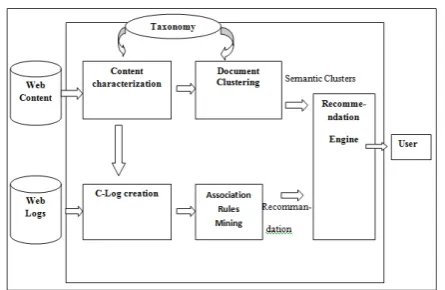
Standing for Semantic Enhancement for Web Personalization uses a combination of web mining techniques to personalize a web site. In short, the web site’s content is processed and characterized by a set of ontology terms (categories). The visitors’ navigational behavior is also updated with this semantic knowledge to create an enhanced version of web logs, C-logs, as well as semantic document clusters. C-Logs are in turn mined to generate both a set of URI and category-based association rules.
[image:3.595.40.263.622.767.2]Finally, the recommendation engine uses these rules, along with the semantic document clusters in order to provide the final, semantically enhanced set of recommendations to the end user.
Figure 1 Standing for Semantic Enhancement for Web Personalization and Recommendation architecture
As illustrated in Figure 1, Standing for Semantic Enhancement for Web Personalization consists of the following components:
a. Content Characterization: This module takes as input
the content of the web site as well as a domain-specific ontology and outputs the semantically annotated content to the modules that are responsible for creating the C-Logs and the semantic document clusters. The content characterization process consists of the keyword extraction, keyword translation and semantic characterization sub-processes.
b. Semantic Document Clustering: The semantically
annotated pages created by the previous component are grouped into thematic clusters. This categorization is achieved by clustering the web documents based on the semantic similarity between the ontology terms that characterize them.
c. C-Logs Creation & Mining: This module takes as
input the web site’s logs as well as the semantically annotated web site content. It outputs the semantically enhanced C-logs (concept logs) which are in turn used to generate both URI and category-based frequent itemsets and association rules. These rules are subsequently matched to the current user’s visit by the recommendation engine.
d. Recommendation Engine: This module takes as input
the current user’s path and matches it with the semantically annotated navigational patterns generated in the previous phases. The recommendation engine generates three different recommendation sets, namely,
original, semantic and category-based ones, depending on the input patterns used.
The creation of the ontology as well as the semantic similarity measures used as input in the aforementioned web personalization process are orthogonal to the proposed framework. We assume that the ontology is descriptive of the web site’s domain and is provided / created by a domain expert. In what follows we describe the key components of our architecture, starting by introducing the similarity measures we used in our work.
B. Proposed Methodology:
a. Data Set: The two key advantages of using this data
(01/01/10 – 31/12/10). After preprocessing, the total web logs’ size was approximately 105 hits including a set of over 67.700 distinct anonymous user sessions on a total of 360 web pages. The sessionizing was performed using distinct IP & time limit considerations (setting 20 minutes as the maximum time between consecutive hits from the same user).
b. Keyword Extraction: We extracted up to 7 keywords
from each web page using a combination of all three methods (raw term frequency, inlinks, outlinks). We then mapped these keywords to ontology categories and kept at most 5 for each page.
c. Document Clustering: We used the clustering scheme
described in recent, i.e. the DBSCAN clustering algorithm and the similarity measure for sets of keywords. However, other web document clustering schemes (algorithm & similarity measure) may be employed as well.
d. Association Rules Mining: We created both
URI-based and category-URI-based frequent itemsets and association rules. We subsequently used the ones over a 40% confidence threshold.
C. Link Analysis for Web Personalization:
The connectivity features of the web graph play important role in the process of web searching and navigating. Several link analysis techniques, based on the popular PageRank algorithm [BP98], have been largely used in the context of web search engines. The underlying intuition of these techniques is that the importance of each page in a web graph is defined by the number and the importance of the pages linking to it. In this thesis, we introduce link analysis in a new context, that of web personalization. Motivated by the fact that in the context of navigating a web site, a page/path is important if many users have visited it before, we propose a new algorithm UPR
(Usage-based PageRank). UPR is based on a personalized version of PageRank, “favoring” pages and paths previously visited by many web site users. We apply UPR to a representation of the web site’s user sessions, termed
Navigational Graph in order to rank the web site’s pages. This ranking may then be used in several contexts:
a. Use it as a “global ranking” of the web site’s pages. The computed rank probabilities can serve as the prior probabilities of the pages when recommendations are generated using probabilistic predictive models such as Markov Chains, higher-order Markov models, tree synopses etc.
b. Apply UPR to small subsets of the web site’s navigational graph (or its approximations), which are generated based on each current user’s visit. This localized version of UPR (named l-UPR) provides localized personalized rankings of the pages most likely to be visited by each individual user. In what follows we illustrate our approach through a motivating example. We then provide the required theoretical background on link analysis before presenting the proposed algorithm. We prove that this hybrid algorithm can be applied to any web site’s navigational graph as long as the graph satisfies certain properties. We then proceed with describing the two proposed frameworks in which UPR can be applied, namely, the localized personalized recommendations with l-UPR and the hybrid probabilistic predictive
models (h-PPM). We conclude with an extensive experimental evaluation we performed on both frameworks (l-UPR and h-PPM), proving our claim that the underlying link structure of the web sites should be taken into consideration in the web personalization process, and details on the system prototype we used.
IV. RESULTS
We created three different sets of recommendations named Original, Semantic, and Category (the sets are named after the respective recommendation methods). We presented the users with the paths and the three sets (unlabeled) in random order and asked them to rate them as “indifferent”, “useful” or “very useful”. The outcome is shown in Figure a, b, and c.
The results of the first experiment revealed the fact that depending on the context and purpose of the visit the users profit from different source of recommendations. More specifically, both Semantic and Category sets are mostly evaluated as useful/very useful. The Category
recommendation set performs better, and this can be explained by the fact that it’s the one that recommends “hub” pages, which seems to be the best after a “random walk” on the site.
The results of this experiment demonstrate the dominance of the Hybrid recommendation set over the
Category-based one. One explanation for this would be that in the second case, important information may be lost during the generalization (convert user’s current path to categories) back to specialization (convert categories to URIs) process.
Based on these experimental results, we observe that what is characterized as useful by the users depends on the objective of each visit. Out of the three possible recommendation sets, the Semantic recommendation set, generated after the semantic expansion of the most popular association rule performs better. Comparing all three recommendation sets with the Hybrid one, we observe that it dominates the other three, since the hybrid recommendations are preferred by the users in most cases. Therefore, we conclude that Standing for Semantic Enhancement for Web Personalization semantic enhancement of the personalization process improves the quality of the recommendations in terms of complying with the users’ needs.
V. CONCLUSION
Most of the research efforts in web personalization correspond to the evolution of extensive research in web usage mining, i.e. the exploitation of the navigational patterns of the web site’s visitors. When a personalization system relies only on usage-based results, however, valuable information conceptually related to what is finally recommended may be missed. Moreover, the structural properties of the web site are often disregarded. In this thesis, we present novel techniques that incorporate the content semantics and the structural properties of a web site in the web personalization process. In the first part of our work we present a semantic web personalization system.
recommended might be missed, we propose a web personalization framework that integrates usage data with content semantics, expressed in ontology terms, in order to compute semantically enhanced navigational patterns and effectively generate useful recommendations. The diversity of our specializations verifies the potential of our approach in providing an integrated framework for applications of link analysis to web personalization.
VI. REFERENCES
[1]. Xiangwei Mu, Yan Chen and Taoying Li, “User-Based
Collaborative Filtering Based on Improved Similarity Algorithm”, IEEE 2010.
[2]. Dimitris Antoniou, Mersini Paschou, Efrosini Sourla,
Athanasios Tsakalidis, “A Semantic Web Personalizing Technique The case of bursts in web visits”, 2010 IEEE Fourth International Conference on Semantic Computing.
[3]. Rong Shan and Zhibin Ren, “Research on Personalized
Recommendation System in E-Iearning”, IEEE 2010 2nd International Conforence on Education Technology and Computer (ICETC).
[4]. Yan Gao, Bin Zhang, Shao-wei Shi, Hong-ning Zhu, Jun Na, Fu-cai Zhou, “A User Requirement-driven Service Dynamic Personalized QoS Model”, IEEE 2010 Third International Conference on Dependability.
[5]. Muhammad Shoaib, Amna Basharat, “Ontology based
Knowledge Represeenation and Sematnic Profiling In
Personalized Semantic Social Networking Framework”, IEEE 2010.
[6]. Dario Vuljani, Lidia Rovan, and Mirta Baranovi,
“Semantically Enhanced Web Personalization Approaches and Techniques”, IEEE Proceedings of the ITI 2010 32nd Int. Conf. on Information Technology Interfaces, June 21-24, 2010, Cavtat, Croatia.
[7]. Raymond Y.K. Lau, “Inferential Language Modeling for
Selective Web Search Personalization and Contextualization”, IEEE 2010 3rd International Conference on Advanced Computer Theory and Engineering(1CACTE).
[8]. Esteban Robles Luna, Irene Garrigos, and Gustavo Rossi, “Capturing and Validating Personalization Requirements in Web Applications”, IEEE 2010.
[9]. Annappa B, K Chandrasekaran, K C Shet, “Meta-Level
Constructs in Content Personalization of a Web
Application”, IEEE Int’l Conf. on Computer &
Communication Technology-ICCCT’10.
[10]. Pedro J. Muñoz-Merino, Carlos Delgado Kloos and Martin Wolpers, and Martin Friedrich, “An Approach for the Personalization of Exercises based on Contextualized Attention Metadata and Semantic Web technologies”, 2010 10th IEEE International Conference on Advanced Learning Technologies.