Symbolic Preference Using Simple Scoring
Paula S. Newman [email protected]
Abstract
Despite the popularity of stochastic parsers, symbolic parsing still has some advantages, but is not practical without an effective mechanism for selecting among alternative analyses. This paper describes the symbolic preference system of a hybrid parser that combines a shallow parser with an overlay parser that builds on the chunks. The hy-brid currently equals or exceeds most sto-chastic parsers in speed and is approaching them in accuracy. The preference system is novel in using a simple, three-valued scor-ing method (-1, 0, or +1) for assignscor-ing preferences to constituents viewed in the context of their containing constituents. The approach addresses problems associ-ated with earlier preference systems, and has considerably facilitated development. It is ultimately based on viewing preference scoring as an engineering mechanism, and only indirectly related to cognitive princi-ples or corpus-based frequencies.
1 Introduction
Despite the popularity of stochastic parsers, sym-bolic parsing still has some advantages, but is not practical without an effective mechanism for se-lecting among alternative analyses. Without it, ac-cept/fail grammar rules must either be overly strong or admit very large numbers of parses. .
Symbolic parsers have recently been augmented by stochastic post-processors for output disam-biguation, which reduces their independence from corpora. Both the LFG XLE parser (Kaplan et.al. 2004), and the HPSG LinGO ERG parser (Tou-tanova et al. 2005) have such additions.
This paper examines significant aspects of a purely symbolic alternative: the preference and pruning system of the RH (Retro-Hybrid) parser
(Newman, 2007). The parser combines a pre-existing, efficient shallow parser with an overlay parser that builds on the emitted chunks. The over-lay parser is "retro" in that the grammar is related to ATNs (Augmented Transition Networks) origi-nated by Woods (1970).
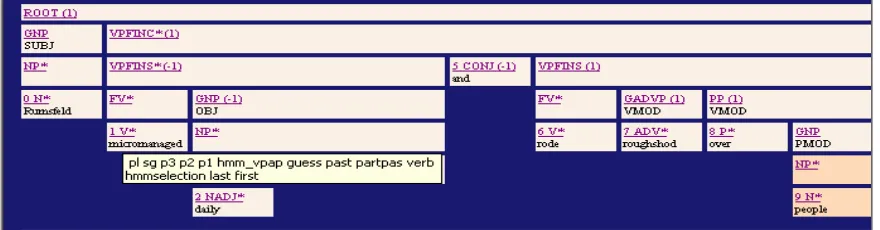
RH delivers single "best" parses providing syn-tactic categories, synsyn-tactic functions, head features, and other information (Figure 1). The parenthe-sized numbers following the category labels in the figure are preference scores, and are explained fur-ther on. While the parses are not quite as detailed as those obtained using "deep" grammars, the missing information, mostly relating to long dis-tance dependencies, can be added at far less cost in a post-parse phase that operates only on a single best parse. Methods for doing so, for stochastic parser output, are described by Johnson (2002) and Cahill et al (2004).
The hybrid parser exceeds most stochastic pars-ers in speed, and approaches them in accuracy, even based on limited manual "training" on a par-ticular idiom, so the preference system is a suc-cessful one (see Section 6), and continues to im-prove.
The RH preference system builds on earlier methods. The major difference is a far simpler scoring system, which has considerably facilitated overlay parser development. Also, the architecture allows the use of large numbers of preference tests without impacting parser speed. Finally, the treat-ment of coordination exploits the lookaheads af-forded by the shallow parser to license or bar alter-native appositive readings.
Section 2 below discusses symbolic preference systems in general, and section 3 provides an over-view of RH parser structure. Section 4 describes the organization of the RH preference system and the simplified scoring mechanism. Section 5 dis-cusses the training approach and Section 6 pro-vides some experimental results. Section 7 sum-marizes, and indicates directions for further work.
Figure 1. Output Parse Tree for "Rumsfeld micromanaged daily briefings and rode roughshod over people." * indicates head. Mouseover shows head features for "micromanaged".
2 Background: Symbolic Preference
2.1 Principles
Preference-based parsing balances necessarily permissive syntactic rules by preference rules that promote more likely interpretations. One of the earliest works in the area is by Wilks (1975), which presented a view of preference as based on semantic templates. Throughout the 1980's there was a considerable amount of work devoted to finding general principles, often cognitively ori-ented, for preference rules, and then to devise mechanisms for using them in practical systems. Hobbs and Bear (1990) provide a useful summary of the evolved principles. Slightly restated, these principles are:
1. Prefer attachments in the "most restrictive context".
2. If that doesn't uniquely determine the result, attach low and parallel, and finally
3. Adjust the above based on considerations of punctuation
Principle 1 suggests that the preference for a constituent in a construction should depend on the extent to which the constituent meets a narrow set of expectations. Most of the examples given by Hobbs and Bear use either (a) sub-categorization information, e.g., preferring the attachment of a prepositional phrase to a head that expects that par-ticular preposition, or (b) limited semantic infor-mation, for example, preferring the attachment of a time expression to an event noun.
Principle 2 implies that in the absence of coor-dination, attachment should be low, and in the presence of coordination, parallel constituents should be preferred. Principle 3 relates primarily to the effect of commas in modifying attachment preferences.
2.2 Implementations
Abstractly, symbolic preference systems can be thought of as regarding a set of possible parses as a collection of spanning trees over a network of po-tential relationships, with each edge having a nu-meric value, and attempting to find the highest scoring tree.1
However, for syntactic parsers, in contrast with dependency parsers, it is convenient to associate scores with constituents as they are built, for con-sistency with the parser structure, and to permit within-parse pruning. A basic model for a prefer-ence system assigns preferprefer-ence scores to rules. For a rule
C → c1, c2, …, cn
the preference score PS(CC) of a resultant con-stituent CC is the sum:
PS(cc1) + PS(cc2) + +PS(ccn) + TRS (C, cc1, cc2, …, ccn)
where PS(cci) is the non-contexted score of
con-stituent cci, and the total relationship score TRS is a
value that assesses the relationships among the sib-ling constituents of CC. The computation of TRS depends on the parser approach. For a top-down parser, TRS may be the sum of contexted relation-ship scores CRS, for example:
TRS = CRS (cc1|C) +CRS (cc2|C, cc1), + CRS (cc3|C, cc1, cc2) + ….. + CRS (cn |C, cc1,….ccn-1)
where each CRS (cci|_ ) evaluates cci in the context
of the prior content of the constituent CC and the category C..
Few publications specify details of how prefer-ence scores are assigned and combined. For exam-ple, Hobbs and Bear (1990) say only that "When a
1
non-terminal node of a parse tree is constructed, it is given an initial score which is the sum of the scores of its child nodes. Various conditions are checked during the construction of the node and, as a result, a score of 20, 10, 3, -3, -10, or -20 may be added to the initial score."
McCord (1993), however, carefully describes how the elements of TRS are computed in his slot grammar system. Each element value is the sum of the results of up to 8 optional, typed tests, relating to structural, syntactic, and semantic conditions. One of these tests, relating to coordination, is a complex test involving 7 factors assessing parallel-ism.
2.3 Multi-Level Contexted Scoring
The scores assigned by symbolic preference sys-tems to particular relationships or combinations usually indicate not just whether they are preferred or dispreferred, but to what degree. For example, a score of 1 might indicate that a relationship is good, and 2 that it is better.
Such multi-level scores create problems in tun-ing parsers to remove undesirable interactions, both in the grammar and the preference system. Even for interactions foreseen in advance, one must remember or find out the sizes of the prefer-ences involved, to decide how to compensate. Yamabana et al. (1993) give as an example a bot-tom-up parser, where an S constituent with a tran-sitive verb head but lacking an object is initially given a strong negative preference, but when it is discovered that the constituent actually functions as a relative clause, the appropriate compensation must be found. (Their solution uses a vector of preference scores, with the vector positions corre-sponding to specific types of preference features, together with an accumulator. It allows the content of vector elements to be erased based on subse-quently discovered compensating features.)
For unforeseen interactions, for example when a review of parser outputs finds that the best parse is not given the highest preference score, multi-level contexted scoring requires complex tracing of the contribution of each score to the total, remember-ing at each point what the score should be, to de-termine the necessary adjustments.
A different sort of problem of multi-level scor-ing stems from the unavoidable incompleteness of information. For example, in Figure 1, the attach-ment of an object to the "guessed" verb
"micro-managed" is dispreferred because the verb is not identified as transitive. Here, the correct reading survives because there are no higher scoring ones. But in some situations, if such a dispreference were given a large negative score, the parser could be forced into very odd readings not compensated for by other factors.
2.4 Corpus-Based Preference
In the early 1990's, the increasing availability and use of corpora, together with a sense that multi-level symbolic preference scores were based on ad-hoc judgments, led to experiments and systems that used empirical methods to obtain preference weights. Examples of this work include a system by Liu et al (1990), and experiments by Hindle and Rooth (1993), and Resnik and Hearst (1993).2
These efforts had mixed success, suggesting that while multi-level preference scores are problem-atic, integrating some corpus data does not solve the problems. In light of later developments, this might be expected. Full-scale contemporary sto-chastic parsers use a broad range of interacting fea-tures to obtain their fine-grained results; frequen-cies of particular relationships are just one aspect.
2.5 OT-based Preference
A more recent approach to symbolic preference adapts optimality theory to parser and generator preference. Optimality Theory (OT) was origi-nally developed to explain phonological rules (Prince and Smolensky, 1993). In that use, poten-tial rules are given one "optimality mark" for each constraint they violate. The marks, all implicitly negative, are ranked by level of severity. A best rule R is one for which (a) the most severe level of constraint violation L is ≤ the level violated by any other rule, and (b) if other rules also violate level L constraints, the number of such violations is ≥ the number of violations by R.
As adapted for use in the XLE processor for LFG (Frank et al. 1998) optimality marks are asso-ciated with parser and generator outputs. Positive marks are added, and also labeled inter-mark posi-tions within the optimality mark ranking. The la-beled positions influence processor behavior. For generation, they are used to disprefer infelicitous strings accepted in a parse direction. And for
2
ing they can be used to disprefer (actually ignore) rarely-applicable rules, in order to reduce parse time (Kaplan et al, 2004).
However, because the optimality marks are global, a single dispreference can rule out an entire parse. To partially overcome this limitation, a fur-ther extension (see XLE Online Documentation) allows direct comparisons of alternative readings for the same input extent. A different optimality mark can be set for each reading, and the use of one such mark in the ranking can be conditioned on the presence of another particular mark for the same extent. For example, a conditional disprefer-ence can be set for an adjunct reading if an argu-ment reading also exists. The extension does not address more global interactions, and is said (Forst et al. 2005) to be used mostly as a pre-filter to limit the readings disambiguated by a follow-on stochas-tic process.
2.6 A Slightly Different View
A slightly different view of preference–based pars-ing is that the business of a preference system is to work in tandem with a permissive syntactic gram-mar, to manipulate outcomes.
The difference focuses on the pragmatic role of preference in coercing the parser. In this light, the principles of section 2.1 are guidelines for desired outcomes, not bases for judging the goodness of a relationship or setting preference values. Instead, preference values should be set based on their ef-fectiveness in isolating best parses. Also, in this light, the utility of a preference system lies not only in its contribution to accuracy, but also in its software-engineering convenience. These consid-erations led to the simpler, more practical scoring system of the RH overlay parser, described in sec-tion 4 below, in which contexted preference scores CRS can have one of only 3 values, -1, 0, or +1.
3 Background: The RH Parser
The RH parser consists of three major components, outlined below: the shallow parser, a mediating "locator" phase, and the overlay parser.
3.1 Shallow Parser
The shallow parser used, XIP, was developed by XRCE (Xerox Research Center Europe). It is actually a full parser, whose per-sentence output consists of a single tree of basic chunks, together
with identifications of (sometimes alternative) typed dependences among the chunk heads (Ait-Mokhtar et al. 2002, Gala 2004). But because the XIP dependency analysis for English was not mature at the time that work on RH began, and because a classic parse tree annotated by syntactic functions is more convenient for some applications, we focused on the output chunks.
XIP is astonishingly fast, contributing very little to parse times (about 20%). It consists of the XIP processor, plus grammars for a number of languages. The grammar for a particular language consists of:
(a) a finite-state lexicon producing alternative part-of-speech and morphological analyses for each token, together with bit-expressed subcategorization and control features, and (some) semantic features,
(b) a substitutable tagger identifying the most probable part of speech for each token, and (c) sequentially applied rule sets that extend and
modify lexical information, disambiguate tags, identify named entities and other multiwords, and produce output chunks and inter-chunk head dependences (the latter not used in the hybrid).
Work on the hybrid parser has included large scale extensions to the XIP English rule sets.
3.2 Locator phase
The locator phase accumulates and analyses some of the shallow parser results to expedite the grammar and preference tests of the overlay parser.
For preference tests, for any input position, the positions of important leftward and rightward tokens are identified. These "important" tokens include commas, and leftward phrase heads that might serve as alternative attachment points.
long sequences of noun and prepositional phrases ending with a coordinating conjunction.
3.3 Overlay Parser
The overlay parser uses a top-down grammar, expressed as a collection of ATN-like grammar networks. A recursive control mechanism traverses the grammar networks depth-first to build constituents. The labels on the grammar network arcs represent specialized categories, and are associated with tests that, if successful, either return a chunk or reinvoke the control to attempt to build a constituents for the category. The label-specific tests include both context-free tests, and tests taking into account the current context. For details see (Newman, 2007).
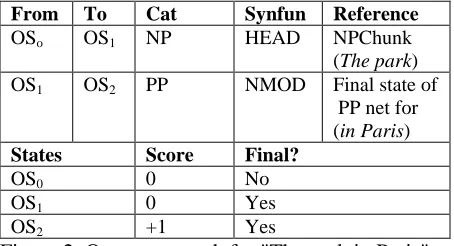
If an invocation of the control is successful, it returns an output network containing one or more paths, with each path representing an alternative sequence of immediate children of the constituent. An example output network is shown in figure 2. Each arc of the network references either a basic chunk, or a final state of a subordinate output net-work. Unlike the source grammar networks, the output networks do not contain cycles or converg-ing arcs, so states represent unique paths.
The states contain both (a) information about material already encountered along the path, in-cluding syntactic functions and head features, and (b) a preference score for the path to that point. Thus the figure 2 network represents two alternative noun phrases, one represented by the path containing OS0 and OS1, and one containing
OS0, OS1, and OS2. State OS2 contains the
preference score (+1), because attaching a locative pp to a feature of the landscape is preferred.
From To Cat Synfun Reference OSo OS1 NP HEAD NPChunk
(The park) OS1 OS2 PP NMOD Final state of
PP net for (in Paris) States Score Final?
OS0 0 No
OS1 0 Yes
OS2 +1 Yes
Figure 2. Output network for "The park in Paris"
Before an output network is returned from an invocation of the control mechanism, it is pruned to remove lower-scoring paths, and cached.
Output from the overlay parser is a single tree (Figure 1) derived from a highest scoring full path (i.e. final state) of a topmost output network. If there are several highest scoring paths, low attach considerations select a "best" one. The preference scores shown in Figure 1 in parentheses after the category labels are the scores at the succeeding states of the underlying output networks.
4 Preference System
Any path in an output network has the form: S0, Ref1, S1, Ref2, …, Sn-1 , Refn, Sn
where Si is a state, and Refi labels an arc, and
refer-ences either a basic chunk, or a final state of an-other output network. A state Si has total
prefer-ence score TPS(i) where:
• TPS(0) = 0 • TPS(i), i>0 =
TPS( i-1) + PS(Refi) +CRS(Refi)
• PS(Refi) is the non-contexted score of the
constituent referenced by Refi, that is, the
score at the referenced final state.
• CRS(Refi) is the contexted score for Refi, in
the context of the network category and the path ending at the previous state i-1.
For example, if Refi refers to a noun phrase
con-sidered a second object within a path, and the syn-tactic head along the path does not expect a second object, CRS(Refi) might be (-1).
Each value CRS is limited to values in {-1, 0, +1}. Therefore, no judgment is needed to decide the degree to which a contexted reference is to be dispreferred or preferred. Also, if the desired parse result does not receive the highest overall score, it is relatively easy to trace the reason. Pruning (see below) can be disabled and all parses can be dis-played, as in Figure 1, which shows the scores TPS(i) in parentheses after the category labels for each Refi (with zero scores not shown). Then, if
TPS(i) > ( TPS(i-1) + PS(Refi))
Test Block Type
Length Independent?
Indexed By
Coordinate Y Parent syncat
Subcat Y No index
FN1 Y synfun
TAG1 Y syncat
FN2 N synfun
TAG2 N syncat
Table 1. Preference Test Block Types
4.1 Preference test organization
To compute the contexted score CRS for a refer-ence, relevant tests are applied until either (a) a score of -1 is obtained, which is used as CRS for the reference, or (b) the tests are exhausted. In the latter case, CRS is the higher of the values {0, +1} returned by any test.
For purposes of efficiency, the preference tests are divided into typed blocks, as shown in Table 1. At most one block of each type can be applied to a reference. Four of the blocks contain tests that are independent of referenced constituent length. They are applied at most once for a returned output net-work and the results are assumed for all paths. The other two blocks are length dependent.
Referring to Table 1, the length-independent co-ordinate tests are applied only to non-first siblings of coordinated constituents. The parent category indicates the type of constituents being coordinated and selects the appropriate test block. Tests in these blocks focus on the semantic consistency of a coordinated sibling with the first one.
Subcategorization tests are applied to preposi-tional, particle, and clausal dependents of the cur-rent head. These tests consist to a large extent of bit-vector implemented operations, comparing the expected dependent types of the head with lexical features of the prospective dependent. The tests are made somewhat more complex because of various exceptions, such as (a) temporal and loca-tive phrases, and (b) the presence of a nearer po-tential head also expecting the dependent type.
The other test block types are selected and ac-cessed either by the syntactic category or the syn-tactic function of the reference, depending on the focus of the test. The length-dependent tests in-clude tests of noun-phrases within coordinations to determine whether post modifiers should be ap-plied to the individual phrase or to the coordination as a whole.
The test blocks are expressed in procedural code. This has allowed the parser to be developed without advance prediction of the types of infor-mation needed for the tests, and also has contrib-uted some efficiency. The blocks, usually short but occasionally long, generally consist of ordered (if-then-else) subtests.
4.2 Preference test scope
A contexted preference test can refer to material on three levels of the developing parse tree: (a) the syntactic category of the parent (available because of the top-down parser direction) (b) information about the current output network path, including head features, already-encountered syntactic func-tions, and a small collection of special-purpose information, and (c) information about the refer-enced constituent, specifically its head and a list of the immediately contained syntactic functions. The tests can also reference lookahead information fur-nished by the locator phase. This material is suffi-cient for most purposes. Limiting the kind of ref-erenced information, particularly not permitting access to sibling constituents or deep elements of the referenced constituent, contributes to perform-ance.
4.3 Pruning
Before an output network is completed, it is pruned to remove lower-scoring output network paths. Any path with the same length as another but with a lower score is pruned. Also, paths having other lengths but considerably lower preference scores than the best-scoring path are often pruned as well.
4.4 Usage Example
To illustrate how the simple scores and modular tests are used to detect and repair problems in the preference system, Figure 1 shows, as noted be-fore, that the attachment of an object to the guessed verb "micromanaged" is dispreferred. In this case the probable reason is the lack of a transitive fea-ture for the verb. To check this, we would look at the FN1 test block for OBJ and find that in fact the test assigns (-1) in this case. The required modifi-cation is best made by adding a transitive feature to guessed verbs.
VMOD and the TAG1 test block for PP finds that there is in fact no subtest that prefers combinations of motion verbs and "over". While this doesn't cause trouble in the example, it could if there were a prior object in the verb phrase. A subtest or sub-categorization feature could be added.
5 Training the Preference System
To obtain the preference system, an initial set of tests is identified, based primarily on subcategori-zation considerations, and then refined and ex-tended based on manual "training" on large num-bers of documents. Several problem situations result in changes to the system, besides random inspection of scores:
(a) the best parse identified is not the correct one, either because the correct parse is not the high-est scoring one, or because another parse with the same score was considered "best" because of low-attach considerations.
(b) The best parse obtained is the correct one, but there are many other parses with the same score, suggesting a need for refinement, both to improve performance and to avoid errors in related circumstances when the correct parse does not "float" to the top.
(c) No parse is returned for an input, because of imposed space constraints, which indirectly control the amount of time that can be spent to obtain a parse.
In some cases the above problems can be solved by adjusting the base grammar, or by extending lexical information to obtain the appropriate pref-erences. For example, the preference scoring prob-lems of Figure 1 can be corrected by adding sub-categorization information, as described above.
In other cases, one or more modifications to the preference system are made, adding positive tests to better distinguish best parses, adding negative tests to disprefer incorrect parses, and/or refining existing tests to narrow or expand applicability.
Positive tests often just give credit to expected structures not previously considered to require rec-ognition beyond acceptance by the grammar. Negative tests fall into many classes, such as: (a) Tests for "ungrammatical" phenomena that
should not be ruled out entirely by the gram-mar. These include lack of agreement, lack of expected punctuation, and presence of unex-pected punctuation (such as a comma between
a subject and a verb when there is no comma within the subject).
(b) Tests for probably incomplete constituents, based on the chunk types that follow them. (c) Tests for unexpected arguments, except in
some circumstances. For example, "benefac-tive" indirect objects ("John baked Mary a cake") are dispreferred if they are not in ap-propriate semantic classes.
Also, a large, complex collection of positive and negative tests, based on syntactic and semantic fac-tors, are used to distinguish among coordinated and appositive readings, and among alternative attach-ments of appositives.
If the addition or modification of preference tests does not solve a particular problem, then some more basic changes can be made, such as the introduction of new semantic classes. And, in rare cases, new features are added to output network states in order to make properties of non-head con-stituents encountered along a path available for testing both further along the path and in the de-velopment of higher-level constituents. An exam-ple is the person and number of syntactic subjects, allowing contexted preference tests for finite verb phrases to check for subject consistency.
5.1 Relationship to "supervised" training
To illustrate the relationship between the above symbolic training method for preference scoring and corpus-based methods, perhaps the easiest way is to compare it to an adaptation (Collins and Roark, 2004) of the perceptron training method to the problem of obtaining a best parse (either di-rectly, or for parse reranking), because the two methods are analogous in a number of ways.
The basic adapted perceptron training assumes a generator function producing parses for inputs. Each such parse is associated with a vector of fea-ture values that express the number of times the feature appears in the input or parse. The features used are those identified by Roark (2001) for a top-down stochastic parser.
The training method obtains a weight vector W (initially 0) for the feature values, by iterating mul-tiple times over pairs <xi, yi> where xi is a training
input, and yi is the correct parse for xi. For each
pair, the best current parse zi for xi produced by the
generator, with feature value vector V(zi), is
se-lected based on the current value of (W · V(zi)).
dec-remented by V(zi). After training, the weights in W
are divided by the number of training steps (# in-puts * # iterations).
The method is analogous to the RH manual training process for preference in a number of ways. First, the features used were developed for suitability to a top-down parser, for example taking into account superordinate categories at several levels, some lexical information associated with non-head, left-side siblings of a node, and some right-hand lookahead. Although only one su-perordinate category is routinely used in RH pref-erence tests, in order to allow caching of output networks for a category, the preference system al-lows for and occasionally uses the promotion of non-head features of nested constituents to provide similar capability.
Also, the feature weights obtained by the per-ceptron training method can be seen to focus on patterns that actually matter in distinguishing cor-rect from incorcor-rect parses, as does RH preference training. Intuitively, the difference is that while symbolic training for RH explicitly pinpoints pat-terns that distinguish among parses, the perceptron training method accomplishes something similar by postulating some more general features as nega-tive or posinega-tive based on particular examples, but allowing the iterations over a large training set to filter out potentially indicative patterns that do not actually serve as such.
These analogies highlight the fact that prefer-ence system training, whether symbolic or corpus-based, is ultimately an empirical engineering exer-cise.
6 Some Experimental Results
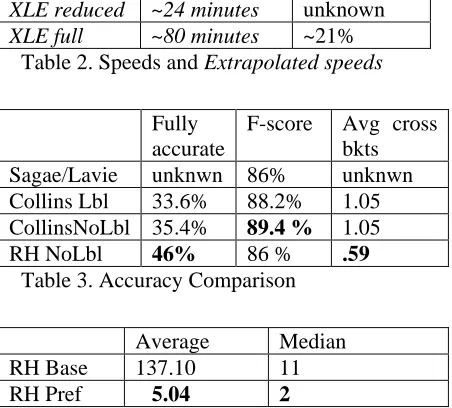
Tables 2, 3, and 4 summarize some recent results as obtained by testing on Wall Street Journal sec-tion 23 of the Penn Treebank (Marcus et al. 1994). The RH results were obtained by about 8 weeks of manual training on the genre.
Table 2 compares speed and coverage for RH and Collins Model3 (Collins, 1999) run on the same CPU. The table also extrapolates the results to two other parsers, based on reported compari-sons with Collins. One extrapolation is to a very fast stochastic parser by Sagae and Lavie (2005). The comparison indicates that the RH parser speed is close to that of the best contemporary parsers.
The second extrapolation is to the LFG XLE parser (Kaplan et al. 2004) for English, consisting of a highly developed symbolic parser and gram-mar, an OT-based preference component, and a stochastic back end to select among remaining al-ternative parser outputs. Two sets of values are given for XLE, one obtained using the full English grammar, and one obtained using a reduced gram-mar ignoring less-frequently applicable rules. The extrapolation indicates that the coverage of RH is quite good for a symbolic parser with limited train-ing on an idiom.
While the most important factor in RH parser speed is the enormous speed of the shallow parser, the preference and pruning approach of the overlay parser make contributions to both speed and cover-age. This can be seen in Table 2 by the difference between RH parser results with and without prun-ing. Pruning increases coverage because without it more parses exceed imposed resource limits.
Table 3 compares accuracy. The values for Collins and Sagae/Lavie are based on comparison with treebank data for the entire section 23. How-ever, because RH does not produce treebank-style tags, the RH values are based only on a random
Time No full parse
Sagae/Lavie ~ 4 min 1.1%
RH Prune 5 min 14 sec 10.8%
RH NoPrune 7 min 5 sec 13.9 %
Collins m3 16 min .6%
XLE reduced ~24 minutes unknown XLE full ~80 minutes ~21%
Table 2. Speeds and Extrapolated speeds
Fully accurate
F-score Avg cross bkts
Sagae/Lavie unknwn 86% unknwn
Collins Lbl 33.6% 88.2% 1.05
CollinsNoLbl 35.4% 89.4 % 1.05
RH NoLbl 46% 86 % .59
Table 3. Accuracy Comparison
Average Median
RH Base 137.10 11
RH Pref 5.04 2
100-sentence sample from section 23, and com-pared using a different unlabeled bracketing stan-dard. For details see Newman (2007). For non-parsed sentences the chunks are bracketed. Accu-racy is not extrapolated to XLE because available measurements give f-scores (all ≤ 80%) for de-pendency relations rather than for bracketed con-stituents.
As a partial indication of the role and effective-ness of the RH preference system, if non-parsed sentences are ignored, the percentage of fully accu-rate bracketings shown in Table 3 rises to ap-proximately 46/89 = 51.6% (it is actually larger because coverage is higher on the 100-sentence sample). As further indication, Table 4 compares, for section 23, the average and median number of parses per sentence obtained by the base grammar alone (RH Base), and the base grammar plus the preference system (RH Pref).3 The table demon-strates that the preference system is a crucial parser component. Also, the median of 2 parses per sen-tence obtained using the preference system ex-plains why the fallback low-attach strategy is suc-cessful in many cases.
7 Summary and Directions
The primary contribution of this work is in demon-strating the feasibility of a vastly simplified sym-bolic preference scoring method. The preference scores assigned are neither "principle-based", nor "ad-hoc", but explicitly engineered to facilitate the management of undesirable interactions in the grammar and in the preference system itself. Re-stricting individual contexted scores to {-1, 0, +1} addresses the problems of multi-level contexted scoring discussed in Section 2, as follows:
• No abstract judgment is required to assign a value to a preference or dispreference.
• Information deficiencies contribute only small dispreferences, so they can often be overcome by preferences.
• Compensating for interactions that are fore-seen does not require searching the rules to find necessary compensating values.
• For unforeseen interactions discovered when reviewing parser results, the simplified
3
The values are somewhat inflated because they include duplicate parses, which have not yet been entirely eliminated.
erence scores facilitate finding the sources of the problems and potential methods of solv-ing them.
This approach to symbolic preference has facili-tated development and maintenance of the RH parser, and has enabled the production of results with a speed and accuracy comparable to the best stochastic parsers, even with limited training on an idiom.
An interesting question is why this very simple approach does not seem to have been used previ-ously. Part of the answer may lie in the lack of explicit recognition that symbolic preference scor-ing is ultimately an engineerscor-ing problem, and is only indirectly based on cognitive principles or approximations to frequencies of particular rela-tionships.
Ongoing development of the RH preference sys-tem includes continuing refinement based on "manual" training, and continuing expansion of the set of semantic features used as the parser is ap-plied to new domains. Additional development will also include more encoding of, and attention to, the expected semantic features of arguments. Experiments are also planned to examine the accu-racy/performance tradeoffs of using additional context information in the preference tests.
References
Salah Aït-Mokhtar, Jean-Pierre Chanod, Claude Roux. 2002. Robustness beyond shallowness: incremental deep parsing, Natural Language Engineering 8:121-144, Cambridge University Press.
Aoife Cahill, Michael Burke, Ruth O’Donovan, Josef van Genabith, and Andy Way. 2004. Long-Distance Dependency Resolution in Automatically Acquired Wide-Coverage PCFG-Based LFG Approximations, In Proc of the 42nd Annual Meeting of the
Associa-tion for ComputaAssocia-tional Linguistics (ACL'04),
Barce-lona
Michael Collins. 1999. Head-Driven Statistical Models for Natural Language Parsing. Ph.D. thesis, Univer-sity of Pennsylvania.
Michael Collins and Brian Roark. 2004. Incremental Parsing with the Perceptron Algorithm. In Proc of the
42nd Annual Meeting of the Association for Compu-tational Linguistics (ACL'04), Barcelona.
LFG05 Conference, Bergen. Available at http://cslipublications.stanford.edu/LFG/10/lfg05.pdf
Anette Frank., Tracy H. King, Jonas Kuhn, and John Maxwell. 1998. Optimality theory style constraint ranking in large-scale LFG grammars. In M. Butt and T. H. King, Eds. Proc of the Third LFG Conference. Available http://csli-publications.stanford.edu/LFG3/ Revised version in Peter Sells, ed. Formal and
Theo-retical Issues in Optimality Theoretic Syntax, CSLI
Publications, 2001.
Nuria Gala. 2004. Using a robust parser grammar to automatically generate UNL graphs. In Proc
Work-shop on Robust Methods for Natural Language Data at COLING'04, Geneva
Donald Hindle and Mats Rooth. 1993. Structural Ambi-guity and Lexical Relations. Computational
Linguis-tics, 19:1,103–120.
Jerry R. Hobbs and John Bear. 1990. Two Principles of Parse Preference. In Proceedings of the 13th
Interna-tional Conference on ComputaInterna-tional Linguistics (COLING'90), Helsinki, Finland, August 1990.
Jerry. R. Hobbs, Douglas E. Appelt, John Bear, Mabry Tyson, and David Magerman. 1992. Robust process-ing of real-world natural language texts. In Paul S. Jacobs, ed., Text-Based Intelligent Systems: Current
Research and Practice in Information Extraction and Retrieval. Lawrence Erlbaum, New Jersey, 1992.
Mark Johnson. 2002. A simple pattern-matching algo-rithm for recovering empty nodes and their antece-dents. Proceedings of the 40th Annual Meeting of the
Association for Computational Linguistics (ACL'02),
Philadelphia, July 2002, pp. 136-143.
Ronald M. Kaplan, Stephan Riezler, Tracy H. King, John T. Maxwell, Alex Vasserman. 2004. Speed and accuracy in shallow and deep stochastic parsing. In
Proc HLT/NAACL'04, Boston, MA.
Chao-Lin Liu, Jing-Shin Chang, and Keh-Yi Su. 1990. The Semantic Score Approach to the Disambiguation of PP Attachment Problem. In Proceedings of
RO-CLING-90, Taiwan
Mitchell P. Marcus, Beatrice Santorini, and Mary Ann Marcinkiewicz. 1994. Building a large annotated corpus of English: The Penn treebank.
Computa-tional Linguistics, 19(2) pp.313--330.
Michael C. McCord. 1993. Heuristics for Broad-Coverage Natural Language Parsing. Proceedings of
the workshop on Human Language Technology 1993,
Princeton, NJ
Ryan McDonald, Fernando Pereira, Kiril Ribarov, and Jan Hajic. Non-projective dependency parsing using spanning tree algorithms. In Proceedings of the
con-ference on Human Language Technology and Em-pirical Methods in Natural Language Processing
(EMNLP 2005), Vancouver.
Paula S. Newman. 2007. RH: A Retro-Hybrid Parser. In Short Papers of Proceedings of NAACL/HLT
2007, Rochester NY
Alan Prince and Paul Smolensky (1993). Optimality Theory: Constraint interaction in generative gram-mar, Rutgers University Center for Cognitive Sci-ence, New Brunswick, NJ. Report RuCCS-TR-2. [Reprinted in John J McCarthy, ed., Optimality
The-ory in Phonology: A Book of Readings, Blackwell
(2003).]
Philip Resnik and Marti Hearst. 1993. Structural
Ambi-guity and Conceptual Relations, in Proc. of 1st
Workshop on Very Large Corpora, 1993.
Brian Roark. 2001. Probabilistic top-down parsing and language modeling. In Computational Linguistics, 27(2), pages 249-276.
Kenji Sagae and Alon Lavie. 2005. A classifier-based parser with linear run-time complexity. In Proc. 9th
Int'l Workshop on Parsing Technologies. Vancouver
Kristina Toutanova, Christopher D. Manning, Dan Flickinger, and Stephan Oepen. 2005. Stochastic HPSG Parse Disambiguation using the Redwoods Corpus. Research in Language and Computation 2005.
Yorick A. Wilks. 1975. An Intelligent Analyzer and Understander of English. Communications of the
ACM 18(5), pp.264-274
William Woods. 1970. Transition network grammars for natural language analysis. Communications of the
ACM 13(10), pp.591-606
XLE Online Documentation. 2006. Available at http://www2.parc.com/isl/groups/nltt/xle/doc/xle.htm l#SEC15
Kiyoshi Yamabana, Shin'ichiro Kamei and Kazunori Muraki. On Representation of Preference Scores. In Proceedings of The Fifth International Conference