Volume 8, No. 5, May – June 2017
International Journal of Advanced Research in Computer Science
RESEARCH PAPER
Available Online at www.ijarcs.info
A Coordinated Approach for Energy-Aware Fault Tolerance in Cloud Computing
Ambica Sood
Dept. Computer Engineering and Technology Guru Nanak Dev University
Amritsar, India
Kamaljit Kaur
Dept. Computer Engineering and Technology Guru Nanak Dev University
Amritsar, India
Abstract: In the current years, the broad utilization of cloud computing in IT industry has prompted excessive utilization of energy in the host and subsequently data centres, which obviously, has turned into a matter of thought. To conserve energy in cloud, dynamic virtual machine consolidation and power aware mechanisms can be thought of one of the best strategies. In this approach, a portion of the under-stacked physical machines (PMs)are placed either into low-control mode or are turned off with the assistance of live relocation of Virtual Machines(VMs). Fault tolerance mechanism with dynamic relocation is proposed through this literature. Proposed work presents a novel approach of conserving energy considering parameters such as fan speed, temperature, power consumption and energy. Fan speed was allocated to each Virtual Machine(VM) along with temperature. Deterioration of virtual machines was detected at distinct level of examination. 1) If temperature rises above threshold value then deterioration is detected 2) Energy consumption is another criterion used to detect deterioration. Deterioration can be detected at any level and if detected, dynamic relocation through Live VM migration is done and progress monitoring mechanism is used to conserve energy. Using the approach energy efficiency is achieved along with continuous availability and reliability of services. Simulation is conducted in Netbeans with Cloudsim 3.0.3. Proposed approach conserve energy up to 25%.
Keywords: Fault Tolerance; Energy efficiency; Reliability; Migration
I. INTRODUCTION
Cloud Computing is the emerging technology satisfying the large scale computational requirements of the clients. Cloud computing offers a package of hardware and software resources that can be leveraged by clients on pay per use basis [1]. The clients no longer need to worry about the initial investments on the resources as cloud computing exploits virtualization technology to share multiple resources such as storage, hardware, software and network resources among different clients in accordance with their requirements on demand basis [2]. As the technological advancement continues the rising demands for high computation facility has resulted in the expansion of IT infrastructure which is a major source of energy consumption and carbon dioxide emission posing greater threat to environment and cloud service providers who would have to spend additional amounts to keep energy consumption within limits. According to Standard Performance Evaluation Corporation, by 2020, the energy consumed by datacenters will rise to 38000 billion Wh/year [3]. The huge servers hosted in the datacenters dissipate a large amount of heat and need cooling systems to regulate the optimal temperature which in turn also adds to the carbon footprints and results in energy crises due to high power consumption. Thus there is a need of energy management strategies which utilize energy efficiently so that energy saving can be considerably increased controlling the rising energy crisis. It also increases profit margins of service providers by promoting the optimal use of cooling equipments and underutilized resources.[6]
Moreover, the failure rate grows with the growth in system components. According to this paper system represents cloud computing infrastructure such as hardware, network, servers and software cloud management system, cloud appliances [4].The number of computing, storage and communication components that can fail is relatively large as
a result failure the probability of failure increases [5]. Continuous availability and reliability of services is key concern in an organization and any interruption due to failure may result in severe consequences and the loss may not be recovered. Thus there is a need of fault tolerant strategies which can handle failures gracefully while ensuring continuous availability, scalability and reliability of services [7].
Fault tolerance and energy efficiency are the two key challenges in cloud computing that need to focused in order to provide the desired QoS(quality of services) to the clients. There is very limited research which considers both these parameters simultaneously. A literature survey is done to explore the present fault tolerance and energy management strategies.
In this paper a fully coordinated approach to provide energy efficient fault tolerance was proposed. In Section II related work is discussed. Section III describes the various objectives than need to be considered to improve the overall energy utilization and reliability of the system. In section IV framework was proposed to achieve the goal. Section V discusses the results obtained on implementing the proposed approach. Finally section VI concludes this paper.
II. RELATEDWORK
Fault tolerance and energy efficiency are the key parameters that must be considered by cloud service providers to provide reliable QoS to clients while gaining profit at the same time. Various fault tolerance strategies where used to improve reliability and availability of cloud services which can be broadly classified as reactive and proactive approaches.
provide fault tolerance which mainly involves repetition of crucial data that can be stored at some reliable location from where it can be retrieved when ever required.
Checkpointing approach proposed by [8] record the progress so that in case of fault or failure vm’s(virtual machines) does not have to perform entire task again rather progress can began from same position where fault occurs. An adaptive checkpointing scheme was proposed in [9] to dynamically adjust the checkpointing interval during task execution. Adaptive checkpointing was further combined with dynamic voltage scaling(DVS) technique to achieve power reduction.
Replication strategy was deployed in [10] to provide fault tolerance in which various replicas(copies) of vm’s were created and stored on variable host machines in order to ensure availability in the event of failure. Additional resources such as storage space are required in order to implement reactive fault tolerance strategies. More over the certain amount of resources needs to be reserved in case of reactive fault tolerance due to which they often remain underutilized thus the focus of researchers moved towards proactive fault tolerant strategies to overcome the drawbacks of above discussed approach.
In proactive fault tolerance strategies various components of cloud infrastructure are regularly monitored to estimate the possibility of failure occurrence. Several metalearning calculations can be utilized on four layers that constitute the framework in particular: • Physical Hardware • Hypervisor/Virtual Machine Monitor (VMM) • (Guest) Operating System • Application and Middleware stack to predict the chances of failure. After having investigated multi-layer faulty expectation, the last step is to select the optimal destination for reallocating virtual machine. This method takes into account the common types of failures that can occur in the system and the impact these failures have on system so as to create system preparedness against them. This is accomplished by removing negative impacts in the system that can result in failures thus dealing with failures before they actually occur. Virtual machine migration generally falls under this category.
Live migration of virtual machines involves the transfer of entire virtual machine from one host to another host without causing any interruption of services. In order to provide fault tolerance the monitoring module can estimate the possibility of occurrence of failure and migrate the deteriorating virtual machine to a more reliable host [11]. Convenient virtual machine relocation for proactive adaptation to non-critical failure was proposed in [13]. The reliability of nodes was determined based on job execution and crucial jobs were assigned to highly reliable nodes. The jobs were migrated in the event of overutilization of resources. Two power aware migration strategies were proposed in [14]. The overall energy consumption by minimized by restricting the number of migrations. The clock speed was altered at the time of migration by using dynamic voltage and frequency scaling(DVFS) approach to further decrease energy consumption.
Energy can also be saved by deploying server consolidation strategy in which the virtual machines from underutilized hosts are migrated to optimal host consuming minimum energy. The underutilized host can be switched off to minimize energy consumption while efficient utilization of active resources is ensured.
A dynamic consolidation approach was proposed in [12] and the results verified that significant amount of energy
consumption can be reduced by deploying energy efficient consolidation. Several heuristics were proposed for energy aware placement of virtual machines in [15] by implementing live migration strategy for the transfer of virtual machines among different hosts. A thermal power-aware strategy was suggested by [17] according to which virtual machine migrations were triggered on the basis cpu utilization and temperature parameter. The observations were compared with minimum and maximum threshold values and migration decision was taken in the event of threshold breach.
Flaws of existing approach in terms of downtime or migration time can be further reduced. The fault tolerant strategy which can be optimized for future endeavors is proactive approach. The literature survey suggested the key points that need to be considered for further improving the overall performance of the system.
• Building Energy efficient fault tolerant strategy
• Saving progress of vm’s to reduce workload in a situation where fault occurs.
• Reducing downtime and migration time in case of vm’s relocation.
III. PROBLEMFORMULATION
A. Definition
Fault tolerance and energy efficiency are the primal challenges these days. Different architectures, frameworks, algorithms and policies have been proposed to make the cloud computing environment fault tolerant and energy efficient. However, there is limited research which considers both parameters simultaneously. This proposed work focus on proactive fault tolerance strategy which predicts system’s thermal behavior to reduce the overall temperature so that failures which may occur due to rising temperature can be avoided by using live migration strategy. Moreover the energy required to operate the data center cooling systems can be saved. The power-aware reallocation approach is used such that virtual machine on deteriorating physical machine can be reallocated to optimal physical machine, which further saves energy. .
B. Objective
1. Deteriorating virtual machine detection on the basis of variation in temperature.
2. Minimizing downtime and migration time by using live virtual machine migration
IV. METHODOLOGY
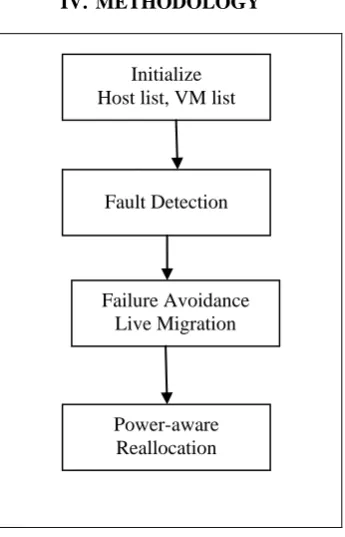
Figure 1: Flow of proposed system
The proposed work can be separated in various phases. Firstly, the host list and vm list in accordance with the active hosts and vm’s required to fulfill the service request of users. Jobs are initially allocated to virtual machines for execution on first come first serve basis.
The detailed description of each step is provided below:
A. Fault Detection
Fault tolerance is the property that empowers a framework to keep working appropriately in case of the failure. Fault tolerance is especially looked for after in high-accessibility or reliable frameworks. A fault-tolerant plan empowers a framework to proceed with its planned operation while ensuring quality of service. The fault detection phase of fault tolerance deals with estimating the presence of faults. The monitoring module keeps track of various components so that any abnormality can be instantly detected and appropriate measures can be taken to avoid disruption of services.
The proposed approach monitors fanspeed, temperature, cpu utilization and energy consumption of each virtual machine to avoid failures which may occur due to overheating and overutilization of resources. The fanspeed is associated with every virtual machine. In case fanspeed is less and temperature is more possibility of fault occurrence increases. The detection process uses threshold values. If the temperature exceeds threshold value, fault was detected as overheating may cause he system to behave abnormally. Power consumption is next in the sequence to detect faults. The power consumption was calculated by Equation 1.
Power=P1+P2*cpuutilization;
Equation 1: Power Consumption Equation
P1 and P2 are factors corresponding the power consumed when there is no workload(idle mode) and addition power required during execution of various jobs. 70% of overall
power is consumed by a system in idle mode [16]. Cpu utilization increases dynamically as the workload increases. Energy consumption can be calculated by Equation 2.
Energy=Cpuutilization(P1+P2)/Power
Equation 2: Energy Consumption Equation
Threshold value of power consumption is 250W [16]. In case, power consumption is higher than threshold, fault is detected.
B. Fault Avoidance(live vm migration)
As the fault appears within the vm on the basis of parameters, energy consumption , temperature, fanspeed etc The deteroriating vms within distinct host must be relocated for future progress. For this process, live vm migration is required. In a proposed approach, the vms are arranged according to fan speed and energy consumption. As the jobs are executed on a vm both energy consumption and temperature increases. As these parameters exceed threshold value, deterioration is detected.
Next efficient vm or optimal vm is to be selected on the basis of power-aware criteria to minimize the overall energy consumption. The deteriorating vm is then migrated to a healthy node. The live migration strategy used for faut avoidance ensures continous availability of services with negligible downtime.
C. Power-aware reallocation
In the proposed approach power aware mechanism is used. To perform reallocation, sorting operation is applied on vm list according to power consumption. Initally load is distributed on vm’s on first come first serve basis. The increase in workload causes increases in cpu utilization which results in increased enrgy consumption. Eneregy consumption is dynamic in nature indicating that energy varies as the load increases as suggested by equation 2. Threshold valueof energy consumption is maintained at 250W. In case, energy consumption exceeds the threshold value, optimal machine is selected for reallocation which consumes minimum energy. Record of allocation is made so that same vm is not selected multiple times. Entire process of energy consumption through virtual machine is dynamic since energy consumption is varied as load increases or decreases.
D. Algorithm for energy-aware fault tolerance
Algorithm EAFT (Energy Aware Fault tolerance)
Input: load /*Variable initialization*/
host list: all the active hosts, VM list: all vms currently available in the pool, Finalized_VM: sorted list of vms consuming minimum energy, Threshold(temp): 60,
Threshold(energy): 250
1. Initialize Fan speed and temperature to each
VM.
Initialize Host list, VM list
Fault Detection
Failure Avoidance Live Migration
2. Evaluate power consumption of each VM using equation
𝑃𝑃𝑃𝑃𝑃𝑃𝑃𝑃𝑟𝑟𝑖𝑖 =𝑃𝑃1 +𝑃𝑃2∗ 𝐶𝐶𝑃𝑃𝑈𝑈𝑈𝑈𝑈𝑈𝑖𝑖𝑈𝑈𝑖𝑖𝑈𝑈𝑈𝑈𝑈𝑈𝑖𝑖𝑃𝑃 𝑛𝑛𝑖𝑖 ---Equation 1
3. Evaluate energy consumption of each VM
using equation
𝐸𝐸𝑛𝑛𝑃𝑃𝑟𝑟𝐸𝐸𝑦𝑦𝑖𝑖 =𝐶𝐶𝑃𝑃𝑈𝑈𝑈𝑈𝑈𝑈𝑖𝑖𝑈𝑈𝑖𝑖𝑈𝑈𝑈𝑈𝑈𝑈𝑖𝑖𝑃𝑃𝑛𝑛 𝑖𝑖𝑃𝑃𝑃𝑃𝑃𝑃𝑃𝑃 𝑟𝑟𝑖𝑖(𝑃𝑃1+𝑃𝑃2)---Equation 2
4. Sort VMs on the basis of energy consumption
Finalized_VMi = VMMin
5. Assign Load to Finalized_vm
6. Check for deteriorating vm
If (Temperature>Threshold and Fan_Speedi
Else (Energy>Threshold) <Temperature)
Migrate VM to optimal destination selected from Finalized_VM list
7. Use Equation 1 and 2 to check for power and
energy consumption
8. Output: Downtime, Migration time, Average
Energy Consumption and Latency
V. RESULTANDPERFORMANCEANALYSIS
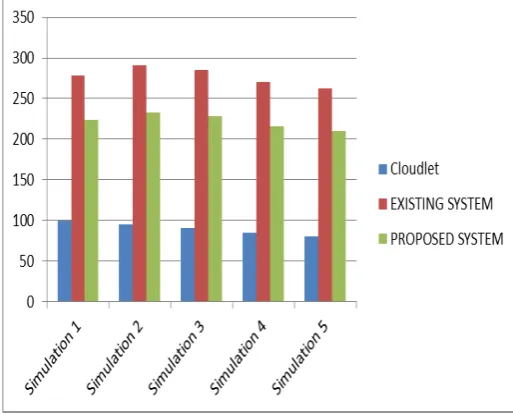
The experiment was conducted using cloudsim simulator. The simulated cloud infrastructure comprised of one data center in which the hosts were created dynamically in accordance with number of jobs which are taken as input from user. Each host had the capacity of ten virtual machines. The proposed approach is implemented and results are expressed in terms of energy consumption and latency and migration time. The results obtained were compared with the results of [17]. Energy consumption was reduced by the margin of 25% and latency is substantially reduced.
[image:4.595.316.573.56.263.2]Result in terms of tabular structure is presented as under:
Table 1: Energy consumption corresponding to existing and proposed approach.
SIMMULATION Cloudlet
Energy EXISTING
SYSTEM
Energy PROPOSED
SYSTEM
Simulation 1 100 278.48314 223.48314
Simulation 2 95 290.45565 232.45565
Simulation 3 90 285.42105 228.42105
Simulation 4 85 270.09743 216.09743
Simulation 5 80 262.55665 210.55665
Figure 2: Comparative analysis of Energy Consumption
[image:4.595.312.583.375.707.2]Cloudlets indicating tasks are varied in each simulation run. Difference in energy consumption through existing and proposed approach is noted. As shown through table 1. 25% energy is conserved through proposed approach. latency is next parameter considered for evaluation. Latency indicats the delay or time consumed in order to execute entire simulation. As the cloudlet increases latency also increases.
Table 2: Latency comparison through with and without power aware mechanism
SIMMULATION Cloudlet Latency
EXISTING SYSTEM(ms)
Latency PROPOSED SYSTEM(ms)
Simulation 1 100 2.2562 1.2656
Simulation 2 95 2.0256 1.0123
Simulation 3 90 2.0980 1.0265
Simulation 4 85 1.9856 1.0125
Simulation 5 80 1.5698 1.0003
Figure 3: Latency comparison of existing and proposed system
Migration time: Migration time is defined as the overall time required for transferring virtual machine from one host
0 0.5 1 1.5 2 2.5
Latency EXISTING SYSTEM(ms)
[image:4.595.24.292.595.709.2]to another. Its value must be minimum in order to obtain energy efficiency.
Table 3: Migration time corresponding to existing and proposed approach.
Simulation Cloudlets Existing Approach(us)
Proposed Approach(us)
Simulation1 120 18.6 8.2
Simulation 2 100 17.3 7.4
Simulation 3 80 16.5 6.8
Simulation 4 60 15.1 5.5
Simulation 5 50 14.8 4.9
Figure 4: Migration time of existing and proposed system
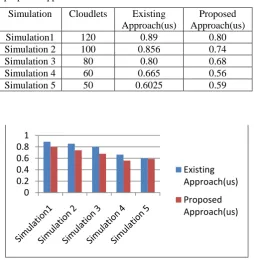
[image:5.595.32.287.436.697.2]Downtime: Downtime is defined as the overall time for which the services provided by the system remain unavailable. An efficient fault tolerant approach must have minimum or negligible downtime.
Table 4: Downtime corresponding to existing and proposed approach.
Simulation Cloudlets Existing Approach(us)
Proposed Approach(us)
Simulation1 120 0.89 0.80
Simulation 2 100 0.856 0.74
Simulation 3 80 0.80 0.68
Simulation 4 60 0.665 0.56
Simulation 5 50 0.6025 0.59
Figure 5: Downtime of existing and proposed system
Result comparison proves the worth of the study as prime objective of conserving energy is accomplished efficiently through power aware energy efficient migration mechanism proposed through this literature.
VI. CONCLUSION
As load on data center increases, energy consumption increases. Energy consumption in case increases beyond threshold levels, normal operation of VM is disturbed. In order to overcome the problem power aware mechanism through proposed literature is suggested. Proposed work detect deteriorating machine in phases. Temperature and fan speed were used as prime parameters for initial deteriorating VM detection. In case deterioration is detected migration is performed on next optimal virtual machine sorted on the basis of energy consumption. Next parameter used to detect deterioration is energy consumption, higher the energy consumption more will be the chance of deteriorating machine. Energy consumption is dynamically varied by changing cpu utilization as load increases on VM. Dynamic relocation strategy was used for next optimal vm selection. Results in terms of energy consumption were specified. Up to 25% conservation of energy was noticed.
REFERENCES
[1] Qi Zhang, Lu Cheng, Raouf Boutaba, “Cloud computing: state-of-the-art and research challenges”, J Internet Serv Appl (2010), springer, pp. 7–18, 2010.
[2] C. N. Höfer, G. Karagiannis, “Cloud computing services: taxonomy and comparison”, Journal of Internet Services and Applications, Springer, 2011.
[3] Sanajay Sharma, “Trends in Server Efficiency and Power Usage in Data Centers” SPEC 2016 Asian Summit, 2016 [4] T. Mastelic , A. Oleksiak , H. Claussen , I. Brandic , J.M.
Pierson , A. V. Vasilakos, “Cloud Computing: Survey on Energy Efficiency”, ACM Computing Surveys (CSUR), v.47 n.2, p.1-36, January 2015
[5] R. Buyya and Chee Shin Yeo, "Cloud Computing and Emerging IT Platforms: Vision, Hype, and Reality for Delivering Computing as the 5th Utility", Future Generation Computer Systems, vol. 25, no. 6, pp. 599-616, 2009 [6] D.Zhu, A.Hakan, "Energy management for real-time
embedded systems with reliability requirements." Proceedings of the 2006 IEEE/ACM international conference on Computer-aided design. ACM, 2006
[7] D. Sun,Guiran, Chang, C. Miao, X. Wang, “Analyzing, modeling and evaluating dynamic adaptive fault tolerance strategies in cloud computing environments” Springer Science+Business Media New York 2013 , 21 March 2013 [8] L. Wang, Z. Kalbarczyk, R.K. Iyer, A. Iyengar,
“Checkpointing Virtual Machines Against Transient Errors: Design, Modeling, and Assessment” , 2010.
[9] Y. Zhang, K. Chakrabarty. "Energy-aware adaptive checkpointing in embedded real-time systems." In Proceedings of the conference on Design, Automation and Test in Europe-Volume 1, IEEE Computer Society, pp. 10918, 2003
[10] H. Goudarzi, P. Massoud, "Energy-efficient virtual machine replication and placement in a cloud computing system." In Cloud Computing (CLOUD), 2012 IEEE 5th International Conference on, pp. 750-757, 2012.
[11] P.G.J. Leelipushpam, J. Sharmila. "Live VM migration techniques in cloud environment—a survey." In Information & Communication Technologies (ICT), 2013 IEEE Conference on, pp. 408-413. IEEE, 2013
[12] Q. Huang,, F. Gao, R. Wang, Z. Qi. "Power consumption of virtual machine live migration in clouds." In Communications and Mobile Computing (CMC), 2011 Third International Conference on, pp. 122-125. IEEE, 2011.
[13] T. J. Charity, “Resource Reliability using Fault Tolerance in Cloud Computing,” no. October, pp. 65–71, 2016
[14] J. Jeong, S.H. Kim, H. Kim, J. Lee, E. Seo, “Analysis of virtual machine live-migration as a method for power-capping”, The Journal of Supercomputing, 66(3), pp.1629-1655, 2013
0 50 100 150
Cloudlets
Existing Approach Proposed Approach
0 0.2 0.4 0.6 0.81
[15] A. Beloglazov, R. Buyya. "Energy efficient resource management in virtualized cloud data centers." In Proceedings of the 2010 10th IEEE/ACM international conference on cluster, cloud and grid computing,. IEEE Computer Society, pp. 826-831, 2010
[16] A. Beloglazov, J. Abawajy, R. Buyya,“Energy-aware resource allocation heuristics for efficient management of data centers
for Cloud Computing”, Future generation Computer System, pp.755-768, 2012.