Volume 8, No. 5, May – June 2017
International Journal of Advanced Research in Computer Science RESEARCH PAPER
Available Online at www.ijarcs.info
An Empirical Analysis on McCall’s Quality factors of Software Engineering using
Analytic Hierarchy Process : A Quantitative Approach
Jogannagari Malla Reddy
Research Scholar ,Dept. of.Computer Science& Engineering Lingaya’s University
Faridabad, Haryana State, India
S.V.A.V. Prasad Professor & Dean (R&D)
Lingaya’s University Faridabad, Haryana State, India
B.V. Ramana Murthy
Professor & Head, Dept. of Computer Science & Engineering AAR Mahaveer Engineering College
Hyderabad, India
Abstract: The software engineering is layered technology. The software product quality significance depends on the implementation of layers. The Analytic Hierarchy Process seems to provide an effective approach for finding the product quality signification at various stages of development life cycle.. These computations can improve the process of verification and validation testing. Even though, there are many critical issues that a decision maker needs to be aware off. This paper examines some of the practical and computational issues involved when the AHP method is used in the software engineering applications to find out the significance of McCall’s quality factors.
Keywords: : Quality focus, process, methods, tools, AHP, Priorities, Alternatives, Pair wise comparisons, Priority Vector, Eigen vector
I. INTRODUCTION
The advancement of software and its complexity drastically and significantly changed in the last 40 years. The software industry is youngest compared to the other industry. But today, software is core for the other industries to making the world as digital in building the innovative systems The software industry is continuously developing the enhanced products to fulfill the ever changing requirements of stakeholder. The software engineering concept progressed within a short period of time compared to the other classical engineering like electrical, mechanical and civil engineering etc. The software engineering is complex activity which involves interactions between people, processes and tools for the software development
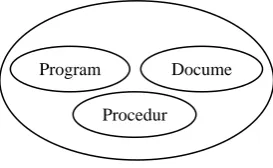
[image:1.595.369.506.404.488.2]The software engineering is systematic, disciplined and quantifiable approach for developing the software products with in the stipulated time, budget and with more quality. The software product is intangible which consists of programs and associated documentation. The subject embedded concept of Project Planning, Project Tracking, Formal Inspections, Configuration Management, Software Quality Assurance, and Risk Management etc. It has contributed a great deal in its short span of time.
Figure 1. Components of Software product
The software engineering is a layered technology which consists of process, methods and tools which are targeted with bedrock of quality focus. The process is important because industry cares about their intrinsic qualities, such as uniformity of performance across different projects. The software industry has been seriously looking for effective methods to improve the quality products to satisfy the customers. Tools provide additional support in process and methods development. The quality of the product depends on the used process, methods and tools.
The McCall, Richards and Walters [1] categorized the factors that effect the software quality in terms of three important aspects like software product operation, product revision and product transition.
This paper presents the significance of quality focus of the software layered technology using Analytic Hierarchy Process. The decision making process depends on multiple parameters and criteria. The parameters are like product operation, revision and product transition. The Section 2 describes the related work focusing on software metrics, measurements and decision making methods. The section
Program Docume
© 2015-19, IJARCS All Rights Reserved 1645
3 states the role of metrics in software engineering. The section 4 states various layers in Software Layered Technology. The Section 5 describes the Mathematical derivation of quality aspect significance using Analytic Hierarchy Process. Finally a discussion about future scope and conclusions is given in the Section 6.
II. RELATED WORK
The good number of theorists and researchers have worked on software engineering on the domain of quality metrics . The developed taxonomy can be useful to extend the knowledge in software engineering for discussion, setting up and evaluating the quality of software products. The various organization are benefited from quality improvement metrics. The appropriate software metrics at right time helps the organization to achieve their required and expected outcomes for the development of high quality products.
• The Department of Defense developed software framework in 1980, for achieving the quality in the context of Capability Maturity Model Integration.
• Mrinal Singh Rawat and Arpita Mittal [2] defined the software qualify on various perspectives of the user views. The paper extend the knowledge on software quality.
• Barbara Kitchenham [3] conducted survey on software metrics. The study assesses 103 papers published in between 2000 and 2005. He highlighted the need of empirical study on software metrics.
• Sadia Rehman and Siffat Ullah Khan [4] expressed that “ the software metrics and its role in global software development with systematic literature”.
• According to Tom Demcrio “ We need not control what we can’t measure”. The software quality models assist and control the software development process.
• Thomas L. Saatty [5], [6], [7], [8] described the principles and philosophy of the Multi criteria decision making approach [AHP] in more detail.
• Rawat and A. Mittal highlighted on views on software quality. The many software models, metrics have developed, utilized resulting with remarkable success [9].
• In 1999, The Ford motor Company used the AHP in finding the quality of the product. Ford gave the Award of Excellence to Expert Choice Inc .
• Nagel and Mills published book in 1990 on Multi criteria Methods for alternative dispute Resolution by applying the concepts of quantitative decision making in public administration.
III. THE ROLE OF METRICS IN SOFTWARE
ENGINEERING
Software quality plays the crucial role in the software development for successful product. The software industry have been anxiously targeted for effective ways to improve the product quality. The faulty software has significant cost to the suppliers and un satisfaction to the customers which fails to meet the goals. The software quality is difficult to define and specify, it depends on the viewpoint of the observer. The software quality emphasize on the various aspects of the following.
• The requirements are basis from which quality is measured. Lack of conformance to requirements leads to lack of quality.
• The set of standards, guidelines and criteria are defined for the software development. If the criteria is not followed, , lack of quality will be almost outcome result.
The Jim McCall produced the model for US Air Force identified with following three main perspectives for characterizing the quality attributes of software product of the following.
Figure 2. Mc Call Quality factors of the Product
Product Operation : The product operation relevant with operational characteristics like Correctness, Reliability, Usability, Integrity and Efficiency.
Product Revision : The product revision is ability to Change and test the product as per requirements. Example : Testability, Flexibility, Maintainability.
Product Transition : The product transition consists of adaptability features of the product to the new environments.
Software quality is being gauges by measuring its internal and external attributes which are subdivided into the other attributes such as interoperability, portability, and reusability etc.
© 2015-19, IJARCS All Rights Reserved 1646
helps the organizations to evaluate their products. The measurement is good practice for understanding, improving the software on quality perspective. The huge impact of measurement on the software engineering.
A metric is quantifiable measurement of software product, or project that directly observed and calculated. The Software metrics are intended to measure the quality and performance quantitatively, encountered during the planning and execution of software development. Many metrics and models have been developed, promoted and utilized resulting in remarkable success.
The successful execution of the control over software quality requires software metrics. The concepts of software metrics are coherent, understandable and well defined, and many metrics related to the product quality have been developed and used. As the complexity of the software increases more metrics have been proposed. This has lead to extensive research in this area of software metrics.
IV.THE SOFTWARE LAYERED TECHNOLOGY
The software engineering is layered technology. It encompasses a process, the management, technical methods, and use of tools to develop the software products. The objective of any software engineering approach is committed for quality factor.
The software layered technology as classified its activities based on importance as quality focus layer, process layer, methods layer and tools
.
Figure 3 : Software Layered Technology
Quality Focus layer : The quality focus is the bedrock of software engineering. The quality management is backbone of software layered technology. The various philosophies which are defined in Total Quality Management, Six Sigma, Statistical analytical processes are targeted software development towards improvement of quality focus.. The software product should fulfill the customer quality requirements (i.e efficiency, reliability, etc), developer quality requirements (maintainability, reusability, etc), users (usability, efficiency etc). The quality constraints are non functional requirements. The some of quality requirements are difficult to specify in an unambiguous way. The software product quality should meet its specification.
Process layer : The process layer is foundation of software engineering process defines a frame work for timely delivery of software. The key process areas form the basis for management control of software projects. The various tasks can be performed in this layer.
- Determining Deliverables - Establishing milestones - Software configuration / Change management.
- Software Quality Assurance
Methods Layer : Software engineering methods provide the technical knowledge (i.e how to’s” ) for building software. Methods comprises various array of tasks like Requirement Analysis, Design, program construction and deployment.
Tools layer: The software Engineering Tools provide automated or semi-automated support for the process and methods. The tools are used to bring automation in software development process.
Ex : CASE (Computer Aided Software Engineering & Rational Rose. etc.
When the tools are integrated so that information created on tool can be used by another, a system for the support of software development called the Computer aided software Engineering. The CASE tools may also include editors, database, test case generators and code generator which automatically generates the source for the system models.
Software Process Frame work
The process framework consists of process activities which are suitable for all software projects irrespective of its size and complexity. The software process which contains set of framework activities. The software process starts with framework of communication and progresses with planning, modeling, construction and concluded with deployment. The following umbrella activities have specific role in the software development.
Risk Management : Assesses and estimates risks that may affect the outcome of the project or the quality.
Software Quality Assurance : Verify the activities to ensure the software quality focus.
Software project tracking and control : Examine the project progress with plan, milestones and work schedules.
Formal Technical Review: Remove the errors in design and code generation before going to next phase.
Configuration management : Manages the effect of change in terms of process and technology throughout the S/W process.
Measurement : The measurement is activity to ensure the product which meets the customer needs.
Work products : Creates the work projects like models, documents, forms, lists etc.
V. ANALYTIC HIERARCHY PROCESS
METHODS
PROCESS TOOLS
© 2015-19, IJARCS All Rights Reserved 1647
The Analytic Hierarchy Process invented by the Saaty in 1980 and improved by Vargas in 2001. The AHP was used in multi-criteria decision making and management science by Anderson et al., in 2000. It is a powerful and flexible tool for decision-making in complex multi criteria problems. The solutions can be both objective and subjective. This tool is developed to solve the various issues and derive the solutions. The Decision making on the basis of several criteria and alternatives is very difficult process.
A. Structure of AHP method
Analytic hierarchy process is a expert mathematical model which divides the main problem into smaller and more detailed elements.
Decision by AHP method can be divided into three different levels
1. hierarchy 2. priorities 3. consistency
Designing a structured AHP hierarchy means developing a system consisting of a goal of decision making process.
Priorities
After sorting their own set of criteria and the establishment of a hierarchical structure at all levels of assessment, various alternatives or criteria that affect the assessment through verbal explanations and figures are compared. The result is given by the weight in proportion to the scale of alternatives and criterions.
Weight allocation
The correct and responsible determination of the individual sub-scales of assessment criteria is one of the key tasks in solving multi criteria problems. It is therefore necessary to know the solved issue well and know the importance and impact of the criteria used to evaluate the result achieved.
This method allows to gather knowledge about a particular problem., to quantify subjective opinions and to force of alternative in relation to established criteria.
1. Define the problem and the main objectives to make the decision.
2. Build a hierarchical structure as Figure 3, the root node is the objective of the problem, Intermediate level as criteria’s and lower levels contain the alternatives. The entire structure overviews the criteria and the alternatives.
3. Construct a set of pair wise comparison matrices. The element in an upper level is used to compare the elements in the level immediately below with respect to it. For each comparison matrix, find the Eigen value, consistency index CI, consistency ratio CR, and normalized values for each criteria / alternative.
4. Use the priorities obtained from pair wise matrix in global matrix. The scale for rating characteristics should be established and described in a precise way. Do this
every element. Then for each element in the level below add its weighted values and obtain its overall or global priority. Continue this process of weighting and adding until the final priorities of the alternatives in the bottom most is obtained. The final value is used to make a decision about the objective.
B. Mathematical derivatives Step 1:
=
n n n n n n na
a
a
a
a
a
a
a
a
a
a
a
A
, 2 1 , 3 32 31 , 2 22 21 , 1 12 11
Step 2: Find the nth root of product of each row.
Step 3: Derivation of Priority (pk ). The numbers are normalized (each row nth -root value) by dividing them with their sum.
Normalized Matrix
−
−
−
−
⋅
⋅
⋅
⋅
=
np
p
p
p
P
3 2 1n
nλ
λ
λ
λ
λ
=
1+
2+
3+
....
+
max Consistency Index
)
1
(
max−
−
=
n
n
C
Iλ
Consistency Ratio = RI is Random Index.
Step 4:
AHP formula for decision making:
Ai AHP = ij wj, for i = 1, 2 … M ---- (1)
C. Analytical Study
The analytical research conducted in “Vasundhara Software Solutions Limited, Hyderabad” based on pertinent data, which is collected through questionnaire approach from eminent analysts, Requirement Engineers, designers, coders, testers and other stakeholder of the product. The other pertinent data is collected from various software libraries
© 2015-19, IJARCS All Rights Reserved 1648
[image:5.595.33.281.132.294.2]evaluated in terms of decision criteria of remaining layers ie. Process, Methods, Tools of the software layered technology using AHP. The pair wise comparison matrix represent the corresponding judgment on scale of relative importance.
Table 1. Scale of Relative importance (As per Saaty ,1990)
Weight Definition Explanation
1 Equal importance Two activities in equal importance
3 Moderate importance One activity moderate over another
5 Strong importance One activity strong over another
7 Very strong importance
One activity very strong in practice over another
9 Extreme importance One activity Extreme over another.
2,4,6,8 Intermediate values between two activities
When compromise is needed.
Reciprocals of above non
Zero
If activity I has of above non nonzero numbers assigned to it when compared with activity j, then j has the
reciprocal value when compared with it
The next step in pair wise comparisons, the corresponding maximum left eigenvector is approximated by using geometric means of each row. An evaluation of the eigen value method can found in (Triantaphyllou and Mann, 1990) [10]. Initially the consistency index(CI) can be estimated. This is done by sum of columns in the judgment matrix and multiply the resulting vector by the vector of priorities (i.e approximated eigenvector) obtained earlier. This result the approximation of the maximum eigenvalue. denoted by
λmax. Then, the C.I value measured by using the formula as CI = ( λmax-n) / (n-1). Then after the consistency ratio CR derived with CI value divided by Random Consistency index (RCI) as the table given below.
Table 2. Random Consistency Index based on Matrix Size ( Satty,2000)
Matrix Size ( n ) Random Consistency Index
1 0
2 0
3 0.58
4 0.90
5 1.12
6 1.24
7 1.32
8 1.41
9 1.45
Evaluate the CR, if the CR value less than or equal acceptable (0.10) which indicate a good level of consistency for decision making otherwise inconsistency of judgments within the respective matrix and the process to be reviewed, reconsidered and improved. The acceptable consistency helps to ensure decision making with more reliability.
The weights of importance of the criteria are also determined by using by using pair wise comparisons. If the problem has M alternatives and N criteria, then the decision maker is required to construct N judgment matrices (each
criteria) of order M*M and one judgment matrix of order N*N ( for N criteria) . Finally, the decision matrix the final priorities denoted as Ai AHP .
Ai AHP = ij wj, for i = 1 , 2 … M ---- (1)
[image:5.595.324.542.192.284.2]The McCall’s Quality Factors i..e Product Revision (PR), Product Transition (PT), Product Operation(PO) significance can be evaluated on based of its process, methods and tools in the pair wise comparisons and AHP methodology
Figure 4. Hierarchical decomposition of criteria’s & Alternatives
In the figure 4, the Level 0 shows the overall goals of “ significance of quality attributes”. The next level, namely level 1 shows the criteria of various layers of software layered technology. Its next level namely level 2 is the highest level shows the quality factors as alternatives.
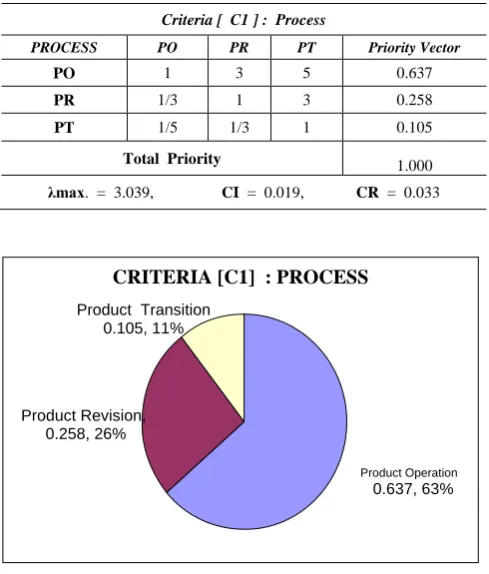
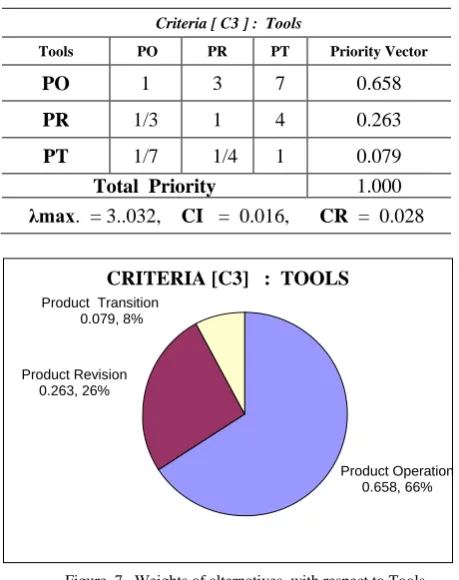
The weights of alternatives with respect to each of the criteria mentioned in the tables 3 to 5 and the its priority vectors represented in Pie graphs from figures 5 to 7.
The first table is shows the ranks of the three quality factors with respect to process is as follows.
Table 3. Weights of alternatives with respect to Process
Criteria [ C1 ] : Process
PROCESS PO PR PT Priority Vector
PO 1 3 5 0.637
PR 1/3 1 3 0.258
PT 1/5 1/3 1 0.105
Total Priority 1.000
λmax. = 3.039, CI = 0.019, CR = 0.033
Figure 5. Weights of alternatives with respect to Process
CRITERIA [C1] : PROCESS
Product Operation 0.637, 63% Product Revision,
0.258, 26%
Product Transition 0.105, 11%
GOAL
Process Methods Tools
[image:5.595.315.560.471.758.2] [image:5.595.36.279.479.623.2]© 2015-19, IJARCS All Rights Reserved 1649
[image:6.595.37.269.134.396.2]The next two matrices are respectively judgments of the relative merits of Product Operation(PO), Product Revision (PR), Product Transition(PT) with respect to methods and tools of software layered technology.
Table 4. Weights of alternatives with respect to Methods
Criteria [ C2 ] : Methods
Methods PO PR PT Priority Vector
PO 1 2 7 0.630
PR 1/2 1 2 0.262
PT 1/7 1/2 1 0.108
Total Priority 1.000
λmax. = 3..035, CI = 0.017, CR = 0.030
[image:6.595.316.554.227.361.2]
Figure 6. Weights of alternatives with respect to Methods
Table 5. Weights of alternatives with respect to Tools
Criteria [ C3 ] : Tools
Tools PO PR PT Priority Vector
PO 1 3 7 0.658
PR 1/3 1 4 0.263
PT 1/7 1/4 1 0.079
Total Priority 1.000 λmax. = 3..032, CI = 0.016, CR = 0.028
Figure 7. Weights of alternatives with respect to Tools
The final step describes the judgment matrix table.6 based on the criteria importance of the three layers Process(P), Methods(M), Tools(T) of software layered technology based
on small project (i.e Tools priority more than methods and process ) and represented in the pie graph figure.8 .
[image:6.595.35.265.428.718.2]Table 6. Weights of Criteria’s (Layers of Software Layered Technology ) TABLE 6. WEIGHTS OF CRITERIA’S ( LAYERS )
3- Criteria’s P M T Priority Vector
P 1 1/3 1/5 0.105
M 3 1 1/3 0.258
T 5 3 1 0..637
Total Priority 1.000 λmax. = 3..039, CI = 0..019, CR = 0.033
Figure 8. shows the weights of the process, methods and Tools layers
Figure 8. Weights of Criteria’s (Layers)
The previous priority vectors are used to form the entries of the decision matrix for this problem. The decision matrix resulted final priorities in the following table.7 (as per formula-1).
Table 7. Significance of the Quality Focus in Software Layered Technology
Quality Focus Process Methods Tools Quality Signific ance Criteria’s > (0.105) (0.258) (0.637)
Product
Operation 0.067 0.163 0.419 0.649
Product
Revision 0.027 0.068 0.167 0.262
Product
Transition 0.011 0..028 0.050 0.089
Total Priority 1.000
The significance of the quality focus of software layered technology in the small scale project shown in the figure. 9 with pie graphs based on performance of remaining layers.
CRITERIA [C2] : METHODS
Product Operation, 0.630, 63%
Product Revision, 0.262, 26%
Product Transition 0.108, 11%
CRITERIA [C3] : TOOLS
Product Operation 0.658, 66% Product Revision
0.263, 26% Product Transition
0.079, 8%
WEIGHTS OF LAYERS IN SOFTWAE LAYERED TECHNOLOGY
Process, 0.105, 11%
Methods 0.258, 26%
Tools, 0.637, 63%
SIGNIFICANCE OF QUALITY FOCUS IN SOFTWARE LAYERED TECHNOLOGY
Prod. Operation 0.649, 65% Prod.
Revision 0.262, 26%
[image:6.595.316.556.456.571.2] [image:6.595.315.559.618.766.2]© 2015-19, IJARCS All Rights Reserved 1650 Figure 9. Significance Quality Focus of Software Layered Technology
Therefore, the quality significance of the Product Operation is followed by Product Revision which is followed by Transition.
D. Observations
* Verification of McCall’s quality factors at various stages of software development life cycle with inter comparisons of AHP computations.
* The Validation of McCall’s quality factors is an inter comparison of Requirement Engineering with final significance of quality focus of AHP computations, if both matched the product satisfies the customer satisfaction. The failure ness of validation testing leads to failure ness of verification testing.
VI. CONCLUSIONSANDDISCUSSION
The AHP provides a convenient approach for solving complex Multi Criteria Decision Making problems in software engineering. The Expert Choice (1990) software , which significantly contributed to wide acceptance of AHP methodology. The extensive research analysis, the authors suggest that when some alternatives to be very close to other, then the decision maker needs to be very cautious. The MCDM method may never end, research in this area of decision making is still critical and vary valuable in many scientific and software engineering applications
VII.ACKNOWLEDGMENT
We sincerely acknowledge to all the faculty members of the Department of Computer Science & Engineering, Lingaya’s University, Faridabad and development team of Vasundara Software Solutions Pvt. Limited, Hyderabad for their motivation and support in the period of Analysis.
VIII.REFERENCES
[1] Practitioner’s Approach”, Mc Graw-Hill. 6th Edition, pp-54.
[2] Mrinal Singh Rawat and Arpita Mittal, “ Survey on Impact of Software Merics on Software Quality”, International Journal of Advanced Computer Science & Applications, Vol.3, No.1, 2012. .
[3] B. Kitchenham, “ What’s up with software Metrics ? - A Preliminary mapping study “, The Journal of Systems and Software, 37-51, 2010. .
[4] Sadia Rehman and Siffat Ullah Khan, “SWOT Analysis of Software Metrics for Global Software Development : A Systematic Literature Review Protocol”, IOSR Journal of Computer Engineering (IOSRJEC),ISSN: 2278-0661, Vol 2, Issue. 1-7, 2012. .
[5] Saaty, T.L, “The Analytic Hierarchy Process.”, Mc Graw-Hill International, New York, NY, 2000.
[6] Saaty, T.L, “ Multi criteria Decision making : The Analytic Hierarchy Process”, McGraw Hill, New York, 1980.
[7] Satty, T.L, “Scaling method for priorities in hierarchical structures”, Journal of Mathematical Psychology, pp. 234 – 281,1977.
[8] Saaty, T.L, “ How to Make a Decision : The Analytic Hierarchical Process”, European Journal of Operational Research, Vol 48, 1990, pp. 9 – 26.
[9] M.S. Rawat, A. Mittal , SLK. Debey, “ Survey Metrics : A Rigorous & Practical Approach”, 2nd Edition, PWS, 1998.