Volume 8, No. 4, May 2017 (Special Issue)
International Journal of Advanced Research in Computer Science RESEARCH PAPER
Available Online at www.ijarcs.info
Performance Analysis of Enhanced Fuzzy Association Rule Mining Algorithm with
Levenstein Distance Using Contact Lens Dataset!
Dhiraj Kapila Student PhD (C.S.E)
SBBS University Jalandhar, Punjab, India Email: [email protected]
Abstract— Association Rule Mining (ARM) with fuzzy logic perception smooth the progress of the easy process of mining of underlying frequent or recurrent patterns based on their own frequencies in the form of association rules from any transactional and relational datasets containing items to signify the most recent trends in the given dataset. These mined recurrent patterns or fuzzy association rules employ either for physical data analysis or also influenced to compel further mining tasks like categorization (classification) and collecting (clustering) which helps domain area experts to automate decision-making. In the concept of data mining, generally fuzzy Association Rule Mining (FARM) technique has been comprehensively adopted in transactional and relational datasets those datasets containing items who has a fewer to medium amount of attributes/dimensions. Few techniques have also adopted for high dimensional dataset also, but whether those techniques have also work for low dimensional datasets are yet to be proven out. Hence, in this paper we propose E-FAR-HD algorithm which is an enhanced version of FAR-HD algorithm that designed exclusively for large or high-dimensional datasets. We have designed this EFAR-HD algorithm that increases the accuracy of FAR-HD algorithm on the smaller datasets and remove the chances of misses when FAR-HD has tested on smaller datasets such as contact lens or patient dataset.
Index Terms—Fuzzy Association Rule Mining, Fuzzy Cluster- ing, Fuzzy Partitioning, Fuzzy Relations, Partitions, Tidlists, High Dimensions, Large Datasets, Smaller Datasets,
I. INTRODUCTION
Data mining is the technique to dig out the inherent information and knowledge from the collection of, incomplete, imperfect ,noisy, fuzzy, random and unsystematic data which is potentially functional and people do not know in advance about this hidden information [65]. The important difference between the traditional data analysis technique such as query reporting and the data mining and is that the data mining is very helpful to determine knowledge and also useful in mining information based on the premise of no clear hypothesis [66]. The most important use of data mining is in programmed data analysis technique to come across or to find out earlier unseen or undiscovered associations among various data items in the dataset.
Data mining is the complete analysis step of the "Knowledge Discovery in Databases" process, or KDD),[45] which is an inter-corrective subarea of computer science,[70][65][71] which is nothing but a computational activity consisting of discovering meaningful and hidden patterns and information in large datasets of items. The applications of data mining involving methods of
intersection of artificial intelligence, machine learning, statistics, and database systems. [70] The overall aim of the data mining procedure is to dig out meaningful and hidden information from a dataset containing items and then renovate it into a reasonable structure for future use. [70] Apart from data analysis step, it also involves the concepts of database and data management, data pre-processing. Various other activities like inference and complexity considerations, interestingness metrics, and post-processing of discovered structures are also the part of data mining process.
Association Rule Mining (ARM) is one of the most imperative research area in the concept of data mining that facilitate the mining of concealed recurrent patterns t h a t based on their own frequencies in the shape of association rules from any itemset or datasets containing entities to represent the most recent trends in the given dataset. These mined recurrent patterns or fuzzy association rules employ either for physical data analysis or also influenced to compel further mining tasks like categorization (associative classification [25], [26], [27]) and collecting (ARM- driven clustering, like document clustering [28], [29], [20], [31]) which helps domain area experts to automate decision-making solutions. Now a day’s FARM has achieve tremendous recognition because of its correctness or accurateness, which can be ascribed to its capability to mine large amounts of data from huge transactional and relational datasets. Now frequent patterns retain all the prevailing relationships between items and entities in the given dataset and pact only with the numerically noteworthy associations, classification or clustering. Association rules mining technique in widely used in various [40] areas such as telecommunication networks, stock market research and risk management, inventory control etc. The Apriori algorithm is used for frequent item set mining using association rules over the transactional databases. The apriori algorithm is proceeds by recognize the frequent individual items in the dataset and expanding them to larger and larger item sets as long as those item sets appear adequately often in the database.
have also work for low dimensional datasets are yet to be proven out.
II. FAR-HD ALGORITHM
FAR-HD algorithm has been proposed and developed by Ashish Mangalampalli and Vikram Pudi [36] which is able to mine fuzzy association rules from high dimensional datasets. As we know that the traditional ARM algorithms like apriori and FP-growth look forward for binary attributes and also these conventional ARM algorithms cannot be applied directly on those datasets and in those fields, in which there is huge amount of contribution of numerical attributes or also have data with very large amount of numerical dimensions like picture datasets have.
The image domain dataset engages the feature vectors with more than 60 dimensions which require the efficient and resourceful algorithm that can able to mine fine association rules from or to carry out the operations like associative classification from this image dataset quickly. So FAR-HD algorithm is one of the good options to use to mine fuzzy association rules from these high-dimensional itemset. This is an efficient algorithm which can bale to mine fuzzy association rules from very high-dimensional numerical datasets that contain more than 0.5 million vectors and each vector length consists of at least 60 dimensions and corresponding to the outline of fuzzy features.
FAR-HD algorithm [36] employs fuzzy C-means (FCM) clustering method to generate fuzzy clusters from the feature vectors of the specified dataset. Each feature vector will be fit in to each of the k clusters with a definite level of membership which helps in dropping the problem of polysemy and synonymy which usually takes place in crisp clustering.
The prominent features of FAR-HD are that the algorithm embodies a two phased processing method, and a Tidlist scheme for manipulating the frequency of itemsets and also employs a nonspecific Zlib compression algorithm to compress Tidlist while handing out them in order to save many more Tidlist in the same amount of memory that is allocated or available to store them. Furthermore for, itemset generation and processing, this FAR-HD works well in DFS like manner in order to pact with those high dimensional datasets who have generated association rules with many items and their normal rule length is very high.
Further in this paper [36], Ashish Mangalampalli and Vikram Pudi has mentioned about the fuzzy pre-processing strategy and fuzzy actions that are employed for the authentic FARM process. This preprocessing strategy executes in two steps. In this first step, there is a production of fuzzy clusters from the numerical vectors and during the second step there is a transformation of crisp dataset that contains numerical vectors into fuzzy datasets with the help of fuzzy-cluster-based representation. The objective of the algorithm in fuzzy pre-processing strategy is to minimize the following equation
………..Eq.(1)
Where m is any real number in the range such that 1 ≤ m < ∞, and is the degree of membership of in the cluster of j, is the dimensional measured data, is the
d-dimensional cluster center, and || * || is any norm stating the comparison between any measured data and the center. The variable 𝑚𝑚 is known as fuzziness parameter which is an arbitrary real number (𝑚𝑚 > 1). The quantity of fuzziness and Gaussian environment of fuzzy sets can be restricted via a suitable approximate value under the range of 1.1–1.5 of the fuzziness parameter 𝑚𝑚 (Eq. 1). Because of this reason, the consequent fuzzy separations of the dataset are produced where each assessment of numeric attributes are exclusively recognized by their membership functions (μ). Based upon the amount of fuzzy separations have described for an attribute, each and every accessible crisp data is changed to compound fuzzy data. This conversion may lead to the leeway of combinatorial outburst of production of fuzzy records. So the authors have placed a low threshold value which is equal to 0.1for the membership function μ to control this numerous production of fuzzy records. Throughout the FARM process, the novel crisp dataset is enlarged with element values within the range of (0, 1) because the huge amount of fuzzy separations are being done on every quantitative element. To execute this enlarged fuzzy dataset, a few procedures are required which are based on the term t-norms [43], [44], [45].Due to this t-norm, the new fuzzy dataset E is created upon which the designed algorithm will work. The FAR-HD algorithm makes use of two phases in a division strategy to produce fuzzy association rules. The fuzzy dataset E is sensibly separated into 𝑝𝑝 disjoint flat separations 𝑃𝑃1, 𝑃𝑃2
• 𝐸𝐸 = Fuzzy dataset based upon fuzzy-cluster-based representation produced after fuzzy pre-processing
,... Each separation is as big as it can fit in the accessible main memory. The authors have used the following notations,
• 𝑃𝑃 = Set of separations • 𝑆𝑆𝑝𝑝
• 𝑡𝑡𝑑𝑑[𝑖𝑖𝑡𝑡] = Tidlist of itemset 𝑖𝑖𝑡𝑡
= Set of singletons in existing separation 𝑝𝑝
• 𝜇𝜇𝑝𝑝
• 𝑐𝑐𝑜𝑜𝑢𝑢𝑛𝑛𝑡𝑡[𝑖𝑖𝑡𝑡] = collective 𝜇𝜇 of itemset 𝑖𝑖𝑡𝑡 over all separations p in which 𝑖𝑖𝑡𝑡 has been executed
= collective fuzzy membership or fuzzy support of any itemset in existing partition 𝑝𝑝
• 𝑑𝑑 = number of partitions for some exacting itemset
𝑖𝑖that have been executed since the separation in which it was added.
FAR-HD algorithm structure employs a byte-vector-like data representation in which each cell accumulates 𝜇𝜇 of the itemset equivalent to the cell indicator of the tid to which the
𝜇𝜇 pertains. Hence, the ith cell of the byte-vector includes the
who are seems not to be 𝑑𝑑-frequent are dropped out. The formation of Tidlist is carried out very soon as the new data set has been created. An itemset is said to be 𝑑𝑑-frequent if its incidence over 𝑑𝑑 partitions are equals to or surpasses the support accustomed for 𝑑𝑑 partitions, then the itemset is considered to be frequent over 𝑑𝑑partitions of the dataset E . Further the authors explained that the calculation of each and every singleton 𝑠𝑠 is preserved in the array data structure [𝑠𝑠]. To produce the bigger itemsets, they the use depth-first search (DFS) traversing approach, i.e. starts with a singleton
𝑠𝑠𝑖𝑖 and create all the supersets of 𝑠𝑠𝑖𝑖, prior to doing the similar for the subsequently singleton 𝑠𝑠𝑖𝑖+1. Primarily, every singleton 𝑠𝑠𝑖𝑖 is united with one more singleton 𝑠𝑠𝑗𝑗 to create supersets of 𝑠𝑠𝑖𝑖 in depth-first search manner. This progression is completed for each, sj where 𝑗𝑗 = 𝑖𝑖 + 1 to ∣𝑆𝑆𝑝𝑝
∣. During the second phase, all the itemsets that has been appended in the existing partition in the first phase are also have been specified over the entire dataset 𝐸𝐸, and hence may be removed. From these removed data itemsets, those itemsets containing singletons which are d-frequent over the entire dataset 𝐸𝐸 are the output. This output dataset E is further logically divided into p displace parallel partitions
𝑃𝑃1,P2,….,𝑃𝑃𝑃𝑃
III. EFAR-HD ALGORITHM
. Each and every displaced partition is as big enough as it can be easily consumed in the accessible main memory because there is also a compression algorithm used.
The EFAR-HD is enhanced version of FAR-HD algorithm. As we now the FAR-HD algorithm works well for high dimensional data but as the number of attributes and transactions in a database increases so there will be a more chances of misses in analysis and rules mining. Our EFAR-HD algorithm is designed to perform the research on the accuracy of the FAR-HD algorithm with smaller data sets such as patient or contact lens dataset to find out any chances of misses occurs during association rule mining, if the misses occur our algorithm will configure out and improve its performance. The algorithm is updated with fuzzy logic and we have also implemented levenstein distance algorithm to improve the performance of the algorithm
In the theory of computer science and knowledge, the term Levenshtein distance [72] is a criterion for computing the sum of differentiation between two strings. The term edit distance is frequently used to refer particularly to Levenshtein distance. The Levenshtein distance between two strings is defined as the lowest number of edits necessary to convert one string into the other with the acceptable edit operations such as insertion, deletion, or substitution of a single character is allowed. It is named after Vladimir Levenshtein, who considered this distance in 1965. In other words, Levenshtein distance (LD) is a measure of the resemblance between two strings, the source string (s) and the target string (t). Therefore according to Vladimir Levenshtein, the distance is the minimum number of deletions, insertions, or substitutions required to transform source string (s) and the target string (t). The higher is the Levenshtein distance, the more different the strings are. Mathematically the Levenshtein distance between two strings a, b is given by leva,b(|a|,|b|) such that
… ....Eq.(2)
For example, the Levenshtein distance between the two strings "kitten" and "sitting" is 3, here “kitten is the source string (s) and "sitting" is target string (t) “since the following three edits are required to transform string (s) and the target string (t), and there is no way to do it with fewer than three edits:
a. kitten → sitten (substitution of 's' for 'k') b. sitten → sittin (substitution of 'i' for 'e') c. sittin → sitting (insertion of 'g' at the end).
Below is the Levenstein distance algorithm pseudo code:
Step 1: Initialization
a. Set n to be the length of s, set m to be the length of t.
b. Construct a matrix containing 0……..m rows and 0………n columns.
c. Initialize the first row to 0………..n.
d. Initialize the first column to 0……….m. Step2: Processing
a. Examine s (i from 1 to n). b. Examine t (j from 1 to m). c. If s[i] equals t[j], then cost is 0. d. If s[i] doesn't equal t[j], then cost is 1.
e. Set cell d[i,j] of the matrix equal to the minimum of:
i. The cell immediately above plus 1: d[i-1,j] + 1. ii. The cell immediately to the left plus 1: d[i,j-1] + 1. iii. The cell diagonally above and to the left plus the
cost: d[i-1,j-1] + cost. Step 3: Result
Step 2 is repeated till the d[n,m] value is found
Levenstein Distance has [74] a large variety of applications such as spell checkers, correction systems for OCR and a software tool used to help out natural language transformation based on conversion memory. The Levenshtein distance can also be used as an aid in fuzzy string matching and searching in applications such as record linkage, the compared strings are typically short to facilitate improve speed of assessment.
long length string which can’t be used for rules pruning. After all singletons in the existing partition have been inspected, the Tidlists of singletons which are not common or whose levenstein distance is more than three are dropped.
Rules pruning are done in the second phase during this phase association rule mining using fuzzy has been done. The algorithm one by-one traverses each and every partition from the beginning and finds out the common and frequent candidate items over the whole dataset. The rules pruning are carried out on these common candidate items.
Pseudocode of EFARM algorithm [36] Phase - I:
• navigate every partition pt
• navigate every operation 0 ∈ existing partition p
∈ P do
t
• for every singleton s ∈ existing operation 0 d o do
• compute µ for every s • If Ld for si
• count[s]+=µ to s <1
• Else
• Swap syllables • If Ld sli to s<1 • counts[s]+=µ • end If end for end for
• navigate every singleton si where i=1 to |Sp • If s
| do
i is not d-frequent i.e ( common candidate item) then eradicate Tid[si
• end if
]
• end for
• navigate every singleton si where i=1 to |sp • navigate every singleton s
| do
j where j=1 to |sp • CreateNewtItemSet(s
| do
i,sj • end for end for end for
)
Pseudocode to create newitemset of commom candidate items
• CreateNewItemSet:
• Coalesce IT and sf to get new item IT • Tid[IT
new new]=Tid[IT] Tid[ITsf]
• Compute µp for ITnew using tid[ITnew • count[IT
]
new]+=µ
• If IT
p new
• Navigate every singleton s
is common candidate item or d-frequent then
k where k=f+1 to |sp • createNewItemSet(IT
| do
new,sk • end for end if
)
• Eliminate Tid[ITnew Phase 2
]
• navigate every partition pt • navigate every itemset IT∈ p
∈𝑃𝑃 do t
• if IT is recurrent in excess of the complete dataset
𝐸𝐸 then
in the first phase do
• output IT • end if • eliminate IT • end for
• for every enduring itemset IT do
• classify ingredient singletons 𝑠𝑠1, 𝑠𝑠2, . . . , 𝑠𝑠t of IT
such that 𝑖𝑖𝑡𝑡 =
• Tidlist is 𝑡𝑡i𝑑𝑑[IT] = interconnect Tidlists of each and every one essential singletons
• compute 𝜇𝜇 for IT using Ti𝑑𝑑[IT] • 𝑐𝑐𝑜𝑜𝑢𝑢𝑛𝑛𝑡𝑡[IT]+ = 𝜇𝜇
• end for
• if no itemsets stay behind to be count then exit • end if
• end for
EFAR-HD is designed to work in efficient manner, Just like the previous algorithm EFAR-HD uses the same function and logic during the phase 2 and it is unchanged during the implementation as this is the updated only during the phase 1 of the previous algorithm developed by Ashish Mangalampalli and Vikram Pudi. Further in during phase 2 the algorithm computed for each residual itemset IT, discover its essential singletons 𝑠𝑠1, 𝑠𝑠2
, 𝑠𝑠t
3. EXPERIMENTAL SETUP AND
ANA LY S I S
and then attain the Tidlist of IT(Ti𝑑𝑑[IT]) by interconnecting the Tidlists of all the ingredient singletons. Furthermore, the count up of every singleton IT is restructured in 𝑐𝑐[IT]. Hence, got exchange among outputting and deleting itemsets and generating Tidlists for itemsets in anticipation of no supplementary itemsets are left behind.
In this section, we explain the experimental setup and analysis used for comparing EFAR-HD with two other Fuzzy ARM algorithms Fuzzy Apriori and FAR-HD - the first is the algorithm described in [9] and [10] and the second one being a . We have re-implement the FARHD and Fuzzy Apriori in the java and further the algorithm FAR-HD is enhanced by adding the levenstein distance in the coding to check the degree of similarity or to compute the distance between two strings. Further we have introduced the concept of phonetics in the EFAR-HD which replaces the character “ee” with the “i” if required. The execution of the algorithm is carried on the eclipse kepler and connect it with the weka tool to find the associations between different items. The weka tool provides the interface to connect the dataset with the EFAR-HD algorithm.
EXPERIMENTAL RESULTS
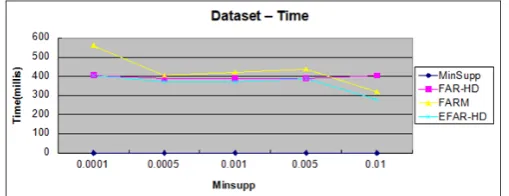
Fig 1. Minsupp Support from 0.0001 to 0.1
Fig 2. Minsupp Support from 0.1 to 0.4
[image:5.595.34.289.55.153.2]Fig 3. Rules generated by EFARHD in Milisec
Fig 4. Rules generated by FAR-HD in milisec
Fig 5. Rules generated by FARM in milisec
The routine metrics in the experimentation are overall execution time and utmost memory used. As in many of the ARM investigational evaluation, overall implementation time is the key performance metric. The highest memory used includes only the memory engaged by the Tidlists and count up of itemsets and also contains the itemsets themselves which supplies the performance metric only for the assessment of EFAR-HD, FAR-HD and FARM. The experiments were performed on a computer with WINDOWS 7 , Intel corei5 processor and 4 GB DDR2 RAM. Figures 3, 4 and 5 demonstrate the outcome acquired by running EFAR-HD, FARM, and FAR-HD is that the EFAR-HD generate rules faster than FARM, and FAR-HD for minimum support values ranging from 0.0001– 0.4.
Figure 1 and 2 shoes the graphical outcome of EFAR-HD, FAR-HD and FARM algorithms which shows that as we increases the Minsupport EFAR-HD generates rules in less time as compared to FARM, and FAR-HD algorithm. The one key point in the output of EFAR-HD algorithm is that the same rules with different option like ‘YES’ or ‘NO’ is merged in the single rule which is not produced in the output of , FAR-HD and FARM algorithm From the results it is clear that EFAR-HD slightly improves the FAR- HD algorithm in terms of rules pruning on the smaller datasets used and o n FAR-Miner, the EFAR-HD gives more accuracy on the large high-dimensional dataset (Consolidated dataset).
As we already know that the FAR-HD algorithm developed by Ashish Mangalampalli and Vikram Pudi possesses the byte-vector demonstration of Tidlists also contains the depth first like itemset creation strategy saved in RAM in compacted form using zlib compression algorithm yields high performance. This feature is also implemented in EFAR-HD to get FAR-HD like performance.
IV. CONCLUSIONS
[image:5.595.33.289.192.298.2]time on the basis of a performance metric and parameters such that minsupport. As future work, we intend to use EFAR-HD with Jaro Winkler algorithm and check its accuracy on the similar parameters built.
REFERENCES
[1] X. Yin and J. Han, “CPAR: Classification based on predictive association rules,” in SDM, 2003.
[2] F. A. Thabtah, “A review of associative classification mining,” Knowledge Eng. Review, vol. 22, no. 1, pp. 37–65,
[3] Veloso, W. M. Jr., and M. J. Zaki, “Lazy associative
classification,” in ICDM, 2006, pp. 645–654.
[4] L.Zhuang and H. Dai, “A maximal frequent itemset approach for web document clustering,” in CIT, 2004, pp. 970–977. [5] H. Yu, D. Searsmith, X. Li, and J. Han, “Scalable construction
of topic directory with nonparametric closed termset mining,” in ICDM, 2004, pp. 563–566.
[6] B. C. M. Fung, K. Wang, and M. Ester, “Hierarchical
document clustering using frequent itemsets,” in SDM, 2003.
[7] H. H. Malik and J. R. Kender, “High quality, efficient
hierarchical document clustering using closed interesting itemsets,” in ICDM, 2006, pp. 991–996.
[8] Pudi and J. R. Haritsa, “ARMOR: Association rule mining
based on ORacle,” in FIMI, 2003.
[9] Mangalampalli and V. Pudi, “FAR-miner: a fast and efficient algorithm for fuzzy association rule mining,” IJBIDM, vol. 7, no. 4, pp. 288–317, 2012.
[10]Mangalampalli and V. Pudi, “Fuzzy association rule mining algorithm for fast and efficient performance on very large datasets,” in FUZZ-IEEE, 2009, pp. 1163–1168.
[11]R. Agrawal, T. Imielinski, and A. N. Swami, “Mining
association rules between sets of items in large databases,” in SIGMOD Conference, 1993, pp. 207–216.
[12]R. Agrawal and R. Srikant, “Fast algorithms for mining
association rules in large databases,” in VLDB, 1994, pp. 487– 499.
[13]J. Han, J. Pei, and Y. Yin, “Mining frequent patterns without candidate generation,” in SIGMOD Conference, 2000, pp. 1– 12.
[14]P. Yan, G. Chen, C. Cornelis, M. D. Cock, and E. E. Kerre, “Mining positive and negative fuzzy association rules,” in KES, 2004, pp. 270–276.
[15]M. D. Cock, C. Cornelis, and E. E. Kerre, “Elicitation of fuzzy association rules from positive and negative examples,” Fuzzy Sets and Systems, vol. 149, no. 1, pp. 73–85, 2005.
[16]H. Verlinde, M. D. Cock, and R. Boute, “Fuzzy versus
quantitative association rules: A fair data-driven comparison,” IEEE Transactions on Systems, Man, and Cybernetics - Part B: Cybernetics, vol. 36, no. 3, pp. 679–683, 2005.
[17]E. H¨ullermeier and Y. Yi, “In defense of fuzzy association analysis,” IEEE Transactions on Systems, Man, and Cybernetics, Part B, vol. 37, no. 4, pp. 1039–1043, 2007.
[18]M. D. Cock, C. Cornelis, and E. E. Kerre, “Fuzzy association rules: A two-sided approach,” in FIP, 2003, p. 385390.
[19]D. Dubois, E. H¨ullermeier, and H. Prade, “A systematic
approach to the assessment of fuzzy association rules,” Data Min. Knowl. Discov., vol. 13, no. 2, pp. 167–192, 2006.
[20]D. Dubois, E. H¨ullermeier, and H. Prade, “A note on quality measures for fuzzy association rules,” in IFSA, 2003, pp. 346– 353.
[21]M. Delgado, N. Marn, D. S´anchez, and M. A. V. Miranda, “Fuzzy association rules: General model and applications,” IEEE Transactions on Fuzzy Systems, vol. 11, pp. 214–225,
2003.
[22]J. C. Dunn, “A fuzzy relative of the isodata process and its use in detecting compact well-separated clusters,” Journal of Cybernetics, vol. 3, pp. 32–57, 1973.
[23]J. C. Bezdek, Pattern Recognition with Fuzzy Objective
Function Algorithms. Norwell, MA, USA: Kluwer Academic Publishers, 1981.
[24]H. Bay, A. Ess, T. Tuytelaars, and L. J. V. Gool, “Speeded-up robust features (SURF),” Computer Vision and Image Understanding, vol. 110, no. 3, pp. 346–359, 2008
[25]Fayyad, Usama; Piatetsky-Shapiro, Gregory; Smyth,
Padhraic: The KDD Process for Extracting Useful Knowledge from Volumes of Data. Communications of the ACM, Volume 39, Issue 11, Page(s): 27 – 34, 1996.
[26] http://www.umsl.edu/~joshik/msis480/chapt11.htm
[27]J. Han and M. Kamber, Data Mining: Concepts and
Techniques: The Morgan Kaufmann Series, 2001.
[28][Hipp, Jochen; Guentzer, Ulrich; Nakhaeizadeh, Gholamreza: Algorithms for Association Rule Mining - A General Survey and Comparison. ACM SIGKDD Explorations Newsletter, Volume 2, Issue 1, 2000.
[29]Agrawal, Rakesh; Imielinski, Tomasz; Swami, Arun: Mining Association Rules between Sets of Items in Large Databases. Proceedings of the 1993 ACM SIGMOD International Conference on Management of Data, 1993.
[30]R. Agrawal and R. Srikant, "Fast Algorithms for Mining Association Rules in Large Databases", Proc. of the 20th International Conference on Very Large Data Bases, VLDB, Page(s): 487-499, 1994.
[31]Han, J, Pei, J, Yin, Y: Mining Frequent Patterns without Candidate Generation. In: SIGMOD Conference, ACM Press, Page(s): 1-12, 2000.
[32]Türks¸en, I.B. and Tian Y. 1993. Combination of rules and their consequences in fuzzy expert systems, Fuzzy Sets and Systems, No. 58,3-40, 1993.
[33]http://www.cs.cmu.edu/Groups/AI/html/faqs/ai/fuzzy/part1/fa q-doc-4.html
[34]L.A.Zadeh.Outline of a new approach to the analysis of complex systems and decision processes. IEEE Transactions on System, Man, and Cybernetics, Volume 3, Pages(s):28-44, January, 1973.
[35]Wai-HO AU, Keith C.C. Chan: An Effective Algorithm for Discovering Fuzzy Rules in Relational Databases, Fuzzy Systems Proceedings, IEEE World Congress on Computational Intelligence. Volume 2.ISSN: 1098-7584, Print ISBN: 0-7803-4863-X, Page(s):1314 – 1319, 1998.
[36]Ashish Mangalampalli, Vikram Pudi: FAR-HD: A Fast And
Efficient Algorithm For Mining Fuzzy Association Rules In Large High-Dimensional Datasetss. FUZZ-IEEE 2013,.
[37]Zadeh, L. A.: Fuzzy sets. Inf. Control, 8, Page(s): 338–358, 1965.
[40]Pudi, V., Haritsa, J.: ARMOR: Association Rule Mining based on Oracle. CEUR Workshop Proceedings, 90, 2003.
[41]Savasere, A., Omiecinski, E., Navathe, S.B.: An Efficient Algorithm for Mining Association Rules in Large Databases. In: VLDB, Morgan Kaufmann, Page(s): 432-444, 1995.
[42]Dunn, J. C.: A Fuzzy Relative of the ISODATA Process and its Use in Detecting Compact Well Separated Clusters. J. Cybernetics and Systems,Volume 3,Page(s):32-57, 1974.
[43]Bezdek, J. C.: Pattern Recognition with Fuzzy Objective Function Algorithms. Kluwer Academic Publishers, Norwell, MA, 1981.
[44]Hoppner, F., Klawonn, F., Kruse, R, Runkler, T.: Fuzzy
Cluster Analysis, Methods for Classification, Data Analysis and Image Recognition. Wiley, New York, 1999.
[45]De Cock, M., Cornelis, C., Kerre, E.E.: Fuzzy Association Rules: A Two-Sided Approach. In: FIP, Page(s): 385-390, 2003.
[46]Yan, P., Chen, G., Cornelis, C., De Cock, M., Kerre, E.E.: Mining Positive and Negative Fuzzy Association Rules. In: KES, Springer, Page(s): 270-276, 2004.
[47]Verlinde, H., De Cock, M., Boute, R.: Fuzzy Versus
Quantitative Association Rules: A Fair Data-Driven Comparison. IEEE Transactions on Systems, Man, and Cybernetics - Part B: Cybernetics, Volume 36, Page(s): 679-683, 2006.
[48]Ehsan Vejdani Mahmoudi, Vahid Aghighi, Masood Niazi
Torshiz, Mehrdad Jalali, Mahdi Yaghoobi: Mining generalized fuzzy association rules via determining minimum supports ,IEEE Iranian Conference on Electrical Engineering (ICEE)2011, E-ISBN :978-964-463-428-4 ,Print
ISBN:978-1-4577-0730-8,Page(s):1 – 6, 2011.
[49]J. Han, et al., "Mining top-k frequent closed patterns without minimum support, " In Proceedings of the 2002 IEEE international conference on data mining, Page(s): 211- 218, 2002.
[50]J. Han and Y. Fu, "Discovery of multiple-level association rules from large databases," in the international conference on very large databases, Zurich, Switzerland, Page(s): 420- 431, 1995.
[51]T. P. Hong, et al., "An ACS-based framework for fuzzy data mining," Expert Systems with Applications, Volume 36, Page(s): 11844-11852, Nov, 2009.
[52]T. P. Hong, et al., "Mining fuzzy multiple-level association rules from quantitative data," Applied Intelligence, Volume 18
[53], Page(s): 79-90, Jan-Feb, 2003.
[54]Y. C. Lee, et al., "Multi-level fuzzy mining with multiple minimum supports," Expert Systems with Applications, Volume 34,Page(s): 459-468, Jan, 2008.
[55]Toshihiko Watanabe: Fuzzy Association Rules Mining
Algorithm Based on Output Specification and Redundancy of Rules, IEEE International Conference on Systems, Man, and Cybernetics (SMC) 2011, ISSN: 1062-922X, Print ISBN: 978-1-4577-0652-3, Page(s):283 – 289, 2011.
[56]Y. C. Lee, T. P. Hong, and T. C. Wang, “Mining Fuzzy
Multiple-level Association Rules under Multiple Minimum Supports,” Proc. of the 2006 IEEE International Conference on Systems, Man, and Cybernetics, Page(s): 4112-4117, 2006.
[57]T. Watanabe: “An Improvement of Fuzzy Association Rules Mining Algorithm Based on Redundancy of Rules,” Proc. of the 2nd International Symposium on Aware Computing, Page(s): 68-73, 2010.
[58]M. Delgado, N. Marin, M. J. Martin-Bautista, D. Sanchez, and M.-A.Vila, “Mining Fuzzy Association Rules: An Overview,” Studies in Fuzziness and Soft Computing, Springer, Volume 164/2005, Page(s): 351-373, 2006.
[59]M. Delgado, N. Marin, D. Sanchez, and M.-A. Vila, “Fuzzy Association Rules: General Model and Applications,” IEEE Trans. on Fuzzy Systems, Volume 11, No.2, Page(s): 214-225, 2003.
[60]Y. Xu, Y. Li, and G. Shaw, “Concise Representations for Approximate Association Rules,” Proc. of the 2008 IEEE International Conference on Systems, Man, and Cybernetics, Page(s): 94-101, 2008.
[61]UCI Machine Learning Repository:
http://www.ics.uci.edu/~mlearn/MLRepository.html
[62]Toshihiko WATANABE, Ryosuke Fujioka: Fuzzy
Association Rules Mining Algorithm Based on Equivalence Redundancy of Items, IEEE International Conference on Systems, Man, and Cybernetics (SMC), 2012, E-ISBN: 978-1-4673-1712-2, Print ISBN: 978-1-4673-1713-9, Page(s):1960 – 1965, 2012.
[63]Frawley, William J.; Piatetsky-Shapiro, Gregory; Matheus, Christopher J.: Knowledge Discovery in Databases: an Overview. AAAI/MIT Press, 1992.
[64]Delgado, Miguel: Fuzzy Association Rules: an Overview.
BISC Conference, 2003.
[65]Pawlak. Z. Rough Sets International Journal of Computer and Information Sciences, Page(s):341-356, 1982.
[66]Agrawal, R., Imielinski, T., and Swami, A. N. 1993. Mining association rules between sets of items in large databases. In Proceedings of the 1993 ACM SIGMOD International Conference on Management of Data, 207-216.
[67]Fayyad, Usama; Piatetsky-Shapiro, Gregory; Smyth, Padhraic (1996). "From Data Mining to Knowledge Discovery in Databases". Retrieved 17 December 2008.
[68]"Data Mining Curriculum". ACM SIGKDD. 2006-04-30. Retrieved 2011-10-28.
[69]Clifton, Christopher (2010). "Encyclopædia Britannica: Definition of Data Mining". Retrieved 2010-12-09.
[70]Hastie, Trevor; Tibshirani, Robert; Friedman, Jerome (2009). "The Elements of Statistical Learning: Data Mining, Inference, and Prediction". Retrieved 2012-08-07.
[71]Shilpa N. Ingoley, J.W. Bakal,”Evaluating Students’
[72]Ming-Syan Chen, Jiawei Han, Philip S yu. Data Mining: An Overview from a Database Perspective[J]. IEEE Transactions on Knowledge and Data Engineering, l996,
[73]R Agrawal ,T 1 mielinski, A Swami. Database Mining: A
Performance Perspective[J]· IEEE Transactions on Knowledge and Data Engineering, 1993,12:914-925.
[74]Y. Peng, G. Kou, Y. Shi, Z. Chen (2008). "A Descriptive Framework for the Field of Data Mining and Knowledge Discovery" International Journal of Information Technology and Decision Making, Volume 7, Issue 4 7: 639 – 682. doi:10.1142/S0219622008003204.
[75]S Schimke, C Vielhauer, J Dittmann. Using Adapted
Levenshtein Distance for On-Line Signature Authentication. Proceedings of the Pattern Recognition, 17th International Conference on (ICPR'04), 2004.
[76]S Schimke, C Vielhauer. Similarity searching for on-line handwritten documents. - Journal on Multimodal User Interfaces, 2007 –