DOI:
AN
Abstr and e bandw some The d can e order demo word Thus depen and i frame a sus Keyw Th [1] h caus autom spam peop ques abou web, decis revie prod influ orga H decis the r Posit and/o The repu purp reade Th mod dece detec seek : http://dx.doi.N AUTOM
ract— With the education. Neve width. The maj ething that the s
detection of the easily overload r to detect the onstrated the re ds for every rev s the demand o nding on the ke improve the det ework for revie tainable model
words: Spam De
he notable rev has demonstra ed by those ty matic framew m information
ple use web fo stions, to find ut not so know
, to know op sion on purch ews about pro duct and vic uence decis anizations.
However, the sion making h reason behind tive opinions or fame for b negative opin utations.Decep
posefully writ ers.
he task of de delled as binary
eptive and tru cting deceptiv k for duplicat
.org/10.26483/
Interna
MATIC F
EN
Yenuga Research Krishna U Machilipatname growth in the ertheless, with jor challenge to sender uses for e spam reviews the review com spam message ejection of the d view writer may of the modern eywords. This w
tection by depl ew spam detect
.
etection, Opinio
I. INTROD
view carried o ated the types ypes. This rev work for opini n specially the or everything, solutions of u wn products or pinions of oth ase of a new p oducts general
ce-versa. Th ion making
significant has also encou
the increasing can result in business, orga nions on some ptive opinions/
tten to sound
eceptive opini y classificatio uthful. Many ve opinions w te reviews. T
/ijarcs.v9i1.547
Volu
ational Jou
Av
FRAMEW
NHANCED
a PadmaScholar in CS University,
m (A.P).,India
e communicatio the increasing o keep the band r promotion and s cannot be don mmunication ch es by deploying
documents base y vary. As a re research is to work proposes loying context d
ion with review
on Detection, S
UCTION
out by Yenuga s of the spam view lays the d on mining an e reviews. In m
they use web unsolved probl r services etc. hers before fi product or serv
ly results in a his reveals t g of indiv
influence of uraged spamm g number of o n significant f
anizations an e entities can /fictitious revi
d authentic a
ion spam det on problem wi of the previo were based on The notable w
73
ume 9, No.
urnal of Ad
RESE
vailable On
WORK FO
D CONTE
SE, aon systems, opi popularity the dwidth up to the d for the receiv ne at the review hannel and redu
g the filters. T ed on the pre-d esult influenced enhance the d a novel automa detection metho w rejection filte
pam Filtration,
a Padma et al m and barriers
demand for an nd detection of modern times
to solve their lems, to know
They also use inalizing their vice. Positive a purchase of a that opinions viduals and
f opinions in mer and is also opinion spams financial gains d individuals damage their iews are and victimize
ection can be ith two classes ous studies on n methods that work by Nitin
1, January
dvanced Re
EARCH PA
nline at ww
OR DOC
EXT FEA
inions became t challenge for a e usage is deali ved may be use w server end and
ce the effective he outcomes a defined keywor d by certain ke detection of the ated framework ods. The major ers. The work o
Machine Learn . s n f , r w e r a s d n o s. s . r e e s, n t n
y-February
esearch in C
APER
ww.ijarcs.in
UMENT
ATURE M
Research Sch
the most used c all internet serv ing with the spa eless. Thus for t d need to done e use of the ban are partially sat rds. Nonetheles eywords, the rec
e spam reviews k powered by m r outcome of th outcomes into a
ning, Feature D
Jindal et al. [ deploying ad and informati also used me reviewer or t the actual co et al. [3] ha detection me parallel resea and proxy ser
Neverthele access to a evaluations w demonstrated [5]. Thus the automatic fra
The rest o from the para the proposed the algorithm framework fu comparative framework pa the Section – is furnished i final conclusi II. OUTCO Text cont methods are
y 2018
Computer
nfo
SPAM D
MATCHI
holar of CSE
Dr.Y.K.Su
Professo Krishna Machilipat
communication vice providers i am messages. A the receiver the at the receiver ndwidth. A num tisfactory as m s, these method ceiver may los s by using enh machine learnin his work is to b highly satisfac
Detection
[2] has demon daptive proces
ion on the we eta-informatio the average ra ntent of the r as demonstrat ethod. These archers as und
rvers, this met
ess, studies p any standard were based o d by MyleOtt e demand of th amework for s
f the work is allel researche frame work i m responsibl unction is illu analysis base arameters and – V, the result in the Section ion from this w
OMEOFTH tent, behavio used by ma
Science
ISSN N
DETECTI
NG
undara Krish
or,Dept of CSE a University,
tnam (A.P),In
n method in the is to keep matc A spam commu e messages are r side. Failing i mber of research most of the para
ds are not satis e some import hanced techniqu ng technique to build and demon ctory detection r
nstrated signif ss for detectio eb. Some othe on such as the ating of the p review. The w
tes a similar works are hi der the light thods are boun
prior to this d dataset an
on some ad-h et al. [4] and C he modern rese spam or fake r
furnished suc es are realized is elaborated i le for makin ustrated in the ed on the para d time comple
ts obtained fr n – VI and the work in Sectio
HEPARALLE oural analysis any researche
No. 0976-56
ION USIN
hna E, ndiae corporates, res ching the deman unication or rev
mostly unimpo n detecting the hers are carried allel researches sfactory as the u
ant communica ues rather than detect the keyw nstrate an autom rate and demon
ficant outcom n of spam rev er researchers e IP address o roduct, rather work by Sihon approach fo ighly criticise of the IP ma nd to fail.
were not ha d therefore hoc procedur
Claire Cardie earch is to bui review detectio
ch as the outc d in the Section
n the Section ng the autom e Section – IV
allel researche xity is disclos rom the frame e work present
on – VII.
ELRESEARC s and super ers to addres
697
NG
search nd for view is ortant. spam out in s have use of ations. n only words mated nstrate mes by views have of the r than ngXie or the ed by sking aving their es as et al. ild an on. comes n – II,problem opinion spam detection. Jindal and Liu had first attempted the study of spam detection and had given two methods for spam detection based on duplicate detection and spam classification [6]. Jindal and Liu, in another study, identified opinion spam by detecting exact text duplicates in an Amazon.com dataset.
The parallel research methods listed out three types of duplicate positive reviews that were used as a spam [2]:
A. Duplicates from different user id on the same product
B. Duplicates from the same user id on different products and
C. Duplicates from different user id on different products.
MyleOtt et al. [4] proposed n-gram text categorization techniques to detect negative deceptive opinion spam with performance far surpassing that of human judges. Similar techniques for detecting positive deceptive opinion spam are proposed by Claire Cardie et al. [5].
Some studies that tried to trick better features to improve classifier performance used sentiment scores, product brand, and reviewer’s profile attributes to train classifiers as demonstrated by Huang et al. [7]. Score computation based on behavioural heuristics, such as rating deviation as proposed by Nguyen et al. [8]. The study reported by Mukherjee et al. [9] focused on finding fraudulent reviewer groups by using frequent item set mining. Different stylistic, syntactical and lexical features describing opinions were identified [10]. They used support vector machine to learn a classifier based on these features of the opinions.
III.PROPOSEDFRAMEWORK
The proposed framework is an automatic detector of fake or spam reviews on the popular web sites or the product pages. The component based framework is elaborated in this section [Figure -1].
Fig. Error! No sequence specified. Proposed Novel Framework
A. Page Layout
The first component is the web crawler in this framework. The web crawler is responsible for crawling all the web links and detects the web links which readable. After listing the web links, the crawler algorithm finds the number of reviews per page. Then for all reviews the corpus is made read for analysis.
B. Page Data Pre-Processor
After the Web Crawler returns all corpus, the pre-processor component filters the unstructured data and fits into the structure which is predefined by this framework. The defined structure is listed here [Table – 1].
TABLEERROR!NO SEQUENCE SPECIFIED.REVIEWDATA
STRUCTUREFORANALYSIS
Parameter Name Parameter Description
TimeStamp The date and time for the review posted
Author The screen name for the author Review Text The extracted text from the review Positive Word List Set of Positive Words Extracted Negative Word
List
Set of negative Words Extracted
Ratings The numeric value for the product given.
C. Text Extractor
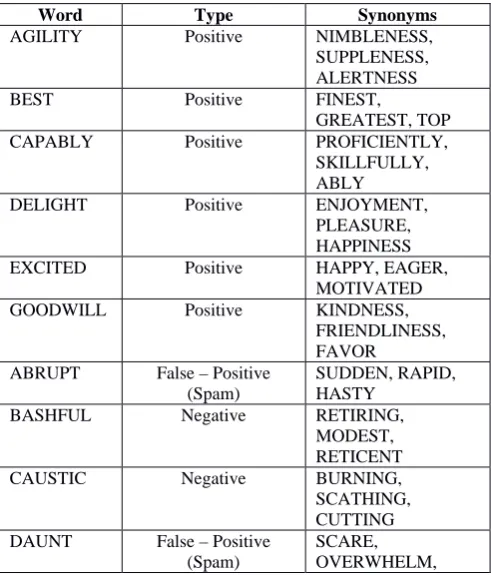
The Text Extractor fills in the data parameters for the Positive Word List and the Negative word list based on the associated English linguistics. The linguistics defines a set of positive and negative words along with the associated synonyms. The used collection is fabricated here with simplicity [Table – 2].
TABLE2EXTRACTORCOLLECTION–SAMPLE
Word Type Synonyms
AGILITY Positive NIMBLENESS,
SUPPLENESS, ALERTNESS
BEST Positive FINEST,
GREATEST, TOP
CAPABLY Positive PROFICIENTLY,
SKILLFULLY, ABLY
DELIGHT Positive ENJOYMENT,
PLEASURE, HAPPINESS
EXCITED Positive HAPPY, EAGER,
MOTIVATED
GOODWILL Positive KINDNESS,
FRIENDLINESS, FAVOR
ABRUPT False – Positive (Spam)
SUDDEN, RAPID, HASTY
BASHFUL Negative RETIRING,
MODEST, RETICENT
CAUSTIC Negative BURNING,
SCATHING, CUTTING DAUNT False – Positive
(Spam)
[image:2.595.319.565.493.781.2] [image:2.595.48.292.551.736.2]FRIGHTEN EXHAUSTS False – Negative
(Spam)
DRAINS, EXPENDS, DISSIPATES
D. Sentiment Extractor
[image:3.595.321.564.54.350.2] [image:3.595.342.555.387.758.2]The novelty of the framework is deployed majorly by this component. The extraction of the sentiment cannot be done only using the keywords. The sentiments are to be identified using the context of the sentence or the used key word. Based on the static information available in the linguist information set, the sentiment extractor highlights the reviews which are under the category of the false – positive or false – negative. These opinions are to be considered as spam as they give anomalous reviews. The sample extracted from the framework is fabricated here [Table – 3].
TABLE3ANOMALOUSREVIEWDETECTION–SAMPLE
Word Identified As Spam
HASTY False – Positive Yes
OVERWHELM False – Positive Yes
EXPENDS False – Negative Yes
E. Opinion Extractor
The success of any model depends on the reduction of false identification and the false identifications can be reduced by using the validation models. The framework deploys a component as Opinion Extractor to match the opinion and the results of the Sentiment Extractor phase. If the extracted opinion is bad and the sentiment extractor result shows the review as positive, then the review should be marked as spam. This component is responsible for the validation.
F. Keyword Base
This is a static component in the framework consisting of widely accepted spam keywords. The keyword base identifies the results from the previous phase and justifies the results based on the type of keyword used.
G. Fake Review Extractor
The final resulting component in this framework is the Fake Review Extractor. This component based on the results from sentiment Extractor, Opinion Extractor and the Keyword Base defines the final results into the system.
H. UI Presenter
The UI Presenter is the presentation level component of this framework to demonstrate the final results to the end use.
IV.PROPOSEDALGORITHM
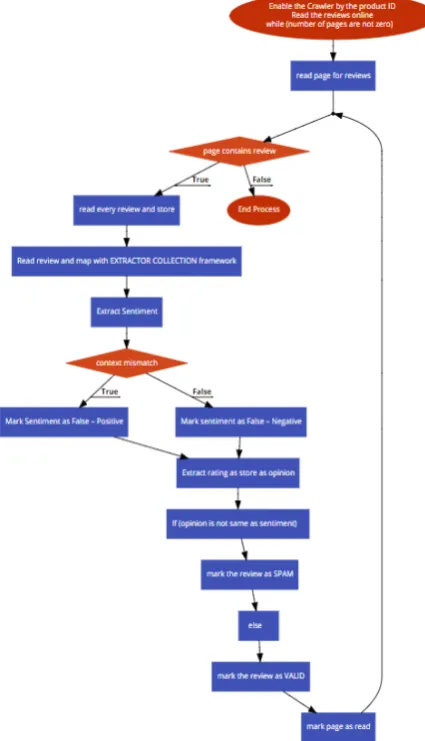
This section of the work elaborates about the algorithm that automates the framework.
Enable the Crawler by the product ID Read the reviews online
while (number of pages are not zero) { read page for reviews;
while(page contains review) {
read every review and store;
Read review and map with EXTRACTOR COLLECTION framework;
Extract Sentiment;
if (context mismatch) {
Mark Sentiment as False
– Positive;
} else {
Mark sentiment as False
– Negative;
}
Extract rating as store as opinion; If (opinion is not same as sentiment) {
mark the review as
SPAM;
} else {
mark the review as VALID; }
mark page as read;
}
} End Process;
The algorithm is analysed visually [Figure – 2].
V. COMPARATIVEANALYSIS
In this section of the work the comparative analysis is carried out. The comparative analysis is based on two major factors as number of attributes used in the framework and the time complexity.
Framework Comparison
Firstly, the comparison on the frameworks are carried out and the findings are listed [Table – 4].
TABLE4FRAMEWORKCOMPARISON
Framework Number of Parameters
Naïve Bayes 9378
SVM 82093
Proposed Algorithm 6
The number of parameters used in the proposed framework is significantly less. Nevertheless, the accuracy of the proposed framework is highly satisfactory.
Time Complexity Analysis
Secondly, the time complexity analysis is carried out and the findings are listed here [Table – 5]. The numbers of reviews per dataset are 92054.
TABLE5TIMECOMPLEXITYANALYSIS
Framework Time to build the model (ms)
Naïve Bayes 0.5
SVM 0.7
Proposed Algorithm 0.3
Thus the reduction in the time complexity is a clear indication of the improvements over existing methods.
VI.RESULTS AND DISCUSSION
The work is been tested with amazon customer review based on various product ids.
Firstly, the number of reviews extracted by this system is enlisted [Table – 6].
TABLE6NUMBEROFPRODUCTREVIEWSEXTRACTED
Item Code Item Name Number of Reviews Extracted
Number of Actual
Reviews
B075RWFCHB Echo Plus with built-in Hub
5632 5632
B078Y4FLCL Donkey Kong Country: Tropical Freeze
- Nintendo Switch
0 0
B078PBR5C6 TAIR Wireless Bluetooth Headphone
1221 1221
B00923H7MA Korg TM50BK Instrument Tuner and Metronome
882 882
Thus the pre-processing phase demonstrates significantly correct number of reviews fetching. The results are also analysed visually [Figure – 3].
Fig. 3 Review Extraction
[image:4.595.324.562.54.142.2] [image:4.595.336.558.186.340.2] [image:4.595.336.549.417.514.2] [image:4.595.34.274.430.488.2] [image:4.595.338.544.562.757.2]Further the detection of the negative, positive or the false positive or the false negative reviews are identified [Table – 7].
TABLE7REVIEWANALYSIS
Item Code Positi ve
Negati ve
False Positi ve
False Negati ve
B078Y4FL CL
0 0 0 0
B078PBR5 C6
1196 12 10 3
B00923H7 MA
643 26 209 4
The results are visualized graphically [Figure – 4].
Finally, the work furnishes the spam detection results [Table – 8].
TABLE8REVIEWANALYSIS
Model Name
False Positive
False Negative
Identified as Spam
Naïve Bayes
219 7 101
SVM 219 7 198
Proposed Algorithm
219 7 226
The results are visualized graphically [Figure – 5].
Fig. 5 Spam Review Detection
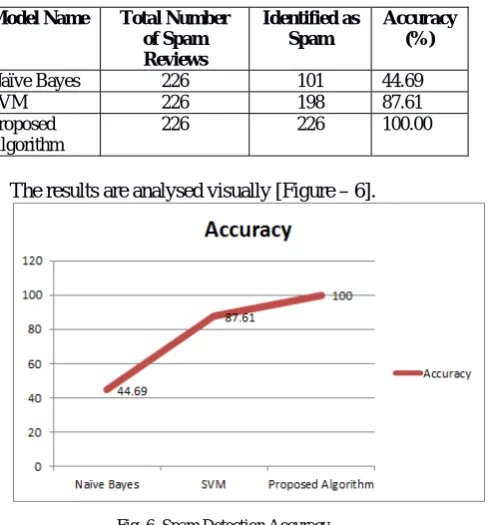
Also the accuracy of the models are analysed [Table – 9].
TABLE9ACCURACYOFSPAMDETECTION
Model Name Total Number of Spam Reviews
Identified as Spam
Accuracy (%)
Naïve Bayes 226 101 44.69
SVM 226 198 87.61
Proposed Algorithm
226 226 100.00
The results are analysed visually [Figure – 6].
Fig. 6 Spam Detection Accuracy
Thus it is natural to understand that, the accuracy of the proposed algorithm and the framework is extremely satisfactory. Thus in the light of the reviews, results and comparative analysis, this work presents the conclusion in the next section.
VII. CONCLUSION
The growth in the online review systems influences many factors for the consumers. Any negative review or any positive reviews can complete change the perspective of the reader. Thus the review systems are to be considered with high importance and need to be validated. The spam reviews which are available online can destroy the branding completely. Thus this work deploys an automatic framework to validate the reviews and mark the spam reviews. The proposed framework enables the consumer or the reader to detect and eliminate the spam reviews completely. The work demonstrates a highly reliable framework with 100% extraction rate and 100% accuracy of the detection of fake or spam reviews. The highly satisfactory result is obtained due to the extraction of words justified by sentiment and validated by opinions. The outcome of the work is justified to make the online review system better for the world by reducing the negative influences by spammers.
VIII. REFERENCES
[1] Yenuga Padma, Dr. Y.K Sundara Krishna, “A literature review on Opinion spam detection and its approaches”, Vol. 15, Issue 6, June 2017, pp. 351-356, IJCSIS.
[2] Nitin Jindal, Bing Liu,” Opinion Spam and Analysis”, ACM Proceedings of the International Conference on Web search and web data mining, 2008, pp. 219-229.
[3] SihongXie, Guan Wang, Shuyang Lin, Philip S. Yu “Review spam detection via time series pattern discovery”, ACM Proceedings of the 21st international conference companion on WWW '12, 2012, pp. 635-636.
[4] MyleOtt, Yejin Choi, Claire Cardie, Jeffrey T. Hancock, “Finding deceptive opinion spam by any stretch of imagination”, Volume 1, 2011, ACM Proc. of the 49th Annual Meeting of the Association for Computational Linguistics: Human Language Technologies, pp. 309-319. [5] Ott, Myle, Claire Cardie, and Jeffrey T. Hancock.
"Negative deceptive opinion spam", Proc. NAACL-HLT, 2013, pp- 497–501.
[6] Nitin Jindal, Bing Liu ,”Review Spam Detection”, ACM Proc., 16th International conference on World Wide Web, 2007,pp. 1189-1190.
[7] Fangtao Li, F.; Huang, M.; Yang, Y.; and Zhu, X, “
Learning to Identify Review Spam” Proc. of Twenty-Second International Joint Conference on Artificial Intelligence, 2011,pp. 2488-2493.
[8] Lim, E. P., Nguyen, V. A., Jindal, N., Liu, B., & Lauw, H.
W., “Detecting product review spammers using rating
behaviours”, Proc., International Conference on
Information and Knowledge Management, 2010, pp. 939-948.
[9] Mukherjee, A.; Liu, B.; and Glance, N. S.,“Spotting fake reviewer groups in consumer reviews”, Proc. 21st international conference on WWW '12 , 2012,pp. 191-200.
[10] Raymond Y. K. Lau, Stephen Shaoyi Liao, Ron Chi-Wai
Kwok, Kaiquan Xu, Yunqing Xia, Yuefeng Li,” Text mining and probabilistic language modeling for online review spam detection” ACM Transactions on
Management Information Systems (TMIS), Volume 2