WIT: A Toolkit for Building Robust and Real-Time Spoken Dialogue
Systems
Mikio Nakano* Noboru Miyazaki, Norihito Yasuda, Akira Sugiyama,
Jun-ichi Hirasawa, Kohji Dohsaka, Kiyoaki Aikawa
N T T Corporation 3-1 M o r i n o s a t o - W a k a m i y a Atsugi, K a n a g a w a 243-0198, Japan
E-mail: [email protected]
Abstract
This paper describes WI'I; a toolkit for building spoken dialogue systems. WIT features an incremental under- standing mechanism that enables ro- bust utterance understanding and real- time responses. WIT's ability to com- pile domain-dependent system specifi- cations into internal knowledge sources makes building spoken dialogue sys- tems much easier than :it is from scratch.
1 Introduction
The recent great advances in speech and language technologies have made it possible to build fully implemented spoken dialogue systems (Aust et al., 1995; Allen et al., 1996; Zue et al., 2000; Walker et al., 2000). One o f the next research goals is to make these systems task-portable, that is, to simplify the process o f porting to another task domain.
To this end, several toolkits for building spo- ken dialogue systems have been developed (Bar- nett and Singh, 1997; Sasajima et al., 1999). One is the CSLU Toolkit (Sutton et al., 1998), which enables rapid prototyping o f a spoken di- alogue system that incorporates a finite-state dia- logue model. It decreases the amount o f the ef- fort required in building a spoken dialogue sys- tem in a user-defined task domain. However, it limits system functions; it is not easy to employ the advanced language processing techniques de- veloped in the realm o f computational linguis- tics. Another is GALAXY-II (Seneffet al., 1998), *Mikio Nakano is currently a visiting scientist at MIT Laboratory for Computer Science.
which enables modules in a dialogue system to communicate with each other. It consists o f the hub and several servers, such as the speech recog- nition server and the natural language server, and the hub communicates with these servers. Al- though it requires more specifications than finite- state-model-based toolkits, it places less limita- tions on system functions.
Our objective is to build robust and real-time spoken dialogue systems in different task do- mains. By robust we mean utterance understand- ing is robust enough to capture not only utter- ances including grammatical errors or self-repairs but also utterances that are not clearly segmented into sentences by pauses. Real time means the system can respond to the user in real time. The reason we focus on these features is that they are crucial to the usability o f spoken dialogue sys- tems as well as to the accuracy o f understand- ing and appropriateness o f the content o f the sys- tem utterance. Robust understanding allows the user to speak to the system in an unrestricted way. Responding in real time is important be- cause if a system response is delayed, the user might think that his/her utterance was not recog- nized by the system and make another utterance, making the dialogue disorderly. Systems having these features should have several modules that work in parallel, and each module needs some domain-dependent knowledge sources. Creat- ing and maintaining these knowledge sources re- quire much effort, thus a toolkit would be help- ful. Previous toolkits, however, do not allow us to achieve these features, or do not provide mecha- nisms that achieve these features without requir- ing excessive efforts by the developers.
This paper presents WIT 1, which is a toolkit
for building spoken dialogue systems that inte- grate speech recognition, language understanding and generation, and speech output. WIT features an incremental understanding method (Nakano et al., 1999b) that makes it possible to build a robust and real-time system. In addition, WIT compiles domain-dependent system specifications into in- ternal knowledge sources so that building systems is easier. Although WIT requires more domain- dependent specifications than finite-state-model- based toolkits, WIT-based systems are capable of taking full advantage o f language processing technology. WIT has been implemented and used to build several spoken dialogue systems.
In what follows, we overview WIT, explain its architecture, domain-dependent system specifica- tions, and implementation, and then discuss its advantages and problems.
2 Overview
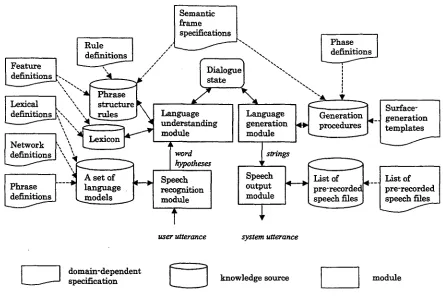
A WIT-based spoken dialogue system has four main modules: the speech recognition module, the language understanding module, the lan- guage generation module, and the speech out- put module. These modules exploit domain- dependent knowledge sources, which are auto- matically generated from the domain-dependent system specifications. The relationship among the modules, knowledge sources, and specifica- tions are depicted in Figure 1.
WIT can also display and move a human-face- like animated agent, which is controlled by the speech output module, although this paper does not go into details because it focuses only on spo- ken dialogue. We also omit the GUI facilities pro- vided by WIT.
3 A r c h i t e c t u r e o f W I T - B a s e d
Spoken
Dialogue Systems
Here we explain how the modules in WIT work by exploiting domain-dependent knowledge and how they interact with each other.
3.1 Speech Recognition
The speech recognition module is a phoneme- HMM-based speaker-independent continuous speech recognizer that incrementally outputs
face Toolldt.
word hypotheses. As the recogn/fion engine, either VoiceRex, developed by NTI" (Noda et al., 1998), or HTK from Entropic Research can be used. Acoustic models for HTK is trained with the continuous speech database of the Acoustical Society of Japan (Kobayashi et al., 1992). This recognizer incrementally outputs word hypotheses as soon as they are found in the best-scored path in the forward search (Hirasawa et al., 1998) using the ISTAR (Incremental Structure Transmitter And Receiver) protocol, which conveys word graph information as well as word hypotheses. This incremental output allows the language understanding module to process recognition results before the speech interval ends, and thus real-time responses are possible. This module continuously runs and outputs recognition results when it detects a speech interval. This enables the language generation module to react immediately to user interruptions while the system is speaking.
The language model for speech recognition is a network (regular) grammar, and it allows each speech interval to be an arbitrary number of phrases. A phrase is a sequence of words, which is to be defined in a domain-dependent way. Sentences can be decomposed into a cou- ple o f phrases. The reason we use a repeti- tion o f phrases instead of a sentence grammar for the language model is that the speech recog- nition module of a robust spoken dialogue sys- tem sometimes has to recognize spontaneously spoken utterances, which include self-repairs and repetition. In Japanese, bunsetsu is appropriate for defining phrases. A bunsetsu consists of one content word and a number (possibly zero) of function words. In the meeting room reservation system we have developed, examples of defined phrases are bunsetsu to specify the room to be re- served and the time o f the reservation and bun- setsu to express affirmation and negation.
When the speech recognition module finds a phrase boundary, it sends the category of the phrase to the language understanding module, and this information is used in the parsing pro- cess.
Semantic [
I ~e
I
/ specifications [ r 1
I R~ae
I
/L..___..-- - ' - ' - ~ ' -
/
Ph~e l/de~;,i~ions I
/"
"-.
I de~i*~._l
I F e a t u r e I L._.___..~.. -~-'-'-'~ , ( "~ "'.
L____i----',.,'-... ~ ~ "-..
• Surface-
I d e . ~ o n s [:-
,, l ; ~ : : - - ° Y \ l
Language
II
L a n g u a g eI
~ G e n e r a f i o ~ n _ /.
I
, ~ , "., "~"----~__Z_--.--" M . -. i i . ) i . . . l,,_J generaraon I ~ \ ,, ~ ~ u n a e r s t a n d i n g I I generation I O t procedures I TM / . . . . ~ .. . . I\
I I
I
. . . . J
I definitions I '\ \ I w o r d I strings
I
hypothesea
+
I . - - I _ _ _ ~ ' ~ s e t o f - " - L _ _ ~ I Speech
i
I ~ , ~ L i T - s t o f - - / L / i . , i s t o fI ~ "
t
I ~angu.~ge I- -I ~ t i o .
I
I ou~u,
r'--'] pre-r~o.dedr'--] pre-r~o~ed I
I
d~f~i~23~_l
t.models ...~1I
module
I
I
~oam~
I~Peech m~._J
,
I
L _ j
user utterance system utterance
domain-dependent:
[image:3.596.113.556.54.350.2]specification knowledge source m o d u l e
Figure 1: Architecture of WIT
switched according to the requests from the lan- guage understanding module. In this way, the speech recognition success rate is increased by using the context of the dialogue.
Although the current version of WIT does not exploit probabilistic language models, such mod- els can be incorporated without changing the ba- sic WIT architecture.
3.2 Language Understanding
The language understanding :module receives word hypotheses from the speech recognition module and incrementally understands the se- quence o f the word hypotheses to update the di- alogue state, in which the resnlt o f understand- ing and discourse information are represented by a frame (i.e., attribute-value pairs). The un- derstanding module utilizes ISSS (Incremental Significant-utterance Sequence Search) (Nakano et al., 1999b), which is an integrated parsing and discourse processing method. ISSS enables the incremental understanding of user utterances that are not segmented into sentences prior to pars-
ing by incrementally finding the most plausible sequence o f sentences (or significant utterances in the ISSS terms) out of the possible sentence sequences for the input word sequence. ISSS also makes it possible for the language generation module to respond in real time because it can out- put a partial result of understanding at any point in time.
vafion and dialogue-related ones that express the user's attitude with respect to the progress o f the dialogue, such as confirmation and denial. Con- sidering the meeting room reservation system, ex- amples o f domain-related sentences are "I need to book Room 2 on Wednesday", "I need to book Room 2", and "Room 2" and dialogue-related ones are "yes", "no", and "Okay".
The semantic representation for a sentence is a command for updatingthe dialogue state. The dialogue state is represented by a list o f attribute- value pairs. For example, attributes used in the meeting room reservation system include task- related attributes, such as the date and time o f the reservation, as well as attributes that represent discourse-related information, such as confirma- tion and grounding.
3.3 Language Generation
How the language generation module works varies depending on whether the user or system has the initiative o f turn taking in the dialogue 2. Precisely speaking, the participant having the ini- tiative is the one the system assumes has it in the dialogue.
The domain-dependent knowledge used by the language generation module is generation proce- dures, which consist of a set o f dialogue-phase definitions. For each dialogue phase, an initial function, an action function, a time-out function,
and a language model are assigned. In addition, phase definitions designate whether the user or the system has the initiative. In the phases in which the system has the initiative, only the ini- tial function and the language model are assigned. The meeting room reservation system, for exam- ple, has three phases: the phase in which the user tells the system his/her request, the phase in which the system confirms it, and the phase in which the system tells the user the result o f the database access. In the first two phases, the user holds the initiative, and in the last phase, the sys- tern holds the initiative.
Functions defined here decide what string should be spoken and send that string to the speech output module based on the current di- alogue state. They can also shift the dialogue
2The notion of the initiative in this paper is different from that of the dialogue initiative of Chu-Carroll (2000).
phase and change the holder o f the initiative as well as change the dialogue state. When the dia- logue phase shifts, the language model foi" speech recognition is changed to get better speech recog- nition performance. Typically, the language gen- eration module is responsible for database access. The language generation module works as fol- lows. It first checks which dialogue participant has the initiative. If the initiative is held by the user, it waits until the user's speech interval ends or a duration o f silence after the end o f a system utterance is detected. The action function in the dialogue phase at that point in time is executed in the former case; the time-out function is executed in the latter case. Then it goes back to the initial stage. If the system holds the initiative, the mod- ule executes the initial function o f the phase. In typical question-answer systems, the user has the initiative when asking questions and the system has it when answering.
Since the language generation module works in parallel with the language understanding module, utterance generation is possible even while the system is listening to user utterances and that ut- terance understanding is possible even while it is speaking (Nakano et al., 1999a). Thus the system can respond immediately after user pauses when the user has the initiative. When the system holds the initiative, it can immediately react to an in- terruption by the user because user utterances are understood in an incremental way (Dohsaka and Shimazu, 1997).
The time-out function is effective in moving the dialogue forward when the dialogue gets stuck for some reason. For example, the system may be able to repeat the same question with an- other expression and may also be able to ask the user a more specific question.
3.4 Speech Output
phrases.
4 Building Spoken Dialo~te Systems w i t h W I T
4.1 Domain-Dependent System Specifications
Spoken dialogue systems can be built with WIT by preparing several domain-dependent specifica- tions. Below we explain the specifications.
Feature Definitions: Feature definitions spec- ify the set o f features used in the grammar for lan- guage understanding. They also specify whether each feature is a head feature or a foot feature (Pollard and Sag, 1994). This information is used when constructing feature structures for phrases in a built-in process.
The following is an example o f a feature defini- tion. Here we use examples from the specification of the meeting room reservation system.
(case h e a d )
It means that the case feature is used and it is a head feature 3.
Lexieal Descriptions: Lexical descriptions specify both pronunciations and grammatical features for words. Below is an example lexical item for the word 1-gatsu (January).
(l-gatsu ichigatsu month nil i)
The first three elements are the identifier, the pro- nunciation, and the grammatical category o f the word. The remaining two elements are the case and semantic feature values.
Phrase Definitions: Phrase definitions specify what kind o f word sequence can be recognized as a phrase. Each definition is a pair compris- ing a phrase category name and a network of word categories. In the example below, m o n t h -
phrase is the phrase category name and the re- maining part is the network o f word categories. o p t means an option and o r means a disjunc- tion. For instance, a word sequence that con- sists o f a word in the m o n t h category, such as 1- gatsu (January), and a word in the a d r a o n i n a l - p a r t i c l e category, such as no (of), forms a phrase in the m o n t h - p h r a s e category.
3In this section, we use examples of different description
from the actual ones for simplicity. Actual specifications are written in part in Japanese.
(month-phrase (month
(opt (or
expression-following-subject (admoninal-particle
(opt
sentence-final-particle))))))
Network Definitions: Network definitions specify what kind o f phrases can be included in each language model. Each definition is a pair comprising a network name and a set o f phrase category names.
Semantic-Frame Specifications: The result o f understanding and dialogue history can be stored in the dialogue state, which is represented by a flat frame structure, i.e., a set o f attribute-value pairs. Semantic-frame specifications define the attributes used in the frame. The meeting room reservation system uses task-related attributes. Two are s t a r t and end, which represent the user's intention about the start and end times o f the reservation for some meeting room. It also has attributes that represent discourse informa- tion. One is c o n f i r m e d , whose value indicates whether if the system has already made an utter- ance to confirm the content o f the task-related at- tributes.
Rule Definitions: Each rule has one o f the fol- lowing two forms.
((rule name)
(child feature structure)
• . . (child feature structure) => (mother feature structu_e)
(priority increase) ) ((role name)
(child feature structure)
• . . (child feature structure) => (flame operation command)
(priority increase) )
paper. The priorities are used for disambiguat- ing interpretation in the incremental understand- ing method (Nakano et al., 1999b).
When the command on the right-hand side o f the arrow is a frame operation command, phrases to which this rule can be applied can be consid- ered a sentence, and the sentence's semantic rep- resentation is the command for updating the dia- logue state. The command is one o f the follow- ing:
• A command to set the value o f an attribute o f the frame,
• A command to increase the priority,
Conditional commands (If-then-else type command, the condition being whether the value o f an attribute o f the flame is or is not equal to a specified value, or a conjunction or disjunction o f the above condition), or
• A list o f commands to be sequentially exe- cuted.
Thanks to conditional commands, it is possible to represent the semantics of sentences context- dependently.
The following rule is an example.
( s t a r t - e n d - t i m e s - c o m m a n d
( t i m e - p h r a s e : f r o m * s t a r t )
( t i m e - p h r a s e (:or :to nil) *end)
=> ( c o m m a n d (set : s t a r t * s t a r t )
(set : e n d * e n d ) ) )
The n a m e of this rule is s t a r t - e n d - t i m e s -
c o m m a n d . The second and third elements
are child feature structures. In these elements,
t i m e - p h r a s e is a phrase category, : f r o m and
( : o r : to n i l ) are case feature values, and
* s t a r t and * e n d are semantic feature val- ues. Here :or means a disjunction, and sym-
bols starting with an asterisk are variables. The
right-hand side o f the arrow is a command to up- date the frame. The second element o f the com- mand, (set : s t a r t * s t a r t ) , changes the : s t a r t atttribute value of the frame to the in- stance o f * s t a r t , which should be bound when applying this rule to the child feature structures.
Phase Definitions: Each phase definition con- sists o f a phase name, a network name, an ini- tiative holder specification, an initial function, an action function, a maximum silence duration, and a time-out function. The network name is the identifier of the language model for the speech recognition. The maximum silence duration spec- ifies how long the generation module should wait until the time-out function is invoked.
Below is an example o f a phase definition. The first element r e q u e s t is the name o f this phase, " f r a r _ r e q u e s t " is the name o f the
network, and m o v e - t o - r e q u e s t - p h a s e and
r e q u e s t - p h a s e - a c t i o n are the names of
the initial and action functions. In this phase,
the maximum silence duration is ten seconds and the name o f the time-out function is r e q u e s t -
p h a s e- t i m e o u t.
( r e q u e s t " f m r _ r e q u e s t "
m o v e - t o - r e q u e s t - p h a s e r e q u e s t - p h a s e - a c t i o n
1 0 . 0
r e q u e s t - p h a s e - t i m e o u t )
For the definitions o f these functions, WIT pro- vides functions for accessing the dialogue state, sending a request to speak to the speech out- put module, generating strings to be spoken us- ing surface generation templates, shifting the di- alogue phase, taking and releasing the initiative, and so on. Functions are defined in terms o f the Common Lisp program.
Surface-generation Templates: Surface- generation templates are used by the surface generation library function, which converts
a list-structured semantic representation to a sequence o f strings. Each string can be spoken, i.e., it is in the list of pre-recorded speech files.
For example, let us consider the conversion o f the semantic representation ( d a t e ( d a t e - e x p r e s s i o n 3 15) ) to strings using the fol- lowing template.
( (date
( d a t e - e x p r e s s i o n * m o n t h * d a y ) )
( ( * m o n t h g a t s u ) ( * d a y n i c h i ) ) )
o f strings appear in the speech file list. It re- turns ( ' ' 3 g a g s u l 5 n i c h i ' ' ) (March 15th) if the string "3gatsul5nichi" is in the list o f pre-recorded speech files, and otherwise, returns
( ' ' 3 g a t s u . . . . 1 5 n i c h i ' ' ) when these
strings are in the list.
List of Pre-recorded Speech Files: The list of pre-recorded speech files should show the corre- spondence between strings and speech files to be played by the speech output module.
4.2 Compiling System Specifications
From the specifications explained above, domain- dependent knowledge sources are created as indi- cated by the dashed arrows in Figure 1. When cre- ating the knowledge sources, WIT checks for sev- eral kinds o f consistency. For example, the set of word categories appearing in the lexicon and the set of word categories appearing in phrase deft- nifions are compared. This makes it easy to find errors in the domain specifications.
5 Implementation
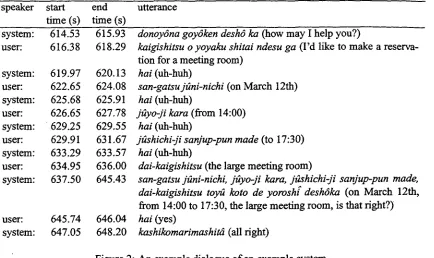
WIT has been implemented in Common Lisp and C on UNIX, and we have built several experi- mental and demonstration dialogue systems using it, including a meeting room reservation system (Nakano et al., 1999b), a video-recording pro- gramming system, a schedule management sys- tem (Nakano et al., 1999a), and a weather in- formation system (Dohsaka et al., 2000). The meeting room reservation system has vocabulary o f about 140 words, around 40 phrase structure rules, nine attributes in the semantic frame, and around 100 speech files. A sample dialogue be- tween this system and a naive user is shown in Figure 2. This system employs HTK as the speech recognition engine. The weather informa- tion system can answer the user's questions about weather forecasts in Japan. The vocabulary size is around 500, and the number of phrase structure rules is 31. The number of attributes in the se- mantic flame is 11, and the number o f the files of the pre-recorded speech is about 13,000.
6 Discussion
As explained above, the architecture of WIT al- lows us to develop a system that can use utter-
ances that are not clearly segmented into sen- tences by pauses and respond in real time. Below we discuss other advantages and remaining prob- lems.
6.1 Descriptive Power
Whereas previous finite-state-model-based tool- kits place many severe restrictions on domain de- scriptions, WIT has enough descriptive power to build a variety o f dialogue systems. Although the dialogue state is represented by a simple attribute- value matrix, since there is no limitation on the number o f attributes, it can hold more compli- cated information. For example, it is possible to represent a discourse stack whose depth is lim- ited. Recording some dialogue history is also possible. Since the language understanding mod- ule utilizes unification, a wide variety o f lin- guistic phenomena can be covered. For exam- ple, speech repairs, particle omission, and fillers can be dealt with in the framework o f unifica- tion grammar (Nakano et al., 1994; Nakano and Shimazu, 1999). The language generation mod- ule features Common Lisp functions, so there is no limitation on the description. Some o f the systems we have developed feature a generation method based on hierarchical planning (Dohsaka and Shirnazu, 1997). It is also possible to build a simple finite-state-model-based dialogue system using WIT. States can be represented by dialogue phases in WIT.
6.2 Consistency
In an agglutinative language such as Japanese, there is no established definition of words, so dia- logue system developers must define words. This sometimes causes a problem in that the defini- tion o f word, that is, the word boundaries, in the speech recognition module are different from that in the language understanding module. In WIT, however, since the common lexicon is used in both the speech recognition module and language understanding module, the consistency between them is maintained.
6-3 Avoiding Information Loss
speaker start end utterance time (s) time (s)
system: 614.53 615.93 user: 616.38 618.29
system: 619.97 620.13 user: 622.65 624.08 system: 625.68 625.91 user: 626.65 627.78 system: 629.25 629.55 user: 629.91 631.67 system: 633.29 633.57 user: 634.95 636.00 system: 637.50 645.43
[image:8.596.94.528.47.305.2]user: 645.74 646.04 system: 647.05 648.20
Figure 2:
donoy6na goy6ken desh6 ka (how may I help you?)
kaigishitsu o yoyaku shitai ndesu ga (I'd like to make a reserva- tion for a meeting room)
hai (uh-huh)
san-gatsujfini-nichi (on March 12th)
hal (uh-huh)
jayo-ji kara (from 14:00)
hai (uh-huh)
jashichi-ji sanjup-pun made (to 17:30)
hai (uh-huh)
dai-kaigishitsu (the large meeting room)
san-gatsu jani-nichi, j~yo-ji kara, jashichi-ji sanjup-pun made, dai-kaigishitsu toyfi koto de yoroshf deshrka (on March 12th, from 14:00 to 17:30, the large meeting room, is that right?) "
hai (yes)
kashikomarimashitd (all right)
An example dialogue of an example system
must disambiguate word meaning and find phrase boundaries by parsing. In contrast, the speech recognition module in WIT sends not only words but also word categories, phrase boundaries, and phrase categories. This leads to less expensive and better language understanding.
6.4 Problems and Limitations
Several problems remain with WIT. One of the most significant is that the system developer must write language generation functions. If the gen- eration functions employ sophisticated dialogue strategies, the system can perform complicated dialogues that are not just question answering. WIT, however, does not provide task-independent facilities that make it easier to employ such dia- logue strategies.
There have been several efforts aimed at de- veloping a domain-independent method for gen- erating responses from a frame representation of user requests (Bobrow et al., 1977; Chu-CarroU,
1999). Incorporating such techniques would deo crease the system developer workload. However, there has been no work on domain-independent response generation for robust spoken dialogue systems that can deal with utterances that might include pauses in the middle of a sentence, which WIT handles well. Therefore incorporating those
techniques remains as a future work.
Another limitation is that WIT cannot deal with multiple speech recognition candidates such as those in an N-best list. Extending WIT to deal with multiple recognition results would improve the performance of the whole system. The ISSS preference mechanism is expected to play a role in choosing the best recognition result.
7 Conclusion
This paper described WIT, a toolkit for build- ing spoken dialogue systems. Although it re- quires more system specifications than previous finite-state-model-based toolkits, it enables one to easily construct real-time, robust spoken dia- logue systems that incorporates advanced compu- tational linguistics technologies.
Acknowledgements
the anonymous reviewers were of' great help.
References
James F. Allen, Bradford W. Miller, Eric K. Ringger, and Teresa Sikorski. 1996. A robust system for nat- ural spoken dialogue. In Proceedings of the 34th Annual Meeting of the Association for Computa- tional Linguistics (A CL-96), pages 62-70.
Harald Aust, Martin Oerder, Frank Seide, and Volker Steinbiss. 1995. The Philips automatic train timetable information system. Speech Communi- cation, 17:249--262.
James Barnett and Mona Singh. 1997. Designing a portable spoken language system. In Elisabeth Maier, Marion Mast, and Susann LuperFoy, editors, Dialogue Processing in Spoken Language Systems, pages 156--170. Springer-Vedag.
Daniel G. Bobrow, Ronald M. Kaplan, Martin Kay, Dona!d A. Norman, Henry Thompson, and Terry Winograd. 1977. GUS, a frame driven dialog sys- tem. Arnficial Intelligence, 8:155-173.
Jennifer Chu-Carroll. 1999. Fo:rrn-based reason- ing for mixed-initiative dialogue management in information-query systems. In Proceedings of the Sixth European Conference on Speech Communica- tion and Technology (Eurospeech-99) , pages 1519- 1522.
Junnifer Chu-Carroll. 2000. MIMIC: An adaptive mixed initiative spoken dialogue system for infor- mation queries. In Proceedings of the 6th Con- f~rence on Applied Natural Language Processing
(ANLP-O0), pages 97-104.
Kohji Dohsaka and Akira Shimazu. 1997. System ar- chitecture for spoken utterance production in col- laborative dialogue. In Working Notes of IJCAI 1997 Workshop on Collaboration, Cooperation and Conflict in Dialogue Systems.
Kohji Dohsaka, Norihito Yasuda, Noboru Miyazaki, Mikio Nakano, and Kiyoaki AJkawa. 2000. An ef- ficient dialogue control method under system's lim- ited knowledge. In Proceedings of the Sixth Inter- national Conference on Spoken Language Process- ing (ICSLP-O0).
Jun-ichi Hirasawa, Noboru Miyazaki, Mikio Nakano, and Takeshi Kawabata. 1998. Implementation of coordinative nodding behavior on spoken dia- logue systems. In Proceedings of the Fgth Interna- tional Conference on Spoken Language Processing (1CSLP-98), pages 2347-2350.
Tetsunod Kobayashi, Shuichi Itahashi, Satoru Hayamizu, and Toshiyuki Takezawa. 1992. Asj
continuous speech corpus for research. The journal of th e Acoustical Society o f Japan, 48(12): 888-893.
Mikio Nakano and Akira Shimazu. 1999. Pars- ing utterances including self-repairs. In Yorick Wilks, editor, Machine Conversations, pages 99-
112. Kluwer Academic Publishers.
Mikio Nakano, Aldra Shimazu, and Kiyoshi Kogure. 1994. A grammar and a parser for spontaneous speech. In Proceedings of the 15th Interna- tional Conference on Computational Linguistics (COLING-94), pages 1014-1020.
Mildo Nakano, Kohji Dohsaka, Noboru Miyazald, Inn ichi Hirasawa, Masafiami Tamoto, Masahito Kawarnon, Akira Sugiyama, and Takeshi Kawa- bata. 1999a. Handling rich turn-taking in spoken dialogue systems. In Proceedings of the Sixth Eu- ropean Conference on Speech Communication and Technology (Eurospeech-99), pages 1167-1170.
Mikio Nakano, Noboru Miyazaki, Jun-ichi Hirasawa, Kohji Dohsaka, and Takeshi Kawabata. 1999b. Understanding unsegmented user utterances in real- time spoken dialogue systems. In Proceedings of the 37th Annual Meeting of the Association for Computational Linguistics (ACL-99), pages 200-- 207.
Mikio Nakano. 1991. Constraint projection: An ef- ficient treatment of disjunctive feature descriptions. In Proceedings of the 29th Annual Meeting of the Association for Computational Linguistics (ACL- 9 0 , pages 307-314.
Yoshiaki Noda, Yoshikazu Yamaguchi, Tomokazu Yamada, Akihiro Imamura, Satoshi Takahashi, Tomoko Matsui, and Kiyoaki Aikawa. 1998. The development of speech recognition engine REX. In Proceedings of the 1998 1EICE General Confer- ence D-14-9, page 220. (in Japanese).
Fernando C. N. Pereira and David H. D. Warren. 1980. Definite clause grammars for language analysis--a survey of the formalism and a compar- ison with augmented transition networks. Artificial Intelligence, 13:231-278.
Carl J. Pollard and Ivan A. Sag. 1994. Head-Driven Phrase Structure Grammar. CSLI, Stanford.
Munehiko Sasajima, Yakehide Yano, and Yasuyuki Kono. 1999. EUROPA: A genetic framework for developing spoken dialogue systems. In Proceed- ings of the Sixth European Conference on Speech Communication and Technology (Eurospeech-99), pages 1163--1166.
the Fifth International Con l~rence on Spoken Lan- guage Processing (ICSLP-98).
Stephen Sutton, Ronaid A. Cole, Jacques de Villiers, Johan SchMkwyk, Pieter Vermeulen, Michael W. Macon, Yonghong Yah, Edward Kaiser, Brian Run- die, K.haldoun Shobaki, Paul Hosom, Alex Kain, Johan Wouters, Dominic W. Massaro, and Michael Cohen. 1 9 9 8 . Universal speech tools: The CSLU toolkit. In Proceedings of the Fifth Interna- tional Conference on Spoken Language Processing (1CSLP-98), pages 3221-3224.
Marilyn Walker, Irene Langkilde, Jerry Wright, Allen Gorin, and Diane Litman. 2000. Learning to pre- dict problematic situations in a spoken dialogue system: Experiments with how may I help you? In Proceedings of the First Meeting of the North Amer- ican Chapter of the Association for Computational Linguistics (NAA CL-O0), pages 210--217.