1
Employing Artificial Intelligence in Intensive Care
Unit(ICU) : A Review
Amruta Bhole1, Dr. P.M.Jawandhiya2
Computer Science and Engineering1,2, P.G.Student1, Professor2 Email: [email protected], [email protected]
Abstract-
Intensive care occupies an important position in the modern medical system. Medical staff in the Intensive Care Unit (ICU) are confronted with large volumes of continuous data from quite a lot of physiological sources which require interpretation as patients are admitted to the Intensive Care Unit (ICU) for the management of a wide variety of severe illnesses and diseases . Though Advancements in technology are improving the quality and quantity of physiological measurement data available in ICUs , it is very necessary to recognise that the patient’s data must be extracted and organised to become useful information, and then an expert team must infer this information before it becomes knowledge for diagnostic and/or therapeutic purposes. A variety of computer-based analytic techniques have been developed and are still being developed. Our aim must be to introduce these techniques and methods and to discuss their potential for clinical applications in the intensive care unit (ICU)..
Index Terms – Intensive Care Unit(ICU); Artificial Intelligence; medical field.
1. INTRODUCTION
The evaluation and monitoring of patients' health status in intensive care units (ICUs) is necessary to help medical team to assess the changes and prioritise resources and take the appropriate diagnostic/therapeutic measures and give accurate treatment. In order to save a patient’s life, the vital functions are supported by medications or by a mechanical device until the patient is able to recover. Many bedside equipment for example, pressure and flow transducers, mechanical ventilators store electronic data and are provided with computer interfaces communicate with a host of devices through data buses and plug-in interfaces. Computerized intensive care systems interface with hospital databases including demographic systems, electronic patient records, order-entry, laboratory, pharmacy and radiology systems.
Artificial intelligence applications have a major advantages over the traditional applications as Artificial Intelligence is more permanent, more consistent, has the ease of duplication and dissemination , can be documented and can perform certain tasks much faster and better than humans. In the case of AI, the neural network of the brain has been successfully imitated, even including the capability to learn from past cases and experiences. Artificial intelligence is what gives computers the ability to learn, think, reason, and even understand human . AI is being designed to assist doctors (not replace them) in the medical field.
.
2. NOMENCLATURE
2.1. Expert System
An expert system is a computer application or computer program that replicates the judgment and behaviour of basically a human with expert knowledge and experience to solve complex problems in a particular domain or a particular field.
2.2. Data Mining
2
2.3. Data-Warehouse
A data warehouse is a central repository for all or significant parts of the data that an enterprise’s various business systems collect. An alternative term is a data mart.
3. DIFFERENT USES OF AI IN ICU
The modern data-intensive ICUs were established somewhere in 1960 with introduction of blood gas electrodes. Although the data is electronically accessible, the synthesis and interpretation of information is done manually in many of today’s ICUs with minimal preprocessing. The records are copied from monitors onto paper records and as the result there is a high risk of data being lost or/ and incorrectly transcribed in the process. The main uses of AI techniques in ICU .
3.1. AI as management information system
A management information system (MIS) has been defined as “a computerised information system that can integrate data from various sources and can organise it to provide the information necessary for management decision making for every level of management in a organisation”. Information presented by the MIS usually shows "real" data over against "intended" results and results from a year before; thus it measures progress achieved against goals set.
The first type of management information system is model-driven or rule-based expert systems(RBS) are based on Top-Down approach where the programming problem is sequentially broken down into smaller essential components or segments to be solved .They are able to represent the subject material accurately and interface well with the user. Some of the early expertsystems were the MYCIN , ONCOCIN which were designed at Stanford and simulated the performance of consultants in infectious disease and oncology respectively and Internist/Quick Medical Reference systems which was designed at the University of Pittsburgh to reproduce the diagnostic behavior of an internist. But these systems were not widely accepted due to some obstacles like the complexity of regulatory requirements.
The newer generation -- Data-driven(Intelligent Assistant) systems are software solutions for information and data management. The functions of these systems are acquisition(using data entry forms
or via interfacing with external data sources),
presentation of information (concerned with retrieval and display of stored information to the user with appropriate navigation and querying facilities) and the management.
Data-driven systems (DDS) are based on bottom up approach and so they help us to acquire large quantity of data electronically and hence to “discover” relationships and assume that future behaviour can be predicted from past behaviour.
3.2. AI to improve mortality prediction accuracy
The accuracy and reliability of the existing systems is still not ideal. A new combination of just-in-time learning (JITL) and extreme learning machine (ELM) has been proposed, aiming at improving mortality prediction accuracy. ELM was selected for fast model building and JITL was used to gather the most relevant data samples for patient-specific modelling. Many synthesis parameters with physiological meanings have been derived as well, which make a contribution for reaching an ideal classification effect.
JITL-ELM model lays stress on patient-specific treatment.
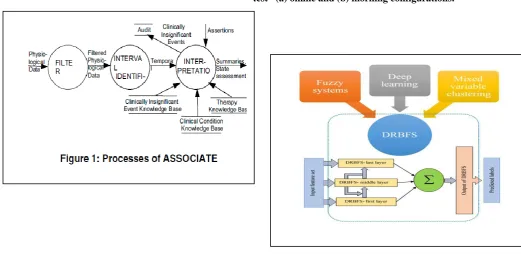
A Deep Rule-Based Fuzzy System (DRBFS) has been proposed to develop an accurate in-hospital mortality prediction in the intensive care unit (ICU) patients by using a large number of input variables. In this system, the hidden layer in each unit is represented by interpretable fuzzy rules which are in turn generated by a modified supervised fuzzy k-prototype clustering (using the strength of soft partitioning). The same input space is kept in every base building unit of the system in accordance to stacked approach. The training set along with random shifts, obtained from random projections of prediction results of the current base building unit is offered as the input to the next base building unit.
3 with different characteristics; also, if there are changes
in patient characteristics, a score system built from a given particular patient data set becomes suboptimal and most of these score systems are built using semi-automated methods that require some amount of manual intervention, making it very difficult to use them for a new patient population. Thus , an attempt had been made few years ago to develop a machine learning method (Orthogonal Matching Pursuit based method (LogitOMP-SS) )that automatically learns a score system type model from given patient data, and hence has the advantage of being adaptive and uses a representation that is easy for clinicians to understand like the standard score systems. LogitOMP-SS method uses a variant of the orthogonal matching pursuit learned score model.
3.3. AI in health monitoring of ICU patients
Status monitoring is a necessary and important step in ICU patients. The state monitoring modelling methods is divided into two categories: mechanism modelling and statistical modelling. Mechanism modelling is widely used by analysing the internal mechanism that consists of a series of differential equations (Zhao et al., 1996), which are comparatively difficult to be established for the critically ill patients.
However, statistical model is relatively simple and practical by fitting the potential relationship between input and output, which makes it the preference for most researchers. In hospitals, several statistical models, such as the acute physiology and chronic health evaluation system (APACHE) (Al-Hadeedi et al., 1989), the simplified acute physiology score (SAPS) (Engel et al., 2003), and the mortality probability model (MPM) (Salluh and Soares, 2014), are commonly used to mark the severity of diseases. But due to low accuracy, short timeliness and particularly low data utilization, these three offline models did not give satisfactory performance. In order to make better use of the massive observational data-- This work was supported by National Natural Science Foundation of China (61374099) and Research Fund for the Taishan Scholar Project of Shandong Province of China. lots of other statistical modelling methods are used, such as fuzzy logic (Kwok et al., 2000), decision tree (Samanta et al., 2009), artificial neural network (Zhou et al., 2013), Bayesian network (Maglogiannis et al., 2006). Most of those models try to establish an offline universally applicable model,
which is difficult to adapt the changes of patients’ status due to its solidified pattern (Ying and Peter, 2008). Therefore, a more personalized and efficient monitoring method is needed.
Sometimes ,patients are often discharged prematurely from Intensive Care Units (ICU) due to clinical resource limitations, economic pressure or poor discharge planning. The readmission of such patients is currently viewed as a marker for poor quality care and is associated with an increased risk of death. On the other hand longer stays are usually a marker for poor quality care for the patients and family and unfortunately it leads to increased health care costs. Though many definations for ICU readmissions are available many authors now- a- days consider as readmission as the return to the ICU within a time period of 72 hours. In these types of problems attempts were made to improve conventional standard logistic regression techniques using machine learning algorithms such as artificial neural networks, fuzzy logic, decision trees and fuzzy modelling such as Takagi-Sugeno (TS) fuzzy models.
3.4 Reducing unnecessary lab testing in the ICU and Interpreting Historical ICU Data
Predictive modelling can be applied to recognize unnecessary lab tests in a real world ICU database. Reducing frequent lab testing and the potential clinical and financial implications are an important issue in intensive care.
4 There is a large amount of historical continuous data
and we could be benefited from assistance in its interpretation. When considering a given time in the past, data is available related to times both before and after that time. So, high level summaries of what has happened to the patient in, say, the past 24 hours, could be of significant importance in assisting a junior clinician to decide which interventions are appropriate, particularly if such a decision has to be made in the absence of more senior staff. It is an important feature of the summarisation of past events that the future (relative to that event) can be used to confirm the presence or absence of that event. For instance , the ASSOCIATE system does the of analysis historical data for summarisation and patient state assessment. It makes the use of a temporal expert system based on associational reasoning and applies three consecutive processes: filtering, which is used to remove noise and some clinically insignificant events; interval identification is applied on the segmented data to generate temporal intervals from the filtered data - intervals which are characterised by a common direction of change (i.e increasing,decreasing or steady); and interpretation which performs summarisation and patient state-assessments with the help of additional data like patient history ,times of therapy administration, knowledge of therapies, clinically insignificant events and clinical conditions. ASSOCIATE system uses three states namely absent, hypothesised and confirmed which describe any clinical condition at any point of time.
4. Figures
Figure2: Schematic representation of input/output configurations used for the modeling of each lab test –(a) online and (b) morning configurations.
5 of acceptable error in medical practice , the complexity involved in
tradeoff of specificity and sensitivity can be improved,
potential application for
not very suitable for big databases and suffers from lack of
Limited number of features
ASSO but evaluates the outcome of therapies
6. Conclusion
6 Support Systems (CDSS) are now in massive use in
clinical care settings, clinical laboratories and are incorporated in electronic medical record systems. AI along with Machine learning algorithms have been designed to derive rules for intelligent alarms on respiratory systems. Another common application in ICU is the real-time analysis of waveforms such as the electrocardiogram and the electroencephalogram. AI techniques have been used for the administration of anaesthetics, administration of fluid ,titration of oxygen therapy ,to control mechanical ventilation and artificial hearts. Along with these , AI applications are used to study and categorize oxygen destruction, interpret EEGs, analyse physiologic data during a simulated cardiac arrest and to distinguish real alarms from false ones. Artificial intelligence not only helps the interpretation of information and the formulation of hypothesis , it also provides us with better and more accurate alarms, and the linking between them . Hence AI systems may serve as tools for dynamic risk prediction and even for autonomous response.
7. Acknowledgement
We are very thankful to our faculty
members, friends and colleagues as they
guided us and gave their full support in
this work. This work was not possible
without their valuable guidance.
8. References
[1] C. William Hanson III, MD, FCCM; Bryan E. Marshall, MD, FRCP, FRCA, Artificial intelligence applications in the intensive care unit,Crit Care Med 2001 Vol. 29, No. 2.
[2] Raheleh Davoodi, Mohammad Hassan Moradi, Department of Biomedical Engineering, Amirkabir University of Technology, Mortality Prediction in Intensive Care Units (ICUs) Using a Deep Rule-Based Fuzzy Classifier, Journal of Biomedical Informatics (2018), doi:
https://doi.org/10.1016/j.jbi.2018.02.008.
[3] Apkar Salatian,School of Computing,The Robert Gordon University,Aberdeen, AB25 1HG,United Kingdom, Interpreting Historical ICU Data Using Associational and Temporal Reasoning,
Proceedings of the 15th IEEE International Conference on Tools with Artificial Intelligence (ICTAI’03).
[4] F. Cismondia,b,c,∗, L.A. Celi a, A.S. Fialhoa,b,c, S.M. Vieirab, S.R. Reti c,
J.M.C. Sousab, S.N. Finkelsteina
a Massachusetts Institute of Technology, Engineering Systems Division, 77 Massachusetts Avenue, 02139 Cambridge, MA, USA
b Technical University of Lisbon, Instituto Superior Técnico, Department of Mechanical Engineering, CIS/IDMEC – LAETA, Av. Rovisco
Pais, 1049-001 Lisbon, Portugal
c Division of Clinical Informatics, Department of Medicine, Beth Israel Deaconess Medical Centre, Harvard Medical School, Boston, MA,USA, Reducing unnecessary lab testing in the ICU with artificial
Intelligence,
http://dx.doi.org/10.1016/j.ijmedinf.2012.11.017
[5] Yi-Zeng Hsieh a, Mu-ChunSu a,n, Chen-HsuWang b, Pa-ChunWang c a Department
ofComputerScience&InformationEngineering,Nationa lCentralUniversity,Taiwan b Medical
IntensiveCareUnit,CathayGeneralHospital,Taiwan c Quality
ManagementCenter,CathayGeneralHospital,Taiwan, Prediction of survival of ICU patients using computational intelligence,
http://dx.doi.org/10.1016/j.compbiomed.2013.12.012
[6] Yangyang Ding1, Youqing Wang2,1*, 1. College of Information Science and Technology, Beijing University of Chemical Technology, Beijing, China 2. College of Electrical Engineering and Automation, Shandong University of Science and Technology, Qingdao, China (*corresponding author: wang.youqing@ ieee.org
Health Status Monitoring for ICU Patients Based on LWPR-PCA.
2017, IFAC (International Federation of Automatic Control)
[7] Yangyang Ding, Xuejian Li and Youqing Wang*, Mortality Prediction for ICU Patients Using Just-in-time Learning and Extreme Learning Machine, 2016 12th World Congress on Intelligent Control and Automation (WCICA)
June 12-15, 2016, Guilin, China
[8] Sérgio Curto, Joao P. Carvalho,
INESC-ID,Instituto Superior Técnico, Universidade de Lisboa Lisboa, Portugal
Cátia Salgado, Susana M. Vieira, João M. C. Sousa, LAETA, IDMEC, Instituto Superior Técnico, Universidade de Lisboa, Lisboa, Portugal
7 [9] Alves, J.; Conceição, M.; Damas, C.;
Estevão-Costa, N.; Jesus, M.; Neto, R.;
Pereira, G.; Pereira, M.; Queirós, P.; Rodrigues, E.; Rodrigues, S.; Santos, P.;
Silva, V.; Videira, P.; ARTIFICIAL
INTELLIGENCE FOR CRITICAL CARE MONITORING AND
DECISION SUPPORT: IMPACT ON PATIENT OUTCOMES. A SYSTEMATIC
REVIEW.
[10] Ying Zhang, MEng, Christine Tsien Silvers, MD, PhD, and Adrienne G. Randolph, MD, MSc, Real-Time Evaluation of Patient Monitoring Algorithms for Critical Care at the Bedside, Proceedings of the 29th Annual International
Conference of the IEEE EMBS Cité Internationale, Lyon, France August 23-26, 2007.
[11] Aadirupa Saha_, Chandrahas Dewanganyx, Harikrishna Narasimhan_, Sriram Sampathz, Shivani Agarwal_