Extracting Pre-ordering Rules from Predicate-Argument Structures
Xianchao Wu, Katsuhito Sudoh, Kevin Duh, Hajime Tsukada, Masaaki Nagata
NTT Communication Science Laboratories, NTT Corporation 2-4 Hikaridai Seika-cho, Soraku-gun Kyoto 619-0237 Japan
{wu.xianchao,sudoh.katsuhito,kevin.duh,tsukada.hajime,nagata.masaaki}@lab.ntt.co.jp
Abstract
Word ordering remains as an essen-tial problem for translating between lan-guages with substantial structural differ-ences, such as SOV and SVO languages. In this paper, we propose to automatically extract pre-ordering rules from predicate-argument structures. A pre-ordering rule records the relative position mapping ofa predicate word and its argument phrases
from the source language side to the tar-get language side. We propose 1) a linear-time algorithm to extract the pre-ordering rules from word-aligned HPSG-tree-to-string pairs and 2) a bottom-up algorithm to apply the extracted rules to HPSG trees to yield target language style source sen-tences. Experimental results are reported for large-scale English-to-Japanese trans-lation, showing significant improvements of BLEU score compared with the base-line SMT systems.
1 Introduction
Statistical machine translation (SMT) suffers from an essential problem for translating between lan-guages with substantial structural differences, such as between English which is a subject-verb-object (SVO) language and Japanese which is a typical subject-object-verb (SOV) language.
Numerous approaches have been consequently proposed to tackle this word-order problem, such as lexicalized reordering methods, syntax-based models, and pre-ordering ways. First, in or-der to overcome the shortages of traditional dis-tance based distortion models (Brown et al., 1993; Koehn et al., 2007), phrase dependent lexical-ized reordering models were proposed by several researchers (Tillman, 2004; Kumar and Byrne, 2005). Lexicalized reordering models learn local
orientations (monotone or reordering) with proba-bilities for each bilingual phrase from the training data. For example, by taking lexical information as features, a maximum entropy phrase reordering model was proposed by Xiong et al. (2006).
Second, syntax-based models attempt to solve the word ordering problem by employing syntac-tic structures. For example, linguissyntac-tically syntax-based approaches (Galley et al., 2004; Liu et al., 2006) first parse source and/or target sentences and then learn reordering templates from the sub-tree fragments of the parse sub-trees. In contrast, hier-archical phrase based translation (Chiang, 2005) is a formally syntax-based approach which can auto-matically extract hierarchical ordering rules from aligned string-string pairs without using additional parsers. These approaches have been proved to be both algorithmically appealing and empirically successful.
However, most of current syntax-based SMT systems use IBM models (Brown et al., 1993) and hidden Markov model (HMM) (Vogel et al., 1996) to generate word alignments. These models have a penalty parameter associated with long distance jumps, and tend to misalign words which move far from the window sizes of their expected positions (Xu et al., 2009; Genzel, 2010).
The third type tackles the word-order prob-lem in pre-ordering ways. Through the usage of a sequence of pre-ordering rules, the word or-der of an original source sentence is (approxi-mately) changed into the word order of the tar-get sentence. Here, the pre-ordering rules can be manually or automatically extracted. For man-ual extraction of pre-ordering rules, linguistic background and expertise are required for pre-determined language pairs, such as for German-English (Collins et al., 2005), Chinese-to-German-English (Wang et al., 2007), Japanese-to-English (Katz-Brown and Collins, 2007), and English-to-SOV languages (Xu et al., 2009).
Specially, for English-to-Japanese translation, Isozaki et al. (2010b) proposed to move syntac-tic or semansyntac-tic heads to the end of correspond-ing phrases or clauses so that to yield head fi-nalized English (HFE) sentences which follow the word order of Japanese. The head information of an English sentence is detected by a head-driven phrase structure grammar (HPSG) parser, Enju1
(Miyao and Tsujii, 2008). In addition, transfor-mation rules were manually written for appending particle seed words, refining POS tags to be used before parsing, and deleting English determiners. Due to the usage of the same parser, we take this HFE approach as one of our baseline systems.
The goal in this paper, however, is to learn pre-ordering rules from parallel data in an automatic
way. Under this motivation, pre-ordering rules can be extracted in a language-independent man-ner. A number of researches follow this auto-matic way. For example, in (Xia and McCord, 2004), a variety of heuristic rules were applied to bilingual parse trees to extract pre-ordering rules for French-English translation. Rottmann and Vo-gen (2007) learned reordering rules based on se-quences of part-of-speech (POS) tags, instead of parse trees. Dependency trees were used by Gen-zel (2010) to extract source-side reordering rules for translating languages from SVO to SOV, etc..
The novel idea expressed in this paper is that, predicate-argument structures (PASs) are intro-duced to extract fine-grained pre-ordering rules. PASs have the following merits for describing re-ordering phenomena:
• predicate words and argument phrases re-spectively record reordering phenomena in a
lexicalized leveland anabstract level;
• PASs provide afine-grained classificationof the reordering phenomena since they include factored representations of syntactic features of the predicate words and their argument phrases.
The idea of using PASs for pre-ordering fol-lows (Komachi et al., 2006). Several reordering operations were manually designed by Komachi et al. (2006) to pre-ordering Japanese sentences into SVO-style English sentences. For compari-son, our proposal 1) makes use of not only PASs but also the source syntactic tree structures for pre-ordering rule matching, 2) extracts pre-pre-ordering
1http://www-tsujii.is.s.u-tokyo.ac.jp/enju/index.html
rules in an automatic way, and 3) use factored rep-resentations of syntactic features to refine the pre-ordering rules.
Following (Wu et al., 2010a; Isozaki et al., 2010b), we use the HPSG parser Enju to gener-ate the PASs of English sentences. HPSG (Pollard and Sag, 1994) is a lexicalist grammar framework. In HPSG, linguistic entities such as words and phrases are represented by a data structure called a sign. A sign gives a factored representation of the syntactic features of a word/phrase, as well as a representation of their semantic content which corresponds to PASs.
In order to record the relative positions among a predicate word and its argument phrases, we propose a linear-time algorithm to extract pre-ordering rules from word-aligned HPSG-tree-to-string pairs2. The syntactic features included in
signs and the types of PASs enable us to extract fine-grained pre-ordering rules and thus make it easier to select appropriate rules for given source HPSG trees. We further propose a bottom-up algorithm to apply the extracted rules to HPSG trees to order source sentences. Using the pre-ordered source sentences, we retrain word align-ments again.
The remaining of this paper is organized as follows. In the next section, we describe the algorithms guided by using a real example for extracting and applying PAS-based pre-ordering rules. Then, we design experiments on large-scale English-to-Japanese translation to testify our pro-posal. Employing Moses (Koehn et al., 2007), we show that our proposal can significantly improve BLEU scores of 2.47∼3.15 points compared with using the original English sentences. We finally conclude this paper by summarizing our proposal and the experiment results.
2 Pre-ordering Rule Extraction and Application
2.1 An example
Figure 1 shows a word-aligned HPSG-tree-to-string pair for English-to-Japanese translation. PASs among lexical nodes and their argument nodes in this HPSG tree are described by arrows in thick-lines. For simplicity, we only draw the identifiers for the signs of the nodes in the HPSG tree. Note that the identifiers that start with ‘c’
when the fluid pressure cylinder 31 is used , fluid is gradually applied .
t0 t1 t2 t3 t4 t5 t6 t7 t8 t9 t10 t11 t12
c2 c5 c7 c9 c11 c12 c14 c15 c17 c20 c22 c24 c25
c3
c4
c6
c8
c10 c13
c18
c19
c21
c23 c16
c1
c0
流体0 圧1 シリンダ 313 の4場合5は6流体7が8徐々に9排出10さ11れる12こと13と14なる15。16 fluid pressure cylinder 31 's when fluid gradually (be) applied thing becomes
c3 c1
c0
c16
t0 c2
<tok id=t0 cat=SC pos=WRB base=when lexentry=[when] pred=conj_arg12 arg1=c16 arg2=c3>
<cons id=c16 cat=S xcat= head=c18 sem_head=c18 schema=mod_head>
<cons id=c3 cat=S xcat= head=c13 sem_head=c13 schema=subj_head>
Figure 1: Illustration of a word-aligned HPSG-tree-to-string pair for English-to-Japanese translation.
denote non-terminal nodes (e.g., c0, c1), and the identifiers that start with ‘t’ denote terminal nodes (e.g., t0, t2). In a complete HPSG tree (Wu et al., 2010b), factored syntactic features listed in Table 1 are included in the terminal and non-terminal signs. These features are used by us to sub-categorize pre-ordering rules. As an example of the XML output of Enju, the signs of “when” (t0) and its arguments c16, c3 are shown in the top-left corner of Figure 1.
2.2 Data structures
We define the following data structures for both extracting and applying pre-ordering rules. First, a PAS-based pre-ordering rule is defined to be a four-tuple<pw,args, srcOrder, trgOrder>. Here,
pw is the predicate word, args are the argument nodes of pw, and srcOrder and trgOrder respec-tively record the relative positions amongpwand
argsin the source and target language sides. Then, we suppose an HPSG tree/subtree object contains the following methods:
• localize(): localize syntactic/semantic heads;
• computeSrcSpans(): topologically compute
the source span of each node;
• computeSpans(A): topologically compute the source and target spans of each node (Gal-ley et al., 2004).Ais the word alignment;
• getArgs(pw): return the argument nodes of
pw;
Name Description Examples
WORD surface word form “when” BASE base word form “when” POS part-of-speech WRB (“when”) LE lexical entry [when] (“when”) PRED type of predicate conj arg12
argument structure (“when”) CAT syntactic category SC (“when”) TENSE tense of a verb (past, present (“used”)
present, untensed)
ASPECT aspect of a verb none (“used”) (none, prefect,
progressive, prefect-progressive)
VOICE voice of a verb passive (“used”) (passive, active)
AUX auxiliary verb or not minus (“used”) (minus, modal, have,
be, do, to, copular)
CAT syntactic category S (c16), S (c3) XCAT extended category
HEAD syntactic head R (c16), R(c3) SEM HEAD semantic head R (c16), R (c3) SCHEMA schema rule mod head (c16)
Table 1: Templates of atomic features included in the predicate node (top size) and its argument nodes (bottom side).
• MCT(pw, args): return the minimum cover tree (Wu et al., 2010a) ofpwandargs.
right-hand-side daughter. For example, for node c16 in Figure 1, its HEAD and SEM HEAD will change from c18 to “R”.
We use the concept ofminimum covering trees
(MCT) defined in (Wu et al., 2010b) to guide the pre-ordering process. A MCT is a subtree of the original HPSG tree that takes a predicate node and its argument nodes as (new) leaf nodes. For exam-ple, as shown in the top-right corner of Figure 1, the MCT of “when” (t0) and its argument nodes c3, c16 is ”c0(c1(c2(t0)c3)c16)”.
Finally, the attributes in the nodes of an HPSG tree include: 1) pred: the PAS of a leaf node, 2) srcSpan: the index set of the source words that current node covers, 3) trgSpan: the index set of the target words that srcSpan aligned to, and 4) sr-cPhrase that stores the pre-ordered source phrase covered by current node.
2.3 Rule extraction algorithm
We express the idea for extracting PAS-based pre-ordering rules by using the first word “when” of the English sentence in Figure 1. Given the PAS information of “when” (t0) in the English side, we need to determine the target-side-order among t0 and its two arguments c16, c3. To achieve this, we compute the target spans of these three nodes by using current word alignment and then sort their target spans. Through referring to the word alignment shown in Figure 1, we can collect the target spans which are {5}, {4,0,1,2,3,6,15},
and {7,8,9,10,11,12,13} respectively for t0, c3, and c16. However, we cannot sort these three spans since there are overlapping between the first two spans3. In order to solve this problem, we
sort the spans in a heuristic way. Note that in c3’s target span, five indices are smaller than 5 yet only two indices are larger than 5. Thus, we take{4,0,1,2,3,6,15}to bedominantly smaller
than {5}. Now, we can determine the pre-order
rule guided by the PAS of t0 to be “t0 c3 c16→
c3 t0 c16” and formally to be “t00c31c162→1 0 2”. Generally, we use the following heuristic rules to sort two spans, named span A and span B:
• if more than half of numbers in A is bigger than the maximum number in B, or if more than half of numbers in B is smaller than the minimum number in A, then B<A;
3In this example, the overlapping is caused by the wrong/ambiguous alignments between “used” and “naru15”, and between “is” and “ha6”.
Algorithm 1Pre-ordering Rule Extraction
Input: HPSG treeTEof an English sentenceE, word
align-mentA
Output: a pre-ordering rule setR
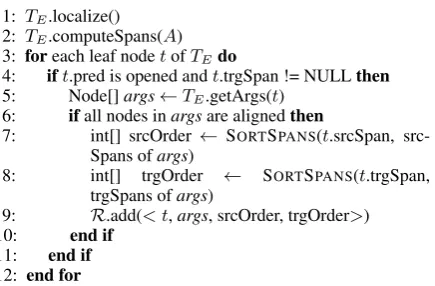
1: TE.localize()
2: TE.computeSpans(A)
3: foreach leaf nodetofTEdo
4: ift.pred is opened andt.trgSpan != NULLthen
5: Node[]args←TE.getArgs(t)
6: ifall nodes inargsare alignedthen
7: int[] srcOrder ← SORTSPANS(t.srcSpan, src-Spans ofargs)
8: int[] trgOrder ← SORTSPANS(t.trgSpan, trgSpans ofargs)
9: R.add(< t,args, srcOrder, trgOrder>)
10: end if
11: end if
12: end for
• if more than half of numbers in B is bigger than the maximum number in A, or if more than half of numbers in A is smaller than the minimum number in B, then A<B.
In case of a tie (e.g., A={3,4,7,8}, B={5,6}), we
keep the original order of A and B in the source-side sentence without any reordering.
Algorithm 1 sketches the pre-ordering rule ex-traction algorithm guided by PASs. The algorithm collect pre-ordering rules through a traversal of the leaf nodes in an HPSG tree. A non-terminal node will not be accessed unless it is an argument of some predicate node(s). Thus, this algorithm runs in a time that is approximatelylinearto the num-ber of leaf nodes in the tree, i.e., the numnum-ber of words in the source sentence.
We define that a terminal node’s PAS isopened
if at least one of its arguments is neither empty nor unknown. We will not extract a pre-ordering rule if the terminal node is unaligned or any of its ar-gument node is unaligned. These constraints are reflected by Line 4 and 6 in Algorithm 1. After heuristically sorting the source/target spans of a predicate node and its argument nodes, we finally extract a pre-ordering rule.
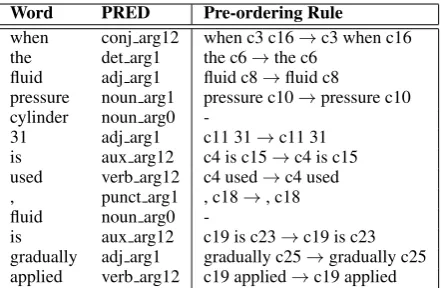
Table 2 summarizes the PAS-based pre-ordering rules extracted from the example shown in Fig-ure 1. Application of these pre-ordering rules to the original English sentence yields the following Japanese style sentence:
• the fluid pressure cylinder 31 is used when, fluid is gradually applied.
Word PRED Pre-ordering Rule
when conj arg12 when c3 c16→c3 when c16 the det arg1 the c6→the c6
fluid adj arg1 fluid c8→fluid c8
pressure noun arg1 pressure c10→pressure c10 cylinder noun arg0
-31 adj arg1 c11 31→c11 31 is aux arg12 c4 is c15→c4 is c15 used verb arg12 c4 used→c4 used , punct arg1 , c18→, c18 fluid noun arg0
-is aux arg12 c19 is c23→c19 is c23 gradually adj arg1 gradually c25→gradually c25 applied verb arg12 c19 applied→c19 applied
Table 2: PAS-based pre-ordering rules extracted from the example shown in Figure 1. We use real words instead of predicate nodes here for intuitive understanding.
Algorithm 2Pre-ordering Rule Application
Input: HPSG treeTEof an English sentenceE[], rule setR
Output: srcPhrase in the root node ofTE
1: TE.localize()
2: TE.computeSrcSpans()
3: mct rule← {}
4: foreach leaf nodetofTEdo
5: Node[]args←TE.getArgs(t)
6: int[] srcOrder←SORTSPANS(t.srcSpan, srcSpans of
args)
7: Ruler←RULEMATCH(R,< t,args, srcOrder>)
8: ifr!= NULLthen
9: mct←TE.MCT(t,args)
10: mct rule.add(<mct,r >)
11: end if
12: end for
13: foreachmctinmct rulein a bottom-up orderdo
14: Ruler←mct rule.get(mct)
15: mct.root().srcPhrase←‘’◃root() returns root node 16: forifrom 0 tor.trgOrder.length-1do
17: mct.root().srcPhrase += ‘ ’ + mct.leaves() [r.trgOrder[i]].srcPhrase
18: end for
19: end for
20: foreach nodeninTEin a topological orderdo
21: ifnis a terminal nodethen
22: n.srcPhrase←E[n.srcSpan[0]]
23: else ifn.srcPhrase = NULLthen
24: n.srcPhrase←CONNECT(n.children().srcPhrase)
25: end if
26: end for
Algorithm 2 sketches the algorithm for apply-ing pre-orderapply-ing rules to a given HPSG tree TE.
The algorithm contains three parts: rule match-ing (Lines 4-12), bottom-up rule applymatch-ing (Lines 13-19), and sentence collecting (Lines 20-26). We first retrieve available pre-ordering rules from rule setRby a left-to-right traversal of the leaf nodes
of TE. For each leaf node, we select one
pre-ordering rule with the highest frequency. Our ex-periments testified that this greedy rule selection
strategy worked quite well. We selected 93% of the top frequent rule without facing a tie.
The terminal node t, the argument nodes oft, and their source-side ordering are taken as the key for rule matching. Available rules will be assigned to the MCT of t. Then, we apply the available rules to the root nodes of each MCT through a bottom-up traversal ofTE. A competitive problem
is that, a non-terminal node can be shared by sev-eral MCTs. For example, node c3 and c18 (gray color) in Figure 1 are respectively shared by two MCTs (t6 and t7, t10 and t12). In order to avoid duplicated reordering of these nodes, we first pick the pre-ordering rule in which there are no “gaps” among the predicate words and argument phrases. For example, there is a gap (t6) between t7 and its argument node c4. We then pick a rule by fre-quency if there are still more than one rule avail-able. Finally, after applying all available rules, we collect the pre-ordered source sentence from the root node of the HPSG tree.
3 Experiments
3.1 Setup
We test our proposal by translating from English to Japanese. We use the NTCIR-9 English-Japanese patent corpus4 as our experiment set. Since the
reference set of the official test set has not been released yet, we instead split the original develop-ment set averagely into two parts, named dev.a and dev.b. In our experiments, we first take dev.a as our development set for minimum-error rate tun-ing (Och, 2003) and then report the final transla-tion accuracies on dev.b. For direct comparison with other systems in the future, we use the con-figuration of the official baseline system5:
• Moses6 (Koehn et al., 2007): revision =
“3717” as the baseline decoder. Note that we also train Moses using HFE sentences (Isozaki et al., 2010b) and the English sen-tences pre-ordered by PASs;
• GIZA++: giza-pp-v1.0.37 (Och and Ney,
2003) for first training word alignment us-ing the original English sentences for pre-ordering rule extraction, and then for
retrain-4http://ntcir.nii.ac.jp/PatentMT/
5http://ntcir.nii.ac.jp/PatentMT/baselineSystems 6http://www.statmt.org/moses/
Train Dev.a Dev.b
# of sent. 2,032,679 1,000 1,000 # of En words 48,322,058 31,890 31,935 Enju suc. rate 99.3% 98.9% 98.7% parse time (sec./sent.) 0.30 0.38 0.48 # of Jp words 53,865,629 37,066 35,921
Table 3: Statistics of the experiment sets.
ing word alignments using the pre-ordered English sentences;
• SRILM8 (Stolcke, 2002): version 1.5.12 for
training a 5-gram language model using the target sentences in the total training set;
• Additional scripts9: for preprocessing
En-glish sentences and cleaning up too long (# of words>40) parallel sentences;
• Japanese word segmentation: Mecab v0.9810
with the dictionary of mecab-ipadic-2.7.0-20070801.tar.gz11.
The statistics of the filtered training set, dev.a, and dev.b are shown in Table 3. The success pars-ing rate ranges from 98.7% to 99.3% by uspars-ing Enju2.3.1. The averaged parsing time for each En-glish sentence ranges from 0.30 to 0.48 seconds.
3.2 Statistics of PASs and PAS-based pre-ordering rules
Figure 2 shows the number (natural log) of the 40 types of the PASs that appeared in the HPSG trees of the three experiment sets. Top five types of opened PASs include adj arg1, det arg1, prep arg12, noun arg1, and verb arg12. By com-paring the distributions of the number of PASs in the three sets, we can see that the distributions ap-proximately share the same tendency. Thus, the pre-ordering rules learned from the PASs in the training set can be expected to be properly applied in dev.a and dev.b.
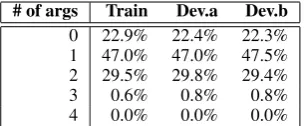
Besides, the statistics of the number of argu-ments for the predicate words is shown in Table 4. From this table, we find that the ratio of the number of arguments in the three sets are approx-imately similar. In particular, nearly half of the
8http://www.speech.sri.com/projects/srilm/ 9 http://homepages.inf.ed.ac.uk/jschroe1/how-to/scripts.tgz
10http://sourceforge.net/projects/mecab/files/ 11 http://sourceforge.net/projects/mecab/files/mecab-ipadic/
# of args Train Dev.a Dev.b
0 22.9% 22.4% 22.3% 1 47.0% 47.0% 47.5% 2 29.5% 29.8% 29.4%
3 0.6% 0.8% 0.8%
4 0.0% 0.0% 0.0%
Table 4: Statistics of the number of arguments of the predicate words in the experiment sets.
Number Ratio
Parse success 45,617,387 94.4% Opened 35,004,893 76.7% Aligned 33,966,923 97.0% Contiguous 30,256,858 89.1%
Table 5: Statistics of predicate words in the train-ing set for rule extraction.
predicate words have one argument. The num-ber of predicate words that contain two arguments occurs around 30.0% of all the predicate words. Also, we can not extract pre-ordering rules from around 23.0% of the predicate words since they do not contain any arguments. Finally, less than 1% of predicate words contain three arguments and we only find one four-argument example of verb arg1234 in the training set.
Now, in Table 5, we show the statistics of predi-cate words in the training set for pre-ordering rule extraction. Of the 48.3 million English words in the training set, there are 45.6 million words (94.4%) that are included in the HPSG trees that were successfully generated. Then, in the PASs of these 45.6 million words, there are 35.0 mil-lion words whose PASs are opened. We also list the number (34.0 million) of aligned predicate words, since we only extract pre-ordering rules from predicate words that are aligned to some tar-get word(s) in Algorithm 1. Finally, there are 89.1% of aligned predicate words that are aligned to contiguous target words.
In order to investigate the sub-categorization ef-fectiveness of the syntactic features included in the pre-ordering rules, we pick four subsets of the to-tal feature set (Table 1). These feature subsets, named from PAS-a to PAS-d, are listed in Table 6. Through the comparison of these four feature subsets, we also attempt to investigate the data-sparseness problem of available pre-ordering rules cased by the factored features.
argu-0
train (ln) dev.a (ln) dev.b (ln)
Figure 2: Number (natural log) of the types of the PASs that appeared in the experiment sets.
Feature PAS-a PAS-b PAS-c PAS-d
WORD √ √ √ √
# rules 469,014 203,184 200,968 148,047 # reorder 179,062 63,378 62,694 37,104 reorder ratio 38.2% 31.2% 31.2% 25.1% avg. # train 12.0 12.1 12.1 12.1 avg. # dev.a 16.2 16.4 16.4 16.5 avg. # dev.b 16.2 16.4 16.4 16.5
Table 6: Feature subsets used in pre-ordering rules and statistics of the extraction and application of the pre-ordering rules under these feature subsets.
ment nodes. We further remove one feature (CAT) of the predicate word in PAS-c. In the fourth sub-set PAS-d, we only use two features WORD and PRED in the predicate word for sub-categorizing pre-ordering rules. Thus, PAS-d is only related to PASs (which can be generated by any kinds of parser) since it does not include additional features generated by the typical HPSG parser.
As the number of syntactic features decreases, more rules can be unified together. Thus, the num-ber of pre-ordering rules and reordering rules, as shown in Table 6, also decreases. The number of reordering rules occurs from 25.1% (PAS-d) to 38.2% (PAS-a) in the pre-ordering rules. For each English sentence in the training set, there are aver-agely 12 reordering rules (instead of monotonic
Source sent. BLEU RIBES
Original sentences 0.2773 0.6619 PAS-a reordered 0.3088 0.7406
PAS-b reordered 0.3054 0.7334 PAS-c reordered 0.3063 0.7336 PAS-d reordered 0.3020 0.7265
Table 7: Translation accuracies by using the orig-inal English sentences or the pre-ordered English sentences under four types of pre-ordering rules.
pre-ordering rules) available under either of the four feature subsets. For each English sentence in dev.a and dev.b, the number of available reorder-ingrules is averagely 16. Around 99.1%, 99.0%, and 98.6% English sentences were respectively re-ordered in the training set, dev.a set, and dev.b set.
3.3 Results
Table 7 shows the final translation accuracies under BLEU score (Papineni et al., 2002) and RIBES12, i.e., the software implementation of
Normalized Kendall’s τ as proposed by (Isozaki et al., 2010a) to automatically evaluate the transla-tion between distant language pairs based on rank correlation coefficients and significantly penalizes word order mistakes. Making use of our pre-ordered English sentences significantly (p <0.01) improved BLEU scores from 2.47 (PAS-d) to 3.15 (PAS-a) points. The effectiveness of our proposal for tackling word-ordering problem can also be proved by comparing the scores of RIBES.
In addition, the accuracies change slightly among using the four types of pre-ordering rules. Among PAS-a, PAS-b, and PAS-c, we did signifi-cant test and could not differ them underp <0.01 or p < 0.05. The only significant difference
Source sent. BLEU RIBES Same PAS
HFE 0.3134 0.7370 -
-HFE+PAS-a 0.3278 0.7379 11.0% 34.7% HFE+PAS-b 0.3302 0.7397 12.3% 32.8% HFE+PAS-c 0.3300 0.7380 10.8% 35.0% HFE+PAS-d 0.3256 0.7337 11.5% 32.8%
Table 8: Translation accuracies by combining HFE and PAS based pre-ordering approach.
(p < 0.05) appeared between PAS-a and PAS-d. Thus, we argue that the factored syntactic features such as WORD, PRED, and CAT are more essen-tial for sub-categorizing pre-ordering rules than the remaining syntactic features.
As former mentioned, we also take the language-dependent HFE approach (Isozaki et al., 2010b) as another baseline. Note that word align-ment was retrained using head-finalized English sentences and Japanese sentences in this HFE ap-proach. Through comparing the HFE results listed in Table 8, we observe that the results are com-parable between PAS-a and HFE: HFE is slightly better under BLEU score and PAS-a is slightly bet-ter under RIBES score.
Since similar HPSG parser (Enju) yet differ-ent linguistic information (syntactic head informa-tion vs. PASs) are used in HFE approach and our proposal. A straightforward question is whether we can combine these approaches together. Un-der this motivation, we select a better pre-orUn-dered English sentence generated by the HFE method and our PAS-based method. Following (Genzel, 2010), we usecrossing scoreas the metric for sen-tence selection. Crossing score is the number of crossing alignment links for a given aligned sen-tence pair. For monotonic alignments without re-ordering, crossing score is zero. During selection, we found that nearly 10% of the pre-ordered En-glish sentences yielded by head-finalization and PAS-based methods were similar. In addition, among the different sentences, around 30% of PAS-based pre-ordering sentences were selected. Since we can not compute crossing score in the de-velopment/test sets, we instead take both kinds of pre-ordered English sentences as inputs and pick one output with a higher translation score.
The translation result based on this reselection approach is shown in Table 8. Compared with HFE approach, the reselection approach signifi-cantly (p <0.01) improved BLEU scores of from 1.22 (PAS-d) to 1.68 (PAS-b) points. These in-teresting results reflect that syntactic head
infor-Source sent. Averagedτ τ≥0.8
English 0.407 0.106
HFE 0.708 0.487
PAS-a 0.571 0.291
HFE+PAS-a 0.809 0.643
Table 9: Comparison of Kendall’sτ.
mation and PASs describe the linguistic informa-tion of an English sentence in different aspects. Furthermore, compared with the single head-finalization rule, the automatically extracted pre-ordering rules kept the variety of word-pre-ordering by dynamically inferring the word order of target sentences and thus enlarged the reordering space.
3.4 Alignment comparison
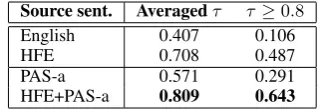
In order to investigate how closely the pre-ordered English sentences follow target language word or-der, we measured Kendall’s τ (Kendall, 1948), a rank correlation coefficient, as shown in Table 9. We exactly follow Isozaki et al. (2010b) to com-pute Kendall’sτ. From Table 9, we can see that the quality of word alignments approximately re-flects the final BLEU scores listed in Table 7 and 8.
4 Conclusion
We have proposed a pre-ordering approach by making use of predicate argument structures. The pre-ordering rules record the relative source-target position mapping among predicate words and their argument phrases. We first proposed an algo-rithm for automatically extracting these lexical pre-ordering rules from aligned HPSG-tree-to-string pairs. Then, we apply these pre-ordering rules to HPSG trees to yield pre-ordered source sentences that follow the word order of target sen-tences. Finally, we do word alignment again by us-ing the pre-ordered source sentences together with the original target sentences.
References
Peter F. Brown, Vincent J. Della Pietra, Stephen
A. Della Pietra, and Robert L. Mercer. 1993.
The mathematics of statistical machine translation:
parameter estimation. Computational Linguistics,
19(2):263–311.
David Chiang. 2005. A hierarchical phrase-based model for statistical machine translation. InProc.of
ACL, pages 263–270.
Michael Collins, Philipp Koehn, and Ivona Kucerova. 2005. Clause restructuring for statistical machine translation. InProc.of ACL, pages 531–540.
Michel Galley, Mark Hopkins, Kevin Knight, and Daniel Marcu. 2004. What’s in a translation rule? InProc.of HLT-NAACL.
Dmitriy Genzel. 2010. Automatically learning source-side reordering rules for large scale machine
transla-tion. InProc.of COLING, pages 376–384.
Hideki Isozaki, Tsutomu Hirao, Kevin Duh, Katsuhito Sudoh, and Hajime Tsukada. 2010a. Automatic evaluation of translation quality for distant language
pairs. InProc.of EMNLP, pages 944–952.
Hideki Isozaki, Katsuhito Sudoh, Hajime Tsukada, and Kevin Duh. 2010b. Head finalization: A simple
reordering rule for sov languages. InProc.of
WMT-MetricsMATR, pages 244–251.
Jason Katz-Brown and Michael Collins. 2007. Syntac-tic reordering in preprocessing for japanese-english translation: Mit system description for ntcir-7 patent
translation task. In Proc.of NTCIR-7 Workshop
Meeting, pages 409–414.
Maurice Kendall. 1948. Rank Correlation Methods.
Charles Griffin.
Philipp Koehn, Hieu Hoang, Alexandra Birch, Chris Callison-Burch, Marcello Federico, Nicola Bertoldi, Brooke Cowan, Wade Shen, Christine Moran, Richard Zens, Chris Dyer, Ondˇrej Bojar, Alexandra Constantin, and Evan Herbst. 2007. Moses: Open source toolkit for statistical machine translation. In
the ACL 2007 Demo-Poster, pages 177–180.
Mamoru Komachi, Masaaki Nagata, and Yuji Mat-sumoto. 2006. Phrase reordering for statistical ma-chine translation based on predicate-argument struc-ture. InProc.of IWSLT, pages 77–82.
Shankar Kumar and William Byrne. 2005.
Lo-cal phrase reordering models for statistiLo-cal machine
translation. In Proc.of HLT-EMNLP, pages 161–
168.
Yang Liu, Qun Liu, and Shouxun Lin. 2006. Tree-to-string alignment templates for statistical machine
transaltion. In Proc.of COLING-ACL, pages 609–
616, Sydney, Australia.
Yusuke Miyao and Jun’ichi Tsujii. 2008. Feature for-est models for probabilistic hpsg parsing. Computa-tional Lingustics, 34(1):35–80.
Franz Josef Och and Hermann Ney. 2003. A sys-tematic comparison of various statistical alignment
models. Computational Linguistics, 29(1):19–51.
Franz Josef Och. 2003. Minimum error rate training in statistical machine translation. InProc.of ACL, pages 160–167.
Kishore Papineni, Salim Roukos, Todd Ward, and Wei-Jing Zhu. 2002. Bleu: a method for automatic eval-uation of machine translation. InProc.of ACL, pages 311–318.
Carl Pollard and Ivan A. Sag. 1994. Head-Driven
Phrase Structure Grammar. University of Chicago Press.
Kay Rottmann and Stephan Vogel. 2007. Word re-ordering in statistical machine translation with a
pos-based distortion model. InProc.of TMI, pages
171–180, Skovde, Sweden.
Andreas Stolcke. 2002. Srilm-an extensible language modeling toolkit. InProc.of ICSLP, pages 901–904.
Christoph Tillman. 2004. A unigram
orienta-tion model for statistical machine translaorienta-tion. In Daniel Marcu Susan Dumais and Salim Roukos,
ed-itors,HLT-NAACL 2004, pages 101–104.
Stephan Vogel, Hermann Ney, and Christoph Tillmann. 1996. Hmm-based word alignment in statistical
translation. InCOLING, pages 836–841.
Chao Wang, Michael Collins, and Philipp Koehn. 2007. Chinese syntactic reordering for statistical
machine translation. In Proc.of EMNLP-CoNLL,
pages 737–745.
Xianchao Wu, Takuya Matsuzaki, and Jun’ichi Tsujii. 2010a. Fine-grained tree-to-string translation rule extraction. InProc.of the 48th ACL, pages 325–334. Xianchao Wu, Takuya Matsuzaki, and Jun’ichi Tsujii. 2010b. Improve syntax-based translation using deep
syntactic structures. Machine Translation (Special
Issue : Pushing the frontiers of SMT), 24(2):141– 157.
Fei Xia and Michael McCord. 2004. Improving a sta-tistical mt system with automatically learned rewrite
patterns. InProc.of COLING, pages 508–514.
Deyi Xiong, Qun Liu, and Shouxun Lin. 2006. Maxi-mum entropy based phrase reordering model for
sta-tistical machine translation. In Proc.of
COLING-ACL, pages 521–528.
Peng Xu, Jaeho Kang, Michael Ringgaard, and Franz Och. 2009. Using a dependency parser to improve
smt for subject-object-verb languages. In Proc.of